

Can businesses truly predict their future revenue in an increasingly uncertain market? The answer is yes—when they rely on accurate, data-driven sales forecasting. In 2026, sales forecasting is no longer just a planning exercise; it has become a strategic necessity that enables organizations to anticipate demand, allocate resources efficiently, and stay ahead of market shifts.
Sales forecasting refers to the process of estimating future sales based on historical data, market trends, and real-time insights. With global markets evolving rapidly and customer behavior becoming more dynamic, businesses that leverage advanced forecasting techniques are better positioned to make informed decisions. In fact, studies suggest that companies with accurate sales forecasts are significantly more likely to achieve their revenue targets and maintain operational efficiency.
However, traditional forecasting methods alone are no longer sufficient. Modern businesses are increasingly turning to AI-powered tools, predictive analytics, and integrated systems to enhance accuracy and agility. Sales forecasting in 2026 is deeply connected with other business functions such as inventory management, finance, and supply chain operations, making it a cornerstone of sustainable growth and competitive advantage.
This is where solutions like Deskera ERP come into play. Deskera ERP provides real-time data visibility, AI-driven insights, and seamless integration across sales, finance, and inventory, enabling businesses to generate more accurate forecasts. With automated reporting, advanced analytics, and a user-friendly interface, it empowers organizations to make proactive, data-backed decisions. By leveraging such modern ERP systems, companies can transform sales forecasting from a reactive task into a powerful driver of growth.
What Is Sales Forecasting?
Sales forecasting is the process of predicting how much a business is likely to sell over a specific future period—whether that’s a month, quarter, or year. It provides an estimate of expected revenue by analyzing factors such as past sales performance, current pipeline opportunities, market trends, and customer demand patterns. In simple terms, it answers two critical questions for any business: how much will we sell and when will that revenue be realized.
The primary goal of sales forecasting is to give organizations a clear, forward-looking view of their revenue potential so they can make informed decisions. For instance, a fast-growing e-commerce brand may use sales forecasts to determine how much inventory to stock before a festive season, while a SaaS company might rely on forecasts to plan subscription growth targets and allocate marketing budgets. These insights directly influence key business areas such as budgeting, hiring, production planning, and overall sales strategy.
The accuracy of a sales forecast depends heavily on the quality and consistency of the data used. Businesses that maintain well-structured and regularly updated records—often through CRM and integrated systems—tend to generate more reliable forecasts. Moreover, effective forecasting is not limited to the sales team alone. It requires collaboration across departments, including finance, operations, and marketing, to ensure that assumptions are realistic and aligned with broader business goals.
At its core, sales forecasting is both a science and an art. The analytical side relies on historical data, trends, and statistical models, while the human side incorporates the judgment and experience of sales professionals who understand customer behavior and deal dynamics. By combining these approaches, businesses can create forecasts that are not only data-driven but also practical and adaptable—helping them stay proactive, reduce risks, and seize growth opportunities in an ever-changing market.
Sales Forecasting vs Demand Planning
While sales forecasting and demand planning are closely related, they serve distinct purposes within a business. Sales forecasting focuses on estimating future revenue based on expected sales performance, whereas demand planning is centered on predicting customer demand to ensure the right products are available at the right time.
In 2026, aligning both functions is essential for improving operational efficiency, reducing costs, and delivering a seamless customer experience.
In summary, sales forecasting tells you how much you expect to sell, while demand planning ensures you are prepared to deliver what customers want. When both are aligned, businesses can achieve better accuracy, improved customer satisfaction, and stronger overall performance.
Why Sales Forecasting is Critical for Businesses in 2026
In 2026, businesses are operating in an environment defined by rapid digital transformation, evolving customer expectations, and unpredictable market conditions. Relying on guesswork is no longer an option.
Sales forecasting has become a vital strategic function that enables organizations to anticipate change, minimize risks, and make smarter, data-driven decisions. It not only helps businesses prepare for the future but also ensures they remain agile and competitive in a dynamic landscape.
1. Enables Data-Driven Decision-Making
Sales forecasting provides leaders with reliable insights into future revenue, helping them make informed decisions rather than relying on assumptions. Whether it’s setting realistic sales targets or planning investments, accurate forecasts ensure that every decision is backed by data and aligned with business goals.
2. Improves Financial Planning and Budgeting
A clear view of expected revenue allows businesses to allocate budgets more effectively. Companies can plan expenses, control costs, and ensure financial stability by aligning their spending with projected income. This is especially critical in 2026, where economic fluctuations demand careful financial management.
3. Optimizes Inventory and Supply Chain Management
Forecasting helps businesses maintain the right balance between supply and demand. For example, a retail company can avoid overstocking slow-moving products or running out of high-demand items during peak seasons. This leads to reduced holding costs, improved customer satisfaction, and smoother supply chain operations.
4. Enhances Sales Performance and Goal Setting
Sales forecasts act as a benchmark for performance. They help sales teams set achievable targets, prioritize high-value opportunities, and manage their pipelines more effectively. With clear visibility into expected outcomes, teams can focus their efforts on deals that are most likely to convert.
5. Supports Strategic Business Growth
Accurate forecasting allows businesses to plan for expansion with confidence. Whether entering new markets, launching new products, or scaling operations, forecasts provide the insights needed to evaluate risks and opportunities. This strategic clarity is essential for sustainable growth in a competitive environment.
6. Helps Manage Risks and Uncertainty
Market conditions in 2026 can shift quickly due to factors such as economic changes, global events, or evolving customer preferences. Sales forecasting helps organizations identify potential risks early and develop contingency plans. Scenario forecasting, for instance, allows businesses to prepare for best-case, worst-case, and most likely outcomes.
7. Strengthens Cross-Department Collaboration
Sales forecasting is not just a sales function—it connects multiple departments. Finance teams rely on forecasts for cash flow planning, operations teams use them for production scheduling, and marketing teams align campaigns with expected demand. This shared visibility ensures better coordination and more efficient execution across the organization.
8. Drives Competitive Advantage
Businesses that leverage accurate and real-time forecasting gain a significant edge over competitors. They can respond faster to market changes, seize new opportunities, and optimize their resources more effectively. In a data-driven world, the ability to predict and act ahead of others is a powerful differentiator.
Key Components of an Effective Sales Forecast
An accurate sales forecast doesn’t happen by chance—it is built on a strong foundation of data, insights, and structured processes. In 2026, businesses that focus on the right components can significantly improve forecast accuracy and make more confident strategic decisions.
Below are the essential elements that form a reliable and effective sales forecast.
1. Historical Sales Data
Past performance is one of the most important inputs for forecasting future sales. By analyzing previous sales figures, seasonal trends, growth rates, and average deal sizes, businesses can establish a baseline for future projections. This component is especially useful in identifying recurring patterns and setting realistic expectations.
2. Sales Pipeline Visibility
A clear and well-maintained sales pipeline provides real-time insights into potential revenue. It includes active deals, their stages, expected close dates, and deal values. The more accurate and updated the pipeline data is, the more reliable the forecast becomes.
3. Market Trends and External Factors
Sales forecasts must account for external influences such as economic conditions, industry trends, competitor activity, and customer preferences. For example, shifts in market demand or pricing strategies can significantly impact future sales outcomes.
4. Customer Behavior and Demand Patterns
Understanding how customers buy—frequency, preferences, and purchasing cycles—helps refine forecasts. Businesses can use customer segmentation and buying behavior analysis to predict demand more accurately and tailor their sales strategies accordingly.
5. Sales Team Input and Expertise
While data is critical, the insights of sales representatives and managers add valuable context. Sales teams have direct interaction with customers and can provide qualitative inputs about deal progress, potential risks, and opportunities that data alone may not capture.
6. Defined Sales Process and Stages
A standardized sales process with clearly defined stages ensures consistency in forecasting. When each stage has a corresponding probability of conversion, it becomes easier to estimate expected revenue from pipeline opportunities.
7. Key Sales Metrics and KPIs
Metrics such as conversion rates, average deal size, sales cycle length, and win rates play a crucial role in forecasting accuracy. Tracking these KPIs helps businesses evaluate performance and refine their forecasting models over time.
8. Data Quality and System Integration
Accurate forecasts depend on clean, consistent, and up-to-date data. Integrating systems like CRM and ERP ensures that all departments work with the same data set, reducing errors and improving collaboration across teams.
9. Forecasting Methodology
Choosing the right forecasting method—or a combination of methods—is essential. Whether it’s historical analysis, pipeline forecasting, or AI-driven models, the methodology should align with the business model and data maturity level.
10. Regular Review and Adjustments
A sales forecast is not static. It needs to be reviewed and updated regularly based on new data, market changes, and pipeline developments. Continuous monitoring ensures that forecasts remain relevant and actionable.
By combining these key components, businesses can create sales forecasts that are not only accurate but also adaptable. A well-structured forecast provides clarity, reduces uncertainty, and empowers organizations to make proactive, growth-oriented decisions.
Methods of Sales Forecasting
There is no one-size-fits-all approach to sales forecasting. The right method depends on your business model, data availability, sales cycle complexity, and market dynamics. In 2026, most organizations use a combination of methods to improve accuracy and gain a well-rounded view of future revenue.
1. Historical Sales Forecasting
This method uses past sales data to predict future performance. By analyzing trends such as seasonal demand, growth patterns, and average deal values, businesses can establish a reliable baseline.
For example, a consumer electronics brand may use last year’s festive season sales to estimate demand for the upcoming year. While simple and effective in stable markets, it may not account for sudden changes in customer behavior or external disruptions.
2. Pipeline (Opportunity Stage) Forecasting
Pipeline forecasting focuses on active deals within the sales funnel. Each opportunity is assigned a probability of closing based on its stage, and the forecast is calculated accordingly.
For instance, a B2B software company might assign a 70% probability to deals in the negotiation stage. This method provides real-time insights but relies heavily on accurate CRM data and disciplined updates from sales teams.
3. Length of Sales Cycle Forecasting
This approach predicts when deals are likely to close based on the average time taken to convert similar opportunities in the past.
For example, if enterprise deals typically close within 90 days, current deals at day 60 can be assessed accordingly. It offers a more objective timeline but may vary depending on deal complexity and customer segments.
4. Intuitive Forecasting
Intuitive forecasting is based on the experience and judgment of sales representatives and managers. It is often used in new businesses or industries where historical data is limited.
For example, a startup launching a new product may rely on sales team insights to estimate demand. While it captures real-world nuances, it can be subjective and less consistent across teams.
5. Top-Down Forecasting
In this method, leadership sets overall revenue targets based on market potential, industry benchmarks, or strategic goals. These targets are then distributed across teams and regions.
For instance, a company aiming for 20% annual growth may allocate targets to different departments accordingly. While useful for strategic planning, it may lack detailed, ground-level insights.
6. Bottom-Up Forecasting
Bottom-up forecasting starts at the individual deal or sales rep level and builds up to a company-wide forecast. It considers pipeline data, conversion probabilities, and rep-level inputs.
For example, each sales rep submits their expected deals, which are then aggregated. This method is generally more accurate but requires detailed data and coordination.
7. Trend and Time Series Analysis
This method analyzes sales data over time to identify patterns such as seasonality, growth trends, and cyclical fluctuations. Retail businesses, for example, often use time series analysis to anticipate demand spikes during holidays. It provides valuable insights into long-term and short-term performance trends.
8. Regression and Causal Analysis
Regression analysis examines the relationship between sales and influencing factors such as pricing, marketing spend, or economic conditions. Causal analysis goes a step further by identifying how specific variables impact demand.
For instance, a company may analyze how discounts or advertising campaigns affect sales volumes. These methods are useful for understanding the “why” behind sales performance.
9. Multivariable Forecasting
This advanced method combines multiple data points—such as deal stage, sales cycle length, customer demographics, and market trends—to generate highly accurate forecasts.
Often powered by predictive analytics, it provides a more comprehensive view of future revenue. For example, a business might evaluate customer behavior, seasonality, and campaign performance together to refine its projections.
10. AI-Driven Sales Forecasting
AI-powered forecasting uses machine learning to analyze large datasets, identify patterns, and predict outcomes. It can automatically detect risks, highlight high-probability deals, and provide real-time updates. For example, AI tools can flag deals that are likely to stall based on past behavior. While highly scalable and efficient, its accuracy depends on clean and well-structured data.
By combining multiple sales forecasting methods, businesses can reduce uncertainty, improve accuracy, and make more confident decisions. The key is to choose the right mix based on your organization’s needs and continuously refine your approach as more data becomes available.
How to Choose the Right Sales Forecasting Method
Choosing the right sales forecasting method is less about finding a “perfect” model and more about selecting an approach that fits your business reality.
In 2026, the most effective organizations don’t rely on a single technique—they choose methods based on their data maturity, market conditions, and business goals.
The key is to strike a balance between accuracy, practicality, and adaptability.
1. Evaluate Your Business Stage
Your company’s growth stage plays a major role in method selection. Startups or new businesses often lack sufficient historical data, making qualitative approaches—such as expert judgment or market research—more practical.
In contrast, established businesses with consistent sales records can leverage advanced, data-driven methods for more precise forecasting.
2. Assess the Quality and Availability of Data
The accuracy of any forecasting method depends on the data behind it. If your organization has clean, structured, and long-term sales data, you can use quantitative models like trend analysis or regression.
However, if data is limited or inconsistent, it’s better to combine basic models with qualitative insights until your data foundation improves.
3. Consider Market Stability and Volatility
In stable industries with predictable demand, historical forecasting methods tend to perform well. However, in fast-changing markets—such as retail, e-commerce, or technology—more flexible approaches like scenario planning or short-term forecasting models are essential. The more volatile the market, the more adaptable your method should be.
4. Align with Your Sales Cycle Length
The duration of your sales cycle influences how you forecast. Businesses with short sales cycles can rely on frequent updates and real-time data, while those with longer cycles—such as enterprise sales—should use pipeline-based methods that factor in deal stages and probabilities. Matching the method to your cycle ensures more realistic timelines.
5. Define the Purpose of Your Forecast
Not all forecasts serve the same purpose. A forecast used for internal planning may differ from one presented to investors or stakeholders. For example, operational forecasts may prioritize accuracy and detail, while strategic forecasts may focus on broader trends and growth projections. Clarifying the objective helps in choosing the most suitable method.
6. Evaluate Available Resources and Expertise
Advanced forecasting techniques, especially AI-driven models, require skilled teams and the right tools. If your organization has limited resources, it’s better to adopt simpler, easier-to-manage methods that still provide reliable insights. As your capabilities grow, you can gradually incorporate more sophisticated approaches.
7. Combine Multiple Methods for Better Accuracy
Relying on a single method can limit perspective. Many businesses achieve better results by combining approaches—for example, using historical data for baseline projections and pipeline forecasting for short-term accuracy. This hybrid strategy balances data-driven insights with real-time visibility.
8. Ensure Flexibility and Scalability
The chosen forecasting method should evolve with your business. As you scale, enter new markets, or adopt new technologies, your forecasting approach should adapt accordingly. A flexible method ensures that your forecasts remain relevant and effective over time.
Ultimately, the right sales forecasting method is one that aligns with your business context and supports better decision-making. Rather than aiming for perfection, focus on building a practical, adaptable approach that improves as your data, tools, and experience grow.
Step-by-Step Process to Create an Accurate Sales Forecast
Creating an accurate sales forecast is not about relying on a single method or guesswork—it requires a structured, data-driven approach combined with continuous refinement.
In 2026, businesses that follow a systematic forecasting process are better equipped to handle uncertainty, optimize resources, and drive consistent growth.
Below is a step-by-step approach to building a reliable sales forecast.
1. Define Clear Objectives
Start by identifying the purpose of your sales forecast. Are you forecasting for budgeting, inventory planning, hiring, or strategic growth? Clear objectives help determine the time frame (monthly, quarterly, yearly) and the level of detail required. For example, a company planning expansion may focus on long-term forecasts, while a retail business may prioritize short-term seasonal forecasts.
2. Gather and Clean Historical Data
Historical data forms the foundation of any sales forecast. Collect past sales records and break them down by product, region, time period, and customer segments.
It’s equally important to clean and validate this data—removing inconsistencies, duplicates, or outdated entries—to ensure accuracy. Reliable data leads to more dependable forecasts.
3. Choose the Right Forecasting Method
Select a forecasting method that aligns with your business model and data maturity. Established businesses with strong historical data may use quantitative methods like trend analysis or pipeline forecasting, while new businesses may rely more on market research and intuitive approaches. In most cases, combining multiple methods yields the best results.
4. Analyze Sales Pipeline and Market Conditions
Evaluate your current sales pipeline, including deal stages, probabilities, expected close dates, and deal values. At the same time, assess market conditions such as demand trends, customer preferences, and competitive activity. For instance, if a competitor launches a new product, it may impact your forecasted sales.
5. Incorporate External Factors
Sales forecasts must reflect both internal and external influences. Consider factors such as pricing changes, new product launches, marketing campaigns, economic conditions, and regulatory changes. For example, a planned promotional campaign or entry into a new market can significantly alter your revenue projections.
6. Use Forecasting Tools and Software
Leverage modern tools such as CRM systems, ERP platforms, and AI-powered forecasting software to improve accuracy and efficiency. These tools can analyze large datasets, identify patterns, and provide real-time insights. They also automate data collection and reporting, reducing manual errors and saving time.
7. Review and Adjust Regularly
A sales forecast is not static—it should evolve as new data becomes available. Regularly review your forecasts, compare them with actual performance, and adjust based on changes in the pipeline or market conditions. Flexibility is key; the goal is not perfection but continuous improvement and relevance.
By following this structured process, businesses can create sales forecasts that are both realistic and actionable. The combination of accurate data, the right tools, and ongoing refinement ensures that forecasts remain aligned with business goals and market realities.
Benefits of an Accurate Sales Forecast
While the importance of sales forecasting lies in guiding strategic direction, its true value is realized when forecasts are accurate. Precision enables businesses to operate with clarity, reduce inefficiencies, and make confident decisions.
In 2026, accurate forecasting is not just a planning tool—it is a performance driver that directly impacts profitability, agility, and long-term success.
1. Improves Revenue Predictability
An accurate sales forecast provides a reliable estimate of future revenue, helping businesses reduce uncertainty in financial planning. With clearer visibility into expected income, companies can better manage cash flow, plan investments, and avoid sudden financial disruptions.
This level of predictability is especially valuable in volatile markets, where even small forecasting errors can significantly impact overall business stability and growth.
2. Identifies Pipeline Gaps Early
Accurate forecasting allows businesses to compare expected revenue against targets and quickly identify shortfalls. This early visibility helps sales leaders take proactive measures, such as increasing pipeline generation or accelerating deal closures.
Instead of reacting at the last minute, teams can adjust strategies in advance, ensuring that revenue goals remain achievable and reducing the risk of missed targets.
3. Reduces Operational Costs
When forecasts are precise, businesses can avoid costly inefficiencies such as overproduction, excess inventory, or unnecessary staffing. Accurate projections enable companies to align operations closely with actual demand, minimizing waste and optimizing resource utilization.
This not only lowers operational expenses but also improves overall profitability, making forecasting a critical tool for cost control and financial efficiency.
4. Enhances Resource Allocation
Accurate sales forecasts help businesses allocate resources more effectively across departments. Whether it’s budgeting, workforce planning, or inventory management, decisions can be aligned with expected demand.
This ensures that resources are neither underutilized nor overstretched. As a result, organizations can maximize productivity, improve operational efficiency, and ensure that every investment contributes to business growth.
5. Improves Sales Team Productivity
With a clear and accurate forecast, sales teams can focus their efforts on the most promising opportunities. It helps them prioritize high-value deals, manage their pipeline more effectively, and set realistic targets.
This reduces time wasted on low-probability prospects and increases overall efficiency. Over time, this leads to higher conversion rates, better performance, and a more motivated sales force.
6. Strengthens Customer Satisfaction
Accurate forecasting enables businesses to anticipate customer demand and prepare accordingly. This ensures that products or services are available when customers need them, reducing delays and stockouts.
By consistently meeting customer expectations, businesses can enhance satisfaction and build long-term loyalty. In competitive markets, this ability to deliver reliably can become a key differentiator.
7. Builds Organizational Alignment
A precise sales forecast creates a shared understanding of business performance across all departments. Sales, marketing, finance, and operations can work with the same data and align their strategies accordingly.
This reduces confusion, improves communication, and fosters collaboration. When everyone is working toward the same goals with consistent insights, decision-making becomes faster and more effective.
8. Supports Smarter Long-Term Planning
Accurate forecasts provide a strong foundation for long-term strategic planning. Businesses can confidently plan expansions, new product launches, or market entry strategies based on reliable data.
This reduces uncertainty and allows leaders to evaluate risks more effectively. As a result, companies can make forward-looking decisions that are both ambitious and grounded in realistic expectations.
9. Increases Sales Accountability
When forecasts are accurate and regularly tracked, sales teams become more accountable for their performance. Reps are encouraged to maintain clean and updated pipeline data, while managers can monitor progress more effectively.
This culture of accountability improves discipline within the sales process and ensures that forecasts remain realistic, actionable, and aligned with actual performance outcomes.
10. Drives Sustainable Business Growth
Accurate sales forecasting enables businesses to grow in a controlled and sustainable way. By aligning demand with resources and strategy, companies can scale operations without overextending themselves.
It helps maintain a balance between growth and stability, ensuring that expansion efforts are supported by reliable data and well-informed decisions, ultimately leading to long-term success.
Common Challenges in Sales Forecasting
Despite its importance, sales forecasting is often complex and prone to errors. In 2026, businesses deal with rapidly changing markets, large volumes of data, and evolving customer behavior—all of which make accurate forecasting more challenging.
Understanding these common obstacles can help organizations refine their approach and improve forecast reliability over time.
1. Inaccurate or Incomplete Data
One of the biggest challenges in sales forecasting is poor data quality. Missing, outdated, or inconsistent data can lead to unreliable predictions and flawed insights.
If sales teams fail to update CRM records regularly, forecasts quickly lose accuracy. Without a strong data foundation, even the most advanced forecasting methods and tools will produce misleading results.
2. Overreliance on Intuition
While experience and judgment are valuable, relying too heavily on intuition can introduce bias into forecasts. Sales reps may overestimate deal closures or base predictions on optimism rather than data.
This subjectivity reduces consistency and makes it difficult to scale forecasting processes across teams, especially in larger organizations.
3. Rapidly Changing Market Conditions
Economic fluctuations, shifting customer preferences, and competitive actions can disrupt even the most well-planned forecasts. For example, sudden demand changes or new market entrants can make historical data less relevant. Businesses often struggle to adapt forecasts quickly enough to reflect these dynamic external conditions.
4. Poor Sales Pipeline Visibility
A lack of clarity in the sales pipeline makes it difficult to estimate future revenue accurately. If deal stages are not clearly defined or regularly updated, it becomes challenging to assign realistic probabilities. This results in overestimated or underestimated forecasts, reducing their reliability for decision-making.
5. Lack of Cross-Department Collaboration
Sales forecasting is not just a sales function—it requires input from finance, marketing, and operations. When departments work in silos, forecasts may overlook critical factors such as budget constraints, campaign performance, or supply chain limitations. This misalignment leads to incomplete and less actionable forecasts.
6. Ineffective Forecasting Methods
Choosing the wrong forecasting method can significantly impact accuracy. For instance, relying solely on historical data in a rapidly changing market may lead to incorrect projections. Businesses often struggle to select or combine the right methods that align with their data maturity and business model.
7. Limited Use of Technology
Organizations that rely on manual processes or outdated tools often face inefficiencies and errors in forecasting. Without modern solutions like AI-powered analytics or integrated systems, it becomes difficult to process large datasets and generate real-time insights, limiting the effectiveness of forecasts.
8. Unrealistic Sales Targets
When leadership sets overly aggressive or unrealistic targets, it can distort the forecasting process. Sales teams may feel pressured to inflate projections to align with expectations, leading to inaccurate forecasts. This disconnect between targets and reality can negatively impact planning and performance evaluation.
9. Long and Complex Sales Cycles
In industries with lengthy or complex sales cycles, predicting deal closures becomes more challenging. Factors such as multiple decision-makers, extended negotiations, and changing requirements can delay deals. This uncertainty makes it harder to estimate when revenue will be realized.
10. Lack of Regular Updates and Reviews
A sales forecast is not a one-time activity. Businesses that fail to review and update forecasts regularly risk working with outdated information. As new data emerges and market conditions change, forecasts must be adjusted to remain relevant and useful for decision-making.
By recognizing and addressing these challenges, businesses can strengthen their sales forecasting processes. Investing in better data practices, collaboration, and technology can significantly improve accuracy and help organizations navigate uncertainty with greater confidence.
Common Sales Forecasting Mistakes
Even with the right tools and processes in place, businesses can still make critical mistakes that reduce forecast accuracy. Unlike broader challenges, these mistakes often stem from execution gaps, poor habits, or oversight during the forecasting process. Avoiding them is essential to ensure forecasts remain realistic, actionable, and aligned with business goals.
1. Ignoring Historical Performance Patterns
One of the most common mistakes is failing to properly analyze past sales data. Businesses may either overlook historical trends or use them without proper context. Ignoring patterns such as growth rates, past campaign performance, or previous forecasting errors can lead to unrealistic projections and missed opportunities for improvement.
2. Overlooking Seasonality and Cyclical Trends
Many businesses underestimate the impact of seasonality on sales. Failing to account for peak and slow periods—such as festive demand spikes or off-season declines—can distort forecasts. This is especially critical for industries like retail, travel, or manufacturing, where timing plays a major role in revenue generation.
3. Relying Too Heavily on a Single Method
Using only one forecasting method can limit accuracy. For example, depending solely on historical data or pipeline projections may not capture the full picture. Businesses that fail to combine multiple approaches miss out on valuable insights, leading to incomplete or biased forecasts.
4. Failing to Validate Assumptions
Every forecast is built on assumptions—about customer behavior, pricing, or market conditions. A common mistake is not reviewing or validating these assumptions regularly. When assumptions go unchecked, forecasts can quickly become outdated or disconnected from actual business realities.
5. Not Leveraging Market Intelligence
Some organizations focus only on internal data while ignoring external insights such as competitor activity, industry trends, or economic indicators. Without market intelligence, forecasts may lack context and fail to reflect real-world conditions, reducing their effectiveness.
6. Inconsistent Forecasting Processes Across Teams
When different teams follow different forecasting approaches or definitions, it creates inconsistencies in data and reporting. This lack of standardization makes it difficult to compare forecasts or align strategies, ultimately reducing overall accuracy and clarity.
7. Delayed Data Updates
Timeliness is crucial in forecasting. A common mistake is updating forecasts too infrequently or relying on outdated information. When pipeline data or market inputs are not refreshed regularly, forecasts lose relevance and fail to reflect current business conditions.
8. Setting Targets First, Then Backtracking Forecasts
Some organizations set aggressive sales targets and then adjust forecasts to match those goals. This reverse approach leads to inflated or unrealistic projections. Forecasts should be objective and data-driven, not influenced by desired outcomes.
9. Ignoring Forecast Variance Analysis
Many businesses fail to analyze the gap between forecasted and actual results. Without reviewing these variances, organizations miss valuable insights into what went wrong or right. This limits their ability to improve future forecasting accuracy.
10. Treating Forecasting as a One-Time Activity
A major mistake is viewing sales forecasting as a periodic task rather than an ongoing process. Markets, pipelines, and customer behavior change constantly. Businesses that do not continuously refine and update their forecasts risk making decisions based on outdated assumptions.
By recognizing and avoiding these common mistakes, businesses can significantly improve the accuracy and reliability of their sales forecasts. A disciplined, data-driven, and continuously evolving approach is key to making forecasting a true strategic advantage.
Best Practices for Accurate Sales Forecasting in 2026
As sales forecasting evolves in 2026, accuracy depends less on isolated techniques and more on how consistently and intelligently the process is executed.
Beyond choosing methods or tools, high-performing organizations focus on refining their forecasting discipline, improving visibility, and embedding forecasting into everyday operations.
The following best practices can help businesses elevate forecast accuracy without repeating common approaches.
1. Establish a Standardized Forecasting Framework
Consistency is key to accuracy. Organizations should define a clear forecasting framework that outlines how data is collected, evaluated, and reported. This includes standard definitions for pipeline stages, forecasting timelines, and reporting formats. A structured approach ensures that forecasts are comparable across teams and periods, reducing ambiguity and improving reliability.
2. Segment Forecasts for Greater Precision
Instead of relying on a single aggregated forecast, businesses should break forecasts down by product lines, regions, customer segments, or sales channels. This granular approach provides deeper insights and helps identify performance variations across different areas. It also allows leaders to make more targeted decisions rather than relying on broad assumptions.
3. Use Scenario Planning Proactively
Rather than relying on a single projection, businesses should develop multiple forecast scenarios—such as best-case, worst-case, and most likely outcomes. Scenario planning helps organizations prepare for uncertainty and respond quickly to changes. It also provides a safety net for decision-making, especially in volatile or rapidly evolving markets.
4. Continuously Monitor Forecast Accuracy
Tracking forecast accuracy over time is essential for improvement. Businesses should regularly compare predicted outcomes with actual results to identify gaps and refine their models. This practice not only improves future forecasts but also builds accountability within teams and highlights areas where assumptions may need adjustment.
5. Align Forecasting with Business Strategy
Sales forecasts should not exist in isolation—they must align closely with overall business goals and strategic initiatives. Whether it’s market expansion, product launches, or pricing changes, forecasts should reflect these priorities. This alignment ensures that forecasting becomes a strategic tool rather than just an operational exercise.
6. Leverage Real-Time Data and Automation
In 2026, static data is no longer sufficient. Businesses should rely on real-time data streams and automated systems to keep forecasts updated. Automation reduces manual intervention, minimizes errors, and ensures that forecasts reflect the latest pipeline activity and market developments.
7. Encourage Accountability Across the Sales Team
Accurate forecasting requires ownership at every level. Sales representatives should be responsible for maintaining realistic projections, while managers should validate and refine those inputs. Creating a culture of accountability ensures that forecasts are based on realistic expectations rather than optimism or pressure.
8. Integrate Forecasting with Broader Business Systems
Forecasting should be seamlessly connected with other business functions such as finance, marketing, and operations. Integration enables a unified view of data and ensures that forecasts reflect real business conditions. This interconnected approach improves decision-making and reduces inconsistencies across departments.
9. Regularly Train and Upskill Teams
Forecasting accuracy improves when teams understand both the tools and the process. Providing regular training on forecasting techniques, data interpretation, and system usage ensures that employees can contribute effectively. Skilled teams are better equipped to identify trends, interpret insights, and make informed predictions.
10. Maintain Flexibility in Forecasting Models
No forecasting model remains perfect over time. Businesses should remain flexible and open to refining their approaches as new data, technologies, or market conditions emerge. This adaptability ensures that forecasting models stay relevant and continue to deliver accurate, actionable insights.
By adopting these best practices, businesses can move beyond basic forecasting and build a more resilient, intelligent, and forward-looking forecasting process. In a fast-changing business environment, accuracy is not just about prediction—it’s about continuous improvement and strategic alignment.
Key Metrics to Track for Sales Forecasting
Accurate sales forecasting depends on tracking the right performance metrics. These metrics provide visibility into sales efficiency, pipeline health, and revenue potential, helping businesses refine their forecasts over time.
In 2026, organizations rely on a mix of operational and financial KPIs to ensure their forecasts are both realistic and actionable.
1. Sales Growth Rate
Sales growth rate measures how revenue is increasing or decreasing over a specific period. It helps identify trends and momentum in business performance. By tracking this metric consistently, businesses can assess whether their forecasts align with actual growth patterns and adjust projections accordingly.
2. Conversion Rate
Conversion rate indicates the percentage of leads or opportunities that turn into actual customers. A higher conversion rate suggests a more efficient sales process. Monitoring this metric helps refine forecasts by providing a realistic view of how many deals in the pipeline are likely to close.
3. Average Deal Size
This metric calculates the average revenue generated per closed deal. Understanding deal size helps businesses estimate total revenue based on the number of expected deals. Variations in deal size can significantly impact forecasts, making it a critical metric to track.
4. Sales Cycle Length
Sales cycle length measures the average time it takes to close a deal, from initial contact to final conversion. Shorter cycles often indicate higher efficiency, while longer cycles may signal complexity or delays. This metric helps predict when revenue will be realized, improving forecast timing accuracy.
5. Pipeline Value
Pipeline value represents the total potential revenue from all active opportunities in the sales funnel. It provides a snapshot of future revenue potential. When combined with conversion probabilities, it becomes a key input for generating accurate forecasts.
6. Pipeline Coverage Ratio
This metric compares the total pipeline value to the sales target. For example, a 3:1 ratio means the pipeline is three times the target revenue. It helps determine whether there are enough opportunities to meet goals and highlights gaps that may impact forecast accuracy.
7. Win Rate
Win rate measures the percentage of deals successfully closed compared to total opportunities. It reflects the effectiveness of the sales team and the competitiveness of the offering. A stable win rate allows businesses to make more reliable predictions about future revenue.
8. Lead-to-Opportunity Ratio
This metric tracks how many leads progress into qualified sales opportunities. It helps evaluate the quality of leads generated and the effectiveness of early-stage sales efforts. A strong ratio improves forecast reliability by ensuring that the pipeline is filled with viable prospects.
9. Customer Acquisition Cost (CAC)
CAC measures the cost of acquiring a new customer, including marketing and sales expenses. While not directly used to predict revenue, it provides context for evaluating the efficiency and profitability of forecasted sales, helping businesses make more informed decisions.
10. Forecast Accuracy Rate
This metric compares predicted sales with actual results to measure how accurate past forecasts have been. Tracking forecast accuracy helps identify gaps, improve methodologies, and build more reliable forecasting models over time.
By consistently monitoring these key metrics, businesses can strengthen their sales forecasting process and improve decision-making. The right combination of KPIs not only enhances accuracy but also provides deeper insights into overall sales performance and growth potential.
How Deskera ERP Helps You with Sales Forecasting
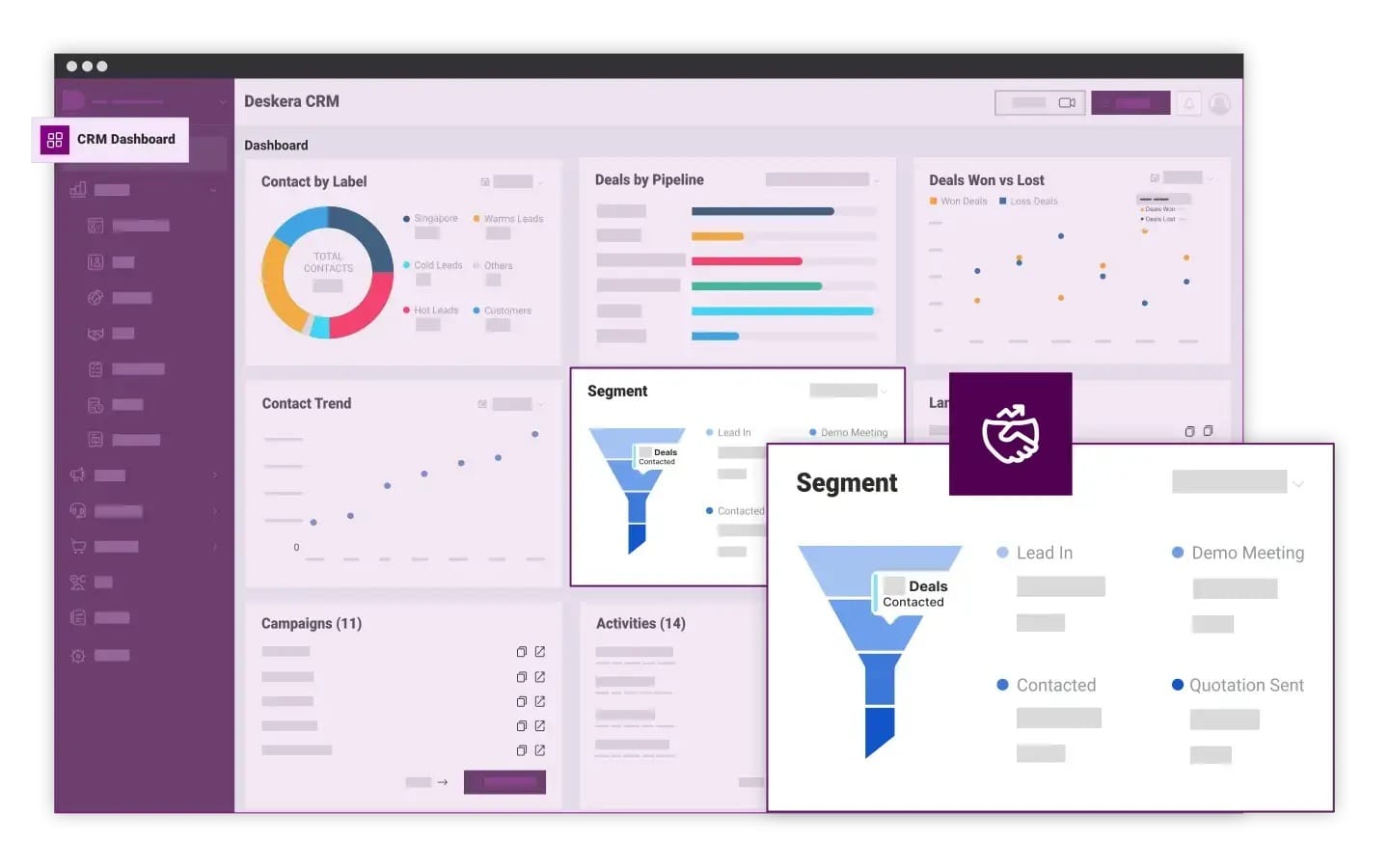
Modern sales forecasting requires more than spreadsheets and assumptions—it demands real-time data, automation, and cross-functional visibility. This is where Deskera ERP stands out by integrating sales, finance, inventory, and analytics into a single platform, enabling more accurate and actionable forecasts.
1. Centralized Data for Accurate Forecasting
Deskera ERP consolidates data from sales, CRM, inventory, and finance into one unified system. This eliminates data silos and ensures forecasts are built on consistent, real-time information. With a single source of truth, businesses can avoid discrepancies and make more reliable predictions.
2. Real-Time Sales Pipeline Visibility
With built-in CRM capabilities, Deskera allows businesses to track leads, opportunities, and deal progress in real time. This visibility helps sales teams understand pipeline health, evaluate deal probabilities, and generate more precise short-term forecasts based on actual sales activity.
3. AI-Powered Predictive Analytics
Deskera leverages advanced analytics and machine learning to identify trends, patterns, and anomalies in historical and current data. These insights help businesses anticipate future sales more accurately and uncover hidden opportunities or risks before they impact performance.
4. Automated Forecasting and Reporting
Manual forecasting is time-consuming and prone to errors. Deskera automates data collection, analysis, and report generation, reducing manual effort and improving accuracy. Businesses can quickly generate forecasts and access detailed reports without relying on spreadsheets.
5. Demand Forecasting and Trend Analysis
Deskera enables businesses to analyze customer demand patterns, seasonality, and buying behavior. By leveraging historical data and advanced algorithms, it helps predict future demand at granular levels—such as by product, region, or customer segment—improving overall forecast precision.
6. Scenario Planning and What-If Analysis
With predictive modeling and analytics, Deskera allows businesses to simulate different scenarios—such as pricing changes, market shifts, or demand fluctuations. This helps organizations prepare for uncertainties and make proactive, data-driven decisions.
7. Integration Across Business Functions
Deskera ERP connects sales forecasting with inventory, procurement, and financial planning. This ensures forecasts are not created in isolation but are aligned with operational capabilities, helping businesses optimize stock levels, production, and cash flow simultaneously.
8. Continuous Forecast Monitoring and Improvement
Deskera provides real-time dashboards and performance tracking tools that allow businesses to compare forecasts with actual results. This enables continuous refinement of forecasting models and improves accuracy over time through data-driven feedback loops.
By combining automation, real-time insights, and advanced analytics, Deskera ERP transforms sales forecasting from a reactive process into a strategic advantage. It empowers businesses to make faster, smarter decisions and stay ahead in an increasingly competitive market.
Key Takeaways
- Sales forecasting enables businesses to predict future revenue with greater accuracy, forming the foundation for strategic planning and decision-making.
- In 2026, sales forecasting is critical for navigating uncertainty, improving agility, and maintaining a competitive edge in rapidly changing markets.
- Effective sales forecasts rely on key components such as quality data, pipeline visibility, customer insights, and clearly defined sales processes.
- Different sales forecasting methods—ranging from historical to AI-driven—should be selected and combined based on business needs and data maturity.
- A structured, step-by-step forecasting process ensures consistency, improves accuracy, and helps businesses adapt to new information over time.
- Sales forecasting and demand planning serve different purposes, but aligning them ensures both revenue goals and operational efficiency are achieved.
- Accurate sales forecasts provide tangible benefits such as cost reduction, better resource utilization, improved customer satisfaction, and sustainable growth.
- Sales forecasting challenges often stem from market dynamics, data issues, and process gaps, making continuous improvement essential.
- Avoiding common forecasting mistakes—such as ignoring seasonality or failing to validate assumptions—helps maintain reliability and credibility.
- Following modern best practices, including standardization, scenario planning, and real-time data usage, significantly enhances forecast accuracy.
- Tracking key sales metrics like conversion rates, pipeline value, and sales cycle length strengthens forecasting precision and performance insights.
- Choosing the right forecasting method requires evaluating business stage, data quality, market conditions, and available resources.
- Leveraging tools like Deskera ERP enhances forecasting through real-time data integration, automation, and AI-driven insights.
Related Articles
 Deskera Content Team
 Deskera Content Team
 Deskera Content Team
 Deskera Content Team
 Deskera Content Team
 Deskera Content Team