


What separates companies that consistently deliver high-quality products from those that struggle with defects, rework, and customer complaints? The answer lies in a structured, organization-wide commitment to quality—better known as Total Quality Management (TQM). Rather than treating quality as a final checkpoint, TQM embeds it into every process, every employee role, and every decision, ensuring that excellence is built into the system from the ground up.
Total Quality Management (TQM) is a holistic approach focused on continuous improvement, customer satisfaction, and long-term success. It goes beyond traditional quality control by emphasizing proactive prevention instead of reactive correction. In today’s competitive landscape—where customer expectations are higher than ever—businesses cannot afford inefficiencies, inconsistencies, or poor-quality outputs. TQM helps organizations create a culture where quality is not a one-time effort but an ongoing strategic priority.
From manufacturing floors to service-based industries, TQM plays a critical role in improving operational efficiency, reducing costs, and enhancing customer loyalty. By aligning processes, people, and technology, organizations can identify inefficiencies early, streamline workflows, and deliver consistent value. This approach not only minimizes errors but also fosters innovation, as teams are encouraged to continuously refine and optimize their work.
Digital solutions like advanced MRP systems further strengthen TQM initiatives by providing real-time visibility and data-driven insights across operations. Platforms such as Deskera MRP enable businesses to streamline production planning, enforce quality checkpoints, and reduce defects through better process control. With capabilities like automated workflows, demand forecasting, integrated inventory management, and detailed reporting, these systems empower teams to track performance, identify quality issues early, and support continuous improvement at scale.
What Is Total Quality Management (TQM)?
Total Quality Management (TQM) is a structured, organization-wide approach focused on continuously improving the quality of products, services, and processes. It emphasizes ongoing refinement based on feedback, ensuring that businesses consistently meet or exceed customer expectations. Rather than treating quality as a final checkpoint, TQM integrates it into every stage of operations—making it a continuous, proactive effort.
At its core, TQM is a management philosophy that places strong emphasis on customer satisfaction, continuous improvement, and employee involvement. It requires every individual in the organization—from top leadership to front-line workers—to take responsibility for maintaining high-quality standards. This collective commitment helps build a culture where quality is not just a goal but a shared value embedded in daily activities and decision-making.
TQM also functions as an integrative system that combines strategy, data, and effective communication to align all business processes with quality objectives. It draws from multiple disciplines, including statistical analysis, process management, and behavioral sciences, to identify inefficiencies and eliminate defects. By leveraging both quantitative and qualitative insights, organizations can make informed decisions that drive consistent improvement.
Ultimately, Total Quality Management is about creating long-term value through excellence. It aims to reduce errors, streamline operations, and enhance customer experience while ensuring accountability across the entire production or service lifecycle. By fostering a culture of continuous improvement and shared responsibility, TQM enables organizations to remain competitive, adaptable, and sustainable in an ever-evolving business environment.
Difference Between TQM and Other Quality Management Approaches
While Total Quality Management (TQM) is a comprehensive, organization-wide philosophy, other quality management approaches often focus on specific methods, tools, or standards.
Understanding these differences helps organizations choose the right approach—or combination of approaches—based on their goals and operational needs.
TQM vs Six Sigma
TQM focuses on building a culture of continuous improvement across the entire organization, emphasizing employee involvement and long-term quality enhancement.
In contrast, Six Sigma is a data-driven methodology aimed at reducing defects and process variation using structured frameworks like DMAIC. While TQM is broader and cultural, Six Sigma is more project-focused and relies heavily on statistical analysis.
TQM vs Lean
TQM emphasizes overall quality improvement and customer satisfaction through continuous refinement of processes. Lean, on the other hand, focuses primarily on eliminating waste and improving efficiency within operations.
While both aim to enhance performance, TQM takes a holistic view of quality, whereas Lean targets speed, cost reduction, and value optimization in workflows.
TQM vs ISO Standards
TQM is a management philosophy that guides how organizations approach quality, whereas ISO standards (such as ISO 9001) provide a formal set of requirements and guidelines for quality management systems.
TQM is flexible and culture-driven, while ISO certification involves compliance, documentation, and audits to meet standardized criteria set by regulatory bodies.
TQM vs Quality Control (QC)
Quality Control is a reactive approach that focuses on inspecting final outputs to identify defects. TQM, in contrast, is proactive and preventive, aiming to eliminate defects by improving processes at every stage.
While QC is limited to product inspection, TQM integrates quality into all organizational activities, making it a more comprehensive approach.
TQM vs Quality Assurance (QA)
Quality Assurance focuses on establishing processes and standards to ensure consistent quality during production or service delivery.
TQM goes beyond QA by involving all employees and continuously improving those processes over time. While QA ensures that standards are followed, TQM ensures that those standards are constantly refined and enhanced.
Overall, TQM stands out as a holistic and long-term approach that integrates people, processes, and strategy, whereas other methodologies often serve as specialized tools or frameworks that can complement TQM within a broader quality management system.
Key Principles of Total Quality Management (TQM)
Total Quality Management is built on a set of core principles that guide organizations in achieving consistent quality, continuous improvement, and long-term customer satisfaction.
These principles collectively ensure that quality is embedded across all functions, processes, and decision-making levels within an organization.
Customer Focus
Customer focus is the foundation of TQM, as quality is ultimately defined by the customer. Organizations must continuously gather feedback, analyze customer expectations, and adapt their offerings accordingly.
By aligning processes and outputs with customer needs, businesses can improve satisfaction, build loyalty, and gain a competitive advantage. A strong customer focus ensures that every improvement effort directly contributes to delivering greater value.
Total Employee Involvement
TQM emphasizes that quality is everyone’s responsibility, requiring active participation from employees at all levels. Organizations must provide proper training, resources, and a supportive environment that encourages employees to take ownership of their work.
When employees feel empowered and engaged, they are more likely to contribute ideas, identify issues, and drive continuous improvement, leading to better quality outcomes and stronger organizational performance.
Process-Centered Approach
A process-centered approach focuses on understanding, managing, and improving workflows to achieve consistent quality. Instead of addressing issues at the output stage, TQM encourages organizations to identify inefficiencies within processes and eliminate root causes of defects.
By standardizing procedures and optimizing operations, businesses can enhance efficiency, reduce variability, and ensure predictable, high-quality results across all activities.
Integrated System
TQM requires organizations to operate as a unified system where all departments and functions are interconnected. Rather than working in silos, teams collaborate and align their efforts with shared quality goals.
This integration ensures that information flows seamlessly across departments, enabling better coordination, faster decision-making, and consistent quality standards throughout the organization.
Strategic and Systematic Approach
A strategic and systematic approach ensures that quality management is aligned with the organization’s long-term vision and objectives. TQM integrates quality into strategic planning, making it a core component of business success.
By following a structured framework, organizations can implement quality initiatives effectively, monitor progress, and ensure that improvement efforts contribute to sustainable growth and competitive advantage.
Continuous Improvement
Continuous improvement is a central principle of TQM, emphasizing that quality enhancement is an ongoing process rather than a one-time effort.
Organizations must regularly evaluate their processes, identify areas for improvement, and implement incremental changes.
This approach enables businesses to adapt to changing market demands, improve efficiency, and maintain high standards of quality over time.
Fact-Based Decision Making
TQM relies on data-driven decision-making to ensure accuracy and objectivity. Organizations collect and analyze performance metrics, quality data, and operational insights to identify trends and areas for improvement.
By using statistical tools and evidence-based analysis, businesses can make informed decisions, reduce uncertainties, and achieve more reliable and consistent outcomes.
Effective Communication
Effective communication is essential for successful TQM implementation, as it ensures alignment across all levels of the organization.
Clear communication of goals, processes, and expectations helps employees understand their roles in maintaining quality.
It also fosters collaboration, transparency, and knowledge sharing, enabling teams to work together efficiently and respond quickly to challenges or changes.
Core Components of Total Quality Management (TQM)
Total Quality Management is supported by a set of core components that ensure quality is consistently planned, maintained, and improved across all organizational processes.
These components provide the structural foundation needed to implement TQM effectively and sustain long-term performance improvements.
Quality Planning
Quality planning involves defining quality standards, objectives, and processes required to meet customer expectations. It focuses on identifying what quality means for the organization and how it can be achieved through structured planning. This includes setting benchmarks, allocating resources, and aligning processes with quality goals to ensure consistency and reliability in outputs.
Quality Assurance
Quality assurance is a proactive component that focuses on preventing defects by ensuring that processes are designed and implemented correctly. It involves establishing standardized procedures, conducting audits, and maintaining compliance with internal and external standards. By emphasizing prevention rather than correction, quality assurance helps organizations build confidence in their processes and deliver consistent results.
Quality Control
Quality control is the process of monitoring and evaluating outputs to ensure they meet predefined quality standards. It involves inspections, testing, and performance checks at various stages of production or service delivery. This component helps identify defects or deviations early, allowing organizations to take corrective actions and maintain the desired level of quality.
Continuous Improvement
Continuous improvement is a fundamental component of TQM that focuses on regularly enhancing processes, products, and services. It encourages organizations to identify inefficiencies, analyze performance data, and implement incremental improvements over time. This ongoing effort ensures that quality standards evolve with changing customer needs and market conditions.
Supplier Quality Management
Supplier quality management ensures that the quality of inputs meets organizational standards. Since suppliers play a critical role in the production process, maintaining strong relationships and clear quality expectations is essential. This component involves evaluating supplier performance, setting quality benchmarks, and collaborating with suppliers to improve consistency and reliability across the supply chain.
Key Tools and Techniques Used in Total Quality Management (TQM)
Total Quality Management relies on a variety of tools and techniques to identify inefficiencies, analyze root causes, and drive continuous improvement. These tools help organizations make data-driven decisions, standardize processes, and maintain consistent quality across operations.
Six Sigma
Six Sigma is a data-driven methodology focused on reducing defects and process variation. It uses statistical analysis to identify the root causes of errors and improve overall process performance. By following structured frameworks like DMAIC (Define, Measure, Analyze, Improve, Control), organizations can enhance quality, reduce costs, and achieve near-perfect output levels.
Lean Manufacturing
Lean manufacturing aims to eliminate waste and improve efficiency across processes. It focuses on delivering maximum value to customers by removing non-value-added activities such as overproduction, delays, and excess inventory. By streamlining workflows and optimizing resource utilization, lean techniques help improve quality while reducing operational costs.
PDCA Cycle (Plan-Do-Check-Act)
The PDCA cycle is a continuous improvement model used to test and implement changes systematically. Organizations first plan a change, execute it on a small scale, evaluate the results, and then act based on findings. This iterative approach helps refine processes, minimize risks, and ensure sustainable improvements over time.
Root Cause Analysis (RCA)
Root cause analysis focuses on identifying the underlying causes of problems rather than just addressing symptoms. Techniques such as the Fishbone Diagram (Ishikawa) and the 5 Whys method are commonly used to trace issues back to their origin. This approach helps prevent recurring problems and supports long-term quality improvement.
Statistical Process Control (SPC)
Statistical Process Control uses statistical methods to monitor and control processes. By analyzing data through control charts and other tools, organizations can detect variations and identify potential issues before they lead to defects. SPC enables proactive quality management and ensures process stability over time.
Benchmarking
Benchmarking involves comparing an organization’s processes and performance metrics with industry best practices or competitors. This technique helps identify performance gaps and uncover opportunities for improvement. By learning from top-performing organizations, businesses can adopt proven strategies to enhance quality and efficiency.
Flowcharts and Process Mapping
Flowcharts and process mapping tools visually represent workflows, making it easier to understand how processes function. They help identify bottlenecks, redundancies, and inefficiencies within operations. By providing clarity and structure, these tools support better process optimization and continuous improvement efforts.
Check Sheets and Quality Checklists
Check sheets and quality checklists are simple yet effective tools for collecting and organizing data. They help track defects, monitor process performance, and ensure consistency in operations. These tools are particularly useful for identifying patterns and trends, enabling organizations to take timely corrective actions.
How to Implement Total Quality Management (TQM)
Implementing Total Quality Management is not a one-size-fits-all process. It requires a structured yet flexible approach tailored to an organization’s culture, goals, and operational needs. While the exact steps may vary, a systematic rollout ensures that quality becomes an integral part of everyday business activities.
Assess Current Practices and Organizational Culture
The first step in implementing TQM is to evaluate existing processes, quality standards, and organizational culture. This involves identifying strengths, weaknesses, and areas where quality issues commonly occur. Understanding current workflows and core values helps organizations recognize gaps and determine how closely their operations align with TQM principles before making improvements.
Define Quality Objectives and Create a Roadmap
Organizations must establish clear, measurable quality goals that align with their overall business strategy. These objectives should focus on improving customer satisfaction, reducing defects, and enhancing efficiency. A well-defined roadmap with timelines, milestones, and responsibilities ensures that TQM implementation progresses in a structured and manageable way.
Understand Customer Needs and Expectations
Since TQM is customer-focused, organizations need to deeply understand what their customers value. This involves collecting feedback, analyzing expectations, and identifying areas where improvements are required. Aligning processes and outputs with customer needs ensures that quality initiatives deliver meaningful results and contribute directly to customer satisfaction.
Build a Cross-Functional Implementation Team
Successful TQM implementation requires collaboration across departments. Organizations should form a team comprising management and employees from different functions to lead quality initiatives. This team is responsible for driving change, ensuring alignment with goals, and integrating TQM practices into daily operations across the organization.
Train and Empower Employees
Employee involvement is critical to TQM success. Organizations must invest in training programs that build awareness of quality principles and enhance practical skills. Empowering employees to identify issues, suggest improvements, and take ownership of their work fosters a culture where quality becomes a shared responsibility rather than a top-down directive.
Integrate TQM into Daily Operations
TQM should not be treated as a separate initiative but embedded into routine business processes. Organizations must align workflows, performance metrics, and decision-making practices with quality objectives. This integration ensures consistency and reinforces the importance of maintaining high standards in every activity.
Collect Feedback and Monitor Performance
Continuous feedback from both employees and customers is essential to measure progress. Organizations should regularly track performance metrics, evaluate outcomes, and identify areas for improvement. This ongoing monitoring helps ensure that quality initiatives remain effective and aligned with business goals.
Continuously Improve and Refine the Approach
TQM is an ongoing journey rather than a one-time implementation. Organizations must regularly review their strategies, learn from outcomes, and refine processes based on feedback and performance data. Continuous improvement ensures adaptability, helping businesses respond effectively to changing customer expectations and market conditions.
Benefits of Implementing Total Quality Management (TQM)
Implementing Total Quality Management delivers both operational and strategic advantages, helping organizations improve performance, reduce inefficiencies, and strengthen their competitive position. By embedding quality into every process and involving all employees, TQM creates a culture of continuous improvement that drives long-term business success.
Improved Product and Service Quality
One of the most significant benefits of TQM is the consistent improvement in product and service quality. By focusing on process optimization and defect prevention, organizations can reduce errors and deliver reliable outputs. This leads to greater consistency across operations and ensures that products and services meet or exceed customer expectations, ultimately strengthening trust and brand reputation.
Increased Customer Satisfaction and Loyalty
TQM places customers at the center of all business activities, ensuring their needs and expectations are consistently met. By delivering higher-quality products and responding effectively to feedback, organizations can enhance customer satisfaction. Over time, this builds stronger relationships, increases customer loyalty, and improves retention, contributing to sustained revenue growth and a positive market image.
Reduced Costs and Waste
Through continuous improvement and process standardization, TQM helps eliminate inefficiencies, defects, and non-value-added activities. This results in lower operational costs, reduced material waste, and better resource utilization. Although implementation may require initial investment, the long-term cost savings and improved cost management significantly enhance overall profitability.
Higher Operational Efficiency and Productivity
TQM promotes a process-driven approach that streamlines workflows and improves coordination across departments. By identifying bottlenecks and optimizing operations, organizations can achieve higher productivity levels.
Improved efficiency not only accelerates production cycles but also ensures consistent performance, enabling businesses to operate more effectively in competitive environments.
Enhanced Employee Engagement and Morale
Employee involvement is a core principle of TQM, encouraging individuals to take ownership of quality and participate in improvement initiatives. This inclusive approach boosts morale, fosters a sense of responsibility, and enhances job satisfaction.
Engaged employees are more motivated, innovative, and committed to achieving organizational goals, resulting in a stronger and more collaborative workforce.
Stronger Competitive Advantage
Organizations that successfully implement TQM gain a significant competitive edge. By delivering superior quality, reducing costs, and improving efficiency, they can outperform competitors who struggle with inconsistencies.
This combination of excellence and reliability enhances market positioning, increases market share, and strengthens long-term business sustainability.
Better Process Management and Innovation
TQM encourages organizations to continuously analyze and refine their processes, leading to more structured and efficient operations. This focus on improvement fosters innovation, as teams are motivated to find better ways of working.
Over time, businesses develop more agile and adaptable systems that support growth and respond effectively to changing market conditions.
Improved Supplier and Stakeholder Relationships
TQM extends beyond internal operations to include suppliers and stakeholders. By establishing clear quality standards and fostering collaboration, organizations can improve supplier performance and ensure consistency across the supply chain. This strengthens relationships, enhances trust, and creates shared value for all stakeholders involved.
Challenges in Implementing Total Quality Management (TQM)
While Total Quality Management offers significant long-term benefits, implementing it can be complex and demanding. Organizations often face several practical and cultural challenges that can hinder successful adoption if not addressed proactively.
Lack of Management Commitment
Strong leadership support is essential for TQM success, yet many organizations struggle with inconsistent commitment from top management. Without clear direction, resource allocation, and active involvement, quality initiatives tend to lose momentum. When leaders fail to reinforce quality as a priority, employees may not fully engage, resulting in fragmented implementation and limited long-term impact.
Resistance to Cultural Change
TQM requires a fundamental shift in organizational mindset, moving from reactive quality control to proactive, continuous improvement. Employees who are accustomed to traditional methods may resist these changes due to uncertainty or fear of increased accountability. Overcoming this resistance requires clear communication, strong leadership, and a supportive environment that encourages participation and trust.
High Time and Resource Investment
Implementing TQM often involves significant upfront investment in training, process redesign, and system improvements. Organizations must dedicate time and financial resources to ensure proper execution. This can be challenging, especially for businesses expecting quick results, as TQM is a long-term strategy that requires sustained effort and commitment.
Lack of Training and Workforce Preparedness
TQM depends heavily on employee involvement, but insufficient training can limit its effectiveness. Without proper education on quality principles and practices, employees may struggle to contribute meaningfully. Continuous training and skill development are necessary to build competence, confidence, and alignment with organizational quality goals.
Poor Communication and Lack of Shared Vision
Ineffective communication can create confusion about goals, roles, and expectations. When employees and departments are not aligned with a shared vision of quality, implementation becomes inconsistent. Clear, transparent communication is essential to ensure everyone understands their responsibilities and works toward common objectives.
Data Management and Measurement Challenges
TQM relies on accurate, timely, and reliable data for decision-making. However, many organizations face difficulties in collecting, analyzing, and utilizing data effectively. Inadequate data systems or poor data quality can lead to incorrect insights, making it harder to track progress and identify areas for improvement.
Short-Term Focus Over Long-Term Goals
Organizations often prioritize immediate financial results over long-term quality improvements. Since TQM takes time to show measurable outcomes, this short-term focus can undermine its effectiveness. Sustained commitment to long-term goals is essential to realize the full benefits of continuous improvement and quality enhancement.
Lack of Cross-Functional Collaboration
TQM requires strong cooperation across departments, but siloed structures can hinder collaboration. When teams fail to work together or share information, it becomes difficult to maintain consistent quality standards. Encouraging teamwork and integrating processes across functions are critical to overcoming this challenge.
Delayed Results and Sustaining Momentum
Unlike quick-fix solutions, TQM delivers results gradually over time. Organizations may become discouraged if improvements are not immediately visible. Maintaining momentum requires patience, consistent effort, and ongoing evaluation to ensure that quality initiatives continue to evolve and deliver value.
Balancing Standardization with Flexibility
While TQM promotes structured processes and data-driven decision-making, excessive rigidity can limit creativity and adaptability. Organizations must strike a balance between maintaining standardized procedures and allowing flexibility for innovation. Achieving this balance is essential to remain competitive in dynamic business environments.
Best Practices for Effective TQM Implementation
Successfully implementing Total Quality Management requires more than just following steps—it demands a strategic, disciplined approach supported by the right culture, leadership, and mindset.
These best practices help organizations sustain TQM efforts and maximize long-term value.
Build a Quality-First Organizational Culture
A strong quality culture is the foundation of TQM success. Organizations must embed quality into their core values, ensuring it influences every decision and activity.
This involves promoting accountability, encouraging ownership at all levels, and reinforcing the idea that quality is everyone’s responsibility, not just a specific department’s function.
Ensure Strong Leadership Commitment
Leadership plays a critical role in driving TQM initiatives. Leaders must actively support quality efforts by setting clear expectations, allocating resources, and leading by example.
Consistent reinforcement of quality goals from top management helps create alignment across the organization and motivates employees to stay committed to continuous improvement.
Align TQM with Business Strategy
For TQM to be effective, it must be integrated into the organization’s overall strategic objectives. Quality goals should directly support business priorities such as growth, customer satisfaction, and operational efficiency. This alignment ensures that improvement efforts are purposeful and contribute to long-term organizational success.
Focus on Long-Term Improvements
TQM is not a quick fix but a long-term commitment to excellence. Organizations should avoid focusing solely on short-term gains and instead prioritize sustainable improvements. Consistent efforts over time lead to meaningful results, helping businesses build resilience and maintain a competitive edge.
Encourage Cross-Functional Collaboration
Breaking down silos and promoting collaboration across departments is essential for TQM success. Teams must work together, share information, and align their efforts to achieve common quality goals. This collaborative approach ensures consistency, improves problem-solving, and enhances overall organizational performance.
Leverage Data for Continuous Improvement
Data-driven decision-making is a cornerstone of TQM. Organizations should consistently collect, analyze, and use data to monitor performance and identify improvement opportunities. Reliable insights enable better decision-making, reduce uncertainty, and ensure that quality initiatives are based on measurable outcomes.
Invest in Continuous Training and Development
Ongoing training ensures that employees understand TQM principles and have the skills needed to contribute effectively. Organizations should provide regular learning opportunities to keep employees updated on best practices and evolving quality standards. This continuous development strengthens capability and supports long-term success.
Maintain Open and Transparent Communication
Clear and consistent communication is essential for aligning teams and sustaining TQM efforts. Organizations must ensure that employees understand quality goals, progress, and expectations. Transparent communication fosters trust, improves coordination, and encourages active participation in quality initiatives.
By following these best practices, organizations can create a strong foundation for TQM, ensuring that quality becomes a sustained competitive advantage rather than a short-term initiative.
How Deskera MRP Supports Total Quality Management (TQM)
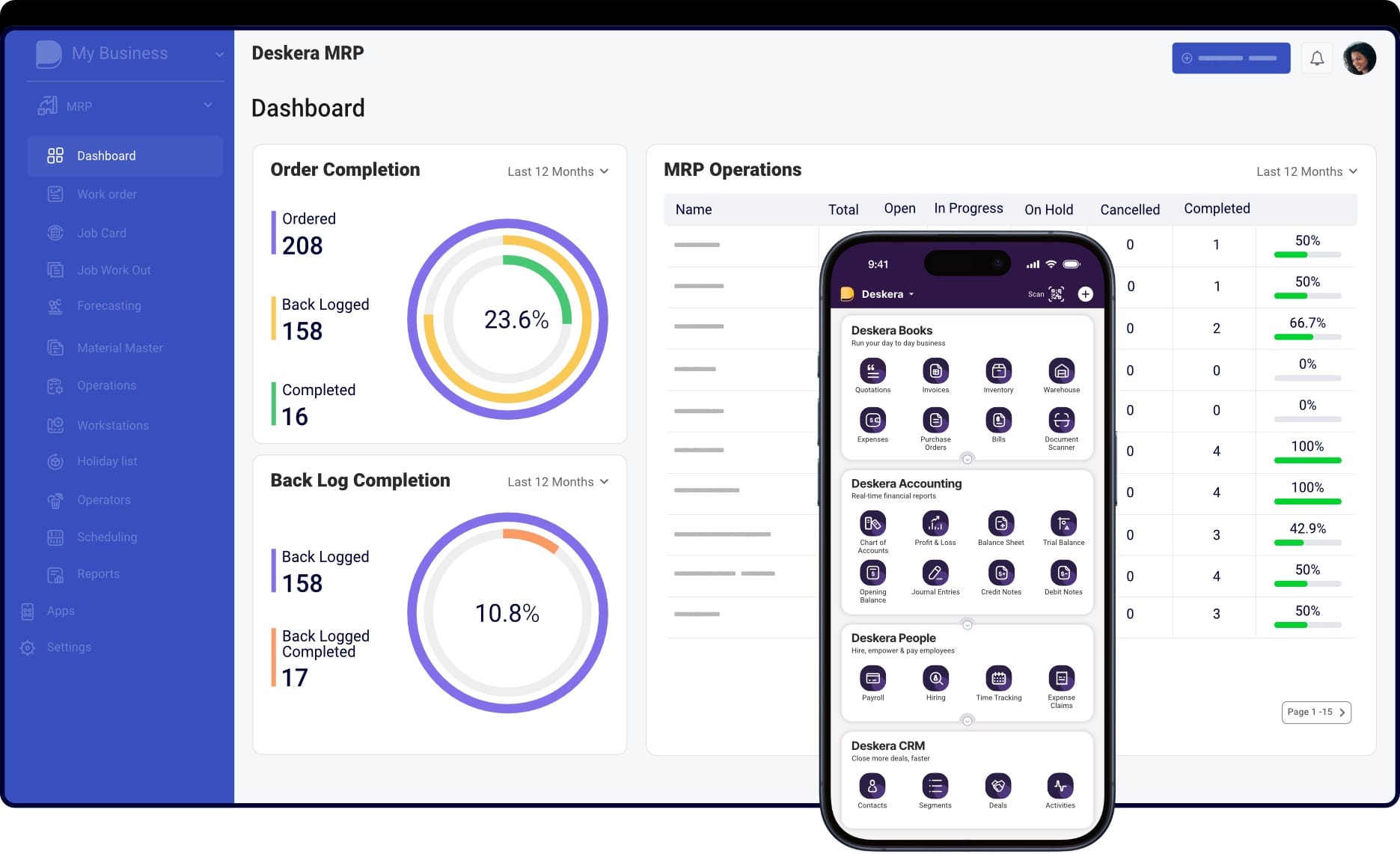
Implementing Total Quality Management requires strong process control, consistent quality checks, and real-time visibility across operations. Deskera MRP supports these requirements by enabling structured quality management within production workflows, helping businesses maintain consistent standards and reduce defects.
Built-In Quality Checks and Control Mechanisms
Deskera MRP allows organizations to define quality parameters, checklists, and acceptance criteria at various stages of production. These built-in controls ensure that products are evaluated against predefined standards before moving to the next stage. This aligns closely with TQM’s focus on preventing defects rather than identifying them at the end.
Standardized Production Processes
Consistency is critical to quality, and Deskera MRP helps standardize production through structured workflows and bill of materials (BOM) management. By ensuring that every process follows defined steps and specifications, businesses can reduce variability and maintain uniform quality across products and batches.
Real-Time Production Monitoring
With features like work order tracking and production reporting, Deskera MRP provides visibility into ongoing operations. This allows teams to monitor progress, identify deviations early, and take corrective action before issues escalate. Such real-time insights support better process control, a key requirement in TQM.
Inventory and Material Quality Management
Quality output depends on the quality of inputs. Deskera MRP enables efficient inventory tracking and material planning, ensuring that the right materials are used at the right time. By maintaining better control over raw materials and stock levels, businesses can reduce the risk of defects caused by inconsistent or poor-quality inputs.
Data-Driven Performance Tracking
Deskera MRP includes reporting and analytics capabilities that help organizations track production performance and operational metrics. These insights make it easier to identify recurring issues, measure process efficiency, and support informed decision-making—key elements in maintaining and improving quality over time.
Improved Operational Efficiency
By streamlining production planning, inventory management, and execution processes, Deskera MRP helps reduce delays and inefficiencies. More efficient operations contribute to consistent output quality and lower chances of errors, supporting the broader goals of TQM without relying on reactive quality fixes.
By enabling structured quality checks, standardized workflows, and real-time monitoring, Deskera MRP provides a strong operational foundation that supports the principles of Total Quality Management, helping organizations deliver consistent quality and improve overall efficiency.
Key Takeaways
- TQM is a holistic, organization-wide approach that embeds quality into every process, driving long-term efficiency, customer satisfaction, and competitive advantage.
- Total Quality Management is a continuous improvement philosophy that integrates people, processes, and data to consistently enhance product and service quality.
- TQM is built on core principles such as customer focus, employee involvement, process orientation, and data-driven decision-making, ensuring quality is embedded across the organization.
- Effective TQM implementation relies on structured components like quality planning, assurance, control, continuous improvement, and supplier quality management.
- Techniques like Six Sigma, Lean, PDCA, and root cause analysis enable organizations to identify inefficiencies, reduce defects, and improve process performance.
- TQM enhances product quality, reduces costs and waste, improves customer satisfaction, and strengthens overall business performance and competitiveness.
- Successful TQM implementation requires assessing current practices, defining clear goals, involving employees, aligning processes, and continuously refining strategies based on feedback.
- Organizations may face challenges such as resistance to change, lack of leadership commitment, resource constraints, and difficulty in sustaining long-term focus.
- Unlike methods like Six Sigma or Lean, TQM is a broad, culture-driven philosophy that complements other quality management approaches rather than replacing them.
- Building a quality-first culture, ensuring leadership support, leveraging data, and encouraging collaboration are essential for sustaining TQM success.
- MRP systems enhance TQM by improving process visibility, enabling data-driven decisions, ensuring material quality, and supporting continuous improvement across operations.
Related Articles
 RVJ
RVJ
 Niti Samani
 Niti Samani
 Niti Samani
 Nalini
 Damini