

Is your business truly in control of its equipment—or just reacting when things go wrong? For many organizations, maintenance is still treated as a last-minute fix rather than a strategic priority. The reality is simple: unplanned downtime, frequent breakdowns, and inefficient maintenance practices can quietly drain profits and disrupt operations. The right maintenance strategy, however, can turn this challenge into a competitive advantage.
Maintenance strategies are no longer limited to basic repairs or routine servicing. Today, businesses have access to a wide range of approaches—from reactive and preventive to predictive and reliability-centered maintenance—each designed to address specific operational needs. Choosing the right one isn’t just about fixing machines; it’s about improving efficiency, extending asset lifespan, and ensuring consistent productivity across your operations.
As industries evolve and technology advances, the importance of adopting a proactive and data-driven maintenance approach continues to grow. Companies that invest in the right strategy can significantly reduce downtime, optimize resource utilization, and make smarter decisions based on real-time insights. In contrast, relying on outdated methods can lead to higher costs, operational risks, and missed opportunities for growth.
This is where modern tools like Deskera MRP play a crucial role. Deskera MRP helps businesses streamline maintenance planning by integrating production, inventory, and asset management into a single platform. With features like automated scheduling, real-time tracking, and data-driven insights, it enables organizations to move from reactive fixes to proactive maintenance strategies. By leveraging such tools, businesses can not only improve operational efficiency but also build a more resilient and future-ready maintenance framework.
What Are Maintenance Strategies?
Maintenance strategies are structured approaches that businesses use to manage, maintain, and optimize the performance of their equipment and assets. At their core, these strategies act as a blueprint for minimizing downtime, controlling maintenance costs, and ensuring operations run smoothly and efficiently. Instead of reacting to failures as they occur, organizations rely on well-defined maintenance strategies to plan, prioritize, and execute maintenance activities in a more systematic way.
In today’s asset-intensive industries, maintenance strategies play a critical role in overall asset management. They help organizations oversee everything that contributes to production—from machinery health and performance to maintenance scheduling and resource allocation. A strong strategy ensures that equipment operates at or near peak capacity while reducing the risk of unexpected breakdowns that can disrupt operations and increase costs.
Modern maintenance strategies go beyond simple repairs or routine servicing. They incorporate a range of approaches, from reactive maintenance that addresses issues after failure to advanced predictive methods powered by data, analytics, and IoT technologies. This evolution has enabled businesses to shift toward more proactive and intelligent maintenance models, where potential issues are identified and resolved before they escalate into costly problems.
Ultimately, a well-designed maintenance strategy is a proactive decision-making framework that aligns maintenance activities with business goals. By combining different approaches—such as preventive, predictive, and condition-based maintenance—organizations can create a tailored plan that improves asset reliability, enhances productivity, and supports long-term operational efficiency.
Why Choosing the Right Maintenance Strategy Matters
Selecting the right maintenance strategy is not just an operational decision—it directly impacts your business performance, cost structure, and long-term growth. A poorly chosen approach can lead to frequent breakdowns, rising maintenance expenses, and production delays, while the right strategy ensures smoother operations, better asset utilization, and improved profitability. As businesses become more data-driven and efficiency-focused, aligning maintenance strategies with operational goals has become more critical than ever.
Minimizes Downtime and Operational Disruptions
Unplanned equipment failures can bring operations to a standstill, resulting in missed deadlines and lost revenue. Choosing the right maintenance strategy allows businesses to detect issues early and schedule timely interventions. This proactive approach reduces the likelihood of sudden breakdowns and ensures smoother production cycles, helping organizations maintain consistent output and avoid costly operational interruptions.
Optimizes Maintenance Costs
Maintenance costs can spiral out of control when businesses rely on inefficient or outdated approaches. The right strategy ensures resources are used effectively by balancing routine maintenance with actual equipment needs. Whether through preventive schedules or predictive insights, organizations can avoid unnecessary repairs, reduce emergency maintenance expenses, and achieve better cost control over the long term.
Improves Asset Reliability and Lifespan
Equipment that is maintained using the right strategy tends to perform more reliably and last longer. Regular monitoring, timely servicing, and data-driven insights help prevent excessive wear and tear. This not only reduces the frequency of breakdowns but also extends the operational life of assets, allowing businesses to maximize their return on investment and delay costly replacements.
Enhances Productivity and Efficiency
Efficient maintenance practices ensure that machines operate at optimal performance levels without frequent interruptions. By aligning maintenance activities with production schedules, businesses can minimize disruptions and maintain workflow continuity. The right strategy also reduces time spent on reactive repairs, enabling teams to focus on value-driven tasks and improving overall productivity across operations.
Supports Data-Driven Decision Making
Modern maintenance strategies leverage data, analytics, and real-time monitoring to provide actionable insights into equipment performance. This allows businesses to make informed decisions about maintenance schedules, resource allocation, and asset utilization. With accurate data at their disposal, organizations can continuously refine their strategies, improve efficiency, and respond more effectively to changing operational demands.
Reduces Operational Risks and Ensures Compliance
Equipment failures can lead to safety hazards, regulatory violations, and financial penalties. A well-chosen maintenance strategy helps businesses maintain safe working conditions by ensuring equipment is regularly inspected and maintained. It also supports compliance with industry standards and regulations, reducing legal risks and protecting both employees and the organization’s reputation.
Aligns Maintenance with Business Goals
Every organization has unique priorities, whether it’s reducing costs, improving efficiency, or scaling operations. The right maintenance strategy ensures that maintenance efforts are aligned with these broader business objectives. By integrating maintenance planning with overall operational goals, companies can create a more cohesive approach that drives long-term growth and sustainable success.
Types of Maintenance Strategies
Maintenance strategies come in various forms, each designed to address specific operational needs, asset criticality, and cost considerations. While some approaches focus on fixing issues after they occur, others aim to prevent failures through planning, monitoring, and data-driven insights. In practice, most organizations adopt a combination of these strategies to create a balanced and effective maintenance program.
Reactive Maintenance (Run-to-Failure)
Reactive maintenance, also known as breakdown or run-to-failure maintenance, involves repairing equipment only after it has failed. This approach requires little to no planning, making it easy to implement, especially for non-critical or low-cost assets. However, it often leads to unexpected downtime, production delays, and higher repair costs due to emergency interventions.
While it may seem cost-effective initially, overreliance on reactive maintenance can negatively impact overall efficiency and asset lifespan. It is best used selectively, where the cost of maintenance outweighs the cost of replacement or downtime.
Benefits:
- Low initial investment and minimal planning required
- Simple and easy to implement
- Suitable for non-critical or low-cost equipment
Corrective Maintenance (Planned and Unplanned)
Corrective maintenance focuses on repairing faults once they are identified, either before or after complete equipment failure. It can be planned, where repairs are scheduled in advance, or unplanned, where immediate action is required. Planned corrective maintenance allows better resource allocation and reduces disruption, while unplanned corrective maintenance can lead to costly downtime.
This strategy is useful for addressing issues that do not immediately halt operations but still require attention. However, it is not entirely proactive and should be supported by preventive or predictive strategies for better efficiency and reliability.
Benefits:
- Addresses faults before they escalate into major failures
- Planned corrections reduce operational disruptions
- Flexible approach for managing emerging issues
Preventive Maintenance (Time-Based and Usage-Based)
Preventive maintenance involves performing maintenance activities at scheduled intervals based on time or usage, regardless of equipment condition. These activities include inspections, lubrication, cleaning, and part replacements. The goal is to reduce the likelihood of unexpected failures and ensure consistent equipment performance.
This strategy is widely adopted due to its simplicity and effectiveness in improving reliability. However, it may sometimes lead to unnecessary maintenance if schedules are not optimized. When combined with data insights, preventive maintenance can significantly enhance asset lifespan and operational efficiency across various industries.
Benefits:
- Reduces the risk of unexpected equipment breakdowns
- Extends asset lifespan and improves reliability
- Enables better planning and scheduling of maintenance tasks
Condition-Based Maintenance (CBM)
Condition-based maintenance relies on monitoring the actual condition of equipment to determine when maintenance is needed. Instead of following a fixed schedule, this approach uses performance indicators such as vibration, temperature, and oil quality to detect early signs of wear.
Maintenance is only performed when these indicators show potential issues, reducing unnecessary interventions. While CBM improves efficiency and resource utilization, it requires specialized monitoring tools and technical expertise. It is particularly useful for critical assets where real-time insights can prevent costly failures and optimize maintenance efforts.
Benefits:
- Reduces unnecessary maintenance activities
- Improves resource utilization and efficiency
- Detects issues early based on real-time data
Predictive Maintenance (PdM)
Predictive maintenance uses advanced technologies such as IoT sensors, data analytics, and machine learning to predict when equipment failures are likely to occur. By analyzing real-time and historical data, businesses can schedule maintenance activities at the most optimal time. This approach minimizes downtime, reduces maintenance costs, and enhances asset performance.
Although it requires a higher initial investment and skilled personnel, the long-term benefits often outweigh the costs. Predictive maintenance is especially valuable for critical equipment where unexpected failures can have significant operational and financial consequences.
Benefits:
- Minimizes unplanned downtime and disruptions
- Optimizes maintenance schedules and reduces costs
- Enhances asset performance and lifespan
Proactive Maintenance
Proactive maintenance focuses on identifying and eliminating the root causes of equipment failures rather than just addressing symptoms. This strategy combines insights from preventive and predictive approaches to improve long-term reliability. By analyzing failure patterns and implementing corrective actions, organizations can prevent recurring issues.
Proactive maintenance requires continuous monitoring, data analysis, and process improvements, making it more resource-intensive. However, it delivers significant long-term benefits by reducing breakdowns, improving efficiency, and extending asset life, making it ideal for organizations aiming for operational excellence.
Benefits:
- Prevents recurring equipment failures
- Improves long-term asset reliability
- Reduces overall maintenance costs
Reliability-Centered Maintenance (RCM)
Reliability-centered maintenance is a structured approach that determines the most appropriate maintenance strategy for each asset based on its criticality, failure modes, and operational impact. It involves detailed analysis to ensure that maintenance efforts are focused where they are most needed.
RCM helps organizations balance cost, performance, and risk effectively. While it offers significant benefits in terms of reliability and efficiency, it can be complex to implement and requires skilled personnel and comprehensive data. It is best suited for organizations with critical assets and mature maintenance processes.
Benefits:
- Prioritizes critical assets for maximum reliability
- Reduces unnecessary maintenance tasks
- Improves overall operational performance
Total Productive Maintenance (TPM)
Total productive maintenance is a holistic approach that involves employees at all levels in maintaining and improving equipment performance. It emphasizes continuous improvement, operator involvement, and preventive care to achieve minimal downtime and maximum efficiency.
TPM fosters a culture of accountability and teamwork, where operators take responsibility for basic maintenance tasks. While it requires strong organizational commitment and training, it significantly enhances productivity and equipment reliability. TPM is widely used in manufacturing environments aiming for lean operations and continuous improvement.
Benefits:
- Enhances productivity and equipment efficiency
- Encourages employee involvement and ownership
- Reduces downtime and operational losses
Risk-Based Maintenance (RBM)
Risk-based maintenance prioritizes maintenance activities based on the likelihood and impact of equipment failure. This approach ensures that resources are focused on high-risk and critical assets, improving efficiency and safety. By using risk assessment tools and data analysis, organizations can allocate maintenance efforts more effectively.
RBM helps reduce unnecessary maintenance while minimizing potential disruptions. However, it requires continuous evaluation and accurate risk analysis. It is particularly useful in industries where safety and reliability are critical, such as energy, manufacturing, and infrastructure.
Benefits:
- Optimizes resource allocation effectively
- Reduces operational and safety risks
- Focuses on high-impact maintenance activities
Prescriptive Maintenance
Prescriptive maintenance is an advanced approach that builds on predictive maintenance by recommending specific actions to prevent failures. Using artificial intelligence and advanced analytics, it not only predicts when maintenance is needed but also suggests the best course of action. This enables organizations to make faster and more accurate decisions.
While highly effective, prescriptive maintenance requires sophisticated technology and integration with existing systems. It is ideal for organizations looking to leverage advanced digital tools for maximum efficiency and performance.
Benefits:
- Provides actionable maintenance recommendations
- Improves decision-making accuracy
- Enhances efficiency through automation and insights
Routine Maintenance
Routine maintenance consists of basic, regular tasks such as cleaning, lubrication, inspections, and minor adjustments. These activities are typically performed by operators or maintenance staff and help maintain equipment in good working condition. While simple, routine maintenance plays a crucial role in preventing minor issues from escalating into major problems.
It forms the foundation of any maintenance strategy and supports more advanced approaches. Consistent routine maintenance ensures smoother operations and reduces the likelihood of unexpected breakdowns.
Benefits:
- Prevents minor issues from becoming major problems
- Easy to implement with minimal training
- Supports overall maintenance effectiveness
Condition Monitoring / Monitoring-Based Maintenance
Condition monitoring involves continuously tracking equipment performance using sensors and monitoring systems. Parameters such as temperature, vibration, and pressure are analyzed to detect abnormalities. This strategy provides real-time insights into asset health and supports predictive and condition-based maintenance.
While it requires investment in monitoring tools and systems, it significantly improves early fault detection and decision-making. It is particularly valuable for critical assets where continuous monitoring can prevent costly failures and downtime.
Benefits:
- Provides real-time visibility into asset performance
- Supports advanced maintenance strategies
- Improves early fault detection
Detective (Sensitive) Maintenance
Detective or sensitive maintenance relies on human senses to identify abnormalities in equipment. Operators inspect machinery for unusual sounds, vibrations, smells, or visible defects. This approach is simple and cost-effective but depends heavily on the skill and attention of personnel.
It is often used as a first line of defense to detect early warning signs before more advanced diagnostics are applied. While not sufficient on its own, detective maintenance complements other strategies by providing immediate, on-the-ground insights.
Benefits:
- Cost-effective and easy to implement
- Helps detect visible or audible issues early
- Complements advanced monitoring techniques
Key Factors to Consider When Choosing a Maintenance Strategy
Choosing the right maintenance strategy is not a one-size-fits-all decision. It requires a careful evaluation of your operational needs, resources, and long-term business objectives. Each strategy comes with its own trade-offs, and selecting the most suitable one depends on how well it aligns with your organization’s goals, asset requirements, and capabilities.
Below are the key factors businesses should consider before making a decision.
Business Goals and Operational Priorities
Your maintenance strategy should directly align with your overall business objectives. Whether your focus is reducing downtime, improving productivity, extending asset lifespan, or minimizing costs, the chosen approach must support these priorities.
For example, organizations aiming for maximum uptime may lean toward predictive or proactive strategies, while those prioritizing cost savings may adopt preventive or selective reactive approaches. Clearly defining your goals helps ensure that maintenance efforts contribute to broader organizational success rather than operating in isolation.
Budget and Resource Availability
Budget plays a crucial role in determining which maintenance strategy is feasible. Advanced approaches like predictive or reliability-centered maintenance often require investment in sensors, software, and skilled personnel. On the other hand, reactive or preventive maintenance can be implemented with fewer resources.
Organizations must evaluate both initial investment and long-term cost implications to strike the right balance. A well-planned strategy should not only fit within budget constraints but also deliver measurable returns in terms of efficiency and reduced downtime.
Type and Criticality of Equipment
The nature, value, and importance of your equipment significantly influence the choice of maintenance strategy. High-value, mission-critical assets often require predictive or reliability-centered maintenance to avoid costly failures.
In contrast, low-cost or non-essential equipment may be suitable for reactive or run-to-failure approaches. Assessing asset criticality helps prioritize maintenance efforts and ensures that resources are allocated where they have the greatest impact on operations and business continuity.
Existing Infrastructure and Technology
Your current technology infrastructure determines how easily you can adopt advanced maintenance strategies. Predictive and prescriptive maintenance rely heavily on IoT sensors, data analytics, and integrated systems.
If your organization lacks these capabilities, implementing such strategies may require additional investment and system upgrades. Evaluating your existing tools, software, and data systems helps ensure that your chosen strategy is practical and scalable within your operational environment.
Workforce Skills and Capabilities
Even the most advanced maintenance strategy depends on skilled personnel to execute it effectively. Organizations must assess whether their workforce has the expertise to handle tasks such as data analysis, condition monitoring, and advanced diagnostics.
If not, training or hiring may be necessary. Simpler strategies like preventive or routine maintenance require less specialization, while predictive and reliability-centered approaches demand higher technical knowledge and experience.
Data Availability and Utilization
Data is a critical enabler of modern maintenance strategies. Organizations must evaluate whether they have access to accurate, real-time, and historical data on equipment performance. Strategies like predictive and prescriptive maintenance rely heavily on data for decision-making.
Without proper data collection and analysis, these approaches may not deliver expected results. Establishing strong data management practices ensures continuous improvement and more informed maintenance decisions over time.
Risk Tolerance and Compliance Requirements
Every organization has a different level of risk tolerance. Some may accept occasional downtime to reduce costs, while others—especially in regulated industries—must prioritize safety and compliance.
Maintenance strategies should reflect this balance. Industries with strict regulations often require preventive or reliability-centered approaches to ensure compliance and avoid penalties. Understanding your risk exposure helps in selecting a strategy that protects both operations and organizational reputation.
Condition and Age of Equipment
The current state of your equipment also influences your maintenance approach. Older or frequently failing machines may not justify heavy investment in advanced maintenance strategies and could be better suited for replacement or reactive maintenance.
Newer, high-performance equipment, however, benefits significantly from predictive or condition-based strategies. Evaluating asset condition helps determine whether to maintain, upgrade, or replace equipment as part of your overall maintenance plan.
Scalability and Future Growth
As your business grows, your maintenance needs will evolve. It’s important to choose a strategy that can scale with your operations. While a basic preventive approach may work initially, expanding organizations may need to adopt more advanced strategies like predictive maintenance over time. Planning for scalability ensures that your maintenance framework remains effective and adaptable as operational complexity increases.
Integration with Overall Business Systems
Maintenance should not operate in isolation. It needs to integrate seamlessly with other business functions such as production, inventory, and procurement.
A well-integrated approach ensures better coordination, improved resource planning, and more efficient operations.
Choosing a strategy that aligns with your existing systems—or can be easily integrated—helps create a unified and streamlined operational ecosystem.
Expert Tips to Choose the Right Maintenance Strategy
Choosing the right maintenance strategy goes beyond evaluating factors—it requires practical decision-making, continuous improvement, and a strategic mindset.
While the right choice depends on your organization’s unique needs, these expert tips can help you make smarter, more effective decisions and build a maintenance approach that evolves with your business.
Start with Asset Criticality Analysis
Begin by identifying which assets are most critical to your operations. Not all equipment requires the same level of attention, so ranking assets based on their impact on production, safety, and costs helps prioritize efforts.
Focus advanced strategies like predictive or proactive maintenance on high-value assets, while applying simpler approaches to less critical equipment. This ensures efficient use of resources and maximum operational impact.
Adopt a Hybrid Maintenance Approach
Relying on a single maintenance strategy is rarely effective. Instead, combine multiple approaches to create a balanced and flexible system. For example, use preventive maintenance for routine tasks, predictive maintenance for critical assets, and reactive maintenance for low-priority equipment. A hybrid strategy allows businesses to optimize costs, improve reliability, and adapt to different operational scenarios more effectively.
Leverage Data for Smarter Decisions
Data should be at the core of your maintenance strategy. Collect and analyze information on equipment performance, failure patterns, and maintenance history to make informed decisions.
Even if you’re not ready for full predictive maintenance, using available data can help refine schedules and reduce unnecessary tasks. Over time, data-driven insights enable continuous improvement and more accurate maintenance planning.
Invest in the Right Technology Gradually
Adopting advanced maintenance strategies doesn’t have to happen all at once. Start with basic tools such as maintenance scheduling software and gradually integrate technologies like IoT sensors and analytics platforms.
This phased approach reduces financial risk and allows your team to adapt to new systems. Investing strategically ensures long-term value without overwhelming your organization.
Focus on Root Cause Analysis
Instead of repeatedly fixing the same issues, take time to understand why failures occur. Conduct root cause analysis to identify underlying problems and implement long-term solutions.
This approach not only reduces recurring breakdowns but also improves overall equipment reliability. Addressing root causes is a key step toward transitioning from reactive to proactive maintenance.
Train and Empower Your Workforce
Your maintenance strategy is only as effective as the people executing it. Invest in training programs to equip your team with the skills needed for modern maintenance practices, including data analysis and condition monitoring.
Encouraging operator involvement, as seen in total productive maintenance, can also improve early issue detection and overall efficiency.
Continuously Monitor and Optimize Your Strategy
A maintenance strategy should not remain static. Regularly review performance metrics such as downtime, maintenance costs, and equipment reliability to assess effectiveness.
Use these insights to refine your approach and adapt to changing business needs. Continuous optimization ensures that your strategy remains relevant and delivers consistent results over time.
Align Maintenance with Production Planning
Maintenance activities should be closely aligned with production schedules to minimize disruptions. Plan maintenance during downtime or low-demand periods whenever possible.
This coordination helps maintain workflow continuity and ensures that maintenance efforts support, rather than hinder, operational efficiency.
Plan for Both Short-Term and Long-Term Needs
Balance immediate operational requirements with long-term strategic goals. While it may be tempting to focus on quick fixes or cost savings, investing in proactive or predictive strategies can deliver greater value over time.
A well-rounded approach considers both current challenges and future growth, ensuring sustainable performance.
Use Maintenance Software for Better Control
Implementing a centralized system to manage maintenance activities can significantly improve efficiency. Maintenance software helps track asset performance, schedule tasks, manage inventory, and generate insights.
With better visibility and control, organizations can make more informed decisions and execute their maintenance strategy more effectively.
Common Mistakes to Avoid
Even with the best intentions, organizations often make critical mistakes when implementing maintenance strategies. These missteps can lead to increased downtime, higher costs, and reduced asset performance.
Being aware of these common pitfalls helps businesses refine their approach and build a more effective, sustainable maintenance strategy.
Relying Too Heavily on Reactive Maintenance
Many organizations fall into the trap of fixing equipment only after it breaks down. While reactive maintenance may seem cost-effective initially, it often leads to unexpected downtime, expensive emergency repairs, and operational disruptions.
Over time, this approach increases overall maintenance costs and reduces asset lifespan. A balanced strategy that includes preventive or predictive elements is essential for long-term efficiency.
Ignoring Data and Performance Metrics
Failing to track and analyze maintenance data is a major mistake that limits visibility into equipment performance. Without metrics such as downtime, failure rates, or maintenance costs, businesses cannot make informed decisions.
Data-driven insights are essential for identifying trends, optimizing schedules, and improving strategy effectiveness. Ignoring data leads to guesswork and missed opportunities for improvement.
Over-Maintaining Equipment
Performing maintenance too frequently can be just as harmful as not doing enough. Over-maintenance leads to unnecessary costs, wasted resources, and potential wear from excessive handling.
This often happens in rigid preventive maintenance schedules that are not optimized with real-time data. Striking the right balance between maintenance frequency and actual equipment condition is key to efficiency.
Lack of Skilled Workforce and Training
A maintenance strategy is only as effective as the team implementing it. Many organizations underestimate the importance of training and skill development, especially when adopting advanced strategies like predictive maintenance.
Without proper expertise, tools and technologies may not be used effectively, leading to poor outcomes. Investing in workforce training ensures better execution and long-term success.
Not Prioritizing Asset Criticality
Treating all equipment the same is a common mistake that leads to inefficient resource allocation. Critical assets that directly impact production require more attention than low-priority equipment.
Without prioritization, businesses may waste time on non-essential assets while neglecting high-risk ones. Conducting asset criticality analysis helps focus efforts where they matter most.
Poor Maintenance Planning and Scheduling
Lack of proper planning often results in maintenance activities clashing with production schedules, causing unnecessary disruptions. Unorganized scheduling can also lead to missed maintenance tasks or delayed interventions.
A well-structured maintenance plan ensures that activities are carried out at the right time without affecting overall operations.
Failure to Integrate Maintenance with Business Systems
Maintenance operations often function in isolation from other departments like production, inventory, and procurement. This lack of integration leads to inefficiencies such as delayed spare parts availability or poor coordination.
Integrating maintenance with broader business systems ensures smoother workflows and better decision-making across the organization.
Neglecting Root Cause Analysis
Fixing the same issues repeatedly without identifying their root causes can result in recurring failures and increased costs. Many organizations focus only on immediate repairs instead of addressing underlying problems.
Conducting root cause analysis helps eliminate recurring issues and improves long-term equipment reliability.
Underestimating the Importance of Technology
Some businesses hesitate to adopt modern tools due to cost concerns or resistance to change. However, ignoring technology limits the ability to implement advanced maintenance strategies.
Tools such as IoT sensors, analytics platforms, and maintenance software provide valuable insights that improve efficiency and decision-making.
Failing to Review and Update the Strategy
A maintenance strategy should evolve with changing business needs, technology advancements, and asset conditions. Sticking to outdated practices can reduce effectiveness over time.
Regularly reviewing performance metrics and updating strategies ensures continuous improvement and alignment with organizational goals.
How Deskera MRP Helps with Machine Maintenance
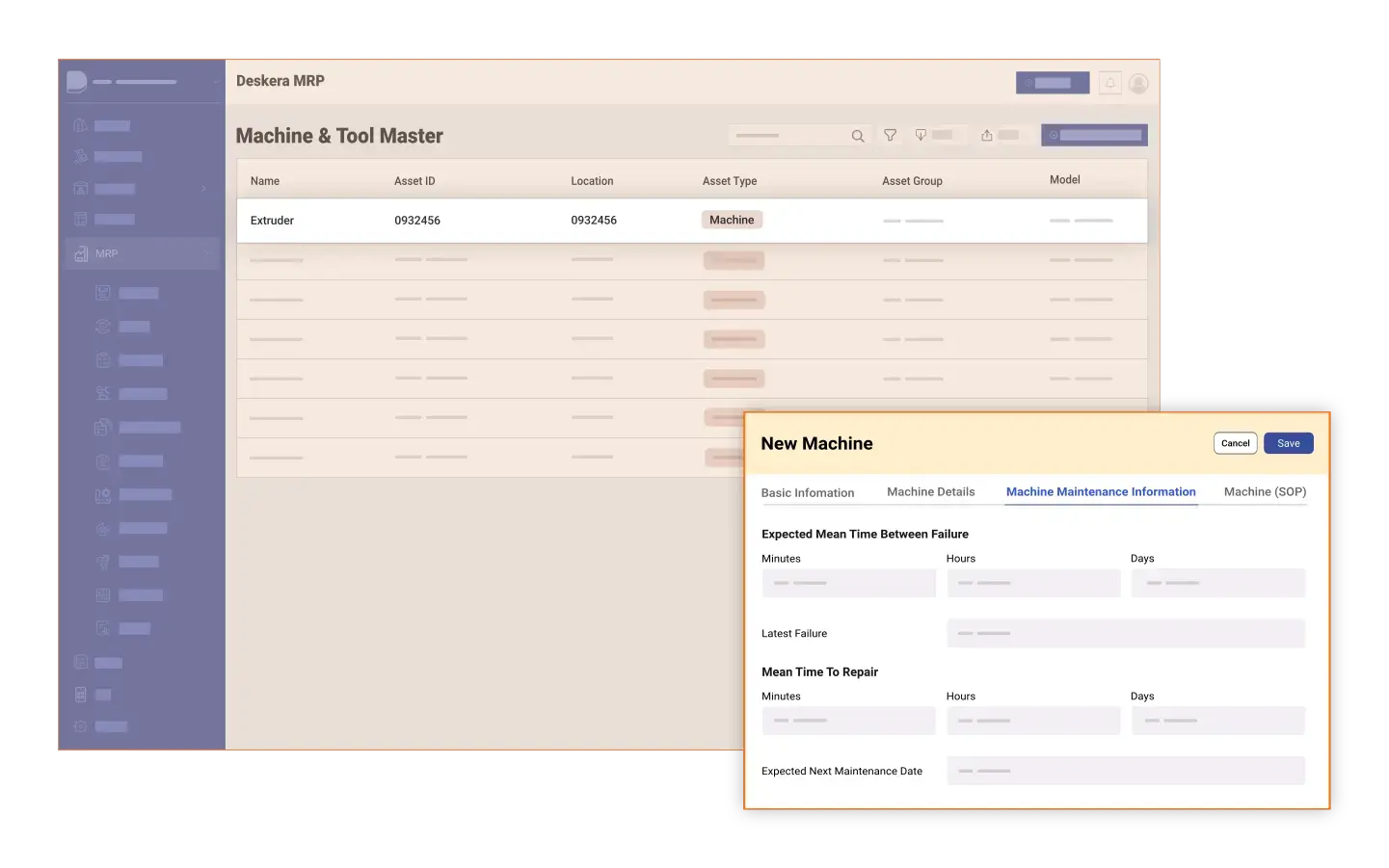
Effective machine maintenance requires more than just scheduling repairs—it demands visibility, coordination, and data-driven decision-making. Deskera MRP simplifies and strengthens maintenance management by integrating it with production, inventory, and overall business operations. This unified approach helps businesses move from reactive maintenance to a more proactive and efficient system.
Automated Preventive Maintenance Scheduling
Deskera MRP allows businesses to schedule routine maintenance tasks based on time, usage, or production cycles. This ensures that inspections, servicing, and part replacements are carried out on time, reducing the risk of unexpected breakdowns. Automated scheduling eliminates manual tracking and helps maintenance teams stay organized and consistent in their activities.
Real-Time Asset Monitoring and Tracking
With centralized data and real-time visibility, Deskera MRP enables businesses to monitor machine performance and maintenance history. This helps teams quickly identify patterns, detect recurring issues, and make informed decisions. Having access to accurate, up-to-date information improves response times and enhances overall equipment reliability.
Seamless Integration with Inventory Management
Maintenance activities often depend on the availability of spare parts and materials. Deskera MRP integrates maintenance with inventory management, ensuring that the required components are always available when needed. This reduces delays caused by stock shortages and helps avoid prolonged downtime due to missing parts.
Improved Work Order Management
Deskera MRP streamlines the creation, assignment, and tracking of maintenance work orders. Teams can easily manage tasks, monitor progress, and ensure accountability. This structured approach reduces confusion, improves coordination, and ensures that maintenance activities are completed efficiently and on schedule.
Data-Driven Insights and Reporting
The platform provides detailed reports and analytics on maintenance performance, equipment usage, and downtime. These insights help businesses evaluate the effectiveness of their maintenance strategies and identify areas for improvement. Over time, data-driven decision-making leads to optimized maintenance schedules and reduced operational costs.
Supports Predictive and Proactive Maintenance
By capturing and analyzing operational data, Deskera MRP lays the foundation for predictive maintenance. Businesses can move beyond fixed schedules and begin identifying potential issues before they escalate. This proactive approach minimizes unexpected failures and improves long-term asset performance.
Enhanced Coordination Across Departments
Maintenance does not operate in isolation, and Deskera MRP ensures seamless coordination between maintenance, production, and procurement teams. This alignment helps schedule maintenance during low-production periods, ensures timely procurement of spare parts, and reduces operational disruptions.
Scalability and Flexibility
As businesses grow, their maintenance needs become more complex. Deskera MRP offers scalable solutions that adapt to evolving requirements, allowing organizations to upgrade their maintenance strategies without overhauling their systems. This flexibility ensures long-term efficiency and sustainability.
By combining automation, real-time data, and seamless integration, Deskera MRP empowers businesses to take a smarter, more proactive approach to machine maintenance—reducing downtime, optimizing costs, and improving overall operational performance.
Key Takeaways
- Maintenance strategies provide a structured approach to reduce downtime, control costs, and improve overall asset performance.
- Choosing the right maintenance strategy directly impacts efficiency, reliability, and long-term business profitability.
- Different types of maintenance strategies serve different needs, and combining them creates a more effective and balanced approach.
- Selecting the right strategy depends on factors like business goals, budget, asset criticality, technology, and workforce capabilities.
- Applying expert tips such as using a hybrid approach and leveraging data helps optimize maintenance performance over time.
- Avoiding common mistakes like over-reliance on reactive maintenance or ignoring data ensures better operational outcomes.
- Deskera MRP enhances maintenance management through automation, real-time insights, and seamless integration with business processes.
Related Articles
 Niti Samani
 Niti Samani
 Niti Samani
 Niti Samani
 Niti Samani
 RVJ
RVJ