
Why do some companies excel at cutting costs while others win by responding instantly to market changes? The answer lies in their supply chain strategy. Businesses today operate in an environment where efficiency alone is not enough—nor is flexibility by itself. The real challenge is understanding whether a lean or agile supply chain approach best aligns with your operational goals and customer expectations.
A lean supply chain focuses on eliminating waste, optimizing processes, and reducing costs through streamlined operations. In contrast, an agile supply chain prioritizes responsiveness, adaptability, and speed to handle unpredictable demand and shifting market conditions. Both approaches offer distinct advantages, but choosing the wrong one can lead to inefficiencies, lost revenue, or missed opportunities.
In today’s fast-paced and often volatile business landscape, the decision between lean and agile is more critical than ever. Factors such as product type, demand variability, and customer expectations play a significant role in determining the right strategy. Many organizations are also exploring hybrid models to balance cost efficiency with responsiveness, creating a more resilient and competitive supply chain.
Modern ERP solutions like Deskera ERP play a crucial role in enabling both lean and agile supply chains. With features such as real-time inventory tracking, demand forecasting, production planning, and advanced analytics, Deskera helps businesses gain complete visibility and control over their operations. By leveraging such technology, companies can make data-driven decisions, improve efficiency, and seamlessly adapt their supply chain strategy to changing market demands.
What Is a Lean Supply Chain?
A lean supply chain is a strategy focused on maximizing efficiency by eliminating waste and optimizing every stage of operations. Rooted in the principles of the Toyota Production System, it emphasizes delivering maximum value to customers while using minimal resources. The goal is simple: remove anything that does not directly contribute to customer value and create a streamlined, cost-effective supply chain.
Key Characteristics of a Lean Supply Chain
- Waste elimination (Muda): Focuses on removing inefficiencies such as excess inventory, overproduction, waiting time, and unnecessary transportation
- Just-in-Time (JIT) production: Produces goods only when needed to reduce inventory holding costs and avoid overstocking
- Continuous improvement (Kaizen): Encourages ongoing evaluation and refinement of processes to enhance efficiency
- Standardization: Establishes consistent and repeatable processes to improve predictability and quality
- Demand stability focus: Works best in environments with predictable demand patterns
Benefits of a Lean Supply Chain
- Cost efficiency: Reduces operational expenses by minimizing waste and optimizing resource utilization
- Improved process efficiency: Streamlined workflows lead to faster and smoother operations
- Better quality control: Eliminating inefficiencies often results in fewer defects and higher product quality
- Optimized inventory levels: Prevents excess stock and reduces storage costs
- Enhanced profitability: Lower costs and efficient operations contribute to higher margins
Challenges of a Lean Supply Chain
- Limited flexibility: Not ideal for highly volatile or unpredictable markets
- Risk of stockouts: Minimal inventory can lead to shortages if demand suddenly spikes
- Dependence on accurate forecasting: Requires precise demand planning to function effectively
- Supply chain vulnerability: Disruptions (e.g., supplier delays) can significantly impact operations
Industries Best Suited for Lean Supply Chains
- Automotive manufacturing: High-volume production with predictable demand
- Consumer electronics: Standardized products with stable demand cycles
- FMCG (Fast-Moving Consumer Goods): Consistent demand and frequent replenishment needs
- Process manufacturing: Industries where efficiency and cost control are critical
Real-World Example of a Lean Supply Chain
- Toyota is a classic example of lean supply chain success
- Uses Just-in-Time production to minimize inventory and reduce waste
- Embraces continuous improvement (Kaizen) across operations
- Achieves high efficiency, lower costs, and strong quality control
- Scales production effectively while maintaining operational excellence
This structured approach makes lean supply chains highly efficient and cost-effective—especially in stable, predictable environments where minimizing waste is a top priority.
What Is an Agile Supply Chain?
An agile supply chain is a strategy designed to prioritize flexibility, speed, and responsiveness in an unpredictable business environment. Unlike lean supply chains that focus on efficiency and cost reduction, agile supply chains are built to quickly adapt to changing customer demands, market trends, and external disruptions. This approach is especially valuable for businesses dealing with high demand variability, short product life cycles, and rapidly evolving markets.
Key Characteristics of an Agile Supply Chain
- Rapid adaptability: Quickly adapts to demand fluctuations, supply disruptions, and market changes
- Data-driven decision-making: Uses live data and analytics to make informed, rapid decisions across the supply chain
- Reduced lead times: Reduces the time between order placement and fulfillment to improve responsiveness
- Distributed decision authority: Empowers teams at different levels to act quickly without waiting for centralized approvals
- Customer-centric approach: Aligns production and distribution closely with real-time customer demand
Benefits of an Agile Supply Chain
- High adaptability: Enables businesses to respond quickly to changing market conditions and customer preferences
- Improved customer satisfaction: Faster response times ensure timely delivery and better service levels
- Reduced risk in volatile markets: Helps mitigate the impact of sudden demand shifts or supply disruptions
- Better demand alignment: Produces based on actual demand, reducing mismatches between supply and market needs
- Competitive advantage: Allows companies to stay ahead in fast-moving industries
Challenges of an Agile Supply Chain
- Higher operational costs: Flexibility and speed often require additional resources and investments
- Complex coordination: Managing real-time data and decentralized decisions can increase operational complexity
- Dependence on technology: Requires advanced systems for data visibility and communication
- Supply chain instability risks: Frequent changes can sometimes lead to inefficiencies if not managed properly
Industries Best Suited for Agile Supply Chains
- Fashion and apparel: Rapidly changing trends and seasonal demand
- Consumer electronics: Short product life cycles and frequent innovation
- Technology and gadgets: High demand variability and customization needs
- E-commerce and retail: Dynamic customer preferences and fast fulfillment expectations
Real-World Examples of Agile Supply Chains
- H&M uses agile practices to respond quickly to changing fashion trends and customer preferences
- Nike leverages agility to offer customization and rapidly adjust to market demand
- Focus on short production cycles and real-time demand insights
- Ability to launch new products quickly and minimize excess inventory
Case Insight: Agile Supply Chain in Action
- H&M continuously updates designs based on real-time market trends
- Uses short-term forecasting and fast production cycles
- Quickly distributes new collections to stores
- Maintains alignment with customer demand while reducing overproduction
An agile supply chain enables businesses to stay resilient and competitive in fast-changing markets by focusing on speed, flexibility, and customer responsiveness.
Lean vs Agile Supply Chain: Key Differences
While both lean and agile supply chains aim to improve overall performance, they take fundamentally different paths to achieve it. Lean focuses on efficiency, cost reduction, and waste elimination—making it ideal for stable, predictable environments. Agile, on the other hand, emphasizes flexibility, speed, and responsiveness, thriving in dynamic markets where demand can shift rapidly. Understanding these differences is crucial for selecting the right strategy that aligns with your business model and market conditions.
This comparison highlights that lean and agile are not competing strategies but rather complementary approaches. Businesses must evaluate their demand patterns, cost priorities, and market volatility to determine which model—or combination of both—best suits their supply chain needs.
Choosing Between Lean and Agile Supply Chain Strategies
Selecting the right supply chain strategy depends on multiple factors, including your product type, demand patterns, market dynamics, and business priorities. While lean focuses on efficiency and cost control, agile emphasizes flexibility and responsiveness.
The right choice isn’t about which is better—it’s about which aligns best with your operational environment. In many cases, businesses may even adopt a hybrid (leagile) approach to balance both efficiency and adaptability.
Product Type: Standardized vs. Customizable
A lean supply chain is ideal when products are standardized, involve minimal variation, and follow long life cycles, allowing businesses to benefit from high-volume production and efficiency—common in industries like automotive and household goods.
In contrast, an agile supply chain is better suited for highly customizable or trend-driven products with short life cycles. Businesses in sectors like fashion and consumer electronics rely on agility to support innovation, frequent updates, and product variety.
Demand Patterns: Stable vs. Volatile
Lean supply chains perform best when demand is stable and predictable, enabling accurate forecasting and efficient resource planning while minimizing waste and cost.
On the other hand, agile supply chains are designed for environments where demand fluctuates frequently and customer preferences change rapidly. In such cases, real-time responsiveness becomes essential to align supply with evolving market needs and avoid missed opportunities.
Market Environment: Stable vs. Dynamic
In stable market environments with minimal disruptions, lean supply chains thrive due to their focus on cost efficiency and long-term planning. Businesses can optimize operations and maintain consistency.
However, in dynamic and fast-changing markets, agile supply chains offer a competitive advantage by enabling companies to respond quickly to disruptions, shifting trends, and evolving customer expectations, making speed-to-market a critical success factor.
Inventory and Lead Time Requirements
Lean supply chains prioritize low inventory levels and rely on Just-in-Time (JIT) systems, making them suitable when longer but predictable lead times are acceptable. This approach reduces holding costs but requires precision.
Agile supply chains, in contrast, emphasize faster delivery and shorter lead times, often maintaining buffer inventory to handle uncertainty. This ensures businesses can meet customer expectations for quick fulfillment and adapt to sudden demand changes.
Cost vs. Service Priorities
A lean supply chain is the right choice when cost leadership is the primary objective, with a strong focus on price competitiveness and operational efficiency to maintain margins. This approach works well when customers value affordability and consistent service over speed or customization.
Conversely, an agile supply chain is more suitable when customer experience, speed, and responsiveness are prioritized, and customers are willing to pay a premium for faster delivery, flexibility, and personalized offerings.
Supply Chain Complexity
Lean supply chains work best in simple, well-controlled environments with fewer suppliers, predictable processes, and limited variability. This allows businesses to streamline operations and reduce inefficiencies.
Agile supply chains, however, are better equipped to handle complex networks involving multiple suppliers, regions, and uncertainties. Their flexibility enables faster adjustments and better coordination across a more dynamic and interconnected supply chain.
Scalability and Flexibility Needs
For businesses with mature and stable operations, lean supply chains offer efficient scalability by optimizing processes and maintaining consistency.
However, when companies are growing rapidly or entering new markets, agile supply chains provide the flexibility needed to adapt to changing volumes, customer demands, and market conditions, ensuring smoother expansion and better responsiveness during periods of growth.
Risk Management Approach
Lean supply chains are suitable when risk levels are low and disruptions are rare, as they prioritize efficiency over redundancy. However, this can make them vulnerable when unexpected issues arise.
Agile supply chains, in contrast, are designed for resilience, making them ideal for environments with higher exposure to risks such as supply disruptions or market volatility, as they enable quicker recovery and adaptation.
Technology and Data Capabilities
Lean supply chains can operate effectively with basic systems that support stable and predictable operations, focusing primarily on process optimization. Agile supply chains, on the other hand, rely heavily on real-time data visibility and advanced technologies such as ERP systems, AI, and analytics. These tools enable faster, data-driven decisions and are critical for maintaining responsiveness and adaptability in dynamic environments.
Company Culture and Organizational Mindset
Lean supply chains align with organizations that emphasize efficiency, discipline, and cost control, often embedding continuous improvement practices like Kaizen into their operations.
Agile supply chains, in contrast, thrive in organizations that value innovation, speed, and adaptability. These companies empower teams to make quick decisions, encourage experimentation, and foster a culture that supports rapid change and responsiveness.
Hybrid Approach: The Leagile Model
For many businesses, a hybrid or leagile approach offers the best of both worlds by combining lean efficiency with agile responsiveness. This model applies lean principles to predictable operations while leveraging agile strategies for high-variability products or markets. It helps organizations balance cost control with flexibility and is particularly effective for businesses managing diverse product portfolios with varying demand patterns.
By evaluating these factors holistically, businesses can make informed decisions about whether a lean, agile, or hybrid supply chain strategy will best align with their operational goals, market conditions, and long-term growth objectives.
What Are Hybrid Supply Chain Models?
In today’s dynamic business environment, many organizations find that relying solely on lean or agile strategies is not enough. Hybrid supply chain models combine the cost efficiency of lean with the responsiveness of agile, enabling businesses to optimize performance across different products, markets, and demand conditions. By applying the right approach to the right part of the supply chain, companies can build systems that are both resilient and efficient.
Types of Hybrid Supply Chain Models
Leagile (Lean + Agile) Model
- Combines lean efficiency for stable, high-volume products with agile responsiveness for variable or customized items
- Often uses a postponement strategy, where products are produced to a base level and finalized after receiving actual demand
- Helps balance cost control with flexibility
- Ideal for businesses managing both predictable and unpredictable demand streams
Push-Pull Hybrid Model
- Integrates forecast-driven (push) production with demand-driven (pull) fulfillment
- Upstream processes (like manufacturing components) follow lean principles for efficiency
- Downstream processes (like final assembly or distribution) respond to real-time customer demand
- Reduces excess inventory while maintaining responsiveness
- Common in industries with modular production systems
Digital-Physical Hybrid Model
- Combines physical supply chain operations with digital technologies such as AI, IoT, and advanced analytics
- Enables real-time visibility, predictive demand sensing, and smarter inventory management
- Enhances both lean efficiency and agile responsiveness through data-driven insights
- Supports faster decision-making and improved coordination across the supply chain
Segmented (Custom-Configured) Supply Chain Model
- Divides the supply chain based on product types, customer segments, or demand patterns
- Applies lean strategies to high-volume, predictable products
- Uses agile approaches for high-value, customized, or volatile-demand items
- Allows businesses to tailor operations instead of using a one-size-fits-all model
- Improves overall efficiency and customer satisfaction
Insourced-Outsourced (Hybrid Sourcing) Model
- Combines in-house operations with third-party logistics (3PL) providers
- Core or strategic activities are managed internally for better control
- External partners handle overflow capacity, seasonal demand, or specialized services
- Provides flexibility, scalability, and cost optimization
- Useful for businesses with fluctuating demand or expanding distribution networks
Key Benefits of Hybrid Supply Chain Models
- Balanced performance: Combines efficiency with flexibility for better overall outcomes
- Improved risk management: Agile elements help respond to disruptions quickly
- Scalability: Easily adapts to growth, new markets, or changing demand patterns
- Optimized resource utilization: Applies the right strategy where it delivers the most value
Challenges of Hybrid Supply Chain Models
- Increased complexity: Managing multiple strategies within one system requires careful coordination
- Strategic alignment: Requires clear segmentation of products and processes
- Technology dependency: Needs strong digital infrastructure for visibility and control
- Cross-functional collaboration: Demands alignment across procurement, production, and logistics teams
How to Implement a Hybrid Supply Chain
- Segment your supply chain: Classify products based on demand predictability and variability
- Leverage technology: Use ERP and analytics tools for real-time visibility and planning
- Align teams and processes: Ensure seamless coordination across all supply chain functions
- Continuously optimize: Regularly evaluate performance and adjust strategies as needed
Hybrid supply chain models offer a practical way for businesses to navigate uncertainty while maintaining efficiency. By blending lean and agile principles, organizations can build more resilient, responsive, and future-ready supply chains.
How Deskera ERP Supports Lean and Agile Supply Chains
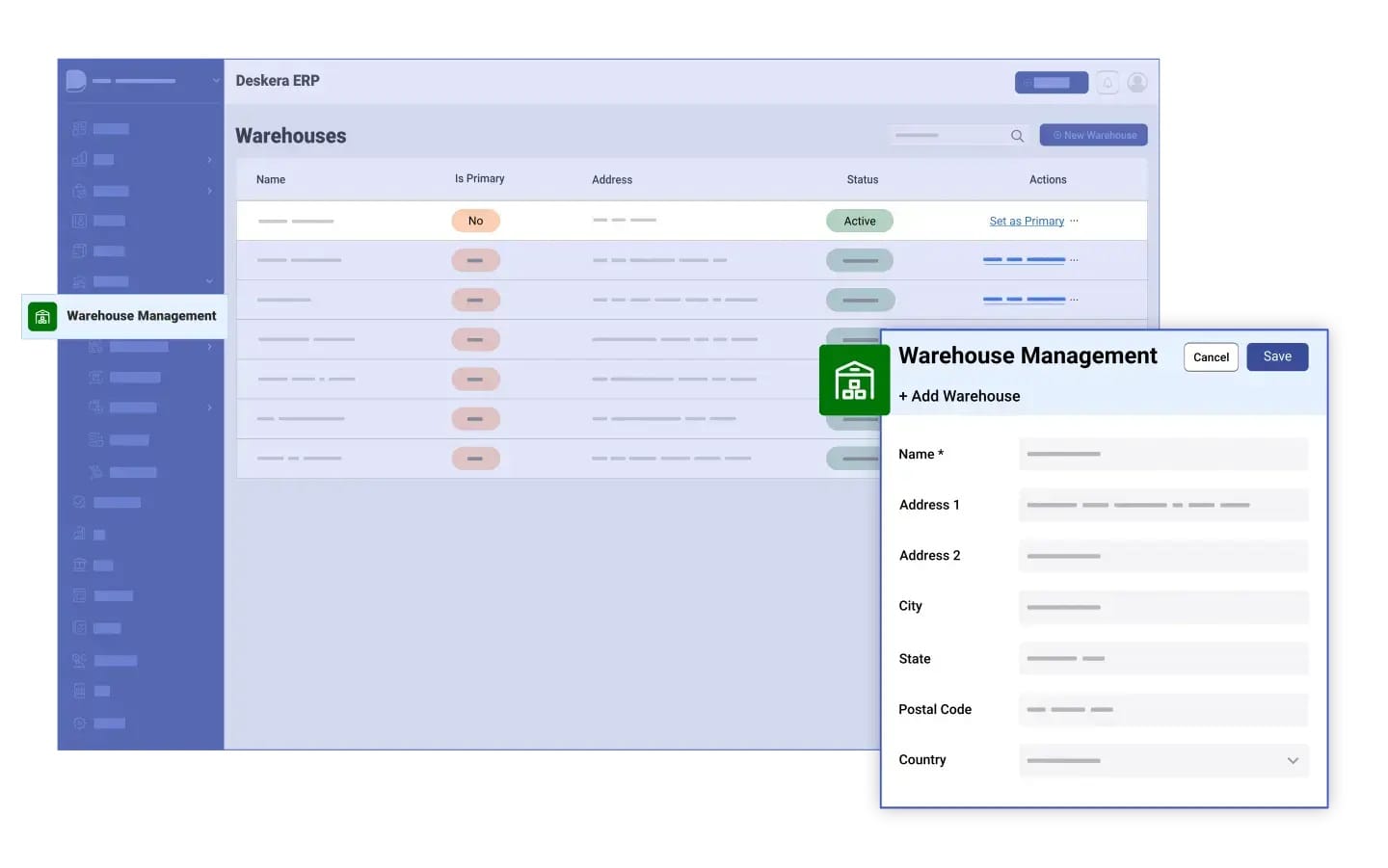
Modern supply chains require a careful balance between efficiency and flexibility—and this is where Deskera ERP plays a critical role. By integrating data, automating workflows, and providing real-time visibility, Deskera enables businesses to implement both lean and agile strategies effectively. Whether your goal is to reduce waste or respond quickly to market changes, the platform provides the tools needed to support both approaches within a unified system.
Real-Time Visibility Across the Supply Chain
- Provides a centralized view of inventory, procurement, production, and order fulfillment
- Enables faster response to demand fluctuations and supply disruptions
- Helps agile supply chains react quickly while supporting lean efficiency through transparency
- Eliminates data silos by connecting all supply chain functions in one platform
Smarter Demand Forecasting and Planning
- Uses historical data and analytics to improve demand forecasting accuracy
- Helps maintain optimal inventory levels—supporting lean (low waste) and agile (quick response) goals
- Enables proactive production and procurement planning
- Reduces risks of stockouts and overstocking
Efficient Inventory and Warehouse Management
- Tracks inventory levels and movements in real time across multiple locations
- Automates reorder points and stock replenishment
- Supports Just-in-Time (JIT) practices for lean supply chains
- Maintains buffer inventory where needed for agile responsiveness
Integrated MRP and Production Planning
- Aligns material availability with production schedules
- Ensures the right materials are available at the right time
- Minimizes production delays and excess inventory
- Allows quick adjustments to production plans for agile operations
Streamlined Procurement and Supplier Management
- Centralizes supplier data, purchase orders, and procurement workflows
- Improves vendor coordination and lead-time tracking
- Reduces procurement delays and operational inefficiencies
- Supports both cost optimization (lean) and supply continuity (agile)
Automation and Workflow Optimization
- Automates routine tasks such as order processing, invoicing, and approvals
- Reduces manual errors and operational bottlenecks
- Improves efficiency across procurement, production, and logistics
- Enables faster execution and adaptability in dynamic environments
Data-Driven Decision Making with Analytics
- Provides real-time dashboards and customizable reports
- Tracks key supply chain metrics like inventory turnover and order fulfillment
- Helps identify inefficiencies and improvement opportunities
- Enables continuous improvement (lean) and rapid decision-making (agile)
Cloud-Based Accessibility and Scalability
- Offers anytime, anywhere access to supply chain data
- Supports remote collaboration and faster decision-making
- Scales easily as business operations grow or become more complex
- Enables businesses to adapt quickly to new markets and changing demand
End-to-End Integration Across the Supply Chain
- Connects procurement, production, inventory, logistics, and finance in one system
- Ensures seamless flow of materials, information, and finances
- Improves coordination across suppliers, manufacturers, and distributors
- Enhances both efficiency (lean) and responsiveness (agile)
By combining automation, real-time visibility, and advanced analytics, Deskera ERP empowers businesses to build supply chains that are both cost-efficient and highly responsive. This makes it an ideal solution for organizations looking to implement lean, agile, or hybrid supply chain strategies with confidence.
Key Takeaways
- Lean supply chains focus on efficiency, waste reduction, and cost optimization, making them ideal for stable and predictable environments
- Agile supply chains prioritize flexibility, speed, and responsiveness, enabling businesses to adapt quickly to changing market demands
- The key differences between lean and agile lie in their approach to cost, inventory, responsiveness, and risk management
- Choosing the right strategy depends on factors such as product type, demand variability, market conditions, and business priorities
- Product characteristics play a crucial role—standardized products align with lean, while customizable products require agile approaches
- Demand patterns determine strategy fit, with lean suited for predictable demand and agile for volatile demand
- Market conditions influence the choice, as stable markets favor lean while dynamic environments require agile responsiveness
- Inventory and lead time requirements differ, with lean minimizing stock and agile maintaining flexibility for faster fulfillment
- Cost vs. service priorities help guide decisions, where lean supports cost leadership and agile enhances customer experience
- Supply chain complexity impacts strategy, with lean fitting simpler systems and agile better handling complex, multi-tier networks
- Scalability needs vary, as lean supports efficient growth while agile enables flexible expansion into new markets
- Risk management approaches differ, with lean being more vulnerable to disruptions and agile offering greater resilience
- Technology and data capabilities are critical, especially for agile supply chains that rely on real-time insights and advanced systems
- Organizational culture influences success, with lean favoring structured efficiency and agile requiring adaptability and innovation
- Hybrid supply chain models combine the strengths of lean and agile to balance efficiency with flexibility
- Different types of hybrid models, such as leagile, push-pull, and segmented approaches, allow businesses to tailor strategies to specific needs
- Hybrid supply chains offer benefits like cost efficiency, adaptability, scalability, and improved risk management
- Implementing hybrid models requires proper segmentation, strong technology integration, and cross-functional collaboration
- Deskera ERP supports both lean and agile supply chains by providing real-time visibility, automation, and data-driven decision-making
Related Articles
 Niti Samani
 Rhema Hans
 Niti Samani
 Niti Samani
 Niti Samani
 Niti Samani