


What causes businesses to miss delivery deadlines, struggle with production delays, and lose customer trust? In many cases, the answer lies in poor lead time management. When companies lack visibility into procurement, inventory, production, and order fulfillment processes, even small disruptions can create major operational bottlenecks. Effective lead time management has become essential for businesses looking to improve efficiency, reduce costs, and meet growing customer expectations.
Lead time management refers to the process of monitoring and reducing the time required to complete business operations such as sourcing raw materials, manufacturing products, and delivering orders to customers. Shorter and more predictable lead times help businesses maintain optimal inventory levels, improve production planning, minimize delays, and increase customer satisfaction. However, managing lead times manually becomes increasingly difficult as supply chains grow more complex and business operations expand across multiple departments and locations.
This is where ERP systems play a critical role. Enterprise Resource Planning (ERP) systems integrate core business functions such as inventory management, procurement, production planning, warehouse operations, sales, and finance into a single centralized platform. By providing real-time visibility, automation, and data-driven insights, ERP systems help businesses identify bottlenecks, streamline workflows, improve forecasting accuracy, and optimize supply chain coordination. As a result, organizations can significantly reduce operational delays and improve overall business agility.
Deskera ERP is a comprehensive business management solution designed to help companies improve operational efficiency and lead time management. It offers features such as real-time inventory tracking, automated procurement workflows, production planning, demand forecasting, warehouse management, and advanced analytics. With its AI-powered insights, mobile accessibility, and integrated business modules, Deskera ERP enables businesses to streamline end-to-end operations, improve supply chain visibility, and accelerate order fulfillment processes.
What Is Lead Time Management?
Lead time management is the process of planning, monitoring, and optimizing the time it takes to complete a business operation from start to finish. In supply chain and manufacturing environments, lead time refers to the total time required to procure raw materials, manufacture products, process orders, and deliver finished goods to customers. Effective lead time management helps businesses reduce delays, improve operational efficiency, maintain optimal inventory levels, and ensure timely deliveries.
Businesses across industries rely on efficient lead time management to maintain smooth workflows and meet customer expectations. When lead times are too long or unpredictable, companies may experience production bottlenecks, inventory shortages, delayed shipments, increased operational costs, and dissatisfied customers. On the other hand, shorter and more accurate lead times improve productivity, strengthen supply chain performance, and enhance overall business profitability.
Lead time management involves analyzing every stage of the operational process to identify inefficiencies and reduce unnecessary delays. This includes supplier coordination, procurement planning, inventory management, production scheduling, warehouse operations, transportation, and order fulfillment. By continuously monitoring these activities, businesses can improve resource utilization, streamline workflows, and respond more effectively to market demand fluctuations.
Modern businesses increasingly use ERP systems and supply chain technologies to improve lead time management. These systems provide real-time visibility into inventory, procurement, production, and logistics operations, enabling organizations to make faster and more informed decisions. With automation, analytics, and predictive forecasting capabilities, ERP solutions help businesses minimize disruptions, optimize supply chain coordination, and achieve faster order fulfillment cycles.
Common Challenges in Lead Time Management
Managing lead times effectively is a major challenge for businesses operating in fast-moving and highly competitive markets. Supply chain disruptions, inaccurate forecasting, poor coordination between departments, and inefficient operational processes can all increase lead times and reduce business efficiency.
Without proper visibility and planning, organizations may struggle to fulfill orders on time, maintain optimal inventory levels, and meet customer expectations. Understanding these challenges is the first step toward improving operational performance and building a more responsive supply chain.
Lack of Real-Time Visibility
One of the biggest challenges in lead time management is the lack of real-time visibility across business operations.
Many companies still rely on disconnected systems, spreadsheets, or manual reporting methods that make it difficult to track inventory levels, supplier deliveries, production progress, and order status accurately.
Without centralized and up-to-date information, businesses often face delays in identifying bottlenecks, responding to disruptions, and making informed operational decisions, resulting in longer and less predictable lead times.
Inaccurate Demand Forecasting
Poor demand forecasting can significantly affect lead time management by creating imbalances in inventory and production planning.
When businesses fail to predict customer demand accurately, they may either overstock inventory or experience stock shortages that disrupt production schedules and order fulfillment.
Inaccurate forecasts also make it difficult to allocate resources efficiently, coordinate procurement activities, and maintain smooth supply chain operations, ultimately increasing operational delays and costs.
Poor Supplier Coordination
Supplier-related issues are another common factor contributing to long lead times. Inefficient communication with suppliers, delayed raw material deliveries, inconsistent supplier performance, and limited visibility into vendor operations can create major procurement bottlenecks.
Businesses that lack strong supplier coordination often struggle to maintain production schedules and fulfill customer orders on time. Managing multiple suppliers across different regions further increases complexity and makes lead time optimization more challenging.
Manual Processes and Human Errors
Many organizations still use manual processes for inventory tracking, procurement management, production scheduling, and order processing. These manual workflows increase the likelihood of data entry errors, duplicated information, approval delays, and communication gaps between departments.
Human errors in forecasting, inventory updates, or order management can disrupt operational workflows and create unnecessary delays throughout the supply chain. As businesses grow, manual systems become increasingly inefficient and difficult to manage effectively.
Inefficient Inventory Management
Poor inventory management practices can directly impact lead times and overall supply chain efficiency. Excess inventory ties up working capital and increases storage costs, while insufficient inventory can lead to stockouts and production interruptions.
Businesses that lack accurate inventory visibility may struggle to maintain the right balance between supply and demand. Slow-moving inventory, inaccurate stock records, and delayed replenishment processes further contribute to operational inefficiencies and longer fulfillment cycles.
Production and Scheduling Delays
Production bottlenecks and inefficient scheduling are major obstacles to effective lead time management, especially in manufacturing industries. Machine downtime, labor shortages, poor production planning, and inefficient workflow coordination can delay manufacturing activities and disrupt delivery timelines.
In many cases, businesses struggle to allocate resources effectively or respond quickly to changing demand conditions. These production inefficiencies not only increase lead times but also reduce overall operational productivity and customer satisfaction.
The Role of ERP Systems in Effective Lead Time Management
ERP systems play a critical role in helping businesses manage and reduce lead times by integrating core business operations into a centralized platform.
From procurement and inventory management to production planning and order fulfillment, ERP software provides real-time visibility, automation, and data-driven insights that improve operational efficiency across the entire supply chain.
By streamlining workflows and improving coordination between departments, ERP systems enable businesses to respond faster to changing market demands and minimize operational delays.
Centralized Data and Real-Time Visibility
ERP systems eliminate data silos by consolidating information from multiple departments into a single platform. This centralized visibility allows businesses to track inventory levels, supplier deliveries, production progress, and customer orders in real time.
With instant access to accurate operational data, managers can quickly identify bottlenecks, respond to disruptions, and make informed decisions that improve workflow efficiency and reduce lead times across procurement, manufacturing, and distribution processes.
Improved Demand Forecasting and Planning
Accurate demand forecasting is essential for reducing lead times and maintaining smooth business operations. ERP systems use historical sales data, market trends, and inventory information to help businesses forecast demand more accurately.
Advanced ERP solutions also incorporate AI-driven analytics and predictive planning tools that improve inventory replenishment and production scheduling. Better forecasting reduces the risk of stockouts, overproduction, and last-minute procurement delays, enabling businesses to maintain consistent operational flow.
Streamlined Procurement Processes
ERP systems simplify and automate procurement activities, helping businesses reduce delays in sourcing raw materials and supplies. Automated purchase order generation, supplier management tools, and real-time procurement tracking improve communication between businesses and vendors.
ERP software also helps organizations monitor supplier performance, track delivery schedules, and maintain accurate procurement records. These capabilities reduce procurement cycle times, improve supplier coordination, and ensure timely availability of materials for production operations.
Enhanced Inventory Management
Effective inventory management is one of the most important factors in lead time reduction, and ERP systems provide businesses with complete visibility into inventory operations.
Real-time stock tracking, automated reorder points, barcode integration, and warehouse management capabilities help businesses maintain optimal inventory levels.
ERP systems minimize stock shortages, prevent overstocking, and improve inventory accuracy, allowing organizations to fulfill orders faster and avoid production interruptions caused by material shortages.
Better Production Scheduling
ERP systems improve production efficiency by helping businesses optimize production schedules, resource allocation, and manufacturing workflows. With access to real-time production data, manufacturers can monitor machine utilization, track work orders, and identify production bottlenecks before they escalate into delays. ERP software also supports capacity planning and labor scheduling, ensuring that resources are used efficiently and production timelines are maintained, ultimately reducing manufacturing lead times.
Faster Order Processing and Fulfillment
ERP systems accelerate order processing by automating sales order management, invoicing, inventory allocation, and shipping workflows. When customer orders are integrated directly with inventory and warehouse systems, businesses can process and fulfill orders more quickly and accurately.
Real-time coordination between departments helps reduce delays caused by manual approvals, incorrect inventory information, or communication gaps, improving order fulfillment speed and enhancing customer satisfaction.
Improved Supply Chain Coordination
Managing complex supply chains requires seamless coordination between suppliers, manufacturers, warehouses, distributors, and logistics providers. ERP systems improve collaboration by providing a unified platform where all stakeholders can access relevant operational information.
Businesses can track shipments, monitor supplier activities, manage warehouse operations, and respond to supply chain disruptions more effectively. Improved coordination reduces delays, enhances operational agility, and supports faster end-to-end supply chain performance.
Automation of Manual Processes
Manual business processes often create inefficiencies, delays, and human errors that increase lead times. ERP systems automate repetitive tasks such as inventory updates, purchase order approvals, production scheduling, invoice processing, and reporting.
Automation reduces paperwork, speeds up workflows, and improves data accuracy across business operations. By minimizing manual intervention, ERP systems help organizations improve operational consistency and reduce delays caused by administrative inefficiencies.
Real-Time Analytics and Performance Monitoring
ERP systems provide advanced reporting and analytics tools that help businesses monitor lead time performance continuously. Real-time dashboards and KPI tracking allow managers to analyze supplier lead times, production cycle times, order fulfillment rates, and inventory turnover.
These insights help businesses identify inefficiencies, predict potential disruptions, and implement proactive improvements. Data-driven decision-making enables organizations to optimize operations continuously and maintain faster, more reliable lead time performance.
Benefits of Using ERP Systems for Lead Time Management
ERP systems provide businesses with the tools and visibility needed to optimize lead time management across procurement, production, inventory, and order fulfillment operations.
By integrating business functions into a centralized platform, ERP software helps organizations improve coordination, automate workflows, reduce delays, and make faster data-driven decisions.
Effective ERP implementation not only shortens lead times but also improves operational efficiency, customer satisfaction, and overall business performance.
Reduced Operational Delays
ERP systems help businesses identify and eliminate bottlenecks that slow down operational processes. With real-time visibility into procurement, inventory, production, and logistics activities, organizations can quickly detect disruptions and take corrective action before delays escalate.
Automated workflows and streamlined communication between departments further reduce waiting times and manual dependencies, enabling businesses to maintain smoother operations and achieve faster order fulfillment cycles.
Lower Inventory Carrying Costs
Effective lead time management supported by ERP systems helps businesses maintain optimal inventory levels and reduce unnecessary inventory holding costs.
Real-time inventory tracking and demand forecasting capabilities minimize the risk of overstocking or stock shortages.
Businesses can automate replenishment processes and improve stock accuracy, ensuring that inventory is available when needed without tying up excessive working capital in surplus inventory storage.
Improved Customer Satisfaction
Faster and more reliable lead times directly improve customer satisfaction by ensuring timely deliveries and accurate order fulfillment. ERP systems provide businesses with better visibility into order status, inventory availability, and shipping schedules, allowing them to communicate more effectively with customers. By reducing delays and improving service reliability, businesses can strengthen customer trust, increase retention rates, and build long-term customer relationships.
Better Supplier Relationships
ERP systems improve supplier management by enabling businesses to track supplier performance, monitor delivery timelines, and maintain accurate procurement records.
Real-time communication and automated procurement workflows help businesses collaborate more efficiently with vendors and reduce delays caused by manual coordination.
Stronger supplier relationships lead to improved reliability, faster material availability, and more stable supply chain operations, all of which contribute to shorter lead times.
Increased Productivity and Efficiency
By automating repetitive tasks and integrating business operations, ERP systems significantly improve workforce productivity and operational efficiency.
Employees spend less time on manual data entry, paperwork, and repetitive administrative processes, allowing them to focus on higher-value activities.
Streamlined workflows, centralized data access, and automated approvals help businesses complete operational tasks more quickly and accurately, reducing lead times across multiple business functions.
Faster Decision-Making
ERP systems provide real-time data and advanced analytics that support faster and more informed decision-making.
Managers can access live dashboards, performance reports, and operational insights related to inventory, production, procurement, and order fulfillment.
This visibility allows businesses to respond quickly to disruptions, adjust production schedules, optimize resource allocation, and make proactive decisions that improve lead time performance and operational agility.
Higher On-Time Delivery Rates
Maintaining high on-time delivery performance is critical for customer satisfaction and business competitiveness. ERP systems improve order accuracy, production planning, and logistics coordination, helping businesses meet delivery commitments consistently.
Automated order processing and real-time shipment tracking reduce the risk of missed deadlines and shipping errors. As a result, businesses can improve delivery reliability and strengthen their reputation for operational excellence.
Greater Supply Chain Agility
Modern supply chains face constant disruptions caused by changing customer demands, supplier delays, market fluctuations, and global uncertainties.
ERP systems improve supply chain agility by providing end-to-end visibility and enabling businesses to respond quickly to unexpected changes.
Real-time insights, predictive analytics, and automated workflows allow organizations to adapt operations efficiently, minimize disruptions, and maintain consistent lead time performance even in dynamic business environments.
Improved Business Scalability
As businesses grow, managing operations manually becomes increasingly complex and inefficient. ERP systems provide scalable infrastructure that supports business expansion without significantly increasing operational complexity.
Integrated workflows, centralized data management, and automation capabilities allow businesses to handle larger transaction volumes, additional suppliers, expanding inventories, and growing customer demands more efficiently.
This scalability ensures that businesses can continue optimizing lead times while supporting long-term growth objectives.
Industries That Benefit Most from ERP-Based Lead Time Management
Lead time management is critical for industries that depend on efficient supply chains, accurate inventory control, timely production schedules, and fast order fulfillment. ERP systems help organizations across various sectors improve operational visibility, automate workflows, and reduce delays throughout their business processes.
Industries with complex procurement, manufacturing, warehousing, and distribution operations benefit significantly from ERP-driven lead time optimization, enabling them to improve efficiency, reduce costs, and enhance customer satisfaction.
Manufacturing
Manufacturing companies rely heavily on efficient lead time management to maintain smooth production operations and meet customer delivery expectations. ERP systems help manufacturers optimize production scheduling, manage raw material procurement, monitor machine utilization, and track work orders in real time.
By improving coordination between inventory, procurement, and production departments, ERP software reduces production delays, minimizes downtime, and ensures faster completion of manufacturing cycles.
Retail and E-commerce
Retail and e-commerce businesses operate in highly competitive markets where customers expect fast and accurate deliveries. ERP systems help these businesses manage inventory levels, forecast customer demand, automate order processing, and streamline warehouse operations.
Real-time inventory visibility and automated replenishment processes reduce stockouts and fulfillment delays, allowing retailers to improve delivery speed, maintain product availability, and enhance the overall customer shopping experience.
Distribution and Logistics
Distribution and logistics companies handle large volumes of inventory movement, transportation coordination, and order fulfillment activities, making lead time management essential for operational success. ERP systems improve shipment tracking, warehouse management, route planning, and supplier coordination.
With real-time visibility into supply chain operations, logistics providers can reduce transportation delays, optimize delivery schedules, improve inventory flow, and ensure timely product distribution across multiple locations.
Food and Beverage
The food and beverage industry requires strict control over inventory freshness, production timelines, and supply chain efficiency. Delays in procurement, manufacturing, or delivery can lead to product spoilage, compliance risks, and revenue losses.
ERP systems help businesses manage inventory expiration dates, production schedules, procurement workflows, and demand forecasting. Improved operational coordination enables food and beverage companies to reduce waste, maintain product quality, and ensure timely product delivery.
Automotive
Automotive companies manage highly complex supply chains involving thousands of components, suppliers, and production processes. Any delay in material availability or production scheduling can disrupt manufacturing operations and increase costs significantly.
ERP systems help automotive manufacturers improve supplier coordination, monitor inventory availability, optimize production planning, and manage just-in-time manufacturing processes. These capabilities reduce production bottlenecks and improve overall supply chain efficiency.
Pharmaceuticals
Pharmaceutical companies must manage strict regulatory requirements, sensitive inventory, and precise production schedules while ensuring timely product availability.
ERP systems help pharmaceutical businesses maintain accurate inventory records, monitor batch tracking, automate procurement processes, and improve production planning.
Real-time visibility into supply chain operations helps reduce delays, improve compliance management, and ensure efficient distribution of critical healthcare products and medications.
Electronics and High-Tech Manufacturing
Electronics and high-tech manufacturers often face challenges related to rapid product changes, fluctuating customer demand, and complex global supply chains. ERP systems help these businesses manage component procurement, production workflows, inventory planning, and supplier relationships more effectively.
Improved forecasting accuracy, automated inventory management, and real-time operational insights enable electronics manufacturers to reduce lead times, respond quickly to market changes, and maintain competitive advantage.
Best Practices for Improving Lead Time Management with ERP
Implementing an ERP system alone is not enough to optimize lead time management effectively. Businesses must also follow structured operational strategies and best practices to maximize the benefits of ERP-driven automation, visibility, and analytics.
By combining standardized workflows, accurate data management, supplier collaboration, and continuous performance monitoring, organizations can significantly reduce delays, improve supply chain efficiency, and maintain consistent operational performance.
Standardize Business Processes
Standardized workflows help businesses reduce inconsistencies and improve operational efficiency across departments. ERP systems work most effectively when procurement, inventory management, production planning, and order fulfillment processes follow clearly defined procedures.
Standardization minimizes communication gaps, reduces process variations, and ensures that operational activities are completed more efficiently. Consistent workflows also make it easier for businesses to identify bottlenecks and implement process improvements that support faster lead times.
Maintain Accurate Inventory Data
Accurate inventory data is essential for effective lead time management and smooth supply chain operations. Businesses should regularly update inventory records, monitor stock movements, and eliminate discrepancies between physical inventory and system data.
ERP systems provide real-time inventory visibility, but maintaining data accuracy requires disciplined inventory practices such as cycle counting, barcode scanning, and automated stock tracking. Accurate inventory information helps businesses avoid stock shortages, overstocking, and procurement delays.
Monitor Supplier Performance Regularly
Supplier performance directly affects procurement lead times and overall supply chain reliability. Businesses should use ERP systems to track supplier delivery timelines, order accuracy, product quality, and responsiveness consistently.
Monitoring supplier performance helps organizations identify unreliable vendors, improve supplier communication, and build stronger procurement relationships.
Businesses can also use supplier performance insights to negotiate better contracts, reduce material delays, and maintain uninterrupted production schedules.
Use Predictive Analytics for Demand Planning
Predictive analytics helps businesses forecast customer demand more accurately and improve operational planning.
ERP systems equipped with analytics and AI capabilities can analyze historical sales patterns, seasonal trends, and market fluctuations to generate more reliable demand forecasts.
Accurate forecasting enables businesses to optimize inventory levels, schedule production efficiently, and reduce the risk of stockouts or excess inventory. Better demand planning ultimately supports shorter and more predictable lead times.
Automate Routine Workflows
Manual processes often slow down operations and increase the likelihood of errors that disrupt lead time performance. Businesses should use ERP systems to automate repetitive workflows such as purchase order creation, inventory replenishment, production scheduling, invoice approvals, and reporting.
Automation improves operational speed, reduces paperwork, and minimizes administrative bottlenecks. By reducing manual intervention, businesses can improve process consistency and accelerate overall supply chain operations.
Continuously Track KPIs and Bottlenecks
Continuous monitoring of operational performance is critical for improving lead time management over time.
Businesses should use ERP dashboards and reporting tools to track key performance indicators such as order lead time, supplier lead time, inventory turnover, production cycle time, and on-time delivery rates.
Regular performance analysis helps organizations identify operational inefficiencies, detect emerging bottlenecks, and make proactive adjustments that improve supply chain efficiency and lead time reliability.
Train Employees on ERP Usage
Even the most advanced ERP system cannot deliver maximum value without proper user adoption and training. Businesses should ensure that employees understand how to use ERP tools effectively for inventory management, procurement, production planning, and reporting activities.
Proper training improves data accuracy, reduces operational errors, and ensures consistent use of ERP functionalities across departments. Well-trained employees can also identify process improvement opportunities that contribute to faster and more efficient operations.
Integrate ERP with Supply Chain Operations
ERP systems deliver greater value when fully integrated with broader supply chain operations, including suppliers, warehouses, logistics providers, and distribution channels. Integration improves data sharing, enhances communication, and provides end-to-end visibility across the supply chain.
Businesses can monitor shipments, track inventory movements, coordinate procurement activities, and respond to disruptions more effectively. Strong supply chain integration supports faster decision-making, minimizes delays, and improves overall lead time management performance.
Key Metrics to Track for Lead Time Management
Tracking the right performance metrics is essential for improving lead time management and maintaining efficient business operations.
Key performance indicators (KPIs) help businesses measure operational efficiency, identify bottlenecks, monitor supplier and production performance, and make data-driven decisions.
ERP systems simplify KPI tracking by providing real-time dashboards, automated reporting, and centralized operational visibility. By continuously monitoring these metrics, businesses can reduce delays, improve supply chain coordination, and enhance overall operational performance.
Order Lead Time
Order lead time measures the total time taken from receiving a customer order to delivering the finished product to the customer. This metric helps businesses evaluate the efficiency of their order processing, production, inventory management, and shipping operations.
A shorter order lead time indicates streamlined workflows and better operational coordination, while longer lead times may signal bottlenecks in procurement, production scheduling, or logistics processes.
Formula: Order Lead Time = Order Delivery Date − Order Placement Date
Supplier Lead Time
Supplier lead time measures the amount of time suppliers take to deliver raw materials or products after a purchase order is placed. This metric is critical for procurement planning and inventory management because supplier delays can disrupt production schedules and order fulfillment timelines.
Monitoring supplier lead time helps businesses identify reliable vendors, improve supplier coordination, and reduce procurement-related operational disruptions.
Formula: Supplier Lead Time = Delivery Date − Purchase Order Date
Production Cycle Time
Production cycle time measures the total time required to manufacture a product from the beginning of production to completion. This metric helps businesses evaluate manufacturing efficiency, machine utilization, workflow coordination, and labor productivity.
Longer production cycle times often indicate production bottlenecks, inefficient scheduling, or equipment downtime. Reducing production cycle time helps businesses improve output capacity and accelerate order fulfillment.
Formula: Production Cycle Time = Production Completion Time − Production Start Time
Inventory Turnover Ratio
Inventory turnover ratio measures how efficiently a business sells and replenishes inventory over a specific period. A higher inventory turnover ratio indicates efficient inventory management and faster inventory movement, while a lower ratio may suggest excess inventory or weak demand forecasting. This metric helps businesses optimize stock levels, reduce carrying costs, and improve supply chain responsiveness.
Formula: Inventory Turnover Ratio = Cost of Goods Sold ÷ Average Inventory
On-Time Delivery Rate
On-time delivery rate measures the percentage of customer orders delivered within the promised timeframe. This KPI is essential for evaluating logistics efficiency, production reliability, and customer service performance.
A high on-time delivery rate reflects strong operational coordination and effective lead time management, while lower rates may indicate supply chain inefficiencies or fulfillment delays.
Formula: On-Time Delivery Rate = (Orders Delivered On Time ÷ Total Orders Delivered) × 100
Perfect Order Rate
Perfect order rate measures the percentage of orders completed without errors, delays, damages, or missing items. This metric evaluates the overall efficiency and accuracy of order fulfillment processes.
A higher perfect order rate indicates strong coordination between inventory management, warehouse operations, shipping, and customer service functions. Improving this metric helps businesses enhance customer satisfaction and reduce costly operational errors.
Formula: Perfect Order Rate = (Perfect Orders ÷ Total Orders) × 100
Stockout Frequency
Stockout frequency measures how often a business runs out of inventory for specific products during a given period. Frequent stockouts can disrupt production schedules, delay customer orders, and reduce customer satisfaction.
Tracking stockout frequency helps businesses improve inventory planning, optimize replenishment strategies, and maintain consistent product availability.
Formula: Stockout Frequency = (Number of Stockouts ÷ Total Inventory Items) × 100
Forecast Accuracy
Forecast accuracy measures how closely actual demand matches forecasted demand over a specific period. Accurate forecasting is essential for inventory optimization, procurement planning, and production scheduling.
Poor forecast accuracy often leads to overstocking, stock shortages, and operational inefficiencies. ERP systems with predictive analytics capabilities help businesses improve forecast reliability and reduce lead time variability.
Formula: Forecast Accuracy = [1 − (|Actual Demand − Forecasted Demand| ÷ Actual Demand)] × 100
Order Fulfillment Cycle Time
Order fulfillment cycle time measures the total time required to process, pick, pack, ship, and deliver a customer order. This metric helps businesses evaluate the efficiency of warehouse operations, inventory availability, and shipping coordination.
Reducing order fulfillment cycle time improves delivery speed, enhances customer satisfaction, and strengthens overall supply chain performance.
Formula: Order Fulfillment Cycle Time = Order Delivery Date − Order Receipt Date
Future Trends in ERP and Lead Time Management
As supply chains become more complex and customer expectations continue to rise, businesses are increasingly adopting advanced ERP technologies to improve lead time management and operational agility.
Modern ERP systems are evolving beyond traditional process automation by incorporating artificial intelligence, predictive analytics, IoT connectivity, and cloud-based capabilities.
These innovations are helping businesses gain deeper operational visibility, improve forecasting accuracy, and respond faster to disruptions across the supply chain.
AI-Powered Predictive Planning
Artificial intelligence is transforming ERP systems by enabling predictive planning and smarter decision-making.
AI-powered ERP platforms can analyze large volumes of historical and real-time data to forecast demand fluctuations, identify potential supply chain disruptions, and optimize production schedules automatically.
Predictive analytics helps businesses reduce uncertainties, improve inventory planning, and minimize operational delays. As AI technology advances, ERP systems will become even more proactive in preventing bottlenecks and improving lead time accuracy.
IoT-Enabled Supply Chain Visibility
The integration of Internet of Things (IoT) technology with ERP systems is improving real-time visibility across supply chain operations. IoT-enabled sensors and connected devices allow businesses to track inventory movements, monitor machine performance, and oversee transportation conditions in real time.
This continuous flow of operational data helps organizations detect disruptions early, reduce equipment downtime, and improve shipment tracking accuracy. Enhanced visibility enables businesses to respond quickly to delays and maintain smoother supply chain operations.
Cloud ERP Adoption
Cloud-based ERP systems are becoming increasingly popular due to their scalability, flexibility, and accessibility. Unlike traditional on-premise solutions, cloud ERP platforms allow businesses to access operational data from anywhere and support real-time collaboration across multiple locations.
Cloud ERP systems also simplify software updates, reduce infrastructure costs, and improve data security. As businesses continue adopting remote and distributed operational models, cloud ERP solutions will play a larger role in improving lead time management and supply chain coordination.
Real-Time Data Analytics
Real-time analytics is becoming a critical capability for businesses seeking faster and more informed operational decisions.
Modern ERP systems provide live dashboards, automated reporting, and advanced analytics tools that allow organizations to monitor inventory levels, supplier performance, production schedules, and order fulfillment activities continuously.
Real-time insights help businesses identify inefficiencies immediately, respond proactively to disruptions, and optimize workflows dynamically to reduce lead times and improve operational performance.
Digital Twins in Manufacturing
Digital twin technology is emerging as a powerful innovation in manufacturing and supply chain management. A digital twin is a virtual replica of a physical production environment, machine, or supply chain process that allows businesses to simulate operations and analyze performance in real time.
ERP systems integrated with digital twins can help organizations predict equipment failures, optimize production workflows, and evaluate operational changes before implementation. This technology improves planning accuracy and helps reduce production-related delays.
Automation and Smart Warehousing
Automation technologies are reshaping warehouse operations and significantly improving lead time efficiency. ERP systems increasingly integrate with robotics, automated storage systems, barcode scanners, and AI-driven warehouse management tools to streamline inventory handling and order fulfillment processes.
Smart warehousing solutions improve picking accuracy, reduce manual labor requirements, accelerate shipment processing, and minimize fulfillment errors. As automation adoption grows, businesses will achieve faster and more efficient warehouse operations with shorter fulfillment cycles.
Blockchain for Supply Chain Transparency
Blockchain technology is gaining attention for its ability to improve transparency and traceability within supply chains. When integrated with ERP systems, blockchain can create secure and tamper-proof transaction records for procurement, inventory movements, and supplier activities.
This enhanced transparency helps businesses improve supplier trust, reduce fraud risks, and monitor supply chain operations more accurately. Improved traceability also enables faster issue resolution and supports more reliable lead time management.
Mobile ERP and Remote Accessibility
Mobile ERP capabilities are becoming increasingly important as businesses seek faster decision-making and greater operational flexibility. Mobile-enabled ERP systems allow managers, warehouse teams, procurement staff, and field employees to access real-time operational data from smartphones and tablets.
Remote accessibility improves communication, accelerates approvals, and enables businesses to respond quickly to operational issues regardless of location. This mobility helps organizations maintain operational continuity and reduce delays across distributed supply chain networks.
How Deskera ERP Helps Improve Lead Time Management
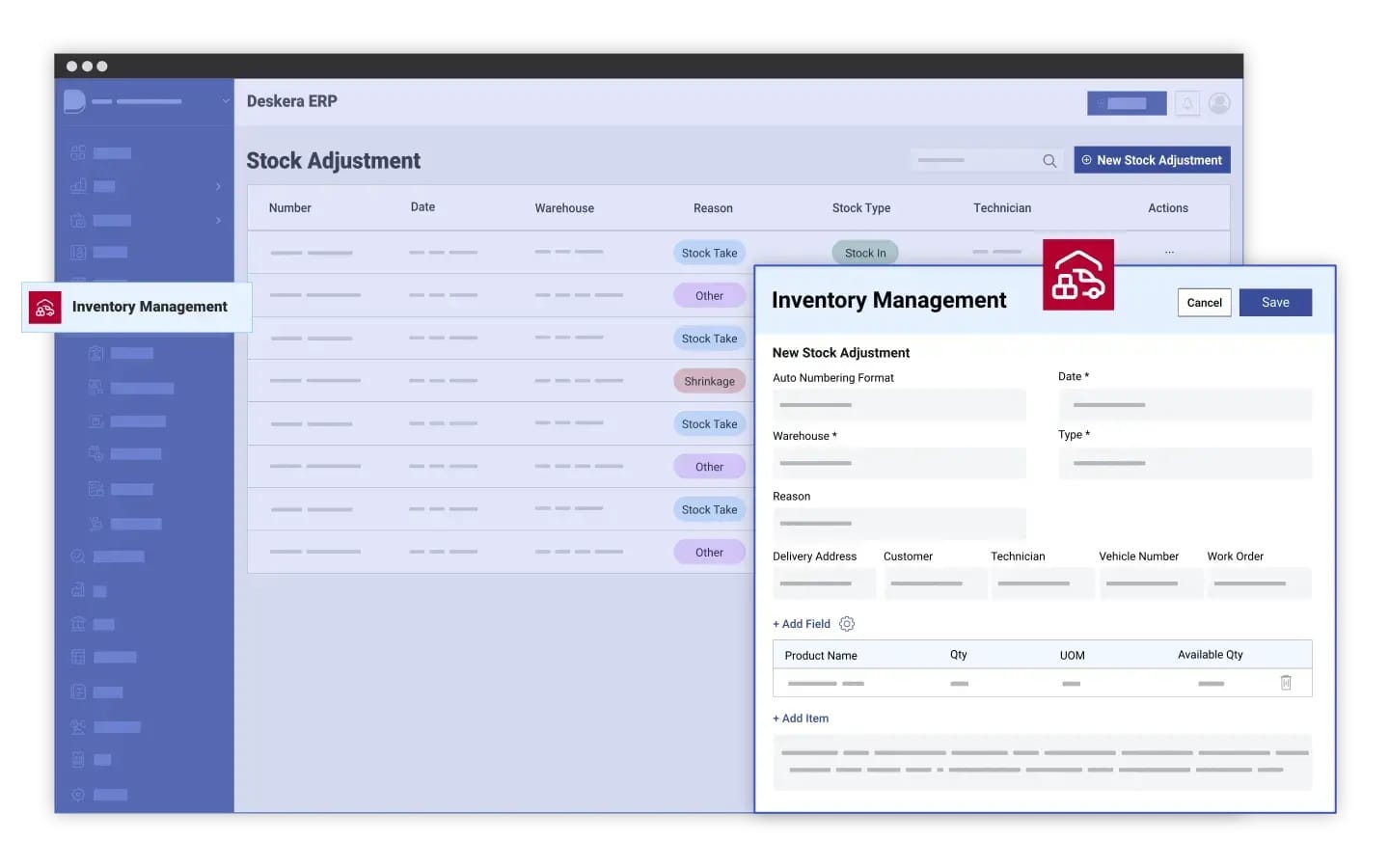
Deskera ERP helps businesses optimize lead time management by integrating procurement, inventory, production, warehouse operations, sales, and supply chain processes into a single centralized platform. With real-time visibility, automation, AI-powered insights, and advanced planning capabilities, businesses can identify operational bottlenecks, reduce delays, and improve overall supply chain efficiency. By streamlining end-to-end business operations, Deskera ERP enables organizations to maintain faster, more predictable, and more efficient lead times.
Real-Time Inventory Tracking
Deskera ERP provides businesses with real-time visibility into inventory levels, stock movements, warehouse operations, and material availability. Accurate inventory tracking helps organizations maintain optimal stock levels, prevent stock shortages, and avoid excess inventory carrying costs. With instant access to inventory data, businesses can make faster replenishment decisions, improve order fulfillment efficiency, and reduce operational delays caused by inventory inaccuracies.
Automated Procurement and Reordering
Deskera ERP simplifies procurement management by automating purchase order creation, supplier coordination, and inventory replenishment processes. Businesses can set automated reorder points to ensure that raw materials and products are replenished before stock levels become critically low. Automated procurement workflows reduce manual intervention, improve supplier communication, and minimize delays associated with procurement approvals and material sourcing activities.
Advanced Production Planning
Efficient production scheduling is essential for reducing manufacturing lead times, and Deskera ERP helps businesses optimize production operations through advanced planning and scheduling tools. The platform enables manufacturers to allocate resources effectively, monitor work orders, track machine utilization, and identify production bottlenecks in real time. Improved production visibility helps businesses maintain smooth workflows, reduce downtime, and accelerate manufacturing cycles.
Demand Forecasting and Analytics
Deskera ERP uses data-driven analytics and forecasting capabilities to help businesses predict customer demand more accurately. By analyzing historical sales data, inventory trends, and operational patterns, businesses can improve procurement planning, optimize production schedules, and maintain better inventory control. Accurate forecasting reduces the risk of stockouts, overproduction, and last-minute operational disruptions that often increase lead times.
Warehouse and Supply Chain Visibility
Deskera ERP improves warehouse efficiency and supply chain coordination by providing centralized visibility into inventory movement, order processing, supplier activities, and shipment tracking. Businesses can monitor supply chain operations in real time and respond quickly to disruptions or delays. Improved visibility across procurement, warehousing, and logistics functions enables organizations to streamline operations and improve end-to-end lead time performance.
Workflow Automation and Process Efficiency
Manual processes often slow down operations and create communication gaps between departments. Deskera ERP automates repetitive tasks such as inventory updates, invoice processing, procurement approvals, production scheduling, and reporting. Workflow automation improves operational speed, reduces administrative burdens, minimizes human errors, and ensures that critical business activities are completed more efficiently and consistently.
AI-Powered Insights and Reporting
Deskera ERP provides advanced reporting tools and AI-powered operational insights that help businesses monitor key lead time management metrics continuously. Real-time dashboards allow managers to track inventory turnover, supplier performance, order fulfillment rates, and production cycle times. These insights help businesses identify inefficiencies, predict operational disruptions, and make proactive decisions that improve supply chain performance and reduce delays.
Mobile Accessibility for Faster Decision-Making
With mobile accessibility features, Deskera ERP allows managers and operational teams to access real-time business information from anywhere. Employees can monitor inventory levels, approve purchase orders, review production updates, and track shipments directly from mobile devices. Faster access to operational data improves communication, accelerates decision-making, and helps businesses respond quickly to unexpected supply chain disruptions or operational issues.
End-to-End Business Process Integration
One of the biggest advantages of Deskera ERP is its ability to integrate multiple business functions into a unified system. Procurement, inventory management, finance, sales, production, and warehouse operations work together seamlessly within a centralized platform. This integration eliminates data silos, improves departmental coordination, enhances operational visibility, and enables businesses to optimize workflows across the entire supply chain, resulting in faster and more reliable lead time management.
Key Takeaways
- Lead time management helps businesses reduce delays, improve operational efficiency, optimize inventory levels, and enhance customer satisfaction across supply chain operations.
- Poor visibility, inaccurate forecasting, supplier coordination issues, manual workflows, inefficient inventory management, and production bottlenecks are some of the biggest challenges affecting lead time performance.
- ERP systems improve lead time management by centralizing business operations, providing real-time visibility, automating workflows, and improving coordination across procurement, production, inventory, and logistics functions.
- Features such as real-time reporting, inventory tracking, demand forecasting, production planning, workflow automation, and AI-driven analytics make ERP systems highly effective for lead time optimization.
- Businesses using ERP systems benefit from reduced operational delays, lower inventory carrying costs, improved customer satisfaction, stronger supplier relationships, and faster decision-making.
- Industries such as manufacturing, retail, logistics, food and beverage, automotive, pharmaceuticals, and electronics gain significant advantages from ERP-based lead time management solutions.
- Best practices such as standardizing workflows, maintaining accurate inventory data, automating routine processes, monitoring KPIs, and integrating ERP with supply chain operations help businesses maximize lead time efficiency.
- Tracking key metrics like order lead time, supplier lead time, inventory turnover ratio, production cycle time, on-time delivery rate, and forecast accuracy helps businesses identify inefficiencies and improve operational performance.
- Emerging technologies such as AI-powered forecasting, IoT-enabled visibility, cloud ERP, digital twins, smart warehousing, blockchain, and mobile ERP are shaping the future of lead time management.
- Deskera ERP helps businesses improve lead time management through real-time inventory tracking, automated procurement, advanced production planning, workflow automation, AI-powered analytics, and end-to-end operational visibility.
Related Articles
 Niti Samani
 Niti Samani
 Niti Samani
 Niti Samani
 Niti Samani
 Niti Samani