

Have you ever wondered why some businesses consistently stay within budget while others struggle with unexpected expenses and cost overruns? The answer often lies in how effectively they plan, monitor, and control their operational budgets. Operational budget planning is not just about estimating expenses—it involves continuously tracking costs, allocating resources efficiently, and making informed financial decisions that support business goals. Without proper budget control, organizations can face cash flow issues, reduced profitability, and limited growth opportunities.
However, traditional budgeting methods often rely on spreadsheets, disconnected systems, and manual processes that make it difficult to maintain accuracy and visibility. As businesses grow, managing budgets across multiple departments, locations, and operational functions becomes increasingly complex. Delayed reporting, inaccurate forecasts, and limited collaboration can prevent decision-makers from identifying financial risks and responding to changing business conditions in time.
ERP (Enterprise Resource Planning) software addresses these challenges by integrating financial, operational, procurement, inventory, and business data into a centralized platform. With real-time visibility into expenses, automated workflows, advanced forecasting capabilities, and comprehensive reporting tools, ERP systems enable organizations to create more accurate budgets, monitor spending continuously, and maintain stronger financial control. By providing a single source of truth, ERP software helps businesses improve decision-making while reducing inefficiencies and unnecessary costs.
Deskera ERP is a comprehensive cloud-based business management solution designed to help organizations streamline financial planning and operational control. It integrates accounting, procurement, inventory management, sales, and business operations into a unified platform, providing real-time visibility into financial performance. With automated workflows, customizable dashboards, advanced reporting, and AI-powered insights through David AI, Deskera ERP enables businesses to improve budgeting accuracy, optimize resource allocation, and maintain better control over operational spending. As a result, organizations can make data-driven decisions, enhance profitability, and support sustainable business growth.
What Is an Operational Budget?
An operational budget is a detailed financial plan that outlines the expected revenue and expenses associated with a company's day-to-day business activities over a specific period, typically a month, quarter, or year. It serves as a roadmap for managing routine operations, helping businesses allocate resources efficiently, control costs, and ensure that operational goals align with overall business objectives. By establishing spending limits and financial targets, an operational budget enables organizations to maintain financial discipline while supporting productivity and growth.
An operational budget typically includes projected sales revenue, direct costs such as raw materials and labor, and indirect operating expenses such as rent, utilities, marketing, administrative costs, and maintenance. These estimates are based on historical performance, market trends, production plans, and business forecasts. By comparing actual results against budgeted figures, businesses can identify variances, evaluate performance, and take corrective actions when necessary.
Unlike a capital budget, which focuses on long-term investments such as equipment purchases, facility expansions, or technology upgrades, an operational budget concentrates on the recurring expenses required to run daily business operations. It helps management monitor financial performance, manage cash flow, and ensure that resources are being used effectively across departments.
A well-planned operational budget provides greater visibility into business finances, improves decision-making, and supports strategic planning. When combined with ERP software, organizations can automate budget creation, track expenses in real time, and gain deeper insights into operational performance, making budget management more accurate and efficient.
Importance of Operational Budget Planning and Control
Operational budget planning and control play a vital role in maintaining an organization's financial stability and operational efficiency.
By establishing clear spending guidelines and continuously monitoring financial performance, businesses can allocate resources effectively, minimize unnecessary expenses, and ensure that operational activities align with strategic objectives.
Effective budget management also helps organizations respond proactively to market changes, maintain profitability, and support long-term growth.
Improves Financial Visibility and Decision-Making
Operational budgets provide a clear view of expected revenues, expenses, and resource requirements across the organization. This visibility enables managers to make informed decisions based on accurate financial data rather than assumptions.
By tracking actual spending against planned budgets, businesses can quickly identify trends, address financial issues, and make adjustments that support better operational and financial outcomes.
Enhances Cost Control
A well-defined operational budget helps businesses establish spending limits and monitor expenses throughout the budgeting period. This structured approach makes it easier to identify unnecessary costs, prevent overspending, and ensure that resources are used efficiently.
Effective budget control supports profitability by helping organizations maintain financial discipline while continuing to meet operational goals and customer demands.
Supports Better Resource Allocation
Budget planning enables organizations to allocate financial, human, and operational resources according to business priorities. By forecasting future requirements and anticipated expenses, companies can ensure that departments receive the resources they need without exceeding available funds. This improves productivity, reduces resource shortages, and helps businesses achieve their objectives more efficiently.
Improves Forecasting Accuracy
Operational budget planning encourages businesses to analyze historical performance, market conditions, and future business requirements when estimating revenues and expenses.
This process improves forecasting accuracy and helps organizations prepare for potential challenges and opportunities. More reliable forecasts support better strategic planning and reduce the risk of financial surprises that can disrupt operations.
Strengthens Cash Flow Management
Effective budget planning and control help businesses anticipate cash inflows and outflows, ensuring that sufficient funds are available to support daily operations.
By monitoring spending and aligning expenses with expected revenue, organizations can avoid cash shortages, manage working capital more effectively, and maintain financial stability even during periods of uncertainty.
Increases Accountability Across Departments
Operational budgets establish clear financial targets and spending responsibilities for different departments and teams. This accountability encourages managers to monitor expenses closely and make cost-conscious decisions.
Regular budget reviews also promote transparency and collaboration, ensuring that all departments contribute to the organization's financial and operational goals.
Supports Long-Term Business Growth
Organizations that consistently plan and control their operational budgets are better positioned to invest in growth opportunities while maintaining financial stability.
Effective budgeting helps businesses optimize costs, improve profitability, and allocate resources toward strategic initiatives. This creates a strong financial foundation that supports expansion, innovation, and long-term competitive success.
Common Challenges in Traditional Operational Budget Management
Many organizations still rely on spreadsheets, disconnected software systems, and manual processes to manage operational budgets. While these methods may work for smaller operations, they often become inefficient as businesses grow and financial data becomes more complex.
Traditional budget management approaches can lead to delays, inaccuracies, and limited visibility, making it difficult for organizations to maintain control over spending and make informed financial decisions.
Limited Visibility into Financial Data
Traditional budgeting systems often store financial information across multiple spreadsheets, departments, or standalone applications. This fragmented approach makes it difficult to obtain a complete and accurate view of organizational spending.
As a result, decision-makers may lack timely insights into budget performance, leading to delayed responses to financial issues and missed opportunities for cost optimization.
Inaccurate Forecasting and Budget Estimates
Many traditional budgeting processes rely heavily on historical data and manual assumptions. Without access to real-time business information and advanced forecasting tools, organizations may struggle to accurately predict future expenses, revenue, and resource requirements.
Inaccurate forecasts can result in unrealistic budgets, inefficient resource allocation, and financial shortfalls that negatively impact business performance.
Time-Consuming Manual Processes
Budget preparation, consolidation, and reporting often require significant manual effort when using traditional methods. Finance teams must collect data from multiple sources, verify information, and update spreadsheets regularly.
These repetitive tasks consume valuable time, increase administrative workload, and reduce the organization's ability to focus on strategic financial planning and analysis.
Increased Risk of Human Errors
Manual data entry and spreadsheet-based budgeting increase the likelihood of calculation mistakes, duplicate entries, and inaccurate reporting. Even small errors can lead to incorrect budget forecasts and poor financial decisions.
As the volume of financial data grows, maintaining accuracy becomes increasingly challenging, creating additional risks for the organization.
Poor Expense Tracking and Monitoring
Traditional budget management systems often lack real-time monitoring capabilities, making it difficult to track actual spending against planned budgets.
Financial reports may only be available weekly or monthly, limiting the organization's ability to detect budget overruns quickly. This delayed visibility can result in uncontrolled spending and reduced financial accountability.
Lack of Collaboration Across Departments
Operational budgeting requires input from multiple departments, including finance, procurement, operations, and human resources. Traditional budgeting methods often create information silos where departments work independently using separate spreadsheets and reports.
This lack of collaboration can lead to inconsistent assumptions, duplicated efforts, and budgets that do not accurately reflect organizational priorities.
Difficulty Managing Budget Changes
Business conditions can change rapidly due to market fluctuations, supply chain disruptions, or shifting customer demand. Traditional budgeting systems often lack the flexibility needed to update budgets efficiently when circumstances change. Revising forecasts, reallocating resources, and communicating budget adjustments can become slow and complicated, reducing organizational agility.
Limited Reporting and Analytical Capabilities
Traditional budgeting tools generally provide basic reporting functions with limited analytical depth. Generating detailed financial insights often requires additional manual calculations and data manipulation.
Without advanced reporting and analytics, organizations may struggle to identify spending patterns, evaluate performance trends, and uncover opportunities to improve financial efficiency.
How ERP Software Improves Operational Budget Planning and Control
ERP software transforms operational budget management by integrating financial and operational data into a single platform.
Instead of relying on disconnected spreadsheets and manual processes, businesses can use ERP systems to automate budgeting activities, gain real-time visibility into spending, and make more informed financial decisions.
This enables organizations to improve budget accuracy, strengthen cost control, and maintain better oversight of financial performance across all departments.
Centralizes Financial and Operational Data
ERP software consolidates data from accounting, procurement, inventory, sales, production, and other business functions into a unified system. This centralized approach eliminates data silos and provides a single source of truth for budget planning.
With access to accurate and consistent information, businesses can create more reliable budgets and make better financial decisions based on real-time operational data.
Enables Real-Time Budget Tracking
One of the biggest advantages of ERP software is its ability to monitor expenses and budget performance in real time. Managers can instantly compare actual spending against budgeted amounts, identify variances, and take corrective action before minor issues become major financial problems. This continuous visibility helps organizations maintain tighter control over operational costs.
Improves Budget Forecasting Accuracy
ERP systems leverage historical financial data, operational trends, and current business information to support more accurate forecasting. By analyzing patterns in sales, procurement, inventory usage, and operating expenses, organizations can develop realistic budget projections. Improved forecasting reduces uncertainty and helps businesses prepare more effectively for future financial requirements.
Automates Budget Creation and Approval Workflows
ERP software streamlines budgeting by automating data collection, budget preparation, and approval processes.
Instead of manually consolidating information from multiple departments, organizations can generate budgets using real-time data already stored within the ERP system.
Automated approval workflows also accelerate budget reviews while ensuring compliance with internal financial policies.
Enhances Cost Control and Expense Management
ERP systems provide detailed visibility into spending across departments, projects, and business units. Organizations can monitor expenses closely, identify areas of overspending, and implement cost-saving measures more effectively.
By tracking expenditures against predefined budgets, businesses can improve financial discipline and prevent unnecessary operational costs.
Supports Department-Level Budgeting and Accountability
ERP software allows organizations to create and manage budgets at the department, project, product line, or location level. Department managers gain greater ownership of their financial performance and can track spending against allocated budgets in real time. This increased accountability promotes responsible resource utilization and better alignment with organizational goals.
Improves Procurement and Inventory Cost Management
Procurement and inventory expenses often represent a significant portion of operational costs. ERP software integrates budgeting with purchasing and inventory management processes, providing better visibility into supplier spending, stock levels, and purchasing trends. This integration helps organizations optimize inventory, reduce waste, and control procurement costs more effectively.
Provides Advanced Reporting and Financial Analytics
ERP systems offer customizable dashboards, automated reports, and financial analytics that provide deeper insights into budget performance. Businesses can analyze budget variances, monitor key financial metrics, and identify trends that impact profitability. These insights support faster, data-driven decision-making and help management improve overall financial performance.
Strengthens Compliance and Financial Governance
ERP software maintains detailed audit trails, standardized financial processes, and controlled approval workflows that improve financial transparency. Organizations can ensure that spending aligns with approved budgets while meeting internal governance requirements and regulatory obligations. Stronger financial controls reduce risk and improve confidence in budget-related decisions.
Facilitates Scenario Planning and Strategic Decision-Making
Modern ERP systems enable organizations to model different financial scenarios and evaluate the impact of potential business decisions before implementation. Businesses can assess how changes in demand, costs, or resource allocation may affect operational budgets. This capability helps management make proactive decisions and develop more resilient financial strategies.
Key Metrics Businesses Should Track for Operational Budget Control
Tracking the right budget control metrics helps organizations evaluate financial performance, identify inefficiencies, and ensure spending remains aligned with business objectives.
These key performance indicators (KPIs) provide valuable insights into budget utilization, cost management, forecasting accuracy, and overall operational efficiency.
By monitoring these metrics regularly, businesses can make proactive decisions that strengthen financial control and improve profitability.
Budget Variance
Budget variance measures the difference between actual spending and the amount originally budgeted. It helps businesses identify whether departments or projects are operating within planned financial limits.
Regularly monitoring budget variance enables organizations to detect overspending or underspending early and take corrective actions to maintain financial stability.
Formula:
Budget Variance = Actual Spending − Budgeted Spending
Budget Utilization Rate
The budget utilization rate indicates how much of the allocated budget has been used during a specific period. This metric helps managers monitor spending patterns and assess whether resources are being utilized as planned.
A utilization rate that is too high or too low may signal the need for budget adjustments or resource reallocation.
Formula:
Budget Utilization Rate (%) = (Actual Spending ÷ Budgeted Spending) × 100
Operating Expense Ratio
The operating expense ratio measures operating expenses as a percentage of revenue. It helps businesses evaluate cost efficiency and determine how much revenue is being consumed by daily operations. A lower ratio generally indicates better operational efficiency and stronger profitability.
Formula:
Operating Expense Ratio (%) = (Operating Expenses ÷ Revenue) × 100
Cost Savings Achieved
This metric measures the amount of money saved compared to the original budget or projected costs. Tracking cost savings helps organizations evaluate the effectiveness of cost-control initiatives, procurement strategies, and operational improvements while identifying opportunities for further optimization.
Formula:
Cost Savings = Budgeted Cost − Actual Cost
Forecast Accuracy
Forecast accuracy measures how closely budget forecasts align with actual financial results. Accurate forecasting supports better planning, resource allocation, and decision-making. Organizations that consistently monitor this metric can refine forecasting models and improve future budget reliability.
Formula:
Forecast Accuracy (%) = [1 − (|Actual Value − Forecast Value| ÷ Actual Value)] × 100
Procurement Cost Variance
Procurement cost variance evaluates the difference between actual purchasing costs and budgeted procurement expenses. This metric helps businesses assess supplier performance, monitor purchasing efficiency, and identify unexpected cost increases that may impact operational budgets.
Formula:
Procurement Cost Variance = Actual Procurement Cost − Budgeted Procurement Cost
Departmental Budget Adherence
Departmental budget adherence measures how effectively individual departments stay within their allocated budgets. Monitoring this KPI improves accountability, highlights areas of overspending, and ensures that financial resources are being managed responsibly across the organization.
Formula:
Departmental Budget Adherence (%) = (Budgeted Department Expenses ÷ Actual Department Expenses) × 100
Cash Flow Variance
Cash flow variance compares projected cash flow with actual cash flow over a specific period. This metric helps businesses identify discrepancies between expected and actual cash movement, allowing them to manage liquidity more effectively and avoid potential cash shortages.
Formula:
Cash Flow Variance = Actual Cash Flow − Forecasted Cash Flow
Best Practices for Improving Operational Budget Planning and Control with ERP
Implementing ERP software can significantly enhance budget planning and control, but organizations achieve the greatest benefits when they follow proven budgeting and financial management practices.
By combining ERP capabilities with structured processes, businesses can improve budget accuracy, strengthen cost control, and make more informed financial decisions.
The following best practices can help organizations maximize the value of their ERP investment.
Establish Clear Budget Objectives
Successful budget planning begins with clearly defined financial and operational goals. Organizations should align budget objectives with broader business strategies, growth targets, and performance expectations.
ERP software helps track progress against these objectives by providing real-time visibility into spending, revenue, and operational performance, ensuring budgets remain aligned with organizational priorities.
Centralize Financial and Operational Data
Accurate budgeting depends on having reliable and consistent data. Businesses should use their ERP system to consolidate financial, procurement, inventory, sales, and operational information into a single platform.
A centralized data environment eliminates duplicate records, improves data accuracy, and provides a comprehensive view of organizational performance for better budget planning.
Use Historical Data to Improve Forecasting
ERP systems store valuable historical business data that can be used to create more realistic budget forecasts. Organizations should analyze past spending patterns, revenue trends, seasonal fluctuations, and operational performance when developing budgets. Leveraging historical insights helps reduce forecasting errors and supports more accurate financial planning.
Monitor Budget Performance Continuously
Budget management should be an ongoing process rather than a periodic activity. Businesses should use ERP dashboards and reporting tools to track actual spending against budgeted amounts in real time.
Continuous monitoring allows managers to identify variances quickly, investigate the causes, and take corrective actions before financial issues escalate.
Automate Budgeting and Approval Workflows
Manual budgeting processes often create delays and increase the risk of errors. Organizations should take advantage of ERP automation capabilities to streamline budget creation, approvals, revisions, and reporting.
Automated workflows improve efficiency, reduce administrative workload, and ensure that budget-related decisions follow established financial controls and approval hierarchies.
Improve Departmental Collaboration
Operational budgets involve multiple departments, each with unique financial requirements and responsibilities. ERP software enables cross-functional collaboration by providing shared access to budgeting information and performance data.
Encouraging department participation during the budgeting process helps create more accurate budgets and improves accountability across the organization.
Track Key Budget Control Metrics
Businesses should establish and regularly monitor KPIs such as budget variance, budget utilization rate, operating expense ratio, forecast accuracy, and procurement cost variance.
ERP systems provide automated reporting and analytics that make it easier to track these metrics, evaluate performance, and identify opportunities for cost optimization and efficiency improvements.
Conduct Regular Budget Reviews and Adjustments
Business conditions can change due to market shifts, supply chain disruptions, or changing customer demand. Organizations should schedule regular budget reviews using ERP-generated reports and insights.
Reviewing budget performance periodically enables businesses to update forecasts, reallocate resources, and adjust financial plans to reflect current operational realities.
Strengthen Cost Control Measures
ERP software provides detailed visibility into expenses across departments, projects, and locations. Organizations should use this visibility to identify unnecessary spending, monitor procurement activities, and enforce spending policies. Strong cost-control practices help maximize profitability while ensuring resources are allocated effectively.
Leverage ERP Analytics for Strategic Decision-Making
Modern ERP systems offer advanced reporting, dashboards, and analytical tools that support data-driven decision-making. Businesses should use these capabilities to analyze financial trends, evaluate budget performance, assess operational efficiency, and identify areas for improvement. Data-backed insights enable more effective budget planning and help organizations achieve long-term financial objectives.
How Deskera ERP Helps with Operational Budget Planning and Control
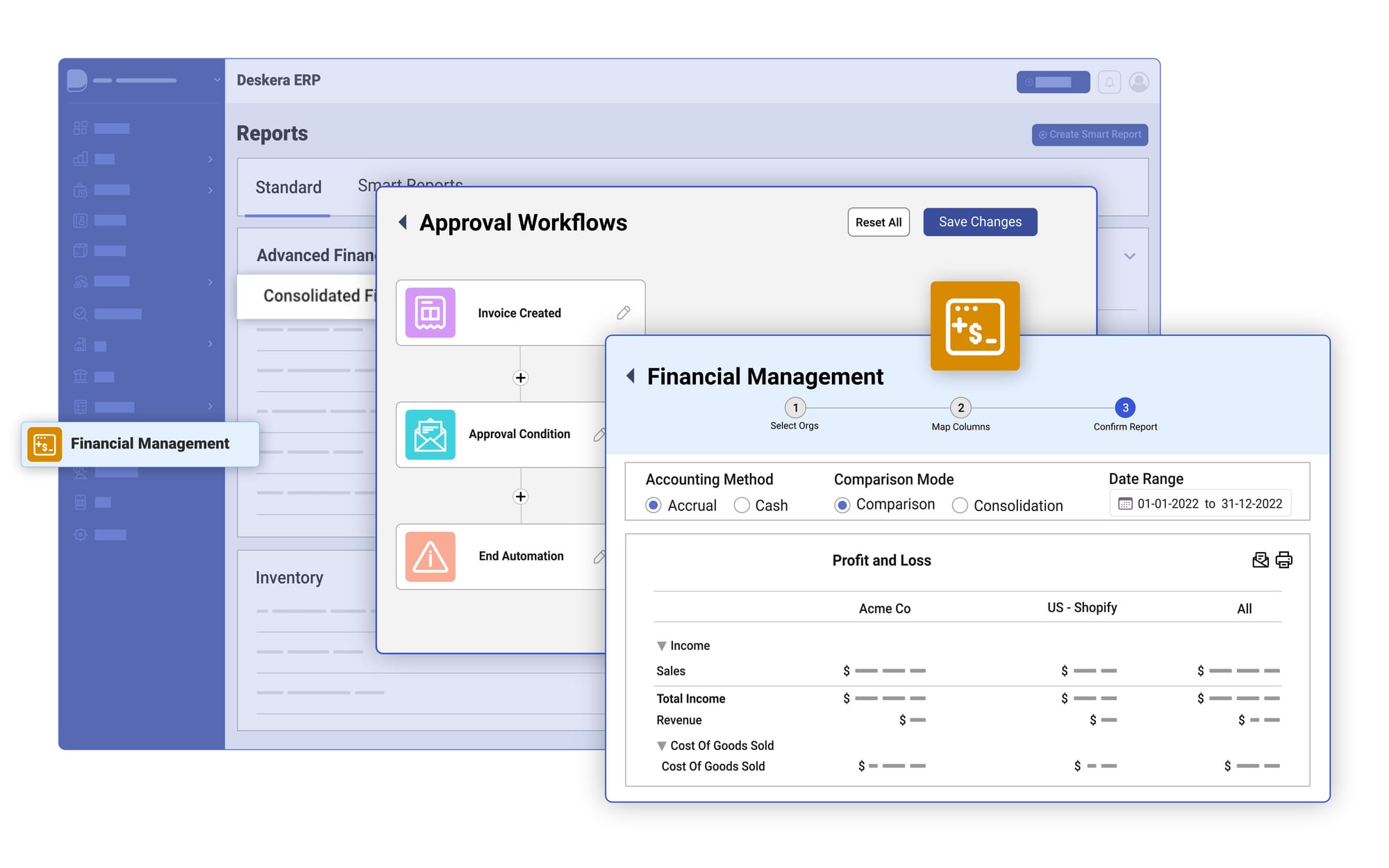
Effective operational budget planning requires accurate financial data, real-time visibility into business performance, and strong cost-control mechanisms. Deskera ERP provides an integrated platform that connects finance, procurement, inventory, sales, and operational processes, enabling businesses to plan budgets more accurately, monitor spending continuously, and maintain greater financial control. By automating key financial workflows and providing actionable insights, Deskera ERP helps organizations improve budgeting efficiency and make better financial decisions.
Centralizes Financial and Operational Data
Deskera ERP brings together data from accounting, inventory, procurement, sales, and business operations into a single platform. This centralized approach eliminates data silos and provides a unified view of financial performance, making it easier to create accurate budgets and track operational expenses across the organization.
Provides Real-Time Financial Visibility
With customizable dashboards and real-time reporting, Deskera ERP enables businesses to monitor revenue, expenses, cash flow, and budget performance as they occur. Decision-makers can quickly identify budget variances, track spending trends, and respond proactively to financial issues before they affect profitability.
Improves Budget Forecasting Accuracy
Deskera ERP helps organizations use historical financial data, sales trends, purchasing patterns, and operational insights to create more reliable budget forecasts. Better forecasting allows businesses to anticipate future costs, allocate resources effectively, and reduce the risk of budget overruns.
Automates Financial Processes and Approvals
Manual budgeting and approval processes can be time-consuming and prone to errors. Deskera ERP automates key financial workflows, including expense tracking, purchase approvals, invoicing, and financial reporting. This improves efficiency, reduces administrative workload, and ensures greater consistency in budget-related processes.
Enhances Expense and Cost Control
Deskera ERP provides detailed visibility into operational spending across departments, projects, and locations. Businesses can monitor expenses in real time, identify areas of overspending, and implement corrective actions quickly. This level of control helps organizations optimize costs and improve overall financial performance.
Integrates Procurement and Inventory Management
Procurement and inventory costs often represent a significant portion of operational expenses. Deskera ERP integrates purchasing and inventory management with financial processes, enabling businesses to track supplier spending, optimize inventory levels, prevent excess stock, and reduce unnecessary procurement costs.
Delivers Comprehensive Reporting and Analytics
Deskera ERP offers advanced reporting tools and customizable dashboards that provide insights into budget utilization, cost trends, financial performance, and operational efficiency. These analytics help management evaluate budget effectiveness, identify improvement opportunities, and make data-driven decisions.
Supports Multi-Department and Multi-Location Budget Management
For growing businesses, managing budgets across multiple departments or locations can be challenging. Deskera ERP enables organizations to track financial performance across different business units while maintaining centralized control. This improves accountability, resource allocation, and budget governance throughout the organization.
Provides AI-Powered Insights with David AI
Deskera’s AI Assistant, David AI, helps businesses analyze financial data, uncover spending patterns, and generate actionable insights. By identifying trends and highlighting potential risks, David AI supports more informed budgeting decisions and helps organizations improve financial planning and operational efficiency.
Strengthens Financial Governance and Compliance
Deskera ERP maintains accurate records, audit trails, and standardized financial processes that improve transparency and accountability. Built-in controls help ensure that spending aligns with approved budgets and organizational policies, reducing financial risks while supporting compliance requirements.
Key Takeaways
- An operational budget serves as a financial roadmap that helps businesses plan, allocate, and manage resources required for daily operations.
- Effective operational budget planning and control improve financial visibility, cost management, resource allocation, and long-term business performance.
- Traditional budget management methods often create challenges such as limited visibility, inaccurate forecasting, manual errors, poor expense tracking, and inefficient collaboration.
- ERP software improves operational budget planning and control by centralizing data, automating processes, and providing real-time financial insights.
- Key ERP capabilities such as budgeting tools, financial dashboards, workflow automation, analytics, and integrated business management support stronger budget governance.
- Tracking metrics such as budget variance, budget utilization rate, operating expense ratio, forecast accuracy, and cash flow variance helps organizations maintain financial control and improve decision-making.
- Industries including manufacturing, retail, distribution, healthcare, professional services, and construction can significantly benefit from ERP-driven budget management.
- Following best practices such as continuous budget monitoring, data centralization, workflow automation, KPI tracking, and regular budget reviews helps maximize the value of ERP-based budgeting.
- Emerging trends such as AI-powered forecasting, predictive analytics, cloud ERP platforms, and real-time financial monitoring are transforming operational budget management.
- Deskera ERP helps businesses improve operational budget planning and control through integrated financial management, real-time visibility, automated workflows, advanced reporting, procurement oversight, and AI-powered insights.
Related Articles
 Niti Samani
 Niti Samani
 Niti Samani
 Niti Samani
 Niti Samani
 Niti Samani