


What happens when procurement decisions are made without visibility, standardized processes, or proper spending controls? The answer is often increased costs, supplier inefficiencies, compliance risks, and budget overruns. In today's competitive business environment, procurement is no longer just a purchasing function—it is a strategic process that directly impacts profitability, operational efficiency, and long-term business growth. Effective procurement control helps organizations manage spending, ensure policy compliance, and maintain strong supplier relationships while optimizing resource utilization.
As businesses grow, procurement activities become increasingly complex. Managing multiple suppliers, tracking purchase requests, monitoring budgets, ensuring timely approvals, and maintaining compliance can be challenging when relying on manual processes or disconnected systems. A lack of real-time visibility into procurement operations can lead to unauthorized spending, duplicate purchases, delayed approvals, and missed opportunities for cost savings. These challenges highlight the need for a more structured and technology-driven approach to procurement control.
This is where Enterprise Resource Planning (ERP) systems play a strategic role. By centralizing procurement data and automating purchasing workflows, ERP systems provide organizations with greater transparency, accountability, and control over procurement activities. From purchase requisitions and supplier management to budget tracking and invoice processing, ERP solutions help streamline the entire procurement lifecycle while ensuring alignment with organizational goals and financial objectives.
Among the leading ERP solutions available today, Deskera ERP offers a comprehensive platform for managing procurement operations efficiently. It enables businesses to automate procurement workflows, track purchasing activities in real time, monitor budgets, manage supplier information, and generate actionable insights through advanced reporting. By integrating procurement with inventory, accounting, and financial management functions, Deskera ERP helps organizations strengthen procurement control, reduce costs, and make more informed purchasing decisions.
In this guide, we will explore the strategic role of ERP systems in procurement control and how they help businesses achieve greater efficiency, compliance, and profitability.
What Is Procurement Control?
Procurement control refers to the policies, procedures, approval processes, and monitoring mechanisms that organizations use to manage and regulate their purchasing activities. Its primary purpose is to ensure that goods and services are acquired in a controlled, cost-effective, and compliant manner while supporting the organization's operational and strategic objectives.
A robust procurement control framework establishes clear guidelines for procurement activities, including vendor selection, purchase approvals, budget management, contract compliance, and spending oversight. By implementing these controls, businesses can ensure that procurement transactions are properly authorized, aligned with company policies, and conducted within approved budgets. This helps prevent unauthorized purchases, reduce procurement-related risks, and maintain financial accountability across the organization.
Procurement control also plays a critical role in improving operational efficiency and supplier management. Through standardized procurement processes, organizations can streamline purchasing workflows, enhance transparency, and maintain consistency in procurement decisions. Effective controls enable businesses to monitor supplier performance, negotiate better contracts, and identify opportunities for cost savings without compromising quality or service levels.
In today's increasingly complex business environment, procurement control has evolved from a purely administrative function into a strategic business practice. By providing visibility into procurement activities and ensuring alignment with organizational goals, procurement control helps companies optimize spending, strengthen compliance, minimize risk, and maximize the value generated from their procurement investments.
Core Components of Procurement Control
Effective procurement control is built on a combination of governance policies, internal controls, and monitoring mechanisms that ensure purchasing activities remain compliant, transparent, and aligned with business objectives. These components work together to minimize risk, prevent fraud, improve accountability, and enhance procurement efficiency.
The following elements form the foundation of a strong procurement control framework.
Segregation of Duties
Segregation of duties involves dividing procurement responsibilities among different individuals or departments to reduce the risk of errors, fraud, and unauthorized transactions.
For example, the employee requesting a purchase should not be the same person approving it or processing payment. This separation creates checks and balances within procurement workflows, improving accountability and strengthening internal controls.
Preventive Controls
Preventive controls are measures designed to stop procurement issues before they occur. These controls may include approval workflows, spending limits, vendor validation procedures, and automated purchase order requirements.
By identifying and addressing potential risks early in the procurement process, preventive controls help organizations reduce errors, avoid policy violations, and maintain financial discipline.
Supplier Data Integrity
Accurate and reliable supplier information is essential for effective procurement control. Supplier data integrity involves maintaining up-to-date vendor records, banking details, contract information, certifications, and performance metrics.
Strong master data governance practices help prevent duplicate vendor entries, payment errors, and compliance issues while ensuring procurement teams can make informed supplier-related decisions.
Compliance Checks
Compliance checks ensure procurement activities adhere to internal policies, contractual obligations, industry regulations, and legal requirements. These reviews help verify that purchasing decisions follow approved procedures and meet applicable standards.
Regular compliance monitoring reduces regulatory risks, supports ethical procurement practices, and helps organizations avoid penalties, disputes, and reputational damage.
Audit Readiness and Risk Assessment
Audit readiness requires organizations to maintain clear documentation and traceable procurement records throughout the purchasing lifecycle. Regular risk assessments and internal reviews help identify control weaknesses, process gaps, and potential compliance concerns before they escalate. A proactive approach to auditing and risk management strengthens procurement governance and supports continuous process improvement.
How Procurement Control Works
Procurement control functions throughout the entire procure-to-pay (P2P) lifecycle, ensuring that every purchasing activity is properly reviewed, authorized, executed, and monitored.
By applying structured controls at each stage, organizations can maintain financial discipline, reduce procurement risks, improve compliance, and ensure that purchasing decisions support business objectives. The process typically involves the following key stages.
Planning and Budgeting
The procurement control process begins with planning and budgeting. Organizations identify purchasing requirements based on operational needs, production schedules, and strategic goals. These requirements are then aligned with approved budgets and financial plans.
Proper planning ensures that procurement activities support business priorities while preventing unnecessary spending and helping maintain effective control over working capital.
Request Validation
Once a procurement need is identified, a purchase request is submitted for review. During the validation stage, procurement teams verify the necessity of the purchase, confirm budget availability, and ensure compliance with company policies.
This step helps eliminate duplicate, unauthorized, or unnecessary requests before they move forward, reducing procurement errors and controlling costs from the outset.
Approval and Authorization
After validation, procurement requests follow predefined approval workflows based on the organization's delegation of authority structure. Depending on the purchase value, category, or department, multiple levels of approval may be required.
Structured authorization processes ensure accountability, prevent unauthorized spending, and maintain compliance with internal procurement policies and financial controls.
Procurement Execution
Once approvals are secured, the procurement team proceeds with supplier selection, purchase order creation, contract execution, and order placement.
Approved purchases are fulfilled by suppliers, goods or services are received and verified, and invoices are processed for payment. Procurement controls during this phase help ensure that transactions are accurate, properly documented, and aligned with agreed terms and conditions.
Monitoring and Continuous Oversight
Procurement control does not end after a purchase is completed. Organizations continuously monitor procurement activities through reporting, audits, compliance reviews, and performance tracking.
Modern systems often leverage real-time dashboards and AI-driven analytics to identify anomalies, monitor spending patterns, and detect potential risks. Continuous oversight helps strengthen governance, improve procurement performance, and support ongoing process optimization.
Common Procurement Control Challenges Businesses Face
Procurement control is essential for managing costs, ensuring compliance, and maintaining operational efficiency. However, many organizations struggle to establish effective controls due to fragmented processes, limited visibility, and increasing procurement complexity.
These challenges can lead to higher costs, operational delays, compliance risks, and reduced supplier performance. Understanding these obstacles is the first step toward building a stronger procurement control framework.
Lack of Visibility into Procurement Activities
Many businesses lack a centralized view of procurement operations, making it difficult to track purchase requests, supplier performance, spending patterns, and order status.
Without real-time visibility, organizations may struggle to identify inefficiencies, monitor budgets, or detect unauthorized purchases. This limited transparency often leads to poor decision-making and reduced control over procurement activities.
Manual and Error-Prone Purchasing Processes
Organizations that rely on spreadsheets, emails, and paper-based approvals often face delays and inaccuracies in procurement operations.
Manual processes increase the likelihood of data entry mistakes, duplicate orders, lost documents, and communication gaps. These inefficiencies not only slow down purchasing activities but also make it harder to maintain consistent procurement controls.
Maverick Spending and Budget Overruns
Maverick spending occurs when employees make purchases outside approved procurement channels or supplier agreements. This lack of control can lead to higher procurement costs, reduced negotiating power, and budget overruns.
Without proper monitoring and approval mechanisms, businesses may find it difficult to enforce spending policies and maintain financial discipline.
Supplier Management Difficulties
Managing multiple suppliers across different categories can be challenging without standardized processes and accurate supplier data.
Businesses may face issues such as inconsistent supplier performance, delayed deliveries, contract non-compliance, and poor communication.
Ineffective supplier management can disrupt operations and limit opportunities for cost savings and strategic sourcing.
Compliance and Approval Workflow Issues
Ensuring compliance with internal policies, contractual obligations, and regulatory requirements can be difficult when approval processes are unclear or inconsistently followed.
Unauthorized purchases, missing approvals, and inadequate documentation can expose organizations to financial, legal, and operational risks. Weak approval controls also make audits more challenging.
Poor Data Accuracy and Reporting
Procurement decisions depend heavily on accurate and timely data. However, businesses often struggle with fragmented information spread across multiple systems or departments.
Inaccurate supplier records, incomplete purchase histories, and inconsistent reporting can hinder decision-making, reduce forecasting accuracy, and make it difficult to evaluate procurement performance effectively.
Fraud and Procurement Risks
Weak procurement controls can create opportunities for fraudulent activities such as unauthorized purchases, duplicate payments, supplier favoritism, or invoice manipulation.
Without proper segregation of duties, audit trails, and monitoring mechanisms, organizations may be unable to detect or prevent procurement-related risks before they impact financial performance.
Difficulty Tracking Procurement Performance
Many organizations lack the tools and processes needed to measure procurement effectiveness. Without clear visibility into key procurement metrics such as purchase cycle times, supplier performance, contract compliance, and cost savings, businesses may struggle to identify improvement opportunities and optimize procurement strategies.
Benefits of Effective Procurement Control
Effective procurement control enables organizations to manage purchasing activities more strategically while maintaining financial discipline and operational efficiency.
By implementing strong procurement controls, businesses can reduce risks, improve visibility, strengthen supplier relationships, and ensure that procurement decisions align with organizational objectives.
The following are some of the key benefits of effective procurement control.
Improved Cost Management
Procurement control helps organizations monitor spending, prevent unauthorized purchases, and ensure that procurement activities remain within approved budgets.
By enforcing purchasing policies and optimizing supplier contracts, businesses can reduce unnecessary expenditures, identify cost-saving opportunities, and achieve better value from their procurement investments.
Greater Financial Visibility
With effective procurement controls in place, organizations gain clear visibility into purchasing activities, spending patterns, and budget utilization.
This transparency enables management to track procurement performance, forecast expenses more accurately, and make informed financial decisions that support business growth and profitability.
Enhanced Compliance and Governance
Procurement control ensures that purchasing activities comply with internal policies, contractual obligations, and regulatory requirements. Structured approval processes, audit trails, and documentation standards help reduce compliance risks, strengthen governance, and improve accountability across the organization.
Reduced Procurement Risks
Strong procurement controls help minimize risks associated with fraud, unauthorized spending, supplier disputes, and operational disruptions.
By implementing approval workflows, segregation of duties, and ongoing monitoring, businesses can identify potential issues early and take corrective action before they impact operations.
Increased Operational Efficiency
Standardized procurement procedures and clearly defined controls streamline purchasing workflows and reduce administrative burdens.
Employees spend less time managing approvals, resolving errors, and handling paperwork, allowing procurement teams to focus on strategic sourcing and supplier relationship management.
Better Supplier Performance and Relationships
Procurement control supports consistent supplier evaluation, contract management, and performance monitoring.
By maintaining clear procurement standards and tracking supplier metrics, organizations can strengthen vendor relationships, improve service quality, negotiate favorable terms, and ensure reliable supply chain performance.
Improved Decision-Making
Access to accurate procurement data and performance insights allows businesses to make more informed decisions.
Procurement control provides visibility into supplier performance, spending trends, purchasing efficiency, and contract compliance, enabling organizations to identify improvement opportunities and optimize procurement strategies.
Stronger Budget Discipline
Effective procurement control helps ensure that purchases are aligned with approved budgets and organizational priorities.
Real-time monitoring and approval mechanisms prevent overspending, improve budget adherence, and support responsible allocation of financial resources across the business.
Enhanced Audit Readiness
Organizations with robust procurement controls maintain comprehensive records of procurement transactions, approvals, contracts, and supplier interactions.
This documentation simplifies audit processes, improves traceability, and demonstrates compliance with internal and external requirements.
Increased Strategic Value of Procurement
When procurement activities are properly controlled and aligned with business objectives, procurement evolves from a transactional function into a strategic contributor.
Effective procurement control helps organizations optimize spending, improve supplier collaboration, support long-term planning, and create sustainable competitive advantages.
The Role of ERP Systems in Procurement Control
As procurement processes become more complex, organizations need greater visibility, consistency, and control over purchasing activities.
Enterprise Resource Planning (ERP) systems play a critical role in strengthening procurement control by centralizing data, automating workflows, enforcing policies, and providing real-time insights.
By integrating procurement with finance, inventory, and supplier management functions, ERP systems help businesses improve efficiency, reduce risks, and make more informed purchasing decisions.
Centralizing Procurement Data and Processes
ERP systems bring all procurement-related information into a single, centralized platform. Purchase requests, supplier records, purchase orders, contracts, invoices, and spending data are stored and managed in one system.
This eliminates data silos, improves information accuracy, and provides stakeholders with a unified view of procurement activities, enabling better coordination and control.
Automating Procurement Workflows
Manual procurement processes often result in delays, errors, and inconsistencies. ERP systems automate key procurement activities such as purchase requisitions, approval routing, purchase order generation, invoice matching, and payment processing.
Automation reduces administrative workloads, accelerates procurement cycles, and ensures that purchasing activities follow standardized procedures.
Enhancing Procurement Visibility and Transparency
One of the most significant advantages of ERP systems is real-time visibility into procurement operations. Procurement teams and management can monitor spending, track purchase orders, review supplier performance, and analyze procurement trends through centralized dashboards and reports. This transparency helps organizations identify inefficiencies, control costs, and make data-driven decisions.
Strengthening Internal Controls and Governance
ERP systems help enforce procurement policies by embedding approval workflows, spending limits, role-based access controls, and audit trails into procurement processes.
Every transaction is documented and traceable, improving accountability and reducing the risk of unauthorized purchases, fraud, or policy violations. Strong governance mechanisms help organizations maintain compliance and financial discipline.
Improving Budget and Spend Control
ERP systems provide real-time access to budget utilization and procurement spending data. Before purchases are approved, the system can verify budget availability and flag potential overspending.
This capability helps organizations prevent budget overruns, control procurement costs, and ensure that purchasing decisions align with financial objectives.
Supporting Supplier Management
Effective supplier management is a key component of procurement control. ERP systems maintain comprehensive supplier profiles, including performance metrics, contract details, pricing agreements, and transaction histories.
Procurement teams can use this information to evaluate supplier performance, strengthen vendor relationships, negotiate better terms, and reduce supply chain risks.
Enhancing Compliance and Risk Management
ERP systems help organizations comply with internal policies, industry standards, and regulatory requirements by enforcing standardized procurement procedures.
Automated approval workflows, contract tracking, audit logs, and compliance monitoring features reduce procurement risks and make it easier to prepare for audits and regulatory reviews.
Enabling Data-Driven Decision-Making
Modern ERP systems provide advanced analytics and reporting capabilities that help organizations evaluate procurement performance and identify opportunities for improvement.
By analyzing procurement KPIs, supplier trends, spending patterns, and cost-saving opportunities, businesses can make strategic decisions that improve procurement efficiency and support long-term growth.
Best Practices for Strengthening Procurement Control
Strengthening procurement control requires more than implementing policies and approval procedures. Organizations must establish a structured framework that promotes transparency, accountability, compliance, and continuous improvement across the procurement lifecycle.
By adopting the following best practices, businesses can maximize the strategic value of procurement control while leveraging ERP systems to enforce and streamline these controls effectively.
Define Clear Procurement Policies and Guidelines
A strong procurement control framework begins with clearly documented policies that outline purchasing procedures, approval requirements, supplier selection criteria, spending limits, and compliance expectations.
Well-defined policies ensure that employees understand their responsibilities and follow consistent procurement practices. ERP systems support this effort by embedding procurement rules directly into workflows, reducing the risk of policy violations.
Standardize Procurement Processes
Standardized procurement processes create consistency across departments and purchasing activities. Establishing uniform procedures for purchase requests, approvals, supplier onboarding, purchase order management, and invoice processing reduces confusion and minimizes operational inefficiencies. ERP systems play a strategic role by automating and enforcing standardized workflows throughout the procurement lifecycle.
Implement Real-Time Monitoring and Visibility
Organizations should continuously monitor procurement activities to identify spending trends, approval bottlenecks, supplier issues, and compliance risks.
Real-time dashboards and reporting tools provide greater visibility into procurement performance and enable faster corrective action when issues arise.
Modern ERP systems enhance procurement control by delivering real-time insights that support proactive decision-making.
Enhance Transparency Across Procurement Operations
Transparency helps build accountability and strengthens governance. Stakeholders should have access to accurate information regarding procurement spending, supplier performance, purchase approvals, and contract compliance.
ERP systems centralize procurement data and provide role-based access to information, ensuring that decision-makers have the visibility needed to manage procurement activities effectively.
Conduct Regular Audits and Compliance Reviews
Periodic audits help organizations evaluate whether procurement controls are functioning as intended. Reviewing procurement records, approval workflows, supplier transactions, and compliance documentation can reveal control gaps and areas for improvement.
ERP systems simplify audit processes by maintaining complete transaction histories, approval logs, and audit trails that support regulatory and internal compliance requirements.
Strengthen Supplier Management Practices
Effective procurement control extends beyond internal processes to include supplier oversight. Organizations should regularly assess supplier performance, monitor contract compliance, and maintain accurate supplier records.
ERP systems provide centralized supplier management capabilities that help procurement teams evaluate vendors, reduce supplier-related risks, and improve sourcing decisions.
Leverage Data and Analytics for Better Decision-Making
Data-driven procurement management enables organizations to identify inefficiencies, control costs, and optimize supplier relationships.
Businesses should regularly analyze procurement KPIs such as procurement cycle time, spend under management, supplier performance, and contract compliance rates.
ERP systems provide advanced analytics that transform procurement data into actionable insights for continuous improvement.
Foster a Culture of Continuous Improvement
Procurement control should evolve alongside changing business requirements, regulatory expectations, and market conditions.
Organizations should regularly review procurement performance, gather stakeholder feedback, and refine procurement controls based on insights gained from audits and analytics.
ERP systems support continuous improvement by providing the visibility and performance data needed to identify opportunities for optimization.
Align Procurement Control with ERP-Driven Strategies
To fully realize the strategic role of ERP systems in procurement control, organizations should integrate procurement processes with finance, inventory, supplier management, and compliance functions.
This integrated approach ensures greater visibility, stronger governance, and more effective decision-making. By combining robust procurement controls with ERP capabilities, businesses can transform procurement from a transactional function into a strategic driver of efficiency, cost savings, and long-term business value.
How Deskera ERP Helps with Procurement Control
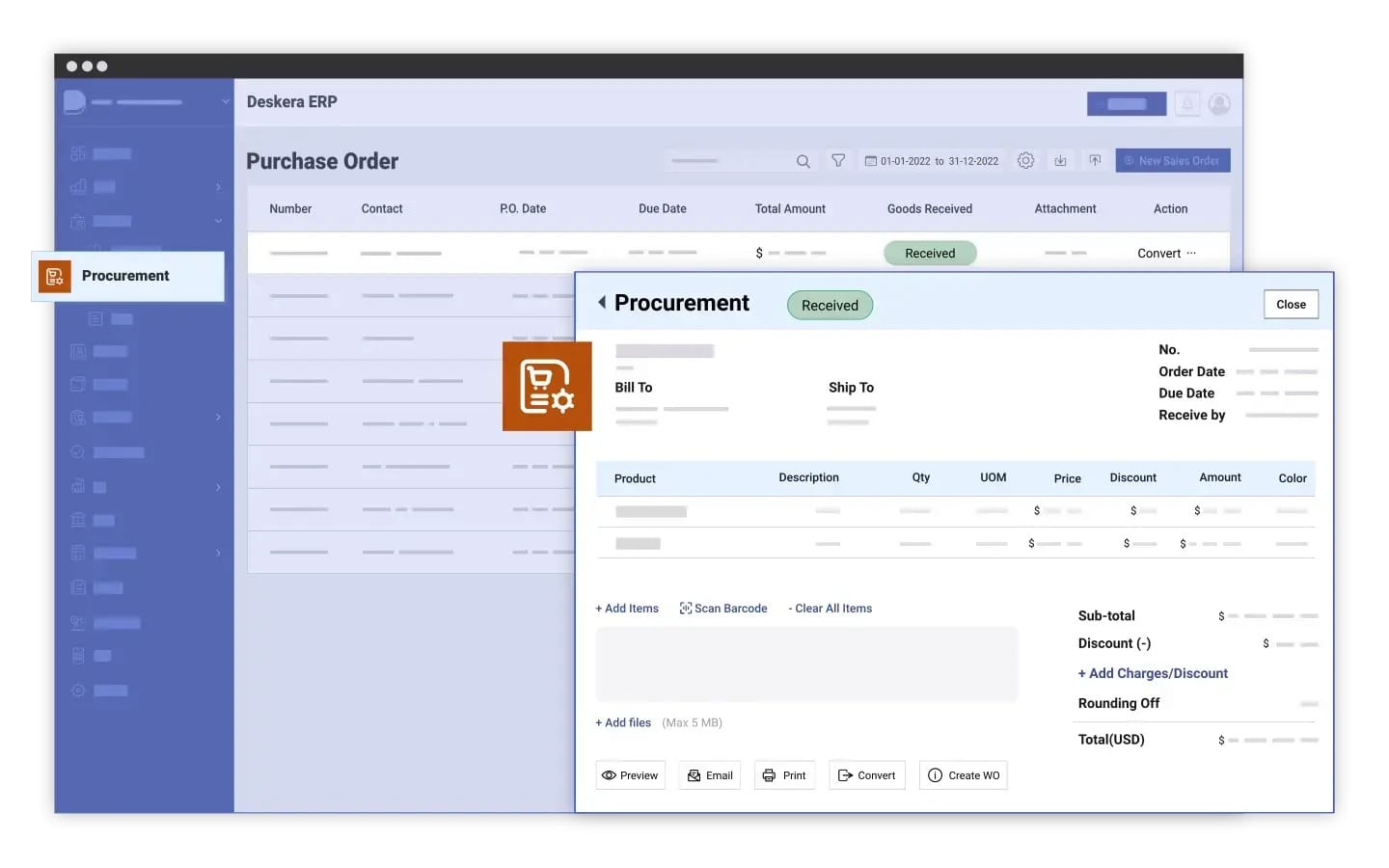
Effective procurement control requires visibility, standardization, automation, and real-time monitoring across the entire purchasing process. Deskera ERP helps businesses strengthen procurement control by centralizing procurement activities, automating workflows, improving spending oversight, and integrating procurement with inventory and financial management. This enables organizations to reduce procurement risks, improve compliance, and make better purchasing decisions.
Centralized Procurement Management
Deskera ERP provides a unified platform for managing procurement activities, including purchase requests, purchase orders, supplier information, goods receipts, and invoices. By consolidating procurement data in a single system, businesses gain better visibility into purchasing operations, eliminate information silos, and improve control over procurement processes.
Automated Purchase Requisitions and Purchase Orders
Manual procurement processes often result in delays and errors. Deskera ERP automates the creation and management of purchase requisitions and purchase orders, helping organizations streamline procurement workflows. Automation ensures consistency, reduces administrative effort, and improves the accuracy of procurement transactions.
Approval Workflow Management
Deskera ERP enables businesses to establish structured approval workflows for procurement requests and purchases. Approval hierarchies can be configured based on spending limits, departments, or organizational roles, ensuring that procurement activities follow company policies and authorization requirements. This helps prevent unauthorized spending and strengthens internal controls.
Real-Time Budget and Spend Tracking
Controlling procurement spending is a critical aspect of procurement control. Deskera ERP provides real-time visibility into purchasing activities and budget utilization, allowing businesses to monitor expenditures as they occur. Procurement teams can identify spending trends, avoid budget overruns, and make informed purchasing decisions based on accurate financial data.
Supplier Management and Performance Monitoring
Deskera ERP maintains centralized supplier records, making it easier to manage vendor information, purchase histories, pricing agreements, and transaction details. Businesses can evaluate supplier performance, monitor delivery reliability, and make more strategic sourcing decisions, helping improve supplier relationships while reducing procurement risks.
Inventory and Procurement Integration
By integrating procurement with inventory management, Deskera ERP helps organizations align purchasing decisions with actual inventory requirements. Procurement teams can track stock levels, monitor material consumption, and generate purchase orders based on inventory needs. This reduces excess inventory, prevents stockouts, and supports more efficient procurement planning.
Enhanced Compliance and Audit Readiness
Deskera ERP creates a complete digital record of procurement activities, including approvals, purchase orders, receipts, invoices, and supplier transactions. These audit trails improve transparency, simplify compliance reporting, and make it easier to prepare for internal and external audits. Organizations can ensure that procurement activities consistently follow established policies and procedures.
Procurement Reporting and Analytics
Deskera ERP offers reporting and analytics capabilities that provide valuable insights into procurement performance. Businesses can monitor key metrics such as procurement cycle times, supplier performance, purchasing costs, and spending patterns. These insights support data-driven decision-making and help organizations continuously improve procurement efficiency and control.
Integrated Financial Management
Since procurement activities directly impact organizational finances, Deskera ERP integrates procurement data with accounting and financial management functions. This integration improves financial visibility, enhances budget control, and ensures that procurement decisions align with broader business objectives. As a result, organizations can maintain stronger financial discipline while optimizing procurement operations.
By combining automation, visibility, supplier management, inventory integration, and financial controls, Deskera ERP helps businesses establish a more structured and effective procurement control framework. This not only improves operational efficiency and compliance but also reinforces the strategic role of ERP systems in procurement control by enabling organizations to manage purchasing activities with greater accuracy, accountability, and confidence.
Key Takeaways
- Procurement control establishes the policies, procedures, and monitoring mechanisms needed to ensure purchasing activities remain compliant, cost-effective, and aligned with organizational goals.
- Effective procurement control relies on key components such as segregation of duties, preventive controls, supplier data integrity, compliance checks, and audit readiness to reduce risk and improve governance.
- Procurement control works throughout the procure-to-pay lifecycle, from planning and budgeting to approval, execution, and continuous monitoring of procurement activities.
- Common procurement control challenges include limited visibility, manual processes, maverick spending, supplier management issues, compliance risks, and poor data accuracy.
- ERP systems play a strategic role in procurement control by centralizing procurement data, automating workflows, enhancing visibility, and strengthening governance across purchasing operations.
- Effective procurement control helps organizations improve cost management, increase financial visibility, strengthen compliance, reduce procurement risks, and enhance operational efficiency.
- Businesses can strengthen procurement control by implementing clear policies, standardizing processes, enabling real-time monitoring, enhancing transparency, conducting audits, and pursuing continuous improvement.
- Deskera ERP supports procurement control through centralized procurement management, automated workflows, approval controls, real-time spend tracking, supplier management, inventory integration, and procurement analytics.
- By combining strong procurement controls with ERP-driven automation and visibility, organizations can transform procurement into a strategic function that drives efficiency, compliance, cost savings, and long-term business value.
Related Articles
 Niti Samani
 Niti Samani
 Niti Samani
 Niti Samani
 Niti Samani
 Niti Samani