


“Why do some businesses convert leads faster while others struggle to get responses from prospects?” The answer often lies in how quickly and efficiently they engage with potential customers. In today’s competitive market, lead response time has become a critical factor influencing conversion rates, customer satisfaction, and overall sales performance. A delayed response can cause businesses to lose valuable opportunities, while companies that respond quickly are more likely to build trust and move prospects through the sales funnel successfully.
Managing lead response efficiently can be challenging when businesses rely on disconnected systems, manual processes, and scattered customer data. Sales teams often waste valuable time switching between spreadsheets, emails, CRM tools, and communication platforms just to gather customer information or assign leads. These inefficiencies slow down follow-ups, create communication gaps, and reduce the chances of converting high-potential leads into customers.
This is where ERP systems help businesses streamline and accelerate lead management processes. An ERP system integrates sales, CRM, customer support, finance, inventory, and communication tools into one centralized platform, enabling teams to access real-time customer information and automate workflows. Features such as automated lead assignment, instant notifications, workflow automation, centralized customer records, and real-time analytics help businesses reduce delays and improve responsiveness across every stage of the sales cycle.
Among the leading solutions available today, Deskera ERP offers a comprehensive platform designed to improve lead response time and sales efficiency. Its integrated CRM, workflow automation, AI-powered insights, real-time dashboards, and mobile accessibility help businesses manage customer interactions more effectively. By combining sales, customer support, inventory, accounting, and business intelligence into a single system, Deskera enables organizations to respond to leads faster, improve collaboration between teams, and deliver a better customer experience.
What Is Lead Response Time?
Lead response time refers to the amount of time it takes for a sales or marketing team to respond to a potential customer after they express interest in a business. This interest can come in many forms, such as filling out a contact form, requesting a demo, downloading an eBook, signing up for a newsletter, sending an inquiry, or booking a consultation. The timer starts the moment the lead reaches out and ends when a representative from the business makes the first response.
It is one of the most important sales performance metrics because it directly affects customer engagement and conversion opportunities. A fast response signals professionalism, attentiveness, and a willingness to help, while a delayed response can cause prospects to lose interest or turn to competitors. In highly competitive industries, even a few minutes can make a major difference in whether a lead converts into a customer.
For example, if a prospect submits a demo request at 10:00 AM and receives a reply from a sales representative at 10:20 AM, the lead response time is 20 minutes. Businesses often measure this metric across different lead sources because response urgency may vary depending on lead intent. A prospect requesting pricing information or a product demo is generally considered a warmer lead and requires a faster follow-up compared to someone downloading an informational resource.
Ultimately, the goal of lead response management is not just to respond quickly, but to respond first with accurate and personalized communication. Reducing lead response time helps businesses improve customer experience, increase conversion rates, strengthen trust, and create a more efficient sales process.
How to Calculate Lead Response Time
Lead response time measures the average amount of time it takes for a sales or support team to respond to incoming leads after they express interest in a business. Calculating this metric helps organizations evaluate sales efficiency, identify delays in communication, and improve customer engagement processes.
The calculation starts by measuring the time difference between when a lead is generated and when the first response is sent. Businesses then add the total response times for all leads and divide the result by the total number of leads handled during a specific period.
Lead Response Time Formula
Lead Response Time = Total Time Taken to Respond to Leads / Total Number of Leads
Example Calculation
Suppose a company received 5 leads in one day, and the response times were:
- Lead 1: 10 minutes
- Lead 2: 20 minutes
- Lead 3: 15 minutes
- Lead 4: 25 minutes
- Lead 5: 30 minutes
Total Response Time = 10 + 20 + 15 + 25 + 30 = 100 minutes
Lead Response Time = 100 / 5
Lead Response Time = 20 minutes
This means the company takes an average of 20 minutes to respond to new leads.
Businesses can further improve accuracy by tracking lead response time by source, campaign, department, or sales representative.
For example, leads requesting demos or pricing information may require much faster follow-ups than informational inquiries.
Monitoring this KPI regularly helps businesses identify bottlenecks, improve responsiveness, and increase lead conversion opportunities.
Why Lead Response Time is Critical for Business Success
Lead response time plays a major role in determining how effectively a business converts prospects into customers. In today’s fast-moving digital environment, customers expect quick communication and immediate assistance when they show interest in a product or service.
A delayed response can reduce engagement, weaken trust, and increase the likelihood of losing leads to competitors. Faster response times help businesses improve sales performance, customer relationships, and operational efficiency.
Higher Lead Conversion Rates
Responding to leads quickly significantly increases the chances of converting prospects into paying customers.
When businesses engage with leads while their interest is still high, they can answer questions, address concerns, and guide prospects through the sales process more effectively.
Slow responses often result in lost opportunities because potential customers may move on to competitors who respond faster and provide immediate support.
Improved Customer Experience
Fast lead response times create a positive first impression and demonstrate that a business values its customers. Quick communication helps prospects feel acknowledged and supported, which improves customer satisfaction and trust.
On the other hand, delayed responses can frustrate potential buyers and negatively impact brand perception. Providing timely assistance strengthens customer relationships and encourages long-term engagement with the business.
Stronger Competitive Advantage
In competitive markets, speed can become a major differentiator. Businesses that respond to inquiries faster than competitors are more likely to capture customer attention and secure sales opportunities.
Prospects often contact multiple companies before making a decision, and the first business to respond professionally and accurately usually gains an advantage. Faster response times help companies stand out and improve their market positioning.
Increased Sales Team Productivity
Efficient lead response processes help sales teams manage inquiries more effectively and reduce time spent on manual follow-ups.
Automated workflows, centralized customer information, and real-time notifications enable representatives to prioritize leads and respond quickly.
This improves productivity, reduces missed opportunities, and allows teams to focus more on nurturing high-value prospects and closing deals.
Better Lead Qualification and Prioritization
Quick responses allow businesses to identify high-intent leads earlier in the sales cycle. Sales teams can assess customer requirements, buying readiness, and potential value more efficiently when communication happens promptly.
Faster lead qualification helps businesses prioritize promising opportunities, allocate resources effectively, and improve overall sales pipeline management while reducing delays in decision-making.
Faster Sales Cycles and Revenue Growth
Reducing lead response time accelerates the entire sales process by keeping prospects engaged and moving them through the pipeline more efficiently.
Faster interactions reduce waiting periods, improve communication flow, and shorten the time required to close deals.
As businesses convert leads more quickly and consistently, they can increase sales revenue, improve forecasting accuracy, and support long-term business growth.
Common Challenges That Slow Down Lead Response Time
Many businesses struggle to respond to leads quickly due to operational inefficiencies, disconnected systems, and manual sales processes. These challenges create delays in communication, reduce sales productivity, and increase the risk of losing potential customers to competitors.
Identifying and addressing these obstacles is essential for improving responsiveness, streamlining lead management, and creating a more efficient customer engagement process.
Disconnected Systems and Data Silos
Businesses often use separate tools for CRM, email communication, marketing automation, customer support, and sales tracking.
When customer information is scattered across multiple platforms, sales teams spend extra time searching for data instead of responding to leads.
This lack of centralized information slows communication, creates inconsistencies, and reduces the efficiency of lead management processes.
Manual Lead Assignment Processes
Many organizations still rely on manual methods to assign leads to sales representatives. This can create delays, confusion, and uneven lead distribution among team members.
Without automated routing systems, leads may remain unattended for extended periods, reducing engagement opportunities. Manual assignment also increases the risk of human error, duplicate follow-ups, and missed sales opportunities.
Poor Communication Between Teams
Ineffective collaboration between sales, marketing, and customer support teams can significantly slow lead response time.
When departments operate independently without sharing real-time information, important customer details may be delayed or overlooked.
Poor communication creates inconsistencies in follow-ups, weakens customer experiences, and prevents teams from responding quickly and accurately to inquiries.
Limited Visibility Into Lead Status
Without real-time tracking and reporting systems, businesses often struggle to monitor lead progress throughout the sales pipeline. Sales managers may not know which leads have been contacted, followed up on, or neglected.
Limited visibility can result in delayed responses, duplicate outreach efforts, and missed follow-ups, making it difficult to maintain an organized and efficient sales process.
High Volume of Incoming Leads
As businesses grow, managing a large number of incoming leads across websites, social media, emails, and other channels becomes increasingly challenging.
Sales teams may find it difficult to prioritize urgent inquiries or identify high-value prospects quickly. Without automation and proper lead management systems, high lead volumes can overwhelm teams and increase response delays.
Lack of Workflow Automation
Manual processes for follow-ups, reminders, approvals, and communication tasks consume valuable time and reduce operational efficiency.
Sales representatives may forget to follow up with prospects or delay responses due to repetitive administrative work.
Without workflow automation, businesses struggle to maintain consistent communication, leading to slower response times and lower lead conversion rates.
Inadequate Lead Prioritization
Not all leads have the same level of interest or urgency, but many businesses lack effective lead scoring and prioritization systems.
As a result, sales teams may spend too much time on low-priority prospects while high-intent leads wait for responses.
Poor prioritization reduces sales efficiency and increases the risk of losing qualified leads to competitors who respond faster.
Limited Mobile Accessibility
Sales teams often work remotely, travel frequently, or manage customer interactions outside traditional office environments. Without mobile access to customer data, CRM tools, and communication systems, representatives may face delays in responding to inquiries.
Limited accessibility reduces flexibility, slows decision-making, and affects the overall speed and quality of customer engagement.
How ERP Systems Help Improve Lead Response Time
ERP systems help businesses improve lead response time by centralizing customer information, automating sales workflows, and enabling faster communication across departments.
Instead of relying on disconnected tools and manual processes, businesses can use ERP software to manage leads, customer interactions, follow-ups, and sales activities from a single platform.
This improves operational efficiency, reduces delays, and helps sales teams respond to potential customers more quickly and effectively.
Centralized Customer and Lead Information
ERP systems store customer data, lead history, communication records, and sales activities in one centralized database.
This allows sales representatives to access complete customer information instantly without switching between multiple systems.
Faster access to accurate data helps teams respond to inquiries quickly, personalize communication, and reduce delays caused by scattered or incomplete information.
Automated Lead Capture and Assignment
Modern ERP systems automatically capture leads from websites, emails, social media, forms, and other communication channels.
Once captured, leads can be assigned automatically to the appropriate sales representatives based on predefined rules such as location, product category, or lead source.
Automation reduces manual effort, eliminates assignment delays, and ensures leads receive immediate attention.
Real-Time Notifications and Alerts
ERP software provides real-time notifications whenever a new lead enters the system or when follow-up actions are required. Sales teams receive instant alerts for inquiries, pending responses, scheduled meetings, and customer activities.
These notifications help representatives respond faster, avoid missed opportunities, and maintain consistent communication throughout the sales process.
Workflow Automation
ERP systems automate repetitive sales and communication tasks such as sending emails, scheduling follow-ups, updating lead statuses, and creating reminders.
By reducing manual administrative work, sales teams can focus more on engaging with prospects and closing deals. Workflow automation also ensures that leads move through the sales pipeline without unnecessary delays or interruptions.
Improved Collaboration Across Departments
Lead management often involves multiple departments, including sales, marketing, customer service, and finance. ERP systems create a unified platform where teams can share real-time information and collaborate more efficiently.
Better coordination between departments improves communication, reduces response gaps, and enables faster resolution of customer inquiries and sales opportunities.
AI-Powered Lead Prioritization
Many modern ERP solutions use artificial intelligence and analytics to score and prioritize leads based on customer behavior, engagement, purchase intent, and historical data.
AI-driven prioritization helps sales teams focus on high-value or high-intent leads first, improving response efficiency and increasing the likelihood of conversions.
Mobile Accessibility for Sales Teams
Cloud-based ERP systems provide mobile access to customer information, lead data, and communication tools.
Sales representatives can respond to inquiries, update lead statuses, and manage follow-ups from any location using smartphones or tablets.
Mobile accessibility improves responsiveness, especially for remote teams or field sales representatives who need instant access to information.
Integration With Communication Channels
ERP systems integrate with emails, chat platforms, websites, social media channels, and customer support systems to centralize all communication activities.
This integration enables businesses to manage leads from multiple channels within a single interface. Unified communication improves visibility, reduces delays, and ensures faster responses to customer inquiries across platforms.
Real-Time Analytics and Performance Monitoring
ERP software provides dashboards and analytics tools that track lead response times, sales activities, conversion rates, and team performance in real time.
Businesses can identify bottlenecks, monitor service levels, and optimize lead management processes more effectively. Real-time visibility helps organizations continuously improve responsiveness and sales efficiency.
Better Lead Tracking and Follow-Up Management
ERP systems help businesses track every stage of the lead lifecycle, from initial inquiry to final conversion. Automated follow-up reminders, task management tools, and activity tracking ensure that no lead is forgotten or neglected.
This improves accountability, strengthens customer engagement, and increases the chances of converting leads into long-term customers.
Benefits of Improving Lead Response Time With ERP
Improving lead response time with ERP systems offers advantages that go beyond faster communication and higher conversions.
ERP software helps businesses build more organized, scalable, and data-driven sales operations by automating workflows, improving visibility, and centralizing customer management.
These operational and strategic benefits help organizations improve efficiency, reduce resource wastage, and create a more consistent sales process across departments.
Better Workflow Standardization
ERP systems help businesses create standardized lead management workflows across teams and departments. Automated processes ensure that every lead follows the same structured journey, from capture and assignment to follow-up and conversion.
Standardization reduces inconsistencies, improves process reliability, and helps businesses maintain uniform customer engagement practices regardless of team size or location.
Reduced Administrative Burden
Manual tasks such as updating spreadsheets, assigning leads, scheduling reminders, and tracking follow-ups consume significant time and resources.
ERP automation reduces repetitive administrative work by streamlining these processes within a centralized platform.
This allows sales teams to focus more on customer engagement, relationship building, and strategic sales activities instead of operational tasks.
Improved Data Accuracy and Consistency
ERP systems centralize lead and customer information in one database, reducing the risk of duplicate records, outdated information, and manual entry errors.
Accurate and consistent data helps sales teams communicate more effectively, track customer interactions properly, and make informed decisions.
Better data quality also improves reporting accuracy and supports more reliable sales forecasting.
Enhanced Sales Pipeline Visibility
ERP software provides real-time visibility into lead movement, sales activities, pending follow-ups, and conversion stages. Managers can monitor pipeline performance, identify bottlenecks, and track team responsiveness more efficiently.
Greater visibility helps businesses optimize lead handling processes, improve accountability, and ensure that no opportunities are lost due to poor tracking or communication gaps.
Stronger Cross-Department Coordination
Lead management often requires coordination between sales, marketing, finance, inventory, and customer support teams. ERP systems integrate these functions into a single platform, enabling departments to share information seamlessly.
Improved coordination reduces delays caused by miscommunication and ensures that customer inquiries, quotations, approvals, and support requests are handled more efficiently.
Scalability for Growing Businesses
As businesses expand, managing increasing lead volumes manually becomes difficult and inefficient.
ERP systems provide scalable infrastructure that can handle larger customer databases, multiple sales channels, and growing operational complexity.
Automated lead management processes allow businesses to maintain fast response times and operational efficiency even as sales activities increase.
Better Compliance and Activity Tracking
ERP systems maintain detailed records of customer interactions, follow-ups, communication history, and sales activities.
This improves transparency and makes it easier for businesses to monitor employee performance, maintain process compliance, and audit customer communication when needed.
Activity tracking also helps businesses identify inefficiencies and continuously improve sales operations.
Improved Decision-Making With Real-Time Insights
ERP platforms provide real-time analytics, dashboards, and reporting tools that help businesses monitor lead response performance and sales efficiency.
Managers can analyze response trends, identify delays, evaluate team productivity, and make faster operational decisions.
Access to real-time business intelligence helps organizations optimize lead management strategies and improve overall sales effectiveness.
Best Practices for Using ERP to Improve Lead Response Time
Implementing an ERP system alone is not enough to achieve faster lead response times. Businesses must also adopt the right strategies, workflows, and operational practices to maximize the effectiveness of their ERP platform.
By combining automation, real-time visibility, standardized processes, and team collaboration, organizations can significantly improve responsiveness, streamline lead management, and create a more efficient customer engagement process.
Automate Lead Capture and Assignment
Businesses should configure their ERP system to automatically capture leads from websites, emails, social media platforms, and contact forms.
Automated lead assignment rules based on territory, product type, lead source, or sales representative availability help eliminate manual delays.
This ensures that leads are routed to the right team members instantly, improving response speed and reducing the risk of missed opportunities.
Set Clear Lead Response Time Goals
Establishing measurable response time targets helps sales teams prioritize speed and accountability. Businesses should define service-level expectations for responding to different types of leads, such as demo requests, support inquiries, or pricing questions. ERP dashboards and analytics tools can then be used to monitor response performance and identify areas requiring improvement.
Centralize Customer and Communication Data
Maintaining all customer interactions, communication history, and lead details within the ERP system improves accessibility and consistency.
Sales representatives should be able to access emails, call records, notes, and previous interactions from a single platform. Centralized information reduces time spent searching for data and enables faster, more personalized customer responses.
Use Workflow Automation for Follow-Ups
ERP workflow automation should be used to schedule reminders, create follow-up tasks, send automated emails, and update lead statuses. Automated workflows help ensure that no lead is overlooked or forgotten during the sales cycle.
Reducing manual administrative work also allows sales teams to focus more on engaging with prospects and building customer relationships.
Integrate All Customer Communication Channels
Businesses should integrate email platforms, websites, live chat systems, social media channels, customer support tools, and CRM functions into the ERP system.
Omnichannel integration provides a unified view of customer interactions and allows teams to manage inquiries from multiple sources in one place. This improves visibility, coordination, and response efficiency across communication channels.
Prioritize High-Intent Leads With AI and Analytics
Many ERP systems provide AI-powered lead scoring and analytics capabilities that help businesses identify high-priority prospects.
Sales teams should use predictive insights to focus on leads with stronger buying intent or higher conversion potential. Prioritizing urgent or valuable inquiries helps improve sales efficiency and increases the chances of successful conversions.
Enable Mobile Access for Sales Teams
Providing mobile access to ERP systems allows sales representatives to respond to leads and update customer information from any location.
Mobile accessibility is especially important for remote teams and field sales representatives who need real-time access to lead data and communication tools. Faster access to information improves responsiveness and enhances customer engagement.
Train Employees on ERP Usage and Workflows
Even advanced ERP systems cannot deliver optimal results without proper employee training. Businesses should ensure that sales, marketing, and customer support teams understand how to use ERP features effectively, including lead tracking, automation tools, dashboards, and reporting systems. Well-trained employees can respond more efficiently, reduce errors, and improve overall lead management performance.
Monitor KPIs and Continuously Optimize Processes
Businesses should regularly track key metrics such as lead response time, follow-up rates, conversion rates, and sales cycle length using ERP analytics tools.
Monitoring performance helps identify bottlenecks, inefficiencies, and communication gaps within the sales process.
Continuous optimization ensures that lead management strategies remain effective as customer expectations and business operations evolve.
Maintain Clean and Accurate Lead Data
Outdated, incomplete, or duplicate customer information can slow response times and reduce communication accuracy. Businesses should regularly update and clean lead databases within the ERP system to maintain reliable customer records.
Accurate data improves workflow efficiency, enhances reporting quality, and helps sales teams engage with prospects more effectively.
Important KPIs to Track Lead Response Performance
Tracking the right key performance indicators (KPIs) helps businesses measure the effectiveness of their lead management process and identify areas for improvement.
These metrics provide valuable insights into response efficiency, sales productivity, customer engagement, and conversion performance.
By monitoring lead response KPIs regularly through ERP systems, businesses can optimize workflows, reduce delays, and improve overall sales outcomes.
Average Lead Response Time
Average lead response time measures how long it takes sales teams to respond to incoming leads. It is one of the most important indicators of sales responsiveness and operational efficiency. A lower response time generally improves customer engagement and conversion opportunities.
Formula:
Average Lead Response Time = Total Time Taken to Respond to Leads / Total Number of Leads
Lead Conversion Rate
Lead conversion rate measures the percentage of leads that successfully convert into customers. This KPI helps businesses evaluate the effectiveness of their lead response process, sales communication, and follow-up strategies.
Formula:
Lead Conversion Rate (%) = (Converted Leads / Total Leads) × 100
First Response Time
First response time tracks the amount of time taken to send the initial response after a lead inquiry is received. This metric specifically focuses on the speed of the first customer interaction, which often plays a major role in shaping customer perception and engagement.
Formula:
First Response Time = Total Time Taken for Initial Responses / Total Number of Leads
Lead Follow-Up Rate
Lead follow-up rate measures how consistently sales teams engage with incoming leads after the first interaction. This KPI helps businesses monitor whether leads are being properly nurtured throughout the sales cycle.
Formula:
Lead Follow-Up Rate (%) = (Leads Followed Up With / Total Leads Received) × 100
Sales Cycle Length
Sales cycle length measures the average time required to convert a lead into a paying customer. Shorter sales cycles often indicate efficient lead management, faster decision-making, and effective communication processes.
Formula:
Sales Cycle Length = Total Number of Days to Close Deals / Total Deals Closed
Lead Qualification Rate
Lead qualification rate measures the percentage of incoming leads that meet predefined qualification criteria. This KPI helps businesses assess lead quality and the effectiveness of lead scoring and prioritization processes.
Formula:
Lead Qualification Rate (%) = (Qualified Leads / Total Leads) × 100
Customer Response Satisfaction Score
This KPI measures how satisfied leads or customers are with the speed and quality of responses they receive. Businesses often collect this data through feedback surveys, ratings, or customer experience forms.
Formula:
Customer Response Satisfaction Score (%) = (Total Positive Response Ratings / Total Responses Collected) × 100
Lead Abandonment Rate
Lead abandonment rate measures the percentage of leads that stop engaging with the business due to delayed responses, poor follow-ups, or ineffective communication. Monitoring this KPI helps businesses identify weaknesses in their lead management process.
Formula:
Lead Abandonment Rate (%) = (Lost or Unresponsive Leads / Total Leads) × 100
Revenue Per Lead
Revenue per lead measures the average revenue generated from each lead acquired. This KPI helps businesses evaluate the financial effectiveness of their lead response and conversion strategies.
Formula:
Revenue Per Lead = Total Revenue Generated From Leads / Total Number of Leads
How Deskera ERP Helps Improve Lead Response Time
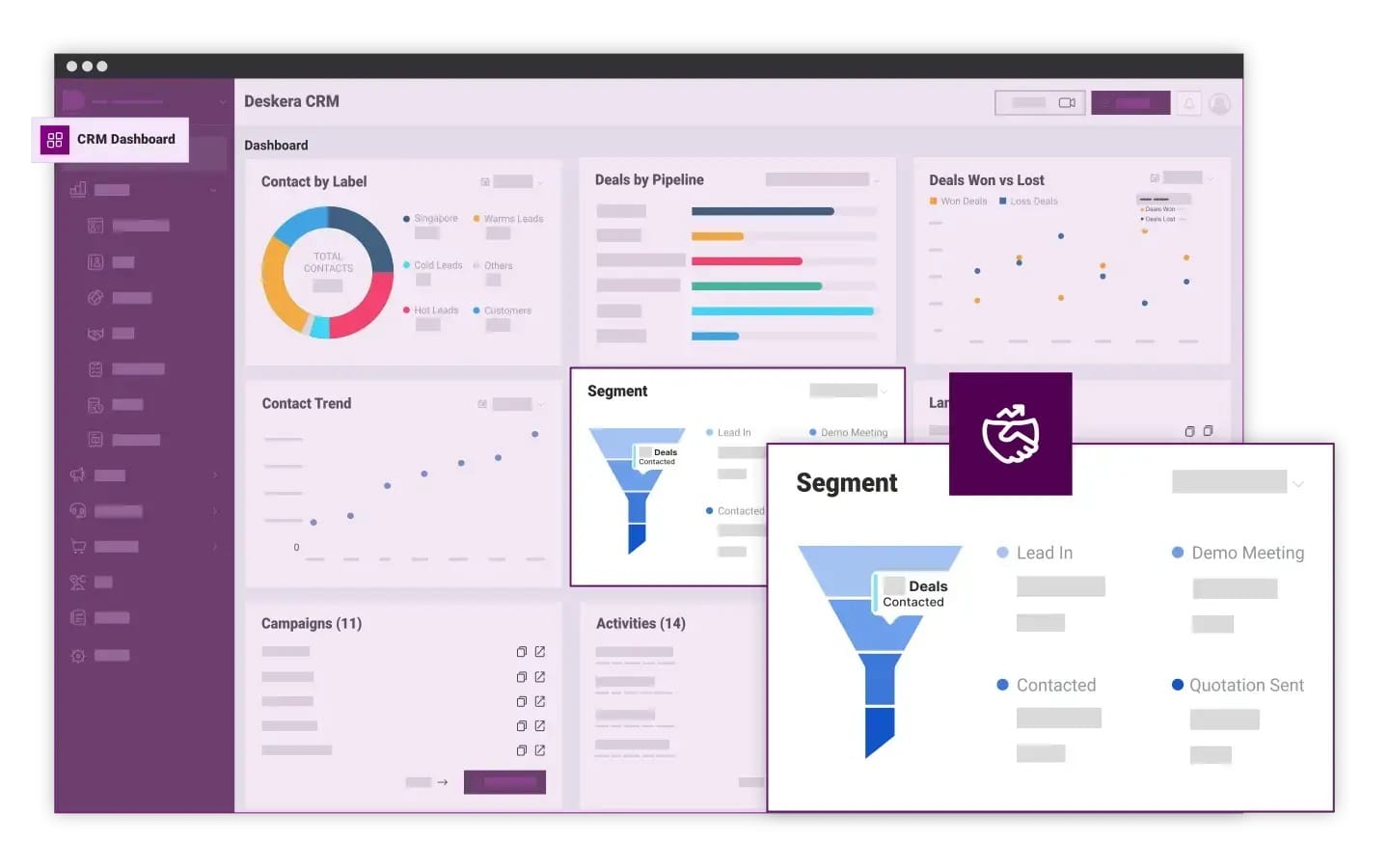
Deskera ERP helps businesses improve lead response time by centralizing customer interactions, automating workflows, and streamlining communication across departments. Its integrated ERP and CRM capabilities enable sales teams to manage leads, customer data, communication history, and sales activities from one unified platform, helping businesses respond to inquiries faster and more efficiently.
Centralized Customer Relationship Management
Deskera ERP includes integrated CRM features that allow businesses to segment customers, create deal pipelines, track customer histories and interactions, and manage opportunities within a centralized system. By giving sales teams quick access to customer information and communication records, Deskera reduces delays caused by disconnected systems and improves response efficiency.
Automated Sales and Workflow Processes
Deskera ERP helps automate sales and marketing tasks through workflow automation and rule-based processes. Businesses can automate repetitive activities such as follow-up reminders, lead management tasks, approval workflows, and customer communication processes. Automation reduces manual effort, speeds up lead handling, and helps teams respond to inquiries more consistently.
Real-Time Dashboards and Business Intelligence
The platform provides dashboards, smart reports, forecasts, and business intelligence tools that help businesses monitor sales activities and track key performance metrics in real time. These insights help managers identify bottlenecks, monitor response performance, and make faster operational decisions to improve lead management efficiency.
Mobile Accessibility and Cloud ERP Capabilities
Deskera ERP offers cloud-based accessibility and mobile application support, allowing sales teams to access customer information, manage leads, and respond to inquiries from anywhere. Mobile accessibility improves flexibility for remote and field sales teams, enabling faster customer engagement and reducing response delays.
Integrated Business Modules for Faster Coordination
Deskera ERP integrates accounting, finance, inventory, procurement, warehouse management, CRM, and customer service into one platform. This centralized business environment improves coordination between departments and reduces communication gaps that can slow lead handling processes. Sales teams can access relevant business information quickly, improving responsiveness and operational efficiency.
Key Takeaways
- Lead response time measures how quickly a business responds after a prospect expresses interest, making it a critical sales performance metric.
- Faster lead response times improve customer engagement, strengthen trust, and increase the likelihood of converting prospects into customers.
- Common challenges such as disconnected systems, manual workflows, poor communication, and limited visibility can significantly delay lead responses.
- Calculating lead response time helps businesses monitor sales efficiency and identify bottlenecks in customer communication processes.
- ERP systems improve lead response time by centralizing customer data, automating workflows, and streamlining communication across departments.
- Features such as automated lead assignment, workflow automation, real-time notifications, and integrated communication tools help businesses respond to leads more efficiently.
- Businesses should look for ERP features such as CRM integration, automation capabilities, analytics dashboards, mobile accessibility, and omnichannel communication support to improve lead management.
- Using ERP systems for lead response management helps businesses standardize workflows, reduce administrative work, improve data accuracy, and strengthen operational visibility.
- Industries such as manufacturing, retail, healthcare, SaaS, professional services, and real estate can benefit significantly from ERP-driven lead management processes.
- Best practices such as automating lead routing, centralizing customer information, integrating communication channels, and monitoring KPIs help maximize ERP effectiveness.
- Tracking KPIs like average lead response time, lead conversion rate, follow-up rate, sales cycle length, and lead qualification rate helps businesses continuously optimize sales performance.
- Emerging trends such as AI-powered analytics, predictive lead scoring, cloud ERP systems, and workflow automation are shaping the future of lead response management.
- Deskera ERP helps businesses improve lead response time through integrated CRM, workflow automation, real-time dashboards, centralized customer management, and connected business operations.
Related Articles
 Niti Samani
 Niti Samani
 Niti Samani
 Niti Samani
 Niti Samani
 Niti Samani