


What happens when manufacturers fail to predict lead times accurately? The result is often production delays, inventory shortages, missed delivery deadlines, rising operational costs, and dissatisfied customers. In today’s highly competitive manufacturing environment, even small forecasting errors can disrupt the entire supply chain. This is why lead time forecasting has become a critical part of modern manufacturing operations.
Lead time forecasting refers to the process of estimating the time required to procure raw materials, manufacture products, and deliver finished goods to customers. Accurate forecasting enables manufacturers to plan production schedules more effectively, optimize inventory levels, improve supplier coordination, and respond quickly to changing customer demand. However, relying on spreadsheets and disconnected systems often leads to inaccurate forecasts and limited visibility across operations.
This is where Enterprise Resource Planning (ERP) systems play a transformative role. Modern ERP solutions centralize business data from procurement, inventory, production, warehouse management, and supply chain operations into a single platform. By providing real-time insights, automation, and predictive analytics, ERP systems help manufacturers improve lead time forecasting accuracy and make faster, data-driven decisions. As supply chains become more complex, ERP-driven forecasting is increasingly essential for maintaining operational efficiency and customer satisfaction.
Deskera ERP helps manufacturers streamline lead time forecasting through integrated inventory management, production planning, procurement automation, and real-time reporting tools. Its AI-powered capabilities enable businesses to analyze historical trends, monitor supplier performance, and optimize production schedules with greater accuracy. With mobile accessibility, cloud-based infrastructure, and advanced analytics, Deskera ERP empowers manufacturers to reduce delays, improve supply chain visibility, and enhance overall operational agility.
What Is Lead Time Forecasting?
Lead time forecasting is the process of estimating the amount of time required to complete a business or manufacturing process from start to finish. In manufacturing, it typically involves predicting how long it will take to procure raw materials, produce goods, and deliver finished products to customers. Accurate lead time forecasting helps businesses plan operations more efficiently, reduce delays, and improve overall supply chain performance.
Manufacturers use lead time forecasting to better align production schedules with customer demand and inventory availability. By analyzing historical data, supplier performance, production capacity, market trends, and demand fluctuations, businesses can make more informed decisions about procurement, inventory replenishment, and production planning. This helps minimize disruptions and ensures smoother operational workflows.
Lead time forecasting is especially important in industries where supply chain complexity, fluctuating demand, and tight delivery schedules directly impact profitability and customer satisfaction. Without accurate forecasting, manufacturers may face stock shortages, production bottlenecks, excess inventory, missed deadlines, and higher operational costs. Effective forecasting enables companies to proactively address risks before they affect business operations.
Modern ERP systems have significantly improved the accuracy and efficiency of lead time forecasting. ERP software integrates data from inventory, procurement, warehouse management, production planning, and supply chain operations into a centralized platform. This provides real-time visibility and predictive insights that help manufacturers forecast lead times more accurately and respond quickly to changing business conditions.
Types of Lead Time in Manufacturing
In manufacturing, lead time is not limited to a single process. It consists of multiple stages across procurement, sourcing, production, inventory handling, and product delivery.
Understanding the different types of lead time helps manufacturers identify operational bottlenecks, improve forecasting accuracy, and optimize supply chain efficiency. Each type plays a critical role in ensuring smooth production workflows, timely deliveries, and improved customer satisfaction.
Customer Lead Time
Customer lead time refers to the total time a customer experiences from placing an order until receiving the finished product. It includes order processing, procurement, production, packaging, shipping, and final delivery.
This metric directly impacts customer satisfaction and brand reputation. Manufacturers that reduce customer lead time can improve service quality, respond faster to market demand, and gain a stronger competitive advantage in their industry.
Material Lead Time
Material lead time is the time required to procure and receive raw materials or components from suppliers. It begins when a purchase order is placed and ends when the materials are delivered and ready for production use.
Delays in material lead time can disrupt manufacturing schedules and create inventory shortages. Accurate forecasting helps businesses maintain sufficient stock levels while avoiding excessive inventory carrying costs.
Procurement Lead Time
Procurement lead time refers to the complete duration involved in sourcing and purchasing materials or services needed for manufacturing operations. It includes supplier selection, purchase approvals, order processing, transportation, and receiving activities.
Longer procurement lead times can slow down production and increase operational inefficiencies. ERP systems help manufacturers automate procurement workflows, track supplier performance, and improve procurement planning for faster material availability.
Production Lead Time
Production lead time is the actual time required to manufacture or assemble a product once all materials, labor, and machinery are available on the factory floor. It includes machine setup, assembly, processing, inspection, and packaging activities.
Long production lead times reduce operational flexibility and delay customer deliveries. Manufacturers use ERP-driven production planning and scheduling tools to optimize workflows and minimize production bottlenecks.
Supplier Lead Time
Supplier lead time measures how long suppliers take to process and deliver materials after receiving a purchase order. This duration may vary due to supplier capacity constraints, transportation delays, market demand fluctuations, or geopolitical disruptions.
Monitoring supplier lead time helps manufacturers evaluate supplier reliability and improve sourcing strategies. ERP systems provide real-time supplier performance data to support better forecasting and supplier relationship management.
Delivery Lead Time
Delivery lead time refers to the time required to transport finished goods from the manufacturing facility to the customer’s location. It includes packaging, warehousing, shipping, and final-mile delivery processes.
Inefficient logistics operations or transportation delays can negatively affect customer satisfaction and profitability. Accurate delivery forecasting enables manufacturers to optimize logistics planning, improve on-time delivery performance, and provide realistic delivery schedules to customers.
Order Lead Time
Order lead time encompasses all internal activities involved in processing a customer order, including order receipt, production scheduling, manufacturing, packaging, and shipping. It reflects the total time required to complete the order fulfillment process within the organization.
Reducing order lead time improves responsiveness and operational efficiency. ERP systems help streamline order processing workflows by integrating inventory, production, procurement, and logistics operations.
Cumulative Lead Time
Cumulative lead time represents the maximum possible time needed to fulfill a customer order when no inventory is available in stock. It combines all procurement, material sourcing, and production lead times into a single metric.
Manufacturers use cumulative lead time for strategic planning, demand forecasting, and capacity management. Understanding this metric helps businesses evaluate production flexibility and prepare for long-term supply chain requirements.
Key Attributes of Lead Time Forecasting
Effective lead time forecasting goes beyond simply estimating delivery or production timelines. It involves analyzing multiple variables that influence supply chain reliability, inventory planning, procurement decisions, and production efficiency.
Understanding the key attributes of lead time forecasting helps manufacturers improve operational accuracy, reduce risks, and make better data-driven decisions across the supply chain.
Lead Time Forecast Value
The lead time forecast value represents the estimated duration required to complete a procurement, production, or delivery process. This forecast is typically generated using historical data, supplier performance, demand patterns, and operational trends.
Accurate forecast values help manufacturers determine when to order materials, schedule production, and plan deliveries. Modern ERP systems provide intelligent forecasting capabilities that continuously update lead time estimates using real-time operational data.
Lead Time Deviation
Lead time deviation measures the variability or inconsistency in supplier or production lead times. A high deviation indicates unpredictable delivery or manufacturing performance, which increases operational risk and requires additional safety stock.
Even a short lead time can create inventory challenges if it fluctuates significantly. Monitoring lead time deviation helps manufacturers assess supplier reliability, improve planning accuracy, and reduce unnecessary inventory carrying costs caused by uncertainty.
Lead Time Reliability
Lead time reliability refers to the consistency with which suppliers, production teams, or logistics providers meet expected timelines. Reliable lead times improve production scheduling, inventory optimization, and customer satisfaction.
Poor reliability often results in delays, stock shortages, and operational disruptions. Manufacturers use ERP systems and supplier performance analytics to monitor reliability trends and identify areas that require process improvements or stronger supplier collaboration.
Lead Time Seasonality
Lead time seasonality refers to recurring fluctuations in lead times caused by seasonal trends or external conditions. Factors such as weather disruptions, supplier shutdowns, holiday demand spikes, employee vacations, and transportation congestion can all affect lead time performance.
Recognizing seasonal patterns enables manufacturers to adjust procurement schedules, increase safety stock when necessary, and avoid unexpected supply chain disruptions during peak or slow periods.
Historical Lead Time Analysis
Historical lead time analysis involves reviewing past lead time data to identify trends, recurring delays, and operational inefficiencies. Analyzing historical performance helps businesses improve forecasting accuracy and make more informed procurement and production decisions.
ERP systems centralize historical operational data, enabling manufacturers to compare supplier performance, evaluate production timelines, and continuously refine forecasting models based on actual business outcomes.
Safety Stock Impact
Lead time forecasting directly affects safety stock requirements. When lead times are uncertain or highly variable, businesses often maintain additional inventory to prevent stockouts and production interruptions.
However, excess safety stock increases storage and carrying costs. Accurate lead time forecasting helps manufacturers balance inventory levels more effectively by minimizing uncertainty and reducing the need for excessive buffer inventory.
Real-Time Data Visibility
Real-time visibility is a critical attribute of modern lead time forecasting. Manufacturers need access to up-to-date information from suppliers, inventory systems, production operations, and logistics networks to make accurate forecasts.
ERP systems provide centralized, real-time dashboards that help businesses monitor operational performance, identify delays quickly, and respond proactively to changing supply chain conditions.
Predictive and Data-Driven Insights
Modern lead time forecasting increasingly relies on predictive analytics, artificial intelligence, and machine learning technologies. These tools analyze large volumes of operational and market data to identify patterns, forecast risks, and improve decision-making accuracy.
Predictive insights help manufacturers anticipate disruptions, optimize procurement timing, and improve production planning before problems impact business operations.
Benefits of Effective Lead Time Forecasting
Effective lead time forecasting helps manufacturers improve operational efficiency, reduce supply chain disruptions, and make more informed business decisions.
By accurately estimating procurement, production, and delivery timelines, businesses can optimize inventory levels, improve customer satisfaction, and strengthen overall supply chain performance.
In today’s competitive manufacturing environment, accurate forecasting has become essential for maintaining profitability and operational agility.
Improved Production Planning
Accurate lead time forecasting enables manufacturers to create more efficient production schedules based on material availability, workforce capacity, and customer demand. Better planning reduces production bottlenecks, machine downtime, and workflow disruptions.
Manufacturers can allocate resources more effectively and ensure smoother production operations while minimizing delays that negatively impact delivery commitments and operational efficiency.
Reduced Inventory Costs
Lead time forecasting helps businesses maintain optimal inventory levels by improving procurement timing and reducing uncertainty. Manufacturers can avoid overstocking excess materials while minimizing the risk of stock shortages that interrupt production.
Lower inventory carrying costs, reduced warehousing expenses, and improved inventory turnover contribute to better cash flow management and higher overall profitability.
Better Supplier Management
Accurate forecasting allows manufacturers to evaluate supplier reliability and plan procurement activities more strategically. Businesses can identify suppliers with inconsistent delivery performance and take corrective actions before disruptions occur.
Improved supplier coordination strengthens supply chain relationships, enhances procurement efficiency, and reduces delays caused by poor supplier performance or inaccurate purchasing decisions.
Faster Order Fulfillment
Effective lead time forecasting improves order processing and delivery performance by aligning production schedules with customer demand. Manufacturers can provide more accurate delivery timelines and reduce delays in order fulfillment.
Faster and more reliable deliveries improve customer satisfaction, increase repeat business opportunities, and strengthen brand reputation in competitive manufacturing markets.
Enhanced Customer Satisfaction
Customers expect accurate delivery commitments and timely order fulfillment. Effective lead time forecasting helps businesses meet customer expectations consistently by reducing unexpected delays and improving communication.
When manufacturers can reliably deliver products on time, they build stronger customer trust, improve retention rates, and enhance overall customer experience.
Improved Supply Chain Visibility
Lead time forecasting provides better visibility into procurement, production, inventory, and logistics operations. Manufacturers can monitor operational performance more effectively and identify potential disruptions before they impact business activities.
Enhanced visibility enables faster decision-making, better coordination between departments, and improved responsiveness to changing market conditions or supply chain challenges.
Reduced Operational Risks
Forecasting helps manufacturers identify potential supply chain risks such as supplier delays, transportation disruptions, material shortages, or demand fluctuations.
Early risk identification allows businesses to implement contingency plans, adjust inventory levels, or source alternative suppliers proactively. This reduces the likelihood of costly production interruptions and improves overall operational resilience.
Increased Operational Efficiency
Accurate lead time forecasting minimizes inefficiencies caused by poor scheduling, inventory imbalances, and reactive decision-making. Manufacturers can streamline workflows, reduce idle production time, and improve resource utilization across departments. Better coordination between procurement, production, and logistics teams leads to smoother operations and higher overall productivity.
Better Financial Planning
Lead time forecasting supports more accurate budgeting and financial planning by improving inventory control and procurement management. Businesses can reduce unnecessary inventory investments, avoid emergency purchasing costs, and optimize working capital usage. Predictable operations also help manufacturers forecast revenue, expenses, and production costs more accurately for long-term business planning.
Stronger Competitive Advantage
Manufacturers with accurate lead time forecasting capabilities can respond more quickly to customer demand, market changes, and supply chain disruptions. Faster decision-making, improved operational agility, and reliable delivery performance provide a significant competitive advantage. Businesses that consistently meet customer expectations are better positioned to grow market share and strengthen long-term profitability.
Challenges of Traditional Lead Time Models
Traditional lead time forecasting models were designed for relatively stable supply chain environments where market conditions, supplier performance, and customer demand remained predictable over long periods.
However, today’s manufacturing landscape is far more dynamic and complex. Rapid market shifts, global disruptions, and changing customer expectations have exposed several limitations in conventional lead time forecasting approaches, making them less effective for modern manufacturing operations.
Overreliance on Historical Data
Traditional lead time models heavily depend on historical averages to estimate future lead times. While past data remains valuable, relying solely on historical trends assumes that business conditions will remain stable over time.
This approach often ignores sudden disruptions such as geopolitical conflicts, tariffs, natural disasters, labor shortages, supplier shutdowns, and rapid demand fluctuations. As a result, manufacturers may generate inaccurate forecasts that fail to reflect current operational realities.
Lack of Real-Time Visibility
One of the biggest limitations of traditional lead time forecasting models is the absence of real-time operational visibility. Conventional systems cannot continuously monitor supplier activity, inventory movement, transportation delays, or production bottlenecks as they occur.
Without access to live data, businesses struggle to identify risks early and respond proactively. This delayed visibility often leads to production disruptions, missed deadlines, and poor customer service performance.
Reactive Rather Than Predictive Approach
Traditional forecasting models typically respond to disruptions only after they have already affected operations. Since these systems lack predictive analytics and automated alerts, manufacturers often operate in a reactive mode, constantly addressing issues after delays occur.
This firefighting approach increases operational inefficiencies, slows decision-making, and creates unnecessary pressure on procurement, production, and logistics teams trying to recover from unexpected disruptions.
Inability to Handle Supply Chain Volatility
Modern supply chains operate in a highly volatile and uncertain environment influenced by global economic shifts, changing regulations, transportation disruptions, and evolving consumer behavior.
Traditional lead time models struggle to adapt to this VUCA (Volatile, Uncertain, Complex, and Ambiguous) environment because they treat lead times as relatively fixed values. This lack of flexibility reduces forecasting accuracy and limits the organization’s ability to respond quickly to changing conditions.
Dependence on Legacy ERP Systems
Many traditional lead time forecasting processes rely on outdated ERP systems that were originally designed for monthly or quarterly planning cycles.
These legacy systems often lack advanced analytics, automation, AI capabilities, and real-time integration features required for modern forecasting.
As a result, businesses experience disconnects between strategic planning and day-to-day operational decisions, limiting their ability to react quickly to market changes and supply chain disruptions.
Limited Supplier Performance Analysis
Traditional forecasting models often fail to analyze supplier reliability and lead time variability in sufficient detail.
They may use standard lead times without accounting for fluctuations in supplier performance, transportation issues, or recurring delivery delays.
This limited visibility makes it difficult for manufacturers to evaluate supplier risks accurately and optimize procurement planning based on actual supplier behavior.
Manual Processes and Human Errors
Many conventional lead time forecasting methods still rely on spreadsheets, manual data entry, and disconnected systems.
These manual processes are time-consuming and highly prone to human error, leading to inaccurate forecasts and inconsistent planning decisions.
Errors in calculations, outdated data, or poor communication between departments can significantly impact production schedules, inventory management, and customer deliveries.
Poor Integration Across Business Functions
Traditional lead time models often operate in isolated systems that lack integration between procurement, inventory management, production planning, warehouse operations, and logistics.
This fragmented approach creates data silos that prevent teams from accessing accurate, organization-wide information. Without integrated data visibility, manufacturers struggle to coordinate operations effectively and make informed forecasting decisions across the supply chain.
How ERP Improves Lead Time Forecasting
Modern ERP systems play a critical role in improving lead time forecasting by providing real-time visibility, centralized data management, automation, and advanced analytics.
Unlike traditional forecasting methods that rely on disconnected systems and historical averages, ERP software integrates procurement, inventory, production, warehouse, and supply chain data into a single platform.
This enables manufacturers to forecast lead times more accurately, respond quickly to disruptions, and optimize overall operational efficiency.
Real-Time Inventory Visibility
ERP systems provide real-time visibility into inventory levels across warehouses, production facilities, and supply chain networks. Manufacturers can monitor stock availability, raw material consumption, reorder points, and inventory movement instantly.
This visibility helps businesses avoid stock shortages and production delays while improving procurement planning. Accurate inventory data also enhances lead time forecasting by ensuring production schedules are aligned with actual material availability.
Centralized Data Management
One of the biggest advantages of ERP systems is their ability to centralize business data from multiple departments into a unified platform. Procurement, production, finance, warehouse management, logistics, and sales teams can access the same real-time information.
This eliminates data silos and improves coordination across operations. Centralized data enables more accurate lead time calculations by providing a complete view of the manufacturing and supply chain process.
AI-Powered Demand Forecasting
Modern ERP solutions use artificial intelligence and machine learning to analyze historical sales trends, customer demand patterns, seasonal fluctuations, and market conditions.
These predictive capabilities help manufacturers forecast future demand more accurately and adjust procurement and production schedules accordingly. AI-driven forecasting reduces uncertainty, improves planning precision, and minimizes delays caused by sudden demand changes or inaccurate inventory assumptions.
Automated Procurement Planning
ERP systems automate procurement workflows by generating purchase orders, tracking supplier deliveries, and monitoring material availability in real time. Automation reduces manual errors and ensures materials are ordered at the right time based on production requirements and forecasted demand.
By improving procurement efficiency and supplier coordination, ERP software helps reduce procurement lead times and prevents delays caused by late or inaccurate purchasing decisions.
Production Scheduling Optimization
ERP systems improve lead time forecasting by optimizing production planning and scheduling processes. Manufacturers can allocate labor, machinery, and materials more efficiently while identifying potential bottlenecks before they disrupt operations.
Real-time production monitoring helps businesses adjust schedules quickly in response to delays or changing priorities. This improves production efficiency and ensures customer orders are completed within expected timelines.
Supplier Performance Monitoring
ERP software enables manufacturers to track supplier performance metrics such as delivery consistency, lead time deviation, order accuracy, and reliability.
Businesses can identify high-risk suppliers, evaluate sourcing performance, and make better procurement decisions based on actual supplier data.
Improved supplier visibility helps manufacturers reduce uncertainty in lead time forecasting and build more resilient supply chain operations.
Predictive Analytics for Risk Management
Advanced ERP systems use predictive analytics to identify potential supply chain risks before they impact operations. These systems analyze trends, disruptions, transportation delays, supplier issues, and market conditions to forecast potential lead time problems.
Early risk identification allows manufacturers to take proactive measures such as adjusting inventory levels, sourcing alternative suppliers, or rescheduling production activities to minimize operational disruptions.
Improved Supply Chain Collaboration
ERP platforms improve communication and collaboration between suppliers, procurement teams, warehouse managers, production planners, and logistics providers.
Shared access to real-time operational data helps all stakeholders coordinate more effectively and respond quickly to changing business conditions. Better collaboration reduces miscommunication, minimizes delays, and enhances overall lead time forecasting accuracy across the supply chain.
Real-Time Reporting and Analytics
ERP systems provide customizable dashboards and real-time analytics that help manufacturers monitor operational performance continuously. Businesses can track KPIs such as supplier lead times, inventory turnover, order fulfillment rates, and production cycle times.
These insights support faster decision-making and help organizations refine forecasting strategies based on actual operational performance and changing market conditions.
Enhanced Operational Agility
By combining automation, predictive analytics, and real-time visibility, ERP systems help manufacturers become more agile and responsive.
Businesses can quickly adapt to supply chain disruptions, demand fluctuations, and production challenges without significantly affecting delivery timelines.
This flexibility improves forecasting accuracy and helps manufacturers maintain consistent operations in increasingly volatile and competitive markets.
How Deskera ERP Helps Manufacturers Improve Lead Time Forecasting
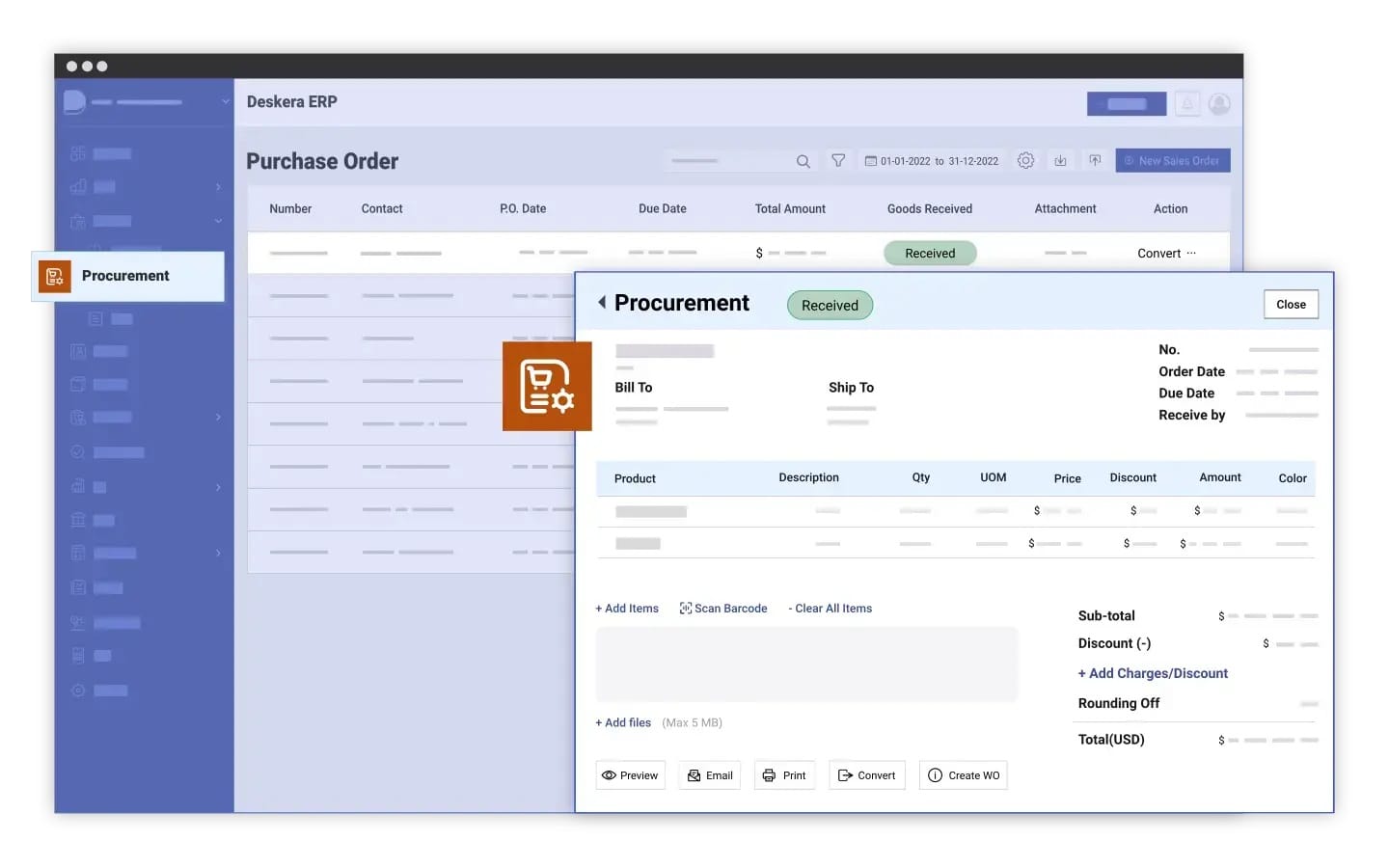
Accurate lead time forecasting requires real-time visibility, efficient planning, and coordinated supply chain operations. Deskera ERP helps manufacturers improve forecasting accuracy by integrating inventory management, procurement, production planning, and reporting into a centralized cloud-based platform. With automation and real-time data access, businesses can reduce delays, improve planning efficiency, and make faster operational decisions.
Real-Time Inventory Visibility
Deskera ERP provides real-time visibility into inventory levels, stock movement, and material availability. Manufacturers can monitor raw materials, work-in-progress inventory, and finished goods across locations, helping them avoid stock shortages and production delays. Better inventory visibility improves procurement planning and supports more accurate lead time forecasting.
Automated Procurement Management
Deskera ERP streamlines procurement workflows by automating purchase orders, supplier management, and inventory replenishment processes. Automated procurement reduces manual errors, improves material availability, and helps manufacturers order supplies based on production requirements and forecasted demand.
Production Planning and Scheduling
Deskera ERP helps manufacturers optimize production schedules by improving resource allocation and workflow planning. Businesses can track production activities in real time, identify bottlenecks, and reduce downtime. Efficient scheduling improves production efficiency and shortens manufacturing lead times.
Supplier Performance Tracking
Deskera ERP enables businesses to monitor supplier performance, including delivery timelines and order consistency. This helps manufacturers identify supplier-related risks, improve sourcing decisions, and reduce procurement delays that can impact overall lead time forecasting accuracy.
Real-Time Reporting and Analytics
Deskera ERP offers real-time dashboards and reporting tools that provide insights into inventory, procurement, production, and order fulfillment performance. These analytics help businesses identify operational inefficiencies quickly and make data-driven forecasting and planning decisions.
Cloud and Mobile Accessibility
As a cloud-based ERP solution, Deskera ERP allows manufacturers to access operational data from anywhere using mobile devices or desktops. Real-time access to production schedules, inventory updates, and procurement information improves responsiveness and supports faster decision-making across the supply chain.
Improved Operational Efficiency
By integrating core manufacturing and supply chain processes into one platform, Deskera ERP improves coordination between departments and reduces workflow inefficiencies. This helps manufacturers respond more effectively to demand fluctuations, minimize delays, and improve overall lead time forecasting accuracy.
Key Takeaways
- Lead time forecasting helps manufacturers estimate procurement, production, and delivery timelines more accurately to improve operational efficiency and customer satisfaction.
- Understanding different types of lead time, such as customer, material, procurement, production, supplier, delivery, order, and cumulative lead time, helps businesses identify operational bottlenecks and improve planning accuracy.
- Key attributes like lead time deviation, reliability, seasonality, historical analysis, and predictive insights play a major role in improving forecasting precision and inventory optimization.
- Traditional lead time forecasting models often struggle due to overreliance on historical data, lack of real-time visibility, reactive planning approaches, and outdated ERP systems.
- ERP systems improve lead time forecasting by centralizing data, automating workflows, providing real-time visibility, and enabling predictive analytics across supply chain operations.
- Real-time inventory visibility through ERP systems helps manufacturers avoid stock shortages, improve procurement timing, and maintain smoother production schedules.
- Automated procurement management reduces manual errors, improves supplier coordination, and ensures timely material availability for uninterrupted manufacturing operations.
- Advanced production planning and scheduling capabilities help manufacturers optimize resource allocation, reduce bottlenecks, and shorten production lead times.
- Supplier performance monitoring enables businesses to track delivery consistency and improve sourcing decisions to reduce procurement-related delays.
- Effective lead time forecasting improves production planning, inventory management, order fulfillment speed, operational efficiency, and overall supply chain agility.
- Accurate forecasting also helps manufacturers reduce operational risks, lower inventory carrying costs, and improve customer satisfaction through reliable delivery performance.
- Real-time reporting and analytics provide manufacturers with actionable insights that support faster, data-driven forecasting and operational decisions.
- Cloud-based ERP systems improve accessibility and responsiveness by enabling businesses to monitor operations and manage supply chain activities from anywhere.
- AI-powered forecasting and predictive analytics help manufacturers anticipate disruptions, respond to demand fluctuations, and improve long-term planning accuracy.
- Deskera ERP helps manufacturers improve lead time forecasting through integrated inventory management, procurement automation, production planning, supplier tracking, and real-time operational analytics.
Related Articles
 Niti Samani
 Niti Samani
 Niti Samani
 Niti Samani
 Niti Samani
 Niti Samani