
What if your equipment could tell you exactly when it needs maintenance instead of relying on fixed schedules or waiting for a breakdown to occur? The answer lies in condition-based maintenance (CBM), a proactive maintenance strategy that monitors the actual condition of equipment and triggers maintenance activities only when signs of deterioration or performance issues are detected. By using real-time data, businesses can address potential problems before they lead to costly failures and operational disruptions.
Traditional maintenance approaches often fall into two categories: reactive maintenance, where repairs are made after equipment fails, and preventive maintenance, where servicing is performed at predetermined intervals regardless of asset condition. While both methods have their place, they can result in unnecessary maintenance costs, unexpected downtime, or inefficient use of resources. Condition-based maintenance offers a more data-driven alternative by ensuring that maintenance is performed only when it is genuinely needed.
Advancements in sensors, Industrial Internet of Things (IIoT) technologies, and data analytics have made condition-based maintenance more accessible and effective than ever before. By continuously monitoring parameters such as vibration, temperature, pressure, and lubrication quality, organizations can gain deeper insights into equipment health, improve reliability, extend asset lifespan, and optimize maintenance spending. As industries increasingly focus on operational efficiency and asset performance, CBM has become a critical component of modern maintenance strategies.
Implementing condition-based maintenance becomes even more effective when supported by an integrated manufacturing and maintenance management system. Deskera MRP helps manufacturers streamline maintenance planning by providing real-time visibility into production operations, inventory levels, and equipment-related activities. With features such as work order management, inventory tracking, automated workflows, and centralized operational data, Deskera MRP enables businesses to coordinate maintenance activities efficiently while minimizing disruptions to production. By combining maintenance insights with broader manufacturing processes, organizations can improve equipment reliability, reduce downtime, and enhance overall operational performance.
What Is Condition-Based Maintenance (CBM)?
Condition-based maintenance (CBM) is a maintenance strategy that uses the actual condition of equipment or assets to determine when maintenance should be performed. Instead of relying on fixed maintenance schedules or waiting for equipment to fail, CBM continuously or periodically monitors asset health and triggers maintenance activities only when specific indicators suggest declining performance or a potential failure. This approach helps organizations perform maintenance at the right time, reducing unnecessary servicing while minimizing the risk of unexpected breakdowns.
At the core of condition-based maintenance is the collection and analysis of real-time operational data. Organizations use sensors, monitoring devices, inspections, and performance measurements to track key equipment parameters such as vibration, temperature, pressure, lubrication quality, energy consumption, and noise levels. When these indicators deviate from established performance thresholds, maintenance teams are alerted to investigate and address the issue before it escalates into a major failure.
Unlike traditional maintenance methods, CBM enables a more proactive and data-driven approach to asset management. Reactive maintenance often results in costly downtime and emergency repairs, while preventive maintenance may lead to unnecessary maintenance activities on equipment that is still functioning properly. Condition-based maintenance bridges this gap by ensuring that maintenance resources are used only when needed, improving equipment reliability, reducing maintenance costs, and maximizing asset availability.
Modern condition-based maintenance programs often leverage advanced technologies such as Industrial Internet of Things (IIoT) sensors, artificial intelligence (AI), machine learning, and predictive analytics. These technologies help organizations identify patterns, detect anomalies, and gain deeper insights into equipment performance. As a result, maintenance teams can make more informed decisions and schedule maintenance interventions before equipment performance falls below acceptable levels.
For condition-based maintenance to be effective, organizations must have the ability to monitor equipment conditions, detect changes in performance early enough to take corrective action, and establish efficient processes for responding to maintenance alerts. It is also important to prioritize critical assets where equipment failure could significantly impact production, safety, or operational costs. By focusing monitoring efforts on high-value assets, businesses can achieve a stronger return on investment from their CBM initiatives.
Overall, condition-based maintenance represents a significant advancement in maintenance management. By combining real-time monitoring, data analysis, and proactive decision-making, CBM helps organizations reduce downtime, extend asset lifespan, improve operational efficiency, and create a more reliable and cost-effective maintenance program.
Condition-Based Maintenance vs Predictive Maintenance vs Preventive Maintenance
Organizations use different maintenance strategies to improve equipment reliability, reduce downtime, and control maintenance costs. While condition-based maintenance (CBM), predictive maintenance (PdM), and preventive maintenance (PM) all aim to prevent equipment failures, they differ significantly in how maintenance activities are triggered, the technologies they use, and the level of data analysis involved.
Preventive maintenance follows a predefined schedule, condition-based maintenance relies on real-time equipment condition data, and predictive maintenance uses advanced analytics to forecast future failures before they occur.
Understanding the differences between these approaches can help businesses choose the most suitable maintenance strategy based on their operational requirements, asset criticality, and available resources.
Which Maintenance Strategy Is Best?
There is no single maintenance strategy that works for every organization. Preventive maintenance is simple and cost-effective for less critical equipment, condition-based maintenance provides greater efficiency by responding to actual asset conditions, and predictive maintenance offers the highest level of optimization by forecasting failures before they occur.
Many modern organizations use a combination of all three approaches, applying each strategy based on asset criticality, operational risk, and available maintenance resources.
Types of Condition Monitoring Techniques
Condition-based maintenance relies on various monitoring techniques to assess equipment health and identify potential issues before they result in failure.
These techniques collect real-time or periodic data from assets while they are operating, allowing maintenance teams to detect abnormalities without disrupting production.
The choice of monitoring method depends on the type of equipment, operating conditions, and the failure modes being monitored.
1. Vibration Monitoring
Vibration monitoring, also known as vibration analysis, is one of the most widely used condition monitoring techniques, particularly for rotating equipment such as motors, pumps, fans, compressors, and turbines.
The technique measures vibration frequencies and amplitudes to identify abnormal patterns that may indicate mechanical problems.
Changes in vibration levels can reveal issues such as:
- Bearing wear or failure
- Shaft misalignment
- Mechanical looseness
- Rotor imbalance
- Bent shafts
- Resonance problems
Because vibration abnormalities often appear long before equipment failure occurs, vibration monitoring enables maintenance teams to detect and resolve issues early, reducing the likelihood of unexpected breakdowns.
2. Infrared Thermography
Infrared thermography uses thermal imaging technology to monitor equipment temperatures and detect overheating or abnormal heat patterns.
Thermal cameras capture infrared radiation emitted by an asset and convert it into a visual image called a thermogram, which helps maintenance teams compare current operating temperatures against normal baseline conditions.
Infrared thermography is commonly used for:
- Electric motors and control panels
- Bearings and rotating equipment
- Switchgear and transformers
- Insulation inspections
- Fluid, gas, and sludge level monitoring
Since temperature increases often indicate friction, electrical resistance, or component degradation, thermography provides an effective non-contact method for identifying developing problems before they become critical.
3. Oil Analysis
Oil analysis evaluates the condition of lubricants used in machinery to determine both equipment health and lubricant effectiveness.
Samples are collected from equipment and analyzed for changes in physical and chemical properties, contamination levels, and wear particles.
Oil analysis helps maintenance teams monitor:
- Lubricant viscosity
- Acidity and oxidation levels
- Water contamination
- Dirt and foreign particles
- Metal wear debris
- Additive depletion
This technique is especially valuable for engines, gearboxes, hydraulic systems, compressors, and other heavily lubricated equipment.
By identifying contamination and component wear early, organizations can prevent costly equipment damage and optimize lubrication practices.
4. Ultrasonic Analysis
Ultrasonic analysis uses high-frequency sound waves that are beyond the range of human hearing to detect mechanical and electrical faults.
Specialized ultrasonic sensors convert these sounds into measurable data that maintenance teams can analyze for signs of equipment deterioration.
Ultrasonic monitoring can identify:
- Bearing defects
- Lubrication problems
- Gear wear
- Pump cavitation
- Steam trap failures
- Compressed air leaks
- Vacuum leaks
- Electrical arcing and corona discharge
Both contact-based and airborne ultrasonic testing methods are used, making this technique highly versatile across a wide range of industrial applications.
5. Pressure Analysis
Pressure analysis monitors pressure levels within systems that transport or contain fluids, gases, or air. Maintaining proper pressure is essential for ensuring equipment performance, process efficiency, and operational safety.
Pressure monitoring is commonly used for:
- Pipelines and valves
- Hydraulic systems
- Air compressors
- Storage tanks
- Gas distribution systems
- Process manufacturing equipment
Continuous pressure monitoring can quickly identify abnormal pressure fluctuations, leaks, blockages, or equipment malfunctions, allowing maintenance teams to take corrective action before system performance is affected.
6. Electrical Analysis
Electrical analysis evaluates the performance and condition of electrical systems and motor-driven equipment. By measuring parameters such as voltage, current, resistance, capacitance, inductance, and power quality, maintenance teams can identify electrical abnormalities that may indicate developing faults.
Electrical analysis helps detect:
- Voltage imbalances
- Power quality issues
- Circuit faults
- Motor winding problems
- Electrical overloads
- Power factor deficiencies
- Loose electrical connections
This monitoring technique is particularly important for manufacturing facilities that rely heavily on motors, drives, transformers, and other critical electrical assets.
Choosing the Right Monitoring Technique
No single condition monitoring technique can detect every type of equipment failure. Many organizations combine multiple monitoring methods to create a comprehensive condition-based maintenance program.
For example, a manufacturer may use vibration monitoring for rotating equipment, infrared thermography for electrical systems, and oil analysis for lubricated machinery.
By integrating multiple monitoring technologies, businesses gain a more complete view of asset health and can make more accurate maintenance decisions.
Ultimately, selecting the right condition monitoring techniques depends on asset criticality, operating conditions, potential failure modes, and the value that proactive maintenance can deliver to the organization.
How Condition-Based Maintenance Works
Condition-based maintenance follows a structured process that uses real-time asset data to determine when maintenance should be performed.
Instead of relying on fixed maintenance schedules, CBM continuously evaluates equipment health and triggers maintenance activities only when performance indicators suggest a developing issue.
This allows organizations to detect potential failures early, reduce unplanned downtime, and optimize maintenance resources.
1. Define Performance Baselines and Objectives
The first step in a condition-based maintenance program is establishing performance baselines for critical assets. A baseline represents the normal operating condition of a machine and serves as a reference point for future comparisons.
Organizations typically define:
- Normal temperature ranges
- Acceptable vibration levels
- Standard pressure readings
- Energy consumption benchmarks
- Lubrication performance parameters
At this stage, maintenance teams also identify critical assets and establish clear objectives for the CBM program, such as reducing downtime, improving equipment reliability, or lowering maintenance costs.
2. Install Monitoring Equipment and Sensors
Once performance standards are established, organizations deploy monitoring technologies to collect equipment data. The type of monitoring equipment depends on the asset being monitored and the failure modes being assessed.
Common monitoring devices include:
- Vibration sensors
- Temperature sensors
- Pressure gauges
- Thermal imaging cameras
- Ultrasonic detectors
- Oil analysis equipment
- Electrical monitoring devices
These sensors continuously or periodically monitor equipment conditions without interrupting normal operations.
3. Collect and Monitor Equipment Data
After the monitoring system is in place, sensors begin collecting operational data from equipment. This data provides real-time visibility into asset performance and helps maintenance teams understand how equipment behaves under different operating conditions.
Organizations may collect data on:
- Temperature fluctuations
- Vibration patterns
- Pressure changes
- Lubrication quality
- Electrical performance
- Acoustic signals
Data can be gathered continuously through connected sensors or at scheduled intervals through inspections and testing procedures.
4. Analyze Data and Identify Anomalies
The collected data is then analyzed to detect deviations from established performance baselines. Maintenance teams use software platforms, analytics tools, and increasingly, artificial intelligence and machine learning technologies to identify patterns, trends, and abnormalities.
Examples of detectable anomalies include:
- Increasing vibration levels in rotating equipment
- Abnormal temperature spikes
- Sudden pressure drops
- Excessive lubricant contamination
- Electrical current irregularities
These warning signs often indicate developing equipment problems that require attention before failure occurs.
5. Generate Maintenance Alerts and Work Orders
When monitoring systems detect conditions that exceed predefined thresholds, maintenance alerts are automatically generated. These alerts notify maintenance personnel that corrective action may be required.
Many organizations integrate CBM systems with computerized maintenance management systems (CMMS) or ERP software to automatically:
- Create work orders
- Assign maintenance tasks
- Prioritize repairs
- Schedule maintenance activities
- Track maintenance progress
This automation helps ensure that maintenance actions are initiated quickly and efficiently.
6. Perform Corrective Maintenance
Once a maintenance task is triggered, technicians inspect the equipment and carry out the required repairs, adjustments, replacements, or servicing activities.
Because the issue is identified before a complete breakdown occurs, maintenance teams can address the problem under planned conditions rather than during an emergency.
Examples of corrective actions include:
- Replacing worn bearings
- Realigning shafts
- Repairing leaks
- Adjusting operating parameters
- Replenishing or replacing lubricants
- Fixing electrical faults
Planned corrective maintenance minimizes operational disruptions and reduces repair costs.
7. Review Results and Continuously Improve
Condition-based maintenance is not a one-time activity but an ongoing cycle of monitoring, analysis, and improvement.
After maintenance is completed, organizations review performance data to evaluate the effectiveness of the corrective actions and refine monitoring strategies.
Continuous improvement activities may include:
- Updating performance thresholds
- Improving sensor placement
- Enhancing data analysis methods
- Expanding monitoring coverage to additional assets
- Optimizing maintenance workflows
Over time, these improvements increase the accuracy and effectiveness of the CBM program, helping organizations achieve greater equipment reliability and operational efficiency.
The Condition-Based Maintenance Cycle
In summary, condition-based maintenance operates through a continuous cycle:
Establish Baselines → Install Sensors → Collect Data → Analyze Conditions → Generate Work Orders → Perform Maintenance → Improve Monitoring Strategies
By continuously monitoring equipment health and acting only when necessary, condition-based maintenance enables organizations to prevent failures, reduce unnecessary maintenance activities, and maximize asset performance throughout the equipment lifecycle.
Benefits of Condition-Based Maintenance
Condition-based maintenance offers a smarter and more efficient approach to asset management by using real-time equipment data to determine when maintenance is actually required.
Rather than relying on fixed maintenance schedules or reacting to unexpected failures, organizations can make informed maintenance decisions based on the actual health of their assets.
This proactive strategy improves equipment performance, reduces operational risks, and helps businesses maximize the return on their maintenance investments.
1. Reduces Unplanned Downtime
One of the most significant benefits of condition-based maintenance is its ability to minimize unexpected equipment failures. By continuously monitoring asset conditions and identifying early warning signs of deterioration, maintenance teams can address issues before they lead to breakdowns.
This enables organizations to:
- Schedule maintenance activities in advance
- Avoid costly production interruptions
- Reduce emergency repairs
- Improve overall equipment availability
As a result, businesses experience fewer disruptions and more predictable operations.
2. Lowers Maintenance Costs
Traditional preventive maintenance can often result in unnecessary servicing of equipment that is still functioning properly. Condition-based maintenance eliminates this inefficiency by ensuring maintenance is performed only when asset conditions indicate a genuine need.
This helps organizations:
- Reduce unnecessary maintenance activities
- Lower labor and service costs
- Minimize spare parts consumption
- Avoid costly catastrophic failures
By targeting maintenance efforts where they are needed most, businesses can significantly improve maintenance cost efficiency.
3. Extends Asset Lifespan
Equipment that is regularly monitored and maintained according to its actual condition tends to operate more efficiently and experience less wear and tear over time. Early detection of developing issues prevents minor problems from escalating into major failures that can permanently damage equipment.
Benefits include:
- Improved equipment health
- Reduced component deterioration
- Longer service life for critical assets
- Greater return on capital investments
Extending asset lifespan also reduces the frequency of expensive equipment replacements.
4. Improves Equipment Reliability
Reliable equipment is essential for maintaining consistent production and operational performance. Condition-based maintenance helps ensure assets continue operating at optimal levels by detecting abnormalities before they impact performance.
This results in:
- Fewer unexpected failures
- More stable production processes
- Improved asset performance
- Increased operational confidence
Higher reliability enables organizations to meet production targets more consistently and efficiently.
5. Enhances Workplace Safety
Equipment failures can create significant safety risks for employees, particularly in industries that operate heavy machinery, high-pressure systems, or electrical equipment. Continuous condition monitoring allows maintenance teams to identify safety-related issues before they become hazardous.
Condition-based maintenance contributes to:
- Reduced risk of equipment-related accidents
- Early detection of dangerous operating conditions
- Improved compliance with safety regulations
- Safer working environments for employees
Proactively addressing equipment issues helps protect both personnel and operational assets.
6. Improves Maintenance Efficiency
Condition-based maintenance helps maintenance teams focus their efforts on assets that genuinely require attention. Instead of spending time on routine inspections or unnecessary maintenance tasks, technicians can prioritize work based on actual equipment conditions.
This improves:
- Resource utilization
- Technician productivity
- Maintenance planning accuracy
- Work order prioritization
As a result, maintenance departments can accomplish more with the same resources.
7. Optimizes Maintenance Scheduling
Because CBM provides early warning of potential failures, maintenance activities can be planned at the most convenient and cost-effective times. Organizations gain greater control over maintenance schedules instead of being forced to react to unexpected breakdowns.
Benefits include:
- Better workforce scheduling
- Reduced overtime expenses
- Improved production planning
- More effective shutdown management
Planned maintenance interventions are typically less disruptive and more economical than emergency repairs.
8. Supports Better Budgeting and Cost Control
Unexpected equipment failures often lead to unplanned expenses, emergency parts procurement, and costly downtime. Condition-based maintenance helps organizations predict maintenance needs more accurately and avoid surprise expenditures.
This enables:
- More accurate maintenance budgeting
- Better forecasting of maintenance expenses
- Improved financial planning
- Greater control over operating costs
By reducing uncertainty, organizations can allocate maintenance budgets more effectively.
9. Improves Operational Efficiency
Condition-based maintenance allows equipment to operate continuously while monitoring systems collect performance data in real time.
Since monitoring activities are generally non-invasive, organizations can gain valuable insights into asset health without interrupting production.
This leads to:
- Increased productivity
- Improved asset utilization
- Reduced operational disruptions
- More efficient manufacturing and maintenance processes
The combination of reliable equipment and optimized maintenance contributes directly to overall operational excellence.
10. Enables Data-Driven Decision Making
Modern condition-based maintenance systems generate large volumes of valuable operational data. This information provides deeper visibility into asset performance, failure trends, and maintenance effectiveness.
Organizations can use these insights to:
- Improve maintenance strategies
- Optimize equipment performance
- Identify recurring issues
- Make more informed investment decisions
Data-driven maintenance decisions ultimately help businesses improve reliability, efficiency, and long-term asset management outcomes.
Condition-based maintenance delivers substantial benefits by aligning maintenance activities with the actual condition of equipment.
By reducing downtime, lowering costs, extending asset lifespan, improving safety, and enhancing operational efficiency, CBM helps organizations maximize asset performance while creating a more proactive and cost-effective maintenance environment.
Challenges of Condition-Based Maintenance
While condition-based maintenance offers significant advantages in terms of equipment reliability, cost savings, and operational efficiency, implementing and managing a successful CBM program is not without challenges.
Organizations must invest in technology, develop new processes, and build the expertise required to effectively collect and interpret equipment data.
Understanding these challenges can help businesses plan more effectively and maximize the return on their condition-based maintenance initiatives.
1. High Initial Implementation Costs
One of the biggest barriers to adopting condition-based maintenance is the upfront investment required. Implementing a CBM program often involves purchasing sensors, monitoring devices, data acquisition systems, software platforms, and communication infrastructure.
Additional costs may include:
- Sensor installation and calibration
- Equipment retrofitting
- Maintenance software deployment
- Network and connectivity upgrades
- Consulting and implementation services
Although CBM can generate substantial long-term savings, the initial investment can be significant, particularly for small and medium-sized businesses.
2. Complex Data Collection and Analysis
Condition-based maintenance relies heavily on accurate and continuous data collection. Modern monitoring systems generate large volumes of information from multiple assets, creating challenges related to data storage, processing, and interpretation.
Organizations must manage:
- Real-time equipment data streams
- Historical performance records
- Sensor-generated alerts
- Equipment health trends
- Maintenance history information
Without effective data management systems and analytical tools, valuable insights can be overlooked, reducing the effectiveness of the CBM program.
3. Need for Specialized Skills and Expertise
Collecting equipment data is only part of the process. Maintenance teams must also understand how to interpret the data and translate findings into actionable maintenance decisions.
Organizations may require expertise in:
- Condition monitoring techniques
- Vibration analysis
- Thermography
- Oil analysis
- Data analytics
- Reliability engineering
Training employees or hiring specialized personnel can increase implementation costs and extend the time required to achieve full program effectiveness.
4. Integration with Existing Systems
Integrating condition monitoring technologies with existing maintenance and operational systems can be challenging, especially in facilities that rely on older equipment or legacy software platforms.
Common integration challenges include:
- Incompatible equipment interfaces
- Legacy machinery lacking sensor connectivity
- Data synchronization issues
- Limited system interoperability
- Complex software integration requirements
In some cases, organizations may need to retrofit equipment or upgrade systems to support real-time monitoring capabilities.
5. Sensor Reliability and Environmental Limitations
The success of a condition-based maintenance program depends on the accuracy and reliability of its monitoring devices. However, sensors often operate in demanding industrial environments where factors such as extreme temperatures, moisture, vibration, dust, and chemical exposure can affect their performance.
Potential issues include:
- Sensor degradation over time
- Calibration inaccuracies
- Communication failures
- False alarms
- Data loss or corruption
Regular maintenance and validation of monitoring equipment are necessary to ensure reliable data collection.
6. Maintenance Scheduling Uncertainty
Unlike preventive maintenance, which follows predictable schedules, condition-based maintenance generates maintenance activities based on actual equipment conditions. While this improves maintenance efficiency, it can also create planning challenges.
Organizations may experience:
- Variable maintenance workloads
- Difficulty forecasting labor requirements
- Uncertain spare parts demand
- Challenges in workforce scheduling
Maintenance managers must develop flexible resource planning strategies to accommodate condition-triggered maintenance activities.
7. Limited Detection of Certain Failure Modes
Condition-based maintenance is highly effective at identifying failures that produce measurable changes in equipment performance. However, not all failure modes generate detectable warning signs.
Examples include:
- Sudden component failures
- Material fatigue failures
- Manufacturing defects
- Certain electronic failures
- Rapid catastrophic breakdowns
As a result, CBM is often most effective when combined with preventive or predictive maintenance strategies for comprehensive asset protection.
8. Cybersecurity and Data Security Risks
Modern condition-based maintenance systems frequently rely on connected sensors, Industrial Internet of Things (IIoT) devices, cloud platforms, and networked monitoring systems. While these technologies improve visibility and automation, they also introduce cybersecurity risks.
Organizations must address:
- Unauthorized system access
- Data breaches
- Network vulnerabilities
- Device security threats
- Data integrity concerns
Strong cybersecurity policies and secure system architectures are essential to protect maintenance and operational data.
9. Difficulty Justifying ROI in the Early Stages
Although CBM can deliver significant long-term benefits, organizations may struggle to demonstrate immediate financial returns after implementation. Benefits such as reduced downtime, improved reliability, and extended asset life often accumulate gradually over time.
This can create challenges when:
- Securing management approval
- Justifying technology investments
- Measuring early program success
- Allocating ongoing funding
Establishing clear performance metrics and tracking results from the outset can help organizations demonstrate the value of their CBM initiatives.
10. Change Management and Organizational Adoption
Successfully implementing condition-based maintenance often requires a shift in maintenance culture. Employees who are accustomed to reactive or schedule-based maintenance practices may initially resist new technologies and data-driven decision-making processes.
Organizations may face challenges such as:
- Resistance to change
- Lack of employee engagement
- Training requirements
- Process redesign needs
- Adoption delays
Strong leadership support, employee training, and clear communication are critical for ensuring successful adoption of condition-based maintenance practices.
Despite these challenges, the long-term benefits of condition-based maintenance often outweigh the implementation difficulties. Organizations that invest in the right technology, develop skilled maintenance teams, establish strong data management practices, and integrate CBM with their broader maintenance strategy can significantly improve equipment reliability, reduce operational costs, and enhance overall business performance.
Best Practices for Implementing Condition-Based Maintenance
Implementing condition-based maintenance successfully requires more than simply installing sensors and collecting equipment data. Organizations must establish clear objectives, prioritize the right assets, develop effective monitoring strategies, and create processes that transform data into actionable maintenance decisions.
By following proven best practices, businesses can maximize the benefits of condition-based maintenance while minimizing implementation challenges.
1. Start with Critical Assets
Not every asset requires condition-based monitoring. The most effective approach is to begin with equipment whose failure would have the greatest impact on production, safety, quality, or operational costs.
When selecting assets, consider:
- Production-critical equipment
- High-value assets
- Equipment with frequent failure histories
- Assets with high repair or replacement costs
- Equipment that presents safety risks when it fails
Focusing on critical assets first allows organizations to achieve faster returns on investment and demonstrate the value of CBM before expanding the program.
2. Establish Clear Performance Baselines
Condition-based maintenance relies on identifying deviations from normal operating conditions. Therefore, organizations should establish baseline performance metrics for each monitored asset before launching a CBM program.
Common baseline measurements include:
- Temperature ranges
- Vibration levels
- Pressure readings
- Power consumption
- Lubrication characteristics
- Production performance indicators
Accurate baselines provide a reliable benchmark for detecting abnormal equipment behavior and triggering maintenance actions.
3. Select the Right Monitoring Technologies
Different assets require different monitoring techniques. Choosing the most appropriate condition-monitoring technology ensures accurate data collection and improves fault detection capabilities.
Examples include:
- Vibration analysis for rotating machinery
- Infrared thermography for electrical equipment
- Oil analysis for lubricated systems
- Ultrasonic testing for leak detection
- Pressure monitoring for hydraulic and pneumatic systems
- Electrical analysis for motors and power systems
Organizations should align monitoring technologies with asset types and likely failure modes.
4. Implement Reliable Data Collection Processes
The effectiveness of condition-based maintenance depends on the quality and consistency of collected data. Inaccurate or incomplete information can lead to missed warning signs or unnecessary maintenance activities.
Best practices include:
- Regular sensor calibration
- Standardized data collection procedures
- Continuous monitoring where appropriate
- Validation of sensor accuracy
- Consistent inspection schedules
Reliable data forms the foundation of informed maintenance decision-making.
5. Define Alert Thresholds and Maintenance Triggers
Monitoring data only becomes valuable when organizations establish clear criteria for identifying abnormal conditions. Maintenance teams should define acceptable operating limits and determine when maintenance intervention is required.
This includes setting:
- Warning thresholds
- Critical alarm levels
- Escalation procedures
- Response timelines
- Maintenance priorities
Clearly defined triggers help eliminate guesswork and ensure timely action when equipment performance begins to deteriorate.
6. Integrate CBM with Maintenance Management Systems
Condition-based maintenance delivers the greatest value when integrated with maintenance management platforms such as CMMS and ERP systems. Integration enables organizations to automate maintenance workflows and improve operational visibility.
Benefits of integration include:
- Automatic work order generation
- Maintenance scheduling
- Asset history tracking
- Spare parts management
- Maintenance reporting and analytics
A connected system ensures that monitoring insights translate into efficient maintenance execution.
7. Train Maintenance Teams and Operators
Technology alone cannot guarantee a successful CBM program. Employees must understand how to interpret condition-monitoring data, respond to alerts, and execute maintenance activities effectively.
Training should cover:
- Condition monitoring techniques
- Sensor technologies
- Data interpretation
- Root cause analysis
- Maintenance procedures
- Equipment reliability principles
Well-trained personnel can identify issues faster and make more informed maintenance decisions.
8. Maintain Accurate Asset and Maintenance Records
Historical asset data provides valuable insights into equipment performance, recurring failures, and maintenance effectiveness. Maintaining comprehensive records helps organizations refine monitoring strategies and improve decision-making over time.
Important records include:
- Asset specifications
- Maintenance history
- Failure reports
- Sensor readings
- Inspection results
- Repair documentation
Accurate records support continuous improvement and long-term reliability planning.
9. Continuously Analyze and Improve the Program
Condition-based maintenance should be viewed as an ongoing process rather than a one-time implementation. Organizations should regularly review performance data and evaluate the effectiveness of their monitoring strategies.
Continuous improvement efforts may include:
- Adjusting alert thresholds
- Expanding monitoring coverage
- Updating monitoring technologies
- Improving maintenance workflows
- Identifying new failure patterns
Regular program reviews help ensure that the CBM strategy remains aligned with operational goals.
10. Combine CBM with Other Maintenance Strategies
While condition-based maintenance is highly effective, it may not be suitable for every asset or failure mode. Many organizations achieve the best results by combining CBM with preventive and predictive maintenance approaches.
A balanced maintenance strategy can:
- Address sudden failure risks
- Improve asset coverage
- Optimize maintenance resources
- Increase overall equipment reliability
- Reduce maintenance costs
Using multiple maintenance strategies allows organizations to create a more comprehensive and resilient asset management program.
Focus on Measurable Performance Outcomes
To evaluate the success of a condition-based maintenance program, organizations should regularly track key performance indicators (KPIs) such as equipment availability, mean time between failures (MTBF), mean time to repair (MTTR), maintenance costs, and unplanned downtime. Monitoring these metrics helps quantify the impact of CBM and identifies opportunities for further optimization.
By following these best practices, organizations can build a successful condition-based maintenance program that improves asset reliability, reduces downtime, optimizes maintenance spending, and supports long-term operational excellence.
Essential KPIs for Measuring Condition-Based Maintenance Success
Implementing a condition-based maintenance (CBM) program is only the first step toward improving asset reliability and maintenance efficiency.
To determine whether the program is delivering the expected results, organizations need to track key performance indicators (KPIs) that measure equipment performance, maintenance effectiveness, downtime reduction, and cost savings.
These metrics provide valuable insights into the health of assets and help maintenance teams continuously optimize their CBM strategies.
1. Mean Time Between Failures (MTBF)
Mean Time Between Failures measures the average amount of operating time between equipment failures. A higher MTBF indicates that assets are operating reliably and that the condition-based maintenance program is successfully preventing unexpected breakdowns.
Formula:
MTBF = Total Operating Time ÷ Number of Failures
Why it matters:
- Measures equipment reliability
- Tracks improvements in asset performance
- Evaluates the effectiveness of maintenance activities
2. Mean Time to Repair (MTTR)
Mean Time to Repair measures the average time required to diagnose, repair, and restore equipment after a failure occurs. A lower MTTR indicates that maintenance teams can respond quickly and efficiently to equipment issues.
Formula:
MTTR = Total Repair Time ÷ Number of Repairs
Why it matters:
- Measures maintenance responsiveness
- Helps minimize production disruptions
- Improves equipment availability
3. Equipment Availability
Equipment availability measures the percentage of time an asset is operational and available for production. Since condition-based maintenance aims to reduce unexpected downtime, increased availability is a strong indicator of program success.
Formula:
Availability (%) = (Operating Time ÷ Planned Production Time) × 100
Why it matters:
- Evaluates overall asset performance
- Measures uptime improvements
- Identifies reliability issues
4. Unplanned Downtime Percentage
This KPI tracks the proportion of total available operating time lost due to unexpected equipment failures and breakdowns. A successful CBM program should steadily reduce unplanned downtime.
Formula:
Unplanned Downtime (%) = (Unplanned Downtime ÷ Total Available Time) × 100
Why it matters:
- Measures the effectiveness of failure prevention
- Identifies recurring equipment problems
- Supports production continuity
5. Maintenance Cost per Asset
Maintenance Cost per Asset measures the average maintenance expenditure for each monitored asset. It helps organizations determine whether CBM is reducing maintenance expenses and improving cost efficiency.
Formula:
Maintenance Cost per Asset = Total Maintenance Costs ÷ Number of Assets
Why it matters:
- Evaluates maintenance cost control
- Supports budgeting decisions
- Measures return on maintenance investments
6. Planned Maintenance Percentage (PMP)
Planned Maintenance Percentage measures the proportion of maintenance work that is planned rather than reactive. As condition-based maintenance matures, organizations should see a higher percentage of planned maintenance activities.
Formula:
Planned Maintenance Percentage (%) = (Planned Maintenance Hours ÷ Total Maintenance Hours) × 100
Why it matters:
- Indicates maintenance maturity
- Reduces emergency repairs
- Improves resource utilization
7. Maintenance Schedule Compliance
This KPI measures how consistently maintenance tasks are completed according to the planned schedule. High compliance rates indicate effective maintenance planning and execution.
Formula:
Schedule Compliance (%) = (Completed Scheduled Maintenance Tasks ÷ Total Scheduled Maintenance Tasks) × 100
Why it matters:
- Ensures maintenance activities are completed on time
- Improves equipment reliability
- Supports preventive and condition-based maintenance objectives
8. Asset Utilization Rate
Asset utilization measures how effectively equipment is being used compared to its available operating capacity. Improved asset reliability through CBM often leads to higher utilization rates.
Formula:
Asset Utilization (%) = (Actual Operating Time ÷ Available Operating Time) × 100
Why it matters:
- Measures operational efficiency
- Tracks productivity improvements
- Identifies underutilized assets
9. Work Order Completion Rate
Work Order Completion Rate measures the percentage of maintenance work orders completed within a specific period. This KPI helps evaluate maintenance team productivity and workflow efficiency.
Formula:
Work Order Completion Rate (%) = (Completed Work Orders ÷ Total Work Orders) × 100
Why it matters:
- Measures maintenance execution effectiveness
- Identifies workflow bottlenecks
- Improves maintenance planning
10. Failure Detection Accuracy
Failure Detection Accuracy evaluates how effectively condition-monitoring systems identify genuine equipment issues before failures occur. It measures the reliability of monitoring technologies and maintenance decision-making.
Formula:
Failure Detection Accuracy (%) = (Correctly Identified Potential Failures ÷ Total Maintenance Alerts) × 100
Why it matters:
- Assesses monitoring system effectiveness
- Reduces false alarms
- Improves maintenance decision quality
11. Spare Parts Inventory Turnover
Condition-based maintenance often improves spare parts planning by providing earlier visibility into maintenance needs. Inventory turnover measures how efficiently spare parts inventory is utilized.
Formula:
Inventory Turnover = Annual Spare Parts Usage Value ÷ Average Spare Parts Inventory Value
Why it matters:
- Optimizes inventory management
- Reduces excess stock
- Improves spare parts availability
12. Return on Maintenance Investment (ROMI)
Return on Maintenance Investment measures the financial benefits generated from maintenance activities relative to maintenance spending. It helps justify investments in CBM technologies and monitoring systems.
Formula:
ROMI (%) = [(Maintenance Savings − Maintenance Costs) ÷ Maintenance Costs] × 100
Why it matters:
- Quantifies maintenance value
- Supports investment decisions
- Measures overall program profitability
Measuring Long-Term CBM Success
No single KPI can fully evaluate the effectiveness of a condition-based maintenance program. Organizations should track a combination of reliability, maintenance, operational, and financial metrics to gain a complete view of performance.
By regularly monitoring KPIs such as MTBF, MTTR, equipment availability, maintenance costs, and unplanned downtime, businesses can continuously refine their condition-based maintenance strategy and maximize asset reliability, operational efficiency, and return on investment.
How Deskera MRP Helps Manage Condition-Based Maintenance
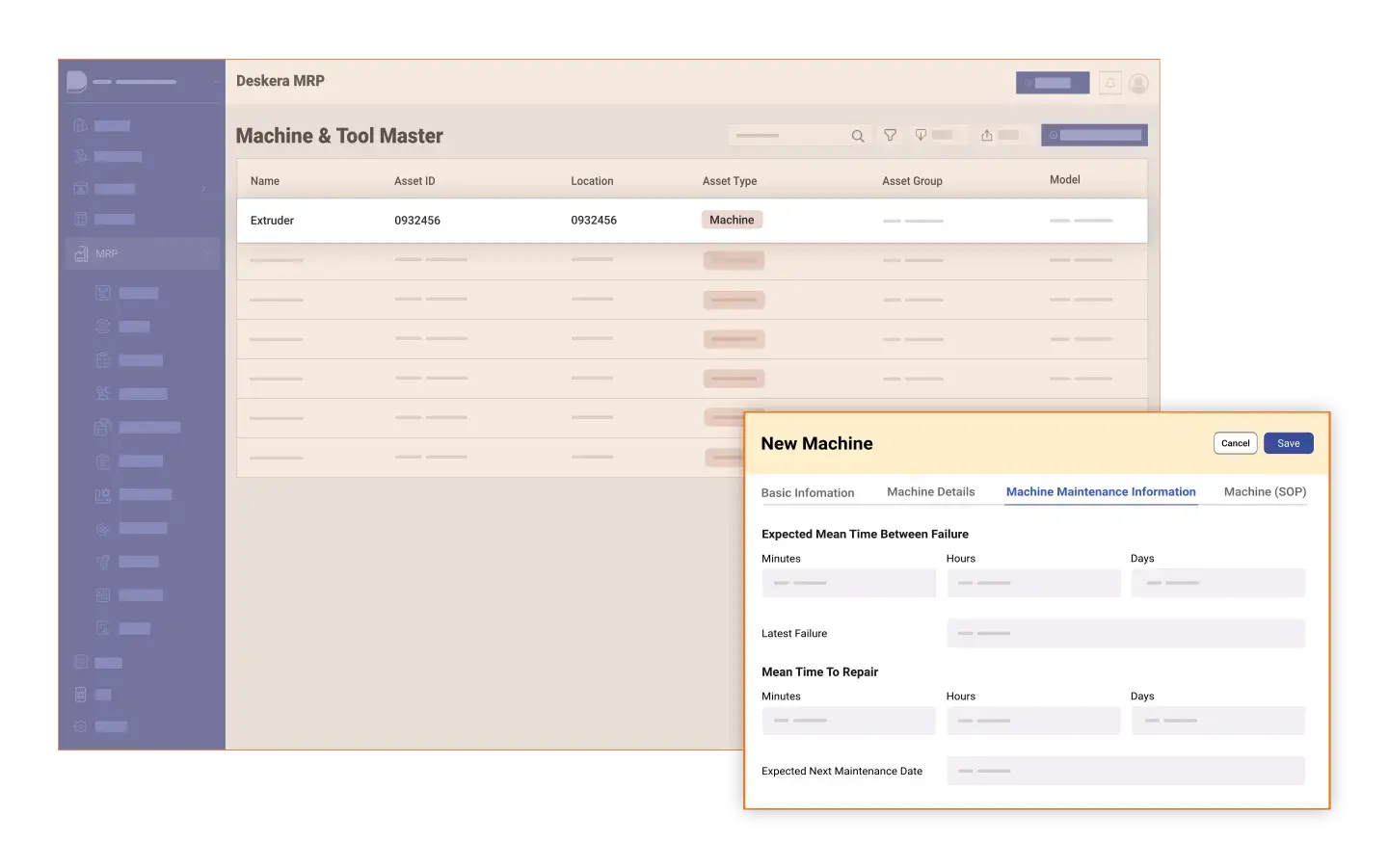
Condition-based maintenance requires real-time visibility into equipment performance, efficient maintenance planning, and seamless coordination between maintenance and production teams.
Deskera MRP helps manufacturers manage maintenance activities more effectively by providing centralized machine management, maintenance scheduling, work order tracking, inventory control, and performance reporting. This enables businesses to reduce downtime, improve equipment reliability, and make more informed maintenance decisions.
Real-Time Machine Monitoring
Deskera MRP provides a centralized view of machine performance, utilization, and maintenance status. By tracking machine operations and performance trends, maintenance teams can identify potential issues early and take corrective action before they impact production. This visibility supports a more proactive approach to equipment maintenance.
Automated Maintenance Scheduling
Deskera MRP simplifies maintenance planning by automating maintenance schedules based on predefined criteria. This helps ensure maintenance tasks are completed on time, reduces manual tracking, and minimizes the risk of missed maintenance activities that could lead to equipment failures.
Work Order Management
The platform allows businesses to create, assign, and track maintenance work orders from a single system. Maintenance teams can monitor task progress, document repairs, and maintain detailed service records, improving maintenance execution and accountability across the organization.
Maintenance History Tracking
Deskera MRP maintains comprehensive maintenance records for every machine, including inspections, repairs, and service activities. Access to historical maintenance data helps businesses identify recurring issues, evaluate equipment performance, and make more informed maintenance decisions.
Spare Parts and Inventory Control
Effective condition-based maintenance depends on having the right spare parts available when needed. Deskera MRP integrates maintenance operations with inventory management, enabling businesses to track spare parts availability, monitor stock levels, and reduce delays caused by material shortages.
Machine Health Monitoring
Deskera MRP helps organizations monitor machine health and equipment performance through centralized machine management capabilities. By tracking asset conditions and operational data, maintenance teams can identify performance issues early and improve equipment reliability.
Reporting and Performance Analytics
The system provides maintenance and machine performance reports that help businesses monitor downtime, maintenance costs, asset utilization, and maintenance effectiveness. These insights support data-driven decision-making and continuous improvement initiatives.
Integration with Production Planning
Deskera MRP connects maintenance activities with production schedules, allowing businesses to coordinate maintenance work with manufacturing operations. This helps minimize production disruptions while ensuring equipment receives timely maintenance.
Centralized Asset Management
Deskera MRP stores machine specifications, maintenance schedules, service records, and operational information in a centralized platform. This improves asset visibility, simplifies maintenance planning, and enables better control over equipment management processes.
Key Takeaways
- Condition-based maintenance (CBM) uses real-time equipment condition data to determine when maintenance should be performed, helping organizations move beyond fixed maintenance schedules.
- A successful CBM program works through a continuous cycle of monitoring asset conditions, analyzing performance data, identifying anomalies, and performing maintenance only when necessary.
- Common condition monitoring techniques such as vibration analysis, infrared thermography, oil analysis, ultrasonic testing, pressure monitoring, and electrical analysis help detect early signs of equipment deterioration.
- Unlike preventive maintenance and predictive maintenance, CBM triggers maintenance based on actual equipment conditions, striking a balance between scheduled maintenance and advanced failure prediction.
- The primary benefits of condition-based maintenance include reduced unplanned downtime, lower maintenance costs, improved equipment reliability, enhanced safety, and longer asset lifespans.
- Despite its advantages, CBM implementation can present challenges such as high initial investment costs, data management complexity, integration difficulties, and the need for specialized expertise.
- Organizations can improve CBM success by prioritizing critical assets, establishing performance baselines, selecting appropriate monitoring technologies, and continuously refining maintenance processes.
- Tracking KPIs such as MTBF, MTTR, equipment availability, unplanned downtime, maintenance costs, and work order completion rates helps measure the effectiveness of a condition-based maintenance strategy.
- Deskera MRP supports condition-based maintenance by providing machine monitoring, maintenance scheduling, work order management, inventory control, maintenance history tracking, and performance reporting within a centralized platform.
- By combining condition monitoring technologies with an integrated maintenance management system, businesses can improve asset performance, optimize maintenance resources, and achieve greater operational efficiency.
Related Articles
 Niti Samani
 Niti Samani
 Niti Samani
 Niti Samani
 Niti Samani
 Niti Samani