


Why do some businesses bounce back from supply chain disruptions in days while others take months to recover? The answer lies in supply chain agility—the ability to sense changes, respond quickly, and adapt operations without compromising efficiency or customer satisfaction. In today’s unpredictable business environment, agility is no longer a competitive advantage; it is a necessity for survival and growth.
Supply chain agility refers to how quickly and effectively an organization can respond to fluctuations in demand, supplier disruptions, or market shifts. From sudden spikes in customer orders to unexpected delays in raw material availability, businesses must be prepared to pivot at a moment’s notice. An agile supply chain ensures seamless coordination across procurement, production, inventory, and distribution, enabling companies to maintain continuity even under pressure.
As global markets become more interconnected and customer expectations continue to rise, rigid supply chains are increasingly becoming a liability. Companies that fail to adapt often face stockouts, excess inventory, delayed deliveries, and lost revenue. On the other hand, agile supply chains leverage real-time data, advanced forecasting, and streamlined processes to make faster, smarter decisions—helping businesses stay ahead of disruptions and capitalize on new opportunities.
This is where solutions like Deskera ERP play a critical role. Deskera ERP empowers businesses with real-time visibility across their supply chain, enabling better coordination and faster decision-making. With built-in ERP capabilities, demand forecasting, and inventory management tools, it helps organizations optimize resources and respond proactively to changes. By integrating data across functions and offering actionable insights, Deskera ERP supports businesses in building a more agile, resilient, and future-ready supply chain.
What Is Supply Chain Agility?
Supply chain agility refers to an organization’s ability to quickly and efficiently respond to changes in demand, supply, and market conditions without disrupting operations. It is not just about reacting to problems as they arise, but also about anticipating potential disruptions and preparing for them in advance. An agile supply chain enables businesses to adjust procurement, production, inventory, and distribution processes in real time, ensuring continuity and customer satisfaction even in uncertain environments.
At its core, supply chain agility combines speed, flexibility, and resilience. It allows companies to reconfigure their resources, processes, and supplier networks to handle sudden demand spikes, raw material shortages, or logistics disruptions. Whether it’s seasonal demand fluctuations, economic shifts, or unexpected global events, agile supply chains are designed to adapt quickly while maintaining operational efficiency and service levels.
Unlike traditional supply chains that prioritize cost efficiency and stability, agile supply chains focus on responsiveness and adaptability. While efficiency-driven models aim to minimize costs through optimized inventory and predictable processes, agility emphasizes the ability to pivot when conditions change. This distinction becomes especially important in today’s volatile environment, where factors such as geopolitical instability, inflation, labor shortages, and supply disruptions can significantly impact operations.
To build supply chain agility, businesses must invest in the right capabilities and resources. This includes improving logistics operations, adopting advanced technologies and automation, and gaining real-time visibility into supply chain activities. Access to accurate data and predictive insights enables organizations to make informed decisions, avoid knee-jerk reactions, and respond strategically to market changes—ultimately creating a more responsive and future-ready supply chain.
Why Supply Chain Agility is Critical in 2026
In 2026, supply chains are operating in an environment defined by constant disruption, rapid technological change, and evolving customer expectations. Traditional, rigid supply chain models are no longer sufficient to handle this level of uncertainty. Businesses must adopt agility to remain competitive, resilient, and responsive in the face of ongoing challenges and opportunities.
1. Increasing Demand Volatility
Customer demand has become highly unpredictable due to changing preferences, shorter product lifecycles, and digital buying behaviors. Businesses must be able to quickly scale production up or down without disrupting operations. Supply chain agility enables organizations to respond to these fluctuations in real time, ensuring they meet customer needs while avoiding overproduction or stock shortages that can impact profitability.
2. Rising Customer Expectations
Modern customers expect faster deliveries, real-time updates, and seamless service experiences. Delays or stockouts can quickly lead to dissatisfaction and lost loyalty. Agile supply chains allow businesses to fulfill orders efficiently, adapt to changing preferences, and maintain high service levels. This responsiveness plays a critical role in building trust and staying competitive in customer-centric markets.
3. Frequent Global Disruptions
From geopolitical tensions and economic instability to climate-related events and supply shortages, disruptions have become more frequent and complex. Businesses need the ability to anticipate risks and respond quickly when disruptions occur. Supply chain agility ensures continuity by enabling organizations to reroute logistics, switch suppliers, and adjust operations without significant downtime.
4. Acceleration of Digital Transformation
The rapid adoption of digital technologies is reshaping how supply chains operate. Businesses are increasingly relying on real-time data, automation, and advanced analytics to drive decisions. Agile supply chains leverage these technologies to improve visibility, forecasting, and coordination. Without agility, organizations risk falling behind competitors who are better equipped to use technology for faster and smarter decision-making.
5. Need for Faster Time-to-Market
In highly competitive industries, speed is a key differentiator. Companies must launch new products, respond to trends, and adapt strategies quickly to stay relevant. Agile supply chains support faster production cycles, flexible sourcing, and efficient distribution, allowing businesses to bring products to market ahead of competitors and capitalize on emerging opportunities.
6. Growing Complexity of Global Supply Chains
Supply chains are becoming more complex, involving multiple suppliers, regions, and logistics partners. Managing this complexity requires greater coordination and flexibility. Agile supply chains provide the ability to navigate these complexities by improving visibility, enhancing collaboration, and enabling quick adjustments across the network.
7. Increased Focus on Risk Management and Resilience
Businesses are placing greater emphasis on building resilient operations that can withstand disruptions. Supply chain agility plays a crucial role in this by enabling proactive risk identification and faster recovery. Organizations with agile supply chains can minimize the impact of disruptions, maintain service levels, and ensure business continuity even in uncertain conditions.
8. Pressure to Improve Cost Efficiency and Sustainability
Companies are under constant pressure to reduce costs while also meeting sustainability goals. Agile supply chains help optimize inventory, reduce waste, and improve resource utilization. This not only lowers operational costs but also minimizes environmental impact, helping businesses achieve both financial and sustainability objectives simultaneously.
In 2026, supply chain agility is no longer optional—it is a strategic necessity. Organizations that invest in agility are better positioned to adapt, innovate, and thrive in an increasingly complex and fast-moving global landscape.
Agile Supply Chain vs Lean Supply Chain
In modern supply chain management, businesses often choose between—or attempt to balance—two key approaches: agile and lean supply chains. While both aim to improve performance and efficiency, they differ significantly in their priorities, strategies, and response to market dynamics.
Understanding these differences is essential for organizations looking to build a supply chain that aligns with their operational goals and market conditions.
In practice, many organizations adopt a hybrid approach, combining lean principles for cost efficiency with agile strategies for responsiveness. This balanced model helps businesses remain competitive while staying prepared for uncertainties in today’s fast-changing market.
What Are the 2 Broad Categories of Supply Chain Agility?
Supply chain agility can be broadly divided into two key categories: structural agility and operational agility. While both are essential for building a responsive and resilient supply chain, they focus on different aspects of adaptability. Structural agility deals with long-term flexibility in the supply chain network, whereas operational agility focuses on short-term responsiveness and execution.
1. Structural Agility
Structural agility refers to an organization’s ability to reconfigure its supply chain network by realigning procurement, inventory flows, and production capacity. It involves making strategic adjustments across suppliers, manufacturing units, warehouses, and distribution channels to respond to medium- and long-term changes in demand or supply conditions.
This type of agility enables businesses to scale production up or down, shift inventory across locations, and optimize resource utilization. It relies heavily on data visibility, automation, and integrated systems to anticipate disruptions and demand trends. For example, integrating inventory management with demand forecasting allows companies to automate stock replenishment and avoid shortages or excess inventory.
2. Operational Agility
Operational agility is the ability to quickly optimize day-to-day processes to respond to short-term and unexpected changes in demand or supply. It focuses on execution—how efficiently a company can adjust production schedules, logistics, and supplier coordination in real time.
This form of agility is driven by real-time planning, strong supplier relationships, and streamlined operations. Businesses with high operational agility can reduce lead times, accelerate production cycles, and respond immediately to disruptions such as sudden demand spikes or material shortages. It ensures that even unexpected challenges are managed without significant delays or losses.
Structural vs Operational Agility at a Glance
Both structural and operational agility are complementary. Organizations that invest in both can not only anticipate and prepare for disruptions but also respond effectively when they occur, creating a truly agile and future-ready supply chain.
5 Core Attributes of an Agile Supply Chain
An agile supply chain is built on a set of core attributes that enable organizations to anticipate changes, respond quickly, and maintain operational efficiency in dynamic environments. These attributes go beyond basic flexibility—they ensure that businesses can sense disruptions early, make informed decisions, and execute changes seamlessly across the entire supply chain.
1. Alertness
Alertness is the ability to identify changes, risks, and opportunities early. This includes monitoring market trends, customer demand shifts, supplier performance, and even competitor strategies. An alert supply chain helps businesses stay proactive rather than reactive, reducing the risk of lost sales or excess inventory.
2. Visibility (Accessibility)
Visibility refers to having real-time access to data across the entire supply chain, including inventory levels, demand patterns, production status, and logistics. With strong visibility, businesses can forecast more accurately, allocate resources efficiently, and make data-driven decisions without delays.
3. Decisiveness
Decisiveness is the capability to make fast, informed decisions based on accurate data and insights. As supply chains grow more complex, relying on automated systems and analytics becomes crucial to ensure decisions are timely, strategic, and aligned with business goals.
4. Flexibility
Flexibility enables businesses to adapt operations quickly—whether it’s switching suppliers, adjusting production levels, or rerouting shipments. A flexible supply chain can accommodate demand fluctuations, introduce new products, and expand into new markets with minimal disruption.
5. Swiftness (Speed & Responsiveness)
Swiftness is the ability to execute decisions rapidly across procurement, production, and distribution. It ensures that once a change is identified and a decision is made, it can be implemented without delays—helping businesses respond effectively to sudden disruptions or customer demands.
Together, these attributes create a supply chain that is not only responsive but also proactive, data-driven, and resilient. Organizations that strengthen these core capabilities are better equipped to navigate uncertainty, maintain service levels, and gain a competitive edge in fast-changing markets.
Benefits of Supply Chain Agility
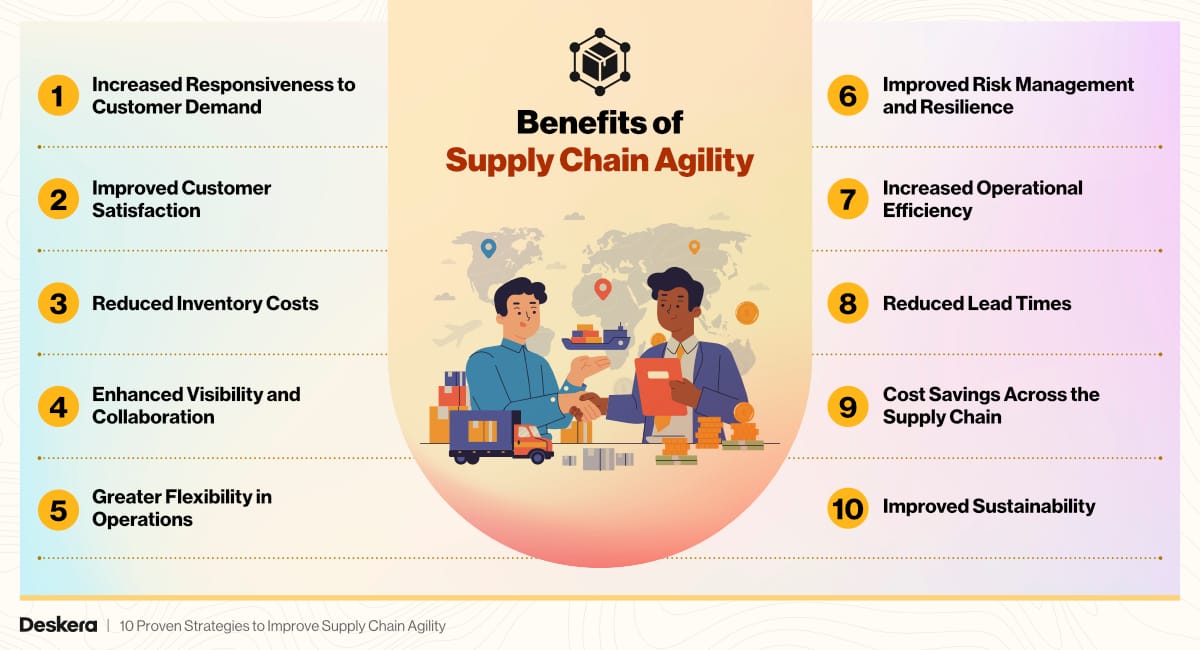
Supply chain agility offers a wide range of benefits that extend beyond handling disruptions. It enables businesses to respond faster, operate more efficiently, and stay aligned with changing market demands. In a dynamic and uncertain environment, agility helps organizations maintain service levels, control costs, and build resilience.
Below are the key benefits of adopting an agile supply chain approach.
1. Increased Responsiveness to Customer Demand
Agile supply chains enable businesses to respond quickly to changing customer demand by leveraging real-time data and advanced forecasting tools. Organizations can monitor trends, detect demand shifts early, and adjust production or inventory levels accordingly.
This responsiveness ensures that businesses can meet customer needs without delays or shortages, reducing lost sales opportunities. Ultimately, faster response times help companies stay competitive and align their operations closely with evolving market expectations.
2. Improved Customer Satisfaction
An agile supply chain directly contributes to higher customer satisfaction by ensuring product availability, faster delivery, and accurate order fulfillment. Businesses can quickly adapt to customer preferences and avoid delays caused by stockouts or inefficiencies.
With improved service levels and consistent performance, companies build stronger relationships with their customers. This reliability enhances brand reputation, encourages repeat purchases, and increases long-term customer loyalty in an increasingly competitive marketplace.
3. Reduced Inventory Costs
Agility allows businesses to optimize inventory levels by aligning stock with actual demand. Instead of maintaining excessive inventory, companies can adopt just-in-time practices to minimize storage and holding costs. This reduces the risk of obsolete or unsold goods while improving cash flow.
Efficient inventory management also lowers warehousing and transportation expenses, enabling businesses to allocate resources more effectively and maintain a lean yet responsive supply chain.
4. Enhanced Visibility and Collaboration
Supply chain agility is driven by improved visibility across all operations, from procurement to delivery. Real-time data access enables better tracking of inventory, shipments, and supplier performance.
This transparency fosters stronger collaboration between internal teams and external partners, allowing faster communication and coordination. As a result, businesses can make informed decisions, resolve issues quickly, and ensure smoother workflows across the entire supply chain network.
5. Greater Flexibility in Operations
Agile supply chains provide the flexibility needed to adapt operations based on changing market conditions. Businesses can switch suppliers, modify production schedules, or adjust distribution strategies with minimal disruption.
This adaptability allows organizations to respond to new opportunities, introduce products faster, and manage unexpected challenges effectively. Greater operational flexibility ensures that companies remain competitive and capable of handling both growth and uncertainty in dynamic markets.
6. Improved Risk Management and Resilience
An agile supply chain enhances a company’s ability to manage risks and maintain continuity during disruptions. By diversifying suppliers, monitoring performance, and maintaining contingency plans, businesses can reduce their dependency on single sources.
This proactive approach helps identify potential issues early and respond effectively. As a result, organizations can minimize the impact of disruptions, recover faster, and ensure consistent delivery of products to customers.
7. Increased Operational Efficiency
Agility improves efficiency by streamlining processes and eliminating unnecessary delays or waste. Automation, data integration, and optimized workflows help businesses enhance productivity across procurement, manufacturing, and distribution.
Faster order processing, improved warehouse operations, and better coordination between teams lead to smoother operations. This increased efficiency not only reduces costs but also enables organizations to handle higher demand without compromising performance or service quality.
8. Reduced Lead Times
Agile supply chains significantly reduce lead times by improving coordination and optimizing sourcing and production processes. Businesses can respond faster to orders, accelerate manufacturing cycles, and streamline logistics operations.
Shorter lead times ensure quicker delivery to customers and improved service levels. This advantage is particularly important in industries where speed is critical, helping companies meet tight deadlines and gain a competitive edge in the market.
9. Cost Savings Across the Supply Chain
Supply chain agility helps reduce costs across multiple areas, including inventory, logistics, and procurement. Optimized inventory levels lower storage expenses, while efficient transportation and supplier management reduce operational costs.
Improved communication with suppliers can also lead to better pricing and contract terms. By eliminating inefficiencies and waste, businesses can achieve significant cost savings while maintaining high performance and responsiveness.
10. Improved Sustainability
Agile supply chains contribute to sustainability by optimizing resource utilization and reducing waste. Efficient inventory management prevents overproduction, while streamlined logistics reduce unnecessary transportation and emissions.
Businesses can also switch to more sustainable suppliers or practices when needed. This ability to adapt supports environmental goals while maintaining operational efficiency. In the long term, sustainability improvements also enhance brand image and align with growing consumer expectations for responsible business practices.
Key Challenges in Achieving Supply Chain Agility
While supply chain agility offers significant advantages, achieving it is not without challenges. Many organizations struggle to transition from traditional, rigid systems to more responsive and flexible operations. These challenges often stem from gaps in technology, processes, and collaboration, making it difficult to build a truly agile supply chain.
1. Lack of Real-Time Visibility
One of the biggest barriers to supply chain agility is limited visibility across operations. Without access to real-time data on inventory, demand, and shipments, businesses cannot make timely decisions. This lack of transparency leads to delays, inefficiencies, and missed opportunities.
Organizations relying on manual processes or disconnected systems often struggle to track performance accurately and respond quickly to disruptions or changing market conditions.
2. Siloed Systems and Data Fragmentation
Many businesses operate with multiple disconnected systems across procurement, production, and logistics. These silos prevent seamless data flow and hinder collaboration between departments. As a result, decision-making becomes slower and less accurate.
Without integrated platforms, it becomes difficult to gain a unified view of the supply chain, limiting the organization’s ability to respond effectively to changes and maintain operational alignment.
3. Inefficient Inventory Management
Balancing inventory levels is a critical challenge in achieving agility. Excess inventory increases costs, while insufficient stock leads to missed sales and customer dissatisfaction.
Without accurate demand forecasting and inventory optimization, businesses struggle to maintain the right balance. Inefficient inventory practices reduce flexibility and make it harder to respond quickly to fluctuations in demand or supply disruptions.
4. Supplier Dependency and Limited Diversification
Relying heavily on a single supplier or a limited supplier base increases vulnerability to disruptions. Any delay, shortage, or failure on the supplier’s end can significantly impact operations.
Lack of supplier diversification limits flexibility and reduces the ability to switch sources quickly. This dependency makes it difficult for organizations to maintain continuity and adapt to unexpected changes in the supply chain.
5. Limited Adoption of Advanced Technologies
Technology plays a crucial role in enabling supply chain agility, yet many organizations are slow to adopt modern solutions. Without tools such as ERP, MRP, automation, and advanced analytics, businesses lack the insights needed for proactive decision-making. Legacy systems and manual processes further restrict scalability and responsiveness, making it challenging to build a data-driven and agile supply chain.
6. Poor Demand Forecasting Accuracy
Inaccurate demand forecasting can lead to overproduction or stockouts, both of which hinder agility. Businesses that rely on outdated data or basic forecasting methods struggle to anticipate market trends effectively.
This results in reactive decision-making rather than proactive planning, reducing the organization’s ability to respond quickly and efficiently to changing customer demands.
7. Resistance to Change and Organizational Inertia
Transitioning to an agile supply chain often requires significant changes in processes, technology, and mindset. Employees and stakeholders may resist these changes due to uncertainty or lack of understanding.
This resistance slows down transformation efforts and prevents organizations from fully adopting agile practices. Building a culture that embraces flexibility and innovation is essential but often challenging.
8. Weak Collaboration Across the Supply Chain
Agility depends on strong collaboration between internal teams and external partners such as suppliers and logistics providers. Poor communication and lack of coordination can lead to delays, errors, and inefficiencies.
Without aligned goals and transparent information sharing, it becomes difficult to respond quickly to disruptions or optimize operations across the supply chain.
9. High Implementation Costs
Implementing agile supply chain strategies often requires investment in technology, infrastructure, and training. For many organizations, especially small and medium-sized businesses, these costs can be a significant barrier.
Budget constraints may delay adoption, preventing companies from realizing the long-term benefits of agility.
10. Complexity of Global Supply Chains
Global supply chains involve multiple stakeholders, regions, and regulatory requirements, making them inherently complex. Managing cross-border logistics, compliance, and varying demand patterns adds layers of difficulty. This complexity makes it harder to maintain visibility, coordination, and responsiveness, ultimately limiting the organization’s ability to achieve true supply chain agility.
Overcoming these challenges requires a strategic approach that combines technology adoption, process optimization, and strong collaboration. Organizations that address these barriers effectively can unlock the full potential of supply chain agility and gain a lasting competitive advantage.
10 Proven Strategies to Improve Supply Chain Agility
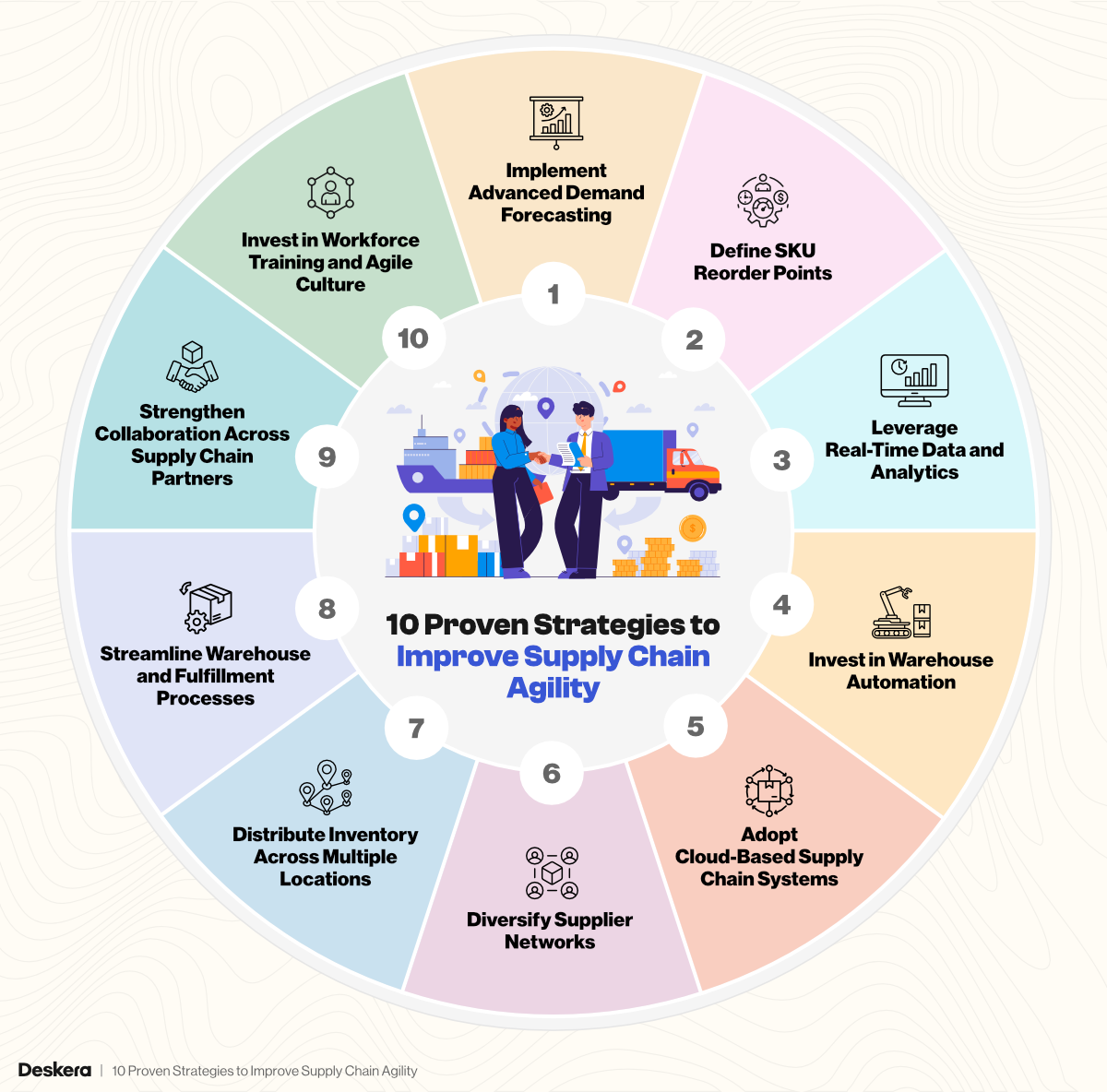
Building an agile supply chain requires a combination of strategic planning, advanced technology, and strong collaboration across the entire supply network. Businesses must be able to quickly adapt to demand fluctuations, operational disruptions, and evolving customer expectations.
By implementing the right strategies, organizations can improve responsiveness, reduce risks, and maintain efficient operations even in unpredictable market conditions.
Below are ten proven strategies that can help organizations strengthen supply chain agility.
1. Implement Advanced Demand Forecasting
Demand forecasting allows businesses to predict future product demand using historical sales data, market trends, and predictive analytics. By analyzing past purchasing patterns and seasonal variations, organizations can estimate how much inventory will be required at different times.
Accurate forecasting helps companies maintain optimal inventory levels, reducing the risk of stockouts or excess inventory. It also enables better production planning, efficient procurement, and improved resource allocation across the supply chain.
2. Define SKU Reorder Points
Setting reorder points at the SKU level helps ensure inventory is replenished at the right time before stock runs out. By analyzing historical sales data and supplier lead times, businesses can determine the optimal moment to place new orders.
Automating reorder point calculations allows organizations to respond faster to changes in demand. This approach minimizes supply disruptions, ensures consistent product availability, and prevents unnecessary overstocking.
3. Leverage Real-Time Data and Analytics
Real-time visibility across the supply chain enables businesses to make faster and more informed decisions. By collecting and analyzing operational data from warehouses, transportation systems, and suppliers, organizations can quickly identify issues and respond to them.
Access to real-time data also improves demand forecasting, inventory optimization, and performance monitoring. With accurate insights, businesses can proactively adjust production schedules, inventory levels, and logistics strategies.
4. Invest in Warehouse Automation
Automating warehouse operations significantly improves speed, accuracy, and efficiency. Technologies such as warehouse management systems, robotics, and smart sensors help automate processes like inventory tracking, picking, packing, and shipping.
Automation reduces manual errors and increases operational productivity. More importantly, it enables organizations to handle sudden demand spikes and maintain consistent fulfillment performance.
5. Adopt Cloud-Based Supply Chain Systems
Cloud-based supply chain platforms provide centralized visibility and connectivity across the entire supply network. These systems allow businesses to integrate data from procurement, manufacturing, warehousing, and logistics operations into a single platform.
With improved transparency and data accessibility, organizations can coordinate activities more effectively and respond quickly to disruptions. Cloud systems also support advanced analytics and collaboration among supply chain partners.
6. Diversify Supplier Networks
Relying on a single supplier increases the risk of supply disruptions. Diversifying supplier networks helps businesses maintain operational continuity when unexpected issues arise.
By establishing relationships with multiple suppliers across different regions, companies gain greater flexibility and resilience. This strategy ensures that alternative sources of supply are available if one supplier experiences delays or shortages.
7. Distribute Inventory Across Multiple Locations
Storing inventory in multiple warehouses or distribution centers improves supply chain flexibility and delivery speed. Geographic distribution enables businesses to serve customers from locations closer to demand centers.
This strategy reduces shipping times, lowers transportation costs, and ensures business continuity in case one facility becomes unavailable due to disruptions or operational challenges.
8. Streamline Warehouse and Fulfillment Processes
Efficient operational processes play a major role in supply chain agility. Businesses should continuously review and optimize workflows related to order processing, inventory management, packing, shipping, and returns handling.
Streamlining these processes reduces delays and eliminates inefficiencies. When operations are optimized, organizations can respond more quickly to demand fluctuations and maintain higher service levels.
9. Strengthen Collaboration Across Supply Chain Partners
Effective collaboration among suppliers, manufacturers, logistics providers, and distributors improves supply chain responsiveness. Transparent communication and shared data allow all stakeholders to align their operations and respond quickly to changes.
Strong partnerships also support joint problem-solving, better coordination, and improved planning. This level of collaboration enhances overall supply chain flexibility and resilience.
10. Invest in Workforce Training and Agile Culture
An agile supply chain requires employees who are equipped with the right skills and mindset. Training programs focused on supply chain management, digital technologies, and agile methodologies help employees respond effectively to operational changes.
Encouraging cross-functional collaboration and empowering teams to make faster decisions also strengthens agility. A well-trained workforce can quickly adapt to disruptions and implement improvements that enhance supply chain performance.
By adopting these strategies, businesses can create a more flexible, responsive, and resilient supply chain. Organizations that prioritize agility are better prepared to handle disruptions, adapt to market shifts, and deliver consistent value to their customers.
Key Metrics to Measure and Improve Supply Chain Agility
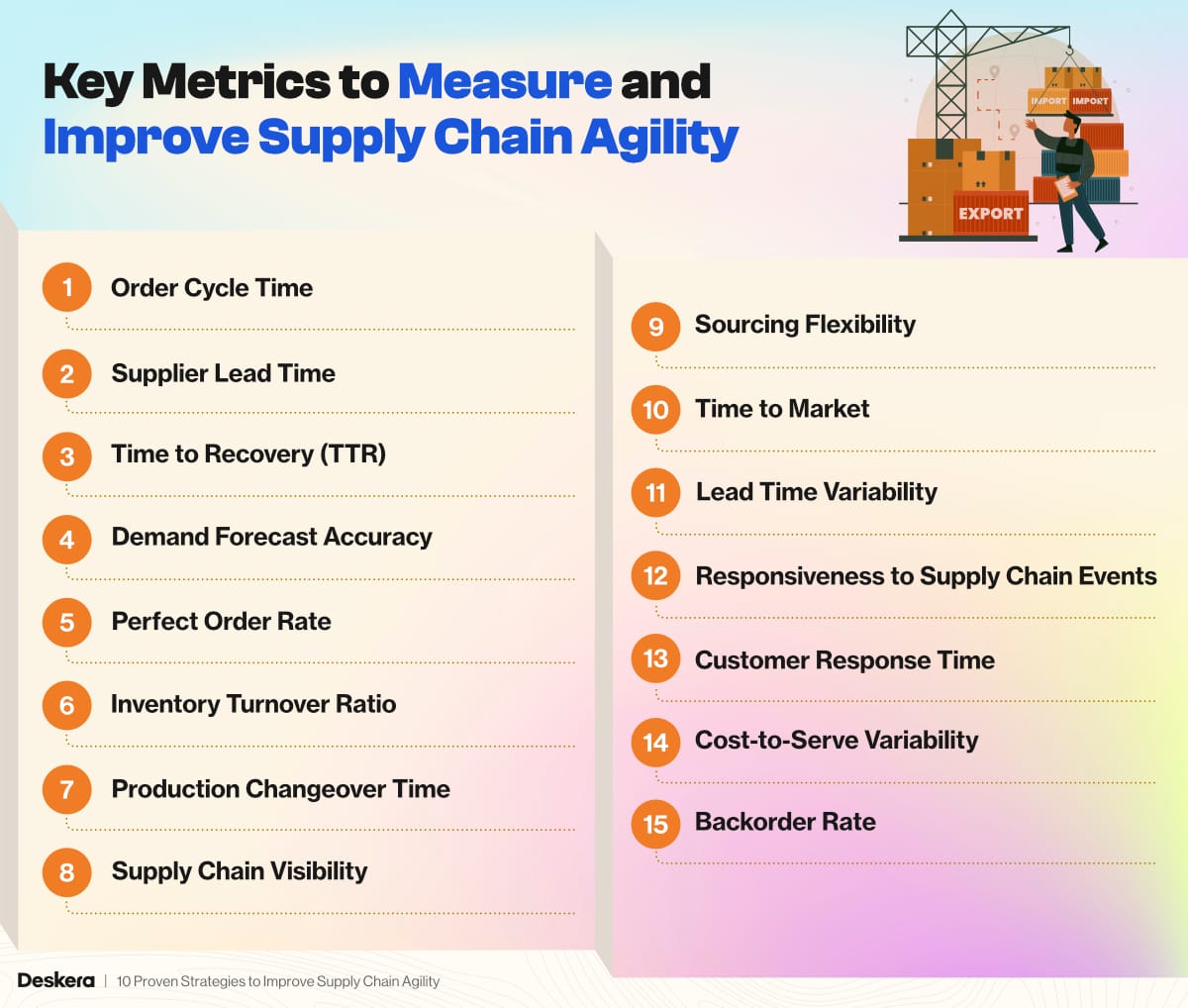
To build and sustain an agile supply chain, businesses must go beyond strategy and focus on measurable performance indicators.
These metrics provide real-time insights into how effectively a supply chain can respond to changes, manage disruptions, and maintain operational efficiency.
By tracking the right metrics, organizations can identify gaps, improve decision-making, and continuously enhance their agility.
1. Order Cycle Time
Order cycle time measures the duration between when a customer places an order and when it is delivered. A shorter cycle time indicates a more responsive and agile supply chain. This metric reflects how efficiently operations—from order processing to fulfillment—are managed. Reducing cycle time helps businesses meet customer expectations faster and improve service levels.
2. Supplier Lead Time
Supplier lead time tracks how long it takes for suppliers to deliver goods after an order is placed. Consistently low and predictable lead times indicate a reliable and agile supplier network. Variability in lead times can disrupt production and inventory planning, making it harder to respond to demand fluctuations effectively.
3. Time to Recovery (TTR)
Time to Recovery measures how quickly a supply chain can return to normal operations after a disruption. A shorter TTR reflects higher resilience and agility. This metric is critical in assessing how well a business can handle unexpected events such as supply shortages, logistics failures, or external disruptions.
4. Demand Forecast Accuracy
Demand forecast accuracy evaluates how closely predicted demand matches actual sales. Higher accuracy enables better inventory planning and production scheduling. While not a direct measure of agility, it plays a crucial role in supporting agile responses by minimizing surprises and reducing the risk of stockouts or excess inventory.
5. Perfect Order Rate
This metric measures the percentage of orders delivered on time, complete, and without errors. A high perfect order rate indicates that the supply chain is operating efficiently even under changing conditions. It reflects the organization’s ability to maintain consistency, accuracy, and customer satisfaction.
6. Inventory Turnover Ratio
Inventory turnover shows how frequently inventory is sold and replenished over a given period. A higher turnover rate indicates efficient inventory management and better adaptability to demand changes. Low turnover may signal overstocking or slow-moving goods, which can reduce overall agility.
7. Production Changeover Time
Production changeover time measures how quickly manufacturing processes can switch from one product to another. Shorter changeover times indicate greater flexibility and responsiveness. This metric is especially important for businesses dealing with diverse product lines or frequent demand shifts.
8. Supply Chain Visibility
This metric reflects the level of real-time data access across the supply chain, including inventory, shipments, and demand patterns. High visibility enables faster decision-making and proactive responses. It is a foundational element of agility, allowing businesses to monitor operations and identify issues early.
9. Sourcing Flexibility
Sourcing flexibility measures the availability of alternative suppliers for critical materials or components. A higher number of sourcing options increases resilience and reduces dependency on single suppliers. This flexibility allows businesses to adapt quickly when disruptions occur in the supply network.
10. Time to Market
Time to market tracks how quickly a product moves from development to final delivery. A shorter time to market indicates a more agile supply chain capable of responding to trends and launching products faster. This metric is crucial for maintaining competitiveness in fast-paced industries.
11. Lead Time Variability
This metric measures fluctuations in order fulfillment or supplier lead times. Lower variability indicates more predictable and stable operations, which supports better planning and responsiveness. High variability can introduce uncertainty and reduce the effectiveness of agile strategies.
12. Responsiveness to Supply Chain Events
This measures how quickly an organization can respond to disruptions, such as rerouting shipments or reallocating inventory. Faster response times prevent minor issues from escalating into major disruptions and demonstrate strong operational agility.
13. Customer Response Time
Customer response time tracks how quickly a business resolves customer inquiries, complaints, or service issues related to orders. Faster response times reflect agility in handling last-mile challenges and contribute to improved customer satisfaction and trust.
14. Cost-to-Serve Variability
This metric evaluates how costs fluctuate across different products, customers, or channels. Lower variability indicates more consistent and efficient operations. High variability may highlight inefficiencies that limit agility and increase operational complexity.
15. Backorder Rate
Backorder rate measures the percentage of orders that cannot be fulfilled on time due to insufficient inventory. A lower backorder rate indicates better inventory planning and higher responsiveness. Reducing backorders helps maintain customer satisfaction and ensures smoother supply chain operations.
By consistently monitoring these metrics, businesses can create a data-driven approach to improving supply chain agility. Tracking performance not only highlights inefficiencies but also enables organizations to adapt quickly, optimize operations, and stay competitive in an ever-changing market.
How Deskera ERP Helps Improve Supply Chain Agility
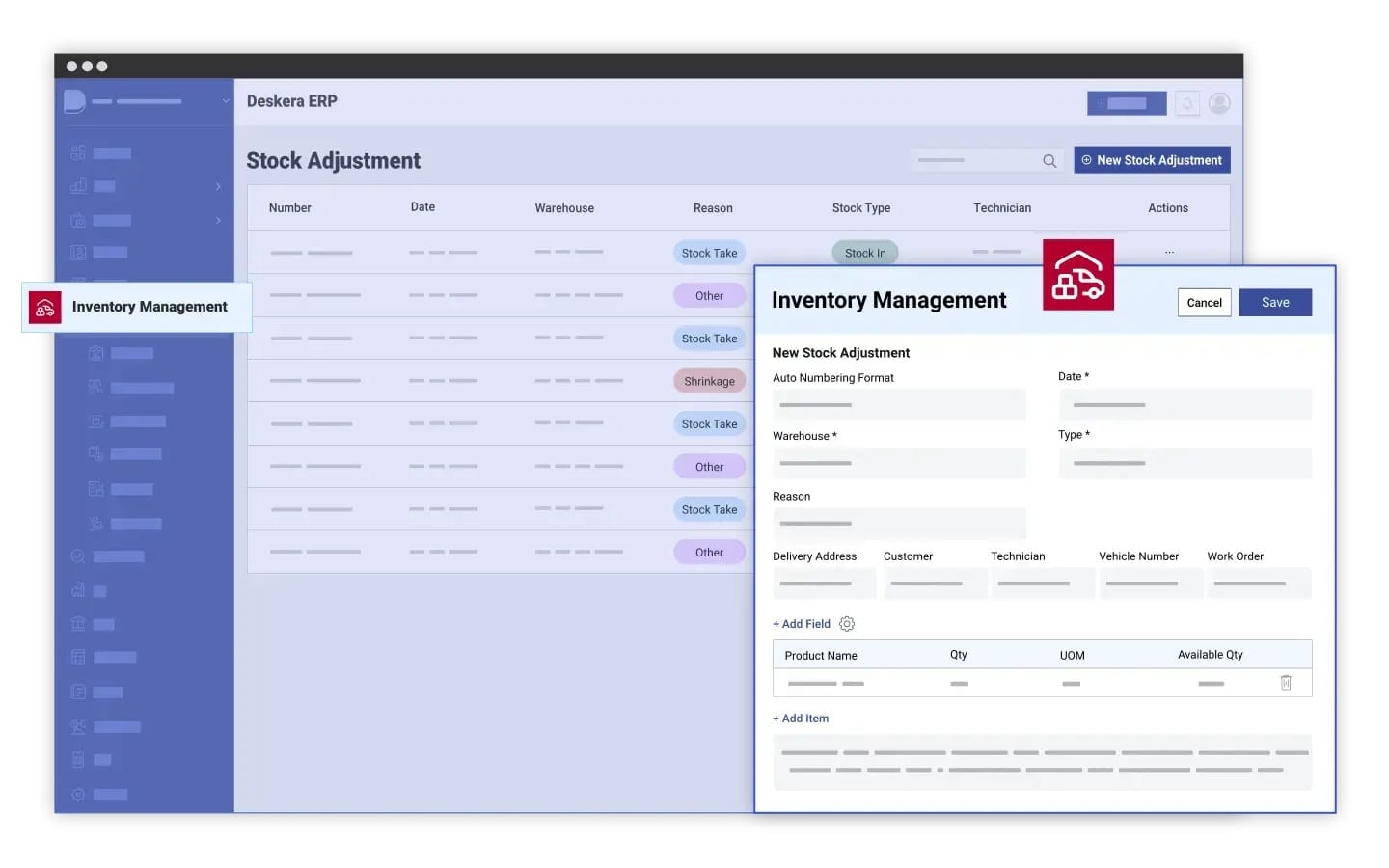
In today’s fast-moving business environment, achieving supply chain agility requires more than just strategy—it demands the right technology. Deskera ERP acts as a centralized, cloud-based platform that connects procurement, inventory, production, and finance, enabling businesses to respond faster, make smarter decisions, and maintain operational flexibility.
1. Real-Time Visibility Across the Supply Chain
Deskera ERP provides a unified view of inventory, orders, procurement, and production through real-time dashboards. This visibility allows businesses to track materials and products at every stage, identify bottlenecks early, and respond quickly to disruptions or demand changes.
2. Smarter Demand Forecasting and Planning
With built-in analytics and historical data tracking, Deskera ERP improves demand forecasting accuracy. Businesses can anticipate demand fluctuations, plan inventory levels efficiently, and align production schedules proactively—reducing stockouts and excess inventory.
3. Optimized Inventory Management
Deskera ERP enables real-time inventory tracking across multiple locations, along with automated reorder points and stock monitoring. This helps maintain optimal inventory levels, reduce carrying costs, and ensure product availability even during demand fluctuations.
4. Integrated MRP and Production Planning
The system’s MRP capabilities align material requirements with production schedules, ensuring that the right resources are available at the right time. This minimizes delays, reduces waste, and allows businesses to quickly adjust production based on changing demand.
5. Streamlined Procurement and Supplier Management
Deskera ERP centralizes supplier data, purchase orders, and procurement workflows. Businesses can monitor supplier performance, manage lead times, and collaborate effectively with vendors—improving sourcing flexibility and reducing supply risks.
6. Enhanced Collaboration Across Teams
By integrating supply chain operations with finance, sales, and logistics, Deskera ERP eliminates data silos. All stakeholders work from a single source of truth, improving coordination, communication, and decision-making across the supply chain.
7. Data-Driven Decision Making with Advanced Analytics
Deskera ERP offers customizable dashboards, KPI tracking, and predictive insights. These analytics help businesses monitor performance, identify inefficiencies, and make faster, data-driven decisions to improve supply chain responsiveness.
8. Automation of Supply Chain Processes
The platform automates routine tasks such as order processing, inventory updates, and procurement workflows. This reduces manual errors, speeds up operations, and allows teams to focus on strategic activities that enhance agility.
9. Cloud-Based Accessibility and Scalability
As a cloud ERP solution, Deskera allows teams to access data anytime, anywhere. This supports remote collaboration, faster approvals, and scalability as businesses grow or expand into new markets—without increasing operational complexity.
10. Improved Cost Control and Financial Integration
Deskera ERP integrates supply chain operations with financial management, providing real-time insights into costs, margins, and cash flow. This helps businesses optimize spending, improve profitability, and make more strategic decisions.
By combining real-time visibility, automation, analytics, and integrated planning, Deskera ERP enables businesses to transition from reactive operations to a proactive, agile, and resilient supply chain model—capable of adapting quickly to market changes and sustaining long-term growth.
Key Takeaways
- Supply chain agility enables businesses to respond quickly to disruptions, adapt to demand changes, and maintain operational efficiency in dynamic markets.
- Agile supply chains focus on flexibility, speed, and responsiveness, while lean supply chains prioritize cost efficiency and waste reduction.
- Structural agility prepares the supply chain for long-term changes, whereas operational agility ensures quick responses to short-term disruptions.
- Core attributes like alertness, visibility, decisiveness, flexibility, and swiftness are essential for building an agile supply chain.
- Supply chain agility improves responsiveness, reduces costs, enhances customer satisfaction, and strengthens overall resilience.
- Common challenges include lack of visibility, siloed systems, inefficient inventory management, and limited technology adoption.
- In 2026, agility is critical due to demand volatility, global disruptions, rising customer expectations, and digital transformation.
- Strategies such as demand forecasting, real-time data usage, supplier diversification, and automation help improve supply chain agility.
- Key metrics like order cycle time, forecast accuracy, inventory turnover, and time to recovery help measure and optimize agility.
- Deskera ERP supports supply chain agility by providing real-time visibility, advanced planning tools, automation, and integrated data insights.
Related Articles
 Damini
 Rhema Hans
 Niti Samani
 Niti Samani
 Niti Samani
 Niti Samani