


What separates businesses that consistently grow their revenue from those that struggle to keep up? The answer lies in having a well-defined, data-driven revenue strategy backed by the right technology. In today’s competitive and fast-evolving market, relying on intuition or disconnected systems is no longer enough. Companies need real-time insights, seamless collaboration across departments, and the ability to respond quickly to changing demand—all of which are difficult to achieve without a unified system.
A revenue strategy is more than just setting sales targets—it involves aligning pricing, customer segmentation, demand forecasting, and financial planning to drive sustainable growth. However, many organizations face challenges such as data silos, inaccurate forecasting, and limited visibility into performance. These gaps often lead to missed opportunities, inefficient operations, and inconsistent revenue outcomes.
This is where Enterprise Resource Planning (ERP) systems play a strategic role. By integrating core business functions such as finance, sales, inventory, and operations, ERP provides a single source of truth for decision-makers. It enables businesses to analyze real-time data, identify trends, and make informed decisions that directly impact revenue growth. With improved visibility and coordination, companies can build more accurate and effective revenue strategies.
Solutions like Deskera ERP take this a step further by combining powerful analytics with user-friendly functionality. With features such as AI-powered insights, real-time financial tracking, demand forecasting, and integrated MRP capabilities, Deskera helps businesses streamline operations and optimize revenue planning. Its mobile accessibility and customizable dashboards ensure that decision-makers have the right information at the right time, enabling smarter and faster strategic decisions.
What Is a Revenue Strategy?
A revenue strategy is a structured and forward-looking plan that outlines how a business will generate, increase, and sustain its income over time. It goes beyond simply setting sales targets—instead, it brings together key functions such as sales, marketing, pricing, product development, and customer success to create a unified approach to growth. By aligning these areas, a revenue strategy helps businesses not only maximize income but also optimize costs and improve overall profitability.
At its core, a strong revenue strategy provides a clear roadmap for acquiring new customers, retaining existing ones, and expanding their value over time. This includes defining how a company positions its products, how it prices them, which channels it uses to sell, and how it nurtures long-term customer relationships. When executed effectively, it enables predictable revenue streams, better financial planning, and sustainable business growth.
Importantly, revenue strategies are not one-size-fits-all. They vary significantly depending on a company’s business model, industry, and target market. For instance, subscription-based businesses often focus on increasing customer lifetime value (CLV) through upselling and cross-selling, while eCommerce companies prioritize driving website traffic and improving conversion rates. Similarly, B2B organizations typically emphasize customer acquisition and retention, whereas B2C companies may focus more on pricing strategies and promotional campaigns.
To remain competitive, businesses must also balance short-term revenue goals with long-term strategic objectives. This means continuously analyzing market trends, customer behavior, and operational performance to refine their approach. In today’s data-driven environment, having the ability to adapt and optimize revenue strategies in real time is what ultimately sets high-performing organizations apart.
Revenue Planning vs Revenue Strategy
While often used interchangeably, revenue planning and revenue strategy serve distinct yet complementary roles in driving business growth. A revenue strategy defines the overarching approach a business takes to generate and grow income, while revenue planning focuses on the execution—translating that strategy into actionable financial targets, budgets, and forecasts.
Understanding the difference between the two is essential for building a structured and results-driven approach to revenue generation.
In essence, revenue strategy sets the vision, while revenue planning ensures that vision is executed effectively. Businesses that align both elements can drive more predictable, scalable, and sustainable growth.
Key Components of a Revenue Strategy
A well-defined revenue strategy is built on multiple interconnected components that work together to drive consistent and scalable growth. Each element plays a critical role in ensuring that revenue generation is not only effective but also sustainable over the long term.
1. Customer Segmentation
Understanding your target audience is the foundation of any revenue strategy. Businesses must segment customers based on factors such as demographics, behavior, needs, and purchasing power. This allows companies to tailor their offerings, messaging, and pricing to specific groups, improving conversion rates and customer satisfaction.
2. Value Proposition
A clear and compelling value proposition defines why customers should choose your product or service over competitors. It highlights the unique benefits, features, and outcomes your offering delivers, directly influencing customer acquisition and customer retention.
3. Pricing Strategy
Pricing plays a crucial role in revenue generation and profitability. Businesses must determine optimal pricing models—such as cost-plus, value-based, or dynamic pricing—based on market demand, competition, and perceived value. The right pricing strategy ensures competitiveness while maximizing margins.
4. Sales Strategy and Channels
This component focuses on how a business sells its products or services. It includes selecting the right sales channels (direct sales, online platforms, distributors), defining sales processes, and setting performance targets. An effective sales strategy ensures consistent revenue flow and market reach.
5. Marketing and Demand Generation
Marketing drives awareness and generates demand for products or services. This includes digital marketing, content strategies, advertising, and lead generation efforts. A strong demand generation engine ensures a steady pipeline of potential customers.
6. Customer Acquisition and Retention
Revenue growth depends not only on acquiring new customers but also on retaining existing ones. Strategies such as loyalty programs, personalized experiences, and customer support help improve retention and increase customer lifetime value (CLV).
7. Upselling and Cross-Selling
Maximizing revenue from existing customers is a key strategy. Upselling (encouraging customers to purchase a higher-value product) and cross-selling (offering complementary products) help increase average transaction value and overall revenue.
8. Demand Forecasting
Accurate demand forecasting helps businesses anticipate customer needs and plan inventory, production, and staffing accordingly. It reduces the risk of stockouts or overproduction, ensuring efficient operations and steady revenue generation.
9. Revenue Streams Diversification
Relying on a single source of income can be risky. Businesses should explore multiple revenue streams—such as subscriptions, one-time sales, services, or partnerships—to reduce dependency and improve financial stability.
10. Performance Metrics and KPIs
Tracking the right metrics is essential to measure success and make informed decisions. Common KPIs include revenue growth rate, customer acquisition cost (CAC), customer lifetime value (CLV), conversion rates, and profit margins. These insights help refine strategies and improve outcomes.
A successful revenue strategy integrates all these components into a cohesive framework, enabling businesses to respond to market changes, optimize performance, and achieve long-term growth.
Types of Revenue Strategies
There is no one-size-fits-all approach to revenue growth. High-performing businesses adopt a combination of strategies tailored to their market, customers, and business model.
The most effective revenue strategies span across pricing, customer engagement, channels, and long-term value creation.
1. Pricing Strategy and Optimization
Pricing strategy determines how businesses capture value from their offerings. This includes tiered pricing, dynamic pricing, bundling, and subscription-based models. Businesses may also localize pricing based on geography or customer segments. A well-optimized pricing strategy balances competitiveness with profitability while maximizing customer willingness to pay.
2. Customer Segmentation and Targeting
This strategy involves dividing customers into meaningful groups based on behavior, needs, or value. By identifying high-value segments, businesses can tailor messaging, pricing, and offerings more effectively. This ensures better resource allocation and improves both acquisition and retention outcomes.
3. Channel Diversification
Channel diversification focuses on expanding where and how products or services are sold. This includes direct sales, online marketplaces, partner networks, and affiliate channels. A multi-channel approach increases market reach, reduces dependency on a single channel, and improves revenue resilience.
4. Upselling and Cross-Selling
This strategy aims to increase revenue from existing customers. Upselling encourages customers to upgrade to higher-value offerings, while cross-selling promotes complementary products. These approaches improve average order value and strengthen long-term customer relationships.
5. Subscription and Recurring Revenue Models
Recurring revenue models provide predictable and stable income streams. Common in SaaS and service industries, subscriptions improve cash flow, enhance customer retention, and increase lifetime value through continuous engagement.
6. Demand Generation and Conversion Optimization
This strategy focuses on attracting potential customers and converting them into buyers. It includes lead generation, marketing campaigns, and conversion rate optimization. The goal is to maximize the efficiency of the sales funnel and increase the return on marketing investments.
7. Product and Portfolio Optimization
Businesses can drive growth by refining their product mix. This includes identifying high-margin products, introducing new offerings, and structuring product tiers (e.g., good-better-best). Focusing on profitable products ensures better margins and stronger revenue performance.
8. Customer Retention and Lifecycle Strategy
Retention strategies focus on keeping customers engaged over time through personalized experiences, loyalty programs, and lifecycle campaigns. Since retaining customers is more cost-effective than acquiring new ones, this strategy plays a critical role in long-term revenue growth.
9. Revenue Stream Diversification
This strategy involves creating multiple income sources, such as adding services, subscriptions, or new product lines. Diversification reduces reliance on a single revenue stream and improves business stability while unlocking new growth opportunities.
10. Partnership and Ecosystem Strategy
Collaborating with partners, resellers, or complementary businesses helps expand market reach and accelerate revenue growth. Partner ecosystems enable businesses to access new customer bases while reducing acquisition costs and scaling faster.
A Three-Tier Framework for Structuring an Effective Revenue Strategy
Understanding the components of a revenue strategy is only the first step—what truly drives results is how these elements are structured and executed. A well-defined framework helps businesses move from scattered efforts to a cohesive, results-driven approach.
By organizing revenue strategy into three interconnected layers—Revenue Architecture, Revenue Operations (RevOps), and Execution—organizations can align planning with action and achieve sustainable growth.
1. Revenue Architecture: Designing Acquisition, Expansion, and Retention Models
Revenue Architecture defines the foundation of how a business generates income. It focuses on the “what” and “how” of revenue generation by outlining strategies for acquiring new customers, expanding existing relationships, and retaining high-value clients.
This includes customer segmentation, pricing models, go-to-market strategies, and identifying high-potential revenue streams. A strong revenue architecture ensures that resources are directed toward the most impactful growth opportunities.
2. Revenue Operations (RevOps): Aligning Teams, Processes, and Technology
Revenue Operations acts as the operational backbone of the strategy. It brings together sales, marketing, and customer success teams, ensuring they are aligned in goals, processes, and performance metrics.
RevOps also leverages technology to centralize data, automate workflows, and improve visibility across the organization. This alignment reduces inefficiencies, enhances collaboration, and enables consistent execution of revenue initiatives. To support the alignment further, businesses can rely on RevOps tools that centralize data, automate workflows, and provide shared visibility across revenue teams. Choosing the top RevOps tools helps improve collaboration and drive more predictable revenue growth.
3. Execution: Turning Strategy into Measurable Outcomes
Execution is where strategy translates into real business results. This layer focuses on implementing actionable initiatives, campaigns, and programs that drive revenue growth.
It involves setting clear KPIs, defining targets, monitoring performance, and continuously optimizing based on insights. Strong execution ensures that revenue strategies are not just theoretical but deliver measurable and predictable outcomes.
By adopting this three-tier framework, businesses can bridge the gap between strategy and execution. It creates clarity, improves accountability across teams, and builds a scalable foundation for long-term revenue growth.
Why Traditional Revenue Strategies Fall Short Without Integrated Systems
In an increasingly data-driven and fast-paced business environment, traditional approaches to revenue strategy are no longer sufficient. Many organizations still rely on disconnected tools, manual processes, and siloed decision-making, which limits their ability to respond quickly to market changes.
Without an integrated system to unify data and workflows, businesses often struggle to build accurate, scalable, and effective revenue strategies.
1. Data Silos Limit Visibility
Traditional systems often store data across multiple departments—sales, finance, marketing, and operations—without proper integration. This fragmented approach makes it difficult to gain a unified view of performance, leading to inconsistent insights and poor strategic decisions.
2. Inaccurate Forecasting and Planning
Without centralized and real-time data, forecasting becomes heavily reliant on assumptions and outdated information. This results in demand-supply mismatches, inefficient resource allocation, and missed revenue opportunities.
3. Lack of Real-Time Insights
Revenue strategies require agility, but traditional systems often provide delayed or static reports. Without real-time insights, businesses cannot quickly adapt pricing, marketing campaigns, or sales tactics in response to changing customer behavior or market trends.
4. Inefficient Collaboration Across Departments
When teams operate in silos, collaboration becomes challenging. Misalignment between sales, marketing, finance, and operations can lead to conflicting goals, delays in execution, and reduced overall efficiency.
5. Manual Processes Increase Errors
Relying on spreadsheets and manual data entry increases the risk of human errors, duplication, and inconsistencies. These inaccuracies can significantly impact revenue planning and decision-making.
6. Limited Scalability
As businesses grow, traditional systems struggle to handle increasing data complexity and operational demands. This lack of scalability restricts the ability to expand revenue strategies effectively across new markets, products, or customer segments.
7. Poor Customer Insights
Without integrated data, businesses cannot fully understand customer behavior, preferences, and purchasing patterns. This limits their ability to personalize offerings, optimize pricing, and improve customer retention.
Without integration, even well-designed revenue strategies can fall short in execution. Businesses need connected systems that provide a single source of truth, enabling better visibility, faster decision-making, and more effective revenue growth.
Why ERP Is Critical for Revenue Strategy
In today’s competitive business landscape, building an effective revenue strategy requires more than intuition and isolated data points—it demands accuracy, speed, and alignment across the entire organization.
This is where Enterprise Resource Planning (ERP) systems become essential. By integrating core business functions into a single platform, ERP enables organizations to make informed, data-driven decisions that directly impact revenue growth.
1. Provides a Single Source of Truth
ERP systems centralize data from finance, sales, inventory, and operations, eliminating inconsistencies and duplication. This unified view ensures that all stakeholders are working with the same accurate information, leading to better strategic alignment and more reliable revenue planning.
2. Enables Real-Time Decision-Making
Revenue strategies need to adapt quickly to changing market conditions. ERP systems provide real-time insights into sales performance, cash flow, and demand trends, allowing businesses to respond proactively rather than reactively.
3. Improves Forecasting Accuracy
With access to historical data and advanced analytics, ERP systems enhance demand forecasting and financial planning. This helps businesses anticipate market needs, allocate resources efficiently, and minimize risks associated with overproduction or stockouts.
4. Aligns Cross-Functional Teams
ERP connects departments such as sales, marketing, finance, and operations, ensuring seamless collaboration. This alignment is crucial for executing revenue strategies effectively, as it reduces miscommunication and ensures that all teams are working toward common goals.
5. Optimizes Pricing and Cost Management
By providing visibility into cost structures, margins, and market trends, ERP systems help businesses develop competitive pricing strategies. This ensures that pricing decisions are both profitable and aligned with customer expectations.
6. Enhances Customer Insights
ERP systems capture and analyze customer data, including purchasing behavior and preferences. These insights enable businesses to segment customers, personalize offerings, and improve retention—key drivers of long-term revenue growth.
7. Supports Scalability and Growth
As businesses expand, ERP systems scale with them, handling increased data complexity and operational demands. This allows organizations to extend their revenue strategies across new markets, products, and channels without losing efficiency or control.
Ultimately, ERP is not just an operational tool—it is a strategic enabler. By providing real-time visibility, improving collaboration, and supporting data-driven decisions, ERP systems empower businesses to build and execute revenue strategies that are both agile and sustainable.
How to Develop an Effective Revenue Strategy
Building a successful revenue strategy requires more than setting ambitious targets—it demands a structured approach grounded in data, customer insights, and market realities. Businesses must align their long-term goals with actionable tactics that drive both revenue growth and profitability.
By following a step-by-step process, organizations can create a strategy that is not only realistic but also scalable and adaptable to changing market conditions.
1. Define Clear Business Goals
The foundation of any revenue strategy starts with clearly defined business objectives. These goals should go beyond generic targets like “increase revenue” and focus on long-term success—such as entering new markets, improving customer retention, or creating recurring revenue streams. When goals are well-defined, leadership and teams can align their efforts and prioritize initiatives that directly contribute to growth.
2. Identify Your Target Market and Customer Needs
Understanding your target market is critical to building an effective strategy. This includes analyzing new, existing, and even former customers to gain a comprehensive view of customer behavior and preferences.
Businesses should gather insights through surveys, interviews, and data analysis to understand what customers value, how they make purchasing decisions, and what influences their loyalty. A deep understanding of customer needs enables more precise targeting and higher conversion rates.
3. Evaluate Current Customers and Revenue Drivers
Existing customers often represent the most reliable source of revenue. Analyzing their purchasing patterns, preferences, and engagement levels can reveal opportunities for upselling, cross-selling, and improving retention.
Businesses should also assess which products or services generate the most revenue and identify factors that influence repeat purchases and long-term customer value.
4. Assess and Optimize Pricing Strategy
Pricing plays a pivotal role in revenue generation. Companies must evaluate how their current pricing structure aligns with customer expectations and market conditions.
This involves analyzing price sensitivity, customer willingness to pay, competitor pricing, and perceived product value. Testing different pricing models—such as tiered pricing, subscription plans, or bundled offerings—can help identify the most profitable approach.
5. Identify Growth Opportunities in Pricing and Offerings
Even well-established pricing models often have room for improvement. Businesses should explore opportunities such as dynamic pricing, volume discounts, product bundling, or introducing new revenue streams like subscriptions or add-on services. These adjustments can help attract new customer segments while increasing revenue from existing ones.
6. Analyze Market Trends and Competitive Positioning
A strong revenue strategy must consider external factors such as industry trends, competitor strategies, and economic conditions. By understanding where the market is heading and how competitors are positioning themselves, businesses can identify gaps, differentiate their offerings, and stay ahead of demand shifts.
7. Set Realistic and Measurable Revenue Targets
Revenue goals should be ambitious yet achievable. Organizations need to base their targets on historical performance, customer behavior, and market potential. Establishing clear key performance indicators (KPIs)—such as conversion rates, customer acquisition cost (CAC), and customer lifetime value (CLV)—helps track progress and ensures accountability across teams.
8. Align Sales, Marketing, and Operations
A revenue strategy can only succeed when all departments work toward shared objectives. Sales, marketing, finance, and operations must be aligned in terms of goals, messaging, and execution. This alignment ensures a consistent customer experience and improves overall efficiency in revenue generation.
9. Continuously Monitor and Refine the Strategy
Revenue strategies are not static—they require ongoing evaluation and optimization. Businesses should regularly monitor performance metrics, gather customer feedback, and adjust their approach based on real-time insights. Continuous improvement ensures that the strategy remains relevant and effective in a dynamic business environment.
By following these steps, businesses can develop a comprehensive revenue strategy that is data-driven, customer-focused, and adaptable. A well-executed strategy not only drives immediate revenue growth but also builds a strong foundation for long-term success.
Key Ways ERP Supports Revenue Strategy Building
An effective revenue strategy relies on accurate data, seamless collaboration, and the ability to act on insights quickly. This is where ERP systems play a transformative role.
By integrating core business functions and providing real-time visibility, ERP enables organizations to design, execute, and continuously refine their revenue strategies with greater precision and efficiency.
1. Centralized Data for Better Decision-Making
ERP systems bring together data from finance, sales, inventory, and operations into a single, unified platform. This eliminates data silos and reduces inconsistencies that often lead to poor decisions.
With a centralized data source, leaders gain a holistic view of business performance, enabling them to identify revenue opportunities, track trends, and make informed strategic choices that align with overall business goals.
2. Advanced Demand Forecasting
ERP systems leverage historical data and analytics to improve the accuracy of demand forecasting. By analyzing past sales trends, seasonal patterns, and customer behavior, businesses can anticipate future demand more effectively.
This helps align production, inventory, and sales strategies, ensuring that the right products are available at the right time, ultimately minimizing losses and maximizing revenue potential.
3. Pricing Optimization
With detailed insights into costs, margins, and customer purchasing patterns, ERP systems enable businesses to refine their pricing strategies. Companies can test different pricing models, evaluate customer willingness to pay, and monitor the impact on sales performance.
This data-driven approach ensures that pricing decisions are competitive, profitable, and aligned with market dynamics, contributing directly to improved revenue outcomes.
4. Improved Sales Performance Tracking
ERP systems provide real-time visibility into key sales metrics such as conversion rates, average deal size, and revenue per customer. This allows businesses to evaluate the effectiveness of their sales strategies and identify high-performing products, teams, and channels.
With these insights, organizations can optimize their sales efforts, focus on high-impact activities, and drive consistent revenue growth.
5. Enhanced Customer Insights and Segmentation
By capturing and analyzing customer data across multiple touchpoints, ERP systems help businesses gain a deeper understanding of customer behavior and preferences. This enables more precise segmentation and targeted marketing strategies.
As a result, companies can deliver personalized experiences, improve customer retention, and increase customer lifetime value, all of which are essential for sustainable revenue growth.
6. Streamlined Financial Planning and Budgeting
ERP systems integrate financial data with operational activities, making it easier to align revenue goals with budgets and forecasts. Businesses can track expenses, monitor cash flow, and allocate resources more effectively.
This level of financial visibility ensures that investments are directed toward the most impactful initiatives, helping organizations maintain profitability while pursuing revenue growth.
7. Inventory and Supply Chain Alignment
ERP provides real-time insights into inventory levels and supply chain operations, ensuring that product availability aligns with demand forecasts. This reduces the risk of stockouts that lead to lost sales, as well as overstocking that ties up capital.
By optimizing inventory management, businesses can improve order fulfillment, enhance customer satisfaction, and support consistent revenue generation.
8. Automation of Revenue-Related Processes
ERP systems automate repetitive and time-consuming tasks such as order processing, invoicing, reporting, and data entry. This reduces manual errors, speeds up operations, and improves overall efficiency.
By freeing up time and resources, businesses can focus more on strategic initiatives, innovation, and revenue-generating activities rather than administrative tasks.
9. Real-Time Reporting and Analytics
ERP systems offer customizable dashboards and real-time reporting capabilities that provide immediate insights into business performance. Decision-makers can monitor KPIs, track revenue trends, and identify areas that need improvement.
This enables faster, data-driven decisions and continuous optimization of revenue strategies, ensuring that businesses remain agile and competitive in dynamic market conditions.
By supporting every stage of revenue strategy—from planning and execution to monitoring and optimization—ERP systems empower businesses to build strategies that are not only effective but also scalable and sustainable.
Benefits of Using ERP for Revenue Strategy
Leveraging an ERP system for revenue strategy goes beyond operational efficiency—it empowers businesses to make smarter decisions, improve coordination, and drive sustainable growth. By integrating data, processes, and teams, ERP provides a strong foundation for building and executing revenue strategies that are both agile and scalable.
1. Data-Driven Decision-Making
ERP systems provide access to accurate, real-time data across all business functions, enabling leaders to make informed decisions with confidence. Instead of relying on assumptions or outdated reports, businesses can analyze trends, monitor performance, and identify opportunities quickly. This data-driven approach ensures that revenue strategies are grounded in insights, reducing risks and improving overall outcomes.
2. Improved Forecasting Accuracy
With integrated data and advanced analytics, ERP systems significantly enhance forecasting capabilities. Businesses can predict demand, revenue trends, and financial performance with greater precision. This allows for better planning of inventory, production, and resources, minimizing uncertainties and ensuring that revenue targets are realistic and achievable.
3. Enhanced Operational Efficiency
ERP streamlines workflows by automating routine tasks and reducing manual intervention. This improves productivity across departments such as sales, finance, and operations. As a result, teams can focus on high-value activities that directly contribute to revenue growth, while minimizing errors and inefficiencies that can impact profitability.
4. Better Cross-Department Collaboration
By connecting different departments through a unified system, ERP ensures that teams work with shared data and aligned objectives. Sales, marketing, finance, and operations can collaborate more effectively, reducing miscommunication and improving execution. This alignment is crucial for implementing revenue strategies consistently across the organization.
5. Increased Revenue Visibility
ERP systems provide a comprehensive view of revenue streams, sales performance, and financial health. Businesses can track key metrics in real time, identify which products or services are driving growth, and quickly address underperforming areas. This visibility enables more proactive and strategic decision-making.
6. Optimized Resource Allocation
With clear insights into performance and demand, ERP helps businesses allocate resources more efficiently. Whether it’s investing in high-performing products, optimizing inventory levels, or prioritizing sales efforts, organizations can ensure that resources are directed toward initiatives that deliver the highest return on investment.
7. Improved Customer Experience
ERP systems enable businesses to better understand customer behavior, preferences, and purchase history. This allows for more personalized interactions, faster response times, and improved service delivery. A better customer experience leads to higher satisfaction, increased loyalty, and ultimately, stronger revenue growth.
8. Scalability for Business Growth
As businesses expand, ERP systems can scale to handle increased data, transactions, and operational complexity. This ensures that revenue strategies can grow alongside the business without compromising efficiency or control. Scalability is essential for entering new markets, launching new products, and managing higher demand.
By offering these benefits, ERP systems transform revenue strategy from a static plan into a dynamic, data-driven process. They enable businesses to respond quickly to market changes, optimize performance, and achieve long-term, sustainable growth.
Key Features to Look for in an ERP for Revenue Strategy
Choosing the right ERP system is critical to successfully building and executing a revenue strategy. Not all ERP solutions are designed with revenue optimization in mind, so businesses must evaluate features that directly support data-driven decision-making, cross-functional alignment, and scalable growth.
The right set of capabilities can significantly enhance how effectively a company plans, executes, and refines its revenue strategy.
1. Real-Time Analytics and Dashboards
An effective ERP should provide real-time visibility into key business metrics through intuitive dashboards. This allows decision-makers to monitor revenue performance, sales trends, and financial health instantly. With up-to-date insights, businesses can quickly identify opportunities, address issues, and adjust strategies to stay aligned with revenue goals.
2. Advanced Forecasting and Demand Planning
Look for ERP systems that offer robust forecasting tools powered by historical data and predictive analytics. These features help businesses anticipate demand, plan inventory, and allocate resources more efficiently. Accurate forecasting reduces uncertainty and ensures that revenue strategies are based on reliable projections rather than assumptions.
3. Integrated Financial Management
A strong ERP must include comprehensive financial management capabilities, such as budgeting, cash flow tracking, and profit analysis. This integration ensures that revenue strategies are closely aligned with financial goals, helping businesses maintain profitability while pursuing growth.
4. Sales and CRM Integration
Seamless integration between sales and customer relationship management (CRM) functions is essential. This enables businesses to track the entire customer journey—from lead generation to conversion and retention. With complete visibility into customer interactions, organizations can optimize sales strategies and improve revenue outcomes.
5. Inventory and Supply Chain Management
For businesses dealing with physical products, inventory and supply chain features are crucial. ERP systems should provide real-time tracking of stock levels, order management, and supplier coordination. This ensures that product availability aligns with demand, preventing lost sales and supporting consistent revenue generation.
6. Pricing and Cost Analysis Tools
An ERP system should offer tools to analyze pricing strategies, cost structures, and profit margins. These insights help businesses optimize pricing models, evaluate profitability across products or services, and make data-driven adjustments to maximize revenue.
7. Automation and Workflow Management
Automation features streamline repetitive tasks such as invoicing, order processing, and reporting. By reducing manual effort and errors, businesses can improve efficiency and focus more on strategic initiatives that drive revenue growth.
8. Customizable Reporting and KPIs
Every business has unique revenue goals and metrics. ERP systems should allow users to create customized reports and track relevant KPIs such as revenue growth, customer acquisition cost, and lifetime value. This flexibility ensures that businesses can measure performance in ways that align with their specific strategy.
9. Cloud Accessibility and Mobile Support
Modern ERP systems should be cloud-based and accessible from anywhere. Mobile support allows decision-makers to access critical data and insights on the go, ensuring faster responses and continuous monitoring of revenue performance.
By selecting an ERP system with these key features, businesses can build a strong foundation for their revenue strategy. The right ERP not only supports operational efficiency but also empowers organizations to make smarter decisions, adapt quickly, and achieve long-term growth.
Overcoming Common Challenges in Revenue Strategy Execution
Even with a well-defined revenue strategy and the right tools in place, businesses often encounter obstacles during execution. These challenges can slow down growth, create inefficiencies, and limit the effectiveness of strategic initiatives. Recognizing these hurdles early—and knowing how to address them—can make the difference between a strategy that looks good on paper and one that delivers measurable results.
1. Data Silos and Inconsistent Information
Many organizations struggle with fragmented data spread across different systems and departments. This lack of integration leads to inconsistent insights and poor decision-making.
How to overcome: Implement a centralized system like ERP to unify data sources, ensuring all teams work with accurate, real-time information.
2. Inaccurate Forecasting
Relying on outdated data or manual processes often results in unreliable forecasts, leading to overproduction, stockouts, or missed opportunities.
How to overcome: Use advanced analytics and historical data to improve forecasting accuracy, and continuously refine projections based on real-time insights.
3. Misalignment Across Teams
When sales, marketing, finance, and operations work in silos, it creates conflicting priorities and inefficiencies in execution.
How to overcome: Establish clear communication channels, shared KPIs, and integrated workflows to ensure all departments are aligned with revenue goals.
4. Resistance to Change
Adopting new systems or strategies often meets resistance from employees who are accustomed to existing processes.
How to overcome: Invest in training, provide clear communication about benefits, and involve teams early in the implementation process to drive adoption.
5. Inefficient Manual Processes
Manual workflows increase the risk of errors, slow down operations, and limit scalability.
How to overcome: Automate repetitive tasks such as reporting, invoicing, and data entry to improve efficiency and free up resources for strategic initiatives.
6. Difficulty in Measuring Performance
Without clear metrics and tracking mechanisms, it becomes challenging to evaluate the success of a revenue strategy.
How to overcome: Define relevant KPIs and use dashboards to monitor performance in real time, enabling quick adjustments and continuous improvement.
7. Scalability Constraints
As businesses grow, outdated systems and processes may not be able to handle increased complexity and volume.
How to overcome: Invest in scalable solutions like cloud-based ERP systems that can adapt to growing business needs and support expansion.
By proactively addressing these challenges, businesses can strengthen their revenue strategy execution and ensure long-term success. With the right approach and tools, organizations can turn potential roadblocks into opportunities for improvement and growth.
Best Practices for Leveraging ERP in Revenue Strategy
Simply implementing an ERP system is not enough to drive revenue growth—how businesses use it determines its true impact. To unlock its full potential, organizations must go beyond basic functionality and adopt strategic practices that align ERP capabilities with revenue goals.
The following best practices focus on maximizing value, improving execution, and driving measurable outcomes.
1. Align ERP Configuration with Revenue Objectives
Instead of using ERP as a generic system, tailor its configuration to match your specific revenue goals. Define workflows, dashboards, and reports that directly reflect KPIs such as revenue growth, margin improvement, and customer lifetime value. This ensures the system actively supports strategic priorities rather than just operational tasks.
2. Break Down Functional Silos Through Process Integration
Use ERP to redesign workflows that cut across departments rather than simply digitizing existing siloed processes. For example, connect sales forecasts with production planning and financial budgeting. This end-to-end integration ensures that every revenue-related decision is backed by synchronized data and coordinated execution.
3. Focus on Actionable Insights, Not Just Data
ERP systems generate vast amounts of data, but the real value lies in turning that data into actionable insights. Set up alerts, exception reports, and performance triggers that highlight deviations from targets. This enables teams to take timely action instead of passively reviewing reports.
4. Continuously Refine Forecasts Using Live Data
Avoid treating forecasts as static outputs. Instead, use ERP’s real-time data capabilities to continuously update forecasts based on actual performance, market changes, and customer behavior. This rolling forecast approach improves accuracy and keeps revenue strategies aligned with current conditions.
5. Standardize Metrics Across the Organization
Ensure that all teams use consistent definitions for key metrics such as revenue, margins, conversion rates, and customer value. ERP can act as the single source of truth for these metrics, reducing confusion and enabling better cross-functional decision-making.
6. Leverage Automation for Strategic Agility
Go beyond basic automation and use ERP to trigger strategic actions. For instance, automate pricing adjustments based on demand fluctuations or initiate marketing campaigns when inventory levels exceed thresholds. This creates a more responsive and agile revenue strategy.
7. Enable Data Accessibility for Decision-Makers
Ensure that relevant stakeholders have easy access to ERP insights through role-based dashboards and mobile access. When decision-makers can quickly access critical data, they can respond faster to opportunities and challenges, improving overall revenue performance.
8. Regularly Audit and Optimize ERP Usage
Many businesses underutilize their ERP systems over time. Conduct periodic reviews to assess whether features are being fully leveraged and identify gaps in usage. Continuous optimization ensures that the ERP system evolves alongside business needs and revenue strategies.
By adopting these best practices, businesses can transform ERP from a back-office system into a strategic growth engine. When used effectively, ERP not only supports revenue strategy but actively drives innovation, agility, and long-term profitability.
Key KPIs to Measure the Effectiveness of Your Revenue Strategy
Tracking the right key performance indicators (KPIs) is essential to understand whether your revenue strategy is delivering the desired results. These metrics provide actionable insights into sales performance, customer behavior, and overall business efficiency. By consistently monitoring these KPIs, businesses can identify gaps, optimize strategies, and ensure sustainable revenue growth.
By focusing on these KPIs, businesses can move beyond assumptions and measure the real impact of their revenue strategy. Regular tracking and analysis not only improve decision-making but also enable continuous optimization, ensuring long-term success and competitiveness.
How Deskera ERP Helps You Build an Effective Revenue Strategy
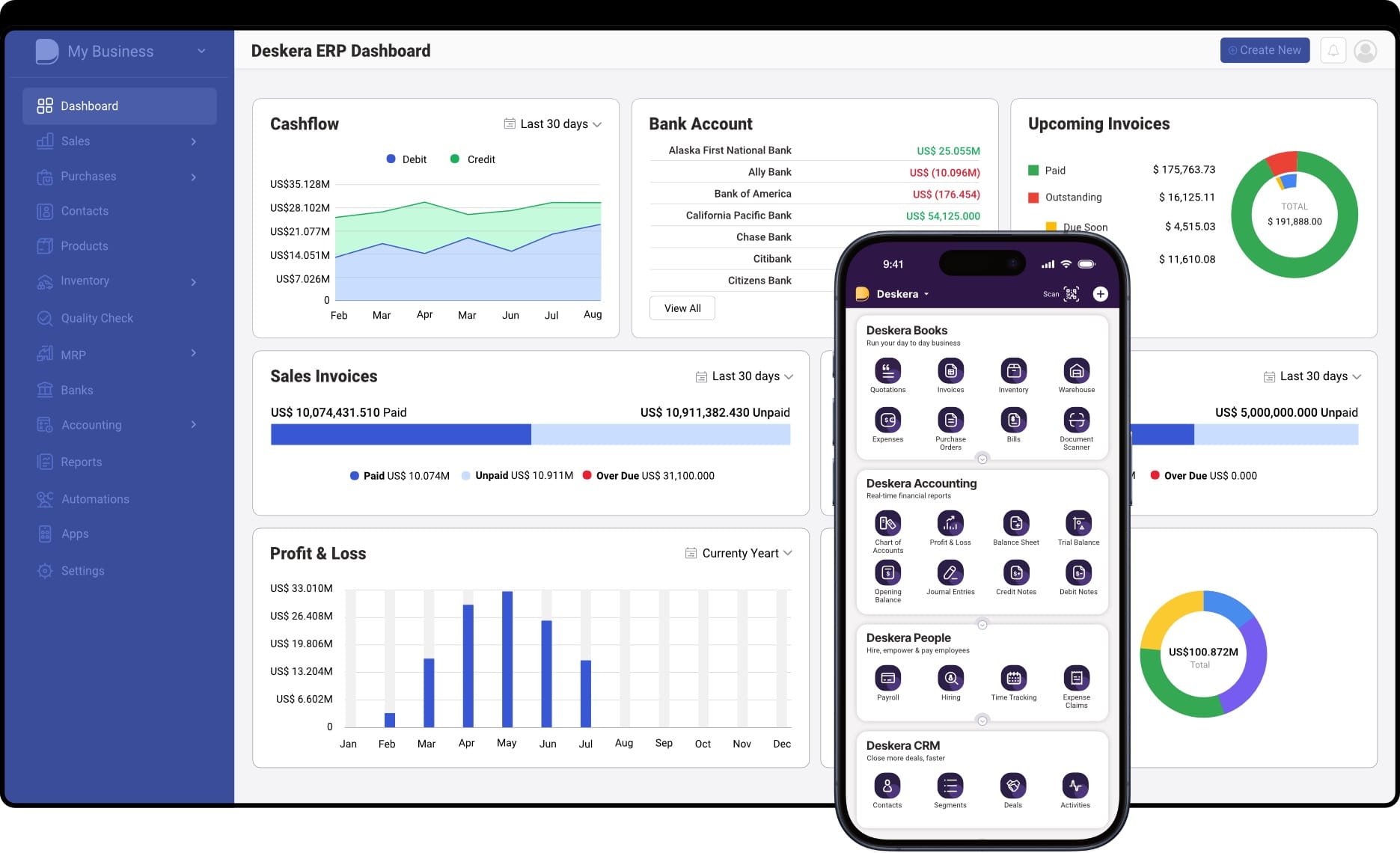
An ERP system becomes truly valuable when it actively supports revenue generation—not just operations. Deskera ERP is designed to do exactly that by integrating data, automating workflows, and providing real-time insights that directly impact how businesses plan, execute, and optimize their revenue strategies.
1. Centralizes Data for Better Revenue Visibility
Deskera ERP integrates core functions like finance, sales, inventory, and CRM into a single platform, creating a unified data environment. This eliminates silos and ensures all teams work with consistent, real-time information—enabling more accurate revenue planning and faster decision-making.
2. Enables Real-Time Insights and Smarter Decisions
With built-in business intelligence and reporting tools, Deskera provides real-time dashboards and analytics. Businesses can track performance, identify trends, and make quick adjustments to their revenue strategies, improving responsiveness to market changes.
3. Improves Demand Forecasting and Planning
Deskera ERP uses historical data and predictive insights to support demand forecasting. This helps businesses align production, inventory, and sales strategies with expected demand, reducing inefficiencies and ensuring revenue opportunities are not missed.
4. Strengthens Customer Relationship Management
With integrated CRM capabilities, Deskera allows businesses to track customer interactions, segment audiences, and manage sales pipelines effectively. This enables personalized engagement, improves customer retention, and increases lifetime value—all key drivers of revenue growth.
5. Streamlines Financial Management and Revenue Tracking
Deskera ERP provides robust financial tools, including budgeting, forecasting, and revenue recognition. Businesses can monitor cash flow, track revenue streams, and align financial planning with strategic goals, ensuring profitability alongside growth.
6. Automates Core Business Processes
By automating tasks such as invoicing, order management, and reporting, Deskera reduces manual effort and errors. This improves operational efficiency and allows teams to focus more on strategic, revenue-generating activities rather than administrative work.
7. Enhances Inventory and Supply Chain Alignment
Deskera’s inventory and warehouse management features provide real-time visibility into stock levels and supply chain operations. This ensures that product availability aligns with demand, preventing lost sales due to stockouts or excess costs from overstocking.
8. Supports Scalability and Business Growth
As businesses grow, Deskera ERP scales with them through cloud-based flexibility and customizable modules. This allows organizations to expand into new markets, add revenue streams, and manage increasing complexity without disrupting operations.
9. Improves Collaboration Across Teams
By connecting departments through a shared platform, Deskera enhances communication and alignment across sales, marketing, finance, and operations. This ensures that all teams work toward common revenue goals with better coordination and efficiency.
In essence, Deskera ERP transforms revenue strategy from a static plan into a dynamic, data-driven system. By combining real-time insights, automation, and cross-functional integration, it empowers businesses to not only plan revenue growth—but actively achieve and scale it.
Key Takeaways
- A revenue strategy aligns sales, pricing, marketing, and customer success to create a clear path for sustainable growth.
- Key components such as pricing, segmentation, and forecasting work together to drive consistent and scalable revenue.
- Different types of revenue strategies, from pricing optimization to channel diversification, help businesses adapt to varying market conditions.
- A structured framework (Revenue Architecture, RevOps, and Execution) ensures that strategy is effectively translated into measurable outcomes.
- Traditional approaches fail due to data silos and lack of real-time insights, limiting strategic effectiveness.
- ERP systems are critical as they unify data, improve visibility, and enable data-driven revenue decisions.
- ERP supports revenue strategy by enhancing forecasting, pricing, customer insights, and operational alignment.
- Using ERP improves efficiency, collaboration, forecasting accuracy, and overall revenue visibility.
- Choosing the right ERP features, such as analytics, automation, and integration, is essential for maximizing strategy success.
- Common challenges like misalignment and inaccurate forecasting can be overcome with integrated systems and clear processes.
- Leveraging ERP effectively requires best practices like aligning it with revenue goals and continuously optimizing its usage.
- Tracking KPIs such as CLV, CAC, and conversion rates is crucial to measure and refine revenue strategy performance.
- A well-defined revenue strategy, supported by ERP, enables businesses to achieve predictable, scalable, and long-term growth.
Related Articles
 Damini
 Niti Samani
 Niti Samani
 Niti Samani
 Niti Samani
 Deskera Content Team