
When does it actually make sense to let equipment fail before fixing it? The answer is simple: run-to-failure (RTF) maintenance can be a smart strategy when applied to non-critical, low-cost assets where the cost of preventive maintenance outweighs the consequences of failure. While many organizations view equipment breakdowns as purely negative, strategic manufacturers know that in the right scenarios, allowing certain assets to operate until failure can optimize maintenance budgets without compromising operational performance.
Run-to-failure maintenance is not about neglecting equipment—it is about making calculated decisions based on asset criticality, repair costs, downtime risks, and replacement planning. For disposable components, redundant systems, or equipment with minimal production impact, RTF can reduce unnecessary servicing expenses while maximizing asset utilization. However, applying this strategy without proper analysis can lead to costly disruptions, safety concerns, and reduced productivity.
The key lies in understanding where RTF fits within a broader maintenance framework. Businesses that effectively balance RTF with preventive and predictive maintenance strategies can improve operational efficiency while controlling maintenance costs. By identifying suitable equipment categories and implementing proper contingency measures, manufacturers can transform what is often seen as a reactive approach into a strategic maintenance tool.
Modern solutions like Deskera MRP make this process more manageable by combining machine maintenance scheduling, work order management, spare parts inventory tracking, and real-time machine performance monitoring into one integrated platform. Deskera MRP helps manufacturers evaluate asset performance, monitor breakdown history, automate maintenance workflows, and maintain production continuity through better planning and resource allocation. This enables businesses to strategically determine when run-to-failure maintenance is financially viable while minimizing unexpected downtime and operational risks.
What Is Run-to-Failure (RTF) Maintenance?
Run-to-failure (RTF) maintenance, often referred to as breakdown maintenance, or “fit and forget” maintenance, is a strategic maintenance approach where equipment or specific components are intentionally allowed to operate until failure occurs.
Rather than performing routine inspections, preventive servicing, or predictive monitoring, organizations wait until the asset breaks down before taking corrective action through repair or replacement. While this may appear reactive on the surface, RTF is actually a planned maintenance strategy designed for situations where failure consequences are manageable and replacement costs are relatively low.
The fundamental principle behind RTF maintenance is straightforward: if the cost of maintaining an asset proactively exceeds the financial and operational impact of failure, it may be more economical to let the asset run until it fails. This strategy is particularly effective for non-critical, low-cost, easily replaceable, or disposable components such as light bulbs, filters, minor mechanical parts, or backup systems where downtime does not significantly disrupt production or compromise safety.
A common misconception is that run-to-failure maintenance is entirely unplanned. In reality, successful RTF programs require careful preparation, including spare parts inventory management, trained maintenance personnel, updated standard operating procedures (SOPs), and rapid response capabilities. Without proper planning, organizations risk excessive downtime, emergency repair expenses, and operational inefficiencies.
RTF maintenance works best when businesses clearly understand asset criticality, failure patterns, and replacement logistics. By strategically applying this method to the right equipment categories, companies can reduce unnecessary maintenance expenditures, simplify maintenance scheduling, and optimize resource allocation. However, it is not suitable for mission-critical assets where unexpected failure could lead to major safety hazards, production losses, or regulatory issues.
RTF Maintenance vs Corrective Maintenance vs Predictive Maintenance vs Preventive Maintenance vs Condition-Based Maintenance
Selecting the right maintenance strategy is essential for balancing equipment reliability, operational efficiency, and cost control.
While run-to-failure (RTF) maintenance focuses on allowing specific assets to fail before intervention, other maintenance approaches prioritize varying levels of proactive planning, monitoring, and risk mitigation.
Each strategy serves different operational needs depending on asset criticality, maintenance budgets, failure tolerance, and production requirements.
Understanding the differences between these maintenance methods helps organizations design a balanced maintenance program that minimizes downtime while maximizing asset performance. The table below highlights the key distinctions between the five major maintenance strategies.
A strategic maintenance program often combines multiple approaches rather than relying on a single strategy. For example, businesses may apply RTF to low-priority assets while using predictive or preventive maintenance for mission-critical machinery. This hybrid approach enables organizations to optimize maintenance spending while maintaining operational resilience.
Key Features of Run-to-Failure (RTF) Maintenance
Run-to-failure (RTF) maintenance is a strategic maintenance approach designed for specific asset categories where failure consequences are acceptable and repair costs are manageable. When properly planned, RTF can reduce maintenance overhead while maximizing equipment utilization.
1. Planned Failure Acceptance
RTF maintenance intentionally allows selected non-critical equipment or components to operate until breakdown occurs. This strategy is based on calculated business decisions where failure costs are lower than preventive maintenance expenses, making it financially practical.
2. Minimal Routine Maintenance
Unlike preventive or predictive maintenance, RTF avoids scheduled inspections, servicing, or condition monitoring before failure. This significantly reduces routine labor requirements, maintenance planning complexity, and recurring service costs for low-priority assets.
3. Cost-Focused Decision Making
RTF prioritizes maintenance decisions based on repair, replacement, and downtime economics. Businesses choose this strategy when the combined cost of proactive maintenance exceeds the financial impact of equipment failure and corrective action.
4. Suitable for Non-Critical Assets
This strategy works best for inexpensive, disposable, or easily replaceable assets that do not significantly impact safety, compliance, or operational continuity. Common examples include bulbs, filters, backup components, or minor machine parts.
5. Spare Parts and Inventory Preparedness
Although maintenance occurs post-failure, organizations must maintain sufficient spare parts inventory to enable quick replacements. Proper stock management minimizes downtime and ensures failures do not disrupt larger production processes.
6. Standard Operating Procedures (SOPs)
Effective RTF maintenance requires updated repair protocols and accessible SOPs so maintenance teams can respond rapidly when failures occur. Clear procedures improve repair speed, reduce confusion, and maintain operational consistency.
7. Skilled Rapid-Response Maintenance Teams
Maintenance personnel must be trained to quickly identify failures, replace damaged components, and restore functionality. Fast response capabilities are essential to minimizing downtime and maintaining productivity under RTF programs.
8. Failure Data Tracking
Tracking equipment failures, repair frequency, and replacement costs helps organizations evaluate RTF effectiveness over time. Historical failure data supports smarter maintenance strategy adjustments and better long-term asset management.
9. Integration with Maintenance Management and MRP Systems
Modern RTF strategies benefit from ERP, CMMS, EAM, and MRP software that tracks breakdowns, maintenance costs, spare parts inventory, production schedules, and resource planning, ensuring maintenance actions align with broader operational efficiency goals.
10. Strategic Asset Segmentation
RTF should only be applied after analyzing asset criticality, operational risk, and replacement economics. Segmenting equipment by maintenance priority ensures RTF supports cost savings without exposing critical operations to unnecessary risk.
Advantages of Run-to-Failure (RTF) Maintenance
Run-to-failure (RTF) maintenance offers several strategic benefits when applied to the right assets and operational scenarios. While it is not suitable for every piece of equipment, RTF can be highly effective for non-critical, low-cost, or easily replaceable components. Its simplicity and cost efficiency make it an attractive option for organizations seeking to optimize maintenance resources.
1. Lower Maintenance Costs
One of the primary advantages of RTF maintenance is reduced maintenance spending. Since no routine inspections, servicing, or preventive tasks are performed before failure, businesses can eliminate many recurring maintenance expenses. This approach is especially cost-effective for inexpensive assets where repair or replacement costs are lower than ongoing maintenance investments.
2. Minimal Planning Requirements
RTF maintenance requires far less scheduling and administrative planning compared to preventive or predictive strategies. Maintenance activities only occur after breakdowns, which reduces the burden of creating detailed maintenance calendars, inspection programs, or monitoring systems. This simplicity can save both management time and operational resources.
3. Easy Implementation
Because of its straightforward “repair after failure” model, RTF is one of the easiest maintenance strategies to implement. It does not require sophisticated predictive technologies, extensive maintenance planning, or complex monitoring systems, making it ideal for organizations with limited maintenance infrastructure or smaller operational teams.
4. Maximum Equipment Utilization
RTF allows businesses to use equipment or components to their full operational lifespan rather than replacing them prematurely. This maximizes the value extracted from assets, ensuring organizations receive the greatest possible return on their equipment investment before incurring replacement costs.
5. Reduced Risk of Over-Maintenance
Preventive maintenance can sometimes result in unnecessary servicing or premature part replacement, increasing maintenance costs without delivering proportional value. RTF eliminates this risk by only intervening when failure actually occurs, ensuring resources are not spent on unnecessary maintenance tasks.
6. Time Savings for Maintenance Teams
By eliminating regular inspections and servicing for selected assets, maintenance personnel can focus their time and expertise on more critical machinery. This improves workforce efficiency and allows teams to prioritize high-value maintenance tasks that directly impact production and operational continuity.
7. Simplified Resource Allocation
RTF reduces the need for extensive maintenance scheduling, specialized diagnostics, or constant monitoring tools. Businesses can allocate labor, budgets, and technical resources more strategically, concentrating preventive and predictive efforts on mission-critical assets while applying RTF to lower-priority equipment.
8. Suitable for Low-Cost, Non-Critical Assets
For disposable, redundant, or low-impact equipment, RTF provides a practical maintenance approach. It avoids unnecessary spending on assets that have limited operational importance while maintaining acceptable risk levels for production and safety.
9. Lower Administrative Burden
RTF programs require less documentation, scheduling oversight, and maintenance coordination than proactive strategies. This can streamline maintenance management processes, reduce paperwork, and simplify operational workflows for maintenance departments.
10. Flexible Integration with Broader Maintenance Strategies
RTF can serve as part of a hybrid maintenance strategy, complementing preventive and predictive maintenance programs. Organizations can strategically apply RTF where financially beneficial while reserving proactive maintenance methods for critical equipment, creating a balanced and cost-optimized maintenance framework.
Disadvantages of Run-to-Failure (RTF) Maintenance
While run-to-failure (RTF) maintenance can offer cost advantages in specific scenarios, it also carries significant operational, financial, and safety risks when applied improperly. For critical assets or poorly planned maintenance environments, RTF can lead to severe disruptions and long-term inefficiencies.
1. Unpredictable Equipment Failures
A major drawback of RTF maintenance is the inability to accurately predict when equipment will fail. Unexpected breakdowns can occur without warning, making maintenance scheduling difficult and increasing the likelihood of operational disruptions, especially when spare parts or maintenance personnel are not immediately available.
2. Unplanned Downtime
RTF often results in sudden production interruptions when equipment fails during active operations. These unexpected outages can reduce productivity, delay customer deliveries, disrupt supply chains, and negatively impact overall business performance, particularly in high-output manufacturing environments.
3. Higher Emergency Repair Costs
Emergency repairs are typically more expensive than scheduled maintenance due to overtime labor, expedited parts procurement, urgent service requirements, and possible third-party support costs. In many cases, the total cost of reactive repairs can exceed preventive maintenance expenses.
4. Potential Secondary Equipment Damage
When components are allowed to fail completely, the breakdown can sometimes damage surrounding systems or connected equipment. This cascading effect can significantly increase repair complexity, replacement costs, and production downtime.
5. Reduced Equipment Lifespan
Allowing machinery to operate until failure may accelerate wear on other components and lead to more severe mechanical deterioration. Over time, this can shorten the useful life of larger equipment systems and increase capital replacement frequency.
6. Safety Risks
Unexpected equipment breakdowns can create hazardous working conditions for operators and maintenance personnel. Mechanical failures may lead to accidents, injuries, environmental hazards, or regulatory compliance violations, especially in industries with strict safety standards.
7. Resource Allocation Challenges
Because failures occur unpredictably, maintenance teams may struggle to efficiently allocate labor, spare parts, and technical resources. Sudden maintenance demands can overwhelm teams and disrupt other planned maintenance activities.
8. Inventory and Spare Parts Pressure
Organizations using RTF must maintain sufficient replacement inventory to avoid prolonged downtime. Without proper stock management, delayed part availability can significantly worsen equipment outages and operational losses.
9. Inconsistent Maintenance Outcomes
Intermittent failures or no-fault-found (NFF) scenarios can complicate troubleshooting and maintenance planning. This inconsistency can make it harder to diagnose recurring issues, optimize asset performance, or establish reliable long-term maintenance strategies.
10. Not Suitable for Critical Assets
RTF is generally inappropriate for mission-critical machinery where failure can severely impact production, customer commitments, or worker safety. Applying RTF to such assets can expose businesses to unacceptable operational and financial risks.
When Does Run-to-Failure Maintenance Make Sense?
Run-to-failure (RTF) maintenance is most effective when organizations deliberately apply it to assets where equipment failure is financially manageable, operationally acceptable, and unlikely to compromise safety or compliance.
Rather than serving as a universal maintenance strategy, RTF should be used selectively for specific equipment categories where preventive maintenance costs exceed replacement or repair expenses.
Careful asset evaluation is essential to determine whether this strategy aligns with broader business objectives.
1. Non-Critical Equipment with Minimal Operational Impact
RTF maintenance is highly suitable for assets that do not directly affect production continuity, customer satisfaction, or essential operational workflows.
Equipment whose failure causes only minor inconvenience rather than major disruption can often be allowed to run until breakdown.
This ensures maintenance resources are reserved for mission-critical assets while reducing unnecessary servicing costs on low-priority equipment.
2. Low-Cost, Easily Replaceable Components
When equipment or components are inexpensive and simple to replace, RTF often becomes the most economical option. Assets such as light bulbs, air filters, belts, signage, or disposable tools may not justify regular inspections or servicing.
In these cases, replacement after failure is usually cheaper and more practical than implementing preventive maintenance schedules.
3. Short-Lifespan or Disposable Assets
Assets with naturally short operational lifespans or disposable designs are ideal candidates for RTF maintenance. Since these components are often replaced frequently regardless of maintenance efforts, proactive servicing may offer little financial or operational value. Allowing them to function until failure maximizes asset use while minimizing maintenance overhead.
4. Backup Systems or Redundant Equipment
RTF maintenance makes sense when backup systems or redundant equipment are available to maintain operational continuity during failures.
In these scenarios, a failed component can be repaired or replaced without disrupting core business functions. This allows organizations to minimize maintenance spending while maintaining acceptable operational resilience.
5. Low Safety, Compliance, or Environmental Risks
RTF should only be applied when equipment failure does not create significant safety hazards, legal liabilities, or environmental risks. Assets with low regulatory or safety implications are better suited for this strategy, as sudden breakdowns are less likely to result in costly accidents, penalties, or compliance violations.
6. Random Failure Patterns with Limited Predictive Value
Certain equipment experiences random or unpredictable failure patterns where preventive maintenance offers little reliability improvement.
In these situations, performing scheduled maintenance may not effectively reduce breakdown risks, making RTF a more financially sensible approach. This is especially relevant when predictive technologies are costly or impractical.
7. Difficult-to-Service or Hard-to-Access Equipment
Some assets are expensive, time-consuming, or operationally disruptive to inspect or maintain regularly. For difficult-to-access systems where servicing costs are disproportionately high, RTF may provide better value by reducing unnecessary interventions while preparing for replacement when failure occurs.
8. Durable Assets with Minimal Wear and Maintenance Needs
Certain durable or low-wear assets require very little active maintenance over their useful life. Structural components, passive systems, or highly reliable equipment may not benefit significantly from preventive maintenance, making controlled failure acceptance a reasonable strategy under specific conditions.
9. Assets with Minimal Downtime Consequences
RTF is often appropriate when equipment failure does not significantly impact productivity, customer service, or revenue generation. If downtime costs are low and failures can be quickly resolved, businesses may achieve substantial cost savings by avoiding routine maintenance.
10. When Preventive Maintenance Costs Exceed Failure Costs
The clearest case for RTF is when preventive maintenance expenses consistently outweigh the combined costs of failure, repair, and replacement. By conducting cost-benefit analysis, organizations can identify situations where allowing failure provides better financial outcomes than proactive maintenance strategies.
Examples of Run-to-Failure (RTF) Maintenance
Run-to-failure (RTF) maintenance is commonly applied to equipment and components where failure is tolerable, replacement is affordable, and operational disruption is limited.
These examples demonstrate how organizations strategically use RTF across various industries to balance maintenance costs and operational efficiency.
1. Lighting Systems
Light bulbs, fluorescent lamps, and facility lighting are classic examples of RTF maintenance. Since these assets are inexpensive, easy to replace, and pose minimal operational risk, businesses typically allow them to function until failure before replacement.
2. Air and Water Filters
Disposable filters in HVAC systems, water treatment units, or industrial machinery are often run to failure or near end-of-life before replacement, especially when replacement costs are low and failure has limited consequences.
3. Office Equipment
Printers, keyboards, mice, desk fans, and minor office devices are commonly managed through RTF because maintenance costs often exceed replacement value, making reactive replacement more practical.
4. Conveyor Rollers or Minor Manufacturing Components
In manufacturing environments, non-critical conveyor rollers, belts, or low-priority machine parts may be allowed to fail before replacement, provided breakdowns do not significantly disrupt production.
5. Backup or Secondary Equipment
Backup pumps, secondary fans, or redundant support systems may operate under RTF strategies because their failure does not immediately halt operations due to available redundancies.
6. Forklifts or Warehouse Tools with Low Criticality
Non-essential pallet jacks, warehouse carts, or auxiliary equipment may be maintained through RTF when temporary failure has limited productivity consequences.
7. Signage and Display Systems
Digital signs, display boards, and non-essential communication systems are often replaced only after malfunction since proactive maintenance offers minimal financial benefit.
8. HVAC Non-Critical Components
Certain fans, thermostats, or non-essential ventilation components may be managed using RTF if their failure does not create safety issues or immediate operational disruption.
9. Consumer Electronics and Disposable Components
Batteries, cartridges, sensors, or small electronic modules are often cheaper to replace after failure than to service regularly.
10. Structural or Low-Wear Assets
Some durable assets, such as minor fixtures, tools, or low-impact facility components, may naturally follow an RTF approach due to their long lifespan and limited maintenance requirements.
While RTF works well for low-priority assets, critical systems in sectors like aviation, transportation, healthcare, or energy production typically require preventive or predictive maintenance due to safety and reliability demands.
Strategic organizations carefully evaluate each asset’s operational importance before applying RTF to ensure cost savings do not compromise performance or safety.
Best Practices for Implementing an Effective Run-to-Failure (RTF) Maintenance Strategy
Run-to-failure (RTF) maintenance can deliver meaningful cost savings when applied strategically, but successful implementation requires far more than simply waiting for equipment to break down.
To avoid excessive downtime, safety issues, and uncontrolled repair expenses, organizations must carefully plan, monitor, and support their RTF programs. The following best practices help ensure RTF remains a calculated maintenance strategy rather than a reactive operational risk.
1. Conduct Asset Criticality Analysis
Before applying RTF, organizations should evaluate each asset’s importance to production, safety, compliance, and customer service. Only non-critical or low-priority equipment with tolerable failure consequences should be selected.
This prevents costly disruptions and ensures critical systems remain protected through proactive maintenance strategies.
2. Segment Equipment by Maintenance Strategy
Not all assets should follow the same maintenance model. Businesses should categorize equipment into run-to-failure, preventive, predictive, or condition-based strategies based on cost, operational impact, and failure risk.
This balanced approach improves resource allocation and overall maintenance effectiveness.
3. Maintain Adequate Spare Parts Inventory
A successful RTF strategy depends on rapid post-failure response. Organizations must stock essential replacement parts for RTF assets to minimize downtime.
Proper inventory management ensures failures can be resolved quickly without delays caused by supply shortages.
4. Develop Clear Standard Operating Procedures (SOPs)
Maintenance teams should have documented, up-to-date procedures for responding to equipment failures. Clear SOPs improve repair speed, consistency, and technician efficiency while reducing confusion during unexpected breakdowns.
5. Train Maintenance Personnel for Rapid Response
RTF maintenance requires skilled technicians capable of quickly diagnosing issues, replacing failed components, and restoring operations. Ongoing workforce training improves repair quality and minimizes downtime.
6. Monitor Failure Trends and Historical Data
Even under RTF, organizations should track breakdown frequency, repair costs, downtime impact, and replacement patterns. Analyzing this data helps determine whether RTF remains cost-effective or if alternative maintenance strategies would provide better outcomes.
7. Integrate ERP, CMMS, or MRP Software
Modern maintenance platforms such as ERP, CMMS, EAM, and MRP systems improve RTF strategy execution by tracking asset failures, managing spare parts, coordinating work orders, monitoring maintenance costs, and aligning maintenance with production schedules for better operational planning.
8. Establish Emergency Repair and Escalation Plans
Organizations should prepare for unexpected failures by defining response protocols, technician responsibilities, vendor contacts, and escalation procedures. Emergency preparedness reduces operational disruption and ensures timely corrective action.
9. Regularly Reassess Asset Suitability
Asset criticality, replacement costs, and business operations can change over time. Periodic reassessment ensures equipment assigned to RTF remains an appropriate fit for this strategy and prevents outdated maintenance practices.
10. Balance Cost Savings with Risk Management
While RTF can reduce maintenance spending, businesses must carefully weigh financial savings against safety risks, downtime consequences, and long-term equipment reliability. Effective RTF programs prioritize controlled risk, not simply reduced maintenance activity.
An effective RTF strategy is built on planning, preparedness, and ongoing optimization. When integrated into a broader maintenance framework, RTF can help organizations reduce costs for suitable assets while preserving operational efficiency, safety, and long-term performance.
How Can Deskera MRP Help You Implement an Effective Run-to-Failure (RTF) Maintenance Strategy?
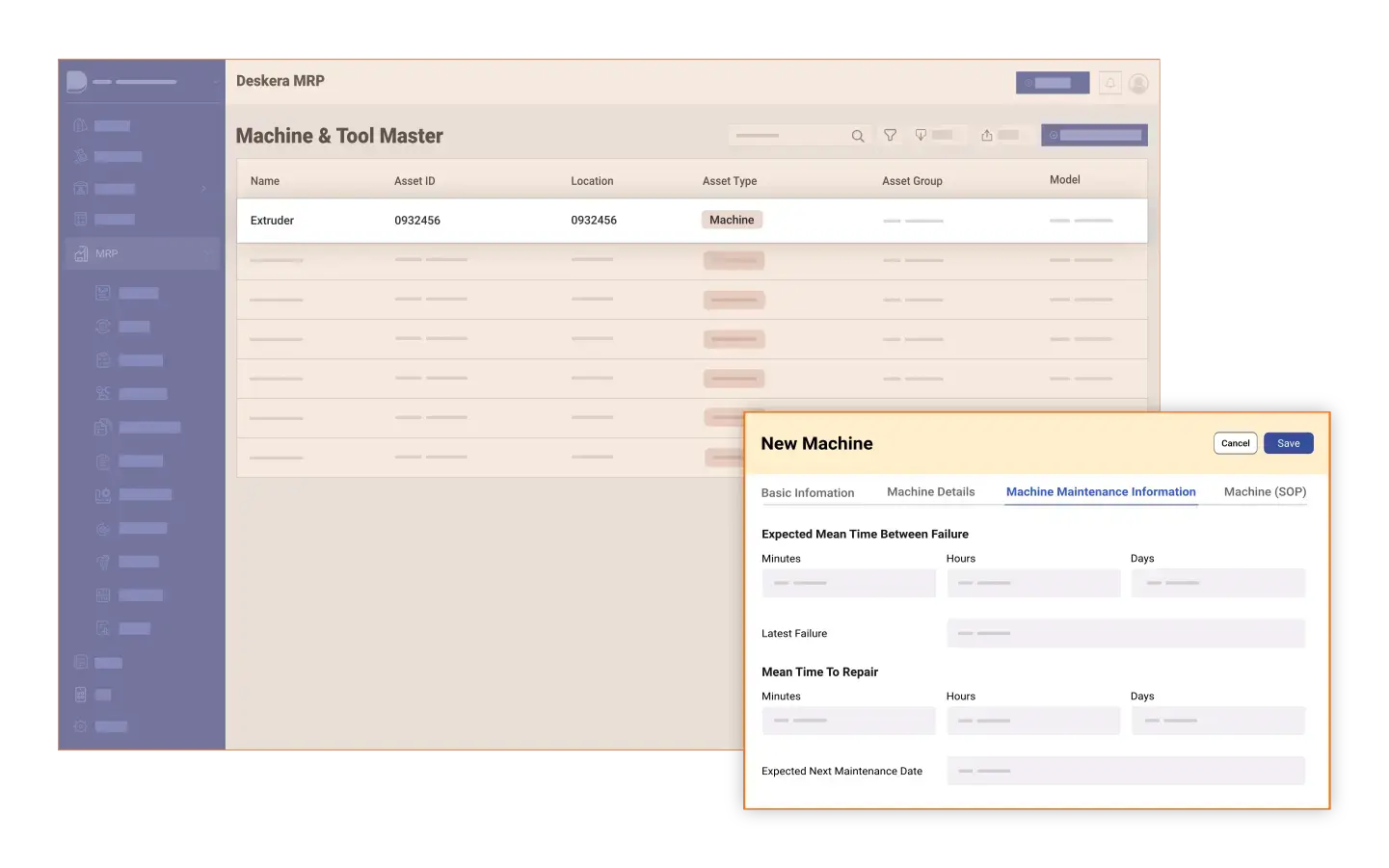
Successfully managing a run-to-failure (RTF) maintenance strategy requires more than simply waiting for equipment breakdowns. Businesses need strong operational visibility, maintenance coordination, spare parts readiness, and cost control to ensure RTF remains financially beneficial rather than disruptive. Deskera MRP supports this process by integrating machine maintenance, inventory management, production planning, and real-time operational insights into a unified platform.
1. Automated Work Order Management
Deskera MRP streamlines maintenance response by automatically creating, assigning, and tracking work orders when equipment failures occur. This helps maintenance teams respond quickly, minimize downtime, and maintain repair consistency across operations.
2. Machine Maintenance Scheduling and Performance Tracking
Deskera’s machine management tools help businesses monitor equipment usage, track maintenance history, and improve scheduling decisions. Even within RTF strategies, this data allows manufacturers to identify which assets are truly suitable for failure-based maintenance and which may require preventive support.
3. Spare Parts and Inventory Management
RTF success depends heavily on having replacement components readily available. Deskera MRP’s real-time inventory tracking, stock alerts, and material planning features help organizations maintain critical spare parts inventory, reducing repair delays after equipment failure.
4. Production Planning Integration
Deskera MRP aligns maintenance activities with production schedules, helping businesses assess whether equipment failures will significantly disrupt operations. This coordination ensures RTF is applied strategically to non-critical assets while preserving production continuity.
5. Maintenance Cost Analysis
Deskera’s reporting and analytics capabilities allow organizations to track maintenance expenses, repair frequency, downtime costs, and asset performance trends. This supports data-driven decisions on whether RTF remains cost-effective for specific equipment categories over time.
6. Demand Forecasting and Resource Planning
Deskera MRP’s demand forecasting and material requirement planning tools help manufacturers ensure resources, labor, and replacement components are aligned with expected production needs, reducing operational risks associated with unexpected equipment failures.
7. Real-Time Reporting and Operational Visibility
Comprehensive dashboards and manufacturing reports provide managers with visibility into machine performance, maintenance trends, production bottlenecks, and cost-saving opportunities. This transparency improves long-term maintenance strategy optimization.
Deskera MRP enables manufacturers to transform run-to-failure maintenance from a purely reactive approach into a structured, controlled, and data-supported strategy. By combining maintenance management, inventory readiness, production planning, and financial oversight, Deskera helps businesses reduce maintenance costs while minimizing operational disruption and preserving manufacturing efficiency.
Key Takeaways
- Run-to-failure (RTF) maintenance is a planned strategy where selected assets are intentionally allowed to operate until failure, making it most effective for non-critical, low-cost, or disposable equipment.
- Unlike preventive, predictive, corrective, and condition-based maintenance strategies, RTF focuses on minimizing maintenance intervention before failure while balancing repair and replacement economics.
- Key features of RTF include planned failure acceptance, minimal routine maintenance, spare parts preparedness, strategic asset segmentation, and integration with ERP, CMMS, and MRP systems.
- The primary advantages of RTF maintenance include lower maintenance costs, simplified implementation, reduced administrative burden, maximum asset utilization, and efficient resource allocation for suitable equipment.
- Major disadvantages of RTF include unpredictable failures, unplanned downtime, higher emergency repair costs, safety risks, potential secondary equipment damage, and reduced suitability for critical assets.
- RTF maintenance makes sense when preventive maintenance costs exceed failure costs, particularly for non-critical assets, low-cost components, short-lifespan equipment, and systems with minimal operational or safety consequences.
- Common examples of RTF maintenance include lighting systems, disposable filters, office equipment, non-critical manufacturing components, backup systems, and other easily replaceable assets.
- Effective RTF implementation requires asset criticality analysis, spare parts management, workforce training, clear SOPs, maintenance software integration, and regular performance reviews.
- Deskera MRP enhances RTF strategy execution through automated work orders, machine maintenance tracking, inventory management, production planning, maintenance cost analysis, and real-time operational visibility.
- A successful maintenance program often combines RTF with preventive and predictive strategies, allowing businesses to optimize maintenance costs while protecting critical assets and maintaining operational efficiency.
Related Articles
 Niti Samani
 Niti Samani
 Niti Samani
 Niti Samani
 Niti Samani
 Niti Samani