


Have you ever faced unexpected equipment downtime simply because a critical spare part wasn’t available when you needed it? The answer, for many businesses, is yes—and it often leads to costly delays, disrupted operations, and frustrated teams. This is where effective spare parts management becomes essential. By ensuring the right parts are available at the right time, businesses can maintain continuity, reduce downtime, and improve overall operational efficiency.
Spare parts management involves the systematic planning, sourcing, storing, and tracking of spare components required for maintenance and repairs. Unlike general inventory management, it deals with unpredictable demand patterns, critical part availability, and the need for rapid response. When handled effectively, it not only supports maintenance operations but also plays a strategic role in cost control and asset longevity.
However, managing spare parts is not without its challenges. Businesses often struggle with issues like overstocking, stockouts, lack of visibility, and inefficient procurement processes. Without a structured approach, these challenges can quickly escalate into operational inefficiencies and increased costs. This makes it crucial for organizations to adopt best practices and leverage modern tools to streamline their spare parts management processes.
This is where solutions like Deskera ERP come into play. Deskera ERP offers a centralized platform to manage spare parts inventory with real-time visibility, automated tracking, and intelligent demand forecasting. It helps businesses optimize stock levels, streamline procurement, and integrate inventory data with maintenance and accounting functions. With features like advanced reporting and mobile accessibility, Deskera ERP enables organizations to make data-driven decisions and maintain seamless operations.
What Is Spare Parts Management?
Spare parts management is the systematic process of planning, sourcing, storing, tracking, and distributing spare components required to maintain equipment and machinery. Its primary goal is simple yet critical: to ensure the right parts are available in the right quantity, at the right place, at the right time, with the right quality—while minimizing overall costs. This balance is essential for maintaining uninterrupted operations and avoiding costly delays caused by missing or inadequate parts.
At its core, spare parts management goes beyond basic inventory control. It encompasses a wide range of interconnected activities, including part identification and coding, criticality classification, procurement, quality inspection, stocking policies, and supplier coordination. It also integrates closely with maintenance planning processes such as kitting and staging, ensuring that technicians have immediate access to the parts they need for repairs and preventive maintenance.
The scope of spare parts management extends across the entire lifecycle of a part—from supplier sourcing to its final point of use. This includes managing inventory levels, maintaining data accuracy, ensuring part quality, and optimizing usage. By keeping a well-organized and strategically controlled inventory, businesses can respond quickly to equipment failures and avoid disruptions in production or service delivery.
Effective spare parts management plays a vital role in improving equipment reliability, reducing downtime, and controlling maintenance costs. It enables organizations to maintain operational readiness, streamline maintenance workflows, and enhance overall productivity. In industries where even minor delays can lead to significant losses, a robust spare parts management system becomes a key driver of efficiency and long-term business performance.
Key Objectives of Spare Parts Management
Effective spare parts management is driven by a set of clear objectives that ensure operational efficiency, cost control, and equipment reliability. These objectives help organizations maintain the right balance between availability and investment.
1. Ensure Availability of Critical Spare Parts
The primary objective is to make sure that essential spare parts are always available when needed. This minimizes equipment downtime and ensures that maintenance teams can respond quickly to breakdowns or scheduled repairs.
2. Minimize Equipment Downtime
By maintaining optimal stock levels and ensuring quick access to parts, organizations can significantly reduce downtime. This directly improves productivity and keeps operations running smoothly.
3. Optimize Inventory Costs
Spare parts management aims to strike a balance between overstocking and stockouts. Holding excess inventory increases carrying costs, while insufficient stock can disrupt operations—both of which impact profitability.
4. Improve Maintenance Efficiency
Having the right parts readily available enables maintenance teams to perform repairs and preventive maintenance without delays. This leads to faster turnaround times and more efficient workflows.
5. Enhance Inventory Visibility and Control
Accurate tracking and real-time visibility of spare parts inventory help businesses make informed decisions. It also reduces errors, duplication, and mismanagement of stock.
6. Support Better Demand Forecasting
Another key objective is to predict spare parts requirements based on historical data, usage patterns, and equipment performance. This helps in planning inventory more effectively.
7. Strengthen Supplier and Procurement Management
Efficient spare parts management ensures reliable supplier relationships, timely procurement, and quality assurance of parts, reducing delays and inconsistencies.
8. Reduce Maintenance and Operational Costs
By optimizing inventory levels, improving procurement processes, and reducing downtime, organizations can significantly lower overall maintenance and operational expenses.
9. Improve Equipment Reliability and Lifespan
Ensuring timely availability of quality spare parts helps maintain equipment in optimal condition, extending its lifespan and reducing the frequency of major breakdowns.
10. Enable Data-Driven Decision Making
With proper systems in place, spare parts management provides valuable insights through reports and analytics, helping organizations continuously improve their inventory and maintenance strategies.
Inventory Management vs Spare Parts Management
While inventory management and spare parts management may seem similar, they serve distinct purposes within an organization. Inventory management focuses on the overall control of goods for sale or production, whereas spare parts management is more specialized, dealing with components required for maintenance and repair.
Understanding the differences between the two helps businesses apply the right strategies, tools, and controls to optimize both operations and maintenance efficiency.
By distinguishing between these two functions, organizations can implement more targeted strategies—ensuring smooth business operations while also maintaining equipment reliability and minimizing downtime.
Types of Spare Parts in Inventory
Spare parts in inventory are not all the same—they differ based on usage frequency, criticality, cost, and role in maintenance operations. Proper classification helps businesses prioritize stocking decisions, reduce downtime risks, and optimize inventory costs.
By segmenting spare parts effectively, organizations can align their maintenance strategies with operational needs and ensure better control over their inventory.
Critical Spare Parts
Critical spare parts are essential components whose failure can lead to complete equipment shutdown or major operational disruption. These parts may not be used frequently, but their absence can halt production or impact safety and compliance.
They require careful identification, priority stocking, and close monitoring to ensure availability at all times, making them a key focus area in spare parts management.
Consumable Spare Parts
Consumable spare parts are items that are used regularly and replaced after a short period due to wear and tear. These parts are typically low in cost but high in usage frequency, making them crucial for routine maintenance activities.
Proper planning and consistent replenishment are necessary to avoid shortages, as their unavailability can slow down maintenance tasks and reduce overall operational efficiency.
Rotable Spare Parts
Rotable spare parts are high-value components that can be repaired, refurbished, and reused multiple times. Instead of being discarded after use, they are restored and returned to inventory for future deployment.
Managing rotables requires detailed tracking of usage, condition, and repair cycles, ensuring that they are available when needed while also optimizing inventory investment and reducing long-term costs.
Insurance Spare Parts
Insurance spare parts are rarely used but highly critical components kept as a precaution against unexpected failures. These parts are often expensive, difficult to procure quickly, or have long lead times.
Although they may remain unused for extended periods, their availability acts as a safeguard, helping organizations avoid prolonged downtime and significant financial losses during critical equipment failures.
Fast-Moving Spare Parts
Fast-moving spare parts are frequently used components that require regular replenishment. These parts are typically involved in routine maintenance or are prone to frequent wear and replacement.
Maintaining adequate stock levels and safety buffers is essential to ensure uninterrupted maintenance operations and prevent delays caused by frequent demand.
Slow-Moving Spare Parts
Slow-moving spare parts are items that are used infrequently and may remain in inventory for long periods.
While they are necessary for specific maintenance scenarios, overstocking these parts can increase carrying costs and reduce inventory efficiency.
Identifying and managing slow-moving items helps businesses optimize storage, reduce excess inventory, and improve overall cost control.
Obsolete Spare Parts
Obsolete spare parts are components that are no longer in use due to equipment upgrades, process changes, or discontinued production. These parts occupy valuable storage space and add to holding costs without providing operational value. Regular inventory reviews and proper disposal or repurposing strategies are essential to prevent unnecessary financial and operational burdens.
Benefits of Effective Spare Parts Management
When spare parts management is executed effectively, it delivers tangible business outcomes that go beyond operational goals.
These benefits directly impact productivity, financial performance, and long-term asset reliability, making it a strategic function rather than just a maintenance activity.
Higher Operational Continuity
An efficient spare parts system ensures that maintenance activities are never delayed due to missing components. This leads to smoother day-to-day operations with fewer disruptions.
As a result, businesses can maintain consistent production schedules, meet deadlines more reliably, and avoid the cascading impact of unexpected equipment stoppages.
Faster Response to Equipment Failures
With well-managed spare parts, maintenance teams can respond immediately to breakdowns without waiting for procurement or approvals. This reduces repair turnaround time significantly.
Faster response capabilities not only improve equipment availability but also strengthen an organization’s ability to handle unexpected operational challenges.
Better Financial Planning and Budget Control
Spare parts management provides greater predictability in maintenance-related expenses. With clear visibility into usage patterns and inventory levels, organizations can plan budgets more accurately.
This reduces unplanned spending, avoids emergency purchases, and enables better allocation of financial resources across operations.
Improved Decision-Making Through Data Insights
A structured spare parts system generates valuable data on usage trends, failure patterns, and inventory movement.
These insights help managers make informed decisions about procurement, maintenance planning, and asset management. Over time, this leads to more strategic and data-driven operations.
Reduced Emergency Procurement
Poor spare parts planning often leads to urgent, last-minute purchases that are expensive and inefficient. Effective management reduces the need for such emergency procurement by ensuring that critical parts are already available. This not only lowers costs but also improves procurement efficiency and vendor coordination.
Enhanced Warehouse Efficiency
Organized spare parts storage improves warehouse operations by reducing search time and simplifying stock handling. Clear labeling, proper categorization, and optimized layouts make it easier to locate and manage parts. This leads to better space utilization and smoother inventory operations.
Stronger Risk Mitigation
Having the right spare parts readily available reduces the risk of prolonged downtime, safety incidents, or compliance failures. It acts as a safeguard against operational uncertainties, especially in environments where equipment reliability is critical. This proactive approach strengthens overall business resilience.
Extended Asset Performance Stability
Consistent availability of the right spare parts supports timely maintenance, which helps equipment perform more reliably over time. Instead of reactive fixes, organizations can maintain stable performance levels, reducing variability in output and ensuring consistent quality in operations.
Improved Cross-Department Coordination
Spare parts management connects procurement, maintenance, and warehouse teams through shared data and processes. This improves communication, reduces misunderstandings, and ensures better alignment across departments. As a result, workflows become more efficient and collaborative.
Scalability of Operations
A well-structured spare parts management system supports business growth by handling increased inventory complexity and maintenance demands. As operations expand, the system can scale without causing inefficiencies, enabling organizations to grow without compromising control or performance.
Challenges in Effective Spare Parts Management
Managing spare parts effectively is complex due to unpredictable demand patterns, diverse inventory types, and the critical role parts play in maintenance operations.
Without a structured approach, these challenges can lead to increased costs, operational inefficiencies, and unexpected downtime.
Below are some of the most common challenges organizations face in spare parts management.
Unpredictable Demand Patterns
Unlike regular inventory, spare parts demand is often irregular and difficult to forecast. Equipment failures can occur unexpectedly, making it challenging to maintain the right stock levels.
This uncertainty can result in either excess inventory or critical shortages, both of which negatively impact operational efficiency and cost control.
Balancing Overstocking and Stockouts
One of the biggest challenges is maintaining the right balance between having too much and too little inventory.
Overstocking ties up capital and increases storage costs, while stockouts can lead to equipment downtime and production delays. Striking this balance requires accurate forecasting and effective inventory planning.
Lack of Real-Time Inventory Visibility
Many organizations struggle with limited visibility into their spare parts inventory, especially when relying on manual systems or disconnected tools.
Without real-time data, it becomes difficult to track stock levels, monitor usage, and make informed decisions, leading to inefficiencies and errors in inventory management.
Poor Data Quality and Standardization
Inaccurate or inconsistent data—such as duplicate entries, incorrect part descriptions, or missing information—can severely impact spare parts management.
Poor data quality makes it difficult to classify parts, forecast demand, and manage inventory effectively, resulting in operational confusion and increased costs.
Long and Uncertain Lead Times
Some spare parts, especially specialized or imported components, have long and unpredictable lead times. Delays in procurement can disrupt maintenance schedules and extend equipment downtime. Managing these uncertainties requires strong supplier relationships and proactive planning strategies.
Inefficient Procurement Processes
Manual or unstructured procurement processes can lead to delays, higher costs, and poor supplier coordination. Without streamlined workflows and clear policies, organizations may face issues such as late deliveries, inconsistent quality, and lack of accountability in purchasing decisions.
Managing Obsolete and Slow-Moving Inventory
Over time, certain spare parts become obsolete or are rarely used, leading to excess inventory that occupies storage space and increases holding costs. Identifying and managing these items is a continuous challenge, especially in large inventories with limited tracking systems.
Integration Gaps with Maintenance Operations
When spare parts management is not aligned with maintenance planning, it can lead to delays and inefficiencies. A lack of coordination between inventory and maintenance teams may result in missing parts during scheduled repairs, causing unnecessary downtime and disruptions.
Storage and Handling Issues
Improper storage conditions or poor warehouse organization can damage spare parts or make them difficult to locate. Some parts may require specific environmental conditions, and failure to maintain these can lead to quality issues and increased replacement costs.
Limited Use of Technology and Automation
Many organizations still rely on manual processes or outdated systems for managing spare parts. This limits their ability to leverage automation, real-time tracking, and data analytics, resulting in inefficiencies and missed opportunities for optimization.
Common Mistakes to Avoid in Spare Parts Management
Even with well-defined systems, spare parts management can fail due to execution gaps, poor decision-making, and lack of discipline in processes.
Unlike challenges, these mistakes are largely avoidable and often arise from oversight or inconsistent practices. Addressing them proactively can significantly improve inventory control and maintenance efficiency.
Failing to Prioritize Critical Spare Parts
One of the most common mistakes is treating all spare parts equally instead of focusing on those that have the highest operational impact. Without prioritization, critical components may be unavailable during breakdowns, while less important items consume valuable storage and budget. This misalignment increases the risk of downtime and inefficient resource allocation.
Over-Relying on Reactive Decision-Making
Managing spare parts based on immediate needs rather than planned strategies often leads to rushed purchases and poor inventory balance. Reactive decisions typically result in higher costs, inconsistent stock levels, and frequent emergency procurement, all of which reduce overall efficiency and control.
Allowing Data Inconsistencies to Persist
Ignoring errors such as duplicate entries, incorrect naming, or incomplete records can create long-term confusion in inventory management.
Over time, these inconsistencies make it difficult to track parts accurately, leading to incorrect decisions and operational inefficiencies that are hard to reverse.
Bypassing Standard Processes for Urgent Requests
In urgent situations, teams may skip established procedures for issuing or recording spare parts. While this may solve immediate problems, it creates gaps in inventory records and reduces accountability. Repeated exceptions can quickly undermine the reliability of the entire system.
Delaying Inventory Reviews and Cleanups
Postponing regular reviews of spare parts inventory allows obsolete, duplicate, and unused items to accumulate. This not only increases carrying costs but also reduces visibility into what is actually needed. Without timely cleanup, inventory becomes cluttered and difficult to manage effectively.
Underestimating the Impact of Lead Times
Failing to plan for supplier lead times, especially for specialized or hard-to-source parts, can result in avoidable delays during maintenance. Many organizations overlook this factor until a critical part is needed, leading to extended downtime and operational disruptions.
Neglecting Accountability and Ownership
When roles and responsibilities are not clearly defined, spare parts management can become disorganized. Lack of ownership leads to inconsistent practices, poor coordination between teams, and errors in inventory handling, making it difficult to maintain control and accuracy.
Ignoring Usage Patterns and Consumption Trends
Not analyzing how spare parts are actually used over time results in poor stocking decisions. Without understanding consumption trends, businesses may continue ordering unnecessary items while failing to stock frequently used parts, leading to inefficiencies and wasted resources.
Overlooking Storage Discipline
Improper handling, inconsistent placement, or failure to follow storage guidelines can result in misplaced or damaged parts. Even when inventory exists, poor storage discipline can delay retrieval and affect maintenance timelines, reducing overall operational efficiency.
Resisting Process Improvement and Change
Sticking to outdated methods and resisting improvements can limit the effectiveness of spare parts management. As operations evolve, processes must adapt to new requirements. Organizations that fail to update their approach risk falling behind in efficiency, accuracy, and overall performance.
Key Components of an Effective Spare Parts Management System
An effective spare parts management system is not built on a single process but on a combination of interconnected components that ensure availability, accuracy, and efficiency.
These components help organizations maintain control over inventory, support maintenance activities, and reduce operational risks while optimizing costs.
Spare Parts Classification and Criticality Analysis
Classifying spare parts based on their importance and usage is fundamental to effective management. Criticality analysis helps identify which parts have the highest impact on operations, safety, or compliance.
By prioritizing these parts, businesses can ensure availability where it matters most while avoiding unnecessary stock buildup for less important items.
Inventory Control and Stock Optimization
Maintaining the right inventory levels is essential to balance availability and cost. This involves defining reorder points, safety stock levels, and stocking policies based on demand patterns. Effective inventory control prevents excess stock while ensuring that essential parts are always available when required.
Demand Forecasting and Planning
Accurate forecasting enables organizations to anticipate spare parts requirements using historical data, maintenance schedules, and equipment performance trends. This helps reduce uncertainty, supports better procurement planning, and ensures that parts are available without overstocking.
Procurement and Supplier Management
A strong procurement process ensures timely sourcing of spare parts with consistent quality. Managing supplier relationships, monitoring lead times, and evaluating performance are key aspects of this component. Efficient supplier management reduces delays and enhances supply chain reliability.
Data Management and Standardization
Clean, accurate, and standardized data is critical for effective spare parts management. Proper part coding, consistent naming conventions, and elimination of duplicates improve inventory accuracy. Reliable data supports better forecasting, reporting, and decision-making across the organization.
Storage and Warehouse Management
Efficient storage practices ensure that spare parts are organized, protected, and easy to access. This includes proper labeling, optimized warehouse layout, and suitable storage conditions for sensitive components. Good warehouse management reduces retrieval time and prevents damage or loss.
Integration with Maintenance Operations
Spare parts management must be closely aligned with maintenance planning and execution. Integration with maintenance systems ensures that required parts are available for scheduled tasks, reducing delays and improving overall maintenance efficiency.
Technology and Automation
Modern systems such as ERP and inventory management software play a crucial role in streamlining spare parts management. Automation helps with tracking inventory, generating alerts, and improving accuracy. Technology also provides real-time visibility and enhances overall operational control.
Performance Monitoring and KPIs
Tracking key performance indicators such as inventory turnover, stock availability, and service levels helps measure the effectiveness of the system. Continuous monitoring allows organizations to identify gaps, improve processes, and make data-driven decisions for ongoing optimization.
How to Implement a Spare Parts Management Strategy
Implementing a spare parts management strategy requires a structured, step-by-step approach that aligns inventory decisions with operational goals. Unlike best practices, which focus on optimization techniques, implementation is about building the foundation, defining direction, and ensuring long-term adoption across the organization.
Assess Current Spare Parts Processes
Start by evaluating your existing spare parts management system to identify gaps, inefficiencies, and risks. Analyze inventory accuracy, stock levels, procurement timelines, and maintenance dependencies. This assessment provides a clear baseline and helps uncover areas that require immediate attention before building a new strategy.
Define Objectives and Success Metrics
Establish clear goals for your spare parts management strategy, such as improving availability, reducing downtime, or controlling costs. Alongside objectives, define measurable KPIs to track performance. Having well-defined targets ensures alignment across teams and provides a framework for evaluating progress.
Map Spare Parts to Assets and Operations
Create a structured linkage between spare parts and the equipment they support. This mapping helps identify dependencies, understand usage patterns, and ensure that critical assets have the necessary parts available. It also improves planning and coordination between maintenance and inventory functions.
Develop Inventory Policies and Governance
Establish clear policies for stocking, replenishment, and usage of spare parts. Define roles, responsibilities, and approval workflows to ensure accountability. A governance framework ensures that inventory decisions are consistent, controlled, and aligned with organizational priorities.
Select and Implement an ERP System
Choose an ERP system that supports spare parts management through integrated inventory, procurement, and maintenance functionalities. Implementing the system enables centralized data management, real-time visibility, and streamlined workflows, forming the backbone of your strategy.
Integrate with Maintenance and Procurement Functions
Ensure that your spare parts strategy is fully integrated with maintenance planning and procurement processes. This alignment allows seamless coordination, ensuring that parts are available when maintenance activities are scheduled and procurement is triggered at the right time.
Establish Data Structure and Migration Plan
Create a standardized data structure for spare parts, including naming conventions, coding systems, and categorization. If transitioning from legacy systems, plan a careful data migration process to ensure accuracy and completeness. A strong data foundation is critical for long-term success.
Train Teams and Drive Change Management
Introduce the new strategy through structured training programs and change management initiatives. Ensure that all stakeholders understand their roles, processes, and the importance of the system. Encouraging adoption and minimizing resistance is key to successful implementation.
Pilot the Strategy and Scale Gradually
Before full-scale rollout, test the strategy in a controlled environment or specific department. This allows you to identify potential issues, refine processes, and make necessary adjustments. Once validated, expand the implementation across the organization in phases.
Monitor Performance and Continuously Refine
After implementation, continuously track KPIs and evaluate system performance. Use insights to refine processes, improve accuracy, and adapt to changing operational needs. A successful spare parts management strategy evolves over time to remain effective and relevant.
Best Practices for Effective Spare Parts Management
Implementing the right practices is essential to ensure that spare parts management remains efficient, cost-effective, and aligned with maintenance goals.
These best practices help organizations improve inventory accuracy, reduce downtime, and create a proactive maintenance environment while maintaining better control over costs and resources.
Identify and Catalog All Spare Parts
Begin by ensuring that every spare part required for maintenance is properly identified and recorded. This includes parts used during major overhauls or one-time activities that may still have future value.
A complete and well-documented inventory prevents duplication, improves tracking, and ensures that no usable component is overlooked.
Classify Spare Parts Based on Criticality
Segment spare parts based on their importance to operations, usage frequency, and impact on downtime. Critical parts should always be prioritized for availability, while less important items can be managed with flexible stocking strategies. This classification helps in defining safety stock levels and optimizing inventory investment.
Maintain Accurate Bill of Materials (BOM)
An up-to-date Bill of Materials ensures that all required parts for specific equipment are clearly defined. This supports preventive maintenance planning and simplifies work order creation. Regularly updating BOMs based on equipment changes or upgrades helps avoid errors in ordering and ensures maintenance teams always have the correct parts.
Standardize Work Order and Parts Issuance Processes
Link all spare parts usage to work orders to maintain accurate inventory records and traceability. Standardized processes ensure consistency in how parts are requested, issued, and recorded. This improves accountability, reduces errors, and provides valuable historical data for future planning and analysis.
Implement Strong Inventory Control Practices
Establish clear inventory policies such as reorder points, minimum and maximum stock levels, and safety stock thresholds. These controls help maintain a balance between availability and cost. Regular monitoring and adjustments based on usage patterns ensure that inventory remains optimized over time.
Optimize Warehouse Organization and Storage
Organize spare parts in a structured and easily accessible manner. Assign specific storage locations for each item and maintain proper labeling to reduce search time. Centralizing and consolidating inventory where possible improves control, enhances security, and increases overall warehouse efficiency.
Leverage ERP Systems for Inventory Management
Using an ERP system enables real-time tracking, automated inventory updates, and better coordination between departments. It improves visibility into stock levels, usage trends, and procurement needs, allowing organizations to make informed decisions and maintain accurate inventory records.
Implement Cycle Counting and Regular Audits
Conduct regular inventory checks through cycle counting to maintain data accuracy. Instead of relying only on periodic full audits, continuous verification of inventory ensures discrepancies are identified and corrected early. This practice improves reliability and prevents long-term inaccuracies.
Standardize Spare Parts Across Equipment
Where possible, standardize parts across similar equipment to reduce the variety of items in inventory. This simplifies procurement, lowers inventory costs, and improves maintenance efficiency. Standardization also strengthens supplier negotiations and ensures easier availability of commonly used parts.
Plan Based on Lead Times and Risk Assessment
Understand supplier lead times and assess the risk associated with part unavailability. Parts with long or uncertain lead times should be stocked more strategically. Evaluating equipment risk and downtime impact helps prioritize which parts need higher stocking levels and closer monitoring.
Adopt Preventive and Proactive Maintenance
Align spare parts management with preventive maintenance strategies to anticipate parts requirements in advance. This ensures that necessary components are available before maintenance activities begin, reducing last-minute delays and improving equipment reliability.
Improve Data Accuracy and Decision-Making
Maintain clean, consistent, and up-to-date inventory data to support better decision-making. Accurate data enables effective forecasting, inventory optimization, and performance tracking. It also ensures that reports and KPIs reflect the true state of spare parts management.
Control Access and Enhance Inventory Security
Limit access to spare parts inventory to authorized personnel to prevent misuse, loss, or errors. Implement clear control measures and accountability systems to ensure that all inventory movements are properly recorded and monitored.
Train Teams and Encourage Collaboration
Ensure that employees involved in spare parts management are well-trained in processes and systems. Encourage collaboration between maintenance, procurement, and warehouse teams to improve communication and coordination, resulting in more efficient operations.
Continuously Monitor and Improve Processes
Regularly review spare parts management processes and performance metrics to identify improvement areas. Continuous optimization ensures that the system evolves with changing operational needs and remains efficient over time.
Key Metrics to Track in Spare Parts Management
Tracking the right metrics is essential to evaluate the effectiveness of your spare parts management system. These key performance indicators (KPIs) provide insights into inventory efficiency, cost control, and maintenance responsiveness. By regularly monitoring these metrics, organizations can identify gaps, improve decision-making, and continuously optimize their spare parts strategy.
Inventory Turnover Ratio
This metric measures how frequently spare parts inventory is used and replenished over a specific period. A low turnover may indicate overstocking or slow-moving items, while a high turnover suggests efficient inventory usage. Maintaining a balanced turnover ratio helps optimize stock levels and reduce carrying costs.
Service Level (Fill Rate)
Service level, or fill rate, indicates the percentage of spare parts requests that are fulfilled immediately from available stock. A high fill rate reflects strong inventory availability and efficient planning, while a low rate may signal stock shortages or poor forecasting, leading to maintenance delays.
Stockout Frequency
Stockout frequency tracks how often critical spare parts are unavailable when needed. Frequent stockouts can disrupt maintenance operations and increase downtime. Monitoring this metric helps identify gaps in inventory planning and ensures that essential parts are consistently available.
Carrying Cost of Inventory
This metric represents the total cost of holding spare parts in inventory, including storage, insurance, depreciation, and capital costs. High carrying costs may indicate excess inventory or inefficient stock management. Controlling these costs is crucial for improving overall financial performance.
Mean Time to Repair (MTTR)
MTTR measures the average time required to repair equipment after a failure. Efficient spare parts management can significantly reduce MTTR by ensuring that required components are readily available. Lower MTTR reflects faster maintenance response and improved operational efficiency.
Order Lead Time
Order lead time measures the time taken from placing a purchase order to receiving the spare parts. Longer lead times can increase the risk of stockouts and downtime. Tracking this metric helps improve procurement planning and supplier performance management.
Inventory Accuracy
Inventory accuracy compares recorded stock levels with actual physical inventory. High accuracy ensures reliable data for decision-making, while discrepancies can lead to stockouts or overstocking. Regular monitoring helps maintain data integrity and operational efficiency.
Parts Usage Rate
This metric tracks how frequently specific spare parts are used over time. Understanding usage patterns helps identify fast-moving and slow-moving items, enabling better demand forecasting and inventory optimization.
Obsolescence Rate
The obsolescence rate measures the proportion of spare parts that are no longer usable due to equipment upgrades or discontinued items. A high rate indicates poor inventory planning and excess stock, leading to increased holding costs and waste.
Procurement Cost per Order
This metric evaluates the cost associated with ordering spare parts, including administrative and logistics expenses. Monitoring procurement costs helps identify inefficiencies in the purchasing process and supports cost optimization strategies.
How Deskera ERP Transforms Spare Parts Management
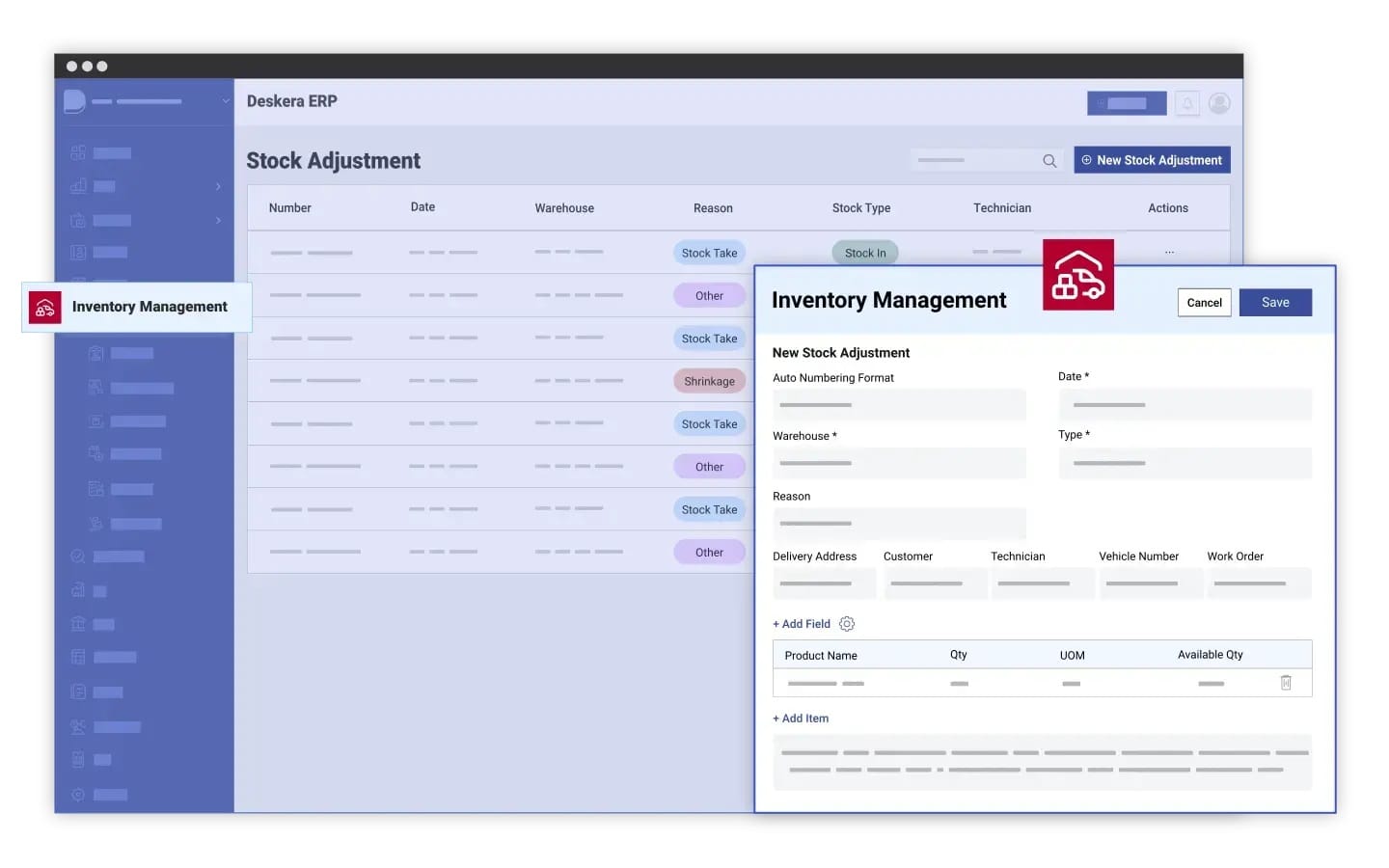
Managing spare parts efficiently requires real-time visibility, accurate data, and seamless coordination across inventory, procurement, and maintenance functions. This is where Deskera ERP plays a crucial role. By centralizing operations and automating key processes, Deskera ERP helps businesses gain better control over spare parts inventory while reducing costs and improving operational efficiency.
Centralized Inventory Management
Deskera ERP provides a unified platform to manage all spare parts across locations. It eliminates data silos and ensures that inventory information is accurate, consistent, and accessible in real time, helping teams make quicker and more informed decisions.
Real-Time Visibility and Tracking
With real-time updates on stock levels, movements, and usage, businesses can track spare parts more effectively. This visibility reduces the risk of stockouts, prevents overstocking, and ensures that critical components are always available when needed.
Automated Reordering and Procurement
Deskera ERP automates procurement processes by setting reorder points and generating purchase orders automatically. This reduces manual intervention, minimizes delays, and ensures timely replenishment of spare parts based on actual demand and usage patterns.
Demand Forecasting and Planning
Using historical data and usage trends, Deskera ERP supports accurate demand forecasting. This helps businesses plan inventory more effectively, optimize stock levels, and reduce unnecessary carrying costs while ensuring availability of essential parts.
Integration with Maintenance and Operations
Deskera ERP integrates spare parts management with maintenance workflows, ensuring that required parts are aligned with work orders and maintenance schedules. This improves coordination, reduces downtime, and enhances overall maintenance efficiency.
Advanced Reporting and Analytics
The platform offers detailed reports and dashboards that provide insights into inventory performance, usage patterns, and costs. These analytics enable data-driven decision-making and continuous improvement in spare parts management strategies.
Mobile Accessibility and Ease of Use
With mobile access, teams can manage and track spare parts from anywhere, improving responsiveness and operational flexibility. Its user-friendly interface ensures quick adoption and efficient use across departments.
By leveraging Deskera ERP, organizations can move from reactive spare parts management to a more proactive, data-driven approach—ensuring better control, improved efficiency, and long-term operational success.
Key Takeaways
- Spare parts management is essential for preventing downtime and ensuring smooth operations by maintaining the right parts at the right time.
- What Is Spare Parts Management?: It is a structured process that covers sourcing, storing, tracking, and using spare parts to support maintenance and operational continuity.
- Key Objectives of Spare Parts Management: The primary focus is to ensure part availability, control costs, and support efficient maintenance operations.
- Inventory Management vs Spare Parts Management: While inventory management focuses on sales and production, spare parts management is centered on maintenance readiness and equipment reliability.
- Types of Spare Parts in Inventory: Classifying spare parts based on usage and criticality helps prioritize stocking decisions and optimize inventory control.
- Key Components of an Effective Spare Parts Management System: A strong system relies on accurate data, inventory control, forecasting, supplier management, and integration with maintenance processes.
- Benefits of Spare Parts Management: Effective management improves operational continuity, reduces unexpected disruptions, and supports better financial planning.
- Challenges in Spare Parts Management: Unpredictable demand, data inconsistencies, and procurement delays are key obstacles that require structured processes to overcome.
- Best Practices for Effective Spare Parts Management: Implementing standardized processes, accurate tracking, and proactive planning ensures better control and efficiency.
- How to Implement a Spare Parts Management Strategy: A successful strategy requires clear objectives, structured policies, system integration, and continuous monitoring.
- Key Metrics to Track in Spare Parts Management: Monitoring KPIs such as inventory turnover, service levels, and stockouts helps measure performance and drive improvements.
- Common Mistakes to Avoid in Spare Parts Management: Avoiding reactive decisions, poor data practices, and process inconsistencies is critical for maintaining system effectiveness.
- How Deskera ERP Transforms Spare Parts Management: Deskera ERP enables real-time visibility, automation, and data-driven decision-making to streamline spare parts management.
- A well-implemented spare parts management approach enhances efficiency, reduces costs, and ensures long-term operational reliability.
Related Articles
 Niti Samani
 Niti Samani
 Niti Samani
 Niti Samani
 Niti Samani
 Niti Samani