
What causes production delays, missed delivery deadlines, and inefficient shop floor operations in manufacturing? In many cases, the answer lies in poor manufacturing scheduling. Without a well-structured scheduling system, manufacturers often struggle with machine downtime, material shortages, labor inefficiencies, and production bottlenecks that disrupt the entire workflow. Effective manufacturing scheduling helps businesses allocate resources efficiently, streamline production processes, and ensure timely order fulfillment.
Manufacturing scheduling plays a critical role in maintaining operational efficiency and meeting customer expectations. It determines when production activities should occur, which resources should be used, and how workflows should be prioritized to maximize productivity. A well-optimized schedule reduces idle time, improves machine utilization, minimizes waste, and enables manufacturers to respond quickly to changing market demands. As production environments become more complex, businesses need smarter scheduling strategies to remain competitive.
Modern manufacturers are increasingly adopting digital tools and automation technologies to improve scheduling accuracy and flexibility. Real-time production monitoring, predictive analytics, AI-driven forecasting, and ERP-integrated scheduling systems allow businesses to make faster and more informed decisions. These technologies help manufacturers identify bottlenecks early, balance production capacity, and quickly adjust schedules during disruptions or sudden demand changes.
One of the solutions helping manufacturers improve scheduling efficiency is Deskera MRP. Deskera MRP enables businesses to streamline production planning, manage inventory levels, track material availability, and optimize resource allocation from a centralized platform. With real-time visibility into manufacturing operations, automated workflows, and integrated production scheduling capabilities, Deskera MRP helps manufacturers reduce delays, improve coordination across departments, and enhance overall operational efficiency. Its cloud-based accessibility and advanced reporting features also support faster decision-making and continuous production improvement.
What Is Manufacturing Scheduling?
Manufacturing scheduling is the process of organizing, planning, and managing production activities to ensure manufacturing operations run efficiently and products are completed on time. It involves assigning resources such as machines, labor, materials, and production lines to specific tasks within a defined timeframe. The primary goal of manufacturing scheduling is to optimize production flow, reduce downtime, improve resource utilization, and meet customer delivery deadlines.
A manufacturing schedule outlines when each production task should start and finish, which machines or workstations will be used, and how production orders will move through the manufacturing process. Effective scheduling helps manufacturers balance production capacity with customer demand while minimizing delays, bottlenecks, and unnecessary costs. It also improves coordination between departments such as procurement, inventory, production, and logistics.
Manufacturing scheduling differs from production planning, although the two are closely connected. Production planning focuses on determining what products need to be produced, in what quantities, and within what timeframe. Manufacturing scheduling, on the other hand, focuses on the execution of those plans by deciding the sequence of operations, resource allocation, and timing of production activities.
Modern manufacturing scheduling often relies on ERP and MRP systems to improve accuracy and efficiency. Advanced scheduling tools provide real-time visibility into machine availability, inventory levels, workforce capacity, and production progress. This allows manufacturers to quickly adjust schedules in response to disruptions such as equipment failures, material shortages, or sudden changes in customer demand, ensuring smoother and more agile manufacturing operations.
Key Objectives of Manufacturing Scheduling
Manufacturing scheduling is designed to ensure that production processes operate smoothly, efficiently, and within planned timelines. It helps manufacturers coordinate resources, reduce operational disruptions, and improve overall productivity. By creating structured production schedules, businesses can optimize workflows, minimize waste, and consistently meet customer expectations while maintaining cost efficiency and operational flexibility.
Optimizing Resource Allocation
One of the primary objectives of manufacturing scheduling is to ensure the efficient use of available resources, including machines, labor, materials, and production lines. Proper scheduling prevents resource conflicts, reduces idle time, and balances workloads across operations. This allows manufacturers to maximize production capacity, improve productivity, and avoid unnecessary delays caused by poor coordination or underutilized resources.
Reducing Production Downtime
Manufacturing scheduling helps minimize downtime by ensuring that production activities are properly sequenced and resources are available when needed. Scheduled maintenance, material availability checks, and efficient workflow planning reduce the chances of unexpected disruptions. Lower downtime improves machine utilization, maintains consistent production flow, and helps manufacturers avoid costly interruptions that impact output and delivery timelines.
Meeting Delivery Deadlines
Timely order fulfillment is a critical goal of manufacturing scheduling. By organizing production activities efficiently, manufacturers can ensure products are completed and delivered according to customer expectations. Effective scheduling helps prioritize urgent orders, manage lead times, and prevent production bottlenecks that may cause delays. Consistently meeting delivery deadlines strengthens customer satisfaction, improves reliability, and supports long-term business growth.
Improving Production Flow
Manufacturing scheduling aims to create a smooth and continuous production process by coordinating tasks in the most efficient sequence. Well-structured schedules reduce bottlenecks, minimize waiting times between operations, and improve communication across departments. A streamlined production flow helps manufacturers maintain operational consistency, increase throughput, and respond more effectively to changes in demand or production requirements.
Types of Manufacturing Scheduling
Manufacturing scheduling methods vary based on production goals, operational complexity, and resource availability. Different scheduling approaches help manufacturers manage workflows, optimize capacity, and meet delivery deadlines more effectively. Choosing the right type of manufacturing scheduling allows businesses to improve production efficiency, reduce delays, and maintain better control over manufacturing operations.
Forward Scheduling
Forward scheduling starts production tasks as soon as resources such as machines, labor, and materials become available. This method focuses on completing production orders at the earliest possible time. It is commonly used in make-to-stock manufacturing environments where businesses aim to maximize production output and maintain inventory levels. However, forward scheduling may sometimes lead to higher inventory holding costs if production exceeds immediate demand.
Backward Scheduling
Backward scheduling begins with the final delivery date and works backward to determine when each production activity should start. This approach helps manufacturers meet customer deadlines while minimizing excess inventory and storage costs. Backward scheduling is especially useful in make-to-order manufacturing, where production is closely aligned with customer demand and delivery commitments.
Finite Capacity Scheduling
Finite capacity scheduling considers the actual availability and limitations of production resources before assigning tasks. It ensures that machines, labor, and workstations are not overloaded beyond their capacity. This method creates more realistic production schedules, reduces bottlenecks, and improves operational efficiency. Finite scheduling is particularly beneficial for manufacturers dealing with limited resources or complex production processes.
Infinite Capacity Scheduling
Infinite capacity scheduling assumes that production resources are always available without limitations. It focuses on completing tasks based on production demand without considering real-world constraints such as machine availability or labor capacity. While this method simplifies planning and allows faster schedule creation, it may lead to unrealistic production expectations and resource conflicts if not adjusted properly.
Why Effective Manufacturing Scheduling Matters
Effective manufacturing scheduling is essential for maintaining smooth production operations and achieving business goals. It helps manufacturers coordinate resources, manage workflows efficiently, and ensure products are completed on time.
Without proper scheduling, businesses may experience production delays, increased operational costs, inefficient resource utilization, and reduced customer satisfaction.
A well-structured scheduling system improves operational visibility, supports better decision-making, and enables manufacturers to adapt quickly to changing production demands.
Improves Production Efficiency
Effective scheduling ensures that production activities are organized in the most efficient sequence, reducing unnecessary delays and interruptions. It helps manufacturers optimize machine usage, labor allocation, and workflow coordination to maximize output.
By minimizing idle time and improving task synchronization, businesses can achieve higher productivity levels and maintain smoother manufacturing operations.
Reduces Production Delays and Bottlenecks
Manufacturing scheduling helps identify and eliminate bottlenecks that can slow down production processes.
Proper scheduling ensures that materials, labor, and machines are available when needed, reducing disruptions and workflow congestion.
This enables manufacturers to maintain consistent production flow, avoid missed deadlines, and respond more effectively to unexpected operational challenges.
Enhances Machine and Labor Utilization
Efficient scheduling improves the use of manufacturing resources by balancing workloads across machines and employees. It prevents overloading some resources while others remain underutilized.
Better resource allocation increases productivity, reduces operational inefficiencies, and helps manufacturers achieve higher returns from their equipment and workforce investments.
Supports On-Time Delivery
Meeting customer delivery deadlines is a major priority for manufacturers, and effective scheduling plays a critical role in achieving it.
Structured production schedules ensure that orders are completed within planned timelines and production tasks are prioritized appropriately.
On-time delivery improves customer satisfaction, strengthens business relationships, and enhances the company’s reputation for reliability.
Minimizes Inventory Carrying Costs
Proper manufacturing scheduling helps align production activities with actual demand, reducing excess inventory and unnecessary storage costs.
Manufacturers can better manage raw materials, work-in-progress inventory, and finished goods levels through accurate scheduling.
Lower inventory carrying costs improve cash flow and reduce the financial burden associated with overproduction and excess stock.
Improves Customer Satisfaction and Profitability
Efficient scheduling contributes directly to better customer experiences by ensuring consistent product quality and timely deliveries. Satisfied customers are more likely to place repeat orders and maintain long-term business relationships.
At the same time, improved operational efficiency, lower production costs, and reduced waste help manufacturers increase profitability and maintain a competitive advantage in the market.
Common Challenges in Manufacturing Scheduling
Manufacturing scheduling can become highly complex due to changing customer demands, resource limitations, production disruptions, and supply chain uncertainties. Even well-planned schedules may face unexpected challenges that affect production timelines and operational efficiency.
Understanding these common scheduling challenges helps manufacturers identify improvement opportunities and implement strategies that support smoother and more reliable production operations.
Unplanned Machine Downtime
Unexpected equipment failures and machine breakdowns can severely disrupt production schedules. Downtime delays manufacturing activities, creates bottlenecks, and affects order completion timelines.
Without proper maintenance planning and real-time monitoring, manufacturers may struggle to adjust schedules quickly, leading to reduced productivity, increased operational costs, and missed delivery commitments.
Material Shortages and Delayed Procurement
Manufacturing schedules heavily depend on the timely availability of raw materials and components. Delays in procurement, supplier issues, or inaccurate inventory tracking can interrupt production workflows and force rescheduling of operations.
Material shortages often lead to idle machines, labor inefficiencies, and production delays that negatively impact customer satisfaction and operational performance.
Inaccurate Demand Forecasting
Poor demand forecasting makes it difficult for manufacturers to create accurate production schedules. Overestimating demand may result in excess inventory and wasted resources, while underestimating demand can cause stockouts and delayed deliveries.
Fluctuating market conditions and changing customer preferences further increase scheduling complexity and make production planning less predictable.
Poor Communication Between Departments
Inefficient communication between production, procurement, inventory, sales, and logistics teams can create scheduling conflicts and operational delays.
Without proper coordination, departments may work with outdated or incomplete information, leading to material shortages, inaccurate production priorities, and workflow disruptions.
Strong cross-functional communication is essential for maintaining accurate and flexible manufacturing schedules.
Manual Scheduling Errors
Many manufacturers still rely on spreadsheets and manual scheduling processes, which increase the risk of human errors and inaccurate planning.
Manual scheduling can be time-consuming, difficult to update, and less effective in handling complex production environments.
Errors in resource allocation, production sequencing, or timeline estimation can significantly affect operational efficiency and delivery performance.
Frequent Production Changes and Rush Orders
Unexpected customer requests, urgent orders, or last-minute production changes can disrupt existing schedules and create operational instability.
Manufacturers often struggle to balance regular production activities with changing priorities while maintaining efficiency and delivery timelines.
Frequent schedule adjustments may also increase setup times, labor stress, and production costs.
Lack of Real-Time Production Visibility
Without real-time visibility into production operations, manufacturers may find it difficult to monitor progress, identify bottlenecks, and respond quickly to disruptions.
Delayed or inaccurate production data limits decision-making capabilities and affects schedule accuracy. Real-time monitoring tools and ERP systems help manufacturers gain better control over scheduling and operational performance.
Capacity Constraints
Limited machine availability, workforce shortages, and production space restrictions can make scheduling more difficult.
Capacity constraints may prevent manufacturers from meeting customer demand within planned timelines, especially during peak production periods.
Proper capacity planning and resource optimization are essential to maintaining realistic schedules and avoiding operational overload.
Key Metrics Used in Manufacturing Scheduling
Manufacturers rely on scheduling metrics to evaluate production efficiency, monitor operational performance, and identify areas for improvement. These metrics provide valuable insights into how effectively resources, machines, labor, and production timelines are being managed.
Tracking key scheduling KPIs helps businesses reduce delays, improve workflow coordination, optimize resource utilization, and maintain consistent production performance.
Production Cycle Time
Production cycle time measures the total time required to complete the manufacturing process for a product, from the beginning of production to final completion.
Monitoring cycle time helps manufacturers identify inefficiencies, reduce delays, and improve overall production speed. Lower cycle times often indicate smoother workflows and higher operational efficiency.
Formula:
Production Cycle Time = Total Production Time / Number of Units Produced
Schedule Adherence
Schedule adherence measures how closely actual production activities follow the planned manufacturing schedule. High schedule adherence indicates efficient production coordination and better operational control.
Monitoring this metric helps manufacturers identify delays, disruptions, and scheduling inconsistencies that may impact delivery timelines and customer satisfaction.
Formula:
Schedule Adherence (%) = (Completed Scheduled Jobs / Total Scheduled Jobs) × 100
Machine Utilization Rate
Machine utilization rate measures how effectively manufacturing equipment is being used during available production time. This metric helps manufacturers identify underutilized machines, excessive downtime, and production bottlenecks.
Improving machine utilization supports higher productivity, better capacity management, and improved return on equipment investments.
Formula:
Machine Utilization (%) = (Actual Machine Operating Time / Available Machine Time) × 100
On-Time Delivery Rate
On-time delivery rate measures the percentage of customer orders delivered within the promised timeframe. This KPI reflects the effectiveness of manufacturing scheduling, production coordination, and supply chain management.
High on-time delivery rates improve customer satisfaction, strengthen business relationships, and enhance the company’s market reputation.
Formula:
On-Time Delivery (%) = (Orders Delivered On Time / Total Orders) × 100
Overall Equipment Effectiveness (OEE)
Overall Equipment Effectiveness (OEE) measures manufacturing productivity by evaluating equipment availability, performance efficiency, and product quality.
OEE helps manufacturers identify production losses caused by downtime, slow performance, or quality issues. A higher OEE score indicates better operational efficiency and more effective use of manufacturing resources.
Formula:
OEE = Availability × Performance × Quality
Benefits of Improving Manufacturing Scheduling
Improving manufacturing scheduling helps businesses streamline production operations, optimize resource utilization, and maintain better control over manufacturing processes.
A well-structured scheduling system reduces operational inefficiencies, minimizes disruptions, and improves coordination across departments.
As manufacturers face increasing pressure to meet customer expectations and manage complex production environments, effective scheduling becomes essential for maintaining productivity, profitability, and long-term competitiveness.
Faster Production Cycles
Efficient manufacturing scheduling reduces unnecessary delays, bottlenecks, and idle time throughout the production process. By organizing workflows and sequencing tasks effectively, manufacturers can complete production activities faster and improve throughput. Shorter production cycles enable businesses to fulfill customer orders more quickly and respond faster to changing market demands.
Better Resource Utilization
Improved scheduling ensures that machines, labor, materials, and production lines are used more efficiently. Proper resource allocation prevents overloading some resources while others remain underutilized. Better utilization increases operational productivity, reduces waste, and helps manufacturers maximize returns on equipment and workforce investments.
Reduced Production Downtime
Effective scheduling minimizes unexpected disruptions by ensuring that materials, machines, and labor are available when needed. Preventive maintenance planning and real-time monitoring also help reduce equipment failures and idle production time. Lower downtime improves operational continuity and supports more stable manufacturing workflows.
Improved On-Time Delivery Performance
Accurate production schedules help manufacturers complete orders within planned timelines and meet customer delivery expectations consistently. Better scheduling coordination reduces production delays and enables faster response to urgent orders or unexpected disruptions. Improved on-time delivery strengthens customer trust, enhances business reputation, and supports long-term customer retention.
Lower Operational Costs
Manufacturing scheduling improvements help reduce operational expenses by minimizing waste, downtime, overtime labor, and inefficient resource usage. Optimized workflows also lower inventory carrying costs and reduce unnecessary production activities. These cost savings improve overall profitability and help manufacturers maintain stronger financial performance.
Increased Production Flexibility
Flexible scheduling systems allow manufacturers to adapt more easily to changing customer demands, rush orders, and supply chain disruptions. Agile production schedules improve operational responsiveness and reduce the impact of unexpected production changes. Increased flexibility also helps businesses manage market fluctuations more effectively while maintaining production stability.
Better Inventory Management
Efficient scheduling aligns production activities with material availability and customer demand, helping manufacturers maintain optimal inventory levels. This reduces excess stock, prevents material shortages, and improves procurement coordination. Better inventory management supports smoother production operations and improves cash flow by reducing unnecessary inventory holding costs.
Enhanced Decision-Making
Modern scheduling systems provide real-time production visibility and performance insights that support faster and more informed decision-making. Manufacturers can monitor machine utilization, production progress, and workflow bottlenecks more effectively. Access to accurate operational data allows managers to make proactive scheduling adjustments and improve overall production efficiency.
Higher Customer Satisfaction
Consistent product quality, reliable delivery timelines, and faster response to customer needs contribute directly to improved customer satisfaction. Effective scheduling helps manufacturers maintain dependable production performance and meet customer expectations more consistently. Satisfied customers are more likely to place repeat orders and build long-term business relationships.
Increased Profitability and Competitive Advantage
Improved manufacturing scheduling enhances overall operational efficiency, reduces costs, and increases production output, all of which contribute to higher profitability. Manufacturers that maintain efficient scheduling processes can respond faster to market demands, deliver products more reliably, and operate more competitively in fast-changing industries.
20 Strategies for Improving Manufacturing Scheduling
Improving manufacturing scheduling requires a combination of technology, process optimization, workforce coordination, and data-driven decision-making.
Modern manufacturers operate in highly dynamic environments where production delays, machine downtime, fluctuating demand, and supply chain disruptions can quickly impact operational efficiency.
By implementing effective scheduling strategies, businesses can improve production flow, maximize resource utilization, reduce bottlenecks, and maintain consistent on-time delivery performance.
1. Understand and Map Current Production Workflows
Before improving scheduling processes, manufacturers must clearly understand how their current production workflows operate.
Mapping the production flow helps identify task sequences, material movement, machine interactions, and operational inefficiencies that may disrupt scheduling.
Techniques such as value stream mapping (VSM) allow manufacturers to detect bottlenecks, excessive waiting times, duplicated activities, and unnecessary movement within production operations.
2. Implement Real-Time Production Monitoring
Real-time production monitoring provides instant visibility into machine performance, job progress, and production status across the shop floor. Manufacturers can quickly detect bottlenecks, downtime events, and workflow disruptions before they escalate into larger operational issues.
Real-time monitoring also improves decision-making by enabling production teams to adjust schedules dynamically based on actual production conditions and resource availability.
3. Use ERP Software for Centralized Scheduling
ERP systems centralize production scheduling by integrating data from inventory, procurement, production, sales, and logistics departments into a single platform. This eliminates data silos and improves schedule accuracy using real-time operational insights.
Centralized scheduling enables manufacturers to coordinate resources more effectively, respond faster to production changes, and maintain better visibility into overall manufacturing performance.
4. Adopt Advanced Production Scheduling (APS) Tools
Advanced Production Scheduling (APS) software improves scheduling accuracy by considering constraints such as machine capacity, labor availability, material availability, routing rules, and job priorities.
APS systems automatically generate optimized production schedules and simulate different production scenarios. These tools help manufacturers improve throughput, reduce bottlenecks, and respond more efficiently to disruptions in production workflows.
5. Improve Demand Forecasting Accuracy
Accurate demand forecasting allows manufacturers to align production schedules with actual customer demand and market trends.
By analyzing historical sales data, seasonal demand patterns, and purchasing behavior, manufacturers can reduce forecasting errors and improve production planning accuracy.
Better forecasting minimizes overproduction, prevents stock shortages, and supports more stable and efficient manufacturing schedules.
6. Prioritize Preventive Maintenance
Preventive maintenance helps reduce unexpected machine breakdowns that can disrupt production schedules and create operational delays. Scheduling regular equipment inspections, servicing, and maintenance activities improves machine reliability and availability.
By minimizing downtime risks, manufacturers can maintain uninterrupted production flow, improve schedule stability, and reduce costly emergency repairs and production interruptions.
7. Optimize Workforce Scheduling
Efficient workforce scheduling ensures that labor availability aligns with production requirements and machine capacity. Manufacturers can improve productivity by assigning operators based on skills, certifications, and experience levels.
Proper workforce scheduling also reduces idle labor time, prevents workforce overload, and improves coordination across production shifts, resulting in smoother manufacturing operations.
8. Cross-Train Employees for Operational Flexibility
Cross-training employees enables manufacturers to quickly reassign workers to different tasks or machines during labor shortages, absenteeism, or demand spikes.
A flexible workforce improves operational resilience and reduces scheduling disruptions caused by skill gaps. Cross-trained employees also support faster problem-solving and improve the organization’s ability to maintain production continuity during unexpected changes.
9. Apply Finite Capacity Scheduling
Finite capacity scheduling creates realistic production schedules by considering actual resource limitations such as machine availability, labor capacity, and production space constraints.
This approach prevents resource overloading and helps manufacturers avoid unrealistic production timelines. Finite scheduling improves workflow stability, reduces bottlenecks, and enables better coordination between production operations and available resources.
10. Reduce Changeover and Setup Times
Long setup and changeover times reduce production efficiency and disrupt scheduling accuracy.
Manufacturers can minimize these delays by standardizing setup procedures, grouping similar production jobs, and applying SMED (Single-Minute Exchange of Dies) techniques.
Faster changeovers improve production flexibility, increase throughput, and allow manufacturers to respond more efficiently to changing customer demands.
11. Improve Inventory and Material Management
Production schedules depend heavily on the timely availability of raw materials and components. Effective inventory management ensures that materials are available when needed without creating excessive inventory costs.
Synchronizing procurement activities with production schedules helps manufacturers avoid material shortages, reduce production stoppages, and maintain consistent manufacturing workflows.
12. Automate Scheduling Processes
Automating scheduling processes reduces reliance on spreadsheets and manual planning methods that are prone to errors and delays.
Automated scheduling systems improve planning speed, accuracy, and responsiveness by dynamically adjusting production schedules based on real-time operational changes.
Automation also reduces administrative workload and enables manufacturers to manage complex production environments more effectively.
13. Enhance Cross-Department Communication
Strong communication between production, procurement, inventory, maintenance, logistics, and sales teams is essential for maintaining accurate production schedules.
Improved coordination helps manufacturers reduce scheduling conflicts, resolve operational issues faster, and align production activities with business priorities. Daily production reviews and centralized communication platforms support better collaboration and decision-making.
14. Use Real-Time IoT and Machine Data
IoT-enabled machines and connected production systems provide real-time operational data that improves scheduling visibility and accuracy.
Manufacturers can monitor machine status, downtime events, cycle times, and job completion progress instantly.
This live data helps schedulers make faster adjustments, improve capacity planning, and create production schedules that reflect actual shop-floor conditions.
15. Leverage AI and Predictive Analytics
AI and predictive analytics help manufacturers anticipate disruptions before they occur by analyzing historical and real-time production data.
Predictive models can identify machine failure risks, potential bottlenecks, labor shortages, and demand fluctuations.
AI-driven scheduling systems also optimize job sequencing and production timelines, helping manufacturers improve efficiency and reduce operational uncertainty.
16. Build Flexible and Agile Production Schedules
Rigid production schedules often fail when unexpected disruptions occur. Flexible scheduling strategies allow manufacturers to adapt quickly to changing customer demands, urgent orders, machine breakdowns, and supply chain issues.
Including contingency plans and schedule buffers improves operational agility and helps manufacturers maintain stable production even during unpredictable conditions.
17. Use Lean Manufacturing Principles
Lean manufacturing principles such as Just-in-Time (JIT) production, load leveling (Heijunka), and continuous flow improve scheduling efficiency by reducing waste and stabilizing production workflows.
Lean scheduling minimizes excess inventory, improves workflow consistency, and supports faster response to production changes. These practices also help manufacturers create more predictable and efficient production schedules.
18. Track Scheduling KPIs Continuously
Monitoring key scheduling metrics such as schedule adherence, machine utilization, OEE, cycle time, and on-time delivery helps manufacturers evaluate scheduling performance and identify inefficiencies.
Continuous KPI tracking provides actionable insights that support process improvements, better resource allocation, and more accurate production planning over time.
19. Perform Root-Cause Analysis on Scheduling Issues
When production schedules fail or delays occur, manufacturers should investigate the root causes behind the disruption. Common causes may include inaccurate cycle time estimates, material shortages, machine downtime, or labor constraints.
Root-cause analysis helps businesses identify recurring operational problems and implement corrective actions that improve future scheduling reliability.
20. Encourage Continuous Improvement and Feedback
Manufacturing scheduling should evolve continuously based on operational feedback and performance analysis. Operators, supervisors, and production planners often identify inefficiencies that may not appear in production reports alone.
Encouraging employee feedback and implementing continuous improvement initiatives helps manufacturers refine scheduling processes, improve workflow stability, and enhance long-term operational performance.
How Deskera MRP Helps Improve Manufacturing Scheduling
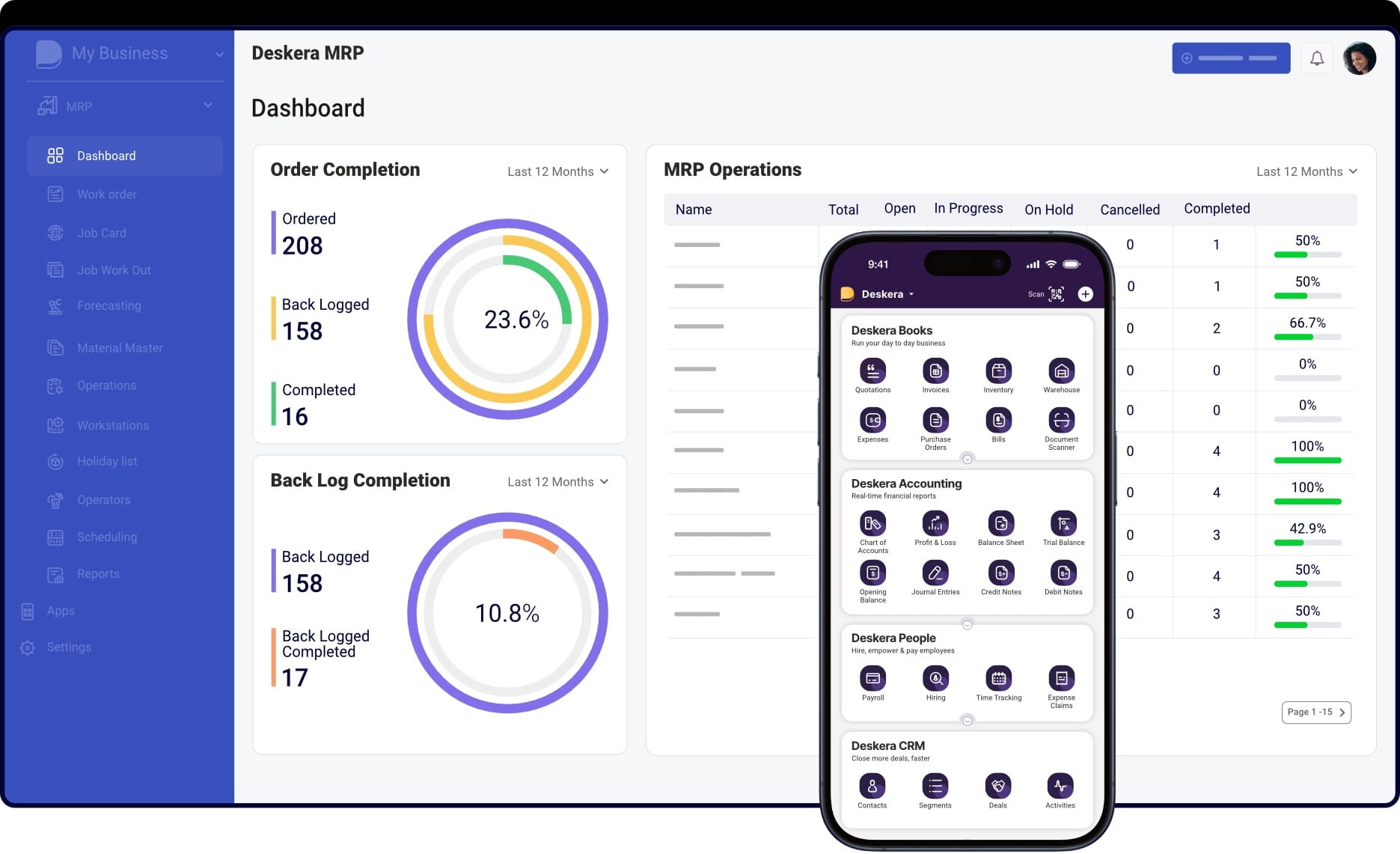
Efficient manufacturing scheduling requires real-time visibility, accurate production planning, seamless coordination across departments, and the ability to respond quickly to operational changes. Manual scheduling methods and disconnected systems often create delays, resource conflicts, and production inefficiencies.
Deskera MRP helps manufacturers streamline scheduling processes by integrating production planning, inventory management, procurement, and shop floor operations into a centralized platform that improves visibility, coordination, and decision-making.
Real-Time Production Visibility
Deskera MRP provides manufacturers with real-time visibility into production activities, machine utilization, inventory availability, and work order progress. Production managers can monitor shop floor operations instantly and identify bottlenecks or delays before they disrupt schedules. Access to real-time operational data enables faster decision-making and helps maintain more accurate and responsive production schedules.
Centralized Production Planning and Scheduling
Deskera MRP centralizes production scheduling by connecting manufacturing, inventory, procurement, and sales processes within a single system. This eliminates information silos and improves coordination between departments. Manufacturers can create more accurate schedules, allocate resources efficiently, and adjust production plans quickly based on changes in demand, material availability, or production capacity.
Integrated Inventory and Material Management
Manufacturing schedules depend heavily on the timely availability of raw materials and components. Deskera MRP helps businesses maintain optimal inventory levels through real-time inventory tracking, automated stock updates, and procurement coordination. This reduces material shortages, prevents production interruptions, and ensures that production schedules remain aligned with material availability.
Automated Workflows and Reduced Manual Errors
Deskera MRP automates several production and scheduling processes that are traditionally managed manually through spreadsheets or disconnected systems. Automated workflows reduce scheduling errors, improve planning speed, and simplify production coordination. Manufacturers can also reduce administrative workload while improving overall scheduling accuracy and operational efficiency.
Better Resource and Capacity Management
Deskera MRP helps manufacturers manage machine capacity, labor allocation, and production resources more effectively. Production planners can monitor resource availability, avoid capacity overload, and create realistic production schedules based on actual operational constraints. Improved capacity planning helps reduce bottlenecks and supports smoother production flow across manufacturing operations.
Improved Demand Forecasting and Production Planning
Deskera MRP uses historical sales data, inventory trends, and operational insights to support more accurate demand forecasting and production planning. Better forecasting helps manufacturers align production schedules with actual customer demand, reducing overproduction, excess inventory, and stock shortages. This improves scheduling stability and overall manufacturing efficiency.
Enhanced Cross-Department Collaboration
Effective manufacturing scheduling requires close coordination between production, procurement, inventory, logistics, and sales teams. Deskera MRP improves communication and collaboration by providing all departments with access to shared real-time data and centralized workflows. Better coordination reduces scheduling conflicts, improves operational alignment, and enables faster responses to production changes.
Advanced Reporting and Performance Tracking
Deskera MRP offers reporting and analytics tools that help manufacturers monitor scheduling performance, production efficiency, machine utilization, and operational KPIs. Managers can identify recurring bottlenecks, analyze workflow inefficiencies, and make data-driven improvements to production schedules. Continuous performance monitoring supports long-term operational optimization and better decision-making.
Cloud-Based Accessibility and Mobility
As a cloud-based platform, Deskera MRP allows manufacturers to access production schedules, operational data, and reports from anywhere using desktop or mobile devices. This flexibility improves responsiveness, supports remote decision-making, and enables managers to stay connected with production operations even outside the factory floor.
Key Takeaways
- Manufacturing scheduling helps manufacturers organize production activities efficiently to improve workflow coordination, resource utilization, and on-time delivery performance.
- The main objectives of manufacturing scheduling include optimizing resource allocation, reducing downtime, improving production flow, and ensuring timely order fulfillment.
- Different scheduling methods such as forward scheduling, backward scheduling, finite scheduling, and infinite scheduling help manufacturers manage production based on operational requirements and capacity constraints.
- Effective manufacturing scheduling improves production efficiency, minimizes bottlenecks, enhances machine and labor utilization, and supports better customer satisfaction.
- Common scheduling challenges include machine downtime, material shortages, inaccurate forecasting, poor communication, manual errors, and capacity limitations that disrupt production flow.
- Key manufacturing scheduling metrics such as cycle time, schedule adherence, machine utilization, on-time delivery, and OEE help businesses measure scheduling performance and identify operational inefficiencies.
- Mapping existing workflows and identifying bottlenecks provide a strong foundation for improving manufacturing scheduling processes.
- Real-time production monitoring enables manufacturers to detect disruptions quickly, improve visibility, and make faster scheduling adjustments.
- ERP systems improve manufacturing scheduling by centralizing production, inventory, procurement, and sales data into a single platform for better coordination.
- Advanced Production Scheduling (APS) tools help manufacturers create optimized schedules by considering machine capacity, labor availability, and production constraints.
- Accurate demand forecasting helps manufacturers align production schedules with customer demand while reducing overproduction and stock shortages.
- Preventive maintenance improves machine reliability and reduces unexpected downtime that can disrupt production schedules.
- Workforce scheduling and skill-based labor allocation improve productivity, reduce idle time, and support smoother production operations.
- Cross-training employees increases workforce flexibility and helps manufacturers adapt quickly to labor shortages or sudden production changes.
- Finite capacity scheduling creates realistic production timelines by considering actual resource availability and operational limitations.
- Reducing setup and changeover times improves production flexibility, increases throughput, and enhances schedule stability.
- Strong inventory and material management ensures raw materials are available when needed, reducing production interruptions caused by shortages.
- Automating scheduling processes improves planning speed, reduces manual errors, and enables dynamic schedule adjustments during disruptions.
- Effective communication between departments improves production coordination, reduces scheduling conflicts, and supports faster operational decisions.
- IoT-enabled machines and real-time data improve scheduling accuracy by providing live visibility into machine performance and production progress.
- AI and predictive analytics help manufacturers anticipate bottlenecks, optimize job sequencing, and improve scheduling decisions proactively.
- Flexible and agile scheduling strategies help manufacturers respond more effectively to demand fluctuations, urgent orders, and operational disruptions.
- Lean manufacturing principles such as JIT production and continuous improvement support more stable, efficient, and waste-free production scheduling.
- Continuous KPI tracking and root-cause analysis help manufacturers identify scheduling inefficiencies and improve long-term operational performance.
- Encouraging employee feedback and continuous improvement initiatives helps manufacturers refine scheduling processes and strengthen production efficiency over time.
- Improving manufacturing scheduling leads to faster production cycles, lower operational costs, better inventory management, higher customer satisfaction, and increased profitability.
- Deskera ERP helps manufacturers improve scheduling through real-time production visibility, centralized planning, automated workflows, inventory management, and advanced reporting capabilities.
Related Articles
 Niti Samani
 Niti Samani
 Niti Samani
 Niti Samani
 Niti Samani
 Niti Samani