
Why do some businesses struggle with rising costs and missed deadlines even when production levels seem strong? The answer often lies in hidden inefficiencies—one of the most critical being rework. Rework rate measures how often completed work needs to be corrected or redone due to defects or errors. While it may appear as a routine part of operations, a high rework rate can quietly erode profitability, disrupt workflows, and signal deeper quality issues within your processes.
In today’s competitive landscape, maintaining consistent quality is no longer optional—it’s a necessity. Studies show that poor quality can account for a significant percentage of operational costs, and rework plays a major role in this. Whether in manufacturing, construction, or service-based industries, frequent rework leads to wasted materials, increased labor costs, and delayed deliveries. Over time, it can also impact customer satisfaction and damage brand reputation, making it essential for businesses to monitor and control their rework rate effectively.
Understanding rework rate goes beyond just identifying defects—it involves analyzing the root causes, tracking key performance metrics, and implementing structured processes to minimize recurring issues. By establishing a clear rework management process and leveraging data-driven insights, organizations can improve first-time quality, optimize resource utilization, and enhance overall operational efficiency. This is where best practices and the right tools play a crucial role in driving continuous improvement.
Modern solutions like Deskera Manufacturing ERP help businesses take control of rework by offering real-time production tracking, automated quality checks, and advanced reporting capabilities. With features such as demand forecasting, production planning, and an AI-powered assistant, Deskera enables teams to identify inefficiencies early and take corrective action faster. By integrating quality management with core operations, it empowers businesses to reduce rework, improve productivity, and achieve sustainable growth.
What Is Rework Rate?
Rework rate is a key performance indicator (KPI) that measures the percentage of tasks, transactions, or units that must be corrected, repeated, or processed again after their initial completion due to errors, defects, or inconsistencies. In simple terms, it shows how often a process fails to deliver the desired outcome the first time. Whether in manufacturing, finance, or engineering, rework rate reflects the efficiency and reliability of your operations.
In manufacturing, rework rate specifically refers to the proportion of products that require adjustments, repairs, or rebuilding before they meet quality standards. If a unit needs to be reopened, modified, or corrected before it can be shipped, it is considered rework. This makes rework rate a direct indicator of first-time quality and production consistency.
Beyond manufacturing, rework rate is equally important in operational and finance processes. For example, in invoice processing, payment approvals, or reconciliations, it measures how often transactions need additional handling due to missing information or errors. A higher rework rate signals poor data accuracy or process gaps, while a lower rate indicates smoother workflows and stronger process control.
Although often overlooked compared to metrics like scrap or defect rate, rework rate plays a critical role in business performance. It silently consumes labor hours, increases material usage, slows down production throughput, and reduces available capacity. Ultimately, tracking and managing rework rate helps organizations identify inefficiencies, improve execution consistency, and move closer to achieving “first-time-right” performance.
Why Rework Rate Matters in Business Operations
Rework rate is more than just a quality metric—it is a direct reflection of how efficiently your business operates. A high rework rate indicates process breakdowns, inconsistent execution, and hidden inefficiencies that can significantly impact overall performance.
By understanding why rework rate matters, organizations can take proactive steps to improve quality, reduce costs, and enhance operational reliability.
Impact on Production Costs and Profitability
Rework directly increases operational costs by consuming additional labor, materials, and machine time. Every unit that requires correction adds to expenses that were not originally planned, reducing profit margins. Over time, frequent rework can significantly inflate the cost of production, making it harder for businesses to remain competitive and maintain healthy financial performance.
Effect on Delivery Timelines and Customer Satisfaction
When products or tasks need to be reworked, it disrupts production schedules and delays final delivery. This can lead to missed deadlines, longer lead times, and dissatisfied customers. In industries where timely delivery is critical, a high rework rate can damage customer trust and weaken long-term relationships, ultimately affecting business growth.
Indicator of Process Efficiency and Quality Control
Rework rate serves as a clear indicator of how well your processes are functioning. A rising rate suggests gaps in quality control, unclear work instructions, or inconsistent execution. Monitoring this metric helps businesses identify weak points in their operations and implement corrective actions to improve process efficiency and ensure consistent output quality.
Hidden Costs and Resource Utilization
Beyond visible expenses, rework introduces hidden costs such as increased energy consumption, equipment wear and tear, and lost opportunity to produce new units. It also ties up valuable resources that could otherwise be used for value-added activities. This inefficient use of resources can limit scalability and reduce overall operational capacity.
Impact on Workforce Productivity and Morale
Frequent rework can frustrate employees, as it often requires repeating tasks that should have been completed correctly the first time. This not only reduces productivity but can also lower morale and engagement levels. Over time, it may lead to burnout or decreased accountability, further affecting overall performance and workplace efficiency.
The Rework Rate Process Explained
Managing rework rate effectively requires a structured and repeatable process that goes beyond simply fixing errors. It involves identifying issues early, understanding their root causes, and implementing corrective actions to prevent recurrence. A well-defined rework process helps organizations improve first-time quality, reduce inefficiencies, and build more reliable operations over time.
Identifying Defects or Errors
The process begins with detecting defects, inconsistencies, or errors in completed work. This can happen during quality inspections, testing, or routine checks. Early identification is critical, as it prevents defective outputs from moving further down the production or operational cycle, where corrections become more costly and complex.
Recording and Categorizing Rework Instances
Once an issue is identified, it must be documented accurately. This includes capturing details such as the type of defect, affected process, responsible team, and frequency of occurrence. Categorizing rework helps in identifying patterns and recurring issues, enabling better analysis and targeted improvements.
Conducting Root Cause Analysis
Simply fixing an issue is not enough—understanding why it occurred is essential. Root cause analysis involves investigating underlying factors such as process gaps, unclear instructions, equipment failures, or human error. Techniques like the 5 Whys or Fishbone Diagram are often used to pinpoint the real cause behind repeated rework.
Implementing Corrective Actions
After identifying the root cause, businesses must take corrective measures to eliminate the issue. This may include updating standard operating procedures, improving training, fixing equipment, or refining workflows. The goal is to ensure that the same problem does not occur again in future operations.
Rework Execution and Quality Validation
The defective unit or task is then corrected, adjusted, or rebuilt to meet the required quality standards. After rework is completed, it undergoes another round of quality checks to ensure it now meets specifications. This step ensures that corrected outputs are fit for final delivery or use.
Continuous Monitoring and Feedback Loop
The final step involves tracking rework trends over time and using insights to drive continuous improvement. Regular monitoring helps organizations evaluate whether corrective actions are effective and identify new areas for improvement. Establishing a feedback loop ensures that lessons learned from rework are integrated into future processes, reducing the likelihood of recurrence.
How to Calculate Rework Rate
Calculating rework rate is essential for understanding how much time, effort, and resources are being spent on correcting errors instead of producing value. Since rework can occur across different functions—such as manufacturing, finance, or engineering—there are multiple ways to measure it. However, the core idea remains the same: identifying the proportion of work that had to be redone after the initial completion.
Standard Rework Rate Formula (Units or Transactions)
The most commonly used formula measures rework based on the number of units or transactions that require correction:
Rework Rate = (Number of Units Reworked ÷ Total Units Produced) × 100
This method is widely used in manufacturing and operations. It provides a clear percentage of how many outputs failed to meet quality standards the first time. It excludes scrap (irreparable units) and focuses only on items that can be corrected and delivered.
Rework Rate Based on Time (Labour Hours)
In process-driven environments like engineering or project management, rework is often measured in terms of time:
Rework Rate (%) = (Rework Hours ÷ Total Productive Hours) × 100
Here, rework hours include time spent fixing errors, revising work, or addressing quality issues. This approach helps businesses understand how much productive capacity is being consumed by inefficiencies, making it especially useful for service-based or knowledge-driven operations.
Example Calculation (Units-Based)
Consider a manufacturing unit that produces 1,000 items in a day. Out of these, 80 units fail quality checks and require correction:
Rework Rate = (80 ÷ 1,000) × 100 = 8%
At first glance, 8% may seem manageable. However, if each reworked unit takes additional time and resources, the cumulative impact on labor hours, machine utilization, and delivery timelines can be significant—especially at scale.
Example Calculation (Process/Transaction-Based)
In a finance department, suppose 10,000 invoices are processed in a month, and 1,400 require corrections due to missing or incorrect data:
Rework Rate = (1,400 ÷ 10,000) × 100 = 14%
This indicates that 14% of transactions needed additional handling, signaling inefficiencies in data accuracy or workflow processes that need improvement.
When and How Often to Measure Rework Rate
Rework rate should be tracked regularly—daily, weekly, or monthly—depending on the volume and nature of operations. Frequent monitoring helps identify trends, detect process breakdowns early, and evaluate the effectiveness of corrective actions. The goal is not just to measure rework, but to use it as a benchmark for continuous improvement and achieving first-time-right performance.
Key Metrics to Track Alongside Rework Rate
Rework rate alone does not provide a complete picture of operational efficiency or quality performance. To fully understand where inefficiencies originate and how they impact your business, it is important to track complementary metrics. These metrics help identify root causes, measure process effectiveness, and support data-driven decision-making for continuous improvement.
First Pass Yield (FPY)
First Pass Yield measures the percentage of products or tasks completed correctly without requiring any rework. It is essentially the opposite of rework rate and provides a clear view of first-time quality. A high FPY indicates efficient processes and strong quality control, while a low FPY signals frequent errors and process inconsistencies that need immediate attention.
Defect Rate
Defect rate tracks the number of defective units produced during a specific period. While rework rate focuses on items that can be corrected, defect rate includes all quality failures. Monitoring this metric helps businesses understand the frequency of issues occurring in production and identify areas where quality standards are not being consistently met.
Scrap Rate
Scrap rate measures the percentage of units that cannot be repaired and must be discarded. Unlike rework, scrap represents a complete loss of materials and production effort. Tracking scrap rate alongside rework rate helps organizations differentiate between recoverable and unrecoverable losses, providing a clearer understanding of total quality-related costs.
Cost of Quality (CoQ)
Cost of Quality includes all costs associated with ensuring and maintaining product quality, such as prevention, appraisal, and failure costs. Rework falls under internal failure costs. By analyzing CoQ, businesses can quantify the financial impact of rework and determine whether investing in prevention strategies would be more cost-effective in the long run.
Overall Equipment Effectiveness (OEE)
OEE measures how effectively manufacturing equipment is utilized based on availability, performance, and quality. High rework rates can negatively impact the quality component of OEE, reducing overall efficiency. Tracking OEE alongside rework rate helps identify how quality issues affect equipment productivity and overall operational performance.
Cycle Time and Throughput
Cycle time refers to the total time required to complete a process, while throughput measures the number of units produced within a given timeframe. Rework increases cycle time and reduces throughput by introducing additional steps into the workflow. Monitoring these metrics helps businesses understand how rework impacts production speed and capacity utilization.
Common Causes of High Rework Rate
A high rework rate is rarely caused by a single issue—it is usually the result of multiple process gaps, inconsistencies, and inefficiencies working together. Identifying these root causes is essential for improving first-time quality and reducing unnecessary costs.
Below are some of the most common factors that contribute to increased rework across operations.
Poor Quality Control Processes
Inadequate or inconsistent quality checks often allow defects to pass through early stages of production. Without standardized inspection procedures or real-time monitoring, errors are detected too late, leading to higher rework. Weak quality control systems also make it difficult to identify recurring issues, resulting in repeated corrections and inefficiencies.
Unclear or Inconsistent Work Instructions
When employees do not have clear, standardized instructions, the likelihood of errors increases significantly. Variations in how tasks are performed can lead to inconsistent output and frequent rework. Lack of documentation, outdated SOPs, or miscommunication between teams often contributes to execution gaps and reduced process reliability.
Insufficient Employee Training and Skills
A workforce that lacks proper training or technical expertise is more prone to making mistakes. Employees may misinterpret requirements, use incorrect methods, or overlook critical quality standards. Continuous training and skill development are essential to ensure that teams can perform tasks accurately and consistently.
Equipment and Machinery Issues
Faulty, outdated, or poorly maintained equipment can produce inconsistent results, leading to defects that require correction. Calibration issues, unexpected breakdowns, or performance fluctuations in machinery can directly impact product quality and increase the need for rework.
Inefficient Production Planning and Scheduling
Poor planning can create bottlenecks, rushed processes, and resource shortages, all of which contribute to errors. When teams are under pressure to meet tight deadlines without adequate preparation, the likelihood of mistakes increases, resulting in higher rework and reduced efficiency.
Design Flaws or Inaccurate Specifications
Errors in product design or unclear specifications can lead to incorrect outputs from the start. If requirements are incomplete or frequently changing, teams may need to redo work multiple times. This is especially common in engineering and product development environments where precision is critical.
Lack of Real-Time Data and Visibility
Without access to real-time data, it becomes difficult to detect issues early or make informed decisions. Delayed insights can cause problems to escalate before corrective actions are taken. Limited visibility into operations often results in reactive rather than proactive management, increasing the chances of rework.
Poor Communication Across Teams
Misalignment between departments—such as design, production, and quality—can lead to misunderstandings and errors. When information is not shared effectively, teams may work with outdated or incorrect data, resulting in inconsistencies and the need for rework. Strong cross-functional communication is essential to maintain process accuracy.
Benefits of Reducing Rework Rate
Reducing rework rate is not just about improving quality—it has a direct and measurable impact on cost efficiency, productivity, and overall business performance.
When organizations focus on minimizing rework, they unlock multiple operational and financial advantages that contribute to long-term growth and competitiveness.
Lower Operational Costs
One of the most immediate benefits of reducing rework is cost savings. Less rework means reduced spending on additional labor, raw materials, and machine usage. Businesses can avoid unplanned expenses and improve profit margins by ensuring that work is completed correctly the first time.
Improved Productivity and Efficiency
When teams spend less time fixing errors, they can focus more on value-added activities. This leads to better utilization of workforce and equipment, increased output, and smoother workflows. As a result, overall operational efficiency improves significantly.
Faster Production and Delivery Timelines
Eliminating rework reduces delays in production cycles. With fewer interruptions and corrections, processes become more streamlined, enabling faster turnaround times. This helps businesses meet deadlines more consistently and respond quickly to market demands.
Better Resource Utilization
Reducing rework ensures optimal use of resources such as labor, materials, and machinery. Instead of being tied up in correcting mistakes, these resources can be redirected toward productive tasks, improving capacity utilization and scalability.
Enhanced Product Quality and Consistency
Lower rework rates indicate stronger process control and better adherence to quality standards. This results in more consistent output and fewer defects, helping businesses maintain high-quality products and services.
Higher Customer Satisfaction
Delivering products or services correctly the first time builds customer trust and confidence. Reduced rework leads to fewer delays, improved quality, and a better overall customer experience, which can strengthen relationships and drive repeat business.
Improved Employee Morale and Engagement
Constantly fixing errors can be frustrating for employees and may reduce motivation. By minimizing rework, organizations create a more efficient and positive work environment where employees can focus on meaningful and productive tasks.
Stronger Competitive Advantage
Businesses with low rework rates operate more efficiently, control costs better, and deliver higher quality. This combination enhances their competitive position in the market, allowing them to scale operations, improve profitability, and achieve sustainable growth.
Challenges in Managing Rework Rate
While tracking rework rate is essential for improving quality and efficiency, managing it effectively can be complex. Many organizations struggle not because they lack data, but because they face practical barriers in identifying root causes, implementing changes, and sustaining improvements.
Understanding these challenges is the first step toward overcoming them.
Lack of Accurate and Consistent Data
One of the biggest challenges is capturing reliable data on rework. Inconsistent reporting, manual tracking, or unclear definitions of what qualifies as rework can lead to inaccurate metrics. Without trustworthy data, it becomes difficult to measure performance, identify trends, or make informed decisions.
Limited Process Visibility
Many businesses lack real-time visibility into their operations, making it hard to detect issues early. When problems are only identified at later stages, rework becomes more extensive and costly. Limited transparency across workflows also prevents teams from pinpointing where breakdowns are occurring.
Difficulty in Identifying Root Causes
Rework is often treated as a surface-level issue rather than a symptom of deeper problems. Without proper root cause analysis, organizations may fix immediate errors but fail to address underlying causes such as process gaps, unclear instructions, or system inefficiencies, leading to recurring issues.
Resistance to Change
Implementing new processes, tools, or quality standards can face resistance from employees and management. Teams may be accustomed to existing workflows and hesitant to adopt new methods, even if they improve efficiency. This resistance can slow down or limit the effectiveness of rework reduction initiatives.
Balancing Speed and Quality
In fast-paced environments, there is often pressure to meet tight deadlines and production targets. This can lead to shortcuts or reduced attention to detail, increasing the likelihood of errors. Striking the right balance between speed and quality is a constant challenge for many organizations.
High Initial Investment in Quality Improvements
Improving processes, upgrading equipment, or implementing advanced quality control systems often requires upfront investment. For some businesses, especially small and medium enterprises, these costs can be a barrier, even though the long-term benefits outweigh the initial expense.
Fragmented Communication Across Teams
Poor coordination between departments such as design, production, and quality can result in misaligned goals and inconsistent execution. When information is not shared effectively, teams may work with outdated or incorrect data, leading to errors and increased rework.
Sustaining Continuous Improvement Efforts
Even when organizations successfully reduce rework, maintaining those improvements over time can be difficult. Without ongoing monitoring, regular audits, and a culture of continuous improvement, processes may gradually revert to old habits, causing rework rates to rise again.
Best Practices to Reduce Rework Rate
Reducing rework rate requires a proactive and structured approach that focuses on improving process consistency, quality control, and execution. Instead of reacting to errors after they occur, businesses must build systems that prevent issues at the source.
The following best practices can help organizations minimize rework, improve first-time quality, and enhance overall operational efficiency.
Standardize Processes and Work Instructions
Clear, well-documented standard operating procedures (SOPs) ensure that every task is performed consistently. Standardization reduces variability in execution and minimizes the chances of errors. Regularly updating and communicating these instructions helps teams stay aligned and maintain quality across all operations.
Invest in Employee Training and Skill Development
A skilled workforce is critical to reducing rework. Providing continuous training ensures that employees understand processes, quality standards, and best practices. Well-trained teams are more confident, make fewer mistakes, and are better equipped to handle complex tasks accurately.
Implement Strong Quality Control Systems
Establishing checkpoints at different stages of the process helps detect issues early before they escalate. Techniques such as in-process inspections, automated quality checks, and real-time monitoring can significantly reduce the likelihood of defects reaching later stages, where rework becomes more costly.
Leverage Data and Analytics for Decision-Making
Tracking rework trends and analyzing data helps identify recurring issues and root causes. By using data-driven insights, businesses can take targeted corrective actions and prevent similar problems in the future. This approach shifts operations from reactive to proactive quality management.
Improve Production Planning and Scheduling
Efficient planning ensures that resources, timelines, and workflows are well-coordinated. Avoiding rushed production and unrealistic deadlines reduces the chances of errors. Proper scheduling also helps maintain consistency and allows teams to focus on quality rather than speed alone.
Enhance Cross-Functional Communication
Effective communication between teams—such as design, production, and quality—ensures everyone is aligned on requirements and expectations. Sharing accurate and up-to-date information reduces misunderstandings and prevents errors caused by miscommunication.
Use Automation and Digital Tools
Automation reduces manual intervention, which is often a major source of errors. Digital tools can streamline workflows, enforce process controls, and provide real-time visibility into operations. This helps in identifying issues early and maintaining consistent quality standards.
Adopt Continuous Improvement Methodologies
Frameworks like Lean and Six Sigma focus on eliminating waste and improving process efficiency. By continuously evaluating and refining processes, businesses can reduce variability, improve quality, and achieve sustainable reductions in rework over time.
Conduct Regular Audits and Root Cause Analysis
Periodic audits help ensure that processes are being followed correctly and consistently. When rework occurs, conducting thorough root cause analysis helps identify underlying issues rather than just addressing symptoms. This prevents recurrence and drives long-term improvements.
How Deskera Manufacturing ERP Helps Reduce Rework Rate
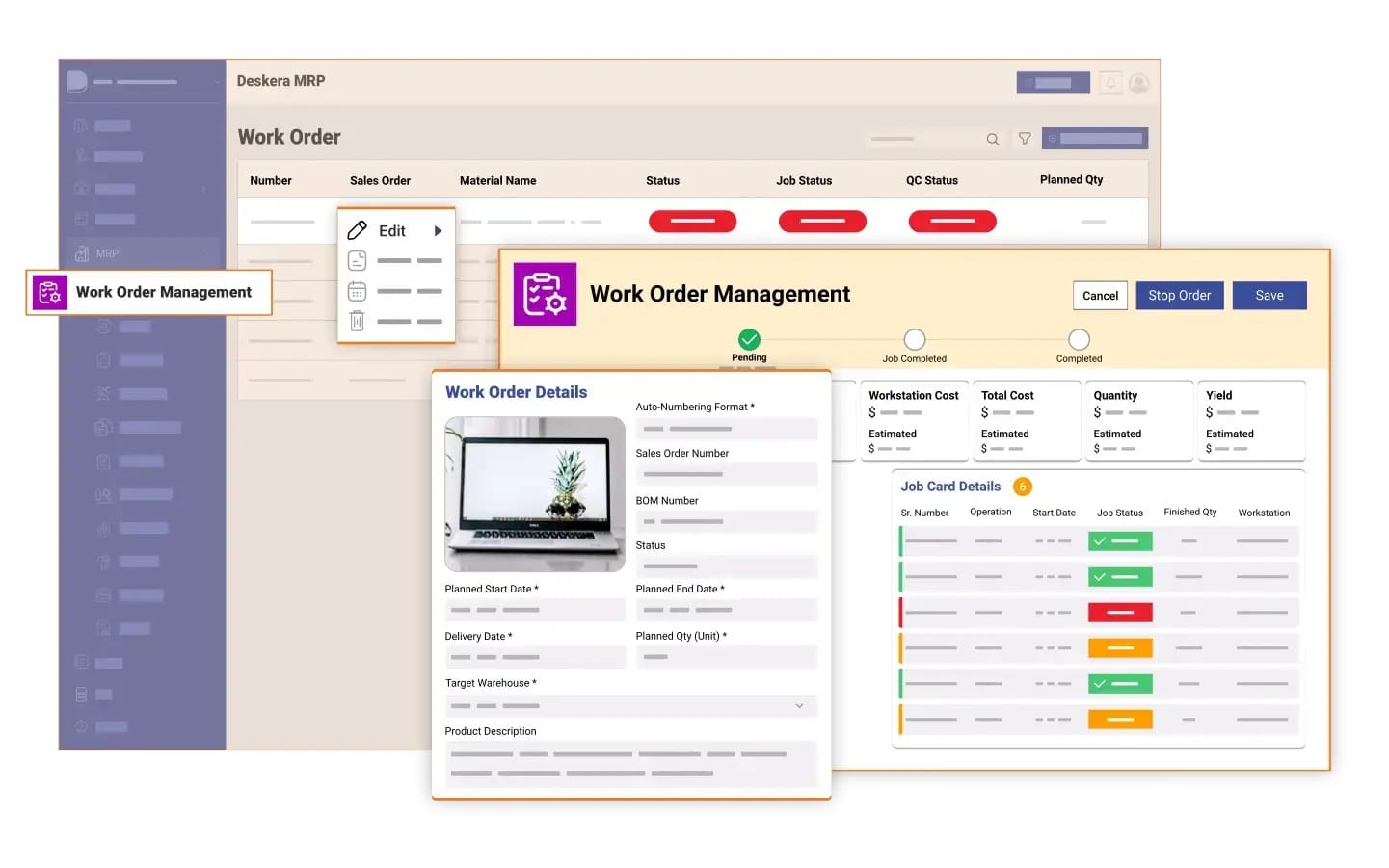
Reducing rework requires more than just fixing errors—it demands better visibility, stronger process control, and proactive decision-making. Deskera Manufacturing ERP provides an integrated platform that connects production, inventory, quality, and analytics, helping businesses identify and eliminate the root causes of rework. By streamlining operations and enforcing quality at every stage, it enables organizations to move closer to first-time-right performance.
Real-Time Production Visibility
Deskera Manufacturing ERP offers real-time tracking of production activities, allowing teams to monitor work-in-progress and detect issues early. With better visibility into shop floor operations, businesses can identify bottlenecks, deviations, or inconsistencies before they escalate into major defects requiring rework.
Built-In Quality Control Mechanisms
The system includes end-to-end quality control features that enforce checks at different stages of production. By defining quality parameters and inspection criteria, businesses can ensure that defects are caught early rather than after completion. This significantly reduces the chances of rework and improves overall product consistency.
Efficient Production Planning and Scheduling
Poor planning is a major cause of rework. Deskera Manufacturing ERP helps optimize production schedules, allocate resources effectively, and avoid rushed or uncoordinated workflows. With structured planning, teams can execute processes more accurately, reducing errors caused by time pressure or misalignment.
Accurate Inventory and Material Management
Errors related to incorrect materials or stock shortages often lead to rework. Deskera’s inventory management capabilities provide real-time tracking, batch and serial monitoring, and automated replenishment. This ensures that the right materials are used at the right time, minimizing production mistakes.
Data-Driven Insights and Reporting
Deskera Manufacturing ERP includes advanced reporting and analytics tools that help track key metrics, including quality performance and operational efficiency. These insights enable businesses to identify recurring issues, analyze root causes, and take corrective actions proactively, rather than reacting after rework occurs.
Improved Cross-Functional Collaboration
Since Deskera integrates multiple business functions—such as production, procurement, finance, and supply chain—it ensures seamless data flow across departments. This reduces miscommunication, eliminates data silos, and ensures that all teams work with accurate and up-to-date information, lowering the risk of errors and rework.
Automation and Reduced Manual Errors
Manual processes are a major source of mistakes. Deskera automates workflows such as order processing, approvals, and data entry, reducing human intervention and improving accuracy. Automation ensures consistency in execution, which directly contributes to lowering rework rates.
Continuous Improvement Through Monitoring
With centralized dashboards and performance tracking, Deskera Manufacturing ERP enables continuous monitoring of operations. Businesses can evaluate the effectiveness of corrective actions, track improvements over time, and build a culture of continuous improvement—ultimately leading to sustained reductions in rework.
By combining real-time visibility, quality control, automation, and data-driven insights, Deskera Manufacturing ERP helps organizations not only reduce rework but also improve efficiency, lower costs, and enhance overall operational performance.
Key Takeaways
- Rework rate measures the percentage of work that must be corrected after initial completion, making it a critical indicator of process efficiency and first-time quality.
- A high rework rate increases costs, delays delivery, and reduces customer satisfaction, making it essential for maintaining operational efficiency and profitability.
- Managing rework effectively requires a structured process that includes defect identification, root cause analysis, corrective action, and continuous monitoring.
- Rework rate can be calculated using units, transactions, or time-based formulas, helping businesses quantify inefficiencies and track performance over time.
- Metrics like First Pass Yield, defect rate, scrap rate, and OEE provide deeper insights into quality performance and help identify the root causes of rework.
- Factors such as poor quality control, unclear instructions, lack of training, and equipment issues are common contributors to increased rework.
- Lower rework leads to reduced costs, improved productivity, faster delivery, better resource utilization, and higher customer satisfaction.
- Standardizing processes, improving training, leveraging data, and adopting continuous improvement methodologies are key to minimizing rework.
- Organizations often face challenges such as inaccurate data, limited visibility, resistance to change, and difficulty in identifying root causes.
- Deskera ERP enables real-time visibility, automation, quality control, and data-driven insights, helping businesses proactively reduce rework and improve efficiency.
Related Articles
 Niti Samani
 Niti Samani
 Niti Samani
 Niti Samani
 Niti Samani
 Niti Samani