


What happens when a warehouse runs out of space during peak demand? Delayed shipments, misplaced inventory, rising storage costs, and frustrated customers quickly follow. The answer lies in effective warehouse capacity planning—a strategic process that helps businesses optimize storage space, streamline inventory movement, and ensure smooth warehouse operations even during periods of fluctuating demand. As supply chains become more complex and customer expectations continue to rise, businesses can no longer rely on guesswork to manage warehouse capacity efficiently.
Warehouse capacity planning involves analyzing available storage space, inventory levels, labor resources, equipment usage, and operational workflows to maximize warehouse performance. It helps businesses determine how much inventory a warehouse can handle without creating congestion or operational inefficiencies. Whether managing a manufacturing facility, distribution center, or retail warehouse, proper capacity planning improves inventory accuracy, enhances order fulfillment speed, and reduces unnecessary operational costs.
However, warehouse capacity planning is no longer just about increasing storage space. Modern warehouses must balance inventory availability, fast-moving SKUs, seasonal demand fluctuations, workforce productivity, and real-time inventory visibility. Without a structured planning strategy, businesses often face issues such as overstocking, underutilized storage areas, picking inefficiencies, and shipping delays. This is why many organizations are turning to advanced ERP and warehouse management solutions to gain better control over warehouse operations and capacity utilization.
Deskera ERP helps businesses simplify warehouse capacity planning through real-time inventory tracking, automated demand forecasting, barcode-enabled inventory management, and centralized warehouse visibility. Its integrated ERP capabilities allow manufacturers and distributors to optimize storage allocation, monitor stock movement, improve replenishment planning, and make data-driven warehouse decisions. With features such as multi-warehouse management, advanced analytics, and mobile accessibility, Deskera enables businesses to build more scalable, efficient, and future-ready warehouse operations.
What Is Warehouse Capacity Planning?
Warehouse capacity planning is the process of analyzing, managing, and optimizing the available warehouse space needed to store inventory efficiently while supporting both current and future business operations. It helps businesses determine how much inventory a warehouse can safely and effectively handle without causing congestion, operational delays, or wasted storage space. This planning process ensures that warehouses maintain the right balance between storage utilization, inventory accessibility, labor productivity, and operational efficiency.
Warehouse capacity refers to the total usable storage space available within a warehouse for inventory, including raw materials, work-in-progress goods, and finished products. To calculate warehouse capacity, businesses typically measure the facility’s total square footage and subtract non-storage areas such as offices, loading docks, packing stations, and employee facilities. The remaining usable storage area is then multiplied by the maximum safe stacking height to estimate total storage capacity.
Warehouse capacity planning goes beyond simply measuring physical space. It involves forecasting future inventory requirements, analyzing SKU movement, evaluating material flows, and understanding operational constraints to ensure the warehouse can meet customer demand efficiently. Effective planning helps businesses avoid common issues such as overstocking, stockouts, warehouse congestion, delayed shipments, and underutilized storage areas. It also improves workload distribution, reduces operational costs, and enhances overall supply chain performance.
A strong warehouse capacity planning strategy is built on several interconnected factors, including space utilization analysis, inventory capacity management, demand forecasting, labor planning, and warehouse layout optimization. Businesses must also account for industry-specific requirements such as temperature-controlled storage, hazardous material handling, quarantine zones, regulatory compliance, quality inspection areas, and specialized material flows. For example, pharmaceutical warehouses may require cold storage and strict compliance monitoring, while retail distribution centers often prioritize high-volume order fulfillment and rapid inventory movement.
Modern warehouse capacity planning increasingly relies on data-driven decision-making and advanced technology. Businesses use real-time inventory tracking, predictive analytics, ERP systems, warehouse management systems (WMS), and even digital twins to model warehouse operations and forecast future storage requirements. These tools help organizations optimize space utilization, improve picking and replenishment processes, reduce congestion, and allocate labor and equipment more efficiently.
Ultimately, warehouse capacity planning plays a critical role in maintaining smooth warehouse operations and ensuring long-term business scalability. By proactively planning for inventory fluctuations, seasonal demand changes, and future growth, businesses can improve operational efficiency, minimize costs, enhance customer satisfaction, and build more resilient supply chain operations.
Factors Influencing Warehouse Capacity Planning
Effective warehouse capacity planning depends on several operational, strategic, and technological factors that directly impact how efficiently warehouse space, labor, and resources are utilized. Businesses must evaluate these factors carefully to maintain smooth inventory flow, maximize storage utilization, and support future growth without compromising operational efficiency.
Demand Variations and Peak Seasons
Customer demand fluctuations and seasonal sales spikes significantly influence warehouse capacity planning. Businesses must forecast inventory requirements accurately to ensure sufficient storage space during peak periods without overloading the warehouse during slower seasons. Effective demand forecasting helps organizations adjust inventory levels, allocate storage space efficiently, and prevent stockouts or overstocking situations.
Seasonal industries such as retail, eCommerce, food distribution, and manufacturing often require flexible warehouse planning strategies to accommodate changing inventory volumes. Capacity planning allows businesses to prepare for high-demand periods while maintaining operational stability and customer service quality.
Space Utilization and Warehouse Layout
Warehouse layout design plays a major role in determining storage efficiency and operational productivity. Proper warehouse capacity planning focuses on maximizing available space through optimized aisle widths, vertical storage utilization, storage zone allocation, and efficient product placement.
A well-structured warehouse layout improves inventory accessibility, reduces travel time for workers, minimizes congestion, and increases storage density. Businesses must also analyze product movement patterns and inventory turnover rates when designing warehouse storage systems to ensure smooth operational flow.
Inventory Types and SKU Complexity
The type of inventory stored within a warehouse directly affects storage requirements and capacity utilization. Warehouses handling bulky products, hazardous materials, temperature-sensitive goods, or high-value inventory often require specialized storage systems and additional operational space.
SKU variety and inventory complexity also influence warehouse capacity planning. A warehouse managing thousands of SKUs may require dedicated storage zones, faster picking systems, and better inventory organization to maintain operational efficiency and reduce picking errors.
Technology and Warehouse Automation
Modern warehouse operations increasingly rely on technology to improve capacity planning accuracy and operational efficiency. Warehouse Management Systems (WMS), ERP software, barcode scanning, RFID tracking, and automated storage and retrieval systems provide real-time visibility into inventory movement and space utilization.
Advanced technologies also support better demand forecasting, inventory tracking, labor management, and warehouse optimization. Automation solutions such as robotics, conveyor systems, and automated picking tools help warehouses increase throughput capacity while reducing manual workload and operational bottlenecks.
Labor Requirements and Workforce Planning
Warehouse productivity heavily depends on workforce availability, efficiency, and skill levels. Capacity planning must account for labor requirements across receiving, storage, picking, packing, and shipping operations.
Businesses need to plan staffing levels based on operational workloads, seasonal demand changes, and warehouse activity levels. Efficient workforce planning helps maintain productivity, improve order fulfillment speed, reduce labor costs, and ensure compliance with workplace safety standards.
Material Handling Equipment
The availability and efficiency of material handling equipment directly impact warehouse throughput and storage management. Forklifts, pallet jacks, conveyors, automated guided vehicles (AGVs), and storage systems influence how quickly inventory can move through the warehouse.
Warehouse capacity planning must evaluate equipment capacity, maintenance schedules, equipment utilization rates, and operational compatibility with warehouse layouts to avoid bottlenecks and delays.
Receiving and Shipping Volume
Inbound and outbound shipment activity affects warehouse congestion, dock utilization, and storage requirements. Warehouses with high receiving and shipping volumes require efficient dock management, staging areas, and inventory flow planning to prevent operational slowdowns.
Proper capacity planning ensures that warehouses have sufficient dock capacity, storage allocation, and handling resources to manage incoming and outgoing inventory efficiently.
Regulatory and Safety Requirements
Many industries must comply with strict storage regulations and workplace safety standards that directly impact warehouse capacity planning. Businesses handling pharmaceuticals, chemicals, food products, or hazardous materials often require dedicated storage zones, quarantine areas, temperature-controlled environments, and compliance monitoring systems.
Safety regulations also influence aisle spacing, stacking height limitations, emergency exits, and material handling procedures. Failing to account for these requirements can reduce operational efficiency and increase compliance risks.
Environmental and Sustainability Factors
Sustainability has become an important consideration in modern warehouse capacity planning. Businesses increasingly focus on energy-efficient warehouse layouts, optimized storage utilization, waste reduction, and environmentally friendly operational practices.
Efficient warehouse design can reduce energy consumption, improve resource utilization, and lower operational costs. Sustainable warehouse planning also supports long-term business goals while improving overall operational resilience.
Business Growth and Scalability
Warehouse capacity planning must support future business expansion and changing operational requirements. Growing businesses need scalable warehouse strategies that can accommodate increasing inventory volumes, new product lines, additional SKUs, and higher order fulfillment demands.
Scalable warehouse planning helps businesses avoid frequent facility changes, reduce expansion costs, and maintain operational continuity as market conditions evolve.
Successful warehouse capacity planning requires balancing all these factors while aligning warehouse operations with overall business objectives. Regular monitoring, data-driven decision-making, and continuous optimization help organizations improve warehouse performance, maximize space utilization, and maintain efficient supply chain operations.
Why Warehouse Capacity Planning Is Important
Warehouse capacity planning plays a critical role in ensuring efficient warehouse operations, smooth inventory flow, and long-term business scalability. As inventory volumes, customer expectations, and supply chain complexities continue to grow, businesses need a structured approach to manage warehouse space, labor, equipment, and operational resources effectively. Proper warehouse capacity planning helps organizations improve operational efficiency, reduce costs, and maintain high service levels.
Improves Space Utilization
One of the biggest benefits of warehouse capacity planning is maximizing the use of available storage space. Proper planning helps businesses organize inventory efficiently, optimize vertical storage, reduce wasted space, and improve storage density.
Efficient space utilization allows warehouses to store more inventory without unnecessary expansion costs while maintaining smooth product movement and accessibility.
Prevents Overstocking and Underutilization
Without effective capacity planning, warehouses often face problems such as overcrowded storage areas or underutilized warehouse space. Overstocking increases storage costs, creates congestion, and slows down warehouse operations, while underutilization leads to wasted resources and lower operational efficiency.
Warehouse capacity planning helps businesses maintain balanced inventory levels and allocate storage space based on actual operational needs.
Enhances Inventory Visibility and Control
Capacity planning improves inventory organization and tracking, making it easier for businesses to monitor stock levels, SKU movement, and inventory availability in real time.
Better inventory visibility helps businesses:
- Reduce stock discrepancies
- Improve inventory accuracy
- Prevent stockouts
- Support faster replenishment decisions
- Enhance inventory turnover
Improved inventory control also contributes to better customer service and order fulfillment accuracy.
Supports Faster Order Fulfillment
Efficient warehouse capacity planning creates smoother workflows across receiving, storage, picking, packing, and shipping operations. Organized storage systems and optimized warehouse layouts reduce travel time for workers and improve picking efficiency.
This enables businesses to process orders faster, reduce fulfillment delays, and meet growing customer expectations for quick and accurate deliveries.
Reduces Operational Costs
Poor warehouse management often leads to higher labor costs, excess inventory holding costs, inefficient equipment usage, and unnecessary warehouse expansion expenses.
Warehouse capacity planning helps reduce operational costs by:
- Improving storage efficiency
- Minimizing wasted space
- Optimizing labor allocation
- Reducing inventory carrying costs
- Preventing operational bottlenecks
Better resource utilization directly improves overall warehouse profitability.
Improves Workforce Productivity
Well-planned warehouse operations create safer, more organized, and more efficient working environments for employees. Proper capacity planning reduces congestion, minimizes unnecessary movement, and streamlines operational workflows.
This helps improve:
- Employee productivity
- Task efficiency
- Labor utilization
- Workplace safety
- Operational consistency
Efficient workforce planning also helps businesses manage labor requirements during peak seasons more effectively.
Helps Manage Seasonal Demand Fluctuations
Many industries experience seasonal spikes in inventory and order volumes. Without proper warehouse capacity planning, sudden demand increases can overwhelm warehouse operations and lead to shipping delays, stock shortages, and operational inefficiencies.
Capacity planning allows businesses to prepare for seasonal demand changes by:
- Forecasting storage requirements
- Allocating temporary storage space
- Adjusting workforce capacity
- Improving replenishment planning
This ensures operational continuity even during peak business periods.
Minimizes Operational Bottlenecks
Warehouse bottlenecks can occur in receiving docks, storage zones, picking areas, or shipping operations when capacity limitations are not properly managed.
Warehouse capacity planning helps identify and eliminate operational constraints before they impact productivity. This improves inventory flow, reduces delays, and ensures smoother warehouse operations across all functional areas.
Supports Business Growth and Scalability
As businesses expand, warehouse operations must be able to handle increasing inventory volumes, additional SKUs, and growing customer demand. Capacity planning helps businesses prepare for future growth without disrupting existing operations.
Scalable warehouse planning supports:
- Business expansion
- Multi-warehouse operations
- New product introductions
- Increased order volumes
- Long-term operational flexibility
This helps organizations remain competitive in rapidly changing markets.
Improves Customer Satisfaction
Efficient warehouse operations directly impact customer experience. Delayed shipments, stockouts, inaccurate orders, and inventory shortages can negatively affect customer trust and brand reputation.
Warehouse capacity planning improves customer satisfaction by enabling:
- Faster order processing
- Better inventory availability
- Accurate deliveries
- Reduced shipping delays
- Improved service reliability
Consistently meeting customer expectations strengthens customer loyalty and business performance.
Enables Better Decision-Making Through Data
Modern warehouse capacity planning relies heavily on real-time data, analytics, and forecasting tools. Businesses can use operational insights to make informed decisions regarding inventory management, labor planning, warehouse expansion, and process optimization.
Data-driven warehouse planning helps organizations improve operational agility and respond more effectively to changing market conditions.
Warehouse capacity planning is essential for maintaining efficient warehouse operations, controlling costs, improving inventory management, and supporting long-term business growth. By proactively managing warehouse resources and optimizing operational workflows, businesses can build more resilient, scalable, and customer-focused supply chain operations.
Types of Warehouse Capacity Planning
Warehouse capacity planning involves managing different operational areas within a warehouse to ensure smooth inventory flow, efficient resource utilization, and high operational performance.
Since warehouse operations depend on multiple interconnected resources, businesses must evaluate different types of capacity to avoid bottlenecks, delays, and underutilized assets.
Understanding these capacity types helps organizations improve warehouse efficiency, optimize storage space, and support future growth.
Storage Capacity Planning
Storage capacity planning focuses on determining how much inventory a warehouse can safely and efficiently store within its available space. This includes evaluating floor space, vertical storage utilization, pallet positions, racking systems, and storage density.
Businesses use storage capacity planning to:
- Maximize warehouse space utilization
- Prevent overcrowding and congestion
- Improve inventory accessibility
- Optimize storage layouts
- Support inventory growth and seasonal demand
Effective storage planning ensures that inventory is stored in a way that supports efficient picking, replenishment, and order fulfillment processes.
Throughput Capacity Planning
Throughput capacity planning measures the warehouse’s ability to process inventory movement within a specific period. It focuses on how efficiently goods move through receiving, storage, picking, packing, and shipping operations.
This type of planning helps businesses evaluate:
- Daily or hourly order processing capability
- Receiving and shipping volume
- Inventory handling efficiency
- Picking and packing productivity
- Order fulfillment speed
High throughput capacity is critical for warehouses handling large order volumes, eCommerce fulfillment, and fast-moving inventory environments.
Labor Capacity Planning
Labor capacity planning determines the workforce requirements needed to support warehouse operations efficiently. It evaluates staffing needs across various warehouse functions, including receiving, storage, picking, packing, inventory management, and shipping.
Key considerations include:
- Workforce productivity
- Shift scheduling
- Seasonal labor requirements
- Employee skill levels
- Labor costs and efficiency
Proper labor planning helps businesses maintain operational productivity, reduce overtime costs, and ensure efficient workload distribution during peak demand periods.
Equipment Capacity Planning
Equipment capacity planning focuses on evaluating the availability, utilization, and performance of material handling equipment used within the warehouse. This includes forklifts, conveyors, pallet jacks, automated guided vehicles (AGVs), and storage systems.
Businesses use equipment capacity planning to:
- Prevent equipment-related bottlenecks
- Improve inventory movement efficiency
- Reduce equipment downtime
- Optimize maintenance schedules
- Support warehouse automation initiatives
Efficient equipment utilization directly impacts warehouse productivity and operational speed.
Dock Capacity Planning
Dock capacity planning ensures that warehouses have enough loading and unloading capacity to manage inbound and outbound shipments effectively. It focuses on the availability and utilization of receiving and shipping docks.
This planning includes:
- Managing truck arrival schedules
- Reducing loading and unloading delays
- Improving dock turnaround time
- Preventing congestion at receiving and shipping areas
- Enhancing inventory flow efficiency
Dock capacity planning is especially important for warehouses with high shipment volumes and time-sensitive deliveries.
Inventory Capacity Planning
Inventory capacity planning involves managing inventory levels to ensure warehouses can accommodate stock without creating storage inefficiencies. It focuses on balancing inventory availability with available warehouse space.
This type of planning helps businesses:
- Avoid overstocking and stock shortages
- Improve inventory turnover
- Support replenishment planning
- Optimize SKU allocation
- Manage seasonal inventory fluctuations
Effective inventory capacity planning improves storage efficiency while maintaining product availability for customers.
Operational Capacity Planning
Operational capacity planning evaluates the warehouse’s overall ability to support daily business activities efficiently. It combines storage, labor, equipment, inventory, and workflow management into a single operational strategy.
This includes:
- Workflow optimization
- Process efficiency
- Resource allocation
- Warehouse layout performance
- Order fulfillment capability
Operational capacity planning helps businesses improve coordination across warehouse functions and maintain consistent operational performance.
Future Growth and Expansion Capacity Planning
This type of planning focuses on preparing warehouses for future business growth, increased inventory volumes, and expanding operational requirements. Businesses evaluate scalability requirements to ensure the warehouse can support long-term growth without major disruptions.
Future capacity planning may involve:
- Expanding storage infrastructure
- Implementing automation technologies
- Adding warehouse locations
- Increasing workforce capacity
- Redesigning warehouse layouts
Scalable warehouse planning allows businesses to adapt to changing market demands while maintaining operational efficiency.
Each type of warehouse capacity planning plays an important role in maintaining efficient warehouse operations and supporting supply chain performance. Businesses that evaluate these capacity areas regularly can improve space utilization, reduce operational costs, enhance inventory management, and build more flexible and scalable warehouse operations.
5 Steps to Develop Effective Warehouse Capacity Planning
Developing an effective warehouse capacity planning strategy requires a structured approach that balances current operational requirements with future business growth. Businesses must continuously analyze storage utilization, forecast inventory demand, optimize warehouse layouts, and monitor performance to ensure efficient warehouse operations.
The following steps help organizations build a scalable and efficient warehouse capacity planning process.
Step 1: Analyze Current Warehouse Capacity and Space Utilization
The first step in warehouse capacity planning is evaluating the warehouse’s current storage capabilities and operational efficiency. Businesses should calculate total usable storage space by subtracting non-storage areas such as offices, packing stations, loading docks, and employee facilities from the overall warehouse area.
This analysis should also include:
- Measuring vertical storage utilization
- Evaluating existing racking and storage systems
- Identifying underutilized or dead storage zones
- Reviewing aisle widths and workflow efficiency
- Assessing inventory accessibility and material flow
Understanding current warehouse utilization helps businesses identify capacity limitations, operational bottlenecks, and opportunities for warehouse space optimization.
Step 2: Forecast Inventory Demand and Storage Requirements
Accurate demand forecasting is essential for effective warehouse capacity planning. Businesses need to analyze historical sales data, inventory trends, seasonal demand fluctuations, promotional activities, and future business projections to estimate future storage requirements.
Effective demand forecasting helps organizations:
- Maintain optimal inventory levels
- Prevent overstocking and stock shortages
- Allocate storage space efficiently
- Prepare for seasonal demand spikes
- Improve replenishment planning
Modern ERP and Warehouse Management Systems (WMS) use real-time analytics and predictive forecasting tools to provide more accurate inventory planning and warehouse capacity projections.
Step 3: Create a Scalable Warehouse Layout Plan
A well-designed warehouse layout improves storage efficiency, inventory movement, and operational productivity. Warehouse capacity planning should include dedicated zones for receiving, storage, picking, packing, staging, and shipping activities to ensure smooth workflow management.
Businesses should also:
- Optimize vertical storage space
- Use flexible racking configurations
- Design efficient picking paths
- Minimize congestion points
- Reserve additional capacity for future growth
Many experts recommend maintaining approximately 10% extra warehouse capacity to handle unexpected inventory surges and business expansion without disrupting operations.
Step 4: Establish Key Warehouse Performance Metrics
Tracking warehouse performance metrics helps businesses evaluate the effectiveness of their capacity planning strategies. Clear KPIs provide visibility into warehouse utilization, operational efficiency, inventory movement, and workforce productivity.
Important metrics include:
- Warehouse utilization rate
- Inventory turnover ratio
- Order fulfillment speed
- Picking accuracy
- Throughput rate
- Labor productivity
- Dock-to-stock time
Regular monitoring of these metrics allows businesses to identify inefficiencies, improve warehouse space optimization, and make data-driven operational decisions.
Step 5: Develop Risk Mitigation and Continuous Improvement Strategies
Warehouse operations are constantly affected by changing customer demand, supply chain disruptions, labor shortages, and seasonal fluctuations. Effective warehouse capacity planning must include contingency plans and flexible operational strategies to minimize risks.
Businesses should implement:
- Dynamic inventory slotting
- Flexible storage allocation
- Automated storage solutions
- Backup labor and equipment planning
- Regular warehouse audits and reviews
Continuous monitoring and improvement ensure that warehouse capacity planning remains aligned with evolving business goals and operational requirements. Regular performance evaluations help organizations identify potential bottlenecks early and adapt warehouse operations before issues impact productivity or customer service.
Successful warehouse capacity planning requires a balance between operational efficiency, inventory control, scalability, and flexibility. By following these structured steps, businesses can maximize warehouse utilization, reduce operational costs, improve order fulfillment performance, and create a more resilient and future-ready supply chain operation.
Common Challenges in Warehouse Capacity Planning
Warehouse capacity planning is essential for maintaining efficient warehouse operations, but businesses often face several operational, technological, and strategic challenges while managing warehouse space and resources.
Factors such as fluctuating demand, limited storage space, inaccurate inventory data, and inefficient workflows can significantly impact warehouse performance. Identifying these challenges early helps businesses improve operational efficiency and build more resilient warehouse systems.
Managing Unpredictable Demand Fluctuations
One of the biggest challenges in warehouse capacity planning is handling sudden changes in customer demand. Seasonal sales spikes, promotional campaigns, market trends, and unexpected viral demand can rapidly increase inventory and order volumes.
Without accurate demand forecasting, businesses may experience:
- Overstocking and warehouse congestion
- Stock shortages and delayed shipments
- Inefficient space allocation
- Increased inventory carrying costs
Warehouses must maintain enough flexibility to handle both regular inventory levels and unexpected demand surges without disrupting operations.
Limited Warehouse Space
Space constraints are a major challenge for many warehouses, especially businesses experiencing rapid growth. Poor warehouse layouts, inefficient storage systems, and underutilized vertical space can reduce storage capacity and create operational bottlenecks.
Limited warehouse space often leads to:
- Congested storage areas
- Difficulty locating inventory
- Reduced picking efficiency
- Delayed order fulfillment
- Higher risk of damaged or misplaced inventory
Optimizing warehouse layouts and improving storage density are essential for overcoming space limitations.
Inaccurate Inventory Data
Warehouse capacity planning heavily depends on accurate inventory data. Errors in inventory records, manual data entry mistakes, missing information, and poor inventory tracking systems can lead to inaccurate capacity calculations and operational inefficiencies.
Data accuracy issues can result in:
- Incorrect inventory levels
- Poor replenishment planning
- Stock discrepancies
- Misallocation of storage space
- Delayed customer orders
Implementing real-time inventory tracking systems, barcode scanning, and automated data validation processes helps improve inventory accuracy.
Balancing Cost Efficiency and Operational Flexibility
Businesses often struggle to balance operational efficiency with the need for flexibility in warehouse operations. Maintaining excess warehouse space and labor capacity may improve flexibility during peak demand, but it also increases operational costs.
On the other hand, maximizing space utilization too aggressively can reduce operational agility and create congestion during high-demand periods.
Warehouse capacity planning must balance:
- Storage efficiency
- Labor costs
- Inventory availability
- Operational scalability
- Customer service requirements
Finding the right balance is critical for maintaining profitability and operational stability.
Inefficient Warehouse Layout and Workflow Design
Poor warehouse layout planning can negatively impact inventory movement, labor productivity, and overall warehouse performance. Inefficient workflows increase employee travel time, slow down picking and packing operations, and create congestion in key operational areas.
Common layout-related issues include:
- Narrow or poorly designed aisles
- Improper storage zone allocation
- Inadequate receiving and shipping areas
- Poor inventory organization
- Bottlenecks in picking and packing operations
Effective warehouse layout optimization improves inventory accessibility and operational flow.
Legacy System Integration Challenges
Many businesses still rely on outdated warehouse systems that lack integration with modern ERP platforms, Warehouse Management Systems (WMS), and automation technologies. Legacy systems often create communication gaps, data silos, and operational inefficiencies.
Integration challenges may lead to:
- Delayed inventory updates
- Poor visibility across warehouse operations
- Order fulfillment bottlenecks
- Inaccurate forecasting
- Reduced operational coordination
Modern integrated warehouse technologies help improve visibility, automation, and decision-making capabilities.
Labor Shortages and Workforce Management
Warehouse operations depend heavily on labor availability and workforce productivity. Managing staffing levels during seasonal demand fluctuations or labor shortages can be extremely difficult.
Common workforce challenges include:
- Insufficient staffing during peak periods
- High employee turnover
- Training and skill gaps
- Rising labor costs
- Productivity inconsistencies
Businesses must develop flexible workforce planning strategies to maintain operational efficiency while controlling labor expenses.
Poor Demand Forecasting
Inaccurate demand forecasting can lead to major warehouse capacity issues. If businesses underestimate demand, they may run out of storage space or inventory. Overestimating demand can result in excess inventory and underutilized warehouse capacity.
Poor forecasting affects:
- Inventory management
- Space allocation
- Procurement planning
- Labor scheduling
- Customer service performance
Using predictive analytics and real-time data improves forecasting accuracy and warehouse planning efficiency.
Managing SKU Complexity
As businesses expand product offerings, managing large numbers of SKUs becomes increasingly challenging. Different product sizes, storage requirements, turnover rates, and handling procedures complicate warehouse organization and space allocation.
SKU complexity can create:
- Storage inefficiencies
- Picking errors
- Slower inventory movement
- Increased labor requirements
- Difficulty tracking inventory accurately
Proper slotting strategies and inventory classification systems help manage SKU complexity more effectively.
Adapting to Changing Business Needs
Warehouse operations must continuously adapt to changing market conditions, customer expectations, supply chain disruptions, and business growth. Rapid changes in order volumes, product lines, and operational requirements can quickly make existing warehouse plans outdated.
Businesses need flexible and scalable warehouse capacity planning strategies to:
- Support business expansion
- Handle changing inventory volumes
- Adapt to supply chain disruptions
- Meet evolving customer expectations
Continuous monitoring and operational adjustments are necessary to maintain warehouse efficiency over time.
Lack of Real-Time Visibility
Without real-time visibility into inventory levels, warehouse utilization, labor productivity, and operational workflows, businesses struggle to make informed decisions regarding warehouse capacity planning.
Limited visibility can result in:
- Delayed operational responses
- Inefficient space allocation
- Inventory inaccuracies
- Increased operational costs
- Reduced customer satisfaction
Real-time warehouse management systems and ERP platforms help businesses improve operational transparency and responsiveness.
Warehouse capacity planning comes with multiple operational and strategic challenges, but businesses that proactively address these issues can significantly improve warehouse efficiency, reduce costs, and strengthen overall supply chain performance.
By combining accurate forecasting, optimized warehouse layouts, real-time inventory visibility, and scalable operational strategies, organizations can create more resilient and future-ready warehouse operations.
Best Practices for Effective Warehouse Capacity Planning
Effective warehouse capacity planning requires a combination of strategic planning, real-time visibility, workforce coordination, and technology-driven decision-making.
Businesses that follow structured best practices can improve space utilization, reduce operational costs, increase inventory accuracy, and maintain smooth warehouse operations even during periods of fluctuating demand.
Regularly Monitor Warehouse Capacity Metrics
Continuous monitoring of warehouse performance metrics is essential for maintaining operational efficiency and identifying capacity-related issues before they become critical problems. Businesses should regularly track KPIs such as:
- Warehouse utilization rate
- Inventory turnover ratio
- Storage density
- Order picking accuracy
- Throughput rate
- Labor productivity
Comparing these metrics against historical trends and industry benchmarks helps organizations identify inefficiencies, improve resource allocation, and make data-driven warehouse decisions.
Invest in Predictive Analytics and Forecasting Tools
Accurate forecasting plays a critical role in warehouse capacity planning. Predictive analytics tools help businesses analyze historical sales data, customer demand trends, seasonal fluctuations, and inventory movement patterns to estimate future storage requirements more accurately.
Modern predictive analytics solutions help businesses:
- Optimize inventory levels
- Reduce stock shortages and overstocking
- Improve replenishment planning
- Anticipate peak demand periods
- Increase operational agility
Using data-driven forecasting improves warehouse responsiveness and overall supply chain performance.
Optimize Warehouse Layout and Storage Design
An efficient warehouse layout significantly improves inventory flow, storage utilization, and workforce productivity. Businesses should design warehouse layouts that support smooth movement across receiving, storage, picking, packing, and shipping operations.
Best practices include:
- Maximizing vertical storage space
- Reducing unnecessary travel paths
- Optimizing aisle widths
- Creating dedicated storage zones
- Using flexible racking systems
- Positioning fast-moving inventory closer to picking areas
A well-planned layout improves operational efficiency while reducing congestion and handling delays.
Implement Real-Time Inventory Tracking
Real-time inventory visibility is essential for accurate warehouse capacity planning. Businesses should implement technologies such as barcode scanning, RFID tracking, Warehouse Management Systems (WMS), and ERP software to monitor inventory movement continuously.
Real-time inventory tracking helps:
- Improve inventory accuracy
- Prevent stock discrepancies
- Optimize storage allocation
- Reduce manual errors
- Support faster decision-making
Improved inventory visibility enables businesses to respond more quickly to operational changes and demand fluctuations.
Develop Standard Operating Procedures (SOPs)
Clearly defined standard operating procedures help maintain consistency and efficiency across warehouse operations. SOPs should cover inventory handling, storage allocation, receiving processes, picking workflows, replenishment procedures, and safety guidelines.
Effective SOPs help businesses:
- Standardize warehouse activities
- Improve workforce productivity
- Reduce operational errors
- Ensure compliance and safety
- Maintain consistent operational performance
Well-documented procedures also simplify employee onboarding and training processes.
Train Warehouse Teams on Space Optimization Techniques
Employees play a major role in warehouse efficiency. Regular training programs help warehouse teams understand proper inventory placement, storage optimization methods, picking techniques, and operational workflows.
Training should focus on:
- Efficient storage utilization
- Inventory organization
- Picking accuracy
- Equipment handling
- Safety procedures
- Workflow optimization
Skilled warehouse teams improve operational productivity while reducing handling errors and space inefficiencies.
Maintain Flexible Storage Strategies
Warehouse requirements often change due to seasonal demand, inventory fluctuations, and business growth. Businesses should adopt flexible storage solutions that can easily adapt to changing operational needs.
Flexible strategies include:
- Adjustable racking systems
- Dynamic slotting methods
- Temporary storage zones
- Modular storage layouts
- Scalable automation systems
Flexibility helps businesses manage unexpected demand changes without disrupting warehouse operations.
Improve Communication Across Departments
Warehouse capacity planning requires strong coordination between inventory management, procurement, sales, logistics, and warehouse operations teams. Effective communication ensures that warehouse decisions align with customer demand, procurement schedules, and supply chain activities.
Real-time dashboards and centralized ERP systems improve communication by providing shared operational visibility across departments.
Better communication helps:
- Prevent inventory imbalances
- Improve replenishment planning
- Reduce operational delays
- Support faster decision-making
Conduct Regular Warehouse Audits
Periodic warehouse audits help businesses evaluate storage utilization, inventory accuracy, operational workflows, and equipment performance. Audits identify inefficiencies, bottlenecks, and areas requiring improvement before they impact productivity.
Warehouse audits should include:
- Inventory accuracy checks
- Space utilization analysis
- Workflow evaluations
- Equipment inspections
- Safety compliance reviews
Regular reviews support continuous operational improvement and better capacity management.
Use Automation Where Appropriate
Warehouse automation can significantly improve storage efficiency, inventory accuracy, and operational speed. Businesses should evaluate automation technologies based on warehouse size, inventory complexity, and operational requirements.
Automation solutions may include:
- Automated storage and retrieval systems (AS/RS)
- Conveyor systems
- Robotics and autonomous mobile robots (AMRs)
- Automated picking technologies
- AI-driven inventory management
Automation reduces manual workload, improves throughput, and enhances warehouse scalability.
Plan for Future Growth and Scalability
Warehouse capacity planning should not focus only on current operational needs. Businesses must also prepare for future expansion, increased inventory volumes, and changing customer demands.
Scalable warehouse planning involves:
- Reserving additional storage capacity
- Designing flexible warehouse layouts
- Investing in scalable technologies
- Expanding labor planning capabilities
- Supporting multi-warehouse operations
Proactive planning helps businesses grow without major operational disruptions or excessive expansion costs.
Prioritize Safety and Compliance
Warehouse safety directly impacts operational efficiency and workforce productivity. Businesses should ensure that storage layouts, equipment usage, and inventory handling procedures comply with industry regulations and workplace safety standards.
Best practices include:
- Maintaining proper aisle spacing
- Following stacking height regulations
- Implementing safety training programs
- Conducting regular safety inspections
- Using appropriate storage systems for hazardous materials
Safe warehouse operations reduce workplace incidents and improve overall operational reliability.
Implementing these best practices helps businesses build efficient, scalable, and resilient warehouse operations. By combining accurate forecasting, real-time visibility, workforce training, optimized layouts, and modern technology, organizations can maximize warehouse capacity while improving operational performance and customer satisfaction.
Key Metrics Used in Warehouse Capacity Planning
Monitoring warehouse performance metrics is essential for effective warehouse capacity planning. These metrics help businesses measure storage efficiency, inventory movement, workforce productivity, and operational performance.
By tracking the right KPIs, organizations can identify bottlenecks, optimize warehouse space, improve inventory control, and make better operational decisions.
Warehouse Utilization Rate
Warehouse utilization rate measures the percentage of available warehouse storage space currently being used. It helps businesses determine whether warehouse space is being efficiently utilized or if the facility is becoming overcrowded or underused.
Formula: Warehouse Utilization Rate = (Used Storage Space / Total Available Storage Space) × 100
A high utilization rate may indicate space constraints and operational congestion, while a low rate may suggest inefficient use of warehouse capacity.
Inventory Turnover Ratio
Inventory turnover ratio measures how often inventory is sold and replaced during a specific period. This metric helps businesses evaluate inventory movement efficiency and storage effectiveness.
Formula: Inventory Turnover Ratio = Cost of Goods Sold / Average Inventory
A higher turnover ratio generally indicates better inventory management and faster inventory movement through the warehouse.
Storage Density
Storage density measures how efficiently warehouse storage space is being used to store inventory. It evaluates the amount of inventory stored within a specific warehouse area.
Formula: Storage Density = Total Inventory Stored / Warehouse Storage Area
Improving storage density helps businesses maximize warehouse capacity without increasing facility size.
Throughput Rate
Throughput rate measures the amount of inventory processed through the warehouse over a specific period. It reflects the warehouse’s ability to handle receiving, storage, picking, packing, and shipping operations efficiently.
Formula: Throughput Rate = Total Units Processed / Time Period
A higher throughput rate indicates faster inventory movement and more efficient warehouse operations.
Dock-to-Stock Time
Dock-to-stock time measures the time required to move incoming inventory from the receiving dock to its assigned storage location.
Formula: Dock-to-Stock Time = Total Time Taken to Move Inventory from Receiving Dock to Storage
Lower dock-to-stock times improve inventory availability and increase warehouse operational efficiency.
Order Picking Accuracy
Order picking accuracy measures the percentage of customer orders picked correctly without errors.
Formula: Order Picking Accuracy = (Correct Orders Picked / Total Orders Picked) × 100
High picking accuracy reduces shipping errors, returns, and customer complaints while improving order fulfillment performance.
Labor Productivity
Labor productivity measures how efficiently warehouse employees perform operational tasks such as receiving, picking, packing, and shipping.
Formula: Labor Productivity = Total Orders Processed / Total Labor Hours
Tracking labor productivity helps businesses improve workforce allocation and operational efficiency.
Inventory Accuracy Rate
Inventory accuracy rate measures how closely warehouse inventory records match the actual physical inventory count.
Formula: Inventory Accuracy Rate = (Accurate Inventory Count / Total Inventory Count) × 100
High inventory accuracy improves replenishment planning, reduces stock discrepancies, and supports efficient warehouse operations.
Zone Capacity Utilization
Zone capacity utilization measures how effectively specific warehouse zones or storage areas are being used.
Formula: Zone Capacity Utilization = (Used Zone Capacity / Total Zone Capacity) × 100
This metric helps businesses identify underutilized storage areas and optimize warehouse layout planning.
Order Cycle Time
Order cycle time measures the total time required to process and deliver a customer order from placement to shipment.
Formula: Order Cycle Time = Order Delivery Time - Order Placement Time
Reducing order cycle time improves customer satisfaction and enhances warehouse responsiveness.
Inventory Carrying Cost
Inventory carrying cost measures the total expense associated with storing and maintaining inventory in the warehouse.
Formula: Inventory Carrying Cost = (Total Inventory Holding Costs / Average Inventory Value) × 100
Lower inventory carrying costs help businesses improve profitability and warehouse efficiency.
Tracking these warehouse capacity planning metrics allows businesses to improve storage utilization, optimize inventory movement, increase workforce productivity, and reduce operational costs. Regular KPI monitoring also supports better forecasting, operational planning, and long-term warehouse scalability.
How Deskera ERP Helps With Warehouse Capacity Planning
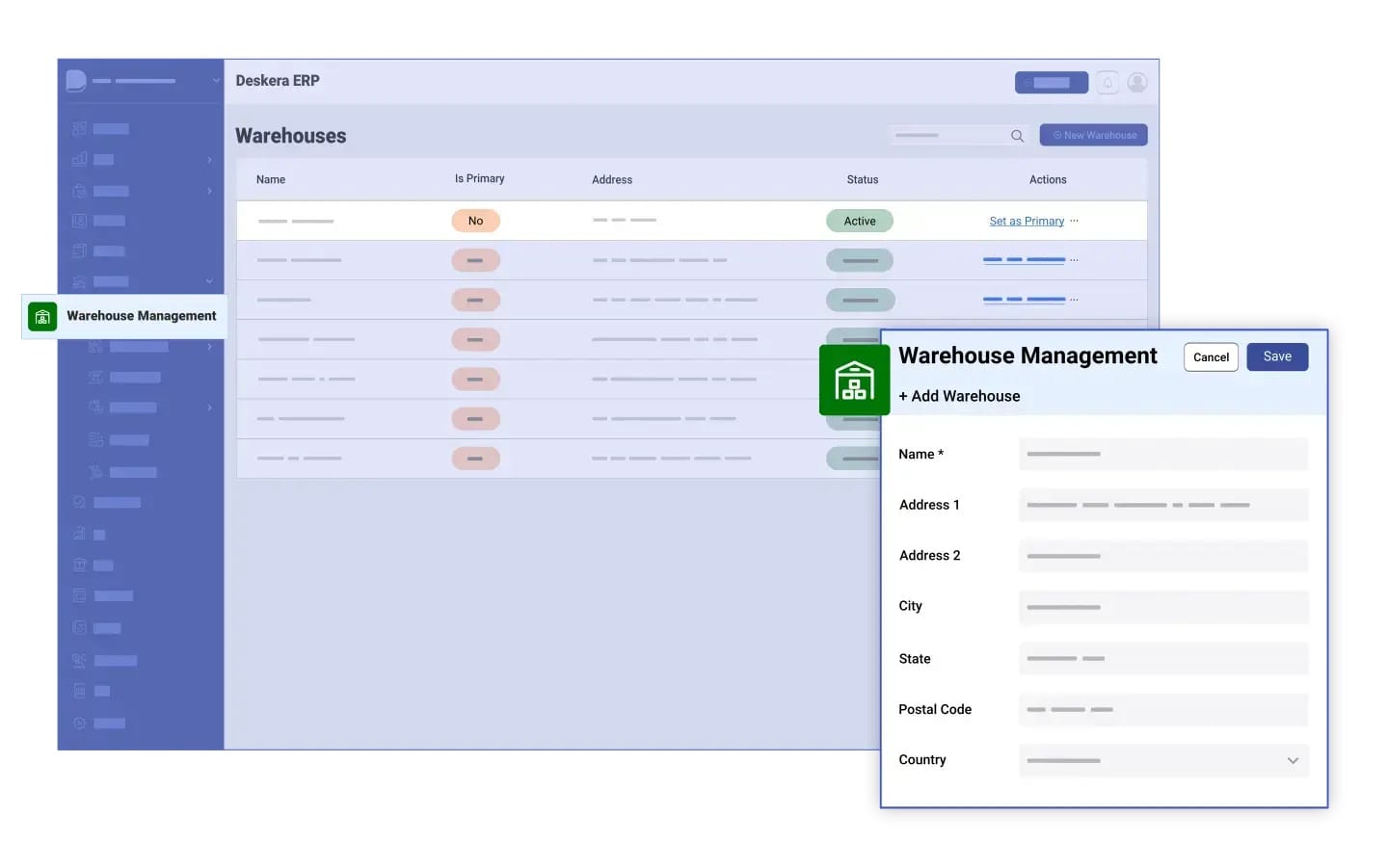
Deskera ERP helps businesses streamline warehouse capacity planning by providing real-time visibility into inventory, warehouse operations, procurement, and supply chain activities. By combining inventory management, automation, analytics, and forecasting capabilities within a centralized platform, Deskera enables organizations to optimize warehouse space utilization, improve inventory flow, and support long-term operational scalability.
Real-Time Inventory Visibility
Deskera ERP provides real-time tracking of inventory across warehouses, helping businesses maintain accurate stock visibility at all times. This allows warehouse managers to monitor stock levels, track SKU movement, and identify storage utilization patterns more effectively.
Real-time visibility helps businesses:
- Reduce stock discrepancies
- Prevent overstocking and stock shortages
- Improve inventory accuracy
- Optimize warehouse space allocation
- Support faster operational decisions
Accurate inventory data is critical for efficient warehouse capacity planning and smooth warehouse operations.
Smart Demand Forecasting
Demand forecasting is essential for managing warehouse capacity efficiently. Deskera ERP uses historical sales data, inventory trends, and purchasing patterns to help businesses forecast future inventory requirements more accurately.
This enables organizations to:
- Anticipate seasonal demand fluctuations
- Improve replenishment planning
- Allocate storage space effectively
- Reduce excess inventory
- Prevent inventory shortages
Better forecasting improves warehouse responsiveness and supports more efficient inventory management.
Multi-Warehouse Management
Businesses operating across multiple warehouse locations can centrally manage inventory and warehouse operations using Deskera ERP. The platform provides a unified view of stock availability, warehouse utilization, and inventory movement across facilities.
Multi-warehouse capabilities help businesses:
- Balance inventory across locations
- Improve stock transfers
- Reduce inventory duplication
- Increase operational coordination
- Improve fulfillment efficiency
Centralized warehouse management improves overall supply chain visibility and capacity planning accuracy.
Automated Inventory Replenishment
Deskera ERP automates inventory replenishment processes by monitoring stock levels and generating purchase recommendations based on predefined reorder points and demand forecasts.
Automated replenishment helps businesses:
- Maintain optimal inventory levels
- Avoid emergency restocking
- Reduce excess inventory storage
- Improve procurement efficiency
- Prevent stockouts during peak demand
Automation improves inventory flow while reducing manual planning effort.
Barcode and Batch Tracking
Deskera ERP supports barcode scanning and batch tracking, improving inventory accuracy and warehouse efficiency. Businesses can quickly track inventory movement, monitor batch information, and reduce manual inventory handling errors.
These capabilities help:
- Improve picking accuracy
- Accelerate inventory audits
- Enhance traceability
- Reduce inventory discrepancies
- Improve warehouse productivity
Accurate inventory tracking supports better warehouse capacity planning and operational control.
Advanced Reporting and Analytics
Deskera ERP provides detailed warehouse analytics and customizable reports that help businesses monitor warehouse performance and capacity utilization.
Businesses can analyze:
- Warehouse utilization rates
- Inventory turnover
- Order fulfillment performance
- Stock movement trends
- Labor productivity
- Inventory carrying costs
These insights enable businesses to identify operational bottlenecks, optimize warehouse processes, and make data-driven planning decisions.
Streamlined Procurement and Inventory Coordination
Warehouse capacity planning depends heavily on procurement and inventory synchronization. Deskera ERP integrates procurement, inventory, finance, and warehouse operations within a single platform, improving coordination across departments.
This integration helps businesses:
- Align purchasing with warehouse capacity
- Improve inbound inventory planning
- Reduce unnecessary inventory accumulation
- Improve supplier coordination
- Maintain smoother inventory flow
Better coordination minimizes operational disruptions and improves warehouse efficiency.
Mobile Accessibility for Warehouse Operations
Deskera ERP offers mobile accessibility, enabling warehouse teams and managers to access inventory data, monitor warehouse activities, and manage operations remotely.
Mobile access helps improve:
- Real-time operational visibility
- Faster inventory updates
- Workforce coordination
- Decision-making speed
- Operational responsiveness
Mobile-enabled warehouse management increases flexibility and improves operational efficiency across warehouse environments.
Supports Scalable Warehouse Operations
As businesses grow, warehouse operations become more complex. Deskera ERP provides scalable warehouse management capabilities that support increasing inventory volumes, additional SKUs, expanding warehouse networks, and evolving operational requirements.
Its scalable infrastructure helps businesses:
- Adapt to changing demand
- Expand warehouse operations efficiently
- Improve long-term planning
- Support operational growth
- Maintain warehouse performance during expansion
This scalability makes Deskera ERP suitable for growing manufacturing, distribution, retail, and supply chain businesses.
By combining real-time inventory visibility, forecasting, automation, analytics, and centralized warehouse management, Deskera ERP helps businesses improve warehouse capacity planning, optimize operational efficiency, reduce inventory costs, and build more agile and scalable warehouse operations.
Key Takeaways
- Warehouse capacity planning helps businesses optimize storage space, improve inventory flow, and maintain efficient warehouse operations while supporting future growth.
- Understanding warehouse capacity involves evaluating both storage space and operational capability to ensure the warehouse can handle current and future inventory demands effectively.
- Effective warehouse capacity planning improves space utilization, reduces operational costs, enhances inventory visibility, and supports faster order fulfillment.
- Factors such as demand fluctuations, warehouse layout, technology adoption, labor availability, inventory complexity, and equipment utilization significantly influence warehouse capacity planning success.
- Different types of warehouse capacity planning, including storage, throughput, labor, dock, and inventory capacity planning, help businesses manage warehouse resources more efficiently.
- Developing an effective warehouse capacity planning strategy requires analyzing current capacity, forecasting demand, optimizing layouts, monitoring KPIs, and implementing risk mitigation strategies.
- Tracking warehouse metrics such as warehouse utilization rate, inventory turnover, throughput rate, and order picking accuracy helps businesses measure operational efficiency and identify improvement opportunities.
- Common warehouse capacity planning challenges include unpredictable demand, limited warehouse space, inaccurate inventory data, inefficient workflows, labor shortages, and outdated technology systems.
- Best practices such as regular KPI monitoring, predictive analytics, real-time inventory tracking, workforce training, and flexible storage strategies help improve warehouse efficiency and scalability.
- Modern technologies like ERP systems, Warehouse Management Systems (WMS), automation, barcode tracking, RFID, and predictive analytics improve warehouse visibility and operational decision-making.
- Deskera ERP helps businesses streamline warehouse capacity planning through real-time inventory tracking, automated replenishment, demand forecasting, warehouse analytics, and multi-warehouse management capabilities.
- Businesses that adopt proactive and data-driven warehouse capacity planning strategies can reduce costs, improve customer satisfaction, and build more scalable and resilient supply chain operations.
Related Articles
 Niti Samani
 Niti Samani
 Niti Samani
 Niti Samani
 Niti Samani
 Niti Samani