


Have you ever wondered why some business investments generate massive profits while others lead to unexpected losses? The answer often lies in one critical process: cost-benefit analysis (CBA). Before launching a new project, purchasing equipment, implementing software, or expanding operations, successful businesses carefully compare expected costs with potential benefits. This structured approach helps organizations make informed decisions that maximize profitability while minimizing financial risks.
Cost-benefit analysis is a powerful decision-making technique that evaluates whether the benefits of a business action outweigh its associated costs. It enables companies to identify profitable opportunities, allocate resources effectively, and avoid unnecessary expenditures. From manufacturing and supply chain management to technology adoption and workforce planning, businesses across industries rely on CBA to support smarter and more strategic decisions.
In today’s highly competitive market, making decisions based on assumptions alone can be costly. Businesses need accurate data, real-time insights, and financial visibility to assess investments with confidence. A well-executed cost-benefit analysis not only improves operational efficiency and financial planning but also helps organizations measure long-term value, evaluate risks, and prioritize initiatives that drive sustainable growth.
This is where Deskera ERP can make a significant difference. Deskera ERP helps businesses streamline financial management, track operational costs, monitor inventory, and generate real-time reports from a centralized platform. With advanced analytics, automation features, and forecasting capabilities, businesses can perform more accurate cost-benefit analyses and make faster, data-driven decisions. By improving visibility across departments, Deskera ERP empowers organizations to optimize investments, reduce inefficiencies, and improve overall profitability.
What Is Cost-Benefit Analysis?
Cost-benefit analysis (CBA) is a systematic and data-driven process used to evaluate whether a business decision, project, or investment is financially worthwhile. It involves comparing the total expected costs of a project with its anticipated benefits to determine if the potential returns justify the investment. By assigning monetary values to both costs and benefits, businesses can make more informed and objective decisions rather than relying on assumptions or intuition.
In simple terms, cost-benefit analysis helps organizations answer a critical question: Do the benefits outweigh the costs? If the projected benefits are greater than the associated costs, the project is generally considered viable and worth pursuing. However, if the costs exceed the expected benefits, businesses may choose to modify the plan, explore alternatives, or avoid the investment altogether.
A cost-benefit analysis typically considers both tangible and intangible factors. Tangible costs may include equipment purchases, labor expenses, software investments, operational costs, and maintenance fees. Tangible benefits often include increased revenue, reduced operational expenses, higher productivity, or improved efficiency. At the same time, businesses also evaluate intangible elements such as customer satisfaction, employee morale, brand reputation, and long-term strategic value.
Another important component of CBA is opportunity cost, which refers to the potential benefits a business may lose when choosing one option over another. By analyzing opportunity costs alongside direct expenses and expected returns, organizations gain a more comprehensive understanding of the trade-offs involved in decision-making.
The process of conducting a cost-benefit analysis generally involves defining the project scope, identifying all relevant costs and benefits, assigning monetary values, calculating metrics such as net present value (NPV) or benefit-cost ratio, analyzing risks, and comparing the final outcomes. This structured approach allows businesses to forecast profitability, minimize financial risks, and allocate resources more effectively.
Today, cost-benefit analysis is widely used across industries for project planning, budgeting, technology investments, supply chain improvements, process optimization, and strategic decision-making. Whether a company is considering implementing new ERP software, expanding production capacity, launching a new product, or automating operations, CBA provides a reliable framework for evaluating feasibility and maximizing business value.
Key Components of Cost-Benefit Analysis
A successful cost-benefit analysis (CBA) depends on evaluating several critical components that help businesses accurately compare the total costs and expected benefits of a project or decision. These components provide a structured framework for assessing financial feasibility, profitability, and long-term business value.
Costs
Costs represent all the expenses and negative impacts associated with a project, investment, or business decision. Identifying every potential cost is essential for conducting an accurate analysis.
Direct Costs
Direct costs are expenses directly tied to the production of a product, service, or project. These may include labor, raw materials, equipment, manufacturing expenses, and operational costs that can be clearly traced to the initiative.
Indirect Costs
Indirect costs are expenses that support the project but are not directly linked to production activities. Examples include office rent, utilities, administrative salaries, maintenance expenses, and other overhead costs that contribute to overall business operations.
Intangible Costs
Intangible costs are difficult to measure financially but can still significantly impact the business. These may include reduced employee productivity, customer dissatisfaction, reputational damage, workflow disruptions, or decreased employee morale during project implementation.
Opportunity Costs
Opportunity costs refer to the potential benefits a business sacrifices when choosing one option over another. For example, investing resources in one project may prevent the company from pursuing another potentially profitable opportunity.
7 Steps for Conducting a Cost-Benefit Analysis
Conducting a cost-benefit analysis (CBA) helps businesses evaluate whether a project, investment, or strategic decision is financially worthwhile. By systematically comparing expected costs with anticipated benefits, organizations can reduce risks, improve resource allocation, and make data-driven decisions.
Below are the key steps involved in performing an effective cost-benefit analysis.
Step 1: Define the Project Scope and Objectives
The first step in a cost-benefit analysis is clearly defining the purpose, scope, and goals of the project or decision. Businesses should identify what they want to achieve, establish timelines, determine required resources, and understand project constraints. Involving key stakeholders at this stage ensures the analysis aligns with operational, financial, and strategic objectives.
Step 2: Identify All Project Costs
Once the project scope is established, businesses must identify all potential costs associated with the initiative. This includes direct costs such as labor, equipment, and materials, as well as indirect costs like utilities, rent, and administrative expenses. Organizations should also consider intangible costs, opportunity costs, recurring expenses, and potential financial or operational risks.
Step 3: Identify Expected Benefits
The next step is to determine the potential benefits the project may generate. Benefits can include increased revenue, cost savings, improved productivity, higher customer satisfaction, enhanced employee morale, or stronger market positioning. Both tangible and intangible benefits should be considered to ensure the analysis captures the project’s overall business value and long-term impact.
Step 4: Assign Monetary Values to Costs and Benefits
After identifying costs and benefits, businesses must assign financial values to each factor to make comparisons easier. Direct financial impacts are usually straightforward to calculate, while intangible factors may require estimates or forecasting models. Using a common monetary unit allows organizations to objectively measure profitability, expected returns, and overall financial feasibility.
Step 5: Perform Cost-Benefit Calculations
At this stage, businesses calculate and compare the total projected costs and benefits of the project. This may involve determining net profit, benefit-cost ratio, return on investment (ROI), payback period, or net present value (NPV). These calculations help decision-makers understand whether the expected benefits outweigh the costs and if the investment is financially viable.
Step 6: Analyze Risks and Alternative Scenarios
A thorough cost-benefit analysis should also account for uncertainty and potential risks. Businesses often perform sensitivity analysis, scenario planning, or risk assessments to evaluate how changing assumptions may impact outcomes. Considering best-case, worst-case, and realistic scenarios helps organizations make more informed decisions and prepare for possible operational or financial challenges.
Step 7: Make Recommendations and Implement Decisions
The final step is interpreting the analysis results and deciding whether to proceed with the project. If the projected benefits exceed the costs and align with business goals, the project may move forward. However, organizations should also consider factors such as available capital, strategic priorities, resource limitations, and long-term sustainability before implementation.
Cost-Benefit Analysis Formula
Cost-benefit analysis uses financial formulas to determine whether a project, investment, or business decision is worth pursuing. These formulas help organizations compare projected costs with expected returns, measure profitability, and evaluate financial feasibility.
The most commonly used cost-benefit analysis formulas are Benefit-Cost Ratio (BCR), Net Present Value (NPV), Return on Investment (ROI), and Net Benefit.
Benefit-Cost Ratio (BCR)
The Benefit-Cost Ratio compares the total expected benefits of a project with its total projected costs. It helps businesses determine whether the financial returns justify the investment.
Formula: BCR = Present Value of Benefits ÷ Present Value of Costs
Interpretation:
- BCR greater than 1 = Benefits outweigh costs
- BCR equal to 1 = Break-even point
- BCR less than 1 = Costs outweigh benefits
For example, a BCR of 1.8 means the business is expected to generate ₹1.80 in benefits for every ₹1 invested.
Net Present Value (NPV)
Net Present Value measures the difference between the present value of expected benefits and the present value of project costs. It considers the time value of money, making it highly useful for long-term investment decisions.
Formula: NPV = Present Value of Benefits − Present Value of Costs
Interpretation:
- Positive NPV = Project is financially viable
- Negative NPV = Project may not be profitable
- Higher NPV = Greater expected profitability
Businesses commonly use NPV to evaluate capital investments, expansion projects, equipment purchases, and technology implementations.
Return on Investment (ROI)
Return on Investment calculates the profitability of an investment as a percentage. It helps businesses measure how efficiently their investment generates returns.
Formula: ROI = (Net Benefits ÷ Total Costs) × 100
Interpretation:
- Higher ROI indicates better investment performance
- Positive ROI shows profitable returns
- Negative ROI suggests financial loss
ROI is widely used to compare multiple projects and identify investments with the highest potential returns.
Net Benefit Formula
The Net Benefit formula provides a simple way to calculate the overall financial gain or loss from a project by subtracting total costs from total benefits.
Formula: Net Benefit = Total Benefits − Total Costs
Interpretation:
- Positive result = Profitable project
- Negative result = Financial loss
- Zero result = Break-even outcome
This formula offers a quick overview of whether a project delivers overall value to the business.
Why These Formulas Matter
Together, these formulas provide businesses with a comprehensive framework for evaluating investment opportunities and strategic decisions. While BCR measures the balance between costs and benefits, NPV evaluates long-term financial value, ROI measures profitability efficiency, and Net Benefit highlights the project’s overall financial outcome. Using these formulas helps organizations make more accurate, data-driven, and financially sound decisions.
Benefits of Cost-Benefit Analysis
Cost-benefit analysis (CBA) provides businesses with a structured and data-driven framework for evaluating decisions, investments, and projects. By comparing projected costs with expected benefits, organizations can improve decision-making, reduce risks, and maximize profitability.
Below are some of the key benefits of conducting a cost-benefit analysis.
Supports Data-Driven Decision-Making
Cost-benefit analysis helps businesses make decisions based on measurable data rather than assumptions or intuition. By evaluating financial and operational impacts objectively, organizations can choose strategies that deliver the highest value. This evidence-based approach reduces bias and improves the overall quality of business decisions.
Simplifies Complex Business Decisions
Business decisions often involve multiple variables, risks, and uncertainties. Cost-benefit analysis simplifies this complexity by converting costs and benefits into quantifiable terms. This allows decision-makers to compare different options more clearly and identify the most financially viable and strategically beneficial solution.
Identifies Hidden Costs and Benefits
One major advantage of CBA is that it encourages businesses to evaluate all direct, indirect, tangible, and intangible factors associated with a project. This process often reveals hidden expenses, overlooked risks, or additional benefits that may not be immediately obvious during initial planning.
Improves Resource Allocation
Cost-benefit analysis helps organizations allocate resources more effectively by identifying projects and investments with the highest potential returns. Businesses can prioritize initiatives that maximize profitability while minimizing waste, unnecessary spending, and operational inefficiencies.
Helps Measure Financial and Non-Financial Outcomes
CBA evaluates not only financial gains but also non-financial factors such as customer satisfaction, employee morale, operational efficiency, and brand reputation. Quantifying these intangible benefits provides businesses with a more comprehensive understanding of a project’s long-term value and overall impact.
Supports Risk Identification and Mitigation
By analyzing different scenarios and forecasting future outcomes, cost-benefit analysis helps businesses identify potential risks before implementation. Organizations can evaluate factors such as budget overruns, market changes, regulatory issues, or operational disruptions and develop strategies to minimize these risks.
Enhances Strategic Planning
Cost-benefit analysis provides valuable insights that support long-term strategic planning and business growth. It helps organizations assess whether projects align with company goals, financial capabilities, and market opportunities, leading to better investment decisions and sustainable growth strategies.
Increases Stakeholder Confidence
A well-structured cost-benefit analysis demonstrates that decisions are backed by research, financial analysis, and measurable data. This transparency improves confidence among investors, stakeholders, management teams, and employees by showing that projects have been carefully evaluated before implementation.
Helps Prioritize Business Projects
Businesses often have limited budgets and resources, making it difficult to pursue every opportunity. CBA provides a clear framework for comparing projects based on expected returns, risks, and strategic value. This enables organizations to prioritize the initiatives that offer the greatest overall benefit.
Improves Profitability and Operational Efficiency
Ultimately, the primary goal of cost-benefit analysis is to improve profitability and business performance. By selecting projects with the highest net benefits and avoiding financially unviable decisions, businesses can optimize operations, reduce unnecessary costs, and improve long-term financial outcomes.
Challenges and Limitations of Cost-Benefit Analysis
Although cost-benefit analysis (CBA) is a valuable tool for evaluating business decisions, it is not without limitations. The accuracy and effectiveness of a CBA depend heavily on data quality, forecasting accuracy, and the ability to measure both financial and non-financial factors.
Understanding these challenges helps businesses apply cost-benefit analysis more realistically and effectively.
Difficulty in Predicting Future Variables
One of the biggest challenges of cost-benefit analysis is accurately predicting future conditions and outcomes. Market demand, economic conditions, inflation, competition, supply chain disruptions, and customer preferences can change unexpectedly over time. These uncertainties can significantly impact projected costs and benefits, especially in long-term projects.
Inaccurate or Incomplete Data Can Affect Results
The effectiveness of a cost-benefit analysis depends on the quality of the data used. If businesses rely on outdated, incomplete, or inaccurate information, the final analysis may produce misleading conclusions. Incorrect data can lead to poor investment decisions, underestimated costs, or overly optimistic benefit projections.
Difficulty in Measuring Intangible Factors
Not all costs and benefits can be easily quantified in monetary terms. Factors such as employee morale, customer satisfaction, environmental impact, brand reputation, and organizational culture are difficult to measure accurately. Assigning financial values to these intangible elements often involves assumptions that may reduce the precision of the analysis.
Potential for Bias in Estimations
Cost-benefit analysis can sometimes be influenced by subjective assumptions or personal biases. Decision-makers may unintentionally overestimate benefits, underestimate costs, or focus only on favorable outcomes to justify a project. This can lead to unrealistic forecasts and inaccurate decision-making if the analysis is not conducted objectively.
Time-Consuming and Resource-Intensive Process
Conducting a comprehensive cost-benefit analysis requires extensive research, data collection, forecasting, and financial evaluation. For large or complex projects, the process can become time-consuming and resource-intensive. Smaller businesses may also face challenges due to limited access to accurate data or analytical expertise.
Less Effective for Long-Term Projects
Cost-benefit analysis is generally more reliable for short- and medium-term decisions than for long-term projects. Forecasting costs, revenues, and market conditions far into the future becomes increasingly difficult, which may reduce the accuracy of long-term financial projections and investment evaluations.
Challenges in Evaluating Non-Financial Decisions
Some business decisions involve ethical, social, environmental, or human considerations that cannot be fully evaluated using financial metrics alone.
For example, healthcare, sustainability, employee well-being, or social responsibility initiatives may provide significant long-term value even if immediate financial benefits are difficult to quantify through traditional CBA methods.
Risk of Overlooking External Factors
A cost-benefit analysis may fail to fully account for external influences such as government regulations, political instability, technological changes, or unexpected economic shifts. These external variables can significantly affect project outcomes and reduce the reliability of the analysis if they are not properly considered.
Complexity in Comparing Multiple Alternatives
When businesses evaluate several competing projects or strategies simultaneously, the analysis can become more complex. Different projects may involve varying risks, timelines, and intangible benefits, making direct comparisons difficult. This complexity can sometimes limit the effectiveness of cost-benefit analysis as a standalone decision-making tool.
Best Practices for Effective Cost-Benefit Analysis
Conducting an effective cost-benefit analysis (CBA) requires more than simply comparing costs and benefits. Businesses must use accurate data, realistic assumptions, and a structured evaluation process to ensure reliable results.
Following best practices helps organizations improve decision-making, reduce financial risks, and maximize the value of their investments.
Clearly Define Objectives and Scope
Before starting a cost-benefit analysis, businesses should clearly define the project’s purpose, goals, and expected outcomes. Establishing a well-defined scope helps identify relevant costs, benefits, timelines, and performance metrics. A clear framework also prevents confusion and ensures the analysis remains focused on business priorities.
Identify All Relevant Costs and Benefits
A comprehensive CBA should include all direct, indirect, tangible, and intangible factors associated with the project. Businesses should avoid focusing only on obvious financial costs while overlooking hidden expenses, opportunity costs, or non-financial benefits such as customer satisfaction and employee morale.
Use Accurate and Reliable Data
The quality of a cost-benefit analysis depends heavily on the accuracy of the data used. Businesses should rely on updated financial records, market research, operational reports, and realistic forecasts when estimating costs and benefits. Using incomplete or outdated information can lead to inaccurate conclusions and poor decision-making.
Assign Realistic Monetary Values
When assigning financial values to costs and benefits, organizations should use realistic assumptions and conservative estimates. Overestimating benefits or underestimating costs can distort the analysis and create unrealistic expectations. Businesses should also use consistent valuation methods throughout the evaluation process.
Consider Both Short-Term and Long-Term Impacts
An effective cost-benefit analysis evaluates both immediate and future impacts of a decision. While some projects may involve high upfront costs, they could deliver substantial long-term savings or strategic advantages. Considering long-term operational, financial, and competitive benefits provides a more balanced assessment.
Account for Risks and Uncertainty
Businesses should include risk assessments and scenario analysis as part of the CBA process. Evaluating best-case, worst-case, and realistic scenarios helps organizations understand how changing market conditions, inflation, supply chain disruptions, or operational challenges could impact project outcomes.
Use Financial Metrics for Better Evaluation
Applying financial metrics such as Benefit-Cost Ratio (BCR), Net Present Value (NPV), Return on Investment (ROI), and payback period improves the accuracy of the analysis. These metrics provide measurable insights into profitability, investment efficiency, and long-term financial feasibility.
Involve Key Stakeholders
Including stakeholders from finance, operations, IT, procurement, and management teams improves the quality of the analysis. Different departments can provide valuable insights into project costs, operational impacts, implementation challenges, and expected business benefits, leading to more informed decisions.
Regularly Review and Update the Analysis
Business conditions, costs, and market trends can change over time. Organizations should regularly review and update their cost-benefit analyses to reflect new information, revised forecasts, or changing priorities. Continuous evaluation helps businesses remain agile and make better long-term decisions.
Use ERP and Analytics Tools
Modern ERP systems and analytics platforms can significantly improve the accuracy and efficiency of cost-benefit analysis. These tools provide real-time financial data, operational insights, forecasting capabilities, and automated reporting, enabling businesses to make faster, data-driven decisions with greater confidence.
Key Metrics Businesses Should Track in Cost-Benefit Analysis
While cost-benefit analysis formulas help determine the financial feasibility of a project, businesses also need to track operational and performance metrics after implementation to measure actual outcomes.
These metrics help organizations evaluate whether a project delivers the expected value, improves efficiency, and supports long-term business goals.
Revenue Growth
Revenue growth measures whether the project contributes to increased sales or business income over time. Businesses track this metric to determine if investments such as product launches, expansion strategies, or marketing campaigns are generating measurable financial returns.
Cost Savings
Cost savings help businesses assess how effectively a project reduces operational expenses. Companies often track reductions in labor costs, production expenses, inventory carrying costs, energy consumption, or administrative overhead after implementing new systems or process improvements.
Productivity Improvement
Productivity metrics measure how efficiently employees, equipment, or operational processes perform after project implementation. Increased productivity may include faster production cycles, reduced downtime, improved workflow efficiency, or higher employee output across departments.
Operational Efficiency
Operational efficiency metrics evaluate how well a project improves business processes and resource utilization. Businesses may track order fulfillment speed, production accuracy, equipment utilization, or process automation improvements to measure efficiency gains.
Customer Satisfaction and Retention
Customer-related metrics help businesses understand whether a project positively impacts customer experience and loyalty. Improved service quality, faster delivery times, better product availability, and enhanced support often contribute to higher customer satisfaction and retention rates.
Employee Performance and Engagement
Businesses also track employee-related metrics to evaluate workplace improvements resulting from new technologies, automation, or operational changes. Higher employee engagement, lower turnover rates, improved collaboration, and increased job satisfaction often indicate successful project implementation.
Project Completion Time
Monitoring project timelines helps businesses assess whether initiatives are completed within expected schedules. Delays in implementation can increase costs, disrupt operations, and reduce the overall effectiveness of the investment.
Budget Variance
Budget variance measures the difference between estimated project costs and actual expenses incurred during implementation. Tracking this metric helps businesses identify cost overruns, improve financial planning, and maintain better budget control in future projects.
Risk Reduction
Organizations often track risk-related metrics to evaluate whether a project successfully minimizes operational, financial, compliance, or supply chain risks. Reduced disruptions, fewer compliance issues, and improved operational stability indicate effective risk management.
Long-Term Business Impact
Businesses should also evaluate the long-term strategic impact of a project beyond immediate financial returns. Metrics such as market share growth, scalability, competitive advantage, innovation capability, and business sustainability help organizations assess overall long-term value.
How Deskera ERP Helps With Cost-Benefit Analysis
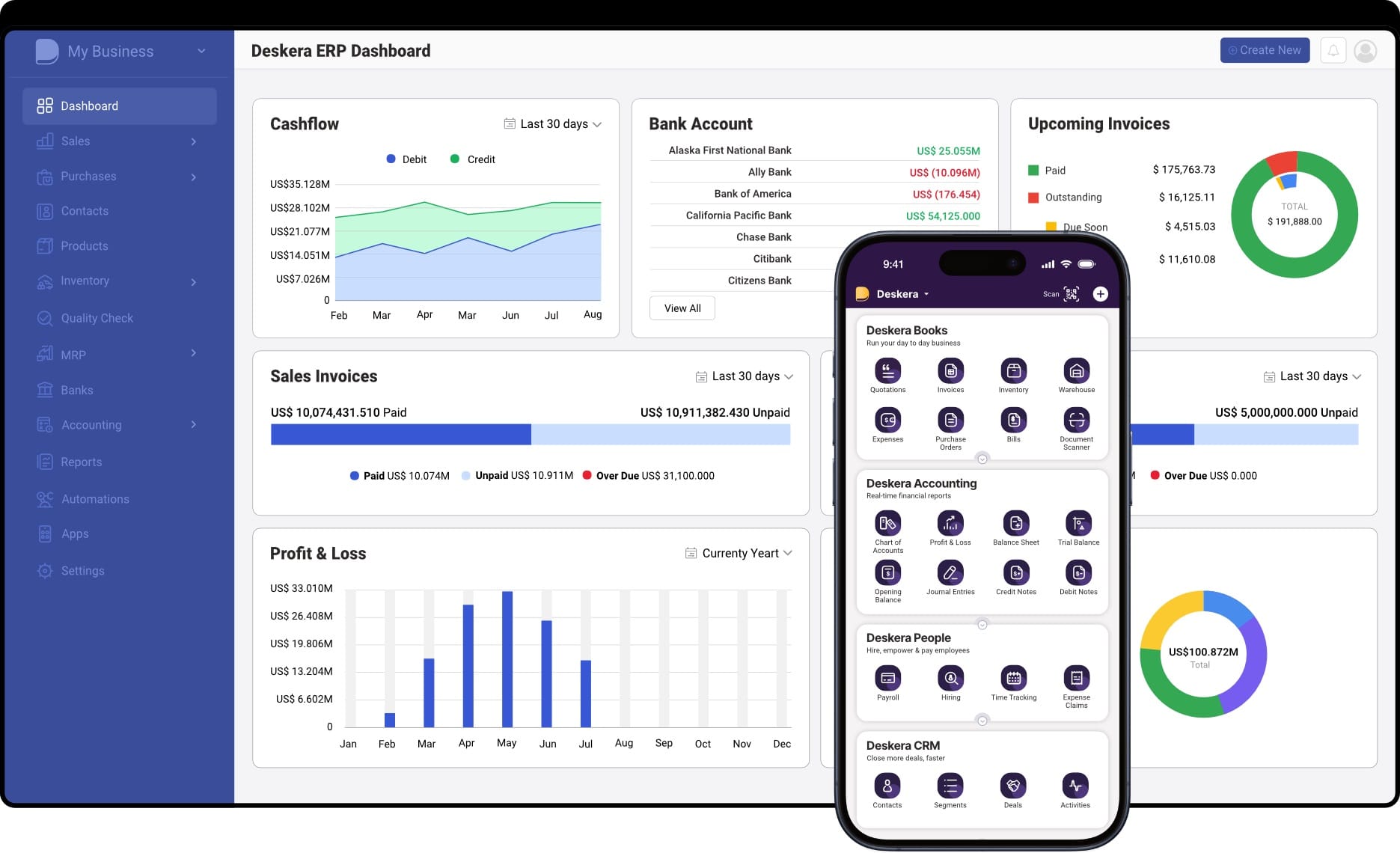
Conducting an accurate cost-benefit analysis requires businesses to collect reliable data, track operational costs, measure performance, and forecast future outcomes. Deskera ERP helps organizations streamline this process by centralizing financial, operational, inventory, procurement, and reporting data into a single integrated platform. This enables businesses to make faster, data-driven, and financially informed decisions.
Centralizes Financial and Operational Data
Deskera ERP integrates accounting, inventory, procurement, warehouse management, CRM, and financial management into one system. Businesses can access real-time operational and financial data from a centralized dashboard, making it easier to gather accurate information for cost-benefit analysis.
Improves Cost Tracking and Visibility
Accurate cost tracking is essential for evaluating project feasibility. Deskera ERP helps businesses monitor direct costs, indirect expenses, inventory carrying costs, procurement spending, labor expenses, and operational overhead in real time. This improved visibility reduces the risk of overlooking hidden costs during analysis.
Enhances Forecasting and Budget Planning
Deskera ERP includes budgeting, forecasting, and financial planning tools that help organizations estimate future costs, revenue growth, and cash flow more accurately. These forecasting capabilities support more reliable cost-benefit analysis by helping businesses evaluate both short-term and long-term financial outcomes.
Provides Real-Time Reporting and Analytics
Real-time dashboards, smart reports, and business intelligence features allow businesses to monitor key financial and operational metrics continuously. Companies can analyze profitability, operational efficiency, production costs, inventory performance, and project expenses more effectively when conducting cost-benefit evaluations.
Supports Inventory and Supply Chain Optimization
Inventory and procurement costs often play a major role in business decision-making. Deskera ERP helps businesses optimize inventory levels, automate replenishment, monitor warehouse performance, and manage procurement processes efficiently. This enables organizations to identify cost-saving opportunities and improve supply chain profitability.
Helps Evaluate Manufacturing Profitability
For manufacturing businesses, Deskera ERP and MRP provide features such as production planning, demand forecasting, yield calculations, finished goods costing, and manufacturing analytics. These capabilities help businesses accurately calculate production costs, analyze profitability, and evaluate operational investments more effectively.
Automates Business Processes
Manual data collection and spreadsheet-based analysis can increase errors and slow decision-making. Deskera ERP automates workflows related to accounting, procurement, inventory management, approvals, reporting, and order processing. Automation improves data accuracy and allows businesses to perform cost-benefit analysis more efficiently.
Improves Decision-Making With Real-Time Insights
Because Deskera ERP provides real-time visibility into business operations, organizations can quickly compare projected costs, expected benefits, and operational performance before making strategic decisions. This helps businesses reduce financial risks, allocate resources more effectively, and prioritize high-value projects.
Supports Scalability and Long-Term Growth
As businesses grow, cost structures and operational complexity also increase. Deskera ERP helps organizations scale efficiently by improving operational control, increasing production efficiency, and reducing costs through integrated business management tools. This makes long-term cost-benefit analysis more accurate and actionable.
Key Takeaways
- Cost-benefit analysis (CBA) helps businesses evaluate whether the expected benefits of a project or investment outweigh its associated costs.
- Understanding cost-benefit analysis is essential for making data-driven, financially informed, and strategic business decisions.
- Key components of CBA include direct costs, indirect costs, intangible costs, opportunity costs, tangible benefits, and long-term value assessment.
- Conducting a cost-benefit analysis involves defining objectives, identifying costs and benefits, assigning monetary values, evaluating risks, and comparing outcomes.
- Financial formulas such as Benefit-Cost Ratio (BCR), Net Present Value (NPV), ROI, and Net Benefit help businesses measure project feasibility and profitability.
- Cost-benefit analysis is widely used in project management, manufacturing, supply chain optimization, technology investments, HR planning, and business expansion decisions.
- The main benefits of cost-benefit analysis include improved decision-making, better resource allocation, risk reduction, operational efficiency, and increased profitability.
- Despite its advantages, CBA has limitations such as forecasting uncertainty, difficulty measuring intangible factors, data dependency, and potential estimation bias.
- Following best practices such as using accurate data, considering long-term impacts, involving stakeholders, and evaluating risks improves the reliability of cost-benefit analysis.
- Businesses should track operational and performance metrics such as revenue growth, cost savings, productivity, efficiency, customer satisfaction, and risk reduction after project implementation.
- Deskera ERP helps businesses perform more accurate cost-benefit analyses through real-time reporting, cost tracking, forecasting, automation, and centralized operational visibility.
Related Articles
 Niti Samani
 Niti Samani
 Niti Samani
 Niti Samani
 Niti Samani
 Niti Samani