
What happens when critical equipment suddenly fails without warning? The answer is often costly downtime, rushed repairs, and operational disruptions—making maintenance strategy one of the most important decisions for any business. Reactive maintenance, often known as the run-to-failure approach, focuses on repairing or replacing equipment only after it breaks down. While this method may seem cost-effective initially, its long-term impact on productivity, expenses, and asset reliability can be significant.
Reactive maintenance remains a widely used strategy, particularly for non-critical or low-cost assets where preventive measures may not justify the investment. Many businesses adopt this approach because it requires minimal upfront planning and lower immediate maintenance costs. However, depending solely on reactive maintenance can lead to unexpected production interruptions, higher emergency repair costs, and increased pressure on maintenance teams. Understanding when and how to use reactive maintenance effectively is essential for balancing cost control with operational efficiency.
For manufacturers and operations leaders, reactive maintenance should not exist in isolation but rather as part of a broader maintenance management strategy. Businesses must evaluate equipment criticality, downtime risks, and repair costs to determine whether reactive maintenance is appropriate. When combined with digital tools, maintenance teams can improve response times, manage spare parts efficiently, and gain better visibility into recurring failures, reducing the negative impact of sudden equipment breakdowns.
Deskera MRP helps businesses strengthen maintenance management by integrating work order management, machine maintenance scheduling, inventory tracking, and production planning into one unified platform. Its real-time monitoring capabilities, automated work orders, spare parts inventory management, and performance tracking enable organizations to reduce downtime, improve maintenance coordination, and optimize overall manufacturing efficiency. By leveraging such tools, companies can transition from purely reactive operations toward more strategic and cost-effective maintenance practices.
What Is Reactive Maintenance?
Reactive maintenance, also known as corrective maintenance or breakdown maintenance, is a maintenance strategy where repairs are only performed after equipment or machinery fails. Rather than scheduling regular inspections or preventive servicing, businesses using reactive maintenance follow a run-to-failure approach—waiting until an asset breaks down before taking corrective action. This strategy is often summarized by the phrase, “If it isn’t broken, don’t fix it.”
The primary goal of reactive maintenance is to minimize upfront maintenance costs by avoiding routine servicing, inspections, or preventive interventions. For organizations managing non-critical, low-cost, or easily replaceable assets, this approach can appear financially practical in the short term. Since maintenance activities occur only when issues arise, businesses may save on labor, planning, and preventive maintenance resources initially.
However, while reactive maintenance can reduce immediate expenses, it often results in unplanned downtime, emergency repairs, production disruptions, and potentially higher long-term costs. Unexpected equipment failures can create operational bottlenecks, increase overtime labor, and shorten equipment lifespan. This makes reactive maintenance less sustainable for critical or high-value assets where reliability and continuous performance are essential.
In modern operations, reactive maintenance is most effective when used selectively as part of a broader maintenance strategy that may also include preventive and predictive maintenance. By carefully evaluating asset importance, repair costs, and downtime risks, businesses can determine where reactive maintenance fits best while avoiding overdependence on emergency repairs.
Reactive Maintenance vs Proactive Maintenance
Choosing between reactive and proactive maintenance is a critical decision that directly impacts equipment reliability, operational costs, and long-term business performance. While reactive maintenance focuses on repairing assets only after failure occurs, proactive maintenance emphasizes preventing breakdowns before they happen through regular monitoring, inspections, and planned interventions.
Reactive maintenance may offer lower upfront costs and simpler execution, but it often leads to unplanned downtime, emergency expenses, and shorter asset lifespans. In contrast, proactive maintenance strategies—such as preventive and predictive maintenance—require greater initial investment but typically improve equipment performance, reduce unexpected failures, and optimize operational efficiency over time.
Ultimately, the best maintenance strategy often involves balancing both approaches. Reactive maintenance may be appropriate for select low-risk assets, while proactive maintenance is essential for protecting critical equipment, reducing long-term costs, and supporting sustainable operational growth.
Types of Reactive Maintenance
Reactive maintenance includes several response-based maintenance approaches, each designed to address equipment issues after problems arise. While all reactive maintenance strategies focus on responding to failures or defects, the urgency, planning level, and operational impact can vary significantly depending on the type.
Breakdown Maintenance
Breakdown maintenance occurs when equipment completely fails and becomes non-operational, requiring repairs or replacement before normal operations can resume. This is one of the most common forms of reactive maintenance and is typically unplanned.
Businesses often use this strategy for non-critical equipment where downtime is manageable, but for essential machinery, breakdown maintenance can lead to costly production interruptions.
Run-to-Failure Maintenance
Run-to-failure (RTF) maintenance is a deliberate reactive strategy where equipment is intentionally allowed to operate until it fails. Unlike unexpected breakdown maintenance, this approach is planned and usually applied to low-cost, non-critical, or easily replaceable assets.
Businesses using run-to-failure maintenance accept the risk of failure in exchange for reduced preventive maintenance costs, making it suitable for assets where replacement is simpler than ongoing servicing.
Corrective Maintenance
Corrective maintenance addresses identified defects or underperforming components before total equipment failure occurs. In this approach, maintenance teams repair specific issues discovered during inspections, routine checks, or unrelated maintenance activities.
Corrective maintenance helps prevent minor issues from escalating into larger breakdowns, offering a more controlled reactive response while still avoiding full preventive maintenance programs.
Emergency Maintenance
Emergency maintenance is the most urgent type of reactive maintenance and is performed when sudden equipment failure threatens safety, production continuity, or property.
These situations demand immediate action and often involve higher repair costs, overtime labor, and expedited parts procurement.
Emergency maintenance typically applies to critical assets where delays could result in severe operational, financial, or safety consequences.
Unplanned Maintenance
Unplanned maintenance refers to unexpected maintenance tasks that arise without prior scheduling. This may include sudden performance issues, partial failures, or early signs of malfunction that require immediate attention.
While not always involving complete breakdowns, unplanned maintenance disrupts regular maintenance schedules and can strain resources if frequent.
Choosing the Right Reactive Maintenance Type
Each reactive maintenance type serves different operational needs based on equipment criticality, cost, and business objectives. While breakdown and emergency maintenance often occur unexpectedly, run-to-failure and corrective maintenance can be strategically integrated into broader maintenance plans. The key is understanding which assets can safely operate under reactive strategies without compromising productivity, safety, or profitability.
Advantages of Reactive Maintenance
Reactive maintenance offers several practical benefits, particularly for organizations managing non-critical assets, limited budgets, or simple operational environments. While it may not be ideal for every scenario, its straightforward nature can make it an effective strategy when applied selectively.
Lower Initial Costs
One of the biggest advantages of reactive maintenance is its low upfront financial commitment. Since maintenance activities are only performed after equipment failure, businesses avoid spending on routine inspections, preventive servicing, and predictive technologies.
This allows organizations to allocate budgets more flexibly toward core operations or growth initiatives. For companies with tight financial resources, this approach can provide immediate cost relief while still ensuring that essential repairs are completed when necessary.
Minimal Planning Requirements
Reactive maintenance significantly reduces the need for detailed planning and scheduling. Organizations do not have to invest time in creating maintenance calendars, forecasting equipment failures, or coordinating regular service intervals.
Maintenance teams can focus only on addressing issues as they arise, simplifying workflows. This makes reactive maintenance especially suitable for smaller businesses or teams with limited resources, where dedicating time to structured maintenance planning may not be practical or necessary.
Simplicity and Ease of Implementation
The reactive maintenance approach is easy to understand and implement, as it follows a simple principle—fix equipment when it breaks. There is no need for complex systems, advanced monitoring tools, or specialized training programs.
This simplicity reduces administrative burden and enables faster decision-making during equipment failures. As a result, businesses can quickly adopt this strategy without significant operational changes, making it particularly appealing for organizations seeking straightforward maintenance processes.
Reduced Routine Operational Interruptions
Since reactive maintenance does not involve scheduled servicing or inspections, businesses can avoid planned downtime associated with preventive maintenance activities. Equipment continues to operate until a failure occurs, allowing uninterrupted production in the short term.
This can be beneficial in environments where stopping operations for routine checks would disrupt workflows or reduce output. By eliminating planned maintenance interruptions, organizations can maintain consistent production levels under stable operating conditions.
Efficient for Non-Critical or Low-Cost Assets
Reactive maintenance is particularly effective for managing non-critical, low-value, or easily replaceable assets. In such cases, the cost of preventive maintenance may exceed the cost of repair or replacement after failure.
By adopting a run-to-failure approach, businesses can optimize resource allocation and avoid unnecessary maintenance efforts. This strategy works well for items like light fixtures, small tools, or auxiliary equipment where failure does not significantly impact overall operations or productivity.
Lower Staffing Demands
Because maintenance activities occur only when equipment fails, reactive maintenance typically requires fewer full-time personnel dedicated to ongoing monitoring and servicing. Organizations can operate with smaller maintenance teams and allocate staff to other critical functions until repairs are needed.
This can help reduce labor costs and improve workforce efficiency, particularly in environments where equipment failures are infrequent or manageable without constant supervision or preventive maintenance efforts.
Greater Operational Flexibility
Reactive maintenance provides organizations with greater flexibility in how they manage resources and respond to equipment issues. Without fixed maintenance schedules, businesses can prioritize repairs based on urgency and operational impact.
This allows teams to adapt quickly to changing production demands or unexpected failures. Such flexibility is valuable in dynamic environments where equipment usage patterns vary, enabling organizations to make maintenance decisions based on real-time needs rather than predetermined plans.
Disadvantages of Reactive Maintenance
While reactive maintenance may offer short-term simplicity and lower upfront costs, relying too heavily on this strategy can create significant operational, financial, and safety challenges over time. For many businesses, the hidden costs of equipment failure often outweigh the initial savings.
Unplanned Downtime and Production Disruptions
One of the most significant disadvantages of reactive maintenance is unexpected equipment failure, which can cause sudden operational stoppages and costly downtime.
Since repairs only begin after a breakdown occurs, businesses may face halted production, delayed deliveries, and service interruptions.
For critical equipment, even short periods of downtime can lead to substantial revenue losses, reduced customer satisfaction, and disruptions across the entire operational workflow.
Higher Long-Term Repair Costs
Although reactive maintenance reduces immediate expenses, it often results in significantly higher long-term costs. Emergency repairs typically involve overtime labor, rush shipping for replacement parts, and premium service fees.
Additionally, equipment failures can cause collateral damage to surrounding components, increasing repair complexity. Over time, repeated breakdowns and urgent interventions can become more expensive than implementing a structured preventive maintenance program.
Difficult Budgeting and Financial Uncertainty
Reactive maintenance creates unpredictable maintenance expenses, making budgeting more challenging for organizations. Because equipment failures occur without warning, businesses cannot accurately forecast repair costs, replacement needs, or downtime-related losses.
Sudden high-cost failures can strain operational budgets and disrupt financial planning. This uncertainty can be especially problematic for organizations with limited capital reserves or strict cost management requirements.
Shortened Equipment Lifespan
Running equipment until failure places excessive stress on machinery, accelerating wear and tear over time. Without regular servicing, minor issues can worsen unnoticed, leading to severe breakdowns that reduce asset longevity.
As a result, businesses may need to replace equipment more frequently, increasing capital expenditures. Reactive maintenance often sacrifices long-term asset performance for short-term cost savings.
Increased Safety Risks
Equipment that is not regularly inspected or maintained may develop hidden faults that pose safety hazards to operators and surrounding personnel.
Sudden failures can result in workplace accidents, equipment-related injuries, or regulatory compliance violations.
For industries managing hazardous machinery or safety-critical systems, overreliance on reactive maintenance can significantly increase operational risk and legal exposure.
Delayed Repairs Due to Spare Parts Shortages
Without proactive inventory planning, organizations may struggle to source necessary replacement parts quickly when failures occur.
Delays in obtaining components can extend downtime significantly, especially for specialized or aging equipment.
Emergency procurement often involves higher costs and supply chain complications, further compounding operational disruptions and financial losses.
Lower Equipment Efficiency and Higher Energy Costs
Poorly maintained equipment often experiences gradual performance degradation before complete failure. This decline can reduce operational efficiency, increase energy consumption, and drive up utility costs.
Machines operating under strain may consume more power, produce inconsistent output, and contribute to higher environmental and operational expenses over time.
Workforce Stress and Overtime Costs
Reactive maintenance often places maintenance teams under high-pressure emergency conditions, requiring after-hours repairs, weekend work, or urgent troubleshooting.
This can lead to employee fatigue, reduced morale, overtime expenses, and lower overall workforce productivity. Frequent emergencies can also strain internal resources and reduce maintenance effectiveness.
Compliance and Legal Risks
For certain industries, neglecting regular maintenance may violate safety regulations, operational standards, or legal compliance requirements. Equipment failures that compromise safety or environmental standards can expose businesses to fines, lawsuits, or reputational damage. Reactive maintenance may not provide sufficient oversight for highly regulated operations.
Ultimately, while reactive maintenance may be practical for select non-critical assets, relying on it too heavily can increase costs, reduce reliability, and expose businesses to greater operational risks. A balanced maintenance strategy often provides greater long-term stability and efficiency.
When Reactive Maintenance Makes Sense
While reactive maintenance is not ideal as a primary strategy for all equipment, there are specific scenarios where it can be a practical, cost-effective, and strategically appropriate approach.
The key is understanding when the risks of failure are low enough that the benefits of reduced maintenance spending outweigh the potential downsides.
Non-Critical Assets
Reactive maintenance is often suitable for equipment that does not significantly impact production, safety, or customer service when it fails. Assets such as office lighting, decorative fixtures, small exhaust fans, or non-essential support equipment can often be repaired or replaced after failure without causing major disruptions. In these cases, preventive maintenance may offer limited financial value compared to a simpler reactive approach.
Low-Cost or Easily Replaceable Equipment
When the cost of routine maintenance exceeds the value of the asset itself, reactive maintenance can be more economical. For inexpensive components like light bulbs, small tools, or basic machinery, it may make more financial sense to replace items only after they fail rather than investing in ongoing maintenance schedules.
Assets With Low Safety Risks
Equipment that does not pose serious safety hazards when it malfunctions may be appropriate for reactive strategies. If a failure is unlikely to cause injury, environmental damage, or regulatory violations, organizations may accept a run-to-failure approach more comfortably. However, safety assessments should always guide this decision.
Redundant Systems
Reactive maintenance can be effective when backup systems or redundant equipment are in place. If one asset can fail without significantly affecting operations because another system can temporarily take over, businesses can afford to delay repairs until breakdown occurs. This minimizes preventive maintenance costs while preserving operational continuity.
Equipment Nearing End of Life
For aging assets that are close to replacement, investing heavily in preventive maintenance may not be financially justified. In such situations, organizations may choose to operate equipment until failure and then replace it entirely, particularly if maintenance would not significantly extend useful life.
Unpredictable Failure Patterns
Some equipment may fail randomly without clear warning signs, making predictive or preventive maintenance less effective. When failure data does not provide reliable maintenance insights, reactive maintenance may become the most practical option. In these cases, organizations may focus on rapid response rather than extensive preventive measures.
Budget-Constrained Operations
For smaller businesses or organizations with limited maintenance budgets, reactive maintenance may serve as an initial strategy when preventive programs are financially difficult to implement. While not always optimal long-term, it can provide operational continuity until more advanced maintenance systems become feasible.
Temporary or Short-Term Operations
In short-term projects, leased equipment, or temporary facilities, reactive maintenance may be more practical than developing full preventive maintenance programs. If the operational lifespan is limited, the investment in proactive maintenance may not deliver sufficient returns.
Reactive maintenance makes the most sense when applied selectively rather than universally. It works best for low-risk, low-value, or easily replaceable assets, while critical equipment generally requires more proactive strategies.
By carefully evaluating asset importance, replacement costs, operational impact, and safety considerations, businesses can determine where reactive maintenance provides the greatest value without compromising efficiency or reliability.
How to Reduce Reactive Maintenance Work Without Overspending
Reducing reactive maintenance does not mean eliminating it entirely or making large investments in expensive systems. Instead, businesses can lower emergency repairs and unexpected breakdowns by strategically improving maintenance planning, workforce efficiency, and asset prioritization through practical, cost-conscious measures.
Prioritize Assets Based on Criticality
Not all equipment requires the same level of maintenance investment. Businesses should identify which assets are most critical to production, safety, and operational continuity, then focus preventive efforts on those high-priority machines.
By targeting maintenance resources where failures would cause the greatest disruption, organizations can reduce costly breakdowns without overspending on low-risk equipment.
Improve Work Order Prioritization
Establishing clear maintenance response protocols helps ensure that critical repairs receive immediate attention while lower-priority issues are handled efficiently.
Structured dispatch rules prevent maintenance teams from being overwhelmed by minor issues and help allocate labor where it delivers the highest operational value.
Maintain Essential Spare Parts Inventory
Keeping commonly used and critical replacement parts readily available can significantly reduce downtime and emergency procurement costs. A well-managed spare parts inventory prevents delays caused by supply shortages while avoiding excessive overstocking. This balanced approach supports faster repairs without unnecessary inventory expenses.
Train Staff to Identify Early Warning Signs
Operators and frontline staff can play an important role in reducing reactive maintenance by recognizing abnormal sounds, performance drops, leaks, or minor defects before they escalate.
Early reporting of issues allows maintenance teams to address small problems before they become costly emergencies, improving efficiency without requiring major new investments.
Standardize Repair Procedures
Developing clear repair processes for common equipment failures can improve response speed, reduce technician errors, and lower labor costs. Standardized maintenance workflows help teams resolve issues faster while ensuring consistency in repairs, particularly for recurring breakdowns.
Track Maintenance Performance Metrics
Monitoring key indicators such as mean time to repair (MTTR), recurring failures, repair costs, and downtime frequency can help organizations identify inefficiencies and recurring problem areas. This data supports smarter resource allocation and helps businesses gradually shift from excessive reactive maintenance toward more balanced maintenance strategies.
Use MRP Systems for Better Maintenance Coordination
An MRP system like Deskera MRP can help businesses reduce reactive maintenance by improving maintenance scheduling, spare parts management, work order tracking, and asset visibility.
By centralizing maintenance operations alongside inventory and production planning, businesses can improve response times, prevent parts shortages, and optimize maintenance spending without unnecessary complexity.
Focus Preventive Maintenance on High-Impact Equipment
Rather than applying preventive maintenance universally, businesses can selectively schedule routine servicing for critical machinery only. This hybrid approach minimizes overspending while significantly lowering the frequency of major breakdowns in essential operations.
Continuously Analyze Failure Patterns
Every reactive maintenance event provides valuable insights. By documenting root causes and recurring failures, businesses can identify problem assets, inefficient processes, or operator issues. This enables targeted improvements that reduce future breakdowns while maintaining cost efficiency.
The goal is not to eliminate reactive maintenance completely but to control it strategically. By combining asset prioritization, workforce training, efficient inventory management, and MRP-driven maintenance coordination, businesses can significantly reduce reactive maintenance workloads while maintaining budget discipline and improving operational reliability.
How Deskera MRP Can Help You Manage Reactive Maintenance
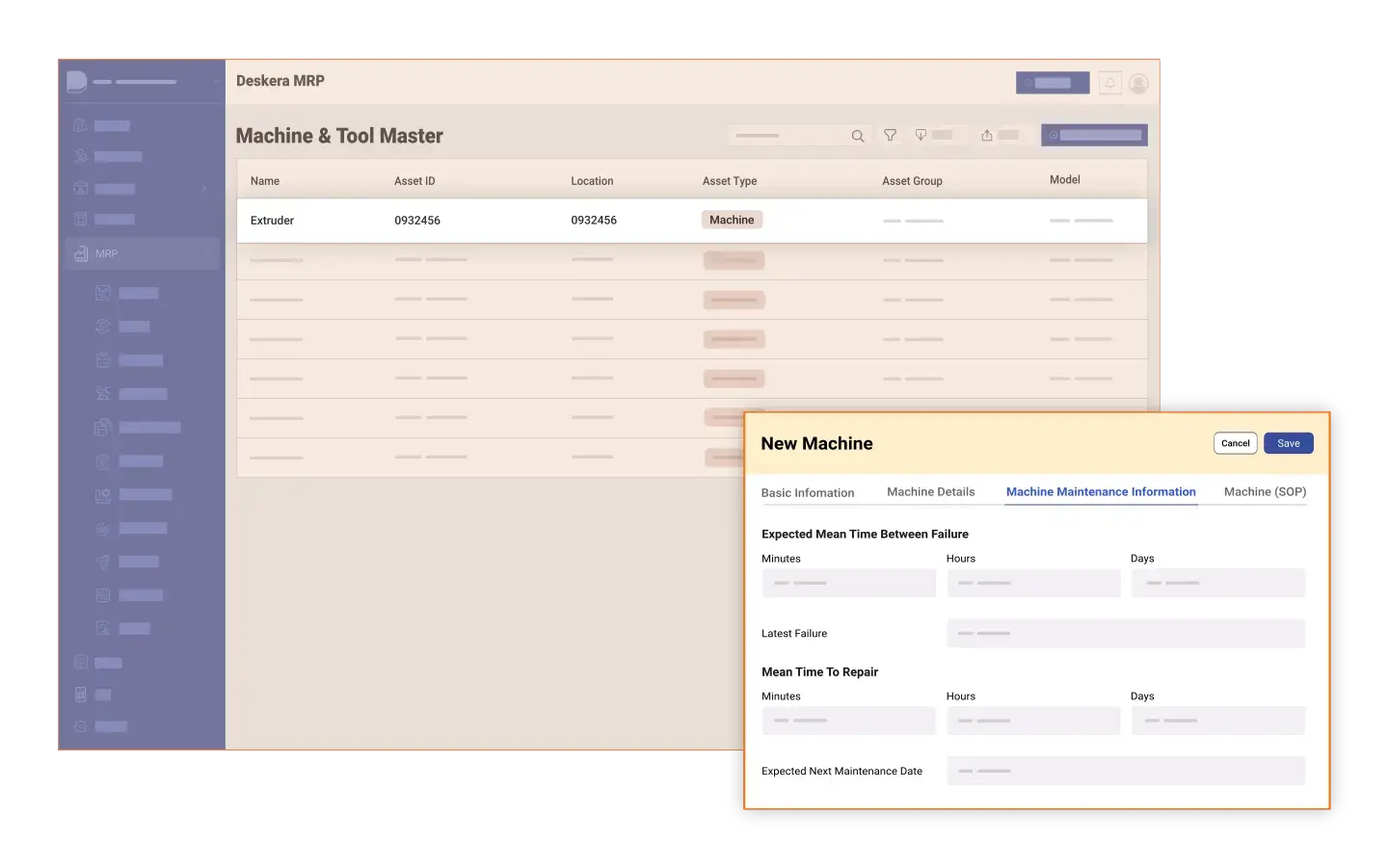
Deskera MRP helps businesses reduce the operational burden of reactive maintenance by improving maintenance coordination, machine visibility, spare parts management, and repair execution within a unified manufacturing system.
Rather than relying solely on emergency responses, Deskera enables organizations to better control breakdowns, minimize downtime, and improve maintenance efficiency.
Deskera’s platform includes machine maintenance scheduling, work order automation, machine breakdown tracking, inventory management, and performance monitoring capabilities that directly support smarter maintenance operations.
Automates Work Order Management
Deskera MRP streamlines maintenance operations by automatically generating, assigning, and tracking work orders for equipment repairs and maintenance tasks. Maintenance teams can monitor task progress, resource allocation, and repair completion in real time, reducing administrative delays and improving response speed when failures occur. This structured approach helps organizations manage reactive maintenance more efficiently while improving accountability across maintenance processes.
Improves Machine Maintenance Scheduling
Deskera allows businesses to establish maintenance schedules based on machine usage, service intervals, and operational requirements. While reactive repairs remain necessary for unexpected failures, scheduled maintenance support helps reduce avoidable breakdowns and balances reactive workloads more effectively. This hybrid maintenance capability strengthens asset reliability while controlling maintenance spending.
Enhances Spare Parts Inventory Control
One of the biggest challenges in reactive maintenance is delayed repairs due to unavailable parts. Deskera MRP helps manage spare parts inventory by tracking stock levels, monitoring consumption, and triggering purchase requisitions or reorder actions when shortages arise. This ensures critical components are available when breakdowns occur, reducing downtime and avoiding costly emergency procurement.
Tracks Machine Performance and Breakdown History
Deskera provides machine monitoring tools that track equipment performance, maintenance history, and breakdown records. By capturing failure patterns and maintenance data, businesses can identify recurring issues, improve repair planning, and make better-informed decisions about asset replacement or maintenance optimization. This visibility supports gradual improvements beyond purely reactive maintenance.
Supports Production and Maintenance Alignment
Deskera integrates maintenance planning with broader production scheduling, inventory management, and resource allocation. This helps organizations schedule repairs with minimal disruption to manufacturing workflows, reducing production losses associated with sudden breakdowns while maintaining operational continuity.
Provides Real-Time Reporting and Cost Visibility
Deskera’s reporting tools allow businesses to monitor maintenance costs, machine efficiency, downtime trends, and resource utilization. These insights help maintenance leaders control budgets, measure maintenance effectiveness, and identify opportunities to reduce excessive reactive maintenance over time.
Key Takeaways
- Reactive maintenance is a run-to-failure strategy where repairs are only performed after equipment breaks down, making it suitable for specific operational scenarios but risky when overused.
- Understanding the different types of reactive maintenance—breakdown, run-to-failure, corrective, emergency, and unplanned maintenance—helps businesses apply the right response strategy based on asset criticality.
- Reactive maintenance offers advantages such as lower upfront costs, minimal planning, operational simplicity, and practicality for low-value or non-critical assets.
- Overreliance on reactive maintenance can lead to major disadvantages, including unplanned downtime, higher long-term costs, safety risks, shorter equipment lifespan, and budgeting uncertainty.
- Comparing reactive maintenance with proactive maintenance highlights that while reactive strategies reduce immediate expenses, proactive approaches generally improve reliability, asset longevity, and long-term efficiency.
- Reactive maintenance makes the most sense for non-critical, low-cost, low-risk, redundant, or end-of-life assets where preventive maintenance costs may outweigh repair or replacement value.
- Businesses can reduce excessive reactive maintenance without overspending by prioritizing critical assets, improving spare parts management, training staff, standardizing repair workflows, and using MRP systems strategically.
- Deskera MRP supports reactive maintenance management by automating work orders, improving maintenance scheduling, optimizing spare parts inventory, tracking machine performance, and enhancing operational visibility.
- A balanced maintenance strategy that combines reactive maintenance with preventive planning often delivers the best results for controlling costs, reducing downtime, and improving overall business performance.
Related Articles
 Niti Samani
 Niti Samani
 Niti Samani
 Niti Samani
 Niti Samani
 Niti Samani