

What happens when a manufacturing company runs out of critical materials in the middle of production or ends up holding excess stock that ties up cash flow? The answer is simple—poor inventory management can disrupt production schedules, increase operational costs, delay customer deliveries, and reduce overall profitability. In today’s highly competitive manufacturing landscape, businesses need effective inventory management strategies to maintain the right balance between supply and demand while ensuring smooth production operations.
Inventory management in manufacturing involves tracking, controlling, and optimizing raw materials, work-in-progress (WIP), finished goods, and maintenance supplies throughout the production cycle. Effective inventory management strategies help manufacturers reduce waste, prevent stockouts, improve warehouse efficiency, and streamline procurement and production planning. With growing market volatility, changing customer demands, and complex global supply chains, manufacturers must adopt modern inventory control techniques to remain agile and cost-efficient.
From Just-in-Time (JIT) inventory and ABC analysis to demand forecasting and safety stock management, manufacturers today rely on a combination of strategic planning and technology-driven solutions to improve inventory accuracy and operational performance. Real-time inventory visibility, automated replenishment, and predictive analytics have become essential for minimizing carrying costs and improving decision-making. Companies that implement strong inventory management practices are better positioned to enhance productivity, optimize cash flow, and deliver products on time.
Deskera ERP helps manufacturers simplify and automate inventory management with powerful cloud-based tools designed for modern production environments. With features such as real-time inventory tracking, warehouse management, automated stock replenishment, demand forecasting, barcode scanning, and integrated procurement and production planning, Deskera ERP enables businesses to gain complete visibility and control over their inventory operations. Its AI-powered insights, mobile accessibility, and advanced reporting capabilities further help manufacturers improve efficiency, reduce inventory-related costs, and support long-term business growth.
What Is Inventory Management in Manufacturing?
Inventory management in manufacturing refers to the process of tracking, controlling, organizing, and optimizing the flow of materials and products throughout the production cycle. It involves managing raw materials, work-in-progress (WIP) inventory, finished goods, and maintenance supplies to ensure the right inventory is available at the right time and in the right quantity. Effective inventory management helps manufacturers maintain smooth production operations while minimizing unnecessary costs and waste.
In manufacturing environments, inventory management plays a critical role in balancing supply and demand. Manufacturers must ensure they have enough raw materials and components to avoid production delays, while also preventing excess inventory that increases storage and carrying costs. Poor inventory control can lead to stockouts, production downtime, delayed deliveries, and reduced customer satisfaction.
Manufacturing inventory is generally divided into four main categories:
- Raw Materials: Components and materials used in the production process
- Work-in-Progress (WIP): Products that are currently being manufactured
- Finished Goods: Completed products ready for sale or distribution
- MRO Inventory: Maintenance, repair, and operations supplies used to support manufacturing equipment and facilities
Modern manufacturing companies use advanced inventory management strategies and digital tools to improve inventory visibility and accuracy. Technologies such as ERP systems, barcode scanning, RFID tracking, AI-driven forecasting, and warehouse automation help businesses monitor stock levels in real time, streamline procurement, and optimize production planning.
Efficient inventory management in manufacturing offers several benefits, including reduced operational costs, improved production efficiency, faster order fulfillment, better cash flow management, and enhanced supply chain performance. By implementing effective inventory management practices, manufacturers can improve productivity, reduce waste, and maintain a competitive advantage in rapidly evolving markets.
What Are Manufacturing Inventory Management Strategies?
Manufacturing inventory management strategies are the methods and approaches manufacturers use to monitor, control, organize, and manage inventory throughout the production process. These strategies help businesses determine how much inventory to keep, when to reorder stock, how inventory should be stored, and how materials move across the manufacturing supply chain.
These strategies apply to different types of inventory, including raw materials, work-in-progress (WIP) inventory, finished goods, and maintenance, repair, and operations (MRO) supplies. Manufacturers use various inventory management techniques depending on production requirements, customer demand, inventory value, supplier lead times, and operational workflows.
Some manufacturing inventory management strategies focus on maintaining minimal inventory levels and ordering stock only when needed, while others prioritize inventory based on importance, usage frequency, or financial value. Certain strategies are designed to improve inventory tracking and warehouse organization, whereas others help manufacturers forecast demand and plan production schedules more accurately.
Modern manufacturing inventory management strategies often involve the use of digital technologies such as ERP systems, barcode scanning, RFID tracking, automation, artificial intelligence (AI), and predictive analytics. These technologies help manufacturers track inventory movement, monitor stock levels in real time, automate replenishment processes, and improve inventory accuracy across warehouses and production facilities.
Why Inventory Management Strategies for Manufacturing Is Important
Effective inventory management strategies are essential for manufacturing companies to maintain smooth production operations, control costs, and meet customer demand efficiently.
Since manufacturing relies heavily on the timely availability of raw materials, components, and finished goods, poor inventory control can quickly lead to production delays, excess stock, and operational inefficiencies.
Strategic inventory management helps manufacturers maintain better visibility, improve coordination across departments, and support long-term business growth.
Reduces Excess Inventory and Carrying Costs
Inventory management strategies help manufacturers maintain optimal stock levels by preventing unnecessary overstocking. Excess inventory increases storage, insurance, handling, and maintenance costs while also tying up valuable working capital.
With better inventory planning and tracking, manufacturers can reduce carrying costs and avoid issues such as product obsolescence, spoilage, or unused materials occupying warehouse space.
Prevents Stockouts and Production Delays
Manufacturing operations depend on the continuous availability of raw materials and components. Effective inventory strategies help businesses monitor inventory levels accurately and replenish stock on time to prevent shortages.
This ensures uninterrupted production workflows, minimizes downtime, and helps manufacturers fulfill customer orders without delays caused by missing materials or inventory shortages.
Improves Production Planning and Scheduling
Inventory management strategies provide manufacturers with better visibility into stock availability, supplier lead times, and production requirements. This allows production managers to plan manufacturing schedules more efficiently and allocate resources effectively.
Accurate inventory data helps reduce scheduling conflicts, improve workflow coordination, and ensure production targets are achieved without unnecessary interruptions.
Enhances Demand Forecasting Accuracy
By analyzing historical inventory data, sales trends, and market demand patterns, manufacturers can forecast future inventory requirements more accurately.
Inventory management strategies support better demand planning by helping companies align purchasing and production decisions with actual customer demand.
This reduces forecasting errors and helps businesses respond more effectively to changing market conditions.
Improves Warehouse Organization and Inventory Visibility
Structured inventory management strategies help manufacturers organize warehouse operations more efficiently and maintain accurate inventory records.
Real-time inventory visibility enables businesses to track inventory movement across storage locations, production floors, and distribution channels.
Better organization reduces inventory discrepancies, improves picking and storage processes, and increases overall operational efficiency.
Supports Better Cash Flow Management
Inventory represents a significant financial investment for manufacturing companies. Effective inventory management strategies help manufacturers avoid unnecessary spending on excess stock while ensuring inventory is available when needed.
Better inventory control improves cash flow by reducing idle inventory costs and allowing businesses to allocate financial resources more efficiently across operations and growth initiatives.
Strengthens Supplier and Supply Chain Coordination
Inventory management strategies improve communication and coordination between manufacturers and suppliers by providing clearer visibility into inventory requirements and procurement schedules.
Better coordination helps manufacturers manage supplier lead times more effectively, reduce procurement delays, and maintain a more reliable supply chain that supports consistent production operations.
Supports Customer Satisfaction and On-Time Delivery
Accurate inventory management helps manufacturers fulfill customer orders on time by ensuring products and materials are readily available when needed.
Efficient inventory control reduces the risk of delayed shipments, backorders, and production bottlenecks that can negatively affect customer experience.
Consistent and timely order fulfillment strengthens customer trust, improves service reliability, and supports long-term customer relationships.
Increases Overall Operational Efficiency
Well-planned inventory management strategies streamline inventory tracking, procurement, storage, and production processes across manufacturing operations.
Improved inventory accuracy and automation reduce manual errors, eliminate inefficiencies, and enhance workflow coordination.
As a result, manufacturers can improve productivity, reduce waste, and operate more efficiently in competitive production environments.
Common Challenges While Implementing Inventory Management Strategies for Manufacturing
Implementing inventory management strategies in manufacturing can be complex due to fluctuating demand, supply chain dependencies, and operational inefficiencies.
Many manufacturers struggle to maintain accurate inventory levels while balancing production requirements, storage costs, and customer expectations.
Without proper systems, processes, and coordination, inventory management challenges can negatively affect productivity, profitability, and supply chain performance.
Demand Forecasting Inaccuracies
One of the biggest challenges manufacturers face is accurately predicting customer demand. Sudden market changes, seasonal fluctuations, and shifting customer preferences can make forecasting difficult.
Inaccurate demand forecasts often result in excess inventory or stock shortages, making it harder for manufacturers to align inventory levels with actual production and sales requirements.
Excess Inventory and Overstocking
Manufacturers often struggle with maintaining the right inventory balance, leading to overstocking of raw materials or finished goods. Excess inventory increases storage and carrying costs while also creating risks of product obsolescence, spoilage, or unused stock. Poor inventory planning and inaccurate purchasing decisions are common causes of overstocking issues.
Stockouts and Material Shortages
Insufficient inventory levels can disrupt manufacturing operations and delay production schedules. Stockouts frequently occur due to poor inventory visibility, inaccurate forecasting, supplier delays, or unexpected spikes in demand. Material shortages can lead to production downtime, missed delivery deadlines, and reduced operational efficiency.
Lack of Real-Time Inventory Visibility
Many manufacturers still rely on manual inventory tracking methods or disconnected systems that limit visibility into inventory movement and stock levels.
Without real-time inventory data, businesses may struggle to monitor inventory accurately across warehouses, production lines, and distribution centers, leading to inventory discrepancies and delayed decision-making.
Supply Chain Disruptions
Manufacturing inventory management heavily depends on supplier reliability and supply chain stability. Delayed shipments, transportation issues, geopolitical events, and raw material shortages can disrupt inventory availability and production schedules. Managing inventory effectively becomes more difficult when supply chain disruptions affect lead times and procurement processes.
Manual Processes and Data Entry Errors
Manual inventory tracking and spreadsheet-based inventory management increase the risk of human errors, duplicate records, and inaccurate stock counts. Errors in inventory data can affect procurement planning, warehouse operations, and production scheduling. Manual processes also reduce operational efficiency and make inventory management more time-consuming.
Inefficient Warehouse Management
Poor warehouse organization can create difficulties in locating, storing, and tracking inventory efficiently. Inefficient storage layouts, improper labeling, and lack of standardized warehouse procedures can slow down inventory movement and increase picking and handling errors. This often affects inventory accuracy and overall operational productivity.
Managing Multiple Inventory Locations
Manufacturers operating across multiple warehouses, production facilities, or distribution centers often face challenges in maintaining synchronized inventory records. Tracking inventory movement across different locations without centralized systems can lead to inconsistencies, duplicate inventory counts, and poor inventory coordination.
Long Supplier Lead Times
Extended supplier lead times make it difficult for manufacturers to maintain optimal inventory levels. Delays in raw material deliveries can disrupt production schedules and increase dependency on safety stock. Manufacturers may struggle to balance inventory availability while avoiding excessive stock accumulation caused by uncertain lead times.
Difficulty Integrating Inventory with Production Planning
Inventory management strategies are closely connected to procurement, warehouse management, and production planning processes. Many manufacturers face challenges integrating inventory systems with production schedules and operational workflows. Poor integration can lead to inaccurate material planning, inefficient resource allocation, and production delays.
Resistance to Technology Adoption
Implementing modern inventory management technologies such as ERP systems, automation tools, barcode scanning, RFID tracking, and AI-based forecasting solutions can be challenging for some manufacturers. Employees may resist process changes, while businesses may face difficulties with system implementation, staff training, and adapting to new technologies.
Maintaining Inventory Accuracy
Inventory accuracy is critical for effective manufacturing operations, yet maintaining accurate stock records remains a major challenge. Inventory discrepancies often occur due to theft, damaged goods, incorrect stock entries, unrecorded inventory movement, or counting errors. Inaccurate inventory data can negatively affect production planning, procurement decisions, and customer order fulfillment.
10 Inventory Management Strategies for Manufacturing in 2026
Manufacturers in 2026 are adopting smarter and more technology-driven inventory management strategies to improve inventory accuracy, reduce waste, and maintain efficient production operations.
With increasing supply chain complexity, changing customer demand, and rising operational costs, manufacturers must use inventory management techniques that provide better visibility, forecasting, and inventory control.
Modern technologies such as AI, automation, cloud ERP systems, and predictive analytics are also playing a major role in helping manufacturers optimize inventory management processes.
1. Just-in-Time (JIT) Inventory Management
Just-in-Time (JIT) inventory management is a lean inventory strategy where manufacturers maintain only the inventory needed for immediate production requirements.
Raw materials and components are ordered and received close to the time they are required in production. This approach minimizes excess inventory and storage requirements while improving inventory flow. JIT works best when manufacturers have accurate demand forecasting and reliable supplier networks.
2. Economic Order Quantity (EOQ)
Economic Order Quantity (EOQ) is a strategy used to determine the optimal quantity of inventory a manufacturer should order at one time. The EOQ model balances ordering costs and inventory holding costs to identify ideal order sizes. Manufacturers with stable and predictable inventory requirements commonly use this method to improve purchasing efficiency and maintain balanced inventory levels.
3. FIFO and LIFO Inventory Management
FIFO (First In, First Out) and LIFO (Last In, First Out) are inventory valuation and usage strategies that determine the sequence in which inventory is consumed or sold. FIFO uses the oldest inventory first, making it suitable for products with expiration dates or limited shelf life. LIFO uses the newest inventory first and is often applied in industries where inventory costs frequently increase over time.
4. Weighted Average Cost (WAC)
Weighted Average Cost (WAC) is an inventory valuation method that calculates the average cost of all inventory items available during a specific period. Instead of assigning costs to individual inventory units, manufacturers use an average cost across all inventory. This strategy helps simplify inventory costing and provides a more stable inventory valuation process when prices fluctuate frequently.
5. ABC Inventory Analysis
ABC inventory analysis categorizes inventory into groups based on value, importance, and usage frequency. “A” items represent high-value inventory requiring strict monitoring, while “B” and “C” items represent moderately important and lower-value inventory. Manufacturers use ABC analysis to prioritize inventory control efforts, purchasing decisions, and stock monitoring based on inventory importance.
6. Demand Forecasting
Demand forecasting involves analyzing historical sales data, market trends, customer behavior, and seasonal patterns to estimate future product demand. Manufacturers use forecasting techniques to plan inventory purchases, production schedules, and stock replenishment activities. In 2026, AI-powered forecasting tools are increasingly being used to improve forecasting accuracy and support real-time inventory planning.
7. Cycle Counting
Cycle counting is a continuous inventory auditing strategy where manufacturers regularly count selected portions of inventory instead of conducting full physical inventory counts at once. Inventory records are compared with physical stock levels to identify discrepancies and improve inventory accuracy. Many manufacturers combine cycle counting with ABC analysis by counting high-value inventory more frequently.
8. Safety Stock Management
Safety stock management involves maintaining a reserve quantity of inventory to protect against unexpected demand spikes, supplier delays, or production disruptions. Safety stock acts as a buffer inventory that helps manufacturers maintain production continuity during uncertain situations. Manufacturers determine safety stock levels based on demand variability, supplier lead times, and inventory consumption patterns.
9. Lean Manufacturing Inventory Strategy
Lean manufacturing inventory management focuses on minimizing waste while improving operational efficiency and inventory flow. This strategy aims to reduce unnecessary inventory movement, excess stock, waiting times, and inefficient production activities. Lean inventory management supports continuous process improvement and helps manufacturers align inventory levels more closely with actual customer demand.
10. Consignment Inventory Management
Consignment inventory management is a strategy where manufacturers place inventory with distributors or retailers while retaining ownership until the products are sold. The consignee stores and sells the inventory, but payment is made to the manufacturer only after sales occur. This model allows manufacturers to maintain product availability in the market while managing inventory ownership differently from traditional inventory arrangements.
Best Practices for Manufacturing Inventory Management
Effective inventory management is essential for maintaining smooth manufacturing operations, reducing unnecessary costs, and ensuring products are available when needed. Manufacturers must balance inventory availability with operational efficiency to avoid both excess stock and material shortages.
By following proven inventory management best practices, manufacturers can improve inventory accuracy, streamline workflows, and strengthen overall supply chain performance.
Set Minimum Inventory Levels and Reorder Points
Manufacturers should establish minimum inventory levels for critical raw materials, components, and finished goods to prevent stock shortages. Reorder points help businesses determine when inventory replenishment should occur based on normal consumption rates and supplier lead times. Maintaining predefined inventory thresholds ensures production continuity while minimizing the risk of emergency purchasing and unexpected stockouts.
Perform Accurate Demand Forecasting
Demand forecasting helps manufacturers predict future inventory requirements using historical sales data, market trends, customer behavior, and seasonal demand patterns. Accurate forecasting improves inventory planning and production scheduling by helping businesses maintain appropriate stock levels. In 2026, many manufacturers are using AI-powered forecasting tools to generate more dynamic and real-time inventory predictions.
Conduct Regular Inventory Audits and Cycle Counts
Regular inventory inspections help manufacturers maintain accurate inventory records and identify discrepancies between physical inventory and system data. Manufacturers can use full physical counts, cycle counting, or spot checks to verify inventory accuracy. Frequent audits improve inventory visibility, support quality control efforts, and help detect issues such as damaged goods, misplaced inventory, or data entry errors.
Improve Cross-Functional Collaboration
Inventory management becomes more effective when departments such as procurement, production, warehouse management, logistics, and sales collaborate closely. Each team contributes valuable insights regarding inventory usage, supplier performance, production requirements, and customer demand. Improved communication and centralized inventory data help manufacturers make more informed inventory decisions and improve operational coordination.
Eliminate Excess and Slow-Moving Inventory
Manufacturers should establish clear processes for identifying and managing excess inventory and slow-moving stock. Inventory that remains unused for extended periods increases storage costs and risks becoming obsolete or unsellable. Businesses can reduce excess inventory through product bundling, discounts, liquidation strategies, or improved forecasting and purchasing practices that better align inventory with demand.
Strengthen Supplier Relationship Management
Maintaining strong supplier relationships helps manufacturers improve inventory reliability and procurement efficiency. Effective supplier relationship management supports better pricing negotiations, consistent delivery schedules, improved communication, and faster issue resolution. Reliable suppliers also help manufacturers reduce lead time uncertainties and maintain smoother inventory replenishment processes.
Replace Outdated Manual Processes
Manual inventory tracking methods and disconnected systems often lead to inventory inaccuracies, delayed updates, and operational inefficiencies. Manufacturers should modernize outdated inventory processes by implementing digital inventory management systems that improve inventory visibility, streamline workflows, and reduce dependency on spreadsheets or paper-based tracking methods.
Automate Inventory Management Processes
Automation improves inventory accuracy and operational efficiency by reducing manual tasks such as stock tracking, data entry, order processing, and inventory updates. Technologies such as barcode scanning, RFID tracking, automated alerts, and ERP systems provide real-time inventory monitoring and faster inventory processing. Automation also supports quicker decision-making and improved inventory control across manufacturing operations.
Implement Lean Manufacturing Principles
Lean manufacturing focuses on reducing waste, improving workflow efficiency, and optimizing resource utilization throughout the production process. Lean inventory management encourages manufacturers to maintain only the inventory necessary for production while eliminating unnecessary storage, movement, waiting times, and overproduction. This approach helps improve inventory flow and operational efficiency.
Develop a Long-Term AI and Technology Strategy
Modern inventory management increasingly relies on AI, predictive analytics, cloud ERP systems, and intelligent automation tools. Manufacturers should develop a long-term technology strategy that aligns inventory management capabilities with business goals and operational requirements. AI-powered systems can support demand forecasting, inventory optimization, procurement planning, and supply chain analysis while helping businesses adapt to changing market conditions.
Monitor Inventory Performance Metrics Regularly
Manufacturers should continuously track key inventory metrics such as inventory turnover, stockout rates, carrying costs, lead times, and order accuracy. Monitoring these KPIs helps businesses identify inefficiencies, measure inventory performance, and make data-driven improvements. Regular performance analysis also supports better decision-making and ongoing inventory optimization efforts.
Focus on Continuous Improvement
Inventory management should be treated as an ongoing process that requires regular evaluation and refinement. Manufacturers should continuously assess inventory processes, identify operational gaps, analyze root causes of inventory issues, and implement corrective actions. A continuous improvement approach helps businesses adapt to changing production needs, market conditions, and supply chain challenges while maintaining efficient inventory operations.
Key Inventory Metrics Manufacturers Should Track
Tracking inventory metrics helps manufacturers measure inventory performance, improve operational efficiency, and make data-driven decisions. These metrics provide valuable insights into inventory movement, stock availability, production efficiency, and supply chain performance. By regularly monitoring inventory KPIs, manufacturers can identify inefficiencies, reduce waste, improve forecasting accuracy, and maintain optimal inventory levels across production and warehouse operations.
Inventory Turnover Ratio
Inventory turnover ratio measures how often inventory is sold or used within a specific period. It helps manufacturers understand how efficiently inventory is moving through production and sales processes. A higher inventory turnover ratio generally indicates efficient inventory management, while a lower ratio may suggest excess inventory or slow-moving stock.
Carrying Cost of Inventory
Carrying cost refers to the total cost of storing and maintaining inventory over time. It includes warehouse storage costs, insurance, labor, handling, depreciation, and inventory obsolescence expenses. Monitoring carrying costs helps manufacturers evaluate how much capital is tied up in inventory and identify opportunities to reduce storage-related expenses.
Stockout Rate
Stockout rate measures how often inventory shortages occur when products or materials are needed. Frequent stockouts can disrupt production schedules and delay customer orders. Tracking stockout rates helps manufacturers assess inventory planning accuracy and identify areas where replenishment processes or forecasting methods need improvement.
Days Sales of Inventory (DSI)
Days Sales of Inventory (DSI) measures the average number of days it takes for a manufacturer to sell or use inventory. This metric helps businesses evaluate inventory efficiency and understand how quickly inventory is converted into revenue. A lower DSI generally indicates faster inventory movement and better inventory utilization.
Order Accuracy Rate
Order accuracy rate measures how accurately customer orders are picked, packed, and delivered without errors. This metric helps manufacturers monitor warehouse efficiency and inventory handling processes. High order accuracy supports better customer satisfaction and reduces issues related to incorrect shipments, returns, and delivery delays.
Fill Rate
Fill rate measures the percentage of customer orders fulfilled immediately from available inventory without delays or backorders. It indicates how effectively manufacturers meet customer demand using current inventory levels. Monitoring fill rate helps businesses evaluate inventory availability and improve order fulfillment performance.
Reorder Point
The reorder point is the inventory level at which manufacturers should place a new order to replenish stock before shortages occur. Tracking reorder points helps businesses maintain sufficient inventory levels while preventing stockouts and excess inventory accumulation. Reorder points are typically based on demand patterns and supplier lead times.
Lead Time
Lead time measures the amount of time required for inventory to move through procurement, production, or delivery processes. This includes supplier lead time, production lead time, and shipping time. Monitoring lead time helps manufacturers improve procurement planning, production scheduling, and inventory replenishment efficiency.
Inventory Accuracy
Inventory accuracy measures how closely recorded inventory levels match actual physical inventory counts. Inaccurate inventory data can lead to stock discrepancies, production delays, and poor purchasing decisions. Manufacturers use inventory accuracy metrics to evaluate the effectiveness of inventory tracking systems and warehouse management processes.
Safety Stock Level
Safety stock level measures the reserve inventory maintained to protect against unexpected demand fluctuations or supply chain disruptions. Tracking safety stock helps manufacturers ensure critical materials remain available during emergencies while avoiding excessive buffer inventory that increases carrying costs.
Backorder Rate
Backorder rate measures the percentage of customer orders that cannot be fulfilled immediately due to insufficient inventory availability. A high backorder rate may indicate poor demand forecasting, inadequate inventory planning, or supplier delays. Monitoring this metric helps manufacturers improve inventory replenishment strategies and customer service performance.
Dead Stock Percentage
Dead stock percentage measures the amount of inventory that remains unused, unsold, or obsolete for extended periods. Tracking dead stock helps manufacturers identify slow-moving inventory and take corrective actions such as liquidation, discounting, or inventory optimization to reduce unnecessary storage costs and inventory waste.
How Deskera ERP Helps with Inventory Management Strategies in Manufacturing
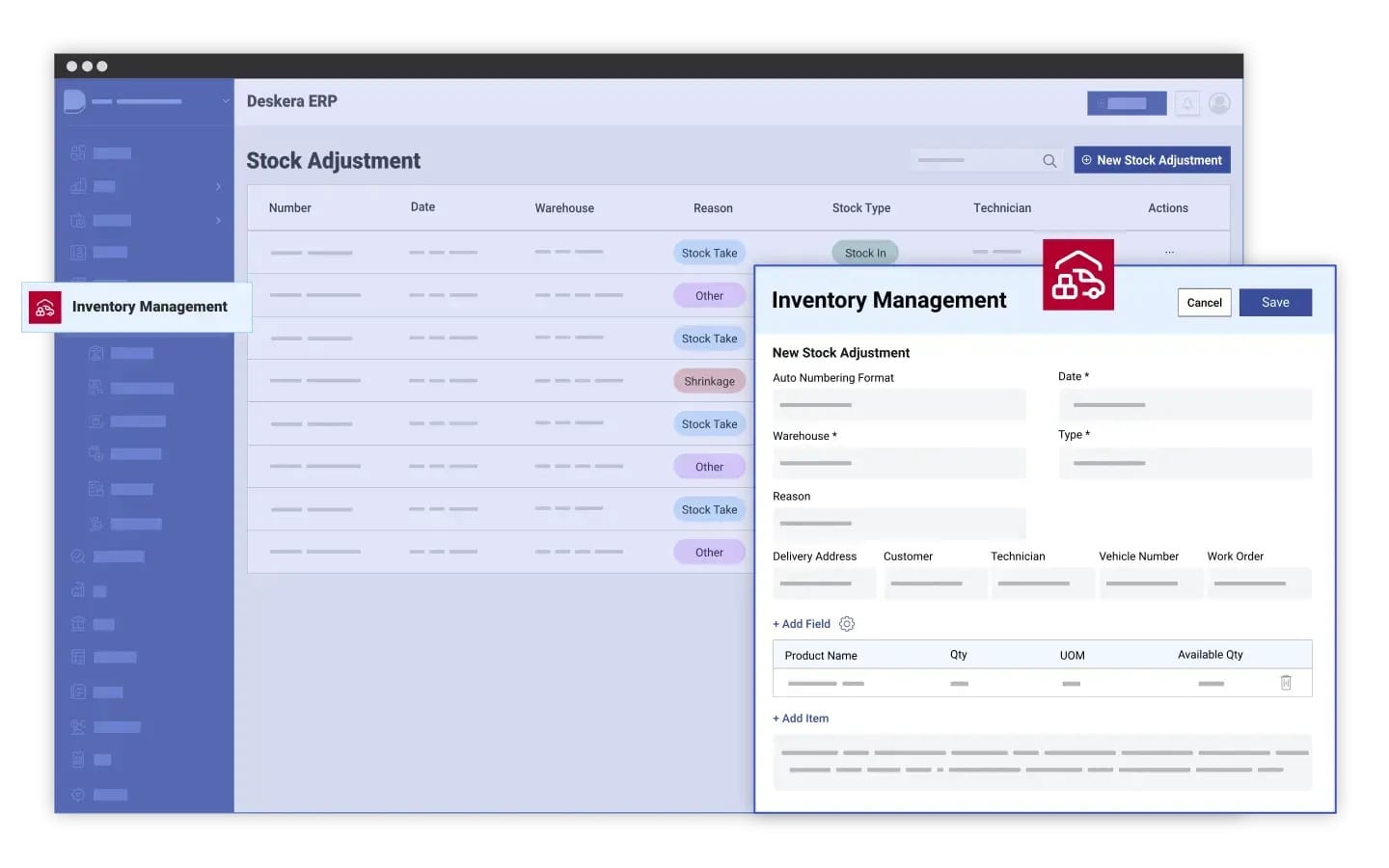
Modern manufacturing businesses require accurate inventory tracking, efficient production planning, and real-time visibility across the supply chain to implement successful inventory management strategies. Deskera ERP provides an integrated cloud-based platform that helps manufacturers automate and optimize inventory management processes while improving operational efficiency and inventory accuracy. Its inventory, warehouse, procurement, and manufacturing capabilities help businesses manage inventory more effectively across production environments.
Real-Time Inventory Tracking and Visibility
Deskera ERP enables manufacturers to track inventory levels and inventory movement in real time across warehouses, production floors, and distribution channels. Real-time visibility helps businesses monitor stock availability, identify shortages quickly, and maintain accurate inventory records. Manufacturers can also generate alerts when inventory reaches critical low levels to support timely replenishment decisions.
Automated Inventory Replenishment
Deskera ERP supports automated inventory replenishment by helping manufacturers monitor stock levels and automate reordering processes. Businesses can establish reorder points and minimum stock thresholds to ensure materials and components are replenished before shortages affect production. Automation reduces manual inventory management tasks and improves inventory planning efficiency.
Demand Forecasting and Production Planning
Demand forecasting features in Deskera ERP help manufacturers anticipate customer demand and align inventory planning with production requirements. Manufacturers can analyze inventory trends, sales forecasts, and production schedules to maintain balanced inventory levels. Integrated production planning tools also help businesses allocate resources, manage manufacturing schedules, and improve material planning accuracy.
Barcode, Lot, Batch, and Serial Tracking
Deskera ERP includes barcode generation and scanning capabilities along with lot, batch, and serial number tracking features. These tools improve inventory accuracy, warehouse organization, and product traceability across manufacturing operations. Manufacturers can track inventory movement more efficiently while supporting quality control, compliance, and product recall management processes.
Multi-Warehouse Inventory Management
Manufacturers operating across multiple storage locations can use Deskera ERP to manage inventory centrally across warehouses and facilities. The platform supports multi-warehouse tracking, stock transfers, warehouse organization, and inventory adjustments. Centralized inventory visibility helps manufacturers maintain synchronized inventory records and improve coordination across locations.
Bill of Materials (BOM) and Material Requirement Planning (MRP)
Deskera ERP supports manufacturing inventory management with Bill of Materials (BOM) and Material Requirement Planning (MRP) capabilities. Manufacturers can manage raw materials, production components, and work-in-progress inventory more effectively while ensuring material availability for production schedules. The system also helps businesses optimize procurement and production workflows.
Cycle Counting and Inventory Auditing
Deskera ERP includes cycle counting and stock adjustment features that help manufacturers maintain inventory accuracy through regular inventory verification processes. Businesses can conduct inventory audits, reconcile discrepancies, and improve inventory record accuracy without disrupting production operations. Automated inventory tracking also reduces errors associated with manual inventory management.
Integrated Procurement and Supply Chain Management
Deskera ERP integrates inventory management with procurement, purchasing, warehouse management, and order fulfillment processes. This integration helps manufacturers improve supplier coordination, monitor purchase orders, manage lead times, and streamline inventory replenishment activities. Centralized data improves decision-making across the supply chain and manufacturing operations.
Advanced Reporting and Analytics
Deskera ERP provides inventory reporting, dashboards, and analytics tools that help manufacturers monitor inventory performance and make data-driven decisions. Businesses can analyze inventory turnover, stock movement, inventory costs, and warehouse performance through real-time reports and business intelligence features. Advanced analytics also support forecasting and operational planning efforts.
Cloud-Based Accessibility and Scalability
As a cloud-based ERP platform, Deskera ERP provides manufacturers with centralized access to inventory and operational data from multiple locations and devices. Cloud accessibility supports remote monitoring, real-time collaboration, and operational scalability as manufacturing businesses grow. Manufacturers can also integrate Deskera ERP with other systems and business processes to improve operational flexibility.
Key Takeaways
- Inventory management in manufacturing involves controlling raw materials, work-in-progress inventory, finished goods, and MRO supplies to maintain smooth production operations.
- Manufacturing inventory management strategies help businesses optimize stock levels, improve inventory visibility, and align inventory planning with production and customer demand.
- Effective inventory management strategies are important for reducing excess inventory, preventing stockouts, improving production planning, and supporting on-time customer deliveries.
- Manufacturers commonly face challenges such as inaccurate forecasting, supply chain disruptions, inventory inaccuracies, manual processes, and inefficient warehouse management while implementing inventory strategies.
- Just-in-Time (JIT) inventory management helps manufacturers maintain minimal inventory levels by ordering stock only when needed for production.
- Economic Order Quantity (EOQ) helps businesses determine the optimal inventory order quantity by balancing ordering costs and holding costs.
- FIFO and LIFO inventory strategies determine the sequence in which inventory is used or sold, depending on product type and inventory costing requirements.
- Weighted Average Cost (WAC) simplifies inventory valuation by calculating the average cost of all inventory items rather than tracking individual unit costs.
- ABC inventory analysis helps manufacturers prioritize inventory management efforts by categorizing stock based on value and importance.
- Demand forecasting enables manufacturers to predict future inventory needs using historical sales data, market trends, and customer demand patterns.
- Cycle counting improves inventory accuracy by regularly verifying portions of physical inventory instead of conducting full inventory counts at once.
- Safety stock management provides a reserve inventory buffer that helps manufacturers handle unexpected demand fluctuations and supply chain disruptions.
- Lean manufacturing inventory strategies focus on reducing waste, improving inventory flow, and increasing operational efficiency throughout production processes.
- Consignment inventory management allows manufacturers to retain ownership of inventory until products are sold by retailers or distributors.
- Setting minimum inventory levels and reorder points helps manufacturers maintain sufficient stock levels while avoiding inventory shortages.
- Regular inventory audits and inspections improve inventory accuracy, identify discrepancies, and support better inventory control processes.
- Cross-functional collaboration between procurement, production, logistics, and warehouse teams improves inventory coordination and operational decision-making.
- Eliminating excess and slow-moving inventory helps manufacturers reduce storage costs, prevent inventory obsolescence, and improve warehouse efficiency.
- Strong supplier relationship management improves procurement reliability, supplier communication, and inventory replenishment processes.
- Automating inventory management processes with ERP systems, barcode scanning, RFID tracking, and AI tools improves inventory visibility and operational efficiency.
- Monitoring inventory metrics such as inventory turnover, stockout rate, carrying cost, fill rate, and lead time helps manufacturers evaluate inventory performance and optimize inventory management processes.
- Deskera ERP helps manufacturers streamline inventory management with features such as real-time inventory tracking, demand forecasting, warehouse management, MRP planning, barcode scanning, and automated replenishment tools.
Related Articles
 Niti Samani
 Niti Samani
 Niti Samani
 Niti Samani
 Niti Samani
 Niti Samani