

Have you ever received payment from a customer before delivering a product or completing a service? If yes, that amount is known as unearned revenue. While it may feel like immediate income, from an accounting perspective, it represents an obligation — not earnings. Until the promised goods or services are delivered, the business owes value to the customer.
Unearned revenue, also called deferred revenue, plays a critical role in maintaining accurate financial records. It ensures that revenue is recognized only when it is actually earned, aligning with core accounting principles. Properly recording unearned revenue prevents overstating profits and helps businesses present a true and fair view of their financial position.
For growing businesses, especially those operating on subscriptions, advance payments, retainers, or milestone-based contracts, tracking unearned revenue becomes even more important. Mismanagement can distort income statements, affect tax reporting, and lead to compliance risks. That’s why understanding how unearned revenue works — from journal entries to financial statement impact — is essential for business owners, finance teams, and decision-makers.
Modern ERP systems like Deskera ERP simplify the management of unearned revenue by automating revenue recognition, tracking advance payments, and generating accurate financial reports in real time. With built-in accounting controls and compliance-ready features, Deskera helps businesses reduce manual errors and stay audit-ready. By integrating finance, invoicing, and reporting in one platform, it ensures your revenue is recognized correctly and consistently.
What Is Unearned Revenue?
Unearned revenue refers to payments a business receives from customers for products or services that have not yet been delivered. It is also commonly known as deferred revenue, advance payment, or prepayment. In simple terms, it is money collected before the company has completed its obligation under a contract.
Under accrual accounting, revenue is recognized when it is earned — not when cash is received. This follows the revenue recognition principle, which ensures that income is recorded in the period in which goods are delivered or services are performed. Because the business still owes something to the customer, the advance payment cannot immediately be treated as income. Instead, it must wait until the obligation is fulfilled.
Until that obligation is met, unearned revenue is recorded as a liability on the balance sheet. It represents a promise to provide value in the future. Once the product is delivered or the service is performed, the liability is reduced and the amount is transferred to the income statement as earned revenue.
Unearned revenue is particularly common in subscription-based and prepaid business models. For example, companies like Netflix collect subscription fees in advance of providing monthly access. Other examples include advance rent payments, prepaid insurance, legal retainers, airline tickets, and annual software subscriptions. Receiving cash upfront can strengthen cash flow and support operations, but it also requires careful tracking to ensure accurate financial reporting and compliance with accounting standards.
Unearned Revenue vs Deferred Revenue vs Accrued Revenue
Understanding the difference between these three terms is essential for accurate financial reporting. While unearned revenue and deferred revenue are often used interchangeably, accrued revenue represents the exact opposite accounting situation.
1. Unearned Revenue
Unearned revenue is money received before a company delivers a product or service. The business has the cash in hand but still owes value to the customer.
For example, if a SaaS company collects ₹12,000 on January 1 for an annual subscription, that entire amount is recorded as unearned revenue on day one. Each month, a portion is recognized as earned revenue as the service is delivered.
Unearned revenue:
- Is recorded as a liability
- Appears under current liabilities (if earned within 12 months)
- Is recognized gradually as performance obligations are fulfilled
- May require refunds if services are not delivered
2. Deferred Revenue
Deferred revenue refers to the same accounting concept as unearned revenue. In practice, the two terms are interchangeable.
Some industries prefer one term over the other:
- Technology and SaaS companies often use “deferred revenue”
- Insurance and financial services commonly use “unearned revenue”
For instance, a company like Salesforce billing quarterly in advance records the payment as deferred revenue and recognizes it month by month as services are delivered.
From an accounting standpoint:
- Both follow GAAP and IFRS revenue recognition standards
- Both are recorded as liabilities
- Both convert to earned revenue over time
The only difference is terminology, not accounting treatment.
3. Accrued Revenue
Accrued revenue is the opposite of unearned/deferred revenue.
It represents revenue that has been earned but not yet received in cash. In this case:
- The service or product has already been delivered
- The customer has not yet paid
- The company records it as an asset (accounts receivable)
For example, if a consulting firm completes a project in March but invoices the client in April, the March income is recorded as accrued revenue.
Key Differences at a Glance
Financial Statement Impact
- Balance Sheet:
- Unearned/Deferred Revenue → Liability
- Accrued Revenue → Asset
- Income Statement:
- Unearned/Deferred Revenue → Appears only when earned
- Accrued Revenue → Recognized immediately when earned
- Cash Flow Statement:
- Unearned/Deferred Revenue → Operating cash inflow when received
- Accrued Revenue → No immediate cash impact
Why Getting This Right Matters
Misclassifying these categories can lead to overstated revenue, distorted profitability, and compliance issues under ASC 606 and IFRS 15. Accurate recognition ensures financial transparency, maintains investor confidence, and prevents audit risks.
In simple terms:
- Unearned/Deferred Revenue = Cash received, work pending
- Accrued Revenue = Work completed, cash pending
Understanding this distinction is fundamental to sound financial management and reliable reporting.
Examples of Unearned Revenue
Unearned revenue appears in many industries, especially where customers pay in advance for future goods or services. Below are some of the most common examples:
1. SaaS Licenses
When customers pay upfront for an annual or multi-year cloud software subscription, the payment is recorded as unearned revenue. For example, a company subscribing to Microsoft for a yearly license pays in advance, but the revenue is recognized gradually over the subscription period.
2. Subscription Plans
Streaming services, online magazines, gym memberships, and mobile plans often collect payments upfront. For instance, Netflix charges subscribers before providing monthly access. If a customer pays for a 12-month subscription in advance, the company records it as unearned revenue and recognizes it month by month.
3. Internet Service Subscriptions
Internet Service Providers (ISPs) frequently receive prepaid fees for broadband plans. The prepaid amount is recorded as unearned revenue and recognized over the service period. If the plan includes usage-based billing or data overage charges, the fixed subscription and variable components must be tracked separately.
4. Installation and Setup Fees
Upfront installation fees—such as fiber optic setup or equipment activation—are often recorded as unearned revenue. If the installation is not considered a separate performance obligation under accounting standards, the fee is recognized over the customer’s contract term rather than immediately.
5. Gift Cards
When a business sells a gift card, it receives cash but has not yet delivered goods or services. Therefore, gift card sales are recorded as unearned revenue and recognized only when the customer redeems the card.
6. Advance Ticket Sales
Event organizers record ticket sales for concerts, sports matches, or conferences as unearned revenue until the event takes place. Once the event occurs, the revenue is recognized.
7. Hotel and Travel Bookings
Advance payments for hotels, airline tickets, or vacation packages are recorded as unearned revenue until the service is provided. For example, airlines like IndiGo recognize ticket revenue when the flight occurs, not when the ticket is purchased.
8. Professional Retainers
Law firms, consultants, and freelancers often receive retainers before beginning work. These advance payments are recorded as unearned revenue and recognized as income once services are performed.
9. Insurance Premiums
When a customer pays a full year’s insurance premium upfront, the insurer records the payment as unearned revenue and recognizes it monthly over the coverage period.
10. Advance Rent Payments
Landlords who collect rent before the rental period begins must record it as unearned revenue. The amount is recognized as income as each rental month passes.
These examples highlight a common theme: whenever payment is received before fulfilling an obligation, it must initially be recorded as a liability and recognized as revenue only when earned.
Types of Unearned Revenue Reporting
Unearned revenue can be reported using two primary accounting approaches: the liability method and the income method. The choice of method determines how advance payments are treated in financial statements and when revenue is recognized. Under most modern accounting frameworks such as GAAP and IFRS, the liability method is the standard practice.
1. Liability Method (Deferred Method)
The liability method — also known as the deferred revenue method — is the most widely accepted and commonly used approach.
Under this method:
- The full advance payment is recorded as a liability when received.
- It appears on the balance sheet under “Unearned Revenue” or “Deferred Revenue.”
- Revenue is recognized gradually as goods or services are delivered.
This approach aligns with the revenue recognition principle, which requires companies to recognize revenue only when performance obligations are satisfied.
Example: If a SaaS company receives $12,000 in January for a one-year subscription, it records the full amount as unearned revenue. Each month, $1,000 is transferred from unearned revenue (liability) to revenue (income statement).
Why it’s preferred:
- Complies with ASC 606 and IFRS 15
- Ensures accurate matching of revenue with service delivery
- Prevents overstated income
- Provides transparency to investors and auditors
This method reflects the economic reality: the company has cash, but it still owes services.
2. Income Method
The income method recognizes revenue immediately when payment is received rather than recording it as a liability.
Under this method:
- The advance payment is recorded directly as revenue.
- No unearned revenue liability is initially created.
- Adjustments may be made later if obligations remain.
This approach is less common and is typically used only when:
- The payment is non-refundable
- There is minimal or no ongoing obligation
- The cost of delivery is insignificant
- Revenue recognition standards allow immediate recognition
For example, if a company receives a non-refundable initiation fee with no significant future obligation, it may recognize the revenue immediately — provided it complies with applicable accounting standards.
Important Note: The income method may not always comply with GAAP or IFRS, especially if performance obligations extend into future periods. Companies must carefully assess whether immediate recognition is appropriate.
Additional Reporting Considerations
Beyond the two primary methods, companies must also consider:
Short-Term vs Long-Term Classification
- Unearned revenue expected to be earned within 12 months → Current Liability
- Amounts extending beyond 12 months → Long-Term Liability
Proper classification affects liquidity ratios and financial analysis.
Industry-Specific Practices
Certain industries commonly deal with deferred revenue reporting:
- SaaS and subscription businesses
- Insurance companies
- Real estate and rental businesses
- Event management and ticketing companies
While terminology may vary (“deferred revenue” vs. “unearned revenue”), the accounting treatment under the liability method remains consistent.
Which Method is Most Appropriate?
In practice, the liability method is the standard and preferred approach because it aligns with accrual accounting principles and regulatory requirements. The income method is rare and should only be applied when revenue recognition standards permit immediate recognition.
Accurate reporting of unearned revenue is critical because improper recognition can:
- Overstate income
- Distort financial ratios
- Create compliance risks
- Mislead stakeholders
For most businesses, especially those with subscriptions or long-term contracts, the liability method ensures financial statements reflect true performance rather than simply cash inflows.
How to Record Unearned Revenue
Recording unearned revenue correctly is essential for maintaining accurate financial statements and complying with accrual accounting principles. Under the revenue recognition principle, revenue must be recognized when it is earned, not when cash is received. Until goods or services are delivered, the advance payment is treated as a liability.
Below is a step-by-step guide to recording unearned revenue.
1. Classify Unearned Revenue Properly
The first step is determining how to classify the payment.
- If the obligation will be fulfilled within 12 months → record as a current liability.
- If the obligation extends beyond 12 months → record as a long-term liability.
On the balance sheet, it typically appears as:
- Unearned Revenue
- Deferred Revenue
- Prepaid Revenue
This classification ensures compliance with accrual accounting standards such as GAAP and IFRS.
2. Record the Initial Journal Entry (When Cash Is Received)
Under the liability method, the company records the advance payment as both:
- An increase in cash (asset)
- An increase in unearned revenue (liability)
Example:
A SaaS company receives $40,000 in advance for annual services on January 1.
Journal Entry:
- Debit: Cash → $40,000
- Credit: Unearned Revenue → $40,000
At this point:
- Cash increases
- A liability is created
- No revenue is recognized yet
3. Estimate Service Delivery and Associated Costs
Before recognizing revenue, businesses should estimate:
- Duration of service
- Monthly or periodic revenue recognition
- Associated service costs
This ensures:
For subscription-based models, revenue is usually recognized evenly over time unless performance obligations vary.
4. Make Adjusting Journal Entries (As Revenue Is Earned)
As goods are delivered or services are performed, the company reduces the liability and recognizes revenue.
Continuing the Example:
If the company earns 20% of the prepaid amount by the end of January:
20% of $40,000 = $8,000
Adjusting Entry:
- Debit: Unearned Revenue → $8,000
- Credit: Service Revenue → $8,000
This:
- Reduces the liability
- Increases earned revenue
- Reflects performance completion
Two journal entries occur in total:
- When cash is received
- When revenue is earned
5. How to Calculate Unearned Revenue
If revenue is recognized evenly, divide the total advance payment by the service period.
Monthly Example:
$5,400 received for 6 months:
5,400÷6=9005,400 ÷ 6 = 9005,400÷6=900
Monthly recognized revenue = $900
Quarterly Example:
$36,000 received for annual services:
36,000÷4=9,00036,000 ÷ 4 = 9,00036,000÷4=9,000
Quarterly recognized revenue = $9,000
This systematic approach ensures revenue is recognized in the correct accounting period.
6. Lifecycle of an Unearned Revenue Transaction
Let’s take a simple $5,000 example:
Step 1: Receive Payment
- Debit Cash → $5,000
- Credit Unearned Revenue → $5,000
The full amount is a liability.
Step 2: Deliver Services
If $2,000 worth of services are completed:
- Debit Unearned Revenue → $2,000
- Credit Revenue → $2,000
The liability decreases, and earned revenue increases.
Step 3: Repeat Until Fully Earned
This process continues until:
- Unearned Revenue = $0
- Full amount is recognized as revenue
7. Compliance and Reporting Requirements
To maintain financial integrity, businesses must:
- Follow accrual accounting principles
- Recognize revenue in the period it is earned
- Comply with GAAP or IFRS
- Match expenses with related revenues
- Maintain proper documentation
For publicly traded companies, compliance with regulatory bodies such as the U.S. Securities and Exchange Commission is mandatory.
Failure to record unearned revenue properly can:
- Overstate income
- Distort profit margins
- Mislead investors
- Create audit risks
Advantages of Unearned Revenue
Unearned revenue is often viewed as a liability from an accounting perspective — but strategically, it can be a powerful advantage. When managed properly, advance payments strengthen cash flow, improve forecasting accuracy, and support long-term growth.
Here are the key advantages businesses gain from unearned revenue.
1. Improves Cash Flow Stability
Cash flow is the lifeblood of any business. Unearned revenue provides cash before services are delivered, which helps:
- Cover operational expenses
- Pay salaries and vendors on time
- Reduce reliance on short-term borrowing
- Cushion against slow sales periods
Receiving payment upfront ensures businesses maintain liquidity even before completing work.
2. Increases Working Capital
Advance payments directly improve working capital by increasing current assets (cash) without immediately increasing expenses.
Instead of taking out loans or using credit lines, businesses can:
- Fund new projects
- Invest in equipment or technology
- Expand marketing efforts
- Support payroll and hiring
In many cases, it is far more cost-effective to receive upfront client payments than to borrow from financial institutions and incur interest.
3. Enhances Financial Forecasting
Unearned revenue represents future earned revenue that is already contracted. This gives finance teams higher visibility into upcoming income.
Benefits include:
- More predictable revenue streams
- Improved budgeting accuracy
- Better long-term financial planning
- Stronger debt and investment decision-making
Companies can use deferred revenue trends to forecast performance with greater confidence.
4. Signals Strong Customer Demand
A growing unearned revenue balance often indicates:
- Strong market demand
- High customer trust
- Subscription renewals
- Long-term contracts
For investors and stakeholders, rising deferred revenue can signal future revenue growth and business stability.
5. Supports Strategic Investment Decisions
Because unearned revenue provides early insight into future performance, leadership teams can make more informed decisions about:
- Entering new markets
- Expanding product lines
- Scaling service operations
- Investing in innovation
It acts as an early indicator of sustainable growth potential.
6. Encourages Better Resource Allocation
Knowing how much revenue must be earned in upcoming periods helps businesses allocate resources efficiently.
For example:
- Hiring based on confirmed service commitments
- Prioritizing fulfillment before new expansion
- Planning production schedules accurately
This reduces the risk of overextending operational capacity.
7. Strengthens Customer Commitment
When customers pay in advance, they are more committed to the relationship. This:
- Improves customer retention
- Reduces cancellation risk
- Encourages long-term engagement
- Increases upsell opportunities
Prepaid contracts often foster stronger client-business relationships.
8. Provides Flexible Payment Options for Clients
Unearned revenue structures such as deposits, milestone payments, or annual prepayments can benefit customers too.
For example:
- Clients can break large projects into manageable installments
- Businesses can offer discounts for annual prepayments
- Payment milestones keep both parties aligned
This flexibility improves customer satisfaction and affordability.
9. Improves Risk Management Awareness
Although unearned revenue represents future obligations, tracking it closely helps businesses:
- Identify revenue concentration risks
- Monitor dependence on key clients
- Plan for fulfillment capacity
- Develop contingency strategies
Awareness of obligations reduces operational and financial surprises.
10. Reduces Dependence on External Financing
Instead of relying on loans regulated by institutions like the U.S. Securities and Exchange Commission (for public markets oversight) or traditional banking channels, businesses can use customer prepayments as an internal funding source.
This:
- Lowers financing costs
- Reduces interest expenses
- Improves financial independence
Impact of Unearned Revenue on Financial Statements
Unearned revenue affects all three primary financial statements — the balance sheet, income statement, and cash flow statement — but in different ways. Because it represents cash received before earning it, its treatment ensures revenue is recognized in the correct accounting period and financial reports remain compliant.
1. Impact on the Balance Sheet
Unearned revenue appears as a liability on the balance sheet because the company owes goods or services to the customer.
When payment is received:
- Cash (Asset) increases
- Unearned Revenue (Liability) increases
In most cases, unearned revenue is classified as a current liability, since the obligation is typically fulfilled within 12 months. However, if the service period extends beyond one year (e.g., multi-year contracts), the portion beyond 12 months is recorded under long-term liabilities.
This classification is important because:
- It affects liquidity ratios like the current ratio
- It shows stakeholders the company’s future obligations
- It maintains the accounting equation: Assets = Liabilities + Equity
2. Impact on the Income Statement
Unearned revenue does not appear on the income statement when cash is first received.
Revenue is recognized only when earned — that is, when the company fulfills its performance obligation. At that point:
- Unearned revenue is reduced
- Earned revenue is recorded on the income statement
Recognizing revenue too early can overstate profitability and violate revenue recognition standards such as ASC 606 and IFRS 15. Proper tracking ensures that income reflects actual performance, not just cash collection.
3. Impact on the Statement of Cash Flows
Unearned revenue improves cash flow immediately.
Since the company receives cash upfront, the amount appears as a positive cash inflow under operating activities. This strengthens short-term liquidity and provides working capital for operations, debt repayment, or growth investments.
However, it is important to remember:
- Strong cash flow does not mean revenue has been earned.
- The company still carries a liability until delivery is completed.
Journal Entry Illustration (Subscription Example)
Assume a SaaS company charges $300 upfront for a 12-month subscription ($25 per month).
Step 1: Initial Payment (January 1)
Debit: Cash $300
Credit: Unearned Revenue $300
This increases assets and liabilities.
Step 2: Monthly Revenue Recognition (End of Each Month)
Debit: Unearned Revenue $25
Credit: Revenue $25
Each month, part of the liability converts into earned revenue.
Financial Analysis Implications
Unearned revenue also influences financial interpretation:
- Liquidity Analysis: A high unearned revenue balance may signal strong customer demand and predictable future income.
- Earnings Quality: Analysts monitor deferred revenue balances to ensure revenue is not being recognized prematurely.
- Ratio Impact: Large deferred revenue balances can affect current ratios and working capital calculations.
Why Proper Classification Matters
Misclassifying unearned revenue as income instead of a liability can:
- Overstate revenue and net profit
- Inflate equity
- Distort financial ratios
- Create audit and compliance risks
In accrual accounting, revenue must match the period in which value is delivered — not when cash is received. Proper tracking of unearned revenue ensures accurate reporting, regulatory compliance, and transparent financial performance.
In simple terms:
- Cash received → Balance sheet impact
- Service delivered → Income statement impact
- Cash inflow → Cash flow statement impact
Understanding this flow is essential for maintaining clean, reliable financial statements.
Best Practices for Managing Unearned Revenue
Effectively managing unearned revenue goes far beyond proper bookkeeping. For finance leaders and FP&A teams, it plays a strategic role in cash flow management, forecasting accuracy, compliance, and customer satisfaction. When managed proactively, unearned revenue becomes a powerful planning tool rather than just a liability on the balance sheet.
Here are the key best practices to follow:
1. Establish a Robust Tracking System
A strong tracking system is the foundation of effective unearned revenue management.
- Clearly differentiate between earned and unearned revenue
- Track performance obligations by contract
- Monitor recognition schedules automatically
- Maintain audit-ready documentation
Using automated accounting or ERP systems reduces manual errors and ensures revenue is recognized in the correct period. Proper tracking keeps financial statements accurate and improves visibility into future revenue streams.
2. Closely Monitor Contracts and Performance Obligations
Every unearned revenue balance is tied to a contractual obligation. Businesses should:
- Review contract terms carefully
- Identify distinct performance obligations
- Set internal timelines for fulfillment
- Ensure operational teams understand delivery requirements
This alignment prevents delays, customer dissatisfaction, and compliance risks.
3. Integrate Unearned Revenue into Financial Forecasting
Unearned revenue is a strong indicator of future revenue recognition. Finance teams should:
- Forecast future earned revenue based on current deferred balances
- Analyze trends in subscription renewals or advance payments
- Use deferred revenue data to predict cash inflows
- Adjust budgets and resource allocation accordingly
Since unearned revenue represents committed future work, it improves the predictability of financial results and strengthens planning accuracy.
4. Collaborate with Sales and Service Teams
Finance cannot manage unearned revenue in isolation. Close collaboration ensures:
- Sales teams understand revenue recognition implications
- Service teams deliver according to contractual timelines
- Renewals and upgrades are properly recorded
- Operational capacity matches financial projections
When sales promises align with service delivery and accounting policies, companies reduce revenue recognition risks.
5. Provide Clear Communication to Customers
Transparent communication improves trust and reduces disputes.
- Set clear timelines for service delivery
- Provide regular updates on fulfillment progress
- Clarify refund and cancellation policies
- Ensure billing terms are clearly documented
When customers understand what they are paying for and when they will receive it, satisfaction improves and refund risks decrease.
6. Review Revenue Recognition Policies Regularly
Revenue recognition standards evolve, and businesses must stay compliant with frameworks such as GAAP and IFRS.
Best practices include:
- Periodic internal audits
- Reviewing revenue recognition policies
- Ensuring alignment with accrual accounting principles
- Monitoring regulatory updates from bodies such as the U.S. Securities and Exchange Commission
Strong internal controls reduce audit findings and financial misstatements.
7. Align Unearned Revenue with Broader Financial Goals
Unearned revenue should support long-term business strategy.
- Use deferred revenue insights to guide investment decisions
- Align cash flow planning with growth objectives
- Evaluate customer lifetime value based on prepaid contracts
- Assess churn risks based on deferred revenue movement
When integrated into financial strategy, unearned revenue becomes a leading indicator of business health and sustainability.
8. Leverage Data for Strategic Customer Engagement
Unearned revenue data can reveal growth opportunities:
- Identify upselling or cross-selling opportunities
- Monitor renewal cycles
- Evaluate customer retention rates
- Enhance service delivery based on contract commitments
This transforms unearned revenue from a passive liability into an active growth driver.
9. Maintain Strong Internal Controls
Implement procedures to:
- Approve contract modifications
- Review revenue schedules monthly
- Segregate duties between billing and accounting
- Conduct regular reconciliations
Strong governance ensures accuracy and prevents overstatement of income.
Strategically managing unearned revenue is not just about compliance — it’s about clarity, predictability, and growth. When properly tracked, forecasted, and aligned with operational execution, unearned revenue becomes a valuable financial insight tool.
Handled correctly, unearned revenue shifts from being “just a liability” to becoming a forward-looking indicator of future performance and business momentum.
How Deskera ERP Helps You Manage Unearned Revenue
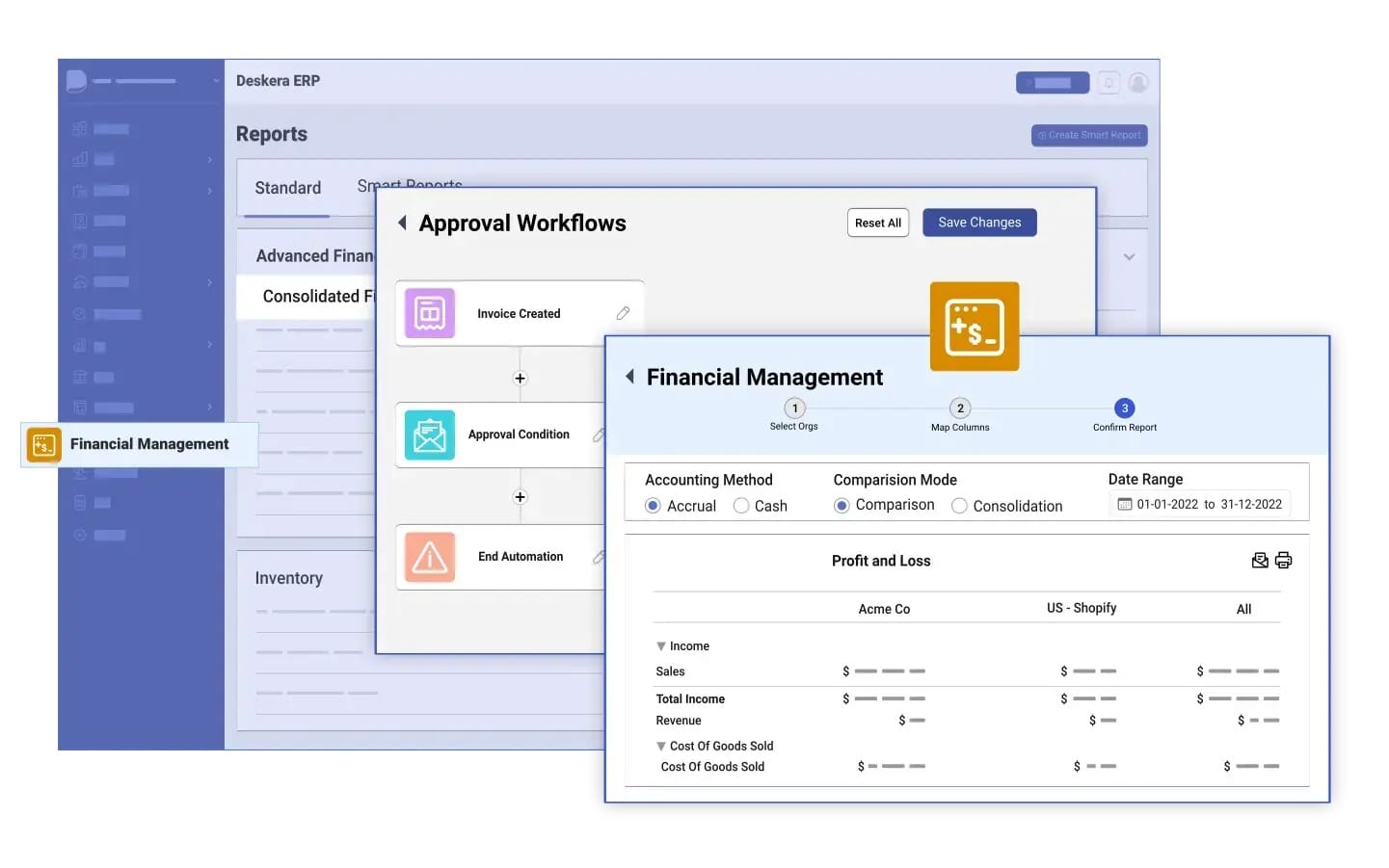
Managing unearned revenue requires accuracy, compliance, and strong financial visibility. Deskera ERP simplifies this process by providing core accounting and revenue recognition capabilities that help businesses track and convert deferred revenue efficiently.
Here’s how Deskera ERP supports unearned revenue management:
1. Automated Revenue Recognition
Deskera ERP allows businesses to define revenue recognition rules and automate journal entries accordingly.
- Record advance payments as unearned (deferred) revenue
- Automatically recognize revenue over time based on defined schedules
- Reduce manual journal entries and errors
- Ensure revenue is recognized when earned, not when cash is received
This helps businesses comply with accrual accounting principles and revenue recognition standards.
2. Accurate Financial Reporting
Deskera ensures unearned revenue is reflected correctly in financial statements:
- Balance Sheet: Displays unearned revenue under liabilities until it is earned
- Income Statement: Recognizes revenue only after performance obligations are fulfilled
- Cash Flow Statement: Records cash inflows from advance payments
This structured reporting prevents overstated income and improves financial transparency.
3. Centralized Ledger and Journal Management
Deskera’s accounting module enables businesses to:
- Record journal entries for advance payments
- Track deferred and earned revenue through the general ledger
- Manage multi-currency transactions (if applicable)
- Maintain clean, organized financial records
Centralized financial management ensures easier reconciliation and reporting.
4. Real-Time Financial Visibility
With built-in dashboards and reporting tools, Deskera provides visibility into:
- Current unearned revenue balances
- Revenue recognition progress
- Financial summaries and statements
- Audit-ready reports
This real-time access allows finance teams to make informed decisions and monitor obligations effectively.
5. Integration with Sales and Billing
Because Deskera integrates accounting with invoicing and sales functions:
- Advance payments recorded through billing automatically reflect in accounting
- Sales transactions connect directly to revenue entries
- Financial records update without manual duplication
This integration reduces errors and ensures consistency between operational and financial data.
Key Takeaways
- Unearned revenue represents advance payments received before delivering goods or services, and it must be recorded as a liability until earned under accrual accounting principles.
- From subscriptions and SaaS contracts to rent, retainers, and ticket sales, unearned revenue commonly appears in businesses that collect payments upfront for future performance obligations.
- The liability method is the standard and compliant approach for reporting unearned revenue, while the income method is rarely used and only appropriate in limited scenarios where no future obligations exist.
- Unearned revenue is recorded by debiting cash and crediting a liability account when payment is received, then gradually recognizing revenue through adjusting entries as services are delivered.
- Effective management requires strong tracking systems, cross-team collaboration, accurate forecasting, contract monitoring, and compliance with accounting standards.
- Although classified as a liability, unearned revenue strengthens cash flow, improves working capital, enhances forecasting accuracy, and signals future business stability.
- Deskera ERP streamlines deferred revenue management through automated revenue recognition, accurate financial reporting, integrated billing, and real-time financial visibility.
- Unearned revenue is more than an accounting entry — when recorded accurately and managed strategically, it becomes a powerful tool for financial stability, forecasting precision, and long-term business growth.
Related Articles
 Deskera
 Deskera
 Niti Samani
 Niti Samani
 Niti Samani
 Deskera Content Team