


Customer churn is no longer just a metric tracked by customer success teams—it is a direct reflection of how well an organization delivers on its promises. In an increasingly competitive market, customers have little tolerance for delayed responses, inconsistent service, or operational inefficiencies. Even a single poor experience can push customers toward alternatives, making retention a critical priority for businesses aiming for sustainable growth.
The financial impact of churn is significant, especially when it could have been prevented. Studies show that avoidable customer churn drains U.S. businesses of nearly $136 billion every year, largely due to issues such as slow order fulfillment, billing errors, lack of visibility, and disconnected internal systems. These are not customer-facing problems alone—they are operational breakdowns that quietly erode trust and loyalty over time.
This is where ERP systems play a pivotal role. By integrating sales, inventory, finance, customer data, and operations into a single platform, ERP systems eliminate silos that often cause service delays and miscommunication. With real-time data access and automated workflows, businesses can respond faster, fulfill orders more accurately, and proactively address issues before they escalate into customer dissatisfaction.
Modern ERP solutions like Deskera ERP take this a step further by combining real-time operational visibility with intelligent automation and actionable insights. Deskera centralizes customer, order, inventory, and financial data, enabling teams to collaborate seamlessly and deliver consistent experiences across touchpoints. By streamlining processes and improving responsiveness, Deskera ERP helps businesses move from reactive problem-solving to proactive customer retention—reducing churn while strengthening long-term customer relationships.
What Is Customer Churn?
Customer churn refers to the percentage of customers who stop doing business with a company over a specific period of time. It measures how many customers discontinue using a product or service, cancel subscriptions, or fail to make repeat purchases.
In simple terms, churn indicates customer loss. A high churn rate suggests that customers are dissatisfied, finding better alternatives, or experiencing issues such as poor service, inconsistent experiences, or unmet expectations. Conversely, a low churn rate signals strong customer satisfaction and customer loyalty.
Customer churn is commonly tracked as a key performance indicator (KPI) because it directly affects revenue, profitability, and long-term growth. Retaining existing customers is typically more cost-effective than acquiring new ones, which is why understanding and reducing churn is a strategic priority for most businesses.
The Business Impact of Customer Churn
Customer churn has far-reaching consequences that go well beyond the immediate loss of revenue. When customers leave, businesses not only forfeit future income but also incur higher acquisition costs, operational inefficiencies, and weakened market positioning. Over time, persistent churn can slow growth, strain resources, and undermine long-term profitability.
Revenue Loss and Reduced Customer Lifetime Value
Every customer who churns represents lost recurring revenue and a decline in overall customer lifetime value (CLV). High churn rates make revenue streams unpredictable and limit a company’s ability to scale sustainably, especially in subscription-based or repeat-purchase business models.
Increased Customer Acquisition Costs
Replacing lost customers is significantly more expensive than retaining existing ones. High churn forces businesses to spend more on marketing, sales, and promotions, diverting resources that could otherwise be invested in product improvements or customer experience initiatives.
Operational Inefficiencies and Resource Strain
Frequent customer turnover often points to internal inefficiencies such as poor coordination between teams, delayed service responses, or inaccurate data. These issues increase rework, support overheads, and internal friction, further impacting operational performance.
Damage to Brand Reputation and Customer Trust
Churned customers are more likely to share negative experiences, which can harm brand perception and influence potential buyers. Over time, declining trust and weaker brand loyalty make it harder for businesses to differentiate themselves in competitive markets.
Slower Growth and Reduced Competitive Advantage
Sustained churn limits a company’s ability to build long-term customer relationships and generate predictable growth. Businesses with high churn often struggle to gain strategic insights from customer data, reducing their ability to innovate and stay ahead of competitors.
Why Disconnected Systems Increase Customer Churn
Disconnected systems create internal inefficiencies that customers eventually feel through delayed responses, inconsistent experiences, and unresolved issues. When sales, support, finance, and operations operate in silos, businesses struggle to deliver the speed, accuracy, and personalization that modern customers expect—making churn more likely.
Lack of a Unified Customer View
When customer data is scattered across multiple systems, teams lack a complete and accurate understanding of customer history, preferences, and interactions. This results in repetitive conversations, missed context, and impersonal engagement, all of which frustrate customers and weaken trust.
Delayed Issue Resolution
Siloed systems slow down access to critical information needed to resolve customer issues. Support teams may need to rely on multiple departments for updates, leading to longer resolution times and increased customer dissatisfaction.
Inconsistent Customer Experiences Across Touchpoints
Without integrated systems, customers often receive conflicting information from sales, support, and billing teams. These inconsistencies create confusion and erode confidence in the business, increasing the likelihood of churn.
Order, Inventory, and Billing Errors
Disconnected inventory, order management, and finance systems increase the risk of stock inaccuracies, delayed deliveries, and invoicing mistakes. Such operational errors directly impact customer satisfaction and can quickly push customers to seek more reliable alternatives.
Limited Ability to Act Proactively
When data is fragmented, businesses struggle to identify early warning signs of churn, such as declining order frequency or repeated service issues. This lack of visibility prevents proactive engagement and timely corrective actions, allowing small problems to escalate into customer loss.
How ERP Systems Help Reduce Customer Churn
ERP systems play a critical role in reducing customer churn by addressing the operational and informational gaps that often lead to poor customer experiences.
By integrating data, automating workflows, and enabling cross-functional alignment, ERP systems help businesses move from reactive customer management to proactive, insight-driven retention strategies.
Breaking Down Data Silos With Unified Systems
Unified ERP and CRM systems eliminate data fragmentation by ensuring customer information, order history, payments, inventory, and interactions flow seamlessly across departments.
With every team accessing the same real-time data, businesses avoid miscommunication, duplication of effort, and inconsistent customer responses—key contributors to churn.
Delivering Real-Time Customer Insights Across Departments
ERP systems align sales, operations, inventory, and finance teams around shared customer intelligence. When sales teams understand inventory availability and operations teams have visibility into customer demand forecasts, decisions become proactive rather than reactive. This alignment enables timely responses and more personalized customer interactions.
Streamlining Operations Through Automation and Efficiency
Automation between ERP and CRM modules minimizes manual tasks such as data entry, invoicing, reporting, and order processing. By reducing errors and speeding up workflows from order placement to after-sales support, ERP systems improve service reliability and overall customer satisfaction.
Enabling a 360-Degree Customer View for Personalization
ERP systems provide a holistic view of each customer’s journey, including purchase history, preferences, feedback, and communication records. This 360-degree visibility enables data-driven personalization, allowing businesses to tailor recommendations, offers, and support interactions—strengthening engagement and loyalty.
Improving Response Time and Service Delivery
With all customer-related data available on a single platform, service teams can resolve inquiries faster without transferring customers between departments. Immediate access to product availability, shipment status, and billing records leads to quicker resolutions and a smoother customer experience.
Supporting Rapid Fulfillment and Real-Time Order Tracking
Modern customers expect fast and transparent delivery, with two- to three-day shipping increasingly becoming the norm. By integrating sales, inventory, and shipping data, ERP systems help businesses avoid delays, prevent stockouts, and provide accurate delivery updates—protecting customer trust throughout the fulfillment cycle.
Strengthening Inventory Control to Prevent Lost Sales
Stockouts represent both lost revenue and lost customers. ERP systems offer real-time visibility into inventory across multiple locations, enabling teams to confirm availability, anticipate replenishment timelines, and suggest suitable alternatives—reducing the likelihood of customers turning to competitors.
Streamlining Returns and Post-Sales Support
ERP systems simplify returns and after-sales service by tracking products, warranties, service agreements, and order histories within a single system. This enables faster processing, clear status updates, and consistent fulfillment of service-level agreements, improving post-purchase satisfaction.
Enhancing Internal Coordination and Collaboration
ERP software ensures that sales, customer service, logistics, and finance teams work from the same data. Shared visibility into pricing, delivery timelines, and customer commitments reduces misalignment and ensures customers receive consistent and accurate information at every touchpoint.
Enabling Smarter Decisions Through Analytics and Predictive Insights
Unified ERP data supports advanced analytics and AI-driven insights that help identify behavioral patterns, unmet needs, service bottlenecks, and early signs of churn. These insights empower businesses to take corrective action early, improve offerings, and continuously refine the customer experience.
Empowering Customer Self-Service
Many modern ERP systems support self-service portals that allow customers to view order history, track shipments, access invoices, and initiate support requests independently. These capabilities enhance convenience, reduce inquiry volumes, and give customers greater control—factors that increasingly influence retention.
Improving Employee Satisfaction to Enhance Customer Experiences
ERP systems reduce employee workload by automating repetitive tasks and centralizing information. When employees are less burdened by manual processes and confusion, they are better equipped to deliver positive, consistent customer interactions—directly influencing retention outcomes.
Role of Automation in Enhancing Customer Retention
Automation plays a crucial role in strengthening customer retention by reducing delays, minimizing errors, and ensuring consistent service delivery. When routine processes are automated through ERP systems, teams can focus more on customer engagement and problem-solving—creating smoother experiences that encourage long-term loyalty.
Faster and Error-Free Order Processing
Automated order workflows ensure that customer orders move seamlessly from sales to fulfillment without manual intervention. This reduces processing errors, shortens turnaround times, and ensures customers receive their products as promised, building reliability and trust.
Automated Invoicing and Billing Accuracy
ERP-driven automation eliminates manual invoicing and billing discrepancies by generating accurate invoices based on real-time order and pricing data. Consistent and transparent billing reduces disputes, improves payment experiences, and strengthens customer confidence.
Proactive Customer Communication
Automation enables timely notifications for order confirmations, shipping updates, delivery statuses, and payment reminders. Keeping customers informed at every stage reduces uncertainty, improves transparency, and enhances overall satisfaction.
Faster Issue Escalation and Resolution
Automated workflows route customer issues to the right teams based on predefined rules and priorities. This ensures faster escalation, quicker resolution, and fewer handoffs—preventing minor issues from turning into churn triggers.
Improved Service Consistency Across Touchpoints
Standardized, automated processes ensure that customers receive the same level of service regardless of channel or department. This consistency reduces frustration, reinforces brand reliability, and improves long-term retention.
Reduced Employee Workload and Better Customer Interactions
By automating repetitive administrative tasks, ERP systems free up employees to focus on high-value, customer-facing activities. Happier, more productive employees are better positioned to deliver positive experiences that keep customers coming back.
How ERP Systems Enable Personalized Customer Experiences
Personalization has become a key differentiator in customer retention, and ERP systems provide the data foundation required to deliver it at scale. By unifying customer, order, and operational data, ERP platforms enable businesses to understand individual customer needs and tailor interactions consistently across the customer lifecycle.
Centralized Customer Profiles for Deeper Understanding
ERP systems consolidate customer data such as purchase history, order frequency, pricing agreements, preferences, and communication records into a single profile. This unified view helps teams understand each customer’s behavior and expectations, enabling more relevant and meaningful interactions.
Data-Driven Recommendations and Offers
With access to historical order data and buying patterns, ERP systems support personalized product recommendations, replenishment suggestions, and targeted offers. These data-driven interactions demonstrate attentiveness to customer needs and increase engagement and repeat purchases.
Consistent Personalization Across Touchpoints
ERP integration ensures that sales, customer service, finance, and operations teams work from the same customer intelligence. As a result, customers receive consistent, personalized experiences whether they are placing an order, raising a support request, or discussing billing—strengthening trust and loyalty.
Tailored Service and Support Interactions
Customer service teams can use ERP insights such as past issues, service history, warranties, and service-level agreements to tailor responses and resolutions. This context-aware support reduces friction and makes customers feel valued rather than treated as generic cases.
Personalized Communication and Engagement Timing
ERP systems help businesses determine the right time and channel to engage customers based on transaction history, order cycles, and behavior trends. Timely, relevant communication improves responsiveness and reinforces long-term relationships.
Continuous Personalization Through Analytics and Insights
ERP analytics enable businesses to track customer behavior over time and refine personalization strategies continuously. By identifying changing preferences and emerging needs, companies can adapt their offerings and interactions—reducing churn and strengthening customer loyalty.
Measuring the Impact of ERP on Customer Churn
Implementing an ERP system is a strategic investment, and its success in reducing customer churn must be measured through clear, data-driven metrics. ERP platforms provide the visibility and analytical tools needed to track customer behavior, evaluate service performance, and continuously improve retention outcomes.
Tracking Customer Churn Rate and Retention Metrics
ERP systems enable businesses to monitor churn rate, customer retention rate, repeat purchase frequency, and renewal patterns using centralized customer and transaction data. These metrics help organizations identify trends and assess whether retention efforts are delivering measurable results.
Analyzing Customer Lifetime Value (CLV)
By consolidating sales, billing, and service data, ERP systems make it easier to calculate and track customer lifetime value. Improvements in CLV over time indicate stronger customer relationships and reduced churn driven by better experiences and operational consistency.
Monitoring Service and Fulfillment Performance
ERP dashboards allow businesses to measure key service-related indicators such as order accuracy, delivery timelines, response times, and issue resolution rates. Consistent improvements in these operational metrics often correlate directly with lower churn levels.
Identifying At-Risk Customers Using Behavioral Data
ERP systems provide insights into behavioral signals such as declining order frequency, delayed payments, repeated complaints, or increased returns. Identifying these early warning signs enables proactive engagement before customers decide to leave.
Evaluating the Impact of Automation and Process Improvements
ERP analytics help assess how automation in invoicing, order processing, inventory management, and support workflows impacts customer satisfaction. Reduced errors, faster turnaround times, and fewer escalations are strong indicators of improved retention.
Using Dashboards and Reports for Continuous Improvement
Real-time ERP dashboards and customizable reports give leadership teams ongoing visibility into customer-centric KPIs. This continuous monitoring supports data-driven decision-making and helps refine strategies to sustain long-term reductions in customer churn.
Key Considerations When Using ERP for Customer Retention
While ERP systems offer powerful capabilities to reduce customer churn, their effectiveness in driving customer retention depends on how thoughtfully they are implemented and used. To maximize impact, businesses must align ERP adoption with customer-centric goals, processes, and people.
Data Accuracy and Consistency Across Systems
Customer retention strategies rely heavily on accurate data. Incomplete, outdated, or inconsistent information can lead to poor decisions and negative customer experiences. Ensuring data quality and standardized data entry across departments is essential for reliable insights and personalization.
Integration With CRM and Customer-Facing Tools
ERP systems deliver the greatest retention value when seamlessly integrated with CRM platforms and customer engagement tools. This integration ensures a unified customer view, smoother workflows, and consistent experiences across sales, service, and support interactions.
User Adoption and Employee Training
Even the most advanced ERP system cannot improve retention if employees do not use it effectively. Ongoing training, role-based access, and intuitive workflows help teams leverage ERP insights to respond faster and engage customers more meaningfully.
Aligning ERP Workflows With Customer-Centric Processes
ERP processes should be designed around customer journeys rather than internal convenience alone. Aligning order management, billing, support, and fulfillment workflows with customer expectations ensures smoother interactions and reduces friction points that drive churn.
Leveraging Analytics for Proactive Retention Strategies
Businesses should actively use ERP analytics to identify churn risks, service bottlenecks, and changing customer behaviors. Proactive use of insights—rather than reactive reporting—enables timely interventions that strengthen customer relationships.
Scalability and Flexibility for Evolving Customer Needs
Customer expectations evolve as businesses grow and markets change. Choosing an ERP system that can scale, adapt, and support new channels, products, and service models ensures long-term retention strategies remain effective.
How Deskera ERP Can Help Reduce Customer Churn
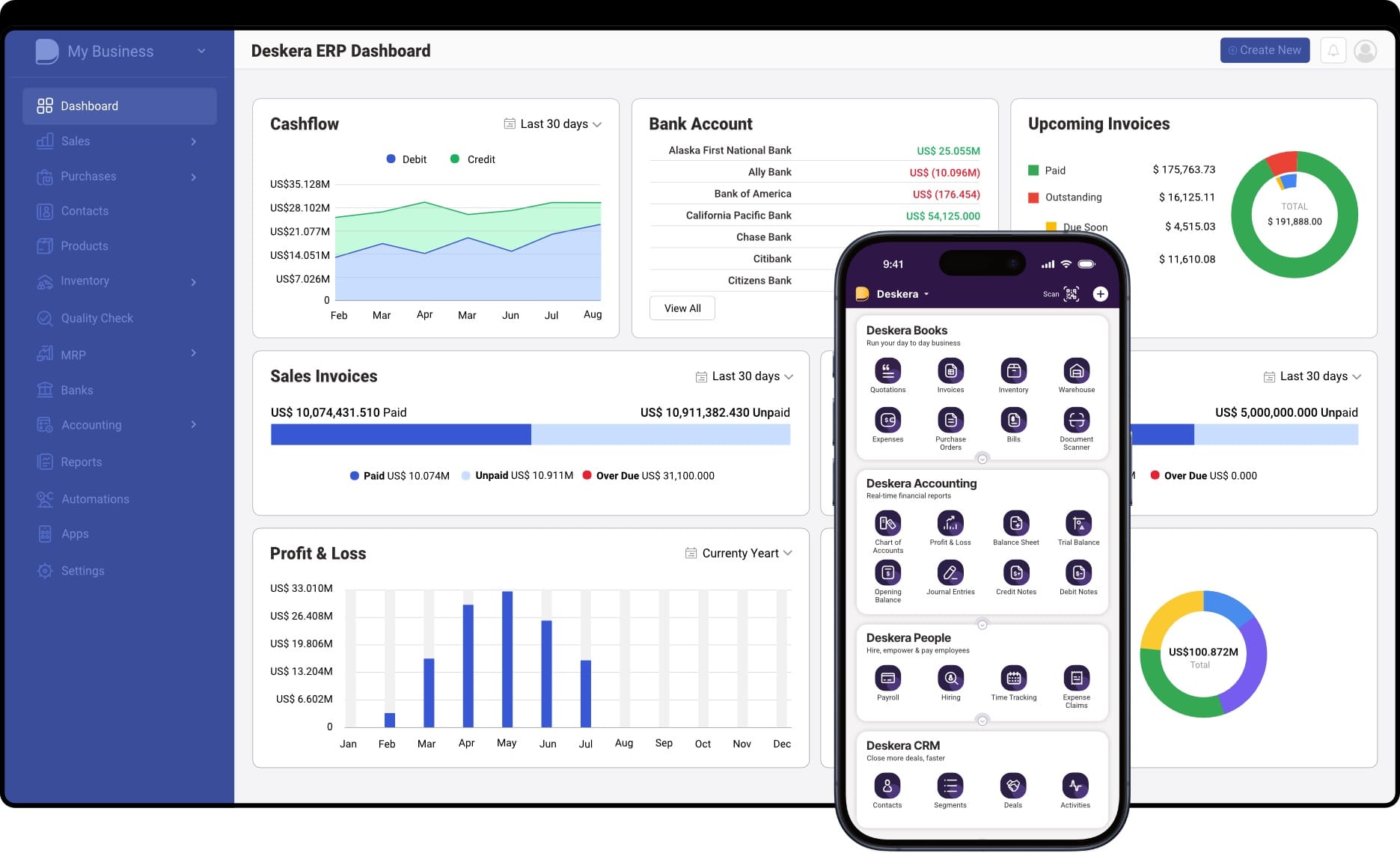
Deskera ERP is designed to unify business processes, streamline operations, and provide real-time insights that directly address the root causes of customer dissatisfaction. By centralizing customer, order, inventory, and financial data on one platform, Deskera helps businesses deliver consistent, personalized, and proactive customer experiences that foster loyalty and reduce churn.
Unified Customer and Operational Data
Deskera ERP eliminates data silos by integrating customer information, order history, inventory levels, payment records, and communication logs in a single system. With every department accessing the same real-time insights, teams can respond faster, avoid errors, and deliver consistent service—reducing customer frustration and churn triggers.
Improved Order Accuracy and Fulfillment Transparency
Accurate order processing and real-time inventory visibility are critical to meeting customer expectations. Deskera enables businesses to monitor stock across locations, prevent stockouts, and provide reliable delivery timelines. Its integrated order and shipping tracking also allow customer service teams to share accurate updates, minimizing uncertainty and improving trust.
Faster Customer Support and Resolution
Deskera’s centralized dashboard gives support teams immediate access to customer profiles, purchase history, billing information, and service records. This empowers representatives to resolve issues quickly without transferring customers between departments—boosting satisfaction and reducing the likelihood that frustrations lead to churn.
Personalized Experiences With a 360-Degree Customer View
With comprehensive customer insights, Deskera lets businesses tailor interactions based on behavior, preferences, and historical data. Personalized recommendations, targeted offers, and context-aware support make customers feel understood and valued—an important driver of long-term retention.
Enhanced Collaboration Across Teams
When sales, support, operations, and finance work from the same platform, internal coordination improves and miscommunications decline. Deskera’s shared database and collaborative tools help teams align around customer needs, ensuring consistent responses and faster resolutions that discourage customer churn.
Real-Time Analytics for Proactive Retention
Deskera’s analytics and reporting capabilities allow businesses to track retention-related KPIs—such as repeat purchase rates, complaint frequency, or late deliveries—in real time. These insights enable early identification of churn risks and support proactive engagement strategies before issues escalate.
Key Takeaways
- Customer churn reflects how effectively a business meets customer expectations, making it a critical indicator of service quality, operational efficiency, and long-term growth.
- High customer churn directly erodes revenue, increases acquisition costs, strains operations, and weakens brand trust—making retention a strategic business priority.
- Siloed systems create delays, inconsistencies, and errors that customers experience firsthand, significantly increasing the likelihood of dissatisfaction and churn.
- By unifying customer, order, inventory, and financial data, ERP systems eliminate fragmentation and enable teams to deliver consistent, informed customer experiences.
- ERP-driven visibility aligns sales, operations, and service teams around shared insights, enabling proactive decision-making and faster customer responses.
- Automation and integrated workflows reduce manual errors and delays, improving service reliability and strengthening customer confidence.
- A holistic view of customer history and behavior allows businesses to personalize interactions, increasing engagement and long-term loyalty.
- Centralized data access enables faster issue resolution and smoother service interactions, reducing friction points that often lead to churn.
- Integrated ERP systems help businesses meet modern delivery expectations by preventing stockouts, avoiding delays, and providing transparent order updates.
- Real-time inventory visibility ensures product availability and accurate commitments, reducing lost sales and customer attrition.
- ERP-integrated CRM data enables tailored recommendations, offers, and support interactions that make customers feel valued and understood.
- Efficient tracking of orders, warranties, and service agreements improves post-purchase experiences, reinforcing trust and retention.
- Shared ERP data enables cross-functional collaboration, ensuring customers receive consistent and accurate information at every touchpoint.
- ERP analytics uncover behavioral patterns, service gaps, and unmet needs, enabling continuous optimization of customer experiences.
- Automation reduces errors, speeds up processes, and frees employees to focus on meaningful customer engagement that drives loyalty.
- ERP dashboards and analytics enable businesses to track churn, retention, CLV, and service performance—turning retention into a measurable outcome.
- The success of ERP-driven retention depends on data accuracy, system integration, user adoption, and aligning workflows with customer-centric goals.
- By centralizing data, automating workflows, improving visibility, and enabling proactive insights, Deskera ERP helps businesses deliver consistent, personalized experiences that reduce churn sustainably.
Related Articles
 Rhema Hans
 Niti Samani
 Deskera Content Team
 Niti Samani
 Niti Samani
 Niti Samani