


Are your financial projections helping you make smarter business decisions—or quietly setting you up for costly surprises? The answer often lies in how accurate and realistic those projections are. Financial projections are more than just numbers on a spreadsheet; they are the foundation of strategic planning, guiding everything from budgeting and hiring to investments and expansion. When done right, they provide clarity and confidence. But when built on flawed assumptions, they can quickly lead businesses in the wrong direction.
In today’s dynamic business environment, financial projections play a critical role in helping organizations anticipate future performance, manage risks, and allocate resources effectively. Whether you’re a startup seeking funding or an established company planning growth, reliable projections act as a roadmap for sustainable success. However, even experienced professionals can fall into common traps—overestimating revenue, underestimating costs, or failing to account for market shifts.
These mistakes, while seemingly small, can have a significant impact on cash flow, profitability, and long-term stability. The good news is that most of these errors are avoidable with the right approach, tools, and mindset. By identifying the most common financial projection mistakes and understanding how to fix them, businesses can create more accurate forecasts and make informed, data-driven decisions.
This is where modern solutions like Deskera ERP come into play. Deskera ERP offers real-time financial insights, automated reporting, and seamless integration across business functions, helping organizations build more accurate and reliable projections. By centralizing financial data and reducing manual errors, it empowers businesses to stay agile, improve forecasting accuracy, and make smarter strategic decisions with confidence.
What Are Financial Projections?
Financial projections are forward-looking estimates of a business’s financial performance over a specific period. They are built using historical data, market trends, and strategic assumptions to predict future revenues, expenses, and profitability. The primary purpose of financial projections is to provide a clear financial roadmap that supports decision-making, helps allocate resources efficiently, and prepares businesses for both opportunities and risks.
At their core, financial projections consist of several key components that together create a comprehensive view of a company’s financial health:
- Revenue forecasts: These estimate the income a business expects to generate from sales over a given period. They are typically based on past performance, market demand, pricing strategies, and growth assumptions.
- Expense estimates: This includes all anticipated costs required to run the business, such as operational expenses, salaries, rent, marketing, and production costs. Accurate expense forecasting is essential to avoid budget shortfalls.
- Cash flow projections: These track the expected inflow and outflow of cash, helping businesses ensure they have enough liquidity to meet obligations. Unlike profit, cash flow focuses on timing, making it crucial for day-to-day financial stability.
- Profit and loss forecasts: Also known as income projections, these summarize expected revenues and expenses to determine projected profitability over a specific timeframe.
Financial projections are essential for both startups and established businesses. For startups, they are critical for securing funding, attracting investors, and setting realistic growth expectations. They demonstrate the viability of the business model and provide a structured plan for scaling operations.
For established businesses, financial projections support strategic planning, performance tracking, and risk management. They help leaders make informed decisions, adapt to changing market conditions, and maintain long-term financial health.
Benefits of Accurate Financial Projections
Accurate financial projections serve as a foundation for informed decision-making and long-term business success. They provide clarity on future performance, help businesses stay prepared for uncertainties, and ensure resources are used effectively. When projections are realistic and data-driven, they not only improve financial control but also build confidence among stakeholders.
Improved Strategic Planning
Accurate financial projections allow businesses to align their financial goals with broader strategic objectives in a structured and realistic way. By having a clear estimate of future revenues, costs, and profitability, leaders can plan expansions, new product launches, and market entry strategies with greater confidence.
This level of clarity reduces guesswork and ensures that every strategic move is backed by reliable financial insights, ultimately improving overall business direction.
Better Cash Flow Management
Cash flow is the lifeblood of any business, and accurate projections help ensure it is managed effectively. By forecasting when cash will come in and go out, businesses can anticipate potential shortfalls or surpluses well in advance.
This enables them to plan payments, manage working capital efficiently, and avoid disruptions in operations. Proper cash flow management also reduces reliance on emergency funding or short-term borrowing.
Enhanced Decision-Making
When financial projections are accurate, they provide a strong foundation for making critical business decisions. Leaders can evaluate different scenarios, weigh potential risks, and choose the most beneficial course of action.
Whether it involves scaling operations, investing in technology, or adjusting pricing strategies, reliable projections offer data-driven insights that minimize uncertainty and improve the overall quality and speed of decision-making.
Increased Investor and Lender Confidence
Investors and lenders rely heavily on financial projections to assess the viability and stability of a business. Accurate and well-structured projections demonstrate professionalism, financial discipline, and a clear growth plan.
This builds trust and credibility, making it easier to secure funding or attract investors. It also shows that the business has a realistic understanding of its financial future, which is crucial for long-term partnerships.
Early Risk Identification
Accurate projections act as an early warning system by highlighting potential financial risks before they escalate. Businesses can identify trends such as declining revenues, rising costs, or cash flow imbalances in advance.
This allows them to take proactive measures, such as cost optimization or strategy adjustments, to mitigate risks. Early identification not only prevents financial setbacks but also strengthens overall business resilience.
Performance Tracking and Accountability
Financial projections provide a benchmark against which actual performance can be measured. By regularly comparing projected figures with real results, businesses can identify gaps, analyze variances, and understand the reasons behind them.
This process promotes accountability across teams and departments, ensuring everyone stays aligned with financial goals. It also supports continuous improvement by refining future projections based on past performance.
Efficient Resource Allocation
With accurate projections in place, businesses can allocate resources such as capital, workforce, and inventory more effectively. They gain a clear understanding of where investments are needed and where costs can be controlled.
This prevents both over-allocation and underutilization of resources, ensuring optimal efficiency. As a result, businesses can maximize returns while maintaining financial discipline across all operations.
Supports Sustainable Growth
Accurate financial projections help businesses grow at a steady and manageable pace. Instead of overextending resources or making overly aggressive expansion decisions, companies can plan growth based on realistic financial expectations.
This ensures profitability is maintained while scaling operations. Sustainable growth supported by reliable projections reduces financial stress and creates a stable foundation for long-term success.
Common Financial Projection Mistakes and How to Fix Them
Even with the best intentions, financial projections can go wrong if they are based on incomplete data, unrealistic assumptions, or outdated methods. These mistakes not only distort financial planning but can also lead to poor decision-making, cash flow issues, and missed growth opportunities.
Understanding these common errors—and how to fix them—can significantly improve the accuracy and reliability of your financial forecasts.
Overreliance on Historical Data
Relying too heavily on historical data is one of the most common mistakes in financial projections. While past performance offers valuable insights, it does not always reflect future realities, especially in fast-changing markets.
Customer preferences, competitive landscapes, and economic conditions evolve over time, making it risky to simply extend past trends into the future. Businesses that depend solely on historical data often miss emerging opportunities or fail to anticipate disruptions.
How to fix it: Combine historical data with forward-looking indicators such as market trends, customer insights, and industry developments. Use scenario planning to model different outcomes and regularly update your assumptions to reflect current market conditions.
Ignoring External Factors
Many organizations focus primarily on internal metrics like sales and costs while overlooking external factors such as economic shifts, regulatory changes, technological advancements, or global events. These external influences can significantly impact business performance and render projections inaccurate if not considered. For instance, inflation, policy changes, or supply chain disruptions can quickly alter cost structures and demand patterns.
How to fix it: Incorporate macroeconomic indicators, industry trends, and geopolitical factors into your forecasting process. Conduct regular environmental scans and use frameworks like PESTLE analysis to evaluate how external conditions may influence your financial outcomes.
Neglecting Cash Flow Projections
A major mistake businesses make is focusing only on profitability while ignoring cash flow. A company can show strong profits on paper but still struggle to pay suppliers, employees, or operational expenses due to poor cash flow management.
Timing differences between receivables and payables can create liquidity issues, even when revenue appears healthy. This oversight can lead to serious financial stress or even business failure.
How to fix it: Develop detailed cash flow projections alongside profit forecasts. Monitor the timing of inflows and outflows, account for payment cycles, and maintain a cash reserve to handle unexpected shortfalls and ensure smooth operations.
Failure to Challenge Assumptions
Financial projections are built on assumptions about growth rates, costs, market demand, and other variables. A common mistake is accepting these assumptions without regularly reviewing or questioning them.
Over time, assumptions can become outdated or unrealistic, leading to projections that no longer reflect actual business conditions. This can result in poor strategic decisions and financial misalignment.
How to fix it: Regularly review and validate all assumptions used in your projections. Encourage collaboration across departments to gather diverse insights and use sensitivity analysis to understand how changes in assumptions impact financial outcomes.
Overlooking Seasonality and Cyclicality
Many businesses experience seasonal demand fluctuations or operate within cyclical industries. Ignoring these patterns can lead to inaccurate forecasts, such as overestimating revenue during slow periods or underestimating demand during peak seasons. This can result in poor inventory management, staffing issues, and cash flow imbalances.
How to fix it: Analyze historical data to identify seasonal trends and industry cycles. Adjust projections to account for these variations and plan resources accordingly to maintain stability throughout the year.
Insufficient Granularity in Forecasts
High-level financial projections often lack the detail needed to uncover important trends and risks. When forecasts are too broad, they may hide underperforming product lines, regional differences, or customer segment variations. This lack of granularity limits the ability to make precise and informed decisions.
How to fix it: Break down projections into detailed categories such as products, services, regions, or departments. A more granular approach improves accuracy and provides actionable insights that support better decision-making.
Neglecting Non-Financial Metrics
Focusing solely on financial data while ignoring non-financial metrics can limit the effectiveness of projections. Indicators such as customer satisfaction, employee engagement, operational efficiency, and market share often provide early signals of future financial performance. Ignoring these metrics can result in missed warning signs or growth opportunities.
How to fix it: Integrate relevant non-financial metrics into your forecasting process. Use these indicators alongside financial data to gain a more comprehensive and forward-looking view of business performance.
Overestimating Revenue Growth
Overestimating revenue growth is a common issue, especially among growing businesses and startups. Optimistic assumptions about market demand, customer acquisition, or pricing can create unrealistic projections. This often leads to overspending, aggressive expansion, and eventual cash flow problems when actual revenue falls short of expectations.
How to fix it: Use conservative and data-driven estimates when forecasting revenue. Build multiple scenarios, including best-case and worst-case situations, and regularly compare projections with actual performance to adjust expectations accordingly.
Ignoring Small and Hidden Costs
Small and recurring expenses are often overlooked during financial projections, as businesses tend to focus on major cost components. However, costs such as subscriptions, utilities, maintenance, and administrative expenses can accumulate over time and significantly impact overall profitability. Ignoring these can lead to budget shortfalls and financial strain.
How to fix it: Identify and include all possible expenses, both major and minor, in your projections. Build contingency buffers to account for unexpected costs and regularly review expenses to ensure accuracy.
Not Comparing Projections with Actual Performance
Many businesses create financial projections but fail to track their accuracy over time. Without comparing projected figures to actual results, it becomes difficult to identify gaps, improve forecasting methods, or correct recurring errors. This limits the effectiveness of financial planning and decision-making.
How to fix it: Conduct a regular plan vs. actual analysis to measure performance. Analyze variances, identify root causes, and use these insights to refine future projections and improve overall forecasting accuracy.
Poor Data Quality and Disconnected Systems
Financial projections are only as reliable as the data used to create them. Poor data quality, manual errors, and disconnected systems across departments can result in inconsistent and inaccurate forecasts. Data silos often prevent a complete view of the organization’s financial health, leading to flawed assumptions.
How to fix it: Implement integrated systems that provide a single source of truth. Automate data collection, ensure real-time updates, and standardize data entry processes to improve accuracy and consistency.
Lack of Scenario Planning for Uncertainty
Many businesses create projections based on a single expected outcome without considering uncertainties. However, unexpected events such as economic downturns, technological disruptions, or changes in consumer behavior can quickly invalidate these projections. This lack of flexibility makes financial planning less resilient.
How to fix it: Use scenario planning and “what-if” analysis to prepare for different possibilities. Develop multiple projections based on varying assumptions, allowing your business to stay agile and respond effectively to changing conditions.
Best Practices for Accurate Financial Projections
Creating accurate financial projections requires more than just numbers—it demands a structured approach, reliable data, and continuous refinement. By following proven best practices, businesses can improve the accuracy of their forecasts, reduce risks, and make more confident, data-driven decisions.
Use Reliable and Up-to-Date Data
The accuracy of your financial projections depends heavily on the quality of the data used. Relying on outdated, incomplete, or inconsistent data can lead to misleading forecasts and poor decision-making. Businesses must ensure that all financial inputs—such as sales figures, expenses, and market data—are current and validated.
Using real-time data allows organizations to reflect the latest business conditions and market dynamics in their projections. It also reduces the risk of errors caused by manual data handling or outdated records. Establishing strong data governance practices, including regular audits and validation checks, ensures that projections are built on a solid and trustworthy foundation.
Collaborate Across Departments
Financial projections should not be created in isolation by the finance team alone. Different departments—such as sales, marketing, operations, and HR—possess valuable insights that can significantly improve forecast accuracy. For example, sales teams can provide realistic revenue expectations, while operations can highlight cost drivers and resource requirements.
Cross-functional collaboration ensures that projections reflect the complete picture of the business rather than a limited perspective. It also helps align financial goals across departments, reducing inconsistencies and improving overall planning. Encouraging open communication and shared accountability leads to more accurate and actionable financial forecasts.
Leverage Automation and Financial Tools
Manual processes and spreadsheets can be time-consuming and prone to errors, especially as businesses grow. Leveraging automation and modern financial tools can significantly enhance the accuracy and efficiency of financial projections. These tools can automate data collection, perform complex calculations, and generate real-time reports with minimal human intervention.
Advanced financial software also enables scenario planning, forecasting, and integration across different business functions. This not only reduces errors but also provides deeper insights into financial performance. By adopting technology-driven solutions, businesses can streamline their forecasting process and focus more on strategic decision-making rather than manual tasks.
Regularly Compare Projections with Actuals
Creating projections is only the first step; regularly comparing them with actual financial performance is essential for continuous improvement. This process, often referred to as plan vs. actual analysis, helps identify gaps between expected and real outcomes.
By analyzing these variances, businesses can understand the reasons behind discrepancies—whether due to incorrect assumptions, market changes, or operational inefficiencies. Regular reviews allow organizations to refine their forecasting models, improve accuracy over time, and make timely adjustments to strategies. This ongoing feedback loop is critical for building reliable and effective financial projections.
Maintain Flexibility and Adaptability
In today’s fast-changing business environment, rigid financial projections can quickly become outdated. Unexpected events such as market disruptions, economic shifts, or changes in consumer behavior can significantly impact financial outcomes. Businesses that fail to adapt their projections may struggle to respond effectively to these changes.
Maintaining flexibility means being open to revising projections as new information becomes available. Incorporating scenario planning and “what-if” analysis allows businesses to prepare for multiple outcomes and respond proactively. An adaptable approach ensures that financial projections remain relevant, realistic, and aligned with evolving business conditions.
How Deskera ERP Helps Improve Financial Projections
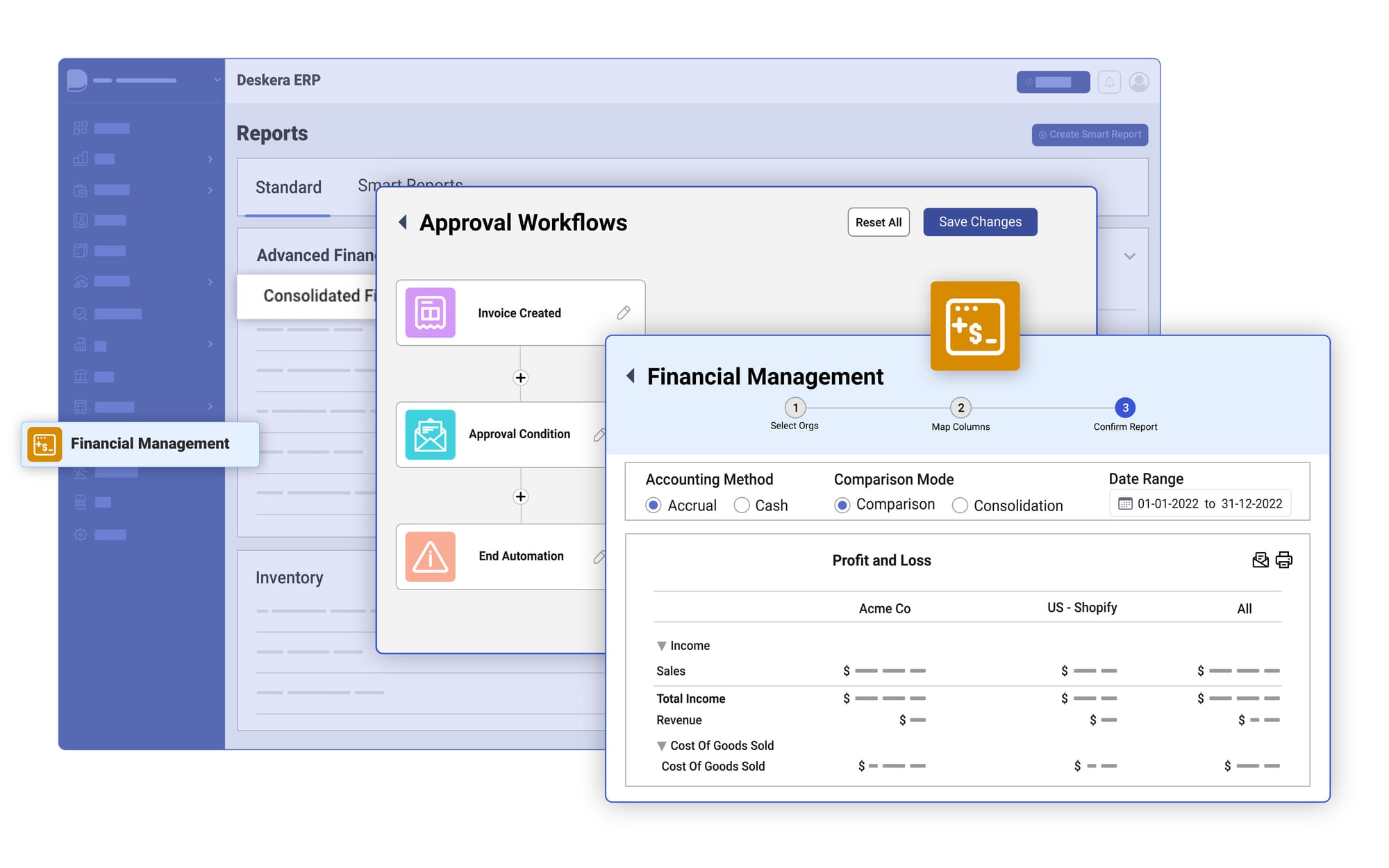
Accurate financial projections require reliable data, real-time visibility, and efficient processes—areas where modern ERP systems play a crucial role. Deskera ERP is designed to streamline financial management by integrating data, automating workflows, and providing actionable insights. This enables businesses to move beyond guesswork and build projections that are both realistic and data-driven.
Centralized Financial Data for Better Accuracy
Deskera ERP unifies accounting, finance, inventory, and operational data into a single platform, creating a “single source of truth.” This eliminates data silos and inconsistencies that often lead to inaccurate projections. With all financial information stored and updated in one place, businesses can rely on consistent and accurate inputs when building forecasts.
Real-Time Financial Visibility and Reporting
One of the key advantages of Deskera ERP is its ability to provide real-time insights into financial performance. Businesses can monitor revenues, expenses, cash flow, and profitability as they happen through dashboards and reports. This real-time visibility allows companies to adjust projections quickly based on current data, ensuring forecasts remain relevant and aligned with actual performance.
Automated Budgeting and Forecasting
Deskera ERP offers built-in budgeting and forecasting tools that automate complex financial processes. Businesses can forecast future revenues, expenses, and cash flows using historical data and predefined assumptions. Automation reduces manual errors, saves time, and improves the overall accuracy of projections, allowing finance teams to focus on strategic planning rather than data entry.
AI-Powered Predictive Insights
With AI-driven capabilities, Deskera ERP enhances financial forecasting by analyzing historical data and identifying patterns and trends. It can generate predictive insights for future sales, expenses, and cash flow, helping businesses anticipate potential outcomes and risks. This data-driven approach supports more informed decision-making and improves the reliability of financial projections.
Seamless Cross-Department Collaboration
Financial projections are more accurate when multiple departments contribute data and insights. Deskera ERP enables collaboration by allowing different teams to access and update shared financial data in real time. This ensures that projections reflect inputs from sales, operations, and finance, leading to more comprehensive and realistic forecasts.
Plan vs. Actual Analysis for Continuous Improvement
Deskera ERP allows businesses to track actual performance against projected figures through real-time reporting and analytics. This makes it easier to identify variances, understand the reasons behind them, and refine forecasting methods. Continuous comparison helps improve accuracy over time and strengthens financial planning processes.
Scalability and Flexibility for Growing Businesses
As businesses grow, their financial processes become more complex. Deskera ERP is a scalable solution that adapts to changing business needs, allowing companies to update projections, adjust assumptions, and manage multi-entity operations easily. This flexibility ensures that financial projections remain accurate and relevant, even as the business evolves.
By combining real-time data, automation, AI-driven insights, and seamless integration, Deskera ERP empowers businesses to create more accurate, dynamic, and reliable financial projections—ultimately supporting better decision-making and sustainable growth.
Key Takeaways
- Financial projections provide a roadmap for future business performance, helping guide strategic decisions and financial planning.
- Accurate financial projections are essential for improving cash flow management, securing funding, and minimizing financial risks.
- Overreliance on historical data can lead to inaccurate forecasts; combining past data with future insights improves reliability.
- Ignoring external factors like market trends and economic changes can distort projections and impact decision-making.
- Neglecting cash flow forecasting can create liquidity issues even when a business appears profitable.
- Failing to review assumptions regularly can result in outdated and unrealistic financial projections.
- Overlooking seasonality and industry cycles can lead to poor planning and resource misallocation.
- Lack of detailed (granular) forecasting can hide risks and limit actionable insights.
- Ignoring non-financial metrics reduces the ability to anticipate future performance accurately.
- Overestimating revenue growth can lead to overspending and financial instability.
- Small and hidden costs can accumulate and significantly impact overall profitability if not accounted for.
- Not comparing projections with actual performance limits opportunities to improve forecasting accuracy.
- Poor data quality and disconnected systems can result in unreliable and inconsistent financial projections.
- Lack of scenario planning makes businesses unprepared for uncertainties and unexpected disruptions.
- Using reliable, up-to-date data ensures projections are accurate and reflect current business conditions.
- Cross-department collaboration improves forecast accuracy by incorporating diverse business insights.
- Leveraging automation and financial tools reduces errors and enhances efficiency in forecasting.
- Regular plan vs. actual analysis helps refine projections and supports continuous improvement.
- Maintaining flexibility allows businesses to adapt projections to changing market conditions.
- Deskera ERP improves financial projections by providing real-time data, automation, and integrated financial insights.
Related Articles
 Niti Samani
 Niti Samani
 Niti Samani
 Niti Samani
 Niti Samani
 Niti Samani