


Have you ever wondered how companies manage customer support, payroll, IT services, and other critical operations without expanding massive in-house teams? The answer often lies in Business Process Outsourcing (BPO). By outsourcing specific business functions to specialized third-party providers, companies can reduce operational costs, improve efficiency, access expert talent, and focus more on their core business goals.
Business Process Outsourcing (BPO) has become a strategic growth driver for organizations of all sizes. From handling customer service and accounting to managing HR and technical support, BPO allows businesses to streamline operations while maintaining high service quality. As digital transformation accelerates across industries, outsourcing is no longer just a cost-saving tactic—it has evolved into a powerful strategy for scalability, innovation, and global competitiveness.
However, managing outsourced operations effectively requires strong coordination, visibility, and real-time data access. Businesses must ensure smooth communication between internal teams and external service providers while maintaining control over workflows, compliance, and performance metrics. This is where integrated business management systems play a critical role in improving outsourcing efficiency and operational transparency.
Deskera ERP helps businesses manage outsourced operations through centralized workflow automation, real-time reporting, integrated accounting, inventory tracking, and cloud-based collaboration tools. With features like AI-powered insights, automated approvals, and end-to-end business visibility, Deskera enables companies to streamline vendor coordination, improve productivity, and make smarter operational decisions. In this guide, we will explore what BPO is, its types, benefits, challenges, industry applications, and how businesses can successfully implement outsourcing strategies for long-term growth.
What Is Business Process Outsourcing (BPO)?
Business Process Outsourcing (BPO) is the practice of hiring third-party service providers to handle specific business functions or operational processes on behalf of a company. These outsourced functions are usually non-core activities—tasks that are necessary for business operations but are not directly tied to the company’s primary products or services. BPO enables businesses to improve operational efficiency, reduce costs, access specialized expertise, and focus more on strategic growth initiatives.
Originally, BPO was primarily used in the manufacturing sector to streamline supply chain operations and improve production efficiency. Over time, however, outsourcing expanded far beyond manufacturing and is now widely adopted across industries such as healthcare, banking, eCommerce, telecommunications, pharmaceuticals, logistics, energy, and information technology. Today, businesses outsource a wide range of processes including customer support, payroll processing, accounting, data entry, procurement, IT services, digital marketing, and human resource management.
BPO services are generally divided into two major categories: back-office outsourcing and front-office outsourcing. Back-office BPO includes internal operational functions such as finance and accounting, procurement, inventory management, IT support, and HR administration. Front-office BPO focuses on customer-facing activities like technical support, sales, telemarketing, and customer service. Many modern BPO providers combine both front-office and back-office services to create a more integrated and efficient operational structure for businesses.
The growth of the BPO industry has been fueled by globalization, digital transformation, and advancements in technologies such as cloud computing, artificial intelligence (AI), automation, analytics, and chatbots. Businesses are no longer outsourcing solely to reduce labor costs; they are also seeking access to advanced technologies, skilled professionals, operational flexibility, and faster scalability. As competition continues to intensify across industries, BPO has become a strategic business solution that helps organizations improve customer experience, enhance productivity, and gain a competitive advantage in the global market.
BPO vs Outsourcing vs Managed Services
Although Business Process Outsourcing (BPO), outsourcing, and managed services are often used interchangeably, they are not the same. All three involve delegating certain business activities to external providers, but they differ in scope, responsibility, level of strategic involvement, and service delivery models.
Understanding these differences helps businesses choose the right operational strategy based on their goals, budget, and long-term requirements.
Types of Business Process Outsourcing (BPO)
Business Process Outsourcing (BPO) can be categorized based on the location of the outsourcing provider and the type of services being outsourced. Different types of BPO help businesses improve operational efficiency, reduce costs, access specialized expertise, and enhance customer service.
Understanding these categories enables organizations to choose the most suitable outsourcing strategy according to their operational goals and business requirements.
Onshore BPO (Domestic Outsourcing)
Onshore BPO refers to outsourcing business functions to a service provider located within the same country. This model helps businesses maintain better communication, cultural alignment, and regulatory compliance.
Companies often choose onshore outsourcing for customer service, accounting, and administrative functions where local language proficiency and market understanding are important. It also allows easier collaboration and faster issue resolution compared to overseas outsourcing models.
Nearshore BPO
Nearshore BPO involves outsourcing business operations to service providers located in neighboring or nearby countries. This outsourcing model offers businesses the advantage of lower operational costs while maintaining similar time zones, languages, and cultural compatibility.
Nearshore outsourcing improves communication efficiency and simplifies collaboration between teams. Companies commonly use nearshore BPO for IT support, software development, customer service, and technical assistance.
Offshore BPO
Offshore BPO occurs when a company outsources its business processes to a provider located in a distant foreign country. Businesses often use offshore outsourcing to reduce labor costs, access global talent, and achieve round-the-clock operations.
Common offshore BPO services include customer support, payroll processing, IT services, and data management. This model is widely adopted by organizations looking to improve scalability and operational flexibility.
Back-Office BPO
Back-office BPO focuses on outsourcing internal business functions that do not directly involve customer interactions. These tasks are essential for smooth business operations but are usually administrative in nature.
Common back-office services include accounting, payroll, human resources, procurement, inventory management, and data entry. Outsourcing these functions helps companies reduce administrative workloads, improve efficiency, and allow internal teams to focus on strategic business activities.
Front-Office BPO
Front-office BPO involves outsourcing customer-facing services to third-party providers. These functions directly impact customer experience and brand reputation.
Common front-office outsourcing services include customer support, technical assistance, telemarketing, sales support, and help desk operations.
Many businesses partner with specialized call centers and support agencies to improve service quality, provide 24/7 assistance, and manage customer interactions more effectively.
Knowledge Process Outsourcing (KPO)
Knowledge Process Outsourcing (KPO) refers to outsourcing specialized and knowledge-intensive tasks that require advanced expertise and analytical skills.
Unlike traditional BPO, KPO focuses on high-value activities such as market research, financial analysis, legal research, content development, and business consulting.
Companies use KPO services to gain access to industry experts, improve decision-making, and enhance innovation without expanding their internal workforce.
Legal Process Outsourcing (LPO)
Legal Process Outsourcing (LPO) is a specialized branch of KPO that involves outsourcing legal services to external professionals or firms.
Businesses and law firms use LPO providers for tasks such as contract drafting, legal documentation, compliance management, litigation support, and intellectual property research.
LPO helps organizations reduce legal operational costs while improving efficiency and access to experienced legal professionals.
Research Process Outsourcing (RPO)
Research Process Outsourcing (RPO) involves outsourcing research and analytical activities to specialized service providers. Businesses use RPO services for market research, investment analysis, product development research, and data analytics.
Industries such as healthcare, pharmaceuticals, finance, and technology frequently rely on RPO providers to support innovation, strategic planning, and informed business decision-making while reducing internal research costs.
IT-Enabled Services (ITES)
IT-Enabled Services (ITES) refer to outsourcing services delivered through internet-based systems and information technology infrastructure. These services include technical support, remote infrastructure management, cloud services, telecommunications support, and web-based customer assistance.
ITES enables businesses to improve operational efficiency, enhance digital capabilities, and access advanced technological expertise without investing heavily in internal IT infrastructure.
How Does Business Process Outsourcing (BPO) Work?
Business Process Outsourcing (BPO) works by transferring specific business functions or operational processes from an organization to an external service provider.
Companies outsource tasks that are essential but not part of their core business activities, allowing internal teams to focus on strategic growth and innovation.
The BPO process involves careful planning, vendor selection, workflow transition, and continuous performance monitoring to ensure efficiency and service quality.
Deciding to Adopt BPO
The first step in the BPO process is determining whether outsourcing is the right strategy for the business. Companies evaluate factors such as operational costs, resource availability, scalability needs, and business objectives before making this decision.
Small businesses may outsource due to limited expertise or staffing, while larger organizations often adopt BPO to improve efficiency, reduce overhead costs, and gain access to specialized skills and technologies.
Identifying Business Functions to Outsource
After deciding to implement BPO, businesses identify which functions are best suited for outsourcing. These are usually non-core processes such as customer support, payroll, accounting, IT services, procurement, or data management.
Organizations analyze how outsourcing these activities will affect workflows, technology infrastructure, compliance requirements, employee responsibilities, and overall business operations before moving forward with the outsourcing strategy.
Choosing the Right BPO Service Provider
Selecting the right outsourcing partner is one of the most critical stages in the BPO process. Businesses compare vendors based on expertise, industry experience, pricing, service quality, technology capabilities, and turnaround time.
Some companies outsource an entire department to a single vendor, while others divide tasks among multiple providers. The goal is to find a reliable partner that aligns with the organization’s operational requirements and long-term business goals.
Defining Contracts and Service-Level Agreements (SLAs)
Once a provider is selected, the company establishes a formal outsourcing agreement. The contract outlines the scope of work, pricing structure, timelines, responsibilities, confidentiality terms, and expected performance standards.
Businesses may choose fixed-price contracts, time-and-materials contracts, or performance-based agreements. Service-Level Agreements (SLAs) are also created to define measurable performance indicators such as response time, accuracy, service quality, and customer satisfaction.
Transferring Business Operations to the Vendor
After finalizing the contract, the organization begins transferring workflows and responsibilities to the BPO provider. This stage includes knowledge sharing, employee training, process documentation, technology integration, and communication planning.
A structured transition process is essential to minimize disruptions and ensure operational continuity. Effective collaboration between the company and the outsourcing provider helps create a smoother and more efficient implementation.
Managing Communication and Collaboration
Successful BPO operations depend heavily on consistent communication and collaboration between the company and the service provider. Businesses often use cloud-based platforms, project management tools, ERP systems, and real-time reporting software to monitor outsourced operations.
Regular meetings, performance reviews, and transparent communication help resolve issues quickly, improve coordination, and ensure that both parties remain aligned with business objectives.
Monitoring Vendor Performance
Once outsourcing operations are fully implemented, businesses continuously monitor vendor performance to ensure service quality and operational efficiency.
Organizations track key performance indicators (KPIs) such as turnaround time, cost savings, customer satisfaction, productivity, and error rates.
Regular evaluations help businesses determine whether the outsourcing arrangement is meeting expectations and whether adjustments, renewals, or contract modifications are required.
Improving and Scaling BPO Operations
As business needs evolve, companies may expand or optimize their outsourcing strategies. Businesses often scale outsourced operations to support growth, enter new markets, improve customer service, or adopt advanced technologies such as automation and artificial intelligence.
Continuous improvement and performance analysis help organizations maximize the long-term value of BPO while maintaining flexibility and operational efficiency.
Benefits of Business Process Outsourcing (BPO)
Business Process Outsourcing (BPO) offers organizations a strategic way to improve operational efficiency, reduce costs, and gain access to specialized expertise without expanding internal resources.
By outsourcing non-core business functions to experienced service providers, companies can focus more on innovation, customer experience, and long-term growth.
As digital transformation continues to reshape industries, BPO has become an important business strategy for organizations seeking flexibility, scalability, and competitive advantage.
Reduced Operational Costs
One of the biggest advantages of BPO is cost reduction. Outsourcing helps businesses lower expenses related to hiring, training, salaries, infrastructure, and employee benefits.
Companies can also reduce operational overhead by using fee-based service models instead of maintaining full-time in-house teams. Offshore outsourcing further helps businesses access lower labor costs while maintaining service quality and operational efficiency.
Greater Focus on Core Business Functions
BPO allows organizations to focus their time, resources, and attention on core business activities that directly contribute to growth and profitability.
Instead of spending valuable resources managing administrative or repetitive tasks, businesses can prioritize innovation, product development, customer engagement, and strategic planning.
This improved focus helps companies strengthen their competitive advantage and enhance overall business performance.
Improved Efficiency and Productivity
BPO providers specialize in specific business functions and often use advanced technologies, standardized workflows, and industry best practices to deliver services more efficiently.
Their expertise enables faster task completion, improved accuracy, and higher productivity levels. By outsourcing routine operations to experienced professionals, companies can streamline processes and improve overall operational performance without increasing internal workloads.
Access to Specialized Expertise
Outsourcing partners typically employ skilled professionals with expertise in areas such as accounting, customer support, IT services, HR management, and analytics.
Businesses gain access to specialized knowledge and industry experience without investing heavily in recruitment or training. This allows organizations to improve service quality and leverage professional capabilities that may not be available internally.
Access to Advanced Technologies
Many BPO providers invest in modern technologies such as artificial intelligence (AI), automation, cloud computing, analytics, and customer relationship management (CRM) systems.
By outsourcing business functions, companies can access these advanced tools and technologies without making large infrastructure investments. This helps businesses improve efficiency, automate workflows, and remain competitive in rapidly evolving markets.
Increased Business Flexibility and Scalability
BPO provides businesses with the flexibility to scale operations up or down based on changing market demands and business requirements.
Companies can quickly adapt to seasonal fluctuations, expansion plans, or unexpected increases in workload without hiring additional staff or investing in new infrastructure.
This flexibility enables organizations to respond faster to market opportunities and operational challenges.
Faster Global Expansion
BPO providers often operate across multiple countries and regions, making it easier for businesses to expand into international markets.
Outsourcing partners can provide multilingual customer support, local market expertise, and region-specific operational knowledge.
This helps companies establish a global presence more efficiently while reducing the complexity and cost associated with international expansion.
Better Customer Service and 24/7 Support
Many outsourcing providers offer round-the-clock customer support services across multiple channels and languages.
This improves customer satisfaction by ensuring faster response times, continuous support availability, and consistent service quality.
Businesses can deliver better customer experiences without building large in-house support teams, especially when serving customers across different time zones.
Reduced Compliance and Operational Risks
BPO providers are often experienced in industry regulations, compliance requirements, and risk management practices.
Outsourcing functions such as payroll, HR, finance, and legal processes helps businesses reduce the risk of compliance errors, penalties, and operational disruptions.
Companies also benefit from expert guidance and updated regulatory knowledge provided by outsourcing specialists.
More Time for Strategic Decision-Making
By outsourcing repetitive and time-consuming operational tasks, businesses can free up management teams to focus on long-term planning and strategic initiatives.
Instead of handling routine administrative work, leadership teams can concentrate on innovation, market expansion, customer relationships, and business development.
This strategic focus supports sustainable growth and stronger organizational performance.
Drawbacks of Business Process Outsourcing (BPO)
While Business Process Outsourcing (BPO) offers significant benefits such as cost savings, scalability, and operational efficiency, it also comes with certain challenges and risks. Businesses that outsource critical operations may face issues related to communication, security, vendor dependency, and service quality.
Understanding these drawbacks helps organizations develop better outsourcing strategies, minimize risks, and maintain stronger control over outsourced business processes.
Data Security and Privacy Risks
One of the biggest concerns associated with BPO is the risk of data breaches and privacy issues. Outsourcing often requires companies to share sensitive customer, financial, or operational information with third-party providers.
When data is transferred across networks or international borders, the chances of cyberattacks, hacking attempts, and unauthorized access can increase. Different countries may also have varying data protection laws and security standards.
Communication and Language Barriers
Communication challenges are common in outsourcing arrangements, especially in offshore BPO models. Differences in language, accents, business practices, and cultural expectations can create misunderstandings and delays.
Poor communication may affect service quality, project timelines, customer support interactions, and collaboration between internal teams and external vendors. These issues can become more significant when multiple departments and stakeholders are involved.
Hidden and Unforeseen Costs
Although outsourcing is primarily adopted to reduce operational costs, businesses sometimes underestimate the actual expenses involved.
Hidden costs may arise from vendor selection, contract renegotiations, technology upgrades, employee transition processes, legal disputes, training requirements, or delayed project delivery.
Currency fluctuations and additional service charges can also increase overall outsourcing expenses beyond the original budget expectations.
Overdependence on External Vendors
Long-term outsourcing relationships can create excessive dependence on third-party providers. When a vendor becomes deeply integrated into business operations, replacing them or bringing processes back in-house can become difficult and expensive.
Businesses may also face operational disruptions if the outsourcing provider experiences staffing shortages, financial issues, poor performance, or service interruptions.
Quality Control Challenges
Maintaining consistent service quality can sometimes be difficult in BPO arrangements. Some outsourcing providers may prioritize cost reduction over service excellence by replacing experienced staff with less skilled employees or handling large workloads with limited resources.
This can negatively affect productivity, customer satisfaction, accuracy, and operational performance if businesses do not regularly monitor vendor performance and establish clear quality standards.
Regulatory and Compliance Issues
Organizations remain responsible for meeting industry regulations and compliance requirements even when operations are outsourced.
Different countries may follow different labor laws, tax regulations, data privacy standards, and compliance practices.
Failure by a BPO provider to meet these requirements can expose businesses to legal penalties, financial losses, and reputational damage.
Increased Risk of Business Disruptions
Outsourcing operations to external vendors can increase vulnerability to disruptions caused by political instability, economic uncertainty, natural disasters, cybersecurity incidents, or infrastructure failures in the provider’s location.
If the outsourcing partner experiences operational problems, the client company’s business activities may also be interrupted. This makes risk management and business continuity planning essential in BPO relationships.
Reduced Direct Control Over Operations
When companies outsource business functions, they lose a certain level of direct control over processes, employees, and service delivery.
Businesses may find it harder to enforce internal standards, monitor day-to-day activities, or quickly implement operational changes.
Limited visibility into outsourced operations can sometimes create delays in decision-making and issue resolution.
Potential Impact on Brand Reputation
Poor service quality, security incidents, or customer dissatisfaction caused by outsourcing providers can negatively affect a company’s reputation.
In customer-facing functions such as technical support or customer service, the outsourcing partner directly represents the brand.
Any negative customer experiences or operational failures can reduce customer trust and harm the company’s public image.
Employee Morale and Public Backlash
Outsourcing certain business functions may create concerns among internal employees regarding job security and organizational stability.
In some cases, businesses may also face criticism from customers or the public if outsourcing is perceived as replacing local jobs to reduce costs.
These concerns can impact employee morale, workplace culture, and brand perception if not managed carefully.
Best Practices for Successful BPO Implementation
Implementing Business Process Outsourcing (BPO) successfully requires more than simply transferring tasks to an external provider.
Businesses must carefully plan their outsourcing strategy, select the right vendor, establish clear expectations, and continuously monitor performance to maximize value.
A well-managed BPO implementation helps organizations improve efficiency, reduce operational risks, enhance service quality, and achieve long-term business goals.
Clearly Define Business Objectives
Before outsourcing any business process, organizations should clearly identify their goals and expectations.
Businesses need to determine whether they are outsourcing to reduce costs, improve efficiency, access specialized expertise, enhance customer service, or support expansion.
Defining measurable objectives helps companies choose the right outsourcing strategy and evaluate the success of the BPO partnership more effectively.
Choose the Right BPO Service Provider
Selecting the right outsourcing partner is one of the most important factors in successful BPO implementation.
Businesses should evaluate vendors based on industry expertise, service quality, technology capabilities, scalability, pricing structure, security standards, and client reviews.
A reliable provider should understand the company’s business requirements and demonstrate the ability to deliver consistent and high-quality services.
Start With Non-Core Business Functions
Organizations should initially outsource non-core activities that do not directly affect their primary value proposition. Functions such as payroll processing, data entry, accounting, customer support, and IT help desk services are commonly outsourced first.
Starting with less critical operations allows businesses to evaluate vendor performance, improve workflows, and reduce implementation risks before expanding outsourcing efforts.
Establish Clear Service-Level Agreements (SLAs)
Service-Level Agreements (SLAs) are essential for setting clear expectations between the company and the outsourcing provider.
SLAs should define performance metrics, response times, quality standards, reporting requirements, confidentiality terms, and escalation procedures.
Well-structured SLAs help ensure accountability, simplify performance evaluation, and reduce misunderstandings throughout the outsourcing relationship.
Prioritize Data Security and Compliance
Since outsourcing often involves sharing sensitive business and customer information, companies must implement strong data security and compliance measures.
Businesses should verify that BPO providers follow industry regulations, cybersecurity standards, and data privacy laws.
Regular audits, secure communication systems, access controls, and confidentiality agreements help minimize security risks and protect critical business information.
Maintain Strong Communication and Collaboration
Effective communication is critical for successful BPO operations. Businesses should establish regular communication channels, reporting schedules, and feedback mechanisms with outsourcing providers.
Frequent meetings, real-time collaboration tools, and transparent discussions help improve coordination, resolve issues quickly, and maintain alignment between both parties. Strong communication also reduces misunderstandings caused by cultural or language differences.
Develop a Structured Transition Plan
A smooth transition process is essential when transferring business operations to a BPO provider.
Companies should create a detailed implementation plan that includes workflow documentation, employee training, technology integration, knowledge transfer, and timeline management.
A phased transition approach helps reduce disruptions, maintain service continuity, and improve operational stability during the outsourcing process.
Continuously Monitor Vendor Performance
Businesses should regularly evaluate the performance of outsourcing providers using key performance indicators (KPIs) and service benchmarks.
Metrics such as turnaround time, customer satisfaction, error rates, cost savings, and productivity levels help organizations measure outsourcing effectiveness.
Ongoing monitoring enables companies to identify performance gaps, optimize workflows, and ensure service quality standards are consistently maintained.
Use Technology for Better Visibility and Automation
Integrating technologies such as ERP systems, cloud platforms, automation tools, and analytics software improves visibility and control over outsourced operations.
Real-time dashboards, workflow tracking, and automated reporting help businesses monitor vendor activities, improve collaboration, and make data-driven decisions.
Technology integration also enhances operational efficiency and simplifies communication between internal teams and outsourcing providers.
Build Long-Term Strategic Partnerships
Successful BPO relationships are built on trust, transparency, and long-term collaboration rather than short-term cost savings alone.
Businesses should work closely with outsourcing providers to improve processes, share feedback, and align operational goals.
Developing a strategic partnership encourages innovation, improves service quality, and creates greater long-term value for both organizations.
Important KPIs to Measure BPO Performance
Measuring Business Process Outsourcing (BPO) performance is essential for ensuring that outsourcing operations align with business objectives and deliver the expected results.
Key Performance Indicators (KPIs) help organizations evaluate service quality, operational efficiency, cost savings, customer satisfaction, and vendor performance.
Tracking the right KPIs enables businesses to identify improvement areas, optimize outsourcing strategies, and maintain accountability across outsourced operations.
Cost Savings Percentage
Cost savings percentage measures how much money a business saves through outsourcing compared to managing the same operations in-house. This KPI helps organizations evaluate the financial effectiveness of their BPO strategy.
Businesses typically compare operational costs before and after outsourcing to determine whether the outsourcing partnership is delivering the expected return on investment and long-term cost efficiency.
Service-Level Agreement (SLA) Compliance
SLA compliance measures how effectively the BPO provider meets the agreed service standards outlined in the contract. This KPI tracks metrics such as response times, resolution times, service availability, and task completion rates.
High SLA compliance indicates reliable vendor performance, while repeated SLA failures may signal operational inefficiencies, communication issues, or the need for contract adjustments.
Customer Satisfaction Score (CSAT)
Customer Satisfaction Score (CSAT) evaluates how satisfied customers are with the services delivered by outsourced teams. Businesses often collect customer feedback through surveys, ratings, or post-service evaluations.
This KPI is especially important for customer-facing BPO functions such as technical support, call centers, and help desk services, where service quality directly impacts customer experience and brand reputation.
First Response Time (FRT)
First Response Time measures how quickly outsourced teams respond to customer inquiries, service requests, or support tickets. Faster response times improve customer satisfaction and operational efficiency.
This KPI is commonly used in customer support and IT service outsourcing to evaluate how effectively the BPO provider handles incoming requests and maintains service responsiveness.
Average Resolution Time
Average Resolution Time tracks the amount of time required to fully resolve customer issues or complete specific tasks. A lower resolution time generally indicates better process efficiency and stronger vendor performance.
Monitoring this KPI helps businesses assess how effectively outsourced teams manage workloads, handle customer concerns, and deliver timely solutions.
Productivity and Efficiency Metrics
Productivity KPIs measure the output generated by outsourced teams within a specific time frame.
These metrics may include tasks completed per employee, number of support tickets handled, transaction processing speed, or operational throughput.
Tracking productivity helps businesses determine whether outsourcing providers are operating efficiently and meeting expected performance targets.
Error Rate and Accuracy Levels
Error rate measures the frequency of mistakes, inaccuracies, or quality issues in outsourced operations. This KPI is particularly important in finance, payroll, data entry, accounting, and compliance-related functions where accuracy is critical.
Lower error rates indicate better process control, stronger quality assurance practices, and higher operational reliability.
Customer Retention Rate
Customer retention rate measures how effectively a business retains customers after outsourcing customer-facing services. Strong retention rates often indicate positive customer experiences and consistent service quality provided by the BPO partner.
Declining retention rates may suggest service issues, communication problems, or customer dissatisfaction that require immediate attention.
Employee Turnover Rate
Employee turnover rate within the BPO provider’s workforce can significantly impact service consistency and operational stability. High turnover rates may lead to lower productivity, reduced service quality, and increased training costs.
Monitoring this KPI helps businesses assess workforce stability and the provider’s ability to maintain experienced and skilled personnel.
Compliance and Security Metrics
Compliance-related KPIs measure how effectively the BPO provider follows regulatory requirements, security standards, and data protection policies.
Metrics may include audit success rates, security incident frequency, policy violations, and regulatory compliance scores.
These KPIs are critical for businesses outsourcing sensitive functions such as finance, healthcare, legal services, and customer data management.
Turnaround Time (TAT)
Turnaround Time measures the total time taken to complete a task, process, or customer request from start to finish. Faster turnaround times improve operational efficiency and customer experience.
This KPI is widely used in outsourced services such as claims processing, payroll management, technical support, and order fulfillment operations.
Return on Investment (ROI)
Return on Investment (ROI) measures the overall value generated from outsourcing compared to the total cost of the BPO engagement.
This KPI considers factors such as cost savings, productivity improvements, service quality, operational efficiency, and business growth.
A positive ROI indicates that the outsourcing strategy is delivering measurable business benefits and supporting long-term organizational goals.
How Deskera ERP Helps You Manage Business Process Outsourcing (BPO)
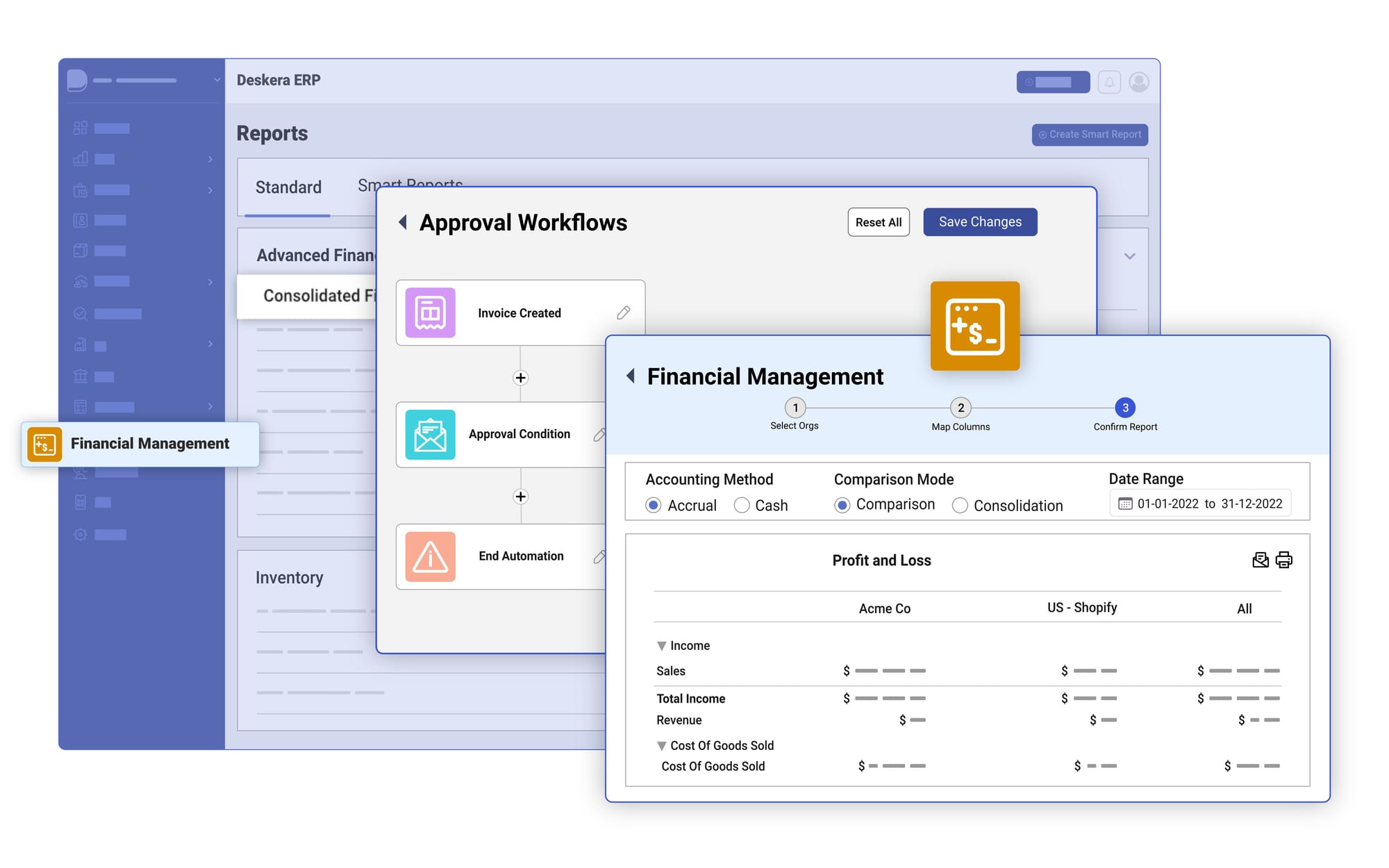
Managing outsourced business operations requires strong coordination, process visibility, real-time communication, and centralized data management. Businesses working with BPO providers must ensure that outsourced teams remain aligned with operational goals, compliance requirements, and performance expectations. Deskera ERP helps businesses streamline outsourced operations through integrated workflows, automation, cloud-based collaboration, and real-time business intelligence.
Centralized Management of Business Operations
Deskera ERP centralizes core business functions such as accounting, procurement, inventory management, payroll, CRM, customer service, and HR operations into a single platform. This unified system helps businesses maintain better control and visibility over outsourced processes while reducing operational silos and communication gaps between internal teams and BPO providers.
Automated Workflow and Process Management
Deskera ERP provides workflow automation features that help businesses standardize outsourced operations and reduce manual intervention. Companies can automate approvals, purchase orders, invoicing, inventory updates, payroll processing, and financial reporting. Automated workflows improve operational consistency, reduce errors, and ensure outsourced tasks are completed more efficiently and accurately.
Real-Time Reporting and Performance Monitoring
Businesses outsourcing critical functions need continuous visibility into vendor performance and operational efficiency. Deskera ERP offers real-time dashboards, smart reports, analytics, and business intelligence tools that help organizations monitor KPIs, track productivity, evaluate SLA compliance, and identify operational bottlenecks. This enables businesses to make faster, data-driven decisions regarding outsourced operations.
Improved Collaboration With BPO Providers
Since BPO operations often involve multiple teams working across locations, communication and collaboration are essential. Deskera ERP’s cloud-based platform enables secure access to shared data, workflows, customer information, procurement records, and operational updates. This improves coordination between businesses and outsourcing providers while ensuring smoother communication and faster issue resolution.
Better Financial and Accounting Control
Deskera ERP simplifies outsourced finance and accounting operations by automating accounts receivable, accounts payable, bank reconciliation, invoicing, budgeting, forecasting, and financial reporting. Businesses can maintain accurate financial records, improve cash flow visibility, and strengthen financial controls while working with outsourced accounting or payroll service providers.
Streamlined Procurement and Supply Chain Operations
For businesses outsourcing procurement, logistics, or supply chain functions, Deskera ERP helps optimize purchasing workflows, vendor management, inventory tracking, and warehouse operations. Features such as automated purchase requisitions, approval workflows, stock monitoring, and order fulfillment improve operational efficiency and reduce delays in outsourced supply chain processes.
Enhanced Inventory and Warehouse Visibility
Deskera ERP offers real-time inventory tracking, warehouse management, barcode scanning, stock alerts, and fulfillment tracking features that improve visibility across outsourced inventory and logistics operations. Businesses can monitor inventory movement, maintain accurate stock levels, and coordinate better with third-party logistics or warehouse providers.
Scalability for Growing Business Operations
As businesses expand, outsourcing requirements often increase as well. Deskera ERP’s cloud-based infrastructure allows companies to scale operations efficiently without major infrastructure investments. Businesses can easily add users, integrate additional modules, and support growing outsourced workflows while maintaining operational visibility and process control.
Improved Operational Efficiency Through Automation
Deskera ERP integrates automation, reporting, CRM, inventory, accounting, and customer service capabilities into a single ecosystem. This reduces process duplication, minimizes manual work, improves turnaround times, and increases operational efficiency across outsourced functions. Businesses can streamline BPO operations while improving productivity and customer satisfaction.
Key Takeaways
- Business Process Outsourcing (BPO) involves hiring third-party providers to manage non-core business functions, helping companies improve efficiency and focus on strategic growth.
- BPO services are broadly categorized into front-office and back-office functions, covering areas such as customer support, accounting, HR, payroll, IT services, and procurement.
- Businesses can choose between onshore, nearshore, and offshore BPO models depending on their operational goals, budget, communication requirements, and geographic preferences.
- Specialized outsourcing models such as KPO, LPO, RPO, and ITES help organizations access advanced expertise, research capabilities, legal support, and technology-driven services.
- BPO works through a structured process that includes identifying outsourcing needs, selecting vendors, establishing SLAs, transferring operations, and continuously monitoring performance.
- Unlike general outsourcing or managed services, BPO focuses on end-to-end business process management and operational efficiency improvement.
- One of the biggest benefits of BPO is cost reduction through lower labor expenses, reduced infrastructure investment, and flexible service-based pricing models.
- Outsourcing non-core operations enables businesses to focus more on innovation, customer experience, business expansion, and other core competencies.
- BPO providers improve efficiency and productivity by using specialized expertise, advanced technologies, standardized workflows, and automation tools.
- Outsourcing gives businesses access to technologies such as AI, cloud computing, analytics, automation, and CRM systems without requiring large internal investments.
- BPO also supports scalability and global expansion by providing multilingual support, operational flexibility, and 24/7 service capabilities.
- Despite its benefits, BPO comes with risks such as data security concerns, communication barriers, vendor dependency, hidden costs, and reduced operational control.
- Businesses must carefully manage compliance, cybersecurity, and vendor relationships to reduce outsourcing risks and maintain service quality.
- Successful BPO implementation requires clear business objectives, strong SLAs, effective communication, secure data management, and continuous performance monitoring.
- Tracking KPIs such as cost savings, SLA compliance, customer satisfaction, turnaround time, productivity, and ROI helps businesses evaluate outsourcing effectiveness.
- ERP systems play a crucial role in managing outsourced operations by improving visibility, workflow automation, collaboration, and real-time performance tracking.
- Deskera ERP helps businesses streamline BPO operations through integrated accounting, inventory management, workflow automation, reporting, HR management, and cloud-based collaboration tools.
Related Articles
 Niti Samani
 Niti Samani
 Niti Samani
 Niti Samani
 Niti Samani
 Niti Samani