

Are you truly maximizing your manufacturing capacity—or unknowingly leaving machines idle while demand goes unmet? The answer for many businesses is surprising: without the right metrics in place, even the most advanced production setups can operate far below their potential. Manufacturing capacity planning is no longer just about estimating output; it’s about using data to ensure every resource—machines, labor, and materials—is aligned with real-time demand.
In today’s fast-evolving manufacturing landscape, capacity planning has become a strategic priority rather than a routine operational task. Fluctuating customer demand, supply chain disruptions, and rising operational costs mean that businesses must constantly monitor how effectively their resources are being utilized. This is where capacity planning metrics come into play, offering clear, measurable insights into performance, efficiency, and scalability.
Tracking the right manufacturing capacity planning metrics enables businesses to identify bottlenecks, reduce downtime, and improve overall productivity. Instead of relying on assumptions, manufacturers can make informed decisions based on real-time data—whether it’s optimizing machine usage, improving workforce efficiency, or balancing production loads. These metrics act as a roadmap, helping organizations transition from reactive problem-solving to proactive planning.
Modern solutions like Deskera MRP further simplify this process by bringing all critical data into a single platform. With features such as real-time production tracking, automated reporting, and demand forecasting, Deskera MRP empowers manufacturers to monitor key capacity metrics effortlessly. It also enhances visibility across operations, enabling smarter scheduling, better resource allocation, and faster decision-making—ultimately driving higher efficiency and sustainable growth.
What Are Manufacturing Capacity Planning Metrics?
Manufacturing capacity planning metrics are measurable indicators that help businesses evaluate how effectively their production resources—such as machines, labor, and materials—are being utilized to meet demand. These metrics provide data-driven insights into whether a manufacturing operation is operating at optimal capacity, underutilized, or overloaded.
In simple terms, they answer critical questions like:
- Are we using our production resources efficiently?
- Can we meet current and future demand?
- Where are the bottlenecks in our processes?
These metrics go beyond basic production numbers. They focus on performance, efficiency, and alignment between capacity and demand, enabling manufacturers to make informed decisions about scaling operations, improving workflows, or reducing costs.
Manufacturing capacity planning metrics typically track areas such as equipment performance, production speed, downtime, labor productivity, and inventory flow. By consistently monitoring these indicators, businesses can identify inefficiencies, minimize delays, and ensure a smoother production process.
Ultimately, these metrics act as a foundation for strategic planning—helping manufacturers shift from reactive operations to proactive, data-driven decision-making that supports long-term growth and operational excellence.
Importance of Tracking Manufacturing Capacity Planning Metrics
In an increasingly competitive and demand-driven manufacturing environment, relying on assumptions is no longer enough. Businesses need clear, real-time insights into how their resources are performing to stay efficient and profitable.
This is where manufacturing capacity planning metrics play a vital role—they provide the data needed to optimize operations, reduce waste, and respond quickly to changing market conditions.
By consistently tracking these metrics, manufacturers can move from reactive decision-making to a more proactive, strategic approach that supports long-term growth and operational excellence.
Improved Resource Utilization
Tracking manufacturing capacity planning metrics helps businesses maximize the use of available resources without overloading or underutilizing them. When resources are properly aligned, operations become more efficient and cost-effective.
- Identify underutilized machines and idle labor hours
- Optimize allocation of equipment and workforce
- Reduce unnecessary overtime and operational strain
- Balance workloads across production lines
- Improve overall equipment efficiency and output
By gaining visibility into how resources are used, manufacturers can make adjustments that enhance productivity while minimizing waste. This leads to smoother operations, better planning, and a more balanced production environment that supports consistent performance and long-term efficiency improvements.
Better Demand and Supply Alignment
Capacity planning metrics allow manufacturers to closely align production levels with actual market demand, reducing inefficiencies caused by mismatches. This alignment is essential for maintaining inventory balance and meeting customer expectations.
- Forecast demand more accurately using historical data
- Adjust production schedules based on real-time insights
- Prevent overproduction and excess inventory buildup
- Avoid stockouts and missed sales opportunities
- Improve responsiveness to market fluctuations
With better demand-supply synchronization, businesses can ensure that production remains flexible and responsive. This not only minimizes carrying costs but also strengthens customer satisfaction by ensuring timely deliveries and consistent product availability.
Early Identification of Bottlenecks
Monitoring key capacity metrics helps uncover inefficiencies and bottlenecks within the production process before they escalate into major issues. Early detection allows for quicker corrective actions and smoother workflows.
- Pinpoint delays in specific production stages
- Identify overloaded machines or workstations
- Analyze process flow disruptions in real time
- Improve coordination between departments
- Reduce waiting time between operations
Addressing bottlenecks promptly ensures uninterrupted production and better throughput. This proactive approach helps manufacturers maintain operational continuity, optimize cycle times, and improve overall efficiency without compromising quality or delivery timelines.
Reduced Downtime and Operational Disruptions
Tracking metrics related to equipment performance and downtime enables businesses to minimize unexpected interruptions. A proactive maintenance strategy can significantly improve operational stability.
- Monitor machine health and performance trends
- Schedule preventive and predictive maintenance
- Reduce unplanned equipment breakdowns
- Improve equipment lifespan and reliability
- Ensure consistent production output
By reducing downtime, manufacturers can maintain steady production schedules and avoid costly delays. This not only improves efficiency but also enhances the reliability of operations, ensuring that production targets are consistently met without unexpected disruptions.
Enhanced Decision-Making
Data-driven insights from capacity planning metrics empower managers to make more informed and strategic decisions. Instead of relying on guesswork, decisions are backed by accurate and timely information.
- Use real-time data for production planning
- Allocate resources based on performance metrics
- Identify areas requiring process improvement
- Evaluate the impact of operational changes
- Support long-term strategic planning
This level of clarity enables faster and more confident decision-making across all levels of the organization. It ensures that every action taken contributes to improved efficiency, better resource management, and stronger overall business performance.
Increased Productivity and Efficiency
Capacity planning metrics provide a clear picture of production performance, helping businesses identify inefficiencies and optimize processes for better output. Continuous improvement becomes easier with measurable data.
- Track output levels across different production units
- Identify performance gaps and inefficiencies
- Streamline workflows and eliminate redundancies
- Improve coordination between teams and departments
- Enhance overall operational efficiency
With consistent monitoring, manufacturers can implement targeted improvements that boost productivity. This results in higher output without increasing costs, enabling businesses to achieve more with the same resources while maintaining quality standards.
Cost Optimization
Tracking capacity metrics helps businesses identify areas where costs can be reduced without affecting productivity or quality. It ensures that every resource is used efficiently and economically.
- Minimize waste in materials and production processes
- Reduce energy consumption through efficient operations
- Optimize labor costs by improving workforce utilization
- Avoid unnecessary inventory holding costs
- Improve budgeting and financial planning accuracy
By focusing on cost efficiency, manufacturers can improve profit margins while maintaining operational effectiveness. This strategic cost control contributes to long-term financial stability and sustainable business growth.
Scalability and Growth Support
As businesses expand, capacity planning metrics provide the insights needed to scale operations efficiently. They help ensure that growth does not lead to inefficiencies or resource shortages.
- Assess current capacity before scaling production
- Plan infrastructure and resource expansion effectively
- Avoid overinvestment in unnecessary resources
- Support smooth transition during business growth
- Maintain operational efficiency at higher production levels
These insights enable manufacturers to grow sustainably without compromising performance. Proper capacity planning ensures that expansion is well-structured, cost-effective, and aligned with long-term business objectives.
Improved Customer Satisfaction
Accurate capacity planning ensures that customer demands are met consistently, leading to better service and stronger relationships. Timely deliveries and quality products are key to customer retention.
- Ensure on-time order fulfillment
- Maintain consistent product quality
- Reduce delays and backorders
- Improve reliability of delivery schedules
- Enhance overall customer experience
By meeting customer expectations reliably, businesses can build trust and loyalty. This not only improves customer retention but also strengthens brand reputation in a competitive market.
Stronger Competitive Advantage
Manufacturers that effectively track and utilize capacity planning metrics gain a significant edge over competitors. Efficiency and agility are critical in today’s fast-paced market environment.
- Respond quickly to changing market demands
- Optimize production processes faster than competitors
- Improve overall operational agility
- Deliver products faster and more reliably
- Continuously innovate based on performance insights
This competitive advantage allows businesses to stay ahead in the market, attract more customers, and adapt to industry changes with confidence. Over time, it leads to sustained growth and a stronger market position.
Top 18 Manufacturing Capacity Planning Metrics to Track
To effectively manage production and ensure optimal resource utilization, manufacturers must rely on a mix of operational and advanced manufacturing-specific metrics. While basic time and resource indicators provide visibility into planning and workforce efficiency, industry-focused KPIs offer deeper insights into equipment performance, process flow, and production quality.
By tracking a comprehensive set of capacity planning metrics, businesses can identify inefficiencies, improve forecasting accuracy, and optimize production output—ultimately enabling smarter, data-driven decision-making and sustainable growth.
1. Utilization Rate
Utilization rate measures how effectively available resources—machines, labor, and equipment—are being used in production. It helps manufacturers understand whether capacity is being fully leveraged or wasted due to inefficiencies.
- Tracks actual output compared to maximum capacity
- Identifies underutilized or overworked resources
- Helps balance workloads across production lines
- Prevents equipment strain and workforce burnout
- Supports better scheduling and planning decisions
By monitoring utilization consistently, businesses can improve operational efficiency, reduce idle time, and ensure that all resources contribute effectively to production goals without unnecessary strain.
2. Total Capacity Level
Total capacity level defines the maximum production capability of a manufacturing facility within a given time frame. It serves as the foundation for all planning and forecasting activities.
- Establishes realistic production limits
- Helps assess ability to meet demand
- Identifies need for additional resources
- Supports long-term capacity planning
- Prevents overcommitment of production
Understanding total capacity ensures that businesses set achievable targets and avoid operational disruptions. It provides clarity on production limits, helping manufacturers align resources with demand while maintaining efficiency and stability.
3. Scheduled Hours
Scheduled hours represent the planned time allocated to production tasks, maintenance, and other operational activities. This metric ensures that workflows are organized and aligned with capacity.
- Includes all planned production and support tasks
- Helps allocate work efficiently across teams
- Ensures deadlines are achievable
- Improves coordination between departments
- Supports accurate production scheduling
Tracking scheduled hours helps manufacturers maintain structured workflows and avoid delays. It ensures that resources are properly allocated and that production plans remain realistic and achievable.
4. Logged Hours
Logged hours capture the actual time spent by employees on production activities. This metric provides a clear picture of how resources are utilized in real operations.
- Records actual time spent on tasks
- Helps evaluate workforce productivity
- Identifies inefficiencies in execution
- Improves future planning accuracy
- Supports performance monitoring
By comparing logged hours with planned schedules, businesses gain valuable insights into operational efficiency. This helps refine planning processes and ensures better alignment between expectations and actual performance.
5. Scheduled vs. Logged Hours
This metric compares planned working hours with actual time spent, highlighting gaps between expectations and execution. It is essential for improving planning accuracy.
- Identifies discrepancies in planning
- Highlights delays and inefficiencies
- Reveals bottlenecks in workflows
- Improves estimation accuracy over time
- Supports continuous process improvement
Analyzing this metric allows manufacturers to refine scheduling practices and reduce errors. It ensures that future plans are more realistic and aligned with actual production capabilities.
6. Billable vs. Non-Billable Time
This metric evaluates the balance between revenue-generating activities and non-revenue tasks, helping businesses understand operational efficiency.
- Tracks productive vs support work
- Identifies time spent on non-value activities
- Helps improve profitability
- Supports better resource allocation
- Reduces operational inefficiencies
Maintaining a balanced ratio ensures that resources are used effectively. It helps manufacturers focus on high-value activities while minimizing unnecessary time spent on non-productive tasks.
7. Overtime and Time Off
This metric tracks workforce availability by monitoring overtime hours and employee leave. It ensures sustainable operations and balanced workloads.
- Tracks additional working hours
- Monitors employee availability
- Prevents burnout and fatigue
- Supports workforce planning
- Ensures compliance with labor regulations
Properly managing overtime and time off helps maintain productivity while protecting employee well-being. It ensures that workloads remain balanced and sustainable over time.
8. Overall Equipment Effectiveness (OEE)
OEE measures how effectively manufacturing equipment is utilized by combining availability, performance, and quality into a single metric.
- Identifies equipment inefficiencies
- Measures true production productivity
- Highlights losses due to downtime or defects
- Supports continuous improvement initiatives
- Improves asset utilization
Tracking OEE provides a comprehensive view of equipment performance. It helps manufacturers identify areas for improvement and maximize the efficiency of their production assets.
9. Throughput
Throughput measures the number of units produced within a specific period, indicating the speed and efficiency of production processes.
- Tracks output over time
- Identifies production capacity limits
- Improves workflow efficiency
- Supports demand fulfillment
- Enhances scheduling decisions
By monitoring throughput, manufacturers can optimize production flow and ensure that output meets demand. It plays a critical role in improving overall operational performance.
10. Cycle Time
Cycle time refers to the total time required to produce one unit from start to finish. It is a key indicator of production efficiency.
- Measures production speed
- Identifies delays in workflows
- Helps reduce processing time
- Improves operational efficiency
- Supports process optimization
Reducing cycle time enables manufacturers to increase output without additional resources. It helps streamline operations and improve overall productivity.
11. Lead Time
Lead time measures the total time from order placement to final delivery, including production and waiting periods. It reflects end-to-end efficiency.
- Tracks complete production timeline
- Improves delivery reliability
- Helps manage customer expectations
- Identifies delays in processes
- Supports better planning
Shorter lead times improve customer satisfaction and operational efficiency. Monitoring this metric helps businesses optimize production and delivery processes.
12. Capacity Variance
Capacity variance measures the difference between planned capacity and actual output achieved. It highlights gaps in performance.
- Identifies deviations from production plans
- Highlights inefficiencies
- Improves forecasting accuracy
- Supports better planning decisions
- Helps adjust capacity strategies
Tracking capacity variance helps manufacturers align expectations with reality. It enables continuous improvement and more accurate production planning.
13. Work-in-Progress (WIP)
WIP represents the number of units currently in production but not yet completed. It helps monitor workflow efficiency and bottlenecks.
- Tracks in-process inventory
- Identifies production bottlenecks
- Improves workflow visibility
- Reduces excess inventory
- Supports lean manufacturing
Managing WIP effectively ensures smooth production flow. It prevents delays and improves overall efficiency across the production process.
14. Downtime (Planned vs Unplanned)
Downtime measures the time when production is halted due to maintenance or unexpected issues. It directly impacts capacity utilization.
- Differentiates planned and unplanned downtime
- Identifies root causes of disruptions
- Improves maintenance scheduling
- Reduces unexpected breakdowns
- Enhances equipment reliability
Reducing downtime helps maintain consistent production output. It improves efficiency and ensures that operations run smoothly.
15. First Pass Yield (FPY)
FPY measures the percentage of products manufactured correctly without rework. It reflects production quality and efficiency.
- Reduces rework and waste
- Improves product quality
- Enhances production efficiency
- Supports quality control initiatives
- Boosts customer satisfaction
High FPY indicates efficient and reliable production processes. It helps manufacturers maintain quality while minimizing costs.
16. Scrap Rate
Scrap rate measures the percentage of materials or products that cannot be reused or repaired. It highlights production waste.
- Tracks material waste
- Identifies quality issues
- Reduces production losses
- Improves cost efficiency
- Supports sustainability goals
Lowering scrap rates helps improve profitability and operational efficiency. It ensures better use of resources and reduces waste.
17. Changeover Time
Changeover time measures how long it takes to switch production from one product to another. It affects flexibility and responsiveness.
- Tracks setup and transition time
- Reduces production delays
- Improves operational flexibility
- Supports smaller batch production
- Enhances responsiveness to demand
Reducing changeover time allows manufacturers to adapt quickly to changing demand. It improves efficiency and supports agile production processes.
18. On-Time Delivery Rate
On-time delivery rate measures how consistently products are delivered within the promised timeframe. It reflects supply chain and production reliability.
- Tracks delivery performance
- Improves customer satisfaction
- Identifies supply chain inefficiencies
- Enhances planning accuracy
- Strengthens operational reliability
Maintaining high on-time delivery ensures customer trust and competitiveness. It highlights the effectiveness of capacity planning and overall production management.
How to Choose the Right Capacity Planning Metrics
Selecting the right manufacturing capacity planning metrics is critical to ensuring that your production strategy aligns with business goals. With so many available KPIs, the key is not to track everything—but to focus on metrics that provide actionable insights and directly impact performance. The right combination of metrics will help you improve efficiency, optimize resources, and make informed, data-driven decisions.
Align Metrics with Business Objectives
Choosing the right metrics starts with understanding what your business is trying to achieve—whether it’s cost reduction, increased output, or improved customer satisfaction.
- Identify short-term and long-term business goals
- Map metrics to specific operational priorities
- Focus on KPIs that directly influence outcomes
- Avoid tracking irrelevant or vanity metrics
- Ensure alignment across departments
When metrics are aligned with clear objectives, they become powerful tools for driving performance. This ensures that every data point contributes to meaningful improvements and measurable business results.
Focus on Actionable and Measurable KPIs
Not all metrics provide value—some may offer data but lack actionable insights. The goal is to track KPIs that lead to clear decisions and improvements.
- Choose metrics that can influence decision-making
- Ensure data is easy to measure and track
- Avoid overly complex or ambiguous KPIs
- Prioritize metrics with clear benchmarks
- Focus on real-time or near real-time data
Actionable metrics enable faster responses to operational challenges. They help teams move beyond analysis and take concrete steps to improve efficiency and productivity.
Consider Your Manufacturing Process Type
Different manufacturing models require different metrics. The metrics you choose should reflect your production environment and operational complexity.
- Identify whether you use discrete manufacturing, process manufacturing, or job-based manufacturing
- Select metrics relevant to your production flow
- Adapt KPIs to batch size and production volume
- Consider industry-specific requirements
- Align metrics with operational structure
Tailoring metrics to your manufacturing type ensures relevance and accuracy. It helps capture the nuances of your operations and provides insights that truly matter.
Balance Leading and Lagging Indicators
An effective capacity planning strategy includes both predictive (leading) and performance-based (lagging) metrics. This balance ensures better planning and evaluation.
- Use leading indicators to forecast demand and capacity needs
- Track lagging indicators to measure actual performance
- Combine predictive and historical data
- Identify trends and patterns over time
- Improve both planning and execution
Balancing these indicators allows businesses to stay proactive while continuously improving past performance. It creates a more complete and forward-looking capacity planning strategy.
Ensure Data Accuracy and Integration
Metrics are only as valuable as the data behind them. Inaccurate or disconnected data can lead to poor decision-making and inefficiencies.
- Use integrated systems to collect data
- Ensure real-time data synchronization
- Eliminate data silos across departments
- Regularly validate and clean data
- Standardize data collection processes
Accurate and integrated data ensures reliability and consistency in reporting. This builds trust in the metrics and supports better strategic decisions.
Prioritize Simplicity and Clarity
Overloading teams with too many metrics can lead to confusion and reduced focus. Simplicity ensures better understanding and usability.
- Limit the number of KPIs to essential ones
- Use clear definitions for each metric
- Avoid unnecessary complexity
- Present metrics in an easy-to-understand format
- Focus on clarity over quantity
Simple and clear metrics improve adoption across teams. They make it easier for stakeholders to interpret data and take meaningful action.
Continuously Review and Optimize Metrics
Business needs and market conditions evolve, and so should your metrics. Regular evaluation ensures continued relevance and effectiveness.
- Review metrics periodically
- Remove outdated or irrelevant KPIs
- Add new metrics as business evolves
- Track performance trends over time
- Adapt metrics to changing goals
Continuous optimization ensures that your capacity planning metrics remain aligned with your business strategy. It helps maintain efficiency, adaptability, and long-term success.
Common Challenges in Tracking Capacity Metrics
While manufacturing capacity planning metrics provide valuable insights, tracking them effectively is not without challenges. Many businesses struggle with data accuracy, system integration, and real-time visibility, which can limit the effectiveness of their capacity planning efforts. Without addressing these challenges, even the most well-defined metrics can fail to deliver actionable insights.
Understanding these common obstacles helps manufacturers take a more proactive approach to improving their tracking processes and ensuring better decision-making.
Lack of Real-Time Data Visibility
One of the biggest challenges in tracking capacity metrics is the absence of real-time data. Delayed or outdated information can lead to poor planning and missed opportunities.
- Relies on manual data entry or delayed reporting
- Limits ability to respond quickly to production issues
- Causes gaps between actual and reported performance
- Reduces accuracy in forecasting and scheduling
- Impacts decision-making speed and effectiveness
Without real-time visibility, businesses operate reactively rather than proactively. Implementing systems that provide live data can significantly improve responsiveness and operational control.
Data Silos Across Departments
In many manufacturing organizations, data is stored across multiple systems and departments, making it difficult to get a unified view of operations.
- Production, inventory, and workforce data are disconnected
- Limits cross-functional visibility
- Creates inconsistencies in reporting
- Slows down decision-making
- Leads to duplicated or conflicting data
Breaking down data silos is essential for effective capacity planning. Integrated systems ensure that all stakeholders have access to consistent and accurate information.
Inaccurate or Incomplete Data
Capacity planning metrics rely heavily on data accuracy. Incomplete or incorrect data can lead to misleading insights and poor decisions.
- Errors in manual data entry
- Missing or inconsistent data points
- Lack of standardized data collection processes
- Inaccurate time tracking or reporting
- Misalignment between planned and actual data
Ensuring data accuracy is critical for reliable metrics. Businesses must invest in automated data collection and validation processes to improve data quality.
Over-Reliance on Manual Processes
Manual tracking methods can slow down operations and increase the risk of errors. They also limit scalability as businesses grow.
- Time-consuming data entry and reporting
- Higher chances of human error
- Delays in data availability
- Difficulty in handling large datasets
- Limited ability to scale operations
Automating data collection and reporting reduces errors and improves efficiency. It also enables businesses to focus on analysis rather than data gathering.
Difficulty in Selecting the Right Metrics
With so many available KPIs, businesses often struggle to identify which metrics are most relevant to their operations.
- Tracking too many or irrelevant metrics
- Lack of alignment with business goals
- Confusion among teams about KPI importance
- Difficulty in prioritizing metrics
- Reduced focus on actionable insights
Choosing the right metrics requires a clear understanding of business objectives and operational priorities. Focusing on key performance indicators ensures better outcomes.
Limited Integration of Systems and Tools
Many manufacturers use multiple disconnected tools for production, inventory, and workforce management, making metric tracking inefficient.
- Lack of centralized data platform
- Difficulty in consolidating information
- Inconsistent reporting formats
- Increased complexity in data analysis
- Reduced visibility across operations
System integration is essential for seamless tracking and reporting. A unified platform improves efficiency and provides a holistic view of capacity metrics.
Resistance to Change and Technology Adoption
Introducing new systems or processes for tracking metrics can face resistance from employees and management.
- Hesitation to adopt new tools or technologies
- Lack of training and awareness
- Fear of increased complexity
- Preference for traditional methods
- Slow implementation of digital solutions
Overcoming resistance requires proper training, communication, and demonstrating the value of new systems. This ensures smoother adoption and better results.
Lack of Standardization
Without standardized definitions and measurement methods, capacity metrics can vary across teams, leading to confusion and inconsistency.
- Different interpretations of the same metric
- Inconsistent data collection methods
- Difficulty in comparing performance
- Reduced reliability of insights
- Challenges in benchmarking
Standardizing metrics ensures consistency and accuracy across the organization. It helps create a common understanding and improves decision-making.
Inability to Act on Insights
Even when metrics are tracked, some businesses struggle to translate insights into actionable strategies.
- Lack of clear ownership of metrics
- Delays in decision-making
- Insufficient analysis of data
- Poor communication between teams
- Missed opportunities for improvement
Metrics are only valuable when they lead to action. Establishing clear processes for analyzing and acting on data ensures that insights drive meaningful improvements.
Scalability Issues
As businesses grow, tracking capacity metrics becomes more complex. Systems that worked for smaller operations may not scale effectively.
- Increased data volume and complexity
- Difficulty in maintaining accuracy
- Challenges in managing multiple production units
- Limited system capabilities
- Inefficiencies in reporting
Scalable systems and processes are essential for growing businesses. They ensure that capacity planning remains effective even as operations expand.
Best Practices for Effectively Tracking Manufacturing Capacity Planning Metrics
Tracking manufacturing capacity planning metrics is only valuable when done consistently, accurately, and with a clear purpose. Without the right approach, even the most important KPIs can fail to deliver meaningful insights.
By following proven best practices, manufacturers can ensure that their metrics drive better decision-making, improve operational efficiency, and support long-term growth.
Establish a Structured Data Governance Framework
A strong foundation begins with well-defined data governance to ensure consistency and reliability across all capacity metrics.
- Define data ownership across departments
- Set rules for data collection and validation
- Maintain uniform data formats and standards
- Ensure compliance with internal policies
- Create audit trails for transparency
A structured governance model prevents discrepancies and ensures that all stakeholders rely on the same accurate data, making capacity metrics more trustworthy and actionable.
Build a Centralized Metrics Repository
Scattered data across multiple systems can create confusion and inefficiencies. Centralizing metrics ensures easy access and consistency.
- Store all capacity metrics in a unified system
- Enable real-time access across teams
- Reduce duplication and data silos
- Improve collaboration between departments
- Simplify reporting and analysis
A centralized repository acts as a single source of truth, helping teams make faster, data-driven decisions without conflicting information.
Standardize Data Collection at the Source
Capturing accurate data at the source is critical for reliable metric tracking. Inconsistent input leads to flawed insights.
- Use IoT devices and sensors for machine data
- Automate shop floor data collection
- Eliminate manual entry wherever possible
- Ensure consistent data capture methods
- Validate inputs in real time
Standardized data collection improves precision and ensures that metrics such as OEE, cycle time, and throughput reflect actual performance.
Implement Layered Performance Tracking
Not all metrics serve the same purpose—some are operational, while others are strategic. A layered approach improves clarity.
- Track shop floor metrics (cycle time, downtime)
- Monitor mid-level KPIs (throughput, capacity utilization)
- Analyze strategic metrics (capacity variance, lead time)
- Align metrics across different management levels
- Enable drill-down analysis for deeper insights
Layered tracking ensures that every level of the organization has relevant and actionable information.
Incorporate Predictive and Prescriptive Analytics
Modern manufacturing requires forward-looking insights rather than just historical analysis.
- Use predictive models to forecast demand and capacity
- Identify potential bottlenecks before they occur
- Optimize production schedules proactively
- Recommend corrective actions using AI insights
- Improve long-term planning accuracy
Predictive and prescriptive analytics transform capacity tracking into a strategic advantage by enabling proactive decision-making.
Ensure Scalability of the Tracking System
As manufacturing operations grow, the tracking system must evolve without losing efficiency or accuracy.
- Design systems that handle increased data volumes
- Support multi-location and multi-plant operations
- Adapt to new production lines or processes
- Maintain performance during expansion
- Enable flexible configuration of new metrics
A scalable system ensures that capacity tracking remains effective as the business expands and becomes more complex.
Integrate Capacity Metrics with Financial Insights
Capacity planning should not operate in isolation—it must align with financial performance to deliver real business value.
- Link capacity utilization with cost metrics
- Analyze the financial impact of downtime
- Track cost per unit alongside throughput
- Evaluate ROI on capacity investments
- Align operational efficiency with profitability goals
This integration helps organizations connect operational performance with bottom-line results, improving overall business strategy.
Enable Exception-Based Monitoring
Instead of tracking every detail constantly, focus on identifying deviations and anomalies that require attention.
- Set thresholds for key metrics
- Trigger alerts for abnormal performance
- Prioritize critical issues for immediate action
- Reduce noise from unnecessary data
- Improve response time to disruptions
Exception-based monitoring ensures that teams focus on what truly matters, improving efficiency and responsiveness.
Foster Cross-Functional Collaboration
Capacity planning metrics impact multiple departments, from production to procurement and finance.
- Encourage collaboration between teams
- Share insights across departments
- Align goals and performance metrics
- Improve communication and coordination
- Break down operational silos
Collaboration ensures that capacity planning decisions are holistic and aligned with overall business objectives.
Continuously Refine the Tracking Framework
An effective tracking system is never static—it must evolve with changing business needs and market conditions.
- Regularly review tracking processes
- Update metrics based on operational changes
- Incorporate feedback from teams
- Adopt new technologies and tools
- Improve accuracy and efficiency over time
Continuous refinement ensures that the tracking framework remains relevant, efficient, and aligned with organizational goals.
Strategic Benchmarking of Manufacturing Capacity Planning Metrics for Competitive Advantage
Benchmarking manufacturing capacity planning metrics is not just about comparing numbers—it’s about understanding where your operations stand in relation to industry peers and identifying opportunities for improvement.
By systematically evaluating metrics such as OEE, throughput, capacity utilization, and cycle time against internal and external standards, manufacturers can uncover performance gaps, adopt best practices, and build a more competitive and resilient operation.
A well-executed benchmarking strategy enables organizations to move beyond internal optimization and align their performance with industry leaders, ensuring sustained growth and operational excellence.
Identify Relevant Benchmarking Sources and Peers
Selecting the right comparison group is critical to ensure meaningful insights from benchmarking efforts.
- Compare performance across internal units or production lines
- Benchmark against direct competitors in the same industry
- Analyze companies with similar production processes
- Explore cross-industry leaders for innovative practices
- Use industry reports and benchmarking databases
Choosing relevant benchmarking sources ensures that comparisons are realistic, actionable, and aligned with your operational context.
Collect Accurate and Contextual Data
Benchmarking is only as effective as the quality and relevance of the data being analyzed.
- Gather data on key metrics like OEE, throughput, and utilization
- Use automated systems for reliable data collection
- Ensure consistency in data definitions and calculations
- Consider business context such as scale and market segment
- Validate and clean data before analysis
Accurate and contextual data ensures that benchmarking results reflect true performance and lead to meaningful insights.
Normalize Metrics for Fair Comparison
Different organizations operate under varying conditions, making raw comparisons misleading without normalization.
- Adjust metrics based on production volume and capacity
- Account for differences in technology and automation levels
- Consider labor intensity and workforce skills
- Align timeframes for consistent comparisons
- Standardize units of measurement across datasets
Normalization ensures a level playing field, allowing manufacturers to draw accurate conclusions from benchmarking data.
Analyze Performance Gaps and Root Causes
Benchmarking should focus on identifying gaps and understanding why they exist, not just highlighting differences.
- Compare current performance against industry benchmarks
- Identify underperforming metrics such as downtime or lead time
- Conduct root cause analysis for performance gaps
- Evaluate process inefficiencies and bottlenecks
- Prioritize areas with the highest improvement potential
This analysis helps organizations move from observation to action by addressing the underlying causes of inefficiencies.
Set Realistic and Data-Driven Improvement Targets
Benchmarking insights should translate into achievable performance goals aligned with business objectives.
- Define short-term and long-term improvement targets
- Align goals with operational and financial priorities
- Use benchmarks to set realistic performance expectations
- Avoid overambitious targets that strain resources
- Track progress against defined KPIs
Setting practical targets ensures steady improvement without disrupting existing operations.
Adopt Industry Best Practices and Innovations
Learning from high-performing organizations helps accelerate improvement and innovation.
- Implement proven practices from industry leaders
- Invest in advanced manufacturing technologies
- Enhance workforce training and skill development
- Optimize production workflows and scheduling
- Incorporate automation and digital tools
Adopting best practices enables organizations to close performance gaps faster and stay competitive.
Leverage Technology for Continuous Benchmarking
Modern tools make benchmarking an ongoing, dynamic process rather than a one-time activity.
- Use ERP and MRP systems for real-time data tracking
- Implement analytics platforms for performance comparison
- Automate benchmarking reports and dashboards
- Integrate external benchmarking data sources
- Enable real-time performance monitoring
Technology-driven benchmarking ensures continuous visibility and faster response to performance changes.
Align Benchmarking with Strategic Objectives
Benchmarking efforts should support broader business goals rather than operate in isolation.
- Link benchmarking outcomes to business strategy
- Align capacity metrics with growth objectives
- Support cost optimization and efficiency goals
- Ensure alignment with customer demand and service levels
- Integrate benchmarking into decision-making processes
Strategic alignment ensures that benchmarking drives meaningful business impact rather than just operational improvements.
Foster a Culture of Continuous Improvement
Benchmarking should encourage a mindset of ongoing learning and adaptation across the organization.
- Promote data-driven decision-making
- Encourage teams to identify improvement opportunities
- Recognize and reward performance improvements
- Share benchmarking insights across departments
- Build accountability for performance outcomes
A continuous improvement culture ensures that benchmarking becomes an integral part of operational excellence.
Regularly Update and Refine Benchmarking Practices
Benchmarking must evolve with changing market conditions and operational dynamics to remain effective.
- Update benchmarking data periodically
- Track changes in industry standards and trends
- Refine metrics based on business needs
- Incorporate feedback from stakeholders
- Adapt strategies to new challenges and opportunities
Regular refinement keeps benchmarking relevant, helping manufacturers stay agile and competitive in a dynamic market.
How Deskera MRP Helps Track Manufacturing Capacity Planning Metrics
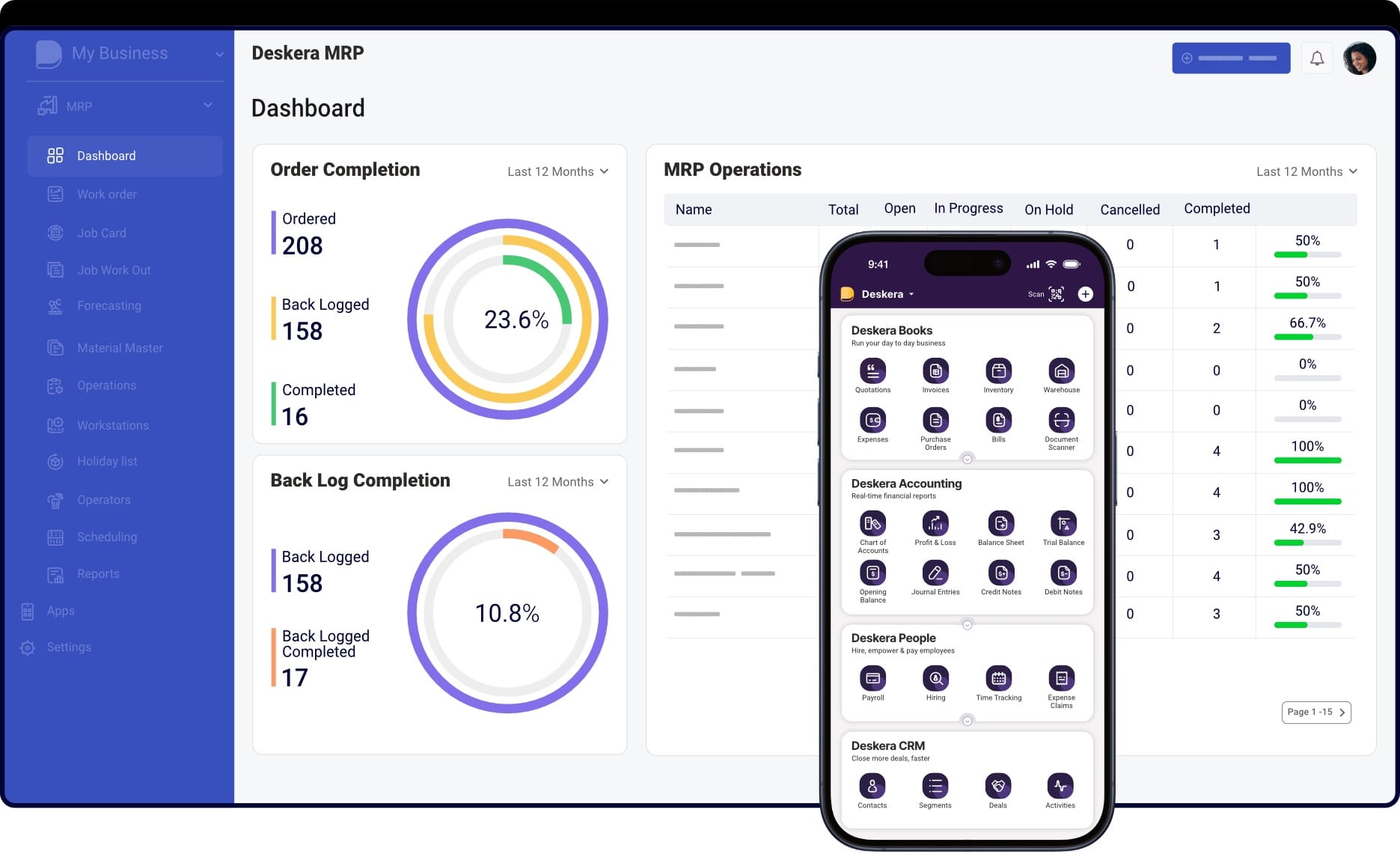
In modern manufacturing, tracking capacity planning metrics requires more than isolated data points—it demands a connected system that brings together production, inventory, and resource planning.
Deskera MRP enables this by offering end-to-end visibility into manufacturing operations. While it may not provide every advanced KPI as a built-in metric, it equips businesses with accurate data, structured workflows, and reporting tools to monitor, analyze, and improve capacity performance effectively.
Real-Time Production and Resource Visibility
Deskera MRP provides centralized dashboards that allow manufacturers to monitor production activities, work orders, and resource utilization in real time. This visibility helps identify inefficiencies, balance workloads across machines and work centers, and ensure that capacity is being used effectively without overloading or underutilization.
Production Planning and Scheduling
The platform supports demand-driven production planning and scheduling, enabling businesses to align manufacturing activities with available capacity. By optimizing schedules and resource allocation, it helps reduce idle time, avoid bottlenecks, and improve on-time delivery performance.
Work Order and WIP Tracking
Deskera MRP tracks work orders and work-in-progress (WIP) across different production stages. This structured tracking allows manufacturers to compare planned versus actual progress, identify delays, and derive key metrics such as cycle time and throughput from operational data.
Machine Monitoring and Downtime Analysis
Through machine tracking and maintenance features, Deskera MRP records uptime and downtime, helping businesses identify recurring issues and improve equipment reliability. While not a dedicated OEE tool, this data forms the foundation for analyzing equipment performance and efficiency.
Lead Time and Process Efficiency Insights
By capturing timelines across the production lifecycle, Deskera MRP enables businesses to monitor lead time and identify delays within workflows. These insights help streamline processes, reduce production time, and improve delivery commitments.
Integrated Inventory and Material Planning
Deskera MRP connects inventory management with production planning, ensuring that material availability aligns with capacity requirements. This reduces production disruptions caused by stock shortages and helps maintain a consistent production flow.
Custom Reporting and Performance Analysis
The system offers flexible reporting capabilities that allow manufacturers to analyze production trends, compare planned versus actual performance, and track capacity-related metrics such as utilization and output. Advanced KPIs can be derived using these reports for deeper insights.
Bottleneck Identification and Continuous Improvement
With visibility into workflows and resource usage, Deskera MRP helps identify bottlenecks and inefficiencies in the production process. This enables manufacturers to take corrective actions and continuously improve operational performance while maintaining optimal capacity utilization.
Key Takeaways
- Tracking manufacturing capacity planning metrics enables businesses to move from reactive decisions to proactive, data-driven operations.
- Monitoring resource utilization helps ensure machines, labor, and materials are used efficiently without overloading or underutilization.
- Aligning production capacity with demand reduces the risks of overproduction, stockouts, and missed delivery timelines.
- Identifying bottlenecks early allows manufacturers to maintain smooth workflows and prevent costly production delays.
- Measuring downtime and equipment performance improves maintenance planning and overall operational reliability.
- Using data-driven insights enhances decision-making across production planning, scheduling, and resource allocation.
- Optimizing capacity metrics leads to higher productivity and improved operational efficiency without increasing costs.
- Controlling and analyzing resource usage helps reduce waste and optimize overall production costs.
- Scalable capacity tracking ensures businesses can grow without losing control over operations or efficiency.
- Accurate capacity planning improves on-time delivery and strengthens customer satisfaction.
- Leveraging advanced metrics like OEE, throughput, and cycle time provides deeper insights into production performance.
- Tracking lead time and capacity variance helps improve planning accuracy and responsiveness to demand changes.
- Choosing the right metrics ensures focus on KPIs that directly impact business performance and strategic goals.
- Addressing challenges in tracking metrics improves data accuracy, consistency, and overall visibility.
- Implementing best practices ensures reliable, consistent, and scalable tracking of capacity planning metrics.
- Benchmarking against industry standards helps identify performance gaps and adopt best practices for improvement.
- Using tools like Deskera MRP enables centralized tracking, better visibility, and continuous improvement in capacity planning.
Related Articles
 Niti Samani
 Niti Samani
 Niti Samani
 Niti Samani
 Niti Samani
 Niti Samani