

Is customer growth actually getting more expensive—or are businesses simply tracking it the wrong way? In today’s hyper-competitive digital landscape, winning new customers often feels like a race against rising marketing costs, longer sales cycles, and shrinking margins. This is where Customer Acquisition Cost (CAC) steps in as a critical metric, helping businesses understand exactly how much they spend to turn prospects into paying customers—and whether that investment truly makes sense.
Customer Acquisition Cost goes far beyond marketing budgets. It reflects the combined impact of advertising spend, sales efforts, tools, technology, and operational resources used to acquire customers. Studies consistently show that acquiring a new customer can cost anywhere from five to twenty-five times more than retaining an existing one, making unchecked CAC a serious threat to profitability. Without visibility into CAC, even fast-growing companies risk scaling inefficiencies instead of sustainable growth.
This is why CAC has become a boardroom-level conversation. A rising CAC can signal deeper issues—inefficient campaigns, misaligned targeting, or broken sales processes—while an optimized CAC creates room for reinvestment, innovation, and long-term value creation. Understanding what drives CAC, why it matters, and how it connects to metrics like customer lifetime value (LTV) is essential for building resilient, growth-focused businesses.
Modern ERP platforms like Deskera ERP play a key role in managing and reducing CAC effectively. By centralizing sales, marketing, and financial data, Deskera ERP provides real-time visibility into acquisition costs and campaign performance. Businesses can track spend accurately, identify high-ROI channels, and streamline processes across teams. With built-in analytics and automation, Deskera ERP enables smarter decision-making that supports scalable growth without letting acquisition costs spiral out of control.
What Is Customer Acquisition Cost (CAC)?
Customer Acquisition Cost (CAC) is the total amount a business spends to acquire a single new customer. Simply put, it answers a critical question: How much does it cost to turn a prospect into a paying customer? CAC helps organizations evaluate the return on investment (ROI) of their marketing and sales efforts and is most effective when analyzed alongside Customer Lifetime Value (LTV) to understand long-term profitability.
At its core, CAC represents the resources, time, and money invested in winning a new customer relationship. While the metric is widely used across industries, it is especially important for SaaS, subscription-based, and growth-focused businesses, where acquisition efficiency directly impacts margins, cash flow, and scalability.
The basic formula for calculating CAC is straightforward:
CAC = Total Marketing & Sales Costs ÷ Number of New Customers Acquired
However, the accuracy of CAC depends entirely on what is included in “total costs.” A common and costly mistake is calculating CAC too narrowly—often limiting it to ad spend alone. In reality, CAC should reflect a fully loaded cost that includes every expense contributing to customer acquisition.
These costs typically include:
- Marketing and advertising expenses, such as paid campaigns, employee salaries, SaaS tools, analytics software, and creative production.
- Sales-related costs, including salaries, commissions, CRM and lead management tools, travel expenses, inventory upkeep, and prospect engagement activities.
- Creative and content production, covering design, copywriting, video, and other campaign assets.
- Software and technology subscriptions, such as marketing automation, SEO tools, analytics platforms, and social media management software.
- Introductory discounts and promotions, where reduced margins on first-time offers directly contribute to acquisition cost.
By accounting for all these elements, businesses move beyond surface-level metrics to calculate a true, comprehensive CAC. This level of accuracy is essential for informed budgeting, smarter resource allocation, and building sustainable growth strategies that scale profitably rather than just aggressively.
Factors Affecting Customer Acquisition Cost (CAC)
Customer Acquisition Cost (CAC) is influenced by a combination of strategic, operational, and market-driven factors. Understanding what drives CAC helps businesses control acquisition spending, improve efficiency, and scale sustainably. Below are the key factors that directly impact customer acquisition costs.
Marketing Channel Selection
Different acquisition channels come with vastly different costs. Paid advertising, influencer marketing, content marketing, SEO, partnerships, and events each have unique cost structures and conversion rates. Channels with higher competition or lower conversion efficiency tend to drive CAC up, while organic and referral-driven channels usually result in lower CAC over time.
Target Audience and Market Competition
Highly competitive markets and premium customer segments typically require higher spending to stand out. If your target audience is saturated with similar offerings, acquisition costs increase due to higher ad bids, longer decision cycles, and greater effort needed to differentiate your brand.
Sales Cycle Length
The longer it takes to convert a prospect into a customer, the higher the CAC. Extended sales cycles—common in B2B and enterprise models—require more touchpoints, sales effort, and follow-ups, all of which add to acquisition costs.
Conversion Rates Across the Funnel
Low conversion rates at any stage of the funnel—from lead generation to checkout or contract signing—can significantly inflate CAC. Improving landing pages, messaging, onboarding flows, and calls to action can reduce friction and lower acquisition costs.
Pricing and Value Proposition
If pricing does not align with perceived value, prospects may hesitate or drop off, increasing the cost per conversion. A clear, compelling value proposition paired with transparent pricing helps shorten decision-making and reduce CAC.
Brand Awareness and Trust
Well-known brands typically acquire customers at a lower cost because trust already exists. New or lesser-known brands often need to invest more in marketing, education, and credibility-building, which increases CAC in the early stages.
Marketing and Sales Team Efficiency
The effectiveness of your marketing and sales teams directly affects CAC. Poor targeting, inefficient processes, or lack of alignment between teams can lead to wasted spend and higher costs. Streamlined workflows, automation, and data-driven decision-making help improve efficiency.
Use of Technology and Tools
The tools you use—such as CRM systems, marketing automation platforms, analytics tools, and ERP software—play a significant role in CAC. While these tools add upfront costs, they often reduce CAC in the long run by improving targeting, attribution, and operational efficiency.
Customer Retention and Referrals
Strong retention and referral programs indirectly lower CAC by reducing dependence on paid acquisition channels. When existing customers advocate for your brand, the cost of acquiring new customers drops significantly.
Economic and Market Conditions
External factors such as economic downturns, changes in consumer behavior, or rising ad platform costs can increase CAC. Businesses must adapt acquisition strategies during these shifts to maintain efficiency.
By understanding and actively managing these factors, businesses can gain greater control over customer acquisition costs and create a growth strategy that balances efficiency, profitability, and long-term value.
How to Calculate Customer Acquisition Cost (CAC)
Calculating Customer Acquisition Cost (CAC) helps you understand how efficiently your business is turning spend into customers. While the formula itself is simple, getting an accurate CAC requires a structured approach and a clear understanding of which costs to include. Here’s how to calculate CAC step by step.
Step 1: Determine the Time Period
Start by defining the time frame you want to analyze. This could be a month, quarter, or year, depending on your business model and sales cycle. Choosing a consistent period ensures your costs and customer numbers align correctly and makes it easier to track trends over time.
Step 2: Identify and Add Up Customer Acquisition Costs
Next, calculate the total cost of acquiring customers during the selected period. This goes far beyond ad spend and should include all sales- and marketing-related expenses, such as:
- Marketing costs: advertising spend, campaign budgets, content creation, design, video production, SEO/SEM, and marketing tools or SaaS subscriptions
- Sales costs: salaries, commissions, bonuses, CRM tools, lead generation software, partnerships, travel, and prospecting expenses
- Support and onboarding costs: customer service or technical support involved in acquisition
- Overhead expenses: software licenses, office space, equipment, servers, and infrastructure
- Promotions and discounts: any margin sacrificed through introductory offers or first-time discounts
For a more accurate view, many businesses calculate a fully loaded CAC, which also includes salaries and overhead for anyone involved in the acquisition process.
Step 3: Count the Number of New Customers
Now, calculate the total number of new customers acquired during the same period. Only include first-time customers—not repeat buyers or retained accounts. This distinction is especially important for SaaS and subscription businesses, where retention and expansion are measured separately from acquisition.
Step 4: Apply the CAC Formula
Once you have both numbers, divide total acquisition spend by the number of new customers:
Customer Acquisition Cost (CAC) = Total Sales & Marketing Costs ÷ Number of New Customers Acquired
Example: If your company spent $150,000 on marketing and $100,000 on sales in a quarter and acquired 300 new customers, your CAC would be:
(150,000+100,000)÷300=833(150,000 + 100,000) ÷ 300 = 833(150,000+100,000)÷300=833
This means it cost $833 to acquire each new customer during that period.
Why Accuracy Matters
A narrowly defined CAC—one that ignores salaries, tools, or overhead—can paint a misleading picture of profitability. CAC is most valuable when tracked alongside Customer Lifetime Value (LTV), Average Order Value, or retention metrics. On its own, CAC shows cost efficiency; with context, it reveals whether your growth strategy is truly sustainable.
By consistently tracking CAC over time and analyzing trends, businesses can spot inefficiencies early, optimize acquisition channels, and make smarter decisions about scaling.
What Is a Good Customer Acquisition Cost (CAC)?
There’s no universal number that defines a “good” Customer Acquisition Cost (CAC). What’s considered healthy varies by industry, business model, pricing strategy, and customer behavior. Instead of looking at CAC in isolation, the most reliable way to evaluate it is by comparing it to Customer Lifetime Value (CLV).
CAC Is Relative, Not Absolute
A low CAC generally signals efficient customer acquisition, but low cost alone doesn’t guarantee profitability. If customers generate little revenue or churn quickly, even a modest CAC can be unsustainable. Likewise, a higher CAC may be perfectly acceptable if customers deliver strong long-term value. This is why CAC must always be assessed in context.
The CLV-to-CAC Ratio: The Real Benchmark
The most widely accepted benchmark for a healthy business is a CLV:CAC ratio of at least 3:1. This means that for every dollar spent acquiring a customer, the business earns roughly three dollars in return over the customer’s lifetime.
In practical terms, this suggests that around 30–35% of a customer’s lifetime value can be safely allocated to acquisition without harming profitability.
- Below 1:1 → Unsustainable (you’re losing money on each customer)
- Around 2:1 → Risky and cash-flow constrained
- 3:1 or higher → Healthy and scalable
- Above 5:1 → Potential underinvestment in growth
When a Higher CAC Is Justifiable
A higher CAC isn’t inherently bad—it can be strategic. Businesses with subscription models, strong retention, or high repeat purchase rates, such as SaaS companies or premium brands, can afford to spend more upfront because long-term revenue offsets the initial cost. In these cases, a higher CAC often reflects confidence in customer loyalty and lifetime value.
Higher CAC can also be justified during:
- Early-stage growth, when companies are building brand awareness
- Market expansion, where acquisition spend helps secure long-term positioning
- Highly competitive industries, where differentiation requires greater investment
As long as CLV significantly outweighs CAC and payback periods remain reasonable, higher acquisition costs can support long-term success.
What Really Defines a “Good” CAC
A good CAC is one that:
- Is lower than customer lifetime value
- Supports a healthy payback period
- Enables profitable and scalable growth
- Remains stable or improves over time
Rather than chasing a universally “low” CAC, successful businesses focus on optimizing the relationship between CAC, CLV, and profitability. When these metrics are aligned, CAC becomes not just a cost—but a strategic investment in sustainable growth.
Importance of Customer Acquisition Cost (CAC)
Customer Acquisition Cost (CAC) is one of the most important metrics for understanding how efficiently a business grows.
It directly links marketing and sales spending to real business outcomes, making it a key indicator of profitability, scalability, and long-term sustainability.
In fact, many businesses struggle—or even fail—not because they lack demand, but because they underestimate or mismanage their CAC.
1. Improves Marketing ROI and Channel Efficiency
CAC helps businesses measure the return on investment (ROI) of their customer acquisition efforts across different channels.
By comparing CAC across social media, paid ads, events, partnerships, or content marketing, companies can identify which channels deliver customers at the lowest cost.
This insight allows teams to shift budgets toward high-performing channels and eliminate inefficient spending, ensuring marketing investments generate measurable value.
2. Strengthens Profitability and Margins
Understanding CAC enables businesses to evaluate how much profit each customer actually generates. If the cost to acquire a customer exceeds—or comes close to—the value that customer brings, profitability suffers.
By tracking CAC, businesses can prioritize acquisition strategies that keep costs below customer value, protect margins, and improve overall financial performance.
3. Enables Sustainable Growth and Scalability
A well-optimized CAC makes growth predictable and scalable. When acquisition costs are controlled, businesses can confidently invest more in marketing and sales without disproportionately increasing expenses.
Conversely, a rising CAC signals that scaling efforts may be inefficient, putting pressure on cash flow and limiting expansion.
4. Optimizes the LTV-to-CAC Ratio
CAC is most powerful when analyzed alongside Customer Lifetime Value (LTV). A healthy LTV-to-CAC ratio—often benchmarked at 3:1 or higher—indicates that a business generates significantly more value from customers than it spends to acquire them. Monitoring this ratio helps businesses fine-tune acquisition strategies and ensure long-term viability.
5. Shortens Payback Periods
Every new customer initially represents a loss until the acquisition cost is recovered. CAC helps businesses determine how long it takes to break even on that investment.
Shorter payback periods improve cash flow, reduce risk, and allow companies—especially SaaS and subscription businesses—to reinvest faster in growth and innovation.
6. Supports Smarter Pricing Decisions
CAC plays a critical role in pricing strategy. Businesses must price products and services in a way that covers acquisition costs while remaining competitive.
If CAC rises without corresponding pricing adjustments or increased customer value, profitability erodes. Understanding CAC ensures pricing decisions are grounded in financial reality.
7. Guides Product and Market Fit Decisions
A consistently high CAC may indicate weak product-market fit, unclear messaging, or misaligned targeting. Product and growth teams can use CAC trends to identify whether acquisition challenges stem from marketing inefficiencies or deeper issues with the product itself, guiding improvements or strategic pivots.
8. Improves Budgeting and Resource Allocation
CAC provides clarity on where to allocate limited resources. By identifying the most cost-effective acquisition strategies, businesses can prioritize spending that delivers the highest return. This data-driven approach prevents waste and ensures marketing and sales budgets are used efficiently.
9. Enhances Financial Health and Cash Flow Management
Because CAC directly affects how much capital is required to grow, it plays a major role in overall financial health. High CAC can strain cash flow and delay profitability, while a lower CAC allows businesses to grow with less financial pressure and greater stability.
10. Increases Investor Confidence
Investors closely examine CAC to assess operational efficiency and growth potential. A clearly defined, well-managed CAC—especially when paired with strong LTV—signals a scalable and sustainable business model. Companies with controlled CAC are more attractive to investors and better positioned to secure funding.
In short, CAC is not just a marketing metric—it’s a business health indicator. When tracked accurately and used alongside complementary metrics, it empowers leaders to make smarter decisions, optimize growth strategies, and build a business that scales profitably over time.
Common Pitfalls to Avoid When Calculating Customer Acquisition Cost (CAC)
While the CAC formula appears simple, many businesses end up with misleading numbers due to incomplete or inconsistent calculations. These errors can distort decision-making, inflate perceived profitability, and lead to unsustainable growth strategies.
Below are the most common pitfalls to watch out for when calculating customer acquisition cost.
Excluding Key Acquisition Costs
One of the biggest mistakes is calculating CAC using only ad spend. Customer acquisition involves far more than paid campaigns—it includes sales salaries, commissions, software tools, creative production, agency fees, and onboarding support. Leaving out these costs results in an artificially low CAC that hides inefficiencies and weakens financial planning.
Failing to Align Costs and Customers to the Same Time Period
CAC must be calculated using costs and new customer counts from the same time frame. Mismatched data—such as monthly spend divided by quarterly customer numbers—can significantly skew results. This is especially problematic for businesses with long sales cycles or seasonal campaigns.
Counting the Wrong Type of Customers
CAC should include only new customers acquired, not repeat buyers, renewals, or upsells. Including existing customers lowers CAC inaccurately and masks true acquisition performance. In SaaS and subscription models, acquisition and retention metrics should always be measured separately.
Ignoring Sales Cycle Length and Lag Effects
Many businesses overlook the delay between marketing spend and customer conversion. In B2B or enterprise sales, deals often take months to close, meaning costs incurred today may not generate customers until later periods. Ignoring this lag can make CAC appear inflated or inconsistent.
Overlooking Discounts and Promotional Costs
Introductory discounts, free trials, and limited-time offers reduce initial revenue and should be treated as acquisition costs. When these incentives are excluded, businesses underestimate the true cost of winning customers—especially in competitive markets.
Using CAC in Isolation
CAC alone does not provide enough context. A low CAC can still be problematic if customer lifetime value (LTV) is low or churn is high. CAC should always be evaluated alongside LTV, payback period, and gross margin to assess sustainable growth.
Calculating CAC once is not enough. Failing to monitor CAC trends across channels, campaigns, and time periods can cause rising costs to go unnoticed until they begin eroding margins or straining cash flow.
Signs Your Customer Acquisition Cost (CAC) Is Too High
A rising Customer Acquisition Cost (CAC) is often an early warning sign that growth is becoming inefficient or unsustainable. While CAC varies by industry and business model, certain red flags consistently indicate when acquisition costs are out of control. Here are the most common signs your CAC may be too high—and why they matter.
Your CAC Is Higher Than Customer Lifetime Value (CLV)
If it costs more to acquire a customer than the revenue they generate over time, your business model is fundamentally unsustainable. Even strong top-line growth cannot compensate for negative unit economics in the long run.
Your LTV:CAC Ratio Falls Below 3:1
A healthy benchmark for most businesses—especially SaaS—is an LTV:CAC ratio of at least 3:1. Falling below this threshold suggests inefficient marketing spend, poor targeting, or weak retention.
Long Payback Periods
If it takes too long to recover your acquisition costs, cash flow pressure increases. Extended payback periods limit your ability to reinvest in growth and make scaling risky, particularly for subscription-based businesses.
Marketing Spend Keeps Increasing Without Proportional Growth
When customer growth plateaus while acquisition costs rise, it indicates diminishing returns from existing channels. This often points to audience saturation, ineffective messaging, or overreliance on paid campaigns.
Low Conversion Rates Across the Funnel
High CAC is frequently driven by weak conversion rates—whether at the ad, landing page, trial, or checkout stage. If large volumes of traffic fail to convert, acquisition costs naturally spike.
Heavy Dependence on Paid Advertising
An overreliance on paid channels like search or social ads can quickly inflate CAC, especially in competitive markets. Without strong organic, referral, or retention-driven growth, costs tend to escalate over time.
High Churn or Poor Customer Retention
When customers leave soon after acquisition, CAC effectively increases because the value of each customer declines. High churn often signals misaligned targeting, unmet expectations, or onboarding gaps.
Declining Profit Margins
Rising CAC directly eats into margins. If profitability continues to shrink despite revenue growth, acquisition inefficiencies are likely a contributing factor.
Inconsistent Performance Across Channels
If some channels deliver strong returns while others consistently underperform, blending CAC across all channels can hide inefficiencies. Persistently funding high-CAC channels without optimization drives overall costs higher.
Increased Pressure to Discount Heavily
Frequent promotions or steep first-time discounts may boost short-term conversions but often inflate CAC and reduce margins. Over time, this creates dependency and undermines long-term profitability.
Investors or Finance Teams Raise Concerns
When CAC becomes a recurring concern in financial reviews or investor discussions, it’s a clear signal that acquisition efficiency needs immediate attention.
Recognizing these signs early allows businesses to course-correct—by refining targeting, improving retention, optimizing channels, and aligning acquisition strategy with long-term value. Left unchecked, high CAC doesn’t just slow growth—it puts the entire business at risk.
Strategies to Reduce Customer Acquisition Cost (CAC)
Reducing Customer Acquisition Cost (CAC) is one of the most effective ways to improve profitability and build a scalable growth engine. The good news is that CAC isn’t fixed—it can be actively managed and optimized with the right strategies across marketing, sales, product, and customer experience.
Below are proven, practical strategies businesses use to lower CAC sustainably.
Align Your Strategy With Customer Buying Preferences
Start by meeting customers where they are. Today’s buyers increasingly prefer digital-first, self-serve, and remote interactions over traditional in-person sales.
Offering frictionless online buying experiences, embracing social and messaging platforms, and enabling customers to research, compare, and purchase on their own terms improves conversion rates and lowers acquisition costs.
Refine Targeting and Messaging
Precise targeting reduces wasted spend. By clearly defining your ideal customer profile and tailoring messaging to specific segments, you attract higher-intent leads who are more likely to convert. Better targeting leads to higher relevance, stronger engagement, and lower CAC across channels.
Optimize Conversion Rates Across the Funnel
Improving conversion rates is one of the fastest ways to reduce CAC. A/B testing landing pages, simplifying forms, optimizing page load speed, and creating frictionless checkout or signup experiences allow you to convert more users from the same traffic—without increasing spend.
Analyze Data to Maximize Marketing ROI
Track acquisition costs by channel instead of relying on blended averages. Identify which campaigns and platforms deliver the lowest CAC and highest returns, then reallocate budget accordingly. Monitoring metrics like CLV:CAC ratio and payback period ensures your acquisition strategy remains profitable as you scale.
Strengthen Customer Retention
Retaining customers is far more cost-effective than acquiring new ones. Strong onboarding, proactive support, loyalty programs, and personalized engagement reduce churn and increase lifetime value—making your acquisition spend work harder. High retention also fuels referrals, which significantly lowers CAC.
Leverage Content and Organic Channels
Content marketing, SEO, email marketing, and organic social media are long-term, low-cost acquisition channels. High-quality content that addresses customer pain points builds trust, attracts qualified traffic, and reduces dependence on expensive paid advertising over time.
Implement Referral and Word-of-Mouth Programs
Happy customers are powerful acquisition assets. Referral programs incentivize existing users to bring in new customers at a fraction of traditional acquisition costs. Referred customers often convert faster, churn less, and deliver higher lifetime value—driving down overall CAC.
Improve Lead Qualification and Sales Efficiency
Not all leads are equal. By improving lead qualification and focusing sales efforts on high-intent prospects, businesses avoid spending time and resources on low-probability conversions. Faster engagement and clearer handoffs between marketing and sales also reduce acquisition inefficiencies.
Use CRM and Automation Tools
CRM and marketing automation tools help centralize customer data, personalize outreach, track interactions, and identify patterns in high-performing customers. While these tools add upfront costs, they often reduce CAC by improving targeting, follow-ups, and overall acquisition efficiency.
Continuously Listen to Customer Feedback
Customer feedback directly impacts CAC. When products align closely with customer needs, conversions improve and churn declines. Sharing insights from sales calls, support tickets, and surveys with product and marketing teams ensures your offering evolves in line with customer expectations—lowering acquisition friction.
Reducing CAC is not about cutting spend blindly—it’s about spending smarter. By combining data-driven decision-making, customer-centric strategies, and operational efficiency, businesses can lower acquisition costs while accelerating sustainable growth.
How Deskera ERP Helps Control Customer Acquisition Cost (CAC)
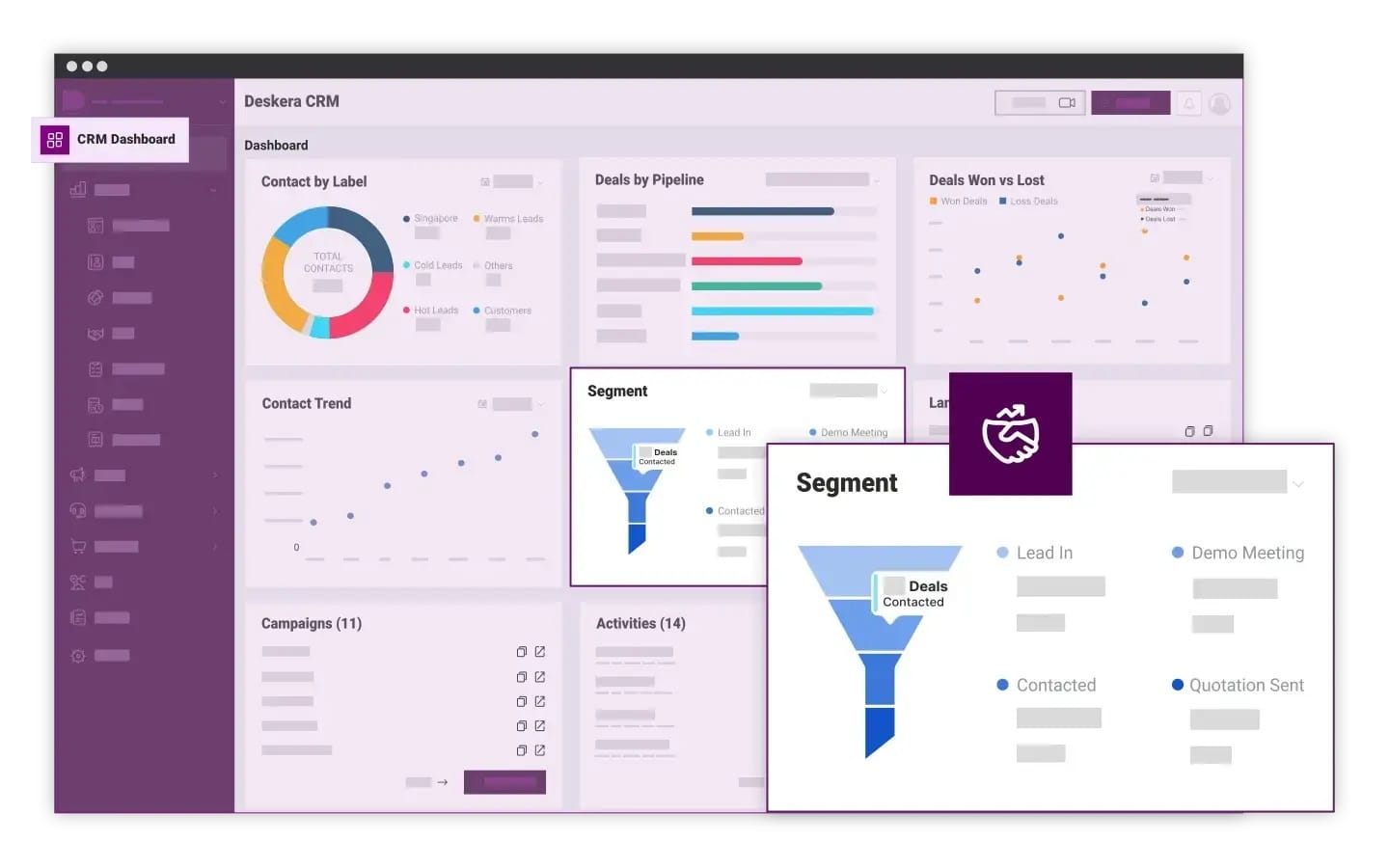
Managing Customer Acquisition Cost (CAC) effectively requires businesses to eliminate inefficiencies, improve visibility, and make smarter decisions across marketing, sales, and operations. Deskera ERP supports all of these goals by providing a unified platform that connects data, automates processes, and enhances collaboration—ultimately helping reduce the cost of acquiring new customers.
1. Centralized Customer Data and CRM Capabilities
Deskera ERP includes built-in CRM tools that let you track leads, segment audiences, and manage the entire sales pipeline from a single dashboard. With detailed customer profiles, interaction histories, and engagement insights, your team can tailor outreach more effectively, improve conversion rates, and reduce wasted marketing spend. Better targeting and personalized interactions directly contribute to lower CAC over time.
2. Automated Marketing and Sales Processes
Automation is key to reducing manual workload and speeding up customer acquisition. Deskera’s automation features—such as drip email campaigns, rule-based workflows, and lead nurturing sequences—help you engage prospects consistently without extra manual effort. This improves efficiency and allows your team to focus on high-impact activities that drive conversions while lowering labor costs tied to acquisition efforts.
3. Real-Time Analytics for Smarter Spend Optimization
Deskera ERP provides real-time reports and dashboards that give visibility into sales performance, campaign effectiveness, and customer behavior. These insights help you identify which channels deliver the highest ROI and which campaigns underperform, enabling you to reallocate marketing budgets toward efforts that reduce CAC. When acquisition costs are tracked and compared regularly, your team can make data-driven decisions to improve efficiency.
4. Streamlined Operations and Lower Overhead
By integrating accounting, financials, procurement, and inventory in one platform, Deskera ERP eliminates data silos and reduces operational redundancies. When departments share consistent information and workflows are automated, administrative costs decline and strategic resources can be redirected toward customer growth rather than repetitive tasks. This streamlined approach supports lower operational overhead, indirectly helping reduce CAC.
5. Enhanced Collaboration Across Teams
Deskera ERP’s unified system ensures that sales, marketing, finance, and support teams work from the same dataset, reducing miscommunication and delays. Faster decision-making and alignment across departments improve the effectiveness of acquisition strategies, enabling quicker responses to market changes and more coordinated campaigns—both of which help keep CAC in check.
6. Scalable Cloud Architecture for Cost Efficiency
As a cloud-based platform, Deskera ERP eliminates the need for heavy upfront IT infrastructure and ongoing maintenance costs. The subscription-based model allows businesses to pay for what they need and scale as they grow, which improves cash flow management and lowers total cost of ownership. More financial flexibility helps businesses invest strategically in acquisition without overextending budgets.
By centralizing customer management, automating key processes, and providing actionable insights, Deskera ERP not only helps lower Customer Acquisition Cost but also enhances overall business performance. In an increasingly competitive marketplace, these capabilities give businesses the visibility and agility needed to grow efficiently and profitably.
Key Takeaways
- Customer Acquisition Cost (CAC) measures the total sales and marketing spend required to acquire a single new customer and is a critical indicator of growth efficiency.
- CAC matters because acquiring new customers can cost 5–25 times more than retaining existing ones, making cost control essential for profitability.
- Calculating CAC accurately requires including all relevant marketing, sales, and overhead costs over a defined period to avoid misleading results.
- Common mistakes in CAC calculation—such as excluding indirect costs or misaligning timelines—often lead to underestimating the true cost of acquisition.
- CAC is influenced by multiple factors, including marketing channel mix, sales cycle length, target audience quality, competition, and conversion rates.
- Clear warning signs of high CAC include declining profit margins, slow payback periods, poor LTV-to-CAC ratios, and increased reliance on paid channels.
- Reducing CAC requires aligning strategies with customer buying preferences, improving conversion rates, optimizing ad spend, and strengthening customer retention.
- Data-driven optimization—through cohort analysis, funnel tracking, and performance monitoring—helps businesses focus on the most efficient acquisition channels.
- Increasing customer lifetime value (CLV) through upselling, cross-selling, and engagement makes acquisition costs easier to recover and sustain.
- Deskera ERP helps control CAC by centralizing customer data, improving lead management, automating sales and marketing workflows, and enabling better ROI tracking.
Related Articles
 Niti Samani
 Niti Samani
 Deskera Content Team
 Deskera Content Team
 Damini
 Niti Samani