

What do businesses do when a customer demands a completely customized product or a sudden change disrupts the production plan? The answer lies in flexibility—and that’s where an AdHoc Bill of Materials (BOM) comes into play. In today’s fast-moving manufacturing environment, relying solely on fixed and predefined BOMs can limit a company’s ability to respond to unique or time-sensitive requirements.
A Bill of Materials (BOM) is the backbone of any production process, detailing all the components, materials, and instructions needed to create a product. However, not every manufacturing scenario follows a standard path. This is where an AdHoc BOM becomes essential. Designed for one-time or highly specific use cases, it allows businesses to quickly create a customized list of materials without altering their standard production structures.
As industries increasingly move toward mass customization and agile manufacturing, the need for dynamic solutions like AdHoc BOMs continues to grow. Whether it’s for prototyping, handling urgent changes, or fulfilling unique customer demands, AdHoc BOMs enable businesses to stay responsive while maintaining operational efficiency. Understanding when and why to use them can significantly improve production planning and customer satisfaction.
Modern manufacturing ERP solutions like Deskera MRP make managing Adhoc BOMs seamless and efficient. With features such as real-time inventory tracking, automated production planning, and intelligent demand forecasting, Deskera helps businesses handle both standard and AdHoc manufacturing processes with ease. Its centralized system ensures accuracy, reduces manual errors, and provides actionable insights, enabling companies to adapt quickly without compromising control or visibility.
What is an AdHoc Bill of Materials (BOM)?
An AdHoc Bill of Materials (BOM) is a temporary, custom-created list of materials, components, and resources used for a specific production need or one-time requirement. Unlike a standard BOM, which is predefined and reused across multiple manufacturing cycles, an AdHoc BOM is created on demand to address unique situations without permanently changing the existing product structure.
It is typically used when businesses need flexibility in their operations—such as for custom orders, prototyping, urgent production changes, or repair jobs. For example, if a customer requests a product with slightly different specifications, a manufacturer can quickly create an AdHoc BOM instead of modifying the standard BOM.
The key advantage of an AdHoc BOM is its ability to support customization and rapid decision-making. However, since it is not standardized, it requires careful tracking to avoid issues related to inventory accuracy, cost estimation, and production consistency.
AdHoc BOM vs Standard BOM
Understanding the difference between an AdHoc BOM and a Standard BOM is essential for choosing the right approach in different manufacturing scenarios. While both serve the purpose of defining materials and components, they differ significantly in structure, usage, and intent.
In simple terms, a standard BOM is ideal for routine manufacturing where consistency and efficiency are critical, while an AdHoc BOM provides the flexibility needed to handle exceptions, custom orders, or rapid changes without disrupting existing production processes.
When Do Businesses Use an AdHoc BOM?
Businesses rely on an AdHoc BOM when standard production structures are too rigid to handle unique, time-sensitive, or non-recurring requirements. It serves as a flexible and practical solution for managing materials in situations where speed, customization, and adaptability are more important than following predefined processes.
Custom or Made-to-Order Products
AdHoc BOMs are widely used for customized or made-to-order products where each order has unique specifications. In such cases, the list of components, materials, and quantities may vary significantly from one customer to another. Instead of altering the standard BOM, manufacturers can quickly create an AdHoc BOM to fulfill specific requirements, ensuring accuracy while maintaining the integrity of core production data.
Prototyping and Product Development
During product development, engineering teams often experiment with different materials, components, or designs. AdHoc BOMs provide a safe and flexible way to test these variations without impacting the finalized BOM. This approach supports innovation and allows teams to validate product concepts efficiently before moving to large-scale production, reducing the risk of costly errors later.
Urgent Production Changes
Unexpected situations such as material shortages, supplier delays, or last-minute design changes can disrupt production schedules. AdHoc BOMs allow manufacturers to quickly substitute materials or adjust component lists without going through lengthy approval processes. This ensures production continuity and helps businesses respond effectively to unforeseen challenges without significant downtime.
Small Batch or One-Time Production
For small batch runs, pilot projects, or one-time manufacturing orders, creating a permanent BOM is often unnecessary. AdHoc BOMs provide a simple and efficient way to organize materials for such limited production scenarios. This reduces administrative effort while ensuring that all required components are accounted for during the production process.
Repair and Maintenance Jobs
In maintenance and repair operations, especially for older or customized equipment, predefined BOMs may not exist. AdHoc BOMs help technicians quickly identify and document the parts required for repairs. This is particularly useful when dealing with unique machine failures or component replacements, ensuring faster turnaround times and improved service efficiency.
Emergency or Breakdown Situations
During unexpected equipment breakdowns or operational disruptions, speed becomes critical. AdHoc BOMs enable teams to immediately list and source the necessary materials required for repairs or replacements. By providing a quick and organized approach, they help minimize downtime, restore operations faster, and reduce the financial impact of production interruptions.
Scenario Planning and Cost Analysis
Businesses often use AdHoc BOMs to create “what-if” scenarios for evaluating alternative materials, suppliers, or production methods. This allows decision-makers to estimate costs, analyze feasibility, and compare different approaches before finalizing a plan. Such flexibility supports better strategic planning and helps optimize production efficiency and profitability.
Overall, AdHoc BOMs are essential wherever flexibility and speed are more important than standardization.
Why Do Businesses Use an AdHoc BOM?
AdHoc BOMs are essential for organizations that need to remain flexible and responsive in a constantly evolving manufacturing environment. In fact, many manufacturers rely on flexible BOM structures to handle dynamic production needs, making AdHoc BOMs a critical tool for maintaining efficiency and competitiveness.
Improved Flexibility
AdHoc BOMs allow businesses to quickly adapt to changing production requirements without modifying the master BOM. Whether it involves adding new components, changing quantities, or substituting materials, these BOMs provide the flexibility needed to handle non-standard situations. This adaptability is crucial in industries where customer demands and supply conditions frequently change.
Faster Decision-Making
With an AdHoc BOM, teams can create and implement material plans almost instantly, without waiting for formal approvals or system updates. This accelerates production planning and enables faster responses to urgent demands. As a result, businesses can reduce delays, improve operational efficiency, and maintain smoother workflows even in dynamic environments.
Supports Customization
Customer expectations are increasingly shifting toward personalized products, and AdHoc BOMs make this possible. They allow manufacturers to tailor production processes to meet specific customer requirements without disrupting standard operations. This capability enhances customer satisfaction and helps businesses stay competitive in markets that demand high levels of customization.
Reduces Dependency on Standard BOMs
By using AdHoc BOMs for temporary or unique requirements, businesses can avoid making unnecessary changes to their standard BOMs. This helps maintain consistency and accuracy in core production data while still addressing exceptional scenarios. It also reduces the risk of errors and confusion that can arise from frequent modifications to standard structures.
Enhances Innovation
AdHoc BOMs support experimentation by allowing teams to test new ideas, materials, and production methods without long-term commitments. This is particularly valuable during research and development phases, where flexibility is essential. By enabling quick iterations and adjustments, AdHoc BOMs foster innovation and help businesses bring new products to market more efficiently.
Designed for Temporary Use
One of the key reasons businesses use AdHoc BOMs is their temporary nature. These BOMs are created for immediate, short-term needs and are not intended for repeated use. This ensures that standard BOM records remain clean and organized, while still allowing teams to handle exceptions effectively without adding unnecessary complexity to the system.
In essence, AdHoc BOMs empower businesses to stay agile, customer-focused, and responsive in dynamic manufacturing environments.
Advantages of AdHoc BOM
AdHoc BOMs offer significant advantages for businesses operating in dynamic and customer-driven manufacturing environments. By enabling flexibility and quick decision-making, they help organizations efficiently manage non-standard production scenarios without disrupting core processes.
Increased Operational Agility
AdHoc BOMs allow businesses to respond quickly to changing production requirements, market demands, or supply chain disruptions. Instead of being restricted by rigid structures, teams can adapt material lists instantly. This agility helps organizations maintain continuity, reduce delays, and stay competitive in fast-paced industries where responsiveness is critical.
Better Handling of Unique Orders
For businesses dealing with custom or engineer-to-order products, AdHoc BOMs provide a practical solution for managing unique requirements. Each order can have its own set of materials and specifications, and AdHoc BOMs ensure these are captured accurately without affecting standard BOMs. This leads to better execution of customized projects.
Faster Time-to-Market
Speed is a major advantage of using AdHoc BOMs. Since they can be created quickly without extensive approvals or system updates, production planning becomes faster. This reduces lead times and allows businesses to deliver products more quickly, which is especially valuable in competitive markets or when handling urgent orders.
Improved Customer Satisfaction
AdHoc BOMs enable businesses to meet specific customer requirements efficiently, whether it’s customization, urgent delivery, or unique configurations. By delivering exactly what customers need within shorter timelines, companies can enhance satisfaction levels, build stronger relationships, and improve customer retention.
Efficient Handling of Exceptions
Not all production scenarios follow a standard process, and exceptions are inevitable. AdHoc BOMs provide a structured yet flexible way to manage these exceptions, such as material substitutions or special requests. This prevents disruptions while ensuring that operations continue smoothly.
Simplified Process for Non-Standard Work
AdHoc BOMs eliminate the need to create complex, permanent BOM structures for temporary or one-off tasks. This simplifies workflows for non-standard production activities, reducing administrative burden and allowing teams to focus on execution rather than documentation.
Supports Rapid Experimentation and Innovation
In research, prototyping, and product development, AdHoc BOMs enable teams to experiment with different materials and configurations without long-term commitments. This flexibility encourages innovation and helps businesses refine their products before finalizing production designs.
Reduces Risk of Disrupting Standard BOMs
By isolating temporary changes within an AdHoc BOM, businesses can protect their standard BOM data from unnecessary modifications. This ensures consistency in routine production processes while still accommodating unique requirements, reducing the risk of errors or data inconsistencies.
Improved Cost Evaluation and Decision-Making
AdHoc BOMs can be used to quickly estimate costs for custom orders or alternative production scenarios. This helps decision-makers evaluate feasibility, compare options, and make informed choices before committing resources, ultimately improving financial planning and control.
Better Resource Utilization
By allowing flexible material selection and quick adjustments, AdHoc BOMs help businesses make better use of available resources. Teams can substitute materials based on availability or cost, reducing waste and optimizing inventory usage during production.
Challenges of Using an AdHoc BOM
While AdHoc BOMs provide flexibility and speed, they also introduce certain challenges that businesses must manage carefully. Without proper controls and systems in place, these temporary and non-standard structures can lead to inefficiencies, errors, and data issues.
Risk of Data Inconsistency
Since AdHoc BOMs are created outside standard processes, there is a higher risk of inconsistent or incomplete data. Different teams may define materials, quantities, or naming conventions differently, leading to confusion and inaccuracies. Over time, this can impact reporting, planning, and overall data reliability if not properly monitored.
Inventory Tracking Complexities
AdHoc BOMs can make inventory management more challenging, especially when materials are substituted or used outside predefined structures. This can lead to discrepancies between recorded and actual stock levels, making it harder to maintain accurate inventory visibility and increasing the risk of stockouts or overstocking.
Cost Estimation Difficulties
Accurate cost estimation becomes more complex with AdHoc BOMs, as they often involve non-standard materials or last-minute changes. Without predefined cost structures, it can be difficult to calculate production costs precisely, which may affect pricing decisions, profitability analysis, and financial planning.
Lack of Standardization
AdHoc BOMs do not follow a consistent structure, which can create challenges in maintaining uniformity across production processes. This lack of standardization may lead to inefficiencies, especially when scaling operations or analyzing performance across multiple projects.
Potential Errors Without Proper Systems
Manual creation of AdHoc BOMs increases the likelihood of human errors, such as incorrect quantities, missing components, or duplicate entries. Without robust systems like ERP software, these errors can lead to production delays, rework, or increased operational costs.
Limited Traceability and Documentation
Because AdHoc BOMs are often temporary, they may not always be well-documented or stored for future reference. This lack of traceability can make it difficult to track changes, audit past decisions, or resolve issues that arise later in the production process.
Integration Challenges with ERP Systems
If not properly managed, AdHoc BOMs may not integrate seamlessly with existing ERP or inventory systems. This can result in data silos, misalignment between departments, and reduced visibility across operations, ultimately affecting decision-making and coordination.
Difficulty in Scaling Operations
While AdHoc BOMs work well for one-off or small-scale production, relying on them too frequently can create inefficiencies when scaling operations. The absence of standardized processes can slow down production and make it harder to maintain consistency at higher volumes.
Compliance and Quality Control Risks
In industries with strict regulatory or quality requirements, using non-standard BOMs can pose compliance risks. Without proper validation and approval processes, there is a chance of using incorrect or non-compliant materials, which can affect product quality and lead to regulatory issues.
Best Practices for Managing AdHoc BOM
Managing AdHoc BOMs effectively requires a balance between flexibility and control. While these BOMs are designed for speed and customization, following structured best practices ensures accuracy, consistency, and minimal disruption to overall operations.
Maintain Proper Documentation
Even though AdHoc BOMs are temporary, maintaining clear and detailed documentation is essential. This includes listing all components, quantities, and reasons for deviations from the standard BOM. Proper records help teams track decisions, improve transparency, and provide a reference point for future similar requirements or audits.
Use Version Control for Changes
AdHoc BOMs often go through multiple revisions, especially in dynamic production environments. Implementing version control ensures that every change is tracked and documented systematically. This helps avoid confusion, prevents the use of outdated information, and ensures that all stakeholders are working with the most accurate and updated BOM version.
Integrate with Inventory Management Systems
To avoid stock discrepancies and ensure real-time visibility, AdHoc BOMs should be integrated with inventory management systems. This allows businesses to track material usage, update stock levels automatically, and reduce the risk of shortages or overstocking. Integration also improves coordination between procurement, production, and warehouse teams.
Standardize Approval Workflows
Even for temporary BOMs, having a structured approval process is critical. Standardized workflows ensure that all AdHoc BOMs are reviewed and validated before execution. This reduces the risk of errors, ensures compliance with internal policies, and improves accountability across departments involved in production.
Leverage MRP Software for Tracking and Accuracy
Using MRP software helps streamline the creation, tracking, and management of AdHoc BOMs. It provides real-time insights into material availability, automates calculations, and reduces manual errors. Advanced systems also support demand forecasting and reporting, enabling businesses to handle both standard and AdHoc production processes more efficiently and accurately.
Ensure Cross-Department Collaboration
AdHoc BOMs often involve multiple teams, including engineering, procurement, and production. Encouraging collaboration and clear communication between departments ensures that all requirements are accurately captured. This reduces misunderstandings, improves coordination, and leads to smoother execution of custom or urgent production tasks.
Regularly Review and Clean Up Temporary BOMs
Since AdHoc BOMs are created for short-term use, it is important to review and archive or delete them after completion. Regular cleanup prevents system clutter, maintains data accuracy, and ensures that only relevant and active BOMs are used in operations, improving overall system efficiency.
How Deskera MRP Helps You Manage AdHoc BOM
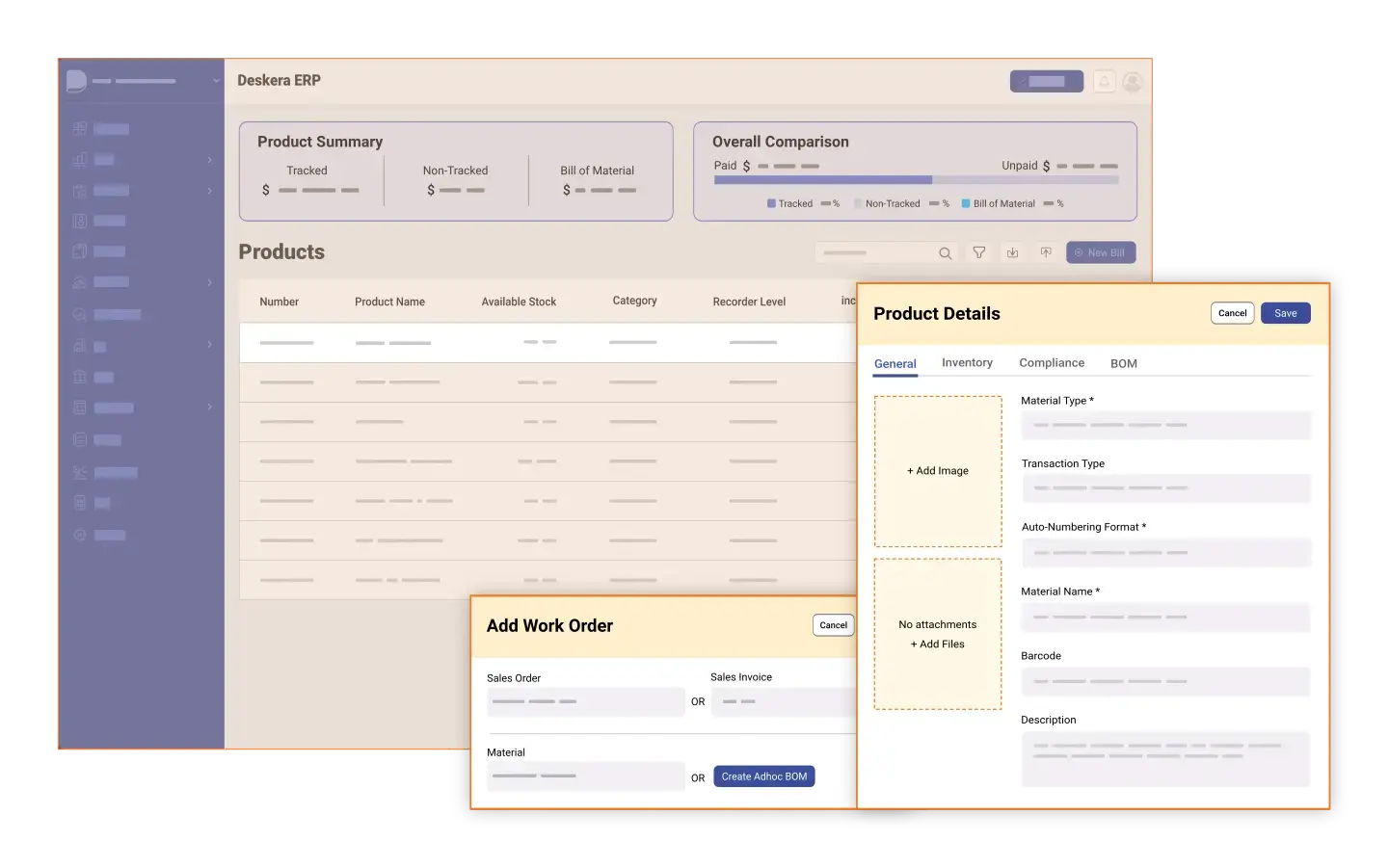
Managing AdHoc BOMs can be complex without the right tools, especially when dealing with custom orders, changing requirements, and tight deadlines. Deskera MRP simplifies this process by providing a centralized, intelligent system that enables businesses to create, manage, and track AdHoc BOMs efficiently without disrupting standard production workflows.
Create Temporary BOMs with Ease
Deskera MRP allows businesses to quickly create one-time, temporary BOMs for custom orders or non-standard production runs. This ensures that unique requirements can be handled efficiently without modifying or impacting the standard BOM database, maintaining data integrity while supporting flexibility.
Seamless Integration with Existing BOMs
AdHoc BOMs in Deskera can be easily integrated with existing BOM structures, providing a unified view of all production data. This ensures consistency across operations and allows teams to manage both standard and custom production processes within a single system.
Efficient Material Planning and Allocation
With Deskera MRP, businesses can plan and allocate materials accurately for AdHoc production runs. The system provides real-time visibility into inventory levels, helping avoid shortages or excess stock while ensuring that all required materials are available when needed.
Smart Production Scheduling
Deskera enables users to schedule and prioritize custom production runs based on resource availability and customer deadlines. This helps optimize production workflows, reduce bottlenecks, and ensure timely execution of AdHoc manufacturing tasks.
Accurate Cost Calculation
The platform helps calculate precise costs for custom orders by factoring in materials, labor, and overhead expenses. This allows businesses to price their products correctly, maintain profitability, and make informed financial decisions.
Real-Time Production Tracking
Deskera MRP provides real-time tracking of AdHoc production processes, allowing businesses to monitor progress, identify delays, and take corrective actions promptly. This improves operational visibility and ensures that projects stay on schedule.
Performance Analysis and Optimization
Businesses can analyze the performance of AdHoc BOMs to identify inefficiencies and areas for improvement. These insights help optimize processes, reduce waste, and enhance overall production efficiency over time.
Built-In Quality Control Measures
Deskera supports quality control by allowing businesses to incorporate checks and standards into AdHoc BOM workflows. This ensures that even custom or one-off products meet the required quality benchmarks.
Improved Inventory Management
By integrating AdHoc BOMs with inventory systems, Deskera helps maintain accurate stock levels during custom production runs. This reduces the risk of stockouts, overstocking, and material mismanagement.
Enhanced Customer Satisfaction
By enabling faster, more accurate handling of custom orders, Deskera MRP helps businesses deliver products on time and as per customer specifications. This leads to improved customer satisfaction, stronger relationships, and increased repeat business.
In essence, Deskera MRP empowers businesses to manage AdHoc BOMs with precision, flexibility, and full control—making it easier to handle custom production while maintaining efficiency and accuracy.
Key Takeaways
- An AdHoc BOM is a temporary, on-demand list of materials used for one-time or custom production needs without altering the standard BOM structure.
- Different BOM types serve different purposes, but AdHoc BOM stands out for its flexibility in handling non-standard and dynamic production scenarios.
- While standard BOMs ensure consistency and efficiency in repetitive production, AdHoc BOMs provide flexibility for unique, one-off requirements.
- AdHoc BOMs are defined by their temporary nature, high flexibility, and suitability for customization, prototyping, repairs, and urgent production needs.
- Businesses use AdHoc BOMs in scenarios like custom orders, prototyping, urgent changes, repairs, and small batch production where standard BOMs are not practical.
- AdHoc BOMs enable flexibility, faster decision-making, customization, and innovation while preserving the integrity of standard BOM data.
- They enhance agility, speed up production, improve customer satisfaction, support innovation, and simplify handling of exceptions and unique orders.
- Despite their benefits, AdHoc BOMs can lead to data inconsistencies, tracking issues, cost estimation challenges, and errors without proper systems.
- Effective management requires documentation, version control, system integration, standardized approvals, and the use of MRP tools for accuracy.
- Deskera MRP streamlines AdHoc BOM management through real-time tracking, accurate costing, efficient planning, and seamless integration with production and inventory systems.
Related Articles
 Niti Samani
 Rhema Hans
 Niti Samani
 Niti Samani
 RVJ
RVJ
 RVJ
RVJ