


Are you confident that your business has complete visibility and control over its finances? For many organizations, the answer is no. Financial data often sits across disconnected systems, spreadsheets, and departments, making it difficult to track performance from start to finish. This lack of integration weakens financial control, increases risk, and slows down decision-making—especially as businesses scale.
End-to-end financial control goes beyond basic accounting. It means having real-time visibility into budgets, costs, cash flow, and compliance across the entire organization. Without a centralized system, finance teams struggle with manual reconciliations, inconsistent reporting, and delayed insights, which can impact profitability and long-term planning.
This is where ERP systems play a transformative role. By unifying financial processes with core business operations such as procurement, inventory, and sales, ERP creates a single source of truth for financial data. This integration not only improves accuracy but also enables faster closes, better forecasting, and proactive financial governance.
Deskera ERP helps businesses achieve this level of financial control through an integrated, cloud-based platform. It brings accounting, reporting, and operational data together in real time, enabling finance teams to monitor performance, manage compliance, and make data-driven decisions with confidence. With scalable features and intuitive dashboards, Deskera ERP supports growing businesses in building a strong, transparent financial foundation.
What Is Financial Control?
Financial control refers to the set of policies, procedures, and mechanisms an organization uses to monitor, manage, and regulate its financial resources. Its primary purpose is to ensure that financial activities are carried out accurately, efficiently, and in alignment with business objectives, while safeguarding assets from misuse, errors, or fraud.
At its core, financial control supports resource management and operational efficiency. Organizations rely on financial controls to track how money is allocated and used across departments, projects, and geographies. These controls also ensure the accuracy and reliability of key financial statements—the income statement, balance sheet, and cash flow statement—which are critical for stakeholders such as investors, auditors, regulators, and management to assess financial health and performance.
Financial controls also serve as an essential risk management tool. By implementing measures such as segregation of duties, access controls, reconciliations, audits, and approval workflows, businesses can prevent, detect, and correct financial irregularities. These controls act as the first line of defense against fraud, misappropriation of assets, and reporting errors, while also supporting regulatory compliance and good corporate governance.
The scope of financial control is broad and organization-wide. It spans activities such as financial planning and budgeting, expense authorization, asset management, risk assessment, record keeping, and financial reporting. Financial controls can be preventive, detective, or corrective, and may be performed manually or through automated systems on a recurring or ad hoc basis. When managed effectively, financial control helps organizations improve accuracy, strengthen accountability, support growth, and maintain long-term financial stability.
Common Financial Control Challenges Without ERP
Managing financial control without an ERP system often means relying on disconnected tools, manual processes, and delayed reporting. As businesses grow, these limitations create gaps in visibility, accuracy, and governance—making it harder for finance teams to maintain control across the entire organization.
Data Silos and Lack of Real-Time Visibility
Without ERP, financial data is scattered across spreadsheets and standalone systems used by different departments. This fragmentation prevents real-time visibility into financial performance and makes it difficult to get a unified view of costs, revenues, and cash flow.
Manual Processes and Error-Prone Reporting
Many finance teams depend heavily on manual data entry and reconciliations. These processes are time-consuming and increase the risk of errors, inconsistencies, and delayed financial reporting, especially during month-end and year-end close.
Limited Control Over Costs and Budgets
Tracking expenses and budgets without ERP is often reactive rather than proactive. Finance leaders may only discover overspending after it occurs, limiting their ability to enforce budget controls and optimize resource allocation.
Difficulty in Managing Cash Flow
Without integrated systems, monitoring receivables, payables, and liquidity becomes challenging. This lack of visibility can lead to missed payments, strained vendor relationships, and unexpected cash shortages.
Compliance and Audit Challenges
In the absence of standardized controls and audit trails, ensuring regulatory compliance becomes complex. Preparing for audits often requires manual data collection, increasing the risk of non-compliance and audit findings.
Scalability and Governance Limitations
As organizations expand, financial control processes that rely on manual systems struggle to scale. This can weaken governance, slow decision-making, and expose the business to higher financial and operational risks.
Types of Financial Control in an ERP-Driven Environment
In an ERP-enabled organization, financial controls are no longer manual, isolated, or reactive. ERP systems embed controls directly into financial and operational workflows, ensuring that governance, accuracy, and compliance are maintained continuously and consistently across the enterprise.
Below is an ERP-aligned view of the key types of financial control, along with additional control layers enabled by modern ERP systems.
Preventive Controls (Built Into ERP Workflows)
Preventive controls in ERP systems act as the first and strongest line of defense by stopping errors and unauthorized actions before they occur. ERP platforms enforce role-based access controls, ensuring users can only view or perform tasks relevant to their roles. Segregation of duties (SoD) is system-enforced, preventing a single user from initiating, approving, and executing the same transaction.
ERP-driven pre-approval workflows automatically route high-value purchases, capital expenditures, or vendor payments to authorized managers. Transaction limits, mandatory validations, and automated checks further reduce the risk of fraud, overspending, and non-compliance—without slowing down operations.
Detective Controls (Real-Time Monitoring and Alerts)
ERP systems significantly strengthen detective controls by enabling continuous monitoring rather than periodic checks. Real-time dashboards, exception reports, and automated alerts help identify anomalies as they occur. For example, ERP-based account reconciliations quickly flag mismatches between ledgers and bank statements.
Built-in variance analysis compares actual performance against budgets and forecasts, helping finance teams detect cost overruns or revenue shortfalls early. ERP also supports internal and external audits by maintaining detailed logs and traceability, reducing audit effort while improving accuracy.
Corrective Controls (Automated Resolution and Learning)
Once issues are identified, ERP systems support fast and consistent corrective action. Automated adjustment entries, controlled reversal of transactions, and workflow-based corrections ensure errors are fixed promptly and transparently.
ERP platforms also support policy revisions by allowing organizations to update approval rules, access levels, or financial thresholds centrally. Integrated training and documentation modules help reinforce correct financial practices, reducing the likelihood of repeated control failures and strengthening long-term financial discipline.
Compliance and Governance Controls (ERP-Enforced Standards)
Modern ERP systems embed compliance into daily operations. Standardized accounting rules, automated tax calculations, regulatory reporting formats, and audit trails ensure financial activities comply with local and global regulations.
ERP-based governance frameworks ensure consistency across entities, locations, and currencies—especially important for growing or multi-entity organizations. This creates a controlled, auditable environment that supports strong corporate governance.
Data Integrity and Validation Controls
ERP systems include built-in data validation checks to ensure accuracy at the point of entry. Mandatory fields, standardized master data (vendors, customers, accounts), and automated matching rules reduce duplication and inconsistencies.
By maintaining a single source of truth, ERP ensures that financial reports, forecasts, and compliance outputs are based on reliable and up-to-date data—an essential pillar of end-to-end financial control.
Scalability and Future-Readiness Controls
ERP systems are designed to evolve with the business. As transaction volumes increase or new business models are introduced, ERP controls scale without manual rework. Scenario modeling, forecasting tools, and predictive analytics help organizations assess future risks, ROI, and control effectiveness.
This forward-looking control layer ensures that financial governance remains strong even as complexity grows.
Why ERP Is Essential for End-to-End Financial Control
By embedding preventive, detective, corrective, compliance, and data integrity controls directly into business processes, ERP systems transform financial control from a periodic task into a continuous, automated discipline.
This ERP-driven control framework not only reduces risk and errors but also enables faster decisions, stronger governance, and sustainable business growth.
12 Ways an ERP System Can Help with Financial Control
An ERP system plays a critical role in strengthening financial control by centralizing data, automating processes, and providing real-time visibility across the organization. By integrating finance with operations, ERP enables businesses to manage resources more effectively, reduce risk, and support informed decision-making at every level.
1. Real-Time Financial Reporting and Analysis
ERP systems provide real-time access to financial data across the organization, enabling finance teams and leadership to make timely, informed decisions. Instead of waiting for month-end reports, stakeholders can track revenue, expenses, margins, and cash flow as they occur.
This immediate visibility helps identify trends, detect anomalies, and respond quickly to market changes. With built-in dashboards and analytics, ERP transforms raw financial data into actionable insights, strengthening financial control and improving overall financial agility.
2. Centralized Financial Control
One of the biggest advantages of ERP is centralized financial management. By bringing accounts payable, accounts receivable, expenses, debts, and investments into a single system, ERP eliminates fragmented data sources.
This centralization ensures consistency in financial records, improves oversight, and reduces the risk of discrepancies. Finance leaders gain a unified view of the organization’s financial position, making it easier to enforce policies, monitor spending, and maintain control across departments and locations.
3. Improved Budgeting and Forecasting
ERP systems enhance budgeting and forecasting by providing a consolidated view of historical and real-time financial data. This allows organizations to create more accurate, data-driven budgets and forecasts.
Finance teams can track actual performance against budgets, identify variances early, and adjust forecasts as conditions change. With ERP, budgeting becomes a continuous process rather than a static annual exercise, enabling tighter cost control and better alignment between financial plans and business objectives.
4. Streamlined Financial Operations
By automating routine financial tasks such as data entry, reconciliations, approvals, and reporting, ERP significantly streamlines financial operations. This reduces manual effort, minimizes errors, and accelerates financial processes like month-end close.
As a result, finance teams can shift their focus from administrative work to analysis and strategic planning. Streamlined operations not only improve efficiency but also enhance financial control by ensuring processes are standardized and consistently followed across the organization.
5. Automated Financial Statements and Finance Modules
ERP finance modules automate the preparation of key financial statements, including income statements, balance sheets, and cash flow statements.
By integrating accounting, payroll, and operational data, ERP ensures that financial reports are accurate, up to date, and compliant with reporting standards.
Automation reduces dependency on manual calculations and spreadsheets, lowering the risk of errors. This reliability strengthens financial control and gives stakeholders confidence in the organization’s financial reporting.
6. Enhanced Cash Management and Cash Flow Visibility
Effective cash flow management is critical to financial control, and ERP systems provide detailed visibility into cash inflows and outflows. By tracking receivables, payables, and payments in real time, ERP helps businesses forecast liquidity and manage working capital more effectively.
Organizations can avoid cash shortages, optimize payment schedules, and improve collections. With accurate cash flow insights, finance teams can maintain tighter control over liquidity and support more confident financial decision-making.
7. Integrated Supply Chain Management
ERP integrates supply chain activities—such as procurement, inventory, and logistics—with financial data. This integration provides clear visibility into supply chain costs and their financial impact. Businesses can better manage supplier spending, optimize inventory levels, and reduce waste.
Improved coordination between finance and supply chain functions leads to more accurate cost tracking and stronger financial control. Ultimately, this helps organizations reduce operational costs and protect profit margins.
8. Stronger Customer Relationship Management (CRM)
ERP systems connect customer data with financial transactions, providing a complete view of customer profitability and payment behavior. This integration improves billing accuracy, accelerates invoicing, and supports effective credit management.
Finance teams can track outstanding receivables, reduce bad debts, and improve cash collection cycles. Stronger control over customer-related financial data helps organizations protect revenue, improve cash flow, and maintain healthier customer relationships.
9. Effective Inventory Management
Inventory has a direct impact on cash flow and profitability, making it a key area of financial control. ERP systems provide real-time inventory tracking and demand forecasting, helping businesses maintain optimal stock levels.
This reduces carrying costs, prevents overstocking, and minimizes stockouts. By aligning inventory data with financial records, ERP ensures accurate valuation and better cost control, supporting improved working capital management and financial stability.
10. Performance Monitoring and Business Insights
ERP systems consolidate data from across the organization to provide a holistic view of business performance. Finance leaders can track key performance indicators (KPIs), monitor progress against financial goals, and evaluate the impact of strategic initiatives.
These insights enable proactive management and early intervention when performance deviates from plan. With ERP-driven visibility, organizations can strengthen financial control while continuously improving operational and financial outcomes.
11. Reduced Financial Errors and Improved Compliance
ERP significantly reduces financial errors by automating processes and minimizing manual data entry. Built-in validation rules, approval workflows, and audit trails help ensure accuracy and consistency in financial records.
ERP also supports regulatory compliance by standardizing reporting and maintaining detailed documentation. This reduces the risk of penalties, audit issues, and financial misstatements, reinforcing trust in financial data and strengthening overall financial governance.
12. Scalability to Support Business Growth
As businesses grow, financial processes become more complex. ERP systems are designed to scale, supporting new locations, entities, currencies, and regulatory requirements without losing control.
This scalability ensures that financial controls remain consistent and effective even as operations expand. By adapting to changing business needs, ERP enables organizations to maintain strong financial discipline while supporting sustainable growth and long-term success.
Benefits of Using ERP Systems for Financial Control
Implementing an ERP system delivers significant advantages for organizations seeking stronger, more reliable financial control. By integrating financial and operational data into a single platform, ERP helps businesses improve accuracy, visibility, and governance across all financial processes.
Improved Financial Visibility
ERP provides a real-time, centralized view of financial data across departments and locations. This transparency enables finance teams to track performance, monitor costs, and manage cash flow more effectively, supporting faster and more informed decision-making.
Greater Accuracy and Reduced Errors
Automation of accounting processes minimizes manual data entry and duplication. Built-in validation checks and standardized workflows significantly reduce errors, ensuring that financial records and reports remain accurate and consistent.
Stronger Compliance and Governance
ERP systems support regulatory compliance through built-in controls, audit trails, and standardized reporting. This strengthens governance, simplifies audits, and reduces the risk of non-compliance or financial penalties.
Enhanced Budgeting and Cost Control
With access to real-time financial data, organizations can create more accurate budgets and monitor spending continuously. ERP helps identify variances early, enabling proactive cost control and better resource allocation.
Faster Financial Close and Reporting
ERP streamlines month-end and year-end close processes by automating reconciliations and consolidations. This reduces closing cycles and ensures timely, reliable financial reporting for stakeholders.
Better Cash Flow and Working Capital Management
ERP improves visibility into receivables, payables, and liquidity positions. This allows businesses to manage working capital more efficiently, optimize payment schedules, and maintain financial stability.
Scalable Financial Processes
As organizations grow, ERP systems scale with them—supporting additional users, entities, and geographies without compromising financial control. This ensures consistency and discipline even as complexity increases.
Data-Driven Strategic Decision-Making
By combining financial and operational insights, ERP empowers leadership with actionable intelligence. This supports strategic planning, risk management, and long-term financial performance improvement.
Overall, ERP systems act as a foundation for strong financial control, enabling organizations to operate with confidence, efficiency, and transparency.
Key Considerations When Implementing ERP for Financial Control
Successfully implementing an ERP system for financial control requires more than selecting the right software. Organizations must align technology, processes, and people to ensure the ERP delivers accurate financial visibility, compliance, and long-term value.
Align ERP Capabilities with Financial Objectives
Start by clearly defining your financial control goals—such as improving reporting accuracy, strengthening compliance, or gaining real-time visibility. The ERP system should support these objectives with the right finance, accounting, and reporting capabilities.
Standardize Financial Processes Before Implementation
ERP works best when financial processes are consistent across the organization. Standardizing workflows for accounting, approvals, and reporting before implementation reduces complexity, minimizes customization, and strengthens financial control.
Ensure Data Accuracy and Clean Migration
Accurate financial control depends on clean, reliable data. Before migrating to ERP, validate and cleanse existing financial data to avoid carrying errors into the new system. A structured migration plan is essential.
Focus on User Adoption and Change Management
Even the best ERP system fails without user adoption. Provide role-based training for finance and non-finance users to ensure correct usage, compliance, and consistent financial reporting.
Configure Strong Controls and Approval Workflows
ERP should be configured with appropriate access controls, segregation of duties, and approval hierarchies. These controls are critical for preventing errors, fraud, and unauthorized financial activity.
Plan for Scalability and Future Growth
Choose an ERP system that can scale with your business. As operations grow in size or complexity, financial controls should remain robust and adaptable without requiring major system overhauls.
Monitor, Review, and Optimize Continuously
ERP implementation is not a one-time effort. Regularly review financial processes, controls, and system performance to ensure they continue to support governance, efficiency, and strategic decision-making.
Taking these considerations into account helps organizations maximize the value of ERP while establishing strong, sustainable financial control.
How Deskera ERP Supports End-to-End Financial Control
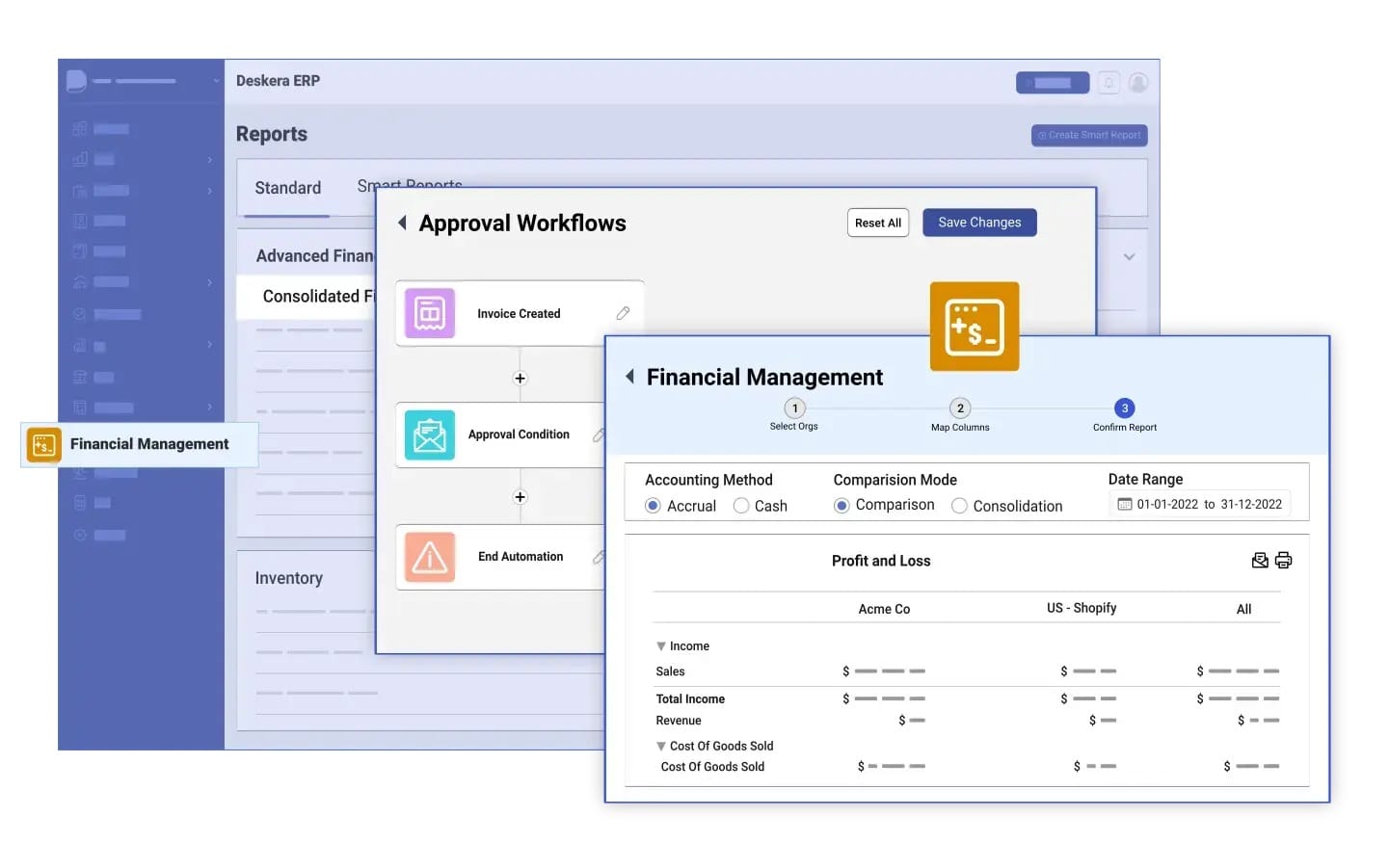
Deskera ERP enables businesses to achieve end-to-end financial control by unifying finance, accounting, and operational data within a single, cloud-based platform. By eliminating data silos and automating core financial processes, Deskera helps organizations gain real-time visibility, maintain accuracy, and strengthen governance across the entire financial lifecycle.
Centralized Finance and Accounting
Deskera ERP brings general ledger, accounts payable, accounts receivable, expenses, and taxation into one integrated system. This centralization ensures consistent financial data, reduces manual reconciliation, and provides a single source of truth for all financial activities.
Real-Time Financial Visibility and Reporting
With real-time dashboards and reports, Deskera ERP allows finance teams to monitor cash flow, expenses, revenues, and profitability as they happen. This immediate visibility supports faster decision-making and tighter financial control.
Automated Financial Processes
Deskera ERP automates routine tasks such as invoicing, expense tracking, journal entries, and reconciliations. Automation reduces errors, improves efficiency, and ensures financial processes are executed consistently and on time.
Budgeting, Forecasting, and Cost Control
Deskera ERP supports accurate budgeting and forecasting by linking financial plans with actual performance. Businesses can track variances, control costs proactively, and align spending with strategic goals.
Compliance, Audit Trails, and Controls
Built-in approval workflows, role-based access controls, and detailed audit trails help ensure compliance with regulatory requirements. Deskera ERP strengthens financial governance and simplifies audit preparation.
Scalability for Growing Businesses
Designed for scalability, Deskera ERP adapts as businesses expand across locations, entities, or markets. Financial controls remain robust and standardized, even as operational complexity increases.
Together, these capabilities make Deskera ERP a powerful solution for achieving comprehensive, end-to-end financial control while supporting accuracy, efficiency, and sustainable growth.
Key Takeaways
- Strong financial control ensures accurate reporting, protects assets, manages risk, and supports operational efficiency across the organization.
- Without ERP, data silos, manual processes, and delayed reporting weaken visibility, accuracy, and governance, increasing financial risk.
- ERP enables instant access to financial data, allowing businesses to respond quickly to trends, issues, and opportunities.
- By consolidating all financial activities into one system, ERP ensures consistency, transparency, and better oversight.
- Integrated financial data allows organizations to build realistic budgets, track variances, and adjust plans proactively.
- ERP reduces manual effort and errors by automating accounting, reconciliations, and reporting processes.
- Real-time insights into receivables, payables, and cash flow help improve liquidity and maintain financial stability.
- Linking finance with inventory, supply chain, CRM, and HR ensures end-to-end visibility and stronger cost control.
- Built-in controls, audit trails, and standardized workflows help meet regulatory requirements and minimize financial inaccuracies.
- ERP systems scale with the business, maintaining consistent financial control even as operations grow more complex.
- Successful ERP adoption depends on clean data, standardized processes, strong controls, and effective user adoption.
- Deskera ERP combines real-time visibility, automation, compliance, and scalability to support true end-to-end financial control.
Related Articles
 RVJ
RVJ
 Rhema Hans
 Niti Samani
 Deskera Bureau
 Niti Samani
 Niti Samani