
Ever wondered why some manufacturers deliver on time, every time, while others struggle with constant delays and rescheduling? The answer often lies in how effectively they manage production scheduling. Production scheduling in manufacturing is the process of deciding what to produce, when to produce it, and how to allocate resources so that orders are completed efficiently and on schedule. When done right, it becomes the backbone of smooth shop-floor operations.
At its core, production scheduling helps manufacturers translate production plans into actionable, time-bound tasks. It aligns machines, labor, and materials to ensure work orders move seamlessly through each stage of production. Without a clear schedule, even well-equipped factories face bottlenecks, idle resources, missed deadlines, and rising operational costs.
In today’s manufacturing landscape—marked by fluctuating demand, shorter lead times, and increasing customization—production scheduling is no longer a manual exercise. It requires real-time visibility, accurate data, and the ability to adapt quickly to disruptions. This is where modern MRP systems play a crucial role by bringing structure, predictability, and control to complex production environments.
Solutions like Deskera MRP are designed to simplify and strengthen production scheduling for manufacturers. Deskera MRP helps businesses create realistic production schedules by aligning demand forecasts with material availability and capacity. With features such as automated work orders, inventory synchronization, and real-time production tracking, it enables manufacturers to respond faster, reduce delays, and maintain consistent operational efficiency.
What Is Production Scheduling in Manufacturing?
Production scheduling in manufacturing is the process of defining when and in what sequence manufacturing activities should take place to achieve production goals efficiently. It focuses on organizing tasks, allocating resources, and setting deadlines for each stage of the production process so that operations run smoothly, on time, and within budget.
More than just a calendar of activities, production scheduling acts as a structured workflow plan. While production planning determines what needs to be produced, production scheduling translates those plans into actionable steps by deciding how and when each task should be executed. The objective is to maximize the use of available resources—machines, labor, and materials—while minimizing waste, delays, and costs.
The production scheduling process typically begins with the creation of a master production schedule (MPS). This high-level schedule outlines overall production targets and serves as a foundation for more detailed schedules. It takes into account critical business factors such as customer demand, inventory levels, material availability, production capacity, lead times, and cost constraints. The master schedule is then broken down into department-level or task-level schedules, ensuring that every team involved understands its responsibilities and required resources.
An effective production schedule is also flexible and adaptable. Manufacturing environments are dynamic, and changes such as demand fluctuations, supply chain disruptions, machine breakdowns, or labor shortages are inevitable. A good production schedule allows manufacturers to adjust plans quickly while minimizing disruption to the overall workflow and avoiding resource wastage.
A manufacturing production schedule usually includes several key components:
- Production orders detailing what products and quantities need to be produced
- Timelines specifying start and end times for each task
- Resource allocation covering machinery, labor, and materials
- Sequence of operations to ensure tasks are performed in the correct order
- Capacity utilization to prevent overloading or underusing resources
- Lead times for procurement and production steps
- Bottleneck identification to manage constraints that could slow down production
Depending on the production environment, scheduling can be applied at different levels, such as batch production, job scheduling, or continuous/flow production.
Regardless of the approach, the ultimate purpose of production scheduling is to ensure efficient operations, timely deliveries, optimal inventory levels, and consistent product quality—helping manufacturers meet both customer expectations and organizational goals.
Essential Components of a Successful Production Schedule
A production schedule does far more than assign deadlines to manufacturing tasks. An effective schedule brings together data from across the organization—demand forecasts, inventory levels, resource availability, and shop-floor capacity—to balance competing priorities without overextending operations.
When these components work in harmony, manufacturers can meet customer expectations while protecting margins and maintaining operational efficiency.
Resource Allocation
Resource allocation ensures that labor, machinery, materials, and tools are assigned to the right tasks at the right time. By aligning available resources with production requirements, manufacturers can prevent common issues such as machine idle time, labor shortages, or workflow bottlenecks. Effective allocation also helps optimize capacity utilization, ensuring that critical resources are neither underused nor overburdened.
Demand Management
Successful production scheduling depends on accurately aligning output with customer demand. This requires a combination of forecasting and real-time demand tracking to anticipate order volumes and delivery timelines. By continuously adjusting schedules based on demand signals, manufacturers can reduce the risk of overproduction, avoid stockouts, and respond more effectively to market fluctuations.
Inventory Control
Inventory control plays a critical role in keeping production on track without inflating carrying costs. Production schedules must be closely linked to raw material availability and component stock levels to prevent delays caused by shortages. At the same time, excess inventory ties up capital and increases storage costs. Balancing reorder points, safety stock, and supplier lead times helps maintain uninterrupted production while controlling expenses.
Sequencing of Operations
Sequencing determines the order in which production tasks are executed. Well-planned sequences group dependent operations logically while allowing independent tasks to run in parallel. This approach improves throughput, minimizes setup and changeover times, and makes it easier to identify and resolve bottlenecks. Effective sequencing also considers shop-floor layout and movement between workstations to reduce unnecessary delays.
Shop Floor Control
Once a production schedule is in place, consistent execution on the shop floor becomes essential. Shop floor control involves monitoring work-in-progress, tracking completed tasks, and responding quickly to disruptions such as equipment breakdowns or labor constraints. Continuous oversight allows managers to make real-time adjustments, ensuring schedules remain achievable even when conditions change.
Together, these components form the foundation of a resilient production schedule—one that adapts to change, maximizes resource efficiency, and keeps manufacturing operations aligned with business goals.
Production Scheduling vs Production Planning: What’s the Difference?
Production planning and production scheduling are closely connected, but they serve distinct purposes in the manufacturing process. Understanding the difference helps manufacturers improve efficiency, reduce delays, and meet delivery commitments more consistently.
What Is Production Planning?
Production planning is the strategic, high-level process that defines what needs to be produced and how it will be produced.
It focuses on:
- Determining production quantities based on demand forecasts
- Identifying required raw materials and components
- Planning labor, machines, and capacity
- Creating bills of materials (BOMs) and routing plans
- Aligning production goals with business objectives
In short, production planning answers the question: “What should we produce, in what quantity, and with which resources?”
What Is Production Scheduling?
Production scheduling is the operational, execution-focused process that determines when and in what order production activities will take place.
It focuses on:
- Assigning jobs to specific machines and workstations
- Sequencing tasks to minimize downtime and bottlenecks
- Allocating labor shifts and machine time
- Adjusting schedules for breakdowns, delays, or rush orders
- Ensuring on-time completion of production orders
Production scheduling answers the question: “When and in what sequence should we produce to meet deadlines efficiently?”
Key Differences at a Glance
How They Work Together
Production planning sets the foundation, while production scheduling brings the plan to life. A well-designed production plan without effective scheduling can lead to delays and inefficiencies, while scheduling without a solid plan results in resource conflicts and missed targets.
Together, they ensure:
- Optimal use of labor, machines, and materials
- Reduced production bottlenecks
- Improved delivery reliability
- Better alignment between demand and operations
Production planning defines the direction, and production scheduling controls the execution. Manufacturers that integrate both effectively gain greater visibility, agility, and control over their operations—key advantages in today’s fast-paced manufacturing environment.
Key Factors to Consider in Production Scheduling in Manufacturing
Effective production scheduling depends on carefully balancing resources, timelines, and operational constraints. By considering the right factors upfront, manufacturers can minimize delays, optimize utilization, and maintain consistent production flow while meeting customer commitments.
The following factors play a critical role in building reliable and adaptable production schedules.
Crew Management
Labor availability is a central consideration in production scheduling. Manufacturers must ensure the right number of skilled workers are available for each task without creating labor shortages or excess idle time. Crew management also extends to safety, shift planning, and job satisfaction—factors that directly influence productivity, morale, and long-term workforce retention.
Production Capacity
Understanding true production capacity is essential for creating achievable schedules. This includes machine capacity, labor hours, maintenance windows, and tooling availability. If capacity is overstated, schedules become unrealistic and lead to missed deadlines; if understated, resources remain underutilized. Accurate capacity planning helps align production output with demand.
Raw Material Availability
Without timely access to raw materials and components, production schedules quickly break down. Factoring in inventory levels, supplier lead times, and procurement cycles allows manufacturers to avoid shortages and reduce emergency purchasing. Early planning also helps secure materials at optimal cost and quality.
Workshop and Shop Floor Logistics
Shop floor logistics significantly influence scheduling efficiency. Equipment availability, plant layout, material handling processes, safety requirements, and space utilization all affect how smoothly work moves through production. Poor logistics planning can lead to congestion, delays, and unnecessary movement, disrupting even well-designed schedules.
Demand and Delivery Commitments
Customer demand and promised delivery dates set the pace for production scheduling. Accurate demand forecasting and clear visibility into order priorities help manufacturers sequence work effectively and meet service-level expectations. For dynamic scheduling environments, schedules must also account for demand fluctuations and urgent or expedited orders.
Problem-Solving and Flexibility
Production scheduling is inherently complex and must accommodate disruptions such as machine breakdowns, labor shortages, or transportation delays. Building flexibility into schedules and treating problem-solving as a core component helps manufacturers respond quickly to issues, reduce downtime, and continuously improve scheduling performance over time.
Documented and Standardized Processes
Documented scheduling processes enable consistency regardless of personnel changes. Standardization supports training, quality control, troubleshooting, and compliance with legal or regulatory requirements. Clear documentation also improves coordination across departments and ensures everyone follows the same scheduling framework.
Integration of Planning, Routing, and Execution
Successful production scheduling connects planning, routing, scheduling, and execution into a single, coordinated workflow. Production planning ensures materials and resources are available, routing defines the most efficient production path, scheduling aligns tasks within timelines, and execution focuses on monitoring and adjusting the plan in real time.
By considering these factors holistically, manufacturers can build production schedules that are realistic, resilient, and aligned with both operational capabilities and customer expectations.
Production Scheduling Process
The production scheduling process is a structured, iterative approach that helps manufacturers align customer demand with available resources while maintaining efficiency and control. Rather than being a one-time activity, it evolves continuously as conditions change on the shop floor, in the supply chain, or in the market.
Below is a clear, end-to-end view of how the production scheduling process typically works in manufacturing environments.
1. Gather Requirements and Inputs
The process begins with collecting all critical inputs needed to build a realistic schedule. This includes demand forecasting based on customer orders, historical sales data, and market trends. Manufacturers also assess current inventory levels of raw materials, components, and finished goods, along with the availability of machines, labor, and external vendors. Accurate inputs at this stage form the foundation of an achievable production schedule.
2. Define Objectives and Constraints
Next, manufacturers establish clear production objectives such as output targets, quality standards, and delivery deadlines. At the same time, constraints are identified—capacity limits, lead times, maintenance windows, labor availability, and budget restrictions. Recognizing these boundaries early helps prevent overcommitting resources and sets realistic expectations for production performance.
3. Break Down and Route the Production Process
The overall production workflow is then broken down into individual tasks or operations. This includes identifying any outsourced or vendor-dependent processes. Routing defines the most efficient and cost-effective path that materials follow from raw input to finished product, ensuring logical sequencing and minimizing unnecessary movement or delays.
4. Estimate Time and Allocate Resources
Each task is assigned estimated processing times, including setup, run, changeover, and lead times for outsourced activities. Resources—machinery, labor, materials, and vendors—are allocated based on availability and skill requirements. This step ensures that every operation has the capacity and inputs needed to proceed without disruption.
5. Develop the Preliminary Schedule
Using the defined tasks, time estimates, and resource allocations, a preliminary production schedule is created. This schedule sequences tasks while checking against capacity constraints to ensure feasibility. Manufacturers also set promise or “drop-dead” dates to ensure production aligns with customer delivery commitments.
6. Optimize the Schedule
Before finalizing, the schedule is analyzed for bottlenecks, overloaded work centers, or inefficient task sequencing. Adjustments may include balancing workloads, reducing setup times, rescheduling tasks, or reallocating resources. The goal is to maximize throughput while maintaining flexibility and cost control.
7. Finalize the Production Schedule
The optimized schedule is reviewed with key stakeholders such as production managers, supervisors, procurement teams, and sales. After incorporating feedback, start and end dates for each task are finalized, ensuring alignment with production goals and customer requirements.
8. Communicate and Implement
Clear communication is critical to execution. The finalized schedule is shared across all relevant departments, often using visual tools such as Gantt charts, dashboards, or production boards. Once communicated, production begins according to the schedule, with teams working toward defined milestones.
9. Monitor and Adjust in Real Time
During execution, managers continuously monitor progress against the schedule. Key performance indicators such as on-time delivery, throughput, and resource utilization are tracked. When disruptions occur—equipment failures, supply delays, or demand changes—the schedule is adjusted in real time to minimize impact.
10. Review and Improve
After production is completed, performance is reviewed to identify gaps, inefficiencies, and improvement opportunities. These insights feed back into future scheduling cycles, supporting continuous improvement and higher levels of operational performance.
Overall, the production scheduling process brings structure to manufacturing complexity. By following a disciplined, repeatable approach—and refining it continuously—manufacturers can achieve greater efficiency, adaptability, and reliability in meeting customer demand.
Types of Production Scheduling in Manufacturing
Manufacturers use different production scheduling methods depending on product type, demand patterns, capacity constraints, and delivery commitments. Each approach is designed to balance resources, timelines, and operational complexity.
Below are the most common types of production scheduling used in manufacturing.
Capacity-Based Scheduling
Capacity-based scheduling focuses on aligning production plans with available resources to ensure feasible and realistic schedules.
- Infinite Capacity Scheduling: This method assumes unlimited availability of labor, machines, and materials. While it simplifies planning, it can lead to overloaded work centers if used in isolation. Infinite capacity scheduling is often applied during high-level planning or in environments managing a small number of large, concurrent projects.
- Finite Capacity Scheduling: Finite capacity scheduling accounts for real-world constraints such as machine hours, labor availability, maintenance windows, and material limits. It produces more accurate and achievable schedules, making it ideal for complex manufacturing operations with multiple overlapping orders.
Forward and Backward Scheduling
These methods determine production timelines based on either the start point or the delivery deadline.
- Forward Scheduling: Forward scheduling starts production as soon as resources are available and moves tasks sequentially toward completion. It is commonly used for standard or make-to-stock products, helping maximize equipment utilization and keep production lines running continuously.
- Backward Scheduling: Backward scheduling begins with the customer’s required delivery date and works backward to determine when each task should start. This approach is best suited for custom or make-to-order products with strict deadlines, as it reduces excess inventory and ensures on-time delivery.
Static and Dynamic Scheduling
The level of complexity and variability in production often determines whether static or dynamic scheduling is used.
- Static Scheduling: Static scheduling assumes production conditions will remain unchanged once the schedule is created. It works well for predictable, low-variation environments where all inputs are secured before production begins.
- Dynamic Scheduling: Dynamic scheduling continuously adapts to changes such as new orders, machine downtime, labor shortages, or shifting priorities. This approach typically relies on advanced manufacturing software and is essential for complex, high-mix production environments.
Flow Scheduling
Flow scheduling is used in continuous or highly standardized production processes involving numerous steps and components. Common in industries such as automotive and aerospace, it focuses on maintaining a smooth production flow while minimizing bottlenecks and delays across interconnected operations.
Mass Production Scheduling
Mass production scheduling supports high-volume manufacturing where large quantities of identical products are produced. Machines are typically dedicated to specific products, and scheduling emphasizes throughput, speed, and efficient material movement to meet demand at scale.
Process Manufacturing Scheduling
Process manufacturing scheduling applies to industries that produce goods based on formulas or recipes, such as chemicals, fuels, pharmaceuticals, and food processing. Each step is a controlled subprocess, and schedules must ensure consistency, compliance, and tight quality standards.
Batch Production Scheduling
Batch scheduling organizes production into groups or lots produced together. It is widely used in food and beverage manufacturing and discrete manufacturing environments where consistency, quality control, and cost efficiency depend on producing standardized batches.
Job or Project-Based Scheduling
Job scheduling plans production for single, customized items or small lot sizes. Common in CNC machining and engineer-to-order environments, this method focuses on unique specifications, routing paths, and resource requirements for each job.
Just-in-Time (JIT) Scheduling
Just-in-time scheduling produces goods only when there is actual customer demand. This approach minimizes inventory holding costs but requires reliable suppliers, precise coordination, and stable demand patterns to avoid production disruptions.
Hybrid Scheduling Approaches
Most manufacturers use a combination of scheduling methods to meet diverse operational needs. For example, forward scheduling may be used for standard products, while backward scheduling supports custom orders. Hybrid approaches provide flexibility and allow manufacturers to adapt scheduling strategies to different product lines and market conditions.
Choosing the right production scheduling method—or combination of methods—helps manufacturers improve efficiency, meet delivery commitments, and respond effectively to changing business demands.
Benefits of Production Scheduling in Manufacturing
Production scheduling delivers far-reaching advantages that go beyond setting timelines on the shop floor. By bringing structure, visibility, and coordination to manufacturing operations, it helps organizations optimize resources, reduce risk, and consistently meet business and customer expectations.
Below are the key benefits of production scheduling in manufacturing.
Improved Inventory Management
Production scheduling provides clear visibility into raw material, work-in-progress, and finished goods inventory. By aligning production plans with actual demand, manufacturers can maintain optimal stock levels, avoid excess inventory, and reduce carrying costs. It also enables timely replenishment, ensuring materials are available when needed without overstocking.
Prevention of Stockouts and Production Delays
With detailed insights into material requirements, lead times, and production duration, production scheduling helps manufacturers proactively prevent stockouts. Anticipating shortages in advance allows teams to reorder materials on time, maintain safety stock, and keep production running without costly interruptions.
Better Workforce Planning
Production schedules make staffing needs more predictable. By forecasting labor requirements ahead of time, manufacturers can ensure adequate workforce availability across shifts while avoiding overtime and underutilization. Effective crew management also supports safer working conditions and higher employee satisfaction.
Optimized Resource Utilization
A well-structured production schedule ensures machines, labor, and materials are used efficiently. Balanced workloads, reduced idle time, and minimized setup or changeover delays help manufacturers maximize capacity without overloading resources. This leads to smoother operations and higher overall productivity.
Increased Operational Efficiency
When tasks, resources, and timelines are clearly defined, manufacturing processes become more streamlined. Production scheduling reduces uncertainty, minimizes rework, and enables faster decision-making. As a result, both human and machine productivity improve, driving better throughput and lower operational costs.
Stronger Risk Management and Flexibility
Production scheduling helps identify potential risks—such as capacity constraints, supplier delays, or equipment downtime—before they disrupt operations. Built-in flexibility allows schedules to be adjusted quickly when unexpected events occur, minimizing the impact of disruptions and maintaining continuity.
Improved Delivery Performance
Accurate production schedules enable manufacturers to commit to realistic delivery dates and meet them consistently. Reliable on-time delivery strengthens customer trust, improves service levels, and provides a competitive advantage in markets where dependability matters.
Enhanced Communication and Transparency
A shared production schedule keeps all departments aligned, from procurement and production to sales and logistics. Real-time visibility into progress and potential issues improves collaboration, accelerates problem resolution, and builds accountability across teams.
Higher Product Quality
By coordinating planning, execution, and quality checks, production scheduling supports consistent production standards. Materials and processes are tracked throughout the workflow, making it easier to maintain quality, meet compliance requirements, and trace issues back to their source when needed.
Greater Customer Satisfaction and Business Performance
Ultimately, production scheduling helps manufacturers deliver the right products, at the right time, and at the right cost. Improved reliability, efficiency, and quality lead to higher customer satisfaction, repeat business, and stronger overall profitability.
Together, these benefits make production scheduling a critical capability for manufacturers aiming to operate efficiently, scale sustainably, and compete effectively in dynamic markets.
Tips for Optimizing Production Scheduling in Manufacturing
Optimizing production scheduling is essential for maintaining agility, improving efficiency, and responding effectively to change. As manufacturing environments become more complex, schedules must be flexible, data-driven, and well-coordinated across teams.
The following tips can help manufacturers strengthen their production scheduling practices and achieve more consistent results.
Embrace Dynamic Scheduling
Static schedules quickly become outdated in real-world manufacturing environments. Dynamic scheduling allows production plans to adapt to changes in demand, resource availability, labor capacity, and supply chain conditions. Building flexibility into schedules helps manufacturers respond to disruptions without derailing overall operations.
Prioritize Work-in-Progress (WIP)
Not all jobs require immediate attention. Clearly defining and controlling work-in-progress ensures that only high-priority and time-sensitive orders are actively in production. This reduces congestion on the shop floor, shortens lead times, and keeps critical orders on track.
Plan Around Delivery Commitments
Effective schedules are driven by delivery requirements rather than just due dates. Working backward from customer delivery dates helps ensure that production, inspection, and shipping activities are aligned. Prioritization should consider both urgency and resource availability to avoid last-minute delays.
Manage Inventory and Material Availability
Optimized scheduling depends on having the right materials at the right time. Coordinating production schedules with inventory planning and supplier deliveries minimizes confusion, prevents stockouts, and reduces excess inventory. This alignment supports smoother production flow and better cash-flow management.
Maintain Equipment and Facilities
Reliable equipment is a prerequisite for effective scheduling. Regular maintenance and timely repairs reduce unplanned downtime and safety risks. Scheduling preventive maintenance during low-demand periods helps protect production capacity while keeping operations running smoothly.
Leverage Real-Time Data
Real-time visibility into shop floor performance enables faster and more informed decision-making. Monitoring metrics such as machine status, order progress, cycle times, and downtime allows teams to spot issues early and adjust schedules before small problems escalate.
Automate Scheduling Where Possible
Automation reduces manual effort and minimizes the risk of human error. Production scheduling software can automatically recalculate timelines when orders change, balance workloads, and notify teams of updates. This frees planners to focus on strategic improvements rather than routine adjustments.
Apply Lean Manufacturing Principles
Lean principles help eliminate waste, reduce setup and changeover times, and improve flow. Applying these principles to production scheduling leads to simpler, more efficient schedules that maximize value while minimizing non-productive activities.
Foster Cross-Department Collaboration
Effective scheduling requires input from sales, procurement, production, and logistics. Regular communication with suppliers and customers improves demand visibility, reduces lead times, and helps identify potential issues early. Cross-functional alignment ensures schedules reflect operational reality.
Use Visual Scheduling Tools
Tools such as Gantt charts, dashboards, and digital production boards make schedules easier to understand and manage. Visual representations improve transparency, support faster updates, and ensure everyone stays aligned as conditions change.
Continuously Review and Improve
Production scheduling is an ongoing process, not a one-time setup. Regularly reviewing performance data, identifying bottlenecks, and refining scheduling rules helps manufacturers unlock deeper efficiency gains over time.
By combining flexibility, real-time data, collaboration, and the right tools, manufacturers can optimize production scheduling to improve reliability, reduce costs, and stay competitive in fast-changing markets.
Production Scheduling KPIs: Metrics That Measure Scheduling Effectiveness
Production scheduling KPIs help manufacturers evaluate how well their schedules are performing in real-world conditions. The right KPIs reveal whether production timelines are realistic, resources are being used efficiently, and customer commitments are being met. More importantly, they highlight where adjustments are needed to reduce delays, waste, and inefficiencies.
Below are some of the most important KPIs used to assess production scheduling performance.
1. On-Time Delivery (OTD)
On-time delivery measures the percentage of orders completed and delivered by the promised date. It is one of the clearest indicators of scheduling accuracy and reliability.
- High OTD indicates realistic schedules and smooth execution
- Low OTD often signals capacity constraints, poor sequencing, or frequent disruptions
Why it matters: Directly impacts customer satisfaction and brand credibility.
2. Production Performance
This KPI evaluates whether manufactured goods meet expected quality, quantity, and performance standards.
- Assesses how closely actual output aligns with planned output
- Highlights gaps between scheduling assumptions and real production conditions
Why it matters: A schedule that meets deadlines but compromises quality is not truly effective.
3. Cycle Time
Cycle time measures the total time required to produce a product from start to finish, including processing, waiting, and transfer time.
- Shorter cycle times generally indicate efficient scheduling
- Longer cycle times may point to bottlenecks, idle time, or poor task sequencing
Why it matters: Faster cycle times improve responsiveness to demand changes and reduce lead times.
4. Production Efficiency
Production efficiency compares actual output to expected or standard output within a given time period.
- Reveals whether schedules are achievable with available resources
- Highlights underutilization or overloading of labor and machines
Why it matters: Helps ensure schedules are both ambitious and realistic.
5. Capacity Utilization
Capacity utilization measures how much of your available production capacity is actually being used.
- Low utilization suggests inefficient scheduling or demand mismatches
- Excessively high utilization may increase breakdowns and burnout
Why it matters: Balanced capacity use supports consistent output and long-term operational stability.
6. Downtime
Downtime tracks the amount of time machines or labor are idle due to breakdowns, changeovers, material shortages, or scheduling gaps.
- Planned vs. unplanned downtime provides insight into schedule resilience
- High downtime often indicates poor coordination between planning and execution
Why it matters: Reducing downtime lowers costs and increases throughput.
7. Waste Rate
This KPI measures the amount of scrap, rework, or material loss generated during production.
- Lower waste rates indicate efficient scheduling and stable processes
- High waste may result from rushed schedules, frequent changeovers, or poor routing
Why it matters: Supports cost control, sustainability goals, and quality improvement.
Production scheduling KPIs transform schedules from static plans into measurable, improvable systems. By tracking metrics like on-time delivery, cycle time, capacity utilization, and waste, manufacturers gain the insights needed to fine-tune schedules, respond to disruptions faster, and consistently meet both operational and customer expectations.
How Deskera MRP Helps with Production Scheduling
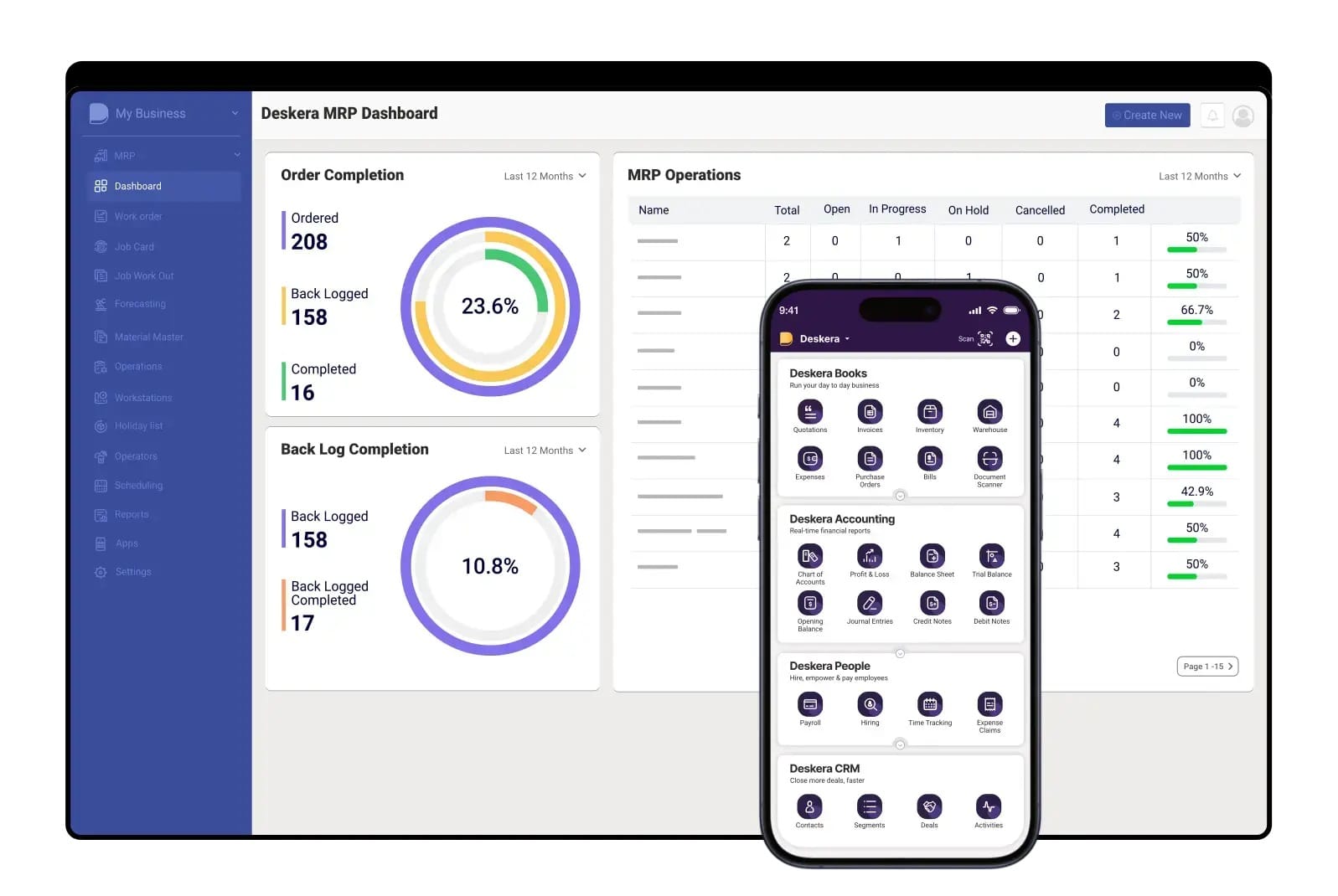
Effective production scheduling requires real-time visibility, accurate planning data, and the flexibility to adapt when conditions change. Deskera MRP brings these elements together by connecting demand, resources, and shop floor execution within a single system—making production schedules more reliable and easier to manage.
Here’s how Deskera MRP supports smarter production scheduling:
Centralized Production Planning and Scheduling
Deskera MRP enables manufacturers to create and manage production schedules from a centralized dashboard. By aligning sales orders, forecasts, and work orders in one place, teams can build schedules that reflect actual demand and operational capacity rather than assumptions.
Real-Time Capacity and Resource Visibility
The system provides clear visibility into machine availability, labor capacity, and work center loads. This helps planners allocate resources realistically, avoid overloading critical equipment, and reduce bottlenecks before they impact delivery timelines.
Bill of Materials (BOM) and Routing Integration
Deskera MRP links production schedules directly to BOMs and routings. This ensures that each job is scheduled with the correct materials, machines, and process steps, reducing errors and preventing last-minute disruptions caused by missing components or incorrect sequencing.
Inventory-Driven Scheduling
By syncing inventory levels with production plans, Deskera MRP helps ensure raw materials and components are available when needed. Automated alerts for low stock and reorder points prevent material shortages that can delay production schedules.
Dynamic Rescheduling and Shop Floor Control
Unexpected disruptions—such as machine breakdowns or urgent orders—are inevitable. Deskera MRP allows manufacturers to quickly adjust schedules based on real-time shop floor data, helping teams respond without derailing overall production targets.
Performance Tracking and Scheduling KPIs
Deskera MRP tracks key scheduling-related KPIs such as on-time delivery, production efficiency, cycle time, and capacity utilization. These insights help planners continuously refine schedules and improve accuracy over time.
Improved Collaboration Across Teams
With shared access to schedules and production data, planning, operations, and inventory teams stay aligned. This reduces miscommunication and ensures everyone works toward the same production priorities and delivery commitments.
Deskera MRP transforms production scheduling from a static plan into a data-driven, adaptable process. By combining real-time visibility, integrated planning, and performance tracking, it helps manufacturers create achievable schedules, minimize disruptions, and consistently meet customer demand.
Key Takeaways
- Production scheduling defines when, how, and in what sequence manufacturing activities occur to ensure timely, cost-effective, and efficient production.
- A well-structured production schedule improves operational control, reduces delays, and aligns manufacturing output with market demand.
- Successful scheduling depends on accurate demand forecasting, capacity planning, resource allocation, and continuous monitoring of shop floor activities.
- Production scheduling enhances inventory management, optimizes workforce utilization, prevents stockouts, mitigates risks, improves efficiency, and strengthens communication across teams.
- Production planning focuses on what and how much to produce, while production scheduling determines when and in what order production tasks are executed.
- KPIs such as on-time delivery, cycle time, capacity utilization, downtime, waste, and production efficiency help measure schedule effectiveness and identify improvement areas.
- Deskera MRP supports production scheduling with real-time capacity visibility, inventory-linked planning, dynamic rescheduling, KPI tracking, and cross-team collaboration.
- Effective production scheduling strengthens overall business performance by improving reliability, reducing costs, increasing customer satisfaction, and enabling scalable manufacturing operations.
Related Articles
 Niti Samani
 Niti Samani
 Niti Samani
 Niti Samani
 Niti Samani
 Niti Samani