


Why does the financial close process feel stressful for so many finance teams? Because it sits at the intersection of accuracy, compliance, and time pressure. Every transaction, adjustment, and reconciliation must be correct—often within tight deadlines. When even small discrepancies slip through, they can delay reporting, impact decision-making, and raise compliance risks. This is why mastering the financial close process is not just an accounting task, but a business-critical discipline.
At its core, the financial close process transforms raw financial data into reliable financial statements. It brings together multiple teams, systems, and data sources to ensure revenues, expenses, assets, and liabilities are accurately recorded. A well-executed close gives leadership confidence in the numbers, supports audits, and lays the foundation for strategic planning. A poorly managed close, on the other hand, leads to rework, errors, and missed insights.
However, as businesses grow, the financial close becomes increasingly complex. Manual reconciliations, spreadsheet dependency, intercompany transactions, and last-minute adjustments can slow down the process and increase the risk of errors. This has led organizations to rethink traditional close methods and adopt more structured, technology-driven approaches that prioritize speed, accuracy, and transparency.
This is where solutions like Deskera ERP play a critical role. Deskera ERP helps streamline the financial close by centralizing financial data, automating journal entries and reconciliations, and providing real-time visibility into financial performance. With built-in reporting, approval workflows, and audit-ready records, it enables finance teams to close books faster, reduce manual effort, and focus more on analysis rather than administrative work.
What Is the Financial Close Process?
The financial close process refers to the structured set of activities used to record, review, and finalize all of a company’s financial transactions for a specific accounting period. This process typically occurs at regular intervals—monthly, quarterly, and annually—and results in finalized financial statements that present an accurate picture of the organization’s financial health. In simple terms, the close process is how businesses “lock in” their numbers for a given period.
During the close, accounting teams gather financial data from across the organization and ensure every transaction has been properly captured. This includes revenues, expenses, accruals, depreciation, and intercompany transactions. The goal is to convert raw transactional data into reliable financial records that reflect the company’s true financial position and performance.
A core part of the financial close process is account reconciliation. Finance teams compare internal records with external documents such as bank statements, supplier invoices, and customer balances. Any discrepancies are investigated and resolved, often through adjusting journal entries. These corrections ensure that the books comply with accounting standards and that the final numbers are accurate and defensible.
While businesses often feel pressure to close the books quickly, speed must be carefully balanced with accuracy. Organizations that rely on manual processes, scattered data, or inconsistent procedures often experience delays, errors, and rework. In contrast, companies that follow standardized close procedures and adopt streamlined, technology-driven processes are better positioned to produce timely, accurate financial statements that support management decisions, investor confidence, and regulatory compliance.
Ultimately, the financial close process is critical because it sets financial records “in stone.” Without a proper close, organizations cannot generate reliable financial statements, making it difficult for leadership to assess performance, for investors to evaluate the business, or for auditors and regulators to verify compliance. A disciplined, recurring close—especially on a monthly basis—helps organizations catch issues early, maintain financial control, and build long-term financial integrity.
10 Steps in the Financial Close Process
While the exact activities in a financial close may vary by company size, industry, and regulatory requirements, most organizations follow a structured, repeatable workflow. Each step builds on the previous one, creating a disciplined progression from raw transactions to finalized financial statements.
Completing these steps thoroughly and in sequence is essential to ensure accuracy, reliability, and stakeholder trust.
1. Record All Revenue and Incoming Cash
The close process begins by capturing every source of income earned during the accounting period. This includes product sales, service revenue, interest income, and any other cash inflows. Accounting teams also identify gaps such as unbilled revenue or late customer payments and ensure they are properly recorded in the correct period.
2. Update Accounts Payable and Expenses
Next, all expenses incurred during the period are recorded. This includes payroll, vendor invoices, taxes, interest expenses, and contractor payments. Finance teams cross-check expenses against the general ledger to confirm that no liabilities are missing or duplicated.
3. Review Prior-Period Balances and Adjustments
Accountants review balances and adjustments carried forward from previous periods, such as prepaid expenses and accrued liabilities. This step ensures that costs and revenues are recognized in the correct periods and that prior estimates are adjusted if necessary.
4. Reconcile All Accounts
Reconciliation is a critical control step. Internal records are matched against external documents such as bank statements, credit card statements, supplier records, and customer balances. Any discrepancies—timing differences, errors, or omissions—are investigated and resolved before moving forward.
5. Post Adjusting Journal Entries
Adjusting entries are made to reflect economic reality. These include accruals, deferrals, depreciation, amortization, and corrections identified during reconciliations. Once posted, an adjusted trial balance is generated to confirm that debits and credits remain in balance.
6. Manage Fixed Assets and Review Inventory
Finance teams record depreciation or amortization for fixed assets such as equipment and property. Inventory balances are also reviewed and reconciled with physical counts or inventory systems to ensure quantities and valuations are accurate.
7. Assemble Financial Statements
With accounts reconciled and adjustments posted, accountants prepare the core financial statements—the income statement, balance sheet, and cash flow statement. These reports summarize the company’s financial performance and position for the period.
8. Conduct a Pre-Close and Management Review
Draft financial statements are reviewed by finance leaders and relevant stakeholders, often by individuals not directly involved in the close. Results are compared against prior periods, budgets, and forecasts to identify anomalies or unusual trends that require further investigation.
9. Finalize Reports and Consolidate Results
After reviews are complete and changes are made, financial statements are finalized. For organizations with multiple entities, results are consolidated and intercompany transactions eliminated to present a unified financial view. Supporting documentation is also prepared for audits and regulatory reporting.
10. Close the Books and Prepare for the Next Period
The final step formally closes the accounting period. Income and expense accounts are reset, balance sheet accounts are locked, and no further changes are allowed. Finance teams document lessons learned and address process gaps to improve efficiency and accuracy in the next close cycle.
Together, these 10 steps form a disciplined financial close process that transforms transactional data into accurate, decision-ready financial statements. When executed consistently, they create financial control, improve reporting speed, and strengthen organizational confidence in the numbers.
Benefits of a Timely Financial Close Process
A timely financial close process is far more than a reporting formality—it is a foundation for informed decision-making, stakeholder confidence, and operational efficiency.
When financial data is finalized quickly and accurately, organizations gain access to current insights that influence strategy, performance management, and compliance. Businesses that consistently close their books on time are better positioned to respond to market changes and allocate resources effectively.
Enables Faster and Better Decision-Making
Business leaders, board members, and managers rely on up-to-date financial statements to analyze performance, manage budgets, track KPIs, and forecast future expenditures.
When the close process is delayed, decisions are often based on outdated data, reducing their relevance and effectiveness. A timely close ensures leadership teams are working with current numbers that reflect the present business environment, not last month’s reality.
Supports Investor and Regulatory Confidence
External stakeholders—including investors, lenders, analysts, and regulators—depend on timely financial reporting to evaluate a company’s financial health and compliance status.
Consistently closing the books on schedule signals strong financial governance and operational discipline. It also reduces the risk of restatements, missed filing deadlines, or regulatory scrutiny, all of which can damage credibility and market confidence.
Balances Speed with Accuracy and Trust
Speed alone is not the goal; accuracy is equally critical. A well-managed, timely close delivers reliable numbers without last-minute corrections or surprises.
This consistency builds trust across the organization, from the boardroom to audit teams. Over time, dependable closes strengthen the finance team’s credibility and simplify audits, reviews, and internal controls.
Improves Finance Team Productivity
Many organizations track close cycle time as a key performance indicator for their finance function. A faster close reduces time spent on manual reconciliations and rework, freeing accounting teams to focus on higher-value activities such as analysis, forecasting, and strategic planning. This shift transforms finance from a transactional function into a strategic partner for the business.
Delivers Strategic Business Insights
A timely close turns financial data into actionable intelligence. When CFOs and finance leaders receive accurate statements quickly, they can identify trends while there is still time to act—such as early signs of margin pressure, inventory buildup, or cash flow constraints. Rather than simply reporting past performance, the close process becomes a powerful tool for shaping future outcomes.
In essence, a timely financial close process strengthens compliance, enhances trust, and unlocks strategic value. Organizations that master the balance between speed and accuracy gain a competitive advantage by making smarter decisions, faster.
Challenges in the Financial Close Process
The financial close process is often one of the most demanding responsibilities for finance teams. It requires delivering accurate, compliant financial statements within tight deadlines, all while coordinating across systems, teams, and geographies.
Organizations that lack standardized processes, modern tools, or sufficient resources tend to feel this pressure most acutely, resulting in delays, errors, and stress during every close cycle.
Lack of Standardization and Cross-Department Coordination
Finance teams depend on timely and accurate data from multiple departments such as sales, operations, procurement, and HR. When processes are not standardized across the organization, accountants are forced to chase information, clarify inconsistencies, and resolve gaps manually. Poor interdepartmental cooperation slows the close and increases the likelihood of errors.
Time Pressure and Tight Reporting Deadlines
One of the biggest challenges is balancing speed with accuracy. Leadership and external stakeholders want financial results as quickly as possible, but thorough reviews take time. When the close process stretches across weeks, financial data becomes outdated by the time it reaches decision-makers, reducing its strategic value and increasing the risk of rushed corrections.
Data Quality and Missing Information
Incomplete, inaccurate, or inconsistent data can derail the close process. Late invoices, unrecorded payments, duplicate entries, or incorrect coding require investigation and rework. Each data issue not only delays the close but also increases the risk of downstream errors in reconciliations and reporting.
Disparate Systems and Lack of Integration
Many organizations operate with multiple, disconnected systems for sales, inventory, payroll, and accounting. Consolidating data from these sources often involves manual exports and spreadsheet manipulation. This lack of integration creates version control issues, increases manual effort, and heightens the risk of inconsistencies in the final numbers.
Heavy Reliance on Manual Processes
Despite their limitations, spreadsheets remain a core tool in many close activities. Manual journal entries, reconciliations, and calculations consume significant time and introduce opportunities for human error. A single formula mistake or misplaced decimal can materially impact financial statements and undermine stakeholder confidence.
Decentralized and Distributed Finance Teams
For organizations with teams spread across regions and time zones, coordination becomes even more complex. Differences in working hours, local accounting practices, and approval dependencies can stall progress. Without clear communication protocols and ownership, handoffs between teams often create delays.
Resource Constraints and Team Burnout
Finance departments are frequently understaffed or under-equipped, with the same teams handling daily transactions and period-end close tasks. Absences, competing priorities, and lack of automation place additional strain on already stretched teams, leading to overtime, burnout, and increased error rates.
Difficulty Scaling as the Business Grows
As organizations expand, add entities, or enter new markets, the close process becomes more complex. Without scalable processes, governance frameworks, and technology, what once worked for a smaller organization quickly breaks down, making each close more painful than the last.
Together, these challenges explain why the financial close is often viewed as a “necessary grind.” Addressing them requires more than incremental fixes—it demands standardization, better data management, process discipline, and the right technology to support a faster, more reliable close.
Best Practices for an Efficient and Accurate Financial Close Process
Creating an effective financial close process requires more than meeting deadlines—it demands accuracy, consistency, and continuous improvement.
High-performing finance teams combine disciplined processes with smart use of technology to transform the close from a monthly scramble into a predictable, value-driven routine.
The following best practices help organizations reduce close cycle times without compromising control, accuracy, or data integrity.
Prioritize Accuracy Over Speed
Speed matters, but accuracy is non-negotiable. Financial statements drive critical business decisions, investor confidence, and regulatory compliance. Rushing the close without proper reviews can lead to restatements, audit findings, and loss of credibility.
Successful teams embed validation checks, layered reviews, and approval workflows into the process so numbers are right the first time—even if it means adding an extra day to the close.
Standardize Close Procedures Across the Organization
Every close should follow the same documented steps, regardless of who performs them or where they are located. Standard operating procedures, close checklists, and clearly defined cut-off rules ensure consistency across teams and entities.
Standardization reduces dependency on individual knowledge, simplifies onboarding and training, and minimizes errors caused by ad-hoc or inconsistent practices.
Automate Repetitive and Manual Tasks
Manual processes slow down the close and increase the risk of human error. Automating reconciliations, depreciation, accruals, intercompany eliminations, and journal postings significantly improves both efficiency and accuracy.
Automation also reduces spreadsheet dependency, eliminates duplicate data entry, and allows finance teams to focus on analysis rather than data manipulation.
Adopt Continuous Accounting Practices
Instead of waiting until month-end, continuous accounting spreads close activities throughout the period. Regular reconciliations, rolling accruals, and ongoing reviews reduce the final close workload and help issues surface earlier.
This approach shortens close cycles, improves data quality, and creates a more sustainable workload for finance teams.
Improve Cross-Functional Collaboration
The financial close depends on timely and accurate input from multiple departments—sales, operations, procurement, payroll, and HR.
Clear communication, shared deadlines, and defined expectations ensure finance teams are not delayed waiting for critical data. Strong cross-functional collaboration reduces last-minute surprises and makes the close more predictable.
Enhance Visibility and Accountability
Real-time visibility into close progress helps teams identify bottlenecks before they escalate. Close calendars, dashboards, and task-level ownership create transparency and accountability across the organization. When every activity has a clearly defined owner and deadline, teams can proactively manage delays rather than react to them.
Strengthen Controls and Maintain Audit Readiness
A strong close process embeds internal controls directly into workflows. Segregation of duties, approval hierarchies, and automated audit trails help ensure compliance while reducing audit effort. Maintaining consistent documentation throughout the close keeps books audit-ready and prevents time-consuming evidence gathering after the fact.
Focus on Data Quality Upstream
Many close issues originate long before period-end. Improving data accuracy at the point of entry—through validations, standardized master data, and routine data hygiene—reduces downstream corrections. Clean, reliable data makes reconciliations faster and financial statements more trustworthy.
Measure Performance Using the Right KPIs
What gets measured gets improved. Tracking metrics such as days to close, post-close adjustments, reconciliation completion rates, and overtime hours provides objective insight into close performance. These KPIs help finance leaders identify recurring bottlenecks and prioritize improvements based on impact.
Conduct Post-Close Reviews for Continuous Improvement
Each close is an opportunity to improve the next one. Post-close reviews allow teams to assess what worked, what didn’t, and where delays or errors occurred. Small, incremental improvements—applied consistently—can significantly reduce close timelines and stress over time.
By applying these best practices, organizations can turn the financial close into a structured, efficient, and insight-driven process—one that supports better decision-making, stronger governance, and long-term business scalability.
How Deskera ERP Helps with the Financial Close Process
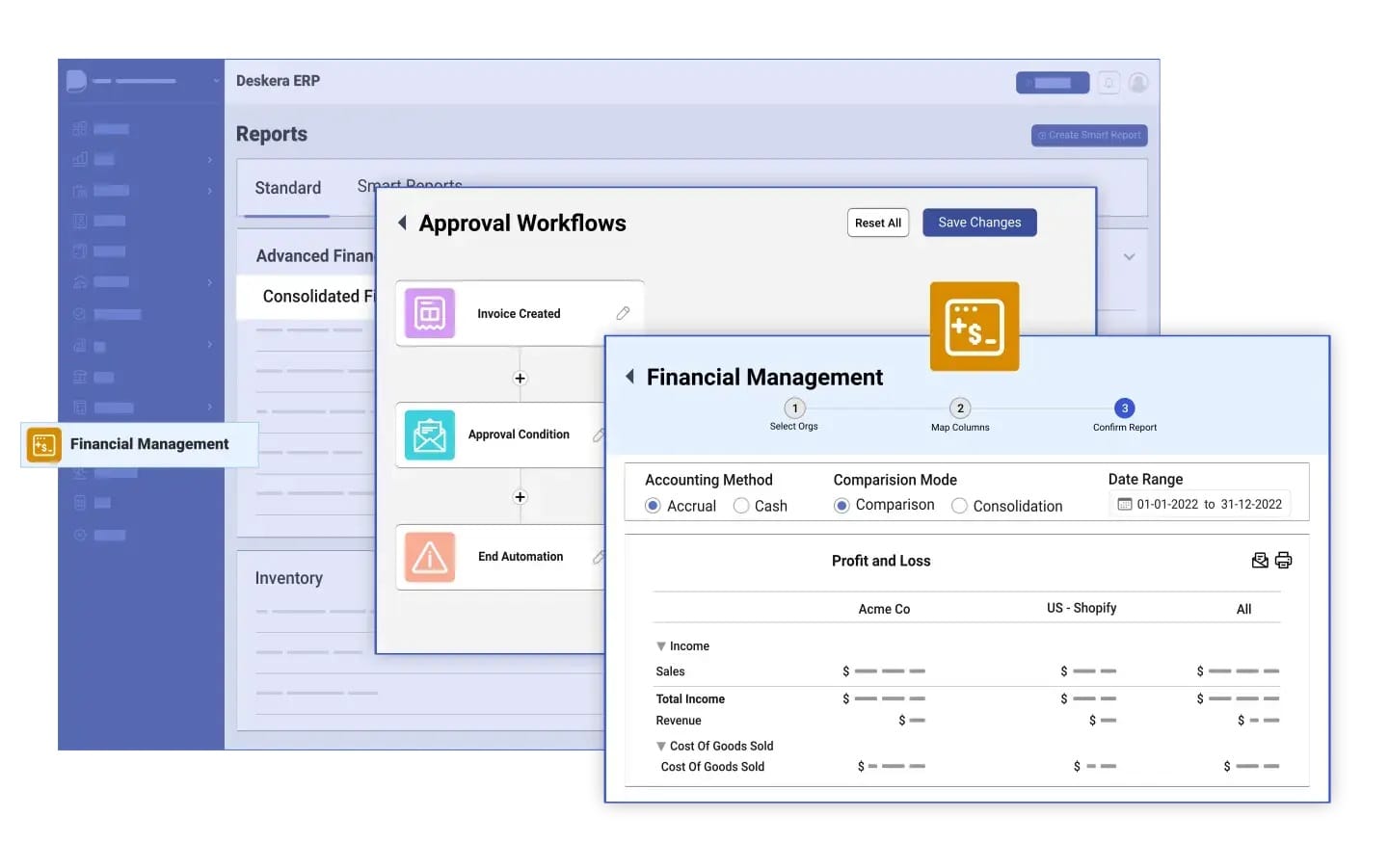
In today’s competitive business environment, traditional financial close methods—relying on spreadsheets, manual reconciliations, and fragmented systems—can slow organizations down and increase the risk of errors. Deskera ERP provides an integrated, automated, and audit-ready solution that simplifies and accelerates every stage of the financial close. Here’s how Deskera ERP empowers finance teams:
1. Centralized Financial Data and Single Source of Truth
Deskera ERP consolidates all financial transactions and records in one unified system. This means:
- Accounts payable, accounts receivable, cash, inventory, and fixed assets are automatically reflected in the general ledger
- Data discrepancies due to mismatched systems are eliminated
- Finance teams no longer waste time gathering information from disparate sources
A single source of truth reduces reconciliation time and enhances confidence in the accuracy of financial results.
2. Automated Transactions and Reconciliations
Manual journal entries, accrual calculations, and reconciliations are time-consuming and error-prone. Deskera ERP automates these processes by:
- Posting recurring transactions automatically (e.g., rent, depreciation)
- Matching bank and ledger entries through built-in reconciliation tools
- Flagging inconsistencies for review
This automation dramatically reduces close cycle time while minimizing the reliance on manual effort.
3. Integrated Reporting and Real-Time Financial Statements
Instead of waiting until month-end to compile reports, Deskera ERP generates real-time financial statements—including income statements, balance sheets, and cash flow statements—on demand. Finance teams can:
- Access up-to-date insight at any time
- Spot issues early and correct them before they affect reporting
- Deliver reports to executives and stakeholders faster
Real-time reporting improves decision-making and enhances financial visibility.
4. Enhanced Controls and Compliance
Close processes must be accurate and audit-ready. Deskera ERP helps organizations:
- Enforce approval workflows for key entries
- Maintain detailed audit trails showing who did what and when
- Apply consistent policies across multiple entities or business units
These controls reduce the risk of errors or compliance issues and make audits smoother, faster, and less disruptive.
5. Better Collaboration Across Departments
Successful closes require timely data from sales, procurement, payroll, and operations. Deskera ERP promotes cross-functional collaboration by:
- Allowing authorized users to access relevant financial data securely
- Standardizing transaction capture across departments
- Providing shared dashboards for key performance indicators
This reduces delays caused by missing or late information and keeps close activities aligned.
6. Continuous Close Capabilities
Deskera ERP supports a continuous accounting approach by enabling teams to perform close-related tasks throughout the period, rather than waiting for month-end. This includes:
- Running reconciliations regularly
- Updating accruals and deferrals in real time
- Monitoring exceptions and correcting them proactively
A continuous close approach lightens the month-end workload and shortens overall close timelines.
7. Analytics, Dashboards, and Insights
Beyond producing statements, Deskera ERP offers business intelligence and visual dashboards that help finance leaders:
- Monitor key close metrics like cycle time and adjustment rates
- Track trends and performance indicators
- Forecast future periods with confidence
These insights transform the close from a backward-looking task into a forward-looking strategic advantage.
By integrating financial data, automating key tasks, and enabling real-time visibility, Deskera ERP not only accelerates the financial close process but also strengthens the quality and integrity of financial reporting. It empowers finance teams to focus less on repetitive work and more on analysis, planning, and value creation.
Key Takeaways
- The financial close process formalizes all financial activity for a period, ensuring records are complete, accurate, and ready to support reporting, compliance, and decision-making.
- A disciplined close provides leadership, investors, and regulators with reliable financial statements that reflect the true financial health of the business.
- Closing books regularly helps organizations identify errors early, maintain financial discipline, and avoid compounding issues at year-end.
- Reconciliations, journal entries, reviews, and final reporting work together to ensure every transaction is validated and aligned with accounting standards.
- Manual processes, data silos, and lack of standardization slow down the close and increase the risk of errors and audit issues.
- While faster closes are valuable, accuracy remains non-negotiable, as financial statements drive strategic decisions and regulatory compliance.
- Documented procedures and consistent close checklists reduce dependency on individuals and ensure repeatable, reliable close outcomes.
- Automating reconciliations, journal postings, and reporting significantly reduces close timelines while improving data integrity.
- Performing reconciliations and reviews throughout the period minimizes month-end pressure and improves overall close quality.
- Timely input from sales, procurement, payroll, and operations is essential to prevent delays and keep the close on schedule.
- Real-time tracking of close tasks and ownership improves accountability and helps teams proactively resolve bottlenecks.
- Evaluating each close cycle enables finance teams to refine processes, shorten timelines, and reduce recurring errors.
- Deskera ERP centralizes financial data, automates key close activities, and delivers real-time reporting, enabling faster, more accurate, and audit-ready closes.
Related Articles
 Niti Samani
 Niti Samani
 Niti Samani
 Niti Samani
 Niti Samani
 Niti Samani