
What helps manufacturers stay efficient, reduce waste, and consistently meet production targets in a competitive landscape? The answer lies in effective production reporting. By capturing and analyzing real-time data from the shop floor, production reporting enables businesses to track performance, identify inefficiencies, and make informed decisions that drive operational excellence.
In today’s fast-paced manufacturing environment, relying on assumptions or outdated data is no longer viable. Production reporting provides a clear and structured view of key activities, such as output levels, machine performance, downtime, and quality metrics. This visibility not only helps in monitoring day-to-day operations but also empowers managers to proactively address issues before they escalate into costly disruptions.
Moreover, production reporting plays a critical role in aligning manufacturing processes with business goals. Whether it is improving productivity, maintaining quality standards, or controlling costs, accurate and timely reports serve as the foundation for continuous improvement. With data-driven insights, manufacturers can streamline workflows, optimize resource utilization, and enhance overall efficiency.
Modern solutions like Deskera MRP further simplify and strengthen production reporting capabilities. With real-time tracking, automated data collection, and intuitive dashboards, Deskera MRP allows manufacturers to gain complete visibility into their operations. It seamlessly integrates production data with inventory, procurement, and financial systems, ensuring accurate reporting and better decision-making. As a result, businesses can respond faster to changes, reduce manual errors, and drive smarter, more efficient manufacturing processes.
What is Production Reporting in Manufacturing?
Production reporting in manufacturing is the process of collecting, analyzing, and presenting data related to production activities to understand the current state of operations. It enables managers to monitor performance in real time while also comparing it with historical data to gain deeper insights and context. This structured approach helps organizations move beyond assumptions and rely on accurate, data-driven decision-making.
At its core, production reporting transforms raw production data into meaningful insights through dashboards, reports, charts, and graphs. These visual tools make it easier for managers and stakeholders to track key performance indicators (KPIs) such as production output, machine efficiency, downtime, and quality levels. By presenting complex data in a simplified format, production reporting ensures better visibility across the entire manufacturing process.
Production reporting also plays a vital role in identifying operational inefficiencies. It helps detect issues such as bottlenecks, unplanned downtime, and poor machine utilization that can hinder productivity. By highlighting these weaknesses, manufacturers can take corrective actions quickly, streamline workflows, and improve overall efficiency on the shop floor.
A production report, which is the output of this process, is a detailed document that captures essential manufacturing KPIs over a specific period. It typically includes metrics like production volume, capacity utilization, quality performance, and cost efficiency. The primary goal of a production report is to provide actionable insights that help production managers optimize operations, improve performance, and ensure consistent manufacturing outcomes.
Key Components of Production Reports
A well-structured production report brings together critical data points that provide a complete picture of manufacturing performance. These components help managers monitor operations, evaluate efficiency, and identify areas for improvement. By including the right elements, production reports become a powerful tool for tracking progress and driving operational excellence.
Production Output
Production output is a fundamental component of any production report, capturing the total number of units produced within a specific timeframe compared to the planned target. This metric helps manufacturers assess whether production goals are being met and identify gaps between expected and actual performance. Consistently tracking output also provides insights into trends, helping businesses adjust schedules and improve capacity planning.
Downtime and Efficiency Metrics
This component focuses on tracking machine downtime, operator idle time, and overall equipment effectiveness (OEE). It highlights how efficiently production resources are being utilized and identifies periods when operations are interrupted. By analyzing downtime and efficiency data, manufacturers can uncover root causes of delays, reduce unplanned stoppages, and ensure smoother production workflows.
Quality Control Metrics
Quality control data is essential for maintaining product standards and minimizing waste. Production reports typically include metrics such as defect rates, scrap levels, and rework (OK/NOK status). These indicators help manufacturers monitor consistency and quickly detect deviations in quality. With this information, teams can implement corrective actions to reduce defects and improve overall product reliability.
Resource Usage
Resource usage tracks the consumption of raw materials and labor hours involved in production. This component provides visibility into how efficiently resources are being utilized and helps identify areas of wastage or overuse. Monitoring resource usage is crucial for cost control, accurate inventory management, and ensuring that production processes remain economically viable.
Process Parameters
Process parameters include operational data such as temperature, pressure, machine speed, and other technical variables that directly impact production outcomes. Tracking these parameters helps ensure that manufacturing processes are running within optimal conditions. Any deviations can be quickly identified and corrected, preventing quality issues and maintaining consistency in production.
Production Capacity Utilization
Production capacity utilization measures how much of the available production capacity is being used. It compares actual output against the maximum possible output under normal conditions. This component helps manufacturers understand whether they are underutilizing or overloading their resources, enabling better planning and improved efficiency.
Production Costs
Including production costs in reports helps businesses track expenses associated with manufacturing, such as material costs, labor costs, and overheads. This component provides valuable insights into cost efficiency and profitability. By monitoring production costs regularly, manufacturers can identify areas for cost reduction and improve overall financial performance.
13 Benefits of Production Reporting
Production reporting is a powerful tool that enables manufacturers to gain better control over their operations and drive continuous improvement. By converting real-time production data into actionable insights, it helps businesses enhance efficiency, maintain quality, and reduce operational costs. When implemented effectively, production reporting not only improves day-to-day performance but also supports long-term strategic growth.
Improved Operational Visibility
Production reporting offers complete transparency across the shop floor by providing real-time insights into production activities. Managers can track output, monitor machine performance, and evaluate workforce productivity without relying on manual updates. This visibility makes it easier to detect inefficiencies, ensure processes are running as planned, and maintain alignment across teams, ultimately improving coordination and operational control.
Enhanced Decision-Making
With accurate and up-to-date data, production reporting empowers managers to make informed decisions quickly. Instead of reacting to issues after they occur, businesses can proactively identify trends and potential disruptions. This enables better resource allocation, improved scheduling, and faster responses to changing market demands, resulting in more confident and strategic decision-making.
Increased Efficiency and Productivity
By analyzing key metrics such as cycle time, downtime, and machine utilization, production reporting helps identify bottlenecks and inefficiencies in the manufacturing process. This allows organizations to optimize workflows, reduce idle time, and improve resource utilization. As a result, manufacturers can achieve higher productivity levels and consistently meet production targets.
Better Quality Control
Production reporting plays a crucial role in maintaining consistent product quality. It tracks defects, scrap rates, and rework, allowing manufacturers to quickly identify and address quality issues. Early detection of deviations ensures that corrective actions can be taken before defects escalate, reducing waste and ensuring products meet required standards and customer expectations.
Cost Control and Optimization
With detailed insights into material usage, labor efficiency, and production inefficiencies, production reporting helps businesses identify areas where costs can be reduced. It highlights waste, excessive consumption, and underutilized resources, enabling manufacturers to take corrective actions. This leads to better cost management, improved budgeting, and increased overall profitability.
Accurate Production Planning and Forecasting
Production reporting provides reliable historical and real-time data that supports better planning and forecasting. Manufacturers can predict demand more accurately, schedule production effectively, and allocate resources efficiently. This reduces the risk of overproduction or stock shortages and ensures smoother, more balanced operations.
Bottleneck Identification and Process Improvement
One of the key advantages of production reporting is its ability to pinpoint exactly where production slows down or stalls. By identifying bottlenecks in workflows, managers can implement targeted improvements to enhance throughput and reduce lead times. This contributes to a more streamlined and efficient production process.
Improved Maintenance Efficiency
Continuous monitoring of production data helps detect anomalies and patterns that may indicate potential equipment failures. This enables a shift from reactive to preventive maintenance, reducing unplanned downtime and extending the lifespan of machinery. Improved maintenance planning also ensures smoother and more reliable operations.
Enhanced Traceability and Compliance
Production reporting creates a digital record of all production activities, ensuring complete traceability of products throughout the manufacturing process. This is especially important for meeting regulatory requirements and quality standards such as ISO or industry-specific guidelines. It also simplifies audits and improves accountability across operations.
Support for Continuous Improvement
Accurate production data provides a strong foundation for continuous improvement initiatives such as Lean and Kaizen. By identifying waste, inefficiencies, and areas of improvement, production reporting enables organizations to refine processes and achieve operational excellence over time.
Standardized Communication Across Teams
Production reports act as a single source of truth for all departments, ensuring consistent and objective communication. This reduces misunderstandings, improves collaboration, and helps align different teams toward common production goals.
Lower Administrative Costs
Automation in production reporting reduces the need for manual data entry, report preparation, and paper-based processes. This not only saves time but also minimizes errors and administrative overhead, allowing teams to focus on more strategic tasks.
Greater Production Flexibility
With quick access to real-time data, manufacturers can respond more effectively to changes in demand, production priorities, or unexpected disruptions. This flexibility allows businesses to adapt quickly and maintain efficiency even in dynamic and challenging environments.
Key Metrics to Track in Production Reporting
Tracking the right metrics is essential for making production reporting truly effective. These metrics provide actionable insights into performance, efficiency, and quality, enabling manufacturers to identify gaps and optimize operations. By consistently monitoring key production indicators, businesses can improve decision-making, enhance productivity, and ensure smoother manufacturing processes.
Production Output
Production output measures the total quantity of goods produced within a specific time period. It helps manufacturers evaluate whether production targets are being met and if operations are running at expected capacity. Tracking output over time also allows businesses to identify trends, seasonal variations, and potential inefficiencies that may be affecting overall production performance.
Machine Utilization
Machine utilization indicates how effectively equipment is being used during production. It measures the percentage of time machines are actively producing compared to their available time. Low utilization may point to issues such as downtime, poor scheduling, or maintenance problems. Monitoring this metric helps manufacturers maximize equipment efficiency and improve return on investment for machinery.
Downtime and Its Causes
Downtime refers to periods when production is halted due to machine breakdowns, maintenance, or other disruptions. Tracking downtime, along with its root causes, helps manufacturers identify recurring issues and take preventive actions. Reducing downtime is critical for maintaining productivity and ensuring that production schedules are not negatively impacted.
Cycle Time
Cycle time measures the time required to complete one unit of production from start to finish. It is a key indicator of process efficiency and helps manufacturers understand how quickly products are being produced. By analyzing cycle time, businesses can identify delays, streamline operations, and improve overall production speed without compromising quality.
Defect Rate
Defect rate tracks the percentage of products that do not meet quality standards. This metric is crucial for maintaining product consistency and minimizing waste. A high defect rate can indicate problems in the production process, such as equipment issues or lack of quality control. Monitoring this metric helps manufacturers take corrective actions and improve product quality.
Overall Equipment Effectiveness (OEE)
Overall Equipment Effectiveness (OEE) is a comprehensive metric that combines availability, performance, and quality to measure the overall efficiency of production equipment. It provides a complete picture of how well machines are operating compared to their full potential. By tracking OEE, manufacturers can identify areas for improvement and work towards achieving optimal production efficiency.
Common Challenges in Production Reporting
While production reporting is essential for improving manufacturing performance, many organizations struggle to implement it effectively. Challenges often arise due to outdated systems, manual processes, and lack of integration across departments. These issues can lead to inaccurate data, delayed insights, and poor decision-making, ultimately impacting overall productivity and efficiency.
Manual Data Collection Errors
Many manufacturers still rely on manual data entry, which increases the risk of human errors and inconsistencies. Inaccurate data can lead to misleading reports, making it difficult for managers to trust the information. Additionally, manual processes are time-consuming and often result in delays, reducing the effectiveness of production reporting.
Lack of Real-Time Visibility
Without real-time data, production reports often reflect past performance rather than current conditions. This delay makes it difficult for managers to respond quickly to issues such as machine breakdowns or production delays. As a result, problems may escalate before corrective actions are taken, impacting efficiency and output.
Data Silos Across Departments
In many organizations, production data is stored in separate systems across different departments such as production, inventory, and quality control. This lack of integration creates data silos, making it difficult to get a unified view of operations. It also leads to duplication of efforts and inconsistencies in reporting.
Difficulty in Tracking Accurate Metrics
Identifying and tracking the right key performance indicators (KPIs) can be challenging for manufacturers. Without clearly defined metrics, production reports may lack focus and fail to provide actionable insights. Inconsistent measurement methods can further complicate analysis and decision-making.
Limited Use of Technology
Some manufacturers are slow to adopt modern tools and technologies for production reporting. Without automation and advanced analytics, it becomes difficult to process large volumes of data efficiently. This limitation restricts the ability to gain deeper insights and optimize production processes effectively.
Resistance to Change
Employees who are привыкed to traditional methods may resist adopting new reporting systems or technologies. This resistance can slow down implementation and reduce the effectiveness of production reporting initiatives. Proper training and change management are essential to overcome this challenge and ensure smooth adoption.
Best Practices for Effective Production Reporting
Implementing production reporting is only the first step—ensuring its effectiveness requires the right strategies and practices. By following proven best practices, manufacturers can improve data accuracy, enhance visibility, and derive meaningful insights that drive operational efficiency. A well-optimized production reporting system not only tracks performance but also supports continuous improvement and smarter decision-making.
Automate Data Collection
Automating data collection eliminates the need for manual entry and significantly reduces the risk of errors. With the help of sensors, IoT devices, and integrated systems, manufacturers can capture real-time production data directly from machines and processes. This ensures accuracy, saves time, and allows teams to focus on analysis rather than data gathering. Automation also enables faster reporting and more reliable insights.
Use Real-Time Dashboards
Real-time dashboards provide instant visibility into production performance, allowing managers to monitor key metrics as they happen. These dashboards present data in an easy-to-understand visual format, making it simpler to identify issues and trends. With immediate access to critical information, teams can respond quickly to disruptions, minimize downtime, and keep production on track.
Standardize Reporting Formats
Standardizing production report formats ensures consistency across departments and reporting periods. When everyone uses the same structure and metrics, it becomes easier to compare data, identify patterns, and make informed decisions. Standardization also reduces confusion and improves communication among teams, leading to more efficient collaboration and better operational alignment.
Define and Track Relevant KPIs
Focusing on the right key performance indicators (KPIs) is essential for meaningful production reporting. Manufacturers should identify metrics that align with their business goals, such as output, efficiency, quality, and cost. Clearly defined KPIs provide direction and ensure that reports deliver actionable insights rather than overwhelming users with unnecessary data.
Ensure System Integration
Integrating production reporting with other business systems, such as inventory, procurement, and finance, provides a unified view of operations. This eliminates data silos and ensures that all departments work with consistent and up-to-date information. System integration enhances data accuracy and enables better coordination across the organization.
Regularly Review and Analyze Reports
Production reports should not just be generated—they should be actively reviewed and analyzed. Regular evaluation helps identify trends, uncover inefficiencies, and highlight opportunities for improvement. By consistently analyzing reports, manufacturers can make proactive decisions, refine processes, and drive continuous operational improvements.
Train Employees and Encourage Adoption
For production reporting to be effective, employees must understand how to use reporting tools and interpret data. Providing proper training ensures that teams can leverage reporting systems efficiently. Encouraging a data-driven culture also helps employees embrace new technologies and contributes to better implementation and long-term success.
Future Trends in Production Reporting
As manufacturing continues to evolve, production reporting is also undergoing a significant transformation. With the rise of smart factories, advanced analytics, and digital technologies, production reporting is shifting from basic data tracking to intelligent, real-time decision support systems. These emerging trends are enabling manufacturers to become more agile, efficient, and competitive in an increasingly complex environment.
AI-Powered and Predictive Reporting
Artificial Intelligence (AI) is transforming production reporting by enabling predictive insights rather than just historical analysis. Advanced algorithms can analyze patterns in production data to forecast potential issues such as machine failures, quality defects, or demand fluctuations. Many manufacturers are already investing in AI and machine learning to enhance operational intelligence and decision-making capabilities. This shift allows businesses to move from reactive to proactive production management.
Real-Time Data and IoT Integration
The integration of Internet of Things (IoT) devices is enabling real-time data collection directly from machines and production lines. Sensors and connected devices continuously feed data into reporting systems, providing instant visibility into operations. This trend ensures faster response times, reduced downtime, and improved efficiency. Real-time reporting is becoming a standard requirement as manufacturers aim for greater agility and responsiveness.
Smart Manufacturing and Industry 4.0
Production reporting is becoming a core component of smart manufacturing ecosystems. With the adoption of Industry 4.0 technologies such as automation, robotics, and cloud computing, reporting systems are becoming more integrated and intelligent. These systems not only track performance but also support automated decision-making and process optimization. Investments in smart manufacturing technologies are expected to continue growing as companies seek to enhance competitiveness and productivity.
Advanced Data Visualization and Dashboards
Future production reporting tools will focus heavily on user-friendly dashboards and advanced data visualization techniques. Interactive charts, real-time KPIs, and customizable dashboards make it easier for managers to interpret complex data quickly. Enhanced visualization improves understanding, speeds up decision-making, and ensures that insights are accessible to both technical and non-technical stakeholders.
Cloud-Based Reporting Systems
Cloud technology is playing a major role in the evolution of production reporting. Cloud-based systems allow manufacturers to access production data from anywhere, enabling remote monitoring and collaboration across multiple locations. These systems also offer scalability, data security, and seamless integration with other enterprise applications, making them ideal for modern manufacturing environments.
Integration with Digital Twins
Digital twin technology—virtual replicas of physical production systems—is becoming increasingly important in production reporting. By combining real-time data with simulation models, manufacturers can analyze performance, test scenarios, and optimize processes without disrupting actual operations. This integration enhances accuracy and supports more informed decision-making.
Focus on Sustainability and ESG Reporting
Sustainability is becoming a key priority for manufacturers, and production reporting is evolving to include environmental metrics such as energy consumption, emissions, and waste generation. Companies are increasingly using reporting systems to track sustainability goals and comply with regulatory requirements. This trend reflects the growing importance of environmentally responsible manufacturing practices.
Automation and Autonomous Reporting
Automation is reducing the need for manual intervention in production reporting. Advanced systems can automatically collect, process, and generate reports without human input. In highly advanced environments, such as “dark factories,” fully automated production systems operate with minimal human involvement, continuously optimizing themselves using real-time data.
Enhanced Integration Across Business Functions
Future production reporting will be more interconnected with other business systems such as inventory, supply chain, finance, and procurement. This integration provides a unified view of operations, enabling better coordination and more accurate decision-making. It also helps eliminate data silos and ensures consistency across the organization.
These trends highlight a clear shift toward smarter, faster, and more intelligent production reporting systems. As technology continues to advance, manufacturers that embrace these innovations will be better positioned to optimize operations, reduce costs, and stay competitive in the evolving industrial landscape.
How Deskera MRP Helps with Production Reporting
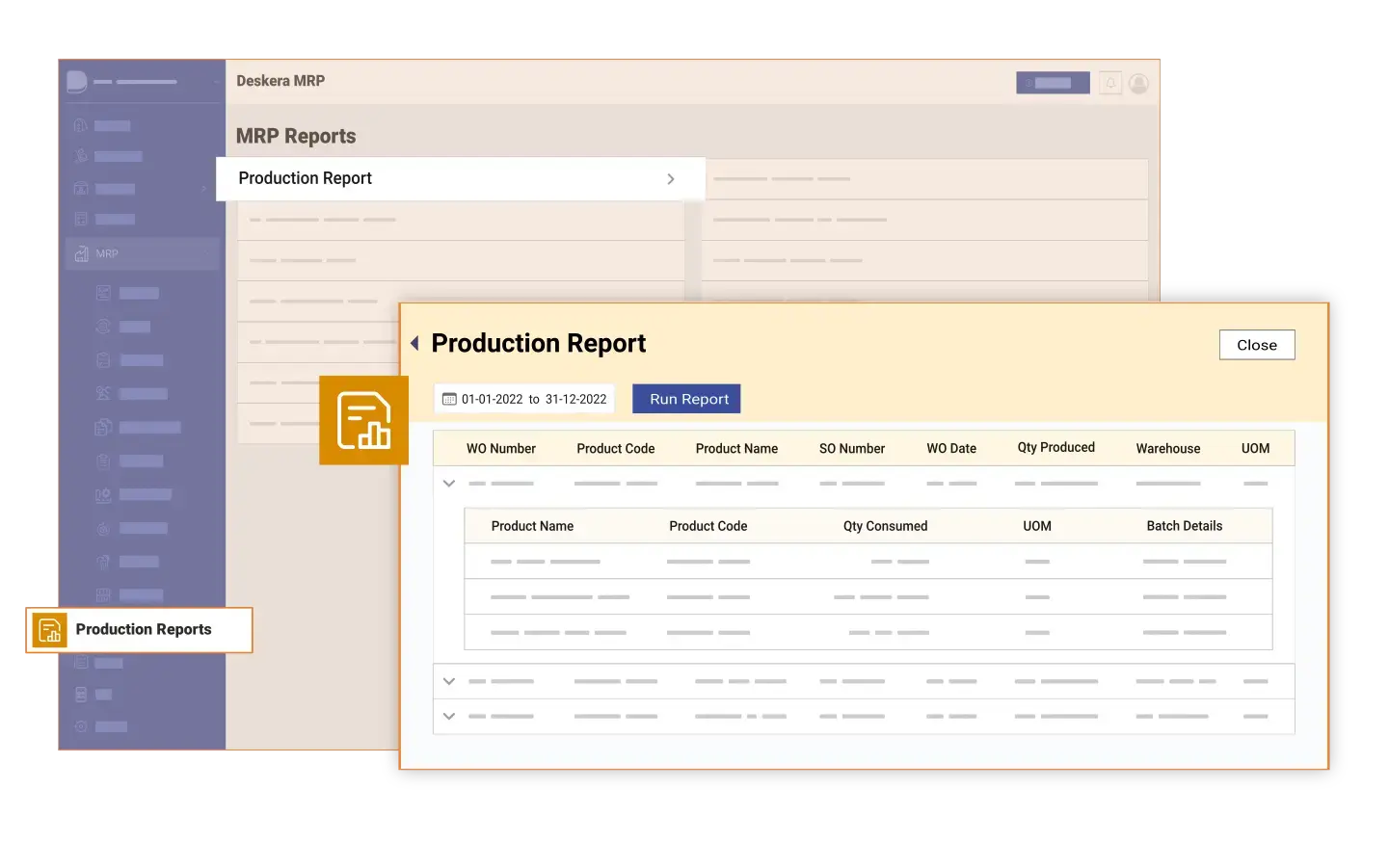
Modern manufacturing demands accurate, real-time insights to stay efficient and competitive. Deskera MRP simplifies production reporting by automating data collection, providing actionable insights, and integrating production data across the entire workflow. This enables manufacturers to monitor performance, improve decision-making, and continuously optimize their operations.
Automated and Accurate Production Reports
Deskera MRP automates the generation of production reports across all stages of the manufacturing process. By eliminating manual data entry, it ensures higher accuracy and consistency in reporting. Automated reports also save time and allow teams to focus on analyzing data rather than compiling it, leading to faster and more reliable insights.
Real-Time Production Monitoring
With Deskera MRP, manufacturers can track production progress in real time. This visibility helps managers monitor ongoing activities, compare actual performance with planned targets, and ensure that deadlines are met. Real-time tracking also allows quick identification of delays or disruptions, enabling faster corrective actions.
Production Efficiency Analysis
Deskera MRP provides detailed insights into production performance by analyzing key metrics such as output, cycle time, and machine utilization. This helps businesses assess the efficiency of their current processes and identify areas where improvements can be made. As a result, manufacturers can optimize workflows and boost overall productivity.
Identification of Improvement Areas
By highlighting inefficiencies, bottlenecks, and performance gaps, Deskera MRP enables manufacturers to identify areas that need improvement. These insights support continuous improvement initiatives and help businesses streamline operations, reduce waste, and enhance overall production performance.
Production Cost Evaluation
Deskera MRP helps calculate and track the cost of production by monitoring material usage, labor, and overhead expenses. This allows manufacturers to understand the true cost of producing goods and evaluate profitability. With accurate cost insights, businesses can make better pricing and budgeting decisions.
Demand Forecasting and Production Planning
Using historical and real-time data, Deskera MRP helps anticipate future production needs. This enables manufacturers to plan production more effectively, align output with demand, and avoid issues such as overproduction or stock shortages. Improved forecasting leads to more efficient resource utilization and smoother operations.
Optimized Production Scheduling
Deskera MRP supports efficient scheduling by aligning production plans with available resources, materials, and capacity. It helps manufacturers create optimized production schedules that minimize downtime and maximize throughput, ensuring timely order fulfillment and improved operational efficiency.
Inventory Tracking and Integration
Deskera MRP integrates production reporting with inventory management, allowing businesses to monitor stock levels in real time. This ensures that sufficient raw materials are available for production while preventing excess inventory. Better inventory visibility supports uninterrupted production and cost control.
Quality Analysis and Control
Production reports generated by Deskera MRP include quality metrics that help manufacturers track defects, rework, and overall product quality. This enables early detection of issues and ensures that corrective actions are taken promptly, maintaining consistent product standards.
By combining automation, real-time insights, and seamless integration, Deskera MRP transforms production reporting into a strategic advantage. It empowers manufacturers to make data-driven decisions, improve efficiency, and achieve better control over their production processes.
Key Takeaways
- Production reporting provides real-time visibility into manufacturing operations, helping businesses monitor performance and stay aligned with production goals.
- It transforms raw production data into actionable insights, enabling better decision-making and continuous process improvement.
- Tracking key metrics such as output, downtime, and quality helps manufacturers identify inefficiencies and optimize productivity.
- Well-structured production reports include critical components like output, resource usage, quality data, and process parameters for comprehensive analysis.
- Despite its benefits, production reporting faces challenges such as manual errors, lack of real-time data, and disconnected systems.
- Implementing best practices like automation, standardized reporting, and KPI tracking ensures more accurate and effective reporting.
- Production reporting delivers significant benefits, including improved efficiency, cost control, better quality, and enhanced planning capabilities.
- Emerging trends like AI, IoT, and cloud-based systems are transforming production reporting into a more intelligent and predictive process.
- Deskera MRP enhances production reporting through automation, real-time tracking, and integrated insights across production, inventory, and costs.
Related Articles
 Niti Samani
 Niti Samani
 Niti Samani
 Niti Samani
 Nalini
 Niti Samani