
What if your supply chain could cut costs, reduce waste, and improve delivery performance—all at the same time? In today’s fast-moving, demand-driven market, businesses are under constant pressure to do more with less. This is where lean supply chain management steps in as a powerful strategy, helping organizations streamline operations while maintaining high levels of customer satisfaction.
Lean Supply Chain Management (LSCM) is built on the principle of eliminating waste and maximizing efficiency across every stage of the supply chain. From procurement to production and distribution, the goal is to deliver value with minimal excess. In fact, companies that successfully adopt lean practices often see 20–25% improvements in key operational areas, making it a highly effective approach for modern businesses striving for agility and cost control.
The impact of lean supply chains goes beyond theory. Studies show that implementing LSCM can lead to up to 20% lower inventory costs and around 25% improvement in order fulfillment rates. These measurable gains highlight how lean strategies not only optimize internal processes but also enhance customer experience by ensuring faster and more reliable deliveries.
To successfully implement and sustain lean practices, businesses increasingly rely on robust digital tools like Deskera ERP. Deskera ERP offers real-time visibility into inventory, production, and procurement processes, enabling smarter decision-making. With features like demand forecasting, automated workflows, and integrated supply chain management, it empowers organizations to reduce inefficiencies, maintain optimal inventory levels, and continuously improve operations in line with lean principles.
What Is Lean Supply Chain Management?
Lean supply chain management is a strategic approach that focuses on streamlining end-to-end supply chain operations by eliminating waste and maximizing value for the customer. It extends the principles of lean thinking beyond manufacturing to include suppliers, logistics, distribution, and customer delivery. The core idea is simple: if a process, activity, or resource does not add value from the customer’s perspective, it should be minimized or removed.
At its foundation, lean supply chain management aims to create a highly efficient, responsive, and cost-effective system. By optimizing the flow of materials, information, and resources, businesses can reduce operational costs, improve product quality, and deliver faster and more reliable service. This approach not only enhances productivity but also helps organizations stay competitive in today’s dynamic and demand-driven markets.
A key characteristic of a lean supply chain is its focus on delivering exactly what the customer needs—when they need it—without excess inventory or overproduction. This is achieved through practices such as just-in-time (JIT) inventory, continuous improvement, and close collaboration with suppliers and partners. By maintaining low inventory levels and ensuring smooth workflows, companies can reduce lead times and improve overall supply chain performance.
Ultimately, lean supply chain management is about building a culture of efficiency and continuous improvement. It encourages organizations to constantly evaluate processes, identify inefficiencies, and refine operations to enhance value delivery. By aligning all stakeholders—from suppliers to distributors—around shared goals, businesses can create a seamless, agile supply chain that drives long-term growth, profitability, and customer satisfaction.
Lean Supply Chain vs Agile Supply Chain
In today’s dynamic business environment, organizations often choose between lean and agile supply chain strategies based on their operational goals and market demands. While both approaches aim to improve efficiency and customer satisfaction, they differ significantly in their focus, execution, and suitability.
Understanding these differences helps businesses adopt the right strategy—or even a hybrid approach—to stay competitive and responsive.
1. Core Focus and Objective
Lean supply chains focus on maximizing efficiency by eliminating waste and reducing costs across all processes. The primary objective is to create a streamlined system that delivers value with minimal resource usage.
In contrast, agile supply chains prioritize flexibility and responsiveness, enabling businesses to quickly adapt to changing customer demands and market conditions.
While lean emphasizes cost efficiency and stability, agile focuses on speed and adaptability. Businesses must choose based on whether their priority is operational efficiency or the ability to respond rapidly to uncertainty and demand fluctuations.
2. Approach to Demand Management
Lean supply chains typically rely on demand forecasting and planned production to maintain efficiency and reduce excess inventory. The goal is to align production closely with expected demand while minimizing waste. On the other hand, agile supply chains are demand-driven and rely on real-time data to respond quickly to actual customer needs.
Agile systems are better suited for unpredictable markets where demand can change rapidly. While lean works well in stable environments with consistent demand patterns, agile excels in industries where customization and quick response times are critical.
3. Inventory Strategy
Lean supply chains maintain low inventory levels using just-in-time (JIT) practices to reduce holding costs and waste. This approach minimizes excess stock but can increase the risk of stockouts if disruptions occur.
Agile supply chains, however, often maintain buffer or safety stock to ensure quick response to demand changes and unexpected disruptions. This flexibility comes at the cost of higher inventory holding expenses.
The choice between the two depends on whether a business prioritizes cost savings through minimal inventory or responsiveness through inventory availability.
4. Flexibility and Responsiveness
Flexibility is a defining feature of agile supply chains, allowing them to adapt quickly to market changes, customer preferences, and supply disruptions. Agile systems are designed to handle variability and uncertainty effectively.
In contrast, lean supply chains prioritize consistency and efficiency, which can limit their ability to respond quickly to sudden changes. While lean systems are highly efficient under stable conditions, they may struggle in volatile environments.
Businesses operating in dynamic markets often benefit more from agile strategies, while those with predictable demand may prefer lean approaches.
5. Supplier Relationships
Lean supply chains focus on building long-term, stable relationships with a limited number of reliable suppliers to ensure consistent quality and cost efficiency. Collaboration is key to maintaining smooth operations and reducing waste.
Agile supply chains, however, require a more flexible supplier network that can quickly adjust to changes in demand or supply conditions. This may involve working with multiple suppliers or maintaining backup options. While lean emphasizes stability and efficiency in supplier relationships, agile prioritizes flexibility and risk mitigation through diversified sourcing strategies.
6. Cost vs Service Trade-Off
Lean supply chains are designed to minimize costs by eliminating inefficiencies and optimizing resource utilization. This makes them highly cost-effective but potentially less responsive to sudden changes.
Agile supply chains, on the other hand, prioritize high service levels and customer responsiveness, even if it results in higher operational costs.
The trade-off between cost and service is a key consideration when choosing between these approaches. Businesses must evaluate whether their competitive advantage lies in offering lower prices or delivering faster and more customized services.
7. Best Use Cases
Lean supply chains are best suited for industries with stable demand, standardized products, and predictable supply conditions, such as manufacturing of essential goods. Agile supply chains are ideal for industries with high demand variability, short product life cycles, and a need for customization, such as fashion or technology.
In many cases, businesses adopt a hybrid “leagile” approach, combining lean efficiency in upstream processes with agile responsiveness in downstream operations. This balanced strategy allows companies to achieve both cost efficiency and flexibility in an increasingly complex market landscape.
Key Principles of Lean Supply Chain Management
Lean supply chain management is guided by a set of core principles that focus on maximizing value while minimizing waste. These principles help businesses create efficient, responsive, and customer-centric supply chains.
1. Eliminate Waste (Muda)
Eliminating waste is the foundation of lean supply chain management. Waste refers to any activity that does not add value to the end customer, such as overproduction, excess inventory, waiting time, unnecessary transportation, defects, and inefficient processing. By identifying these inefficiencies, organizations can streamline operations and reduce unnecessary costs.
Techniques like just-in-time inventory and process optimization help minimize waste across the supply chain. As a result, businesses can improve productivity, reduce lead times, and ensure better utilization of resources while maintaining a high level of service quality.
2. Focus on Customer Value
A lean supply chain prioritizes delivering maximum value to the customer. This principle involves understanding what customers truly need and aligning supply chain processes to meet those expectations effectively. By focusing on value, businesses can avoid unnecessary features, processes, or inventory that do not contribute to customer satisfaction.
This approach enhances product quality, ensures timely deliveries, and strengthens customer relationships. Additionally, organizations can use demand data and feedback to refine their offerings continuously. Ultimately, a strong focus on customer value helps businesses remain competitive and build long-term loyalty in an increasingly dynamic marketplace.
3. Value Stream Mapping
Value stream mapping is a critical tool used to visualize and analyze the entire supply chain process. It involves identifying every step required to deliver a product, from sourcing raw materials to final delivery. This process helps businesses distinguish between value-added and non-value-added activities.
By mapping the value stream, organizations can identify bottlenecks, delays, and inefficiencies that hinder performance. Once identified, these issues can be addressed through process improvements and better coordination. This principle enables companies to streamline workflows, reduce lead times, and create a more efficient and transparent supply chain system.
4. Create Continuous Flow
Creating a continuous flow ensures that products, materials, and information move smoothly through the supply chain without interruptions. This principle focuses on eliminating bottlenecks and reducing delays that can disrupt operations. By optimizing workflows and maintaining consistent production rates, businesses can achieve faster turnaround times and improved efficiency.
Continuous flow also helps reduce excess inventory and minimizes the risk of production delays. Implementing standardized processes and improving coordination between departments further enhances flow. As a result, organizations can deliver products more quickly, respond better to customer demands, and maintain a stable and predictable supply chain.
5. Implement a Pull-Based System (Just-in-Time)
A pull-based system, often associated with just-in-time (JIT) inventory, ensures that production is driven by actual customer demand rather than forecasts. This approach helps prevent overproduction and reduces the need for large inventory storage. By producing only what is needed when it is needed, businesses can optimize resource utilization and minimize waste.
Pull systems also improve responsiveness to market changes and customer requirements. However, they require strong coordination with suppliers and accurate demand forecasting. When implemented effectively, this principle leads to lower costs, improved efficiency, and better alignment with customer expectations.
6. Continuous Improvement (Kaizen)
Continuous improvement, or Kaizen, is a key principle that encourages organizations to consistently refine their processes. Instead of making large, infrequent changes, lean supply chains focus on small, incremental improvements over time. Employees at all levels are encouraged to identify inefficiencies, suggest solutions, and implement changes.
This creates a culture of innovation and accountability within the organization. Continuous improvement helps enhance product quality, reduce errors, and optimize operations. Over time, these incremental changes lead to significant performance gains, making the supply chain more efficient, adaptable, and resilient in a competitive business environment.
7. Build Strong Supplier Relationships
Strong collaboration with suppliers is essential for a successful lean supply chain. By building long-term partnerships, businesses can improve communication, ensure consistent quality, and achieve better coordination in production and delivery schedules. Close collaboration allows companies to align their goals with suppliers, reducing delays and improving overall efficiency.
Suppliers can also contribute to lean initiatives by adopting similar practices, such as just-in-time delivery and continuous improvement. This partnership approach fosters trust, reduces risks, and enhances supply chain performance. Ultimately, strong supplier relationships create a more reliable and responsive supply chain network.
8. Enhance Flexibility and Responsiveness
Flexibility and responsiveness are crucial in today’s fast-changing business environment. A lean supply chain must be capable of adapting quickly to fluctuations in demand, market conditions, and external disruptions. This principle involves using real-time data, advanced analytics, and agile processes to make informed decisions.
By maintaining flexible production systems and diversified supplier networks, businesses can respond effectively to unexpected changes. Improved responsiveness helps minimize disruptions, maintain service levels, and capitalize on new opportunities. As a result, organizations can achieve a balance between efficiency and adaptability while ensuring consistent customer satisfaction.
4 Elements of Lean Supply Chain Management
Lean supply chain management is built on four core elements that work together to create an efficient, responsive, and cost-effective system. These elements ensure seamless coordination across the entire supply chain while minimizing waste and maximizing value.
1. Integration
Integration acts as the backbone of a lean supply chain, ensuring smooth communication and coordination among all stakeholders, including suppliers, manufacturers, and distributors. It focuses on aligning information flow, demand planning, and execution processes to achieve shared objectives. In a lean environment, integration relies on real-time data and collaborative tools rather than purely forecast-driven planning.
This enables faster decision-making and improved responsiveness to customer demand. Strong integration reduces errors, enhances visibility, and ensures that every stage of the supply chain works in harmony, ultimately improving efficiency, reducing delays, and delivering better outcomes for both businesses and customers.
2. Operations
Operations represent the day-to-day activities involved in producing goods and managing workflows within the supply chain. In lean supply chain management, operations are designed to be highly efficient, flexible, and responsive to real-time demand. Instead of relying heavily on forecasts, lean operations use tools like Kanban systems and FIFO methods to maintain smooth production flow.
The focus is on reducing idle time, eliminating bottlenecks, and ensuring consistent output quality. By optimizing operational processes, businesses can lower production costs, reduce waste, and improve productivity. Efficient operations also enable faster response to market changes, ensuring better service levels and customer satisfaction.
3. Purchasing & Procurement
Purchasing and procurement play a critical role in ensuring that the right materials are available at the right time and in the right quantity. In a lean supply chain, this element emphasizes building long-term, collaborative relationships with suppliers rather than focusing solely on cost reduction. Strong supplier partnerships improve communication, ensure consistent quality, and reduce lead times.
Lean procurement also focuses on aligning supply with actual demand, avoiding excess inventory and shortages. By working closely with suppliers and streamlining purchasing processes, businesses can achieve better resource utilization, minimize disruptions, and create a more reliable and efficient supply chain ecosystem.
4. Distribution & Logistics
Distribution and logistics focus on the efficient movement of goods from production facilities to the end customer. In a lean supply chain, the goal is to minimize delays, reduce transportation waste, and eliminate unnecessary handling of products. This often results in shorter, simpler distribution networks and lower inventory levels.
Lean logistics emphasizes optimizing routes, improving warehouse efficiency, and ensuring timely deliveries. By reducing lead times and streamlining delivery processes, businesses can enhance customer satisfaction while lowering operational costs. Effective distribution and logistics ensure that products reach customers quickly, reliably, and in the most cost-efficient manner possible.
When these four elements—integration, operations, purchasing & procurement, and distribution & logistics—work together seamlessly, they create a highly efficient and agile lean supply chain that drives performance, reduces waste, and delivers superior value.
Benefits of Lean Supply Chain Management
Adopting lean supply chain management goes beyond simply reducing waste—it transforms the entire supply chain into a more efficient, cost-effective, and customer-focused system. By streamlining processes and aligning operations with real demand, businesses can unlock significant performance improvements and long-term competitive advantages.
1. Reduced Operational Costs
One of the most significant benefits of lean supply chain management is cost reduction. By eliminating non-value-added activities such as excess inventory, overproduction, and inefficient transportation, businesses can significantly lower operational expenses. Lean practices also reduce storage, handling, and insurance costs associated with maintaining large inventories.
Additionally, improved procurement strategies and better supplier collaboration can help secure more favorable terms. These combined efficiencies directly impact the bottom line, allowing businesses to improve profitability while maintaining high service levels and operational performance across the supply chain.
2. Minimized Waste Across Processes
Lean supply chain management is centered on identifying and eliminating waste in all forms, including time, materials, and effort. Waste can exist in processes such as waiting times, unnecessary movement, defects, and excess inventory. By systematically addressing these inefficiencies, businesses can optimize resource utilization and reduce environmental impact.
Minimizing waste not only cuts costs but also simplifies operations and improves overall process clarity. This leads to a more streamlined and sustainable supply chain where every activity contributes directly to value creation and customer satisfaction.
3. Improved Efficiency and Productivity
Lean principles enable organizations to streamline workflows, remove bottlenecks, and improve coordination across the supply chain. By optimizing processes and ensuring smooth flow of materials and information, businesses can significantly enhance operational efficiency. This leads to faster cycle times, better resource utilization, and increased productivity.
Lean systems also encourage standardization and continuous monitoring, which further improves performance consistency. As a result, organizations can produce and deliver goods more efficiently, enabling them to handle higher volumes without increasing operational complexity or costs.
4. Lower Inventory Holding Costs
Lean supply chains rely on just-in-time (JIT) practices to maintain optimal inventory levels, reducing the need for excess stock. This approach minimizes storage requirements, lowers warehousing costs, and reduces the risk of inventory obsolescence.
By aligning inventory with actual demand, businesses can free up working capital that would otherwise be tied up in unused stock. Lower inventory levels also simplify inventory management and improve cash flow. This financial flexibility allows organizations to invest in growth initiatives while maintaining a more agile and responsive supply chain structure.
5. Faster Lead Times and Improved Responsiveness
Lean supply chain management enhances the speed and responsiveness of operations by eliminating delays and improving coordination among stakeholders. With streamlined processes and better communication, businesses can reduce lead times and respond more quickly to customer demands.
This is particularly beneficial in industries where timely delivery is critical. Faster lead times also enable companies to adapt to market changes more effectively, ensuring that products reach customers when needed. Improved responsiveness not only boosts operational performance but also strengthens a company’s ability to compete in dynamic markets.
6. Enhanced Product Quality
Lean methodologies emphasize continuous improvement and defect prevention, leading to higher product quality. By focusing on process optimization and reducing variability, businesses can minimize errors and produce more consistent outputs.
Quality control becomes an integral part of every stage in the supply chain, ensuring that defects are identified and addressed early. This results in fewer returns, lower rework costs, and improved customer trust. Enhanced quality not only improves customer satisfaction but also strengthens brand reputation, making it a key competitive advantage in the marketplace.
7. Increased Customer Satisfaction
Customer satisfaction is at the core of lean supply chain management. By delivering products faster, maintaining consistent quality, and aligning production with actual demand, businesses can meet customer expectations more effectively. Reduced delays and improved service reliability contribute to a better overall customer experience.
Additionally, lean supply chains enable companies to respond quickly to customer feedback and changing preferences. This customer-centric approach fosters loyalty, encourages repeat business, and enhances brand reputation, ultimately contributing to long-term business success.
8. Greater Sustainability and Resource Optimization
Lean supply chain management promotes efficient use of resources, which contributes to more sustainable business practices. By reducing waste, optimizing transportation, and minimizing excess production, businesses can lower their environmental footprint. Efficient resource utilization not only supports sustainability goals but also reduces costs associated with energy, materials, and waste disposal.
As sustainability becomes increasingly important for stakeholders and consumers, adopting lean practices helps organizations align with environmental standards while maintaining operational efficiency and profitability.
Drawbacks of Lean Supply Chain Management
While lean supply chain management is widely recognized for its efficiency and cost-saving potential, it is not without limitations. By prioritizing waste elimination and minimal inventory, businesses often operate with very little margin for error.
This can make supply chains more fragile, especially in unpredictable environments. External disruptions, demand fluctuations, and supplier dependencies can quickly create bottlenecks that ripple across the entire network.
Below are the key drawbacks businesses should carefully consider before fully adopting a lean supply chain approach:
Risk of Stockouts and Inventory Shortages
Lean supply chains rely heavily on minimal inventory levels and just-in-time (JIT) practices, which significantly reduce holding costs. However, this efficiency comes at a cost—limited buffer stock. In the event of unexpected demand spikes or supply delays, businesses may struggle to meet customer requirements.
Stockouts can lead to lost sales, dissatisfied customers, and damaged brand reputation. Without safety stock as a cushion, even small disruptions can halt production or delay order fulfillment, making inventory planning a critical challenge.
High Vulnerability to Supply Chain Disruptions
A lean model often depends on a limited number of suppliers to streamline operations and reduce costs. While efficient, this creates a single point of failure. Events such as natural disasters, geopolitical issues, pandemics, or transportation delays can disrupt the entire supply chain.
Since lean systems lack redundancy, businesses may find it difficult to recover quickly. This vulnerability can lead to production stoppages, missed deadlines, and increased operational risks, especially in global and highly interconnected supply chains.
Difficulty in Managing Demand Variability
Lean supply chains perform best in stable and predictable demand environments. However, in industries with fluctuating or seasonal demand, this approach can become restrictive. Relying on historical data alone for forecasting may not capture real-time market changes, leading to inaccurate planning.
As a result, businesses may face either excess demand they cannot fulfill or underutilized resources. This limitation makes lean less suitable for dynamic markets where flexibility and responsiveness are essential.
Increased Pressure on Supplier Performance
With fewer suppliers and tighter schedules, lean supply chains place significant pressure on supplier reliability and performance. Any delay, quality issue, or miscommunication from suppliers can disrupt the entire production process.
Additionally, businesses may lack visibility into the full capacity and capabilities of their suppliers, leading to inefficiencies. Strong supplier relationship management becomes crucial, but even then, over-dependence on a small supplier base increases operational risk.
Implementation Challenges and Initial Costs
Transitioning to a lean supply chain is not a simple process. It requires substantial investment in technology, process redesign, and employee training. Poor implementation can lead to wasted resources, operational inefficiencies, and missed deadlines.
Organizations must also ensure proper change management and clear communication across teams. Without adequate training and planning, employees may struggle to adapt to new workflows, increasing the risk of errors and reducing overall effectiveness.
Limited Flexibility and Rigidity
Lean systems are designed for efficiency, but this often results in reduced flexibility. Rapid changes in customer preferences, market trends, or product requirements can be difficult to accommodate.
Unlike agile supply chains, which emphasize responsiveness, lean models focus on consistency and cost control. This rigidity can hinder innovation and make it challenging for businesses to pivot quickly in competitive markets.
Over-Optimization and Cost-Cutting Risks
An excessive focus on eliminating waste and reducing costs can sometimes backfire. Businesses may cut too many resources, impacting product quality, employee morale, or customer experience.
Over-optimization can also reduce resilience, leaving the supply chain unable to absorb shocks. Striking the right balance between efficiency and sustainability is essential to avoid long-term negative consequences.
Compliance and Global Supply Chain Risks
As businesses expand globally, lean supply chains may face compliance and governance challenges. Limited oversight of international suppliers can lead to regulatory violations, ethical concerns, or reputational risks. Additionally, relying on tightly controlled inventory and JIT practices across borders increases exposure to customs delays, policy changes, and logistical complexities.
In conclusion, while lean supply chain management offers substantial efficiency gains, it requires careful planning, strong supplier relationships, and robust risk management strategies. Many organizations today adopt a hybrid approach—combining lean efficiency with agile flexibility—to build more resilient and adaptive supply chains.
Best Practices for Implementing Lean Supply Chain Management
Implementing lean supply chain management requires more than just reducing inventory or cutting costs—it demands a strategic, data-driven, and collaborative approach across the entire value chain. When executed correctly, lean practices can significantly enhance efficiency, reduce waste, and improve customer satisfaction.
Below are the most effective best practices to ensure a successful lean transformation:
Start with Value Stream Mapping
Value stream mapping helps businesses visualize every step in the supply chain, from procurement to final delivery. By mapping workflows, organizations can identify non-value-added activities, bottlenecks, and inefficiencies.
This clarity enables teams to eliminate waste systematically and redesign processes for optimal flow. It also ensures that every activity aligns with customer value, which is the core principle of lean methodology.
Implement Just-in-Time (JIT) Inventory Strategically
Just-in-Time inventory is a cornerstone of lean supply chains, ensuring materials arrive exactly when needed. However, it must be implemented carefully with accurate demand forecasting and reliable suppliers.
Businesses should avoid over-reliance on JIT without contingency planning. Combining JIT with safety stock for critical items can help balance efficiency with resilience, reducing the risk of stockouts during disruptions.
Strengthen Supplier Relationships and Diversification
Lean supply chains depend heavily on supplier performance. Building strong, collaborative relationships with suppliers ensures consistent quality, timely deliveries, and better communication.
At the same time, supplier diversification is essential to reduce dependency risks. Working with multiple reliable vendors and regularly evaluating their performance helps create a more resilient and adaptable supply network.
Leverage Data-Driven Demand Forecasting
Accurate demand forecasting is critical for lean success. Businesses should use advanced analytics, historical data, and real-time insights to predict demand more precisely.
Incorporating technologies like AI and machine learning can further enhance forecasting accuracy. Collaborative planning with suppliers and distributors also improves visibility across the supply chain, enabling better alignment and reducing uncertainty.
Invest in Technology and Automation
Modern lean supply chains rely on integrated digital tools to streamline operations. ERP systems, inventory management software, and transportation management systems (TMS) help automate processes, track performance, and provide real-time visibility.
Solutions like Deskera ERP enable businesses to manage procurement, inventory, production, and reporting on a single platform, making it easier to identify inefficiencies and maintain lean operations at scale.
Focus on Continuous Improvement (Kaizen)
Lean is not a one-time initiative—it is an ongoing process of continuous improvement. Organizations should foster a culture where employees at all levels are encouraged to identify inefficiencies and suggest improvements.
Regular performance reviews, process audits, and feedback loops help ensure that the supply chain evolves with changing business needs and market conditions.
Optimize Transportation and Logistics
Efficient transportation is a critical component of a lean supply chain. Businesses should use route optimization, shipment consolidation, and real-time tracking to reduce logistics costs and improve delivery performance.
Implementing a Transportation Management System (TMS) can help streamline operations, minimize delays, and enhance visibility across the logistics network.
Enhance Communication and Collaboration
Seamless communication across the supply chain—from suppliers to distributors—is essential for lean success. Integrated platforms that enable real-time data sharing help reduce delays, improve coordination, and enhance decision-making. Regular meetings and collaborative planning sessions with stakeholders ensure alignment and quick resolution of issues.
Develop Risk Management and Contingency Plans
While lean focuses on efficiency, businesses must also prepare for uncertainties. Conducting regular risk assessments and developing contingency plans helps mitigate disruptions caused by supplier failures, demand fluctuations, or external events. A balanced approach that combines lean principles with risk management ensures both efficiency and resilience.
Train Employees and Manage Change Effectively
Successful lean implementation requires skilled and well-informed teams. Businesses should invest in employee training to ensure a clear understanding of lean principles, tools, and processes. Effective change management, including transparent communication and leadership support, is crucial to overcome resistance and ensure smooth adoption across the organization.
By following these best practices, businesses can unlock the full potential of lean supply chain management—achieving cost efficiency, operational excellence, and long-term sustainability while maintaining the flexibility needed to navigate modern supply chain challenges.
Role of Technology in Lean Supply Chain Management
In today’s fast-evolving business landscape, technology plays a pivotal role in enabling lean supply chain management. While lean focuses on eliminating waste and improving efficiency, digital tools make it possible to achieve these goals with greater accuracy, speed, and scalability.
From real-time visibility to predictive decision-making, technology empowers organizations to identify inefficiencies, streamline processes, and continuously improve operations. By integrating advanced solutions, businesses can enhance agility while maintaining the cost-efficiency that defines lean supply chains.
AI and Machine Learning for Smarter Decision-Making
Artificial Intelligence (AI) and Machine Learning (ML) significantly enhance lean supply chains by enabling predictive and data-driven decision-making.
These technologies analyze large volumes of data to identify patterns, forecast demand, and recommend optimal actions. AI-driven forecasting reduces errors and aligns production with actual demand, minimizing overproduction and stockouts.
Additionally, machine learning algorithms optimize transportation routes, automate repetitive tasks, and improve overall process efficiency. This leads to reduced waste, faster operations, and more accurate planning across the supply chain.
Mobile Inventory Management for Real-Time Control
Mobile inventory management solutions provide real-time visibility into stock levels, helping businesses maintain lean inventory practices. With features like barcode scanning, instant updates, and remote access, these tools reduce manual errors and improve accuracy.
They support just-in-time (JIT) inventory by ensuring materials are replenished only when needed. This not only minimizes excess inventory but also enhances operational efficiency by enabling quick decision-making and better coordination between warehouses, suppliers, and production teams.
Data Analytics for Continuous Improvement
Data analytics is a cornerstone of modern lean supply chains. By analyzing historical and real-time data, businesses can identify inefficiencies, bottlenecks, and areas of waste. Advanced analytics tools provide actionable insights that support better forecasting, demand planning, and resource allocation.
This data-driven approach improves transparency across the supply chain and enables organizations to make informed decisions. Ultimately, it fosters a culture of continuous improvement, which is essential for sustaining lean operations.
ERP Systems for End-to-End Integration
Enterprise Resource Planning (ERP) systems integrate all supply chain functions—procurement, inventory, production, and finance—into a single platform. This integration ensures seamless data flow and real-time visibility across the organization.
Solutions like Deskera ERP help automate workflows, reduce manual intervention, and improve coordination between departments. By centralizing data and processes, ERP systems enable businesses to maintain lean operations while scaling efficiently and responding quickly to market changes.
Automation for Process Efficiency
Automation technologies streamline repetitive and time-consuming tasks such as order processing, inventory updates, and reporting. By reducing human intervention, automation minimizes errors and accelerates operations.
In a lean supply chain, this leads to faster cycle times, improved accuracy, and lower operational costs. Automation also frees up employees to focus on higher-value activities, contributing to overall productivity and efficiency.
Enhanced Visibility and Collaboration Tools
Modern supply chains require seamless communication and collaboration among multiple stakeholders. Digital platforms enable real-time information sharing between suppliers, manufacturers, and distributors. This enhanced visibility helps businesses quickly identify and resolve issues, reduce delays, and improve coordination. As a result, organizations can maintain a smooth flow of goods and information, which is critical for achieving lean objectives.
In summary, technology acts as a powerful enabler of lean supply chain management by improving precision, agility, and transparency. By leveraging AI, analytics, mobile solutions, and integrated systems, businesses can not only eliminate waste but also build smarter, more resilient, and future-ready supply chains.
Key Metrics to Track in Lean Supply Chain
To successfully implement lean supply chain management, businesses must continuously measure performance and identify areas for improvement. Tracking the right metrics ensures that waste is minimized, efficiency is maximized, and customer value remains at the core of operations. Below are the most critical metrics every organization should monitor in a lean supply chain:
Inventory Turnover Ratio
Inventory turnover measures how frequently inventory is sold and replaced over a specific period. A higher turnover ratio indicates efficient inventory management and reduced holding costs—key goals of a lean system. It reflects how well a business aligns production with demand, minimizing excess stock and waste. However, extremely high turnover without proper planning may increase the risk of stockouts, so maintaining a balanced ratio is essential.
Order Fulfillment Rate
This metric tracks the percentage of customer orders delivered accurately and on time. A high order fulfillment rate indicates strong coordination across procurement, production, and logistics. In a lean supply chain, improving this metric ensures customer satisfaction while maintaining efficiency. Poor performance, on the other hand, may signal issues such as supply delays, inaccurate forecasting, or process inefficiencies.
Lead Time
Lead time refers to the total time taken from order placement to delivery. Reducing lead time is a core objective of lean practices, as it enhances responsiveness and reduces waiting waste. Monitoring lead time helps identify bottlenecks in procurement, production, or transportation. Shorter and more consistent lead times indicate a well-optimized and agile supply chain.
Demand Forecast Accuracy
Accurate demand forecasting is essential for maintaining lean operations. This metric measures how closely predicted demand matches actual demand. High accuracy enables better inventory planning, reduces excess stock, and prevents stockouts. Poor forecasting can lead to inefficiencies, increased costs, and missed sales opportunities, making this a critical metric for lean success.
Perfect Order Rate
The perfect order rate measures the percentage of orders delivered without any errors—on time, in full, and without damage. It combines multiple performance indicators into a single metric, providing a holistic view of supply chain efficiency. A high perfect order rate reflects streamlined operations, effective coordination, and strong process control within a lean system.
Supply Chain Cycle Time
Supply chain cycle time measures the total time required to fulfill a customer order, from procurement of raw materials to final delivery. This metric helps businesses evaluate the overall efficiency of their supply chain processes. Reducing cycle time is essential in lean management, as it directly impacts responsiveness, cost efficiency, and customer satisfaction.
Carrying Cost of Inventory
Carrying cost includes expenses related to storing and managing inventory, such as warehousing, insurance, and obsolescence. Lean supply chains aim to minimize these costs by reducing excess inventory. Monitoring carrying costs helps businesses identify inefficiencies and optimize inventory levels without compromising availability.
Supplier Performance Metrics
Supplier reliability plays a crucial role in lean supply chains. Metrics such as on-time delivery, lead time consistency, and defect rates help evaluate supplier performance. Strong supplier performance ensures smooth operations and reduces disruptions, while poor performance can create delays and increase costs. Regular monitoring helps maintain accountability and improve collaboration.
Waste and Scrap Rate
Lean methodology focuses heavily on waste elimination. Tracking waste and scrap rates helps businesses identify inefficiencies in production and material usage. Reducing waste not only lowers costs but also improves sustainability and resource utilization. Continuous monitoring allows organizations to implement corrective actions and improve overall process efficiency.
Transportation and Logistics Costs
Transportation costs are a significant component of supply chain expenses. Monitoring these costs helps businesses identify opportunities for route optimization, shipment consolidation, and improved logistics planning. In a lean supply chain, reducing transportation inefficiencies contributes directly to cost savings and faster deliveries.
By consistently tracking these key metrics, businesses can ensure their lean supply chain remains efficient, responsive, and aligned with customer demands. These insights enable continuous improvement, helping organizations strike the right balance between cost optimization and operational resilience.
How Deskera ERP Supports Lean Supply Chain Management
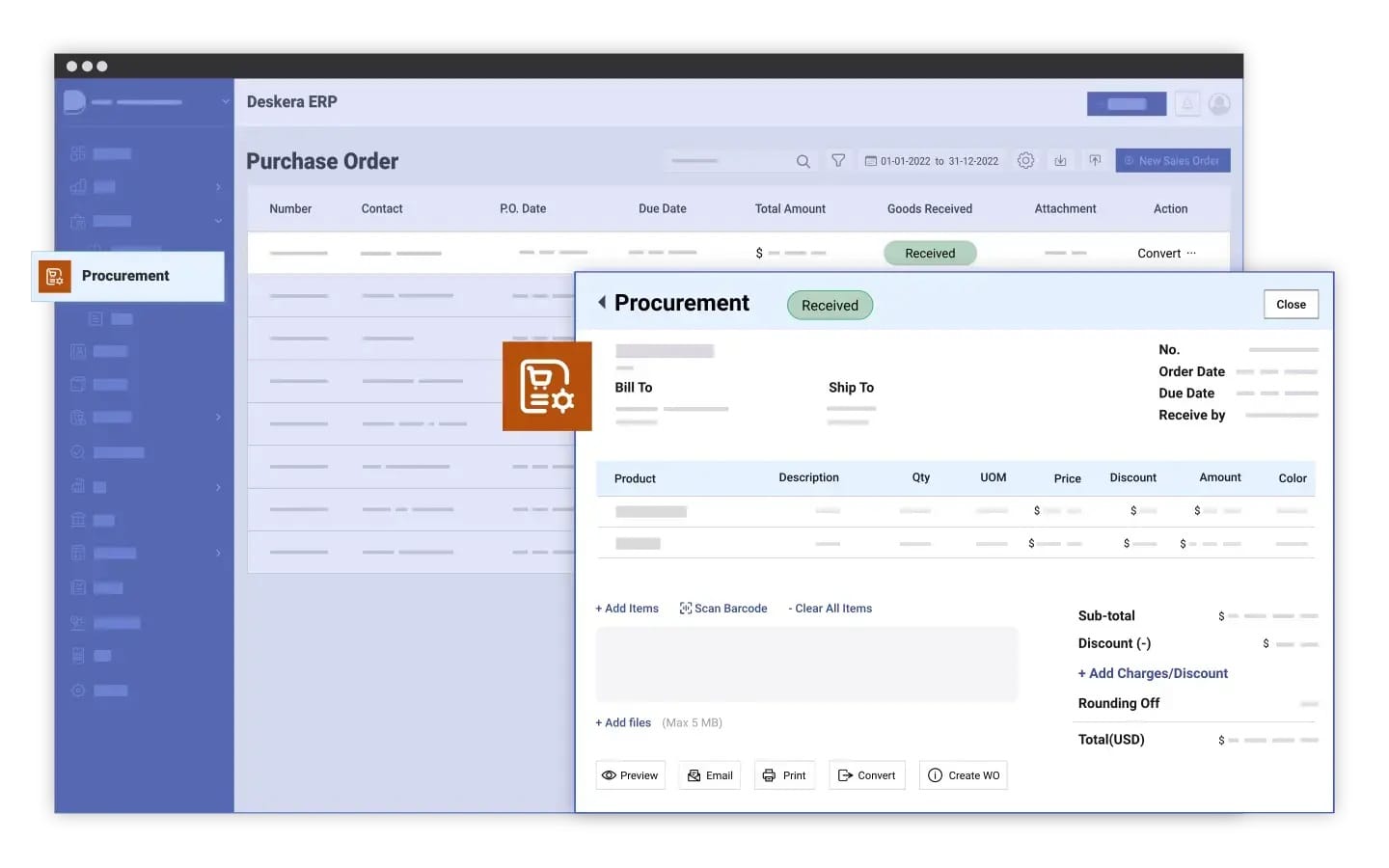
Implementing lean supply chain management requires real-time visibility, process automation, and data-driven decision-making—all of which are enabled by a robust ERP system. Deskera ERP acts as a centralized platform that integrates procurement, inventory, production, and finance, helping businesses eliminate waste, streamline operations, and maintain optimal efficiency. By aligning technology with lean principles, Deskera empowers organizations to build agile, cost-effective, and highly responsive supply chains.
Real-Time Inventory Management and Control
Deskera ERP provides complete visibility into inventory levels across warehouses and locations. With real-time tracking, businesses can monitor stock movements, avoid overstocking, and prevent stockouts. This supports just-in-time (JIT) practices by ensuring that materials are replenished only when needed. Automated alerts and smart inventory controls help maintain optimal stock levels, reducing carrying costs and minimizing waste—key objectives of lean supply chain management.
Demand Forecasting and Planning
Accurate demand forecasting is essential for lean success, and Deskera ERP leverages historical data and analytics to improve prediction accuracy. By aligning production and procurement with actual demand patterns, businesses can avoid overproduction and excess inventory. This data-driven approach enables better planning, reduces uncertainty, and ensures that resources are utilized efficiently across the supply chain.
Streamlined Procurement and Supplier Management
Deskera ERP simplifies procurement processes through automation and centralized supplier management. Businesses can track supplier performance, manage purchase orders, and ensure timely deliveries. Strong supplier coordination is critical in lean supply chains, where delays can disrupt operations. By improving supplier visibility and collaboration, Deskera helps reduce lead times and ensures a smooth flow of materials.
Production Planning and Scheduling
Efficient production planning is at the heart of lean operations. Deskera ERP enables businesses to schedule production activities based on real-time demand and resource availability. This reduces idle time, minimizes work-in-progress inventory, and ensures optimal utilization of machines and labor. With better planning and coordination, businesses can eliminate bottlenecks and improve overall production efficiency.
Automation of Routine Processes
Manual processes often lead to errors, delays, and inefficiencies. Deskera ERP automates repetitive tasks such as order processing, inventory updates, and reporting. This not only improves accuracy but also accelerates operations, allowing businesses to focus on value-added activities. Automation plays a crucial role in reducing waste and maintaining consistency in lean supply chains.
Advanced Reporting and Analytics
Deskera ERP offers powerful reporting and analytics tools that provide actionable insights into supply chain performance. Businesses can track key metrics such as inventory turnover, order fulfillment rates, and lead times. These insights help identify inefficiencies, monitor progress, and support continuous improvement—an essential aspect of lean methodology.
Enhanced Collaboration and Visibility
Lean supply chains require seamless communication across departments and stakeholders. Deskera ERP connects different functions within the organization, enabling real-time data sharing and collaboration. This improved visibility ensures faster decision-making, better coordination, and reduced delays across the supply chain network.
Scalability and Flexibility for Growth
As businesses grow, their supply chain requirements become more complex. Deskera ERP is designed to scale with business needs, allowing organizations to maintain lean operations even as they expand. Its flexible architecture ensures that businesses can adapt to changing market conditions while continuing to optimize efficiency and reduce waste.
Key Takeaways
- Lean supply chain management focuses on eliminating waste and improving efficiency, helping businesses achieve lower costs and better operational performance.
- Key components such as just-in-time inventory, continuous improvement, and strong supplier collaboration form the foundation of a successful lean supply chain.
- Lean supply chains offer significant benefits, including reduced inventory costs, improved order fulfillment rates, enhanced efficiency, and better customer satisfaction.
- However, lean models also come with drawbacks like stockout risks, vulnerability to disruptions, limited flexibility, and high dependency on supplier reliability.
- When comparing lean vs agile supply chains, lean prioritizes efficiency and cost reduction, while agile focuses on flexibility and responsiveness to demand changes.
- Implementing lean successfully requires best practices such as value stream mapping, data-driven forecasting, supplier diversification, and continuous improvement.
- Tracking key metrics like inventory turnover, lead time, order fulfillment rate, and demand forecast accuracy is essential to measure lean supply chain performance.
- Technology plays a critical role in lean supply chains by enabling real-time visibility, automation, and data-driven decision-making through AI, analytics, and digital tools.
- Businesses should adopt lean supply chains when demand is stable, processes are mature, supplier networks are reliable, and strong risk management strategies are in place.
- Deskera ERP supports lean supply chain management by providing real-time inventory control, demand forecasting, process automation, and end-to-end visibility for improved efficiency.
Related Articles
 Rhema Hans
 Niti Samani
 Niti Samani
 Niti Samani
 Niti Samani
 Niti Samani