
What if you could eliminate unexpected equipment failures before they disrupt your production line? The answer lies in proactive maintenance—a forward-thinking approach that focuses on identifying and resolving potential issues before they escalate into costly breakdowns. In today’s fast-paced manufacturing environment, where even a few minutes of downtime can lead to significant financial losses, shifting from reactive fixes to proactive strategies is no longer optional—it’s essential.
Proactive maintenance goes beyond routine inspections and scheduled servicing. It emphasizes understanding the root causes of equipment failures and using data-driven insights to prevent them from recurring. As manufacturing systems become more complex and interconnected, relying solely on traditional maintenance approaches can lead to inefficiencies, higher operational costs, and reduced asset lifespan. This is why forward-looking manufacturers are embracing proactive maintenance to stay competitive and resilient.
In fact, studies show that unplanned downtime can cost manufacturers thousands of dollars per hour, depending on the scale of operations. By implementing proactive maintenance strategies, businesses can significantly reduce downtime, improve equipment reliability, and optimize overall productivity. From leveraging real-time monitoring tools to integrating advanced analytics, proactive maintenance empowers organizations to make smarter, faster decisions that directly impact their bottom line.
Solutions like Deskera MRP play a crucial role in enabling proactive maintenance by offering real-time visibility into equipment performance and maintenance schedules. With features such as automated alerts, preventive maintenance planning, and integrated inventory management, Deskera MRP helps ensure that the right resources are available at the right time. Its AI-powered insights and mobile accessibility further support maintenance teams in identifying issues early and taking timely action, making proactive maintenance more efficient and scalable.
What Is Proactive Maintenance?
Proactive maintenance is a strategic, data-driven approach to asset management that focuses on identifying and resolving potential issues before they lead to equipment failure. Instead of reacting to breakdowns, this method emphasizes early detection, root cause analysis, and continuous improvement to ensure that machinery operates at peak performance. The primary goal is simple: increase asset reliability while minimizing unplanned downtime and costly disruptions.
Unlike traditional maintenance strategies such as reactive (run-to-failure) or even preventive maintenance, proactive maintenance goes a step further by addressing the underlying causes of equipment problems. It is not just about fixing visible issues—it’s about understanding why those issues occur in the first place. By eliminating these root causes, manufacturers can prevent recurring failures, extend equipment lifespan, and reduce the need for frequent repairs.
A key element of proactive maintenance is the use of historical and real-time data. Organizations analyze past performance, failure patterns, and equipment conditions to develop detailed maintenance plans. Assets are prioritized based on their criticality to operations and the potential impact of their failure. This allows maintenance teams to focus their efforts where it matters most, ensuring optimal resource utilization and operational continuity.
In modern manufacturing environments, proactive maintenance often combines elements of predictive and condition-based maintenance. Through continuous monitoring, regular inspections, and advanced analytics, teams can detect early warning signs—such as misalignment, wear, or lubrication issues—before they escalate. This forward-looking approach not only improves efficiency but also creates a more reliable, safe, and cost-effective production ecosystem.
Proactive Maintenance Strategy vs Reactive Maintenance Strategy
When it comes to managing equipment and assets in manufacturing, choosing the right maintenance strategy can significantly impact operational efficiency, costs, and productivity.
Two commonly used approaches—proactive maintenance and reactive maintenance—represent opposite ends of the maintenance spectrum. While proactive maintenance focuses on preventing failures before they occur, reactive maintenance deals with fixing issues only after equipment has already broken down.
Understanding the differences between these strategies helps manufacturers make informed decisions and strike the right balance for their operations.
This comparison clearly shows that while reactive maintenance may seem simpler in the short term, proactive maintenance offers far greater long-term value by improving reliability, reducing costs, and ensuring smoother operations.
Key Components of Proactive Maintenance Strategies
A successful proactive maintenance strategy is built on a strong foundation of data, technology, and continuous improvement practices. Rather than relying on a single method, manufacturers combine multiple capabilities to detect issues early, prevent failures, and optimize asset performance.
The following are the key components that make proactive maintenance effective:
1. Condition Monitoring
Condition monitoring is the backbone of proactive maintenance. It involves continuously tracking the health of equipment using real-time data collected from sensors and connected devices. These sensors monitor parameters such as temperature, vibration, pressure, and lubrication levels to detect anomalies. By identifying early warning signs, maintenance teams can intervene before minor issues escalate into major failures, ensuring smooth and uninterrupted operations.
2. Predictive Analytics
Predictive analytics uses historical and real-time data to forecast potential equipment failures. By leveraging advanced technologies like machine learning and data analytics, manufacturers can identify patterns and trends that indicate declining performance. This allows maintenance teams to take targeted actions only when needed, reducing unnecessary maintenance tasks while improving equipment reliability and extending asset lifespan.
3. Root Cause Analysis (RCA)
Root cause analysis focuses on identifying the underlying reasons behind equipment failures rather than just addressing surface-level symptoms. Even in well-maintained systems, breakdowns can occur. RCA helps teams investigate why a failure happened and implement corrective actions to prevent recurrence. This continuous improvement approach not only enhances long-term reliability but also reduces repeated maintenance costs and operational disruptions.
4. MRP System Integration
An MRP (Material Requirements Planning) system plays a crucial role in supporting proactive maintenance by streamlining maintenance planning and resource allocation. It provides real-time visibility into equipment status, spare parts inventory, and maintenance schedules. With automated workflows, work order management, and data-driven insights, an MRP system ensures that the right materials and resources are available when needed. This integration enables maintenance teams to act quickly, avoid delays, and maintain consistent operational efficiency.
Characteristics of Proactive Maintenance Strategy
A proactive maintenance strategy is defined by its forward-thinking, data-centric, and continuous approach to asset management. Unlike traditional methods that respond to failures, proactive maintenance is built around anticipating and preventing issues before they occur.
Below are the key characteristics that set it apart:
1. Data-Driven Approach
Proactive maintenance relies heavily on data collected from equipment through sensors and monitoring systems. Parameters such as temperature, vibration, pressure, and usage patterns are continuously tracked to assess asset health. This data-driven foundation enables more accurate decision-making and reduces reliance on guesswork.
2. Predictive Capabilities
One of the defining features of proactive maintenance is its ability to predict potential failures. By using advanced analytics and machine learning, organizations can identify patterns and trends that signal equipment deterioration. This allows maintenance teams to act at the right time—before a breakdown occurs.
3. Preventive Focus
The core objective of proactive maintenance is to prevent equipment failures altogether. Instead of waiting for issues to arise, teams address potential risks in advance. This significantly reduces unplanned downtime, lowers repair costs, and ensures consistent production performance.
4. Continuous Monitoring
Proactive maintenance is not a one-time effort but an ongoing process. It requires continuous monitoring of equipment conditions and performance metrics. Real-time insights help organizations quickly detect abnormalities and take corrective action without delays.
5. Root Cause Elimination
Rather than repeatedly fixing the same issues, proactive maintenance focuses on identifying and eliminating the root causes of failures. This approach leads to long-term improvements in equipment reliability and reduces recurring maintenance problems.
6. Integration with Technology
Modern proactive maintenance strategies are closely integrated with digital tools such as IoT devices, analytics platforms, and ERP/MRP systems. These technologies enable automation, real-time visibility, and better coordination across maintenance operations.
7. Focus on Asset Reliability and Longevity
Proactive maintenance prioritizes maximizing the lifespan and performance of assets. By addressing issues early and maintaining optimal operating conditions, organizations can extend equipment life and achieve better returns on their investments.
8. Cost Optimization
By preventing major failures and minimizing emergency repairs, proactive maintenance helps control maintenance costs. It ensures that resources are used efficiently and reduces unnecessary maintenance activities, leading to overall cost savings.
Types of Proactive Maintenance Strategies
Proactive maintenance is not a single approach but a combination of multiple strategies that work together to prevent equipment failures and improve asset reliability. Organizations typically adopt a mix of these methods based on their operational needs, asset criticality, and level of digital maturity.
Below are the most common types of proactive maintenance strategies used in modern manufacturing:
1. Preventive Maintenance (PM)
Preventive maintenance involves performing regular, scheduled maintenance activities to keep equipment in optimal condition and prevent failures before they occur. These activities may include inspections, cleaning, lubrication, and part replacements.
Preventive maintenance can be time-based (e.g., monthly servicing), usage-based (e.g., after a certain number of operating hours), or condition-triggered. It forms the foundation of most proactive maintenance programs.
2. Predictive Maintenance (PdM)
Predictive maintenance uses historical data, real-time inputs, and advanced analytics to forecast when equipment is likely to fail. By leveraging technologies like machine learning and IoT sensors, this approach helps maintenance teams act just in time—before a breakdown occurs. It reduces unnecessary maintenance activities while improving asset performance and minimizing downtime.
3. Condition-Based Maintenance (CBM)
Condition-based maintenance focuses on monitoring the real-time condition of equipment and performing maintenance only when specific thresholds are exceeded. For example, if a machine’s vibration or temperature crosses a predefined limit, a maintenance task is triggered. This ensures that maintenance is performed only when necessary, optimizing resource utilization and avoiding over-maintenance.
4. Reliability-Centered Maintenance (RCM)
Reliability-centered maintenance prioritizes maintaining the overall reliability of critical assets. It involves analyzing failure modes, understanding their impact on operations, and applying the most effective maintenance strategy accordingly. RCM helps organizations focus their efforts on high-priority equipment that is essential for business continuity and operational efficiency.
5. Automated (IoT-Enabled) Maintenance
Automated maintenance leverages advanced technologies such as IoT, artificial intelligence (AI), and machine learning to streamline maintenance processes. Systems automatically collect data, generate alerts, and even trigger work orders without manual intervention. This approach enhances efficiency, reduces human error, and enables real-time decision-making across multiple assets.
6. Prescriptive Maintenance
Prescriptive maintenance takes predictive maintenance a step further by not only forecasting failures but also recommending the best course of action. Using AI-driven insights, it suggests specific interventions—such as adjusting operating conditions or replacing components—to prevent failure. This helps maintenance teams make faster and more accurate decisions.
In practice, most manufacturers use a hybrid approach, combining multiple proactive maintenance strategies to create a robust and flexible maintenance program tailored to their specific operational requirements.
Benefits of Proactive Maintenance Strategies
Implementing proactive maintenance strategies delivers significant advantages for manufacturers aiming to improve efficiency, reduce costs, and enhance asset reliability.
By shifting from reactive fixes to a prevention-focused approach, organizations can leverage data, automation, and analytics to streamline operations. This not only minimizes disruptions but also creates a more predictable and scalable production environment.
Below are the key benefits explained in detail:
1. Reduced Unplanned Downtime
Proactive maintenance enables organizations to detect early warning signs of equipment failure through continuous monitoring and data analysis. By addressing potential issues before they escalate, manufacturers can significantly reduce unexpected breakdowns that disrupt production schedules.
This ensures smoother workflows and consistent output levels. Reduced downtime also means fewer delays in order fulfillment, helping businesses maintain customer commitments while avoiding the high financial impact typically associated with sudden equipment failures.
2. Lower Maintenance Costs
While proactive maintenance may require an upfront investment in sensors, software, and training, it leads to substantial cost savings over time. Planned maintenance activities are far more economical than emergency repairs, which often involve expedited parts, overtime labor, and production losses.
By preventing major failures and optimizing maintenance schedules, organizations can reduce unnecessary expenses, improve budget predictability, and allocate resources more efficiently across operations.
3. Increased Equipment Reliability
A proactive approach ensures that equipment is consistently monitored, maintained, and optimized for performance. By addressing root causes of potential failures rather than temporary fixes, maintenance teams can improve the overall reliability of assets.
This leads to fewer interruptions, more stable production processes, and greater confidence in machinery performance. Reliable equipment also supports better planning and scheduling, as manufacturers can depend on their assets to function without unexpected disruptions.
4. Extended Asset Lifespan
Proactive maintenance helps extend the useful life of equipment by ensuring that issues are identified and resolved early. Regular inspections, timely servicing, and data-driven interventions prevent minor wear and tear from turning into major damage.
As a result, assets operate under optimal conditions for longer periods. This reduces the need for frequent replacements, lowers capital expenditure, and maximizes the return on investment for machinery and equipment.
5. Improved Operational Efficiency
With fewer breakdowns and better-maintained equipment, production processes become more streamlined and efficient. Proactive maintenance eliminates unnecessary interruptions, allowing teams to focus on core operations rather than emergency fixes.
It also improves coordination between departments by enabling better planning of maintenance activities. This leads to higher productivity, optimized resource utilization, and a more stable manufacturing environment that supports consistent business performance.
6. Enhanced Workplace Safety
Equipment failures can pose serious safety risks, especially in manufacturing environments where heavy machinery is involved. Proactive maintenance minimizes these risks by identifying potential hazards before they lead to accidents.
Regular monitoring and timely repairs ensure that machines operate within safe parameters. This not only protects workers but also helps organizations comply with safety regulations, reduce liability risks, and create a safer, more secure workplace for employees.
7. Better Planning and Workflow Optimization
Proactive maintenance allows organizations to plan maintenance tasks in advance rather than reacting to emergencies. This improves scheduling, resource allocation, and coordination across teams. Maintenance activities can be aligned with production cycles to minimize disruption.
Additionally, automated workflows and standardized processes reduce manual errors and improve efficiency. As a result, organizations achieve smoother operations, better time management, and more effective utilization of manpower and materials.
8. Data-Driven Decision-Making
One of the biggest advantages of proactive maintenance is access to real-time and historical data. This data provides valuable insights into equipment performance, failure patterns, and maintenance needs.
Managers can use these insights to make informed decisions, optimize maintenance schedules, and prioritize critical assets. Data-driven strategies also support continuous improvement initiatives, helping organizations refine their maintenance practices and achieve better long-term outcomes.
9. Improved Customer Satisfaction
Consistent production performance and reduced downtime directly contribute to better customer satisfaction. When equipment operates reliably, manufacturers can meet delivery timelines and maintain product quality. This builds trust and strengthens relationships with customers.
Additionally, fewer disruptions mean better service consistency, which enhances brand reputation and encourages repeat business. Proactive maintenance, therefore, plays a key role in supporting both operational excellence and customer-centric growth.
Challenges in Implementing Proactive Maintenance
While proactive maintenance offers significant long-term benefits, implementing it is not without challenges. Many organizations struggle with the transition from traditional maintenance approaches due to technological, financial, and organizational barriers.
Understanding these challenges is essential for building a realistic and effective maintenance strategy.
1. High Initial Investment
One of the biggest barriers to adopting proactive maintenance is the upfront cost. Implementing technologies such as IoT sensors, analytics platforms, and integrated systems requires significant capital investment.
Additionally, costs related to infrastructure upgrades, software deployment, and employee training can add to the financial burden.
For small and mid-sized manufacturers, justifying this initial expense can be difficult, even though the long-term return on investment is substantial.
2. Data Management Complexity
Proactive maintenance relies heavily on large volumes of real-time and historical data. Managing, processing, and analyzing this data can be complex, especially for organizations without robust data systems in place.
Poor data quality or lack of integration between systems can lead to inaccurate insights. Without the right tools and frameworks, companies may struggle to convert raw data into actionable maintenance decisions.
3. Lack of Skilled Workforce
Implementing proactive maintenance requires a workforce skilled in data analysis, predictive technologies, and modern maintenance practices. However, many organizations face a talent gap in these areas.
Maintenance teams may need extensive training to adapt to new tools and technologies. The shortage of skilled professionals can slow down implementation and reduce the effectiveness of proactive maintenance initiatives.
4. Resistance to Change
Shifting from reactive or preventive maintenance to a proactive approach often involves significant cultural and operational changes. Employees and management may resist adopting new processes, especially if they are accustomed to traditional methods.
This resistance can delay implementation and reduce overall adoption. Strong leadership, clear communication, and change management strategies are essential to overcome this challenge.
5. Integration with Existing Systems
Many manufacturing facilities operate with legacy systems that are not designed to support modern, data-driven maintenance strategies. Integrating new technologies with existing infrastructure can be complex and time-consuming.
Compatibility issues, data silos, and lack of standardization can hinder seamless implementation. Organizations must carefully plan system integration to ensure smooth data flow and operational efficiency.
6. Difficulty in Defining Clear ROI
Although proactive maintenance delivers long-term benefits, measuring its immediate return on investment can be challenging. The value often comes in the form of avoided costs, such as reduced downtime and fewer failures, which can be difficult to quantify. This lack of clear, short-term ROI can make it harder for decision-makers to justify investments and gain stakeholder support.
Despite these challenges, organizations that invest in the right technologies, training, and change management strategies can successfully implement proactive maintenance and unlock significant operational and financial benefits.
Best Practices to Transition from Reactive to Proactive Maintenance Strategies
Shifting from reactive to proactive maintenance requires more than just adopting new tools—it demands a strategic, data-driven, and cultural transformation across the organization. While reactive maintenance focuses on fixing problems after they occur, proactive maintenance emphasizes prevention, planning, and continuous improvement.
The following best practices can help manufacturers successfully make this transition and build a sustainable, efficient maintenance program:
1. Assess Current Maintenance Processes
The first step is to evaluate your existing maintenance approach and identify gaps. Analyze historical data to understand recurring failures, downtime patterns, and cost implications.
This assessment helps pinpoint areas where reactive maintenance is causing inefficiencies. By gaining a clear understanding of your current state, you can build a roadmap for transitioning to a more proactive and structured maintenance strategy.
2. Prioritize Critical Assets
Not all equipment requires the same level of attention. Identify and prioritize assets that are critical to production, safety, and operational continuity. Focusing proactive maintenance efforts on high-impact equipment ensures maximum return on investment.
Even small improvements in managing critical assets can significantly reduce downtime, improve productivity, and enhance overall operational performance.
3. Develop a Comprehensive Maintenance Plan
Create a structured maintenance plan that includes preventive, condition-based, and predictive maintenance activities. Clearly define maintenance schedules, responsibilities, and procedures for each asset.
A well-documented plan ensures consistency and alignment with business goals. It also helps teams move away from ad hoc repairs and adopt a more disciplined, proactive approach to equipment management.
4. Leverage MRP Systems for Maintenance Management
Modern MRP systems play a crucial role in enabling proactive maintenance by centralizing data and automating workflows. They provide real-time visibility into asset performance, maintenance schedules, and spare parts inventory.
With features like automated work orders, maintenance tracking, and reporting, MRP systems help streamline operations and improve coordination. This ensures that maintenance activities are planned efficiently and executed without delays.
5. Collect and Analyze Maintenance Data
Data is the foundation of proactive maintenance. Implement systems to collect real-time and historical data on equipment performance, usage, and failure patterns.
Analyzing this data helps identify trends, detect early warning signs, and predict potential issues. With accurate insights, maintenance teams can make informed decisions and schedule interventions before problems escalate.
6. Focus on Root Cause Analysis
Instead of repeatedly fixing the same issues, organizations should focus on identifying and eliminating the root causes of failures. Conduct detailed root cause analysis (RCA) whenever breakdowns occur.
This approach prevents recurring problems, improves equipment reliability, and supports continuous improvement in maintenance practices.
7. Train and Empower Maintenance Teams
A successful transition depends on a skilled and knowledgeable workforce. Provide training on proactive maintenance techniques, data interpretation, and the use of modern tools.
Encourage collaboration between maintenance teams and operators to share insights and identify issues early. Empowered teams are more likely to adopt proactive practices and contribute to long-term operational success.
8. Establish Key Performance Indicators (KPIs)
Define and track key metrics such as equipment uptime, mean time between failures (MTBF), mean time to repair (MTTR), and maintenance costs. These KPIs help measure the effectiveness of your proactive maintenance strategy. Regular monitoring allows organizations to identify areas for improvement and refine their approach for better results.
9. Start Small and Scale Gradually
Transitioning to proactive maintenance does not have to happen all at once. Begin with a pilot program focused on a few critical assets. Test strategies, measure results, and refine processes before scaling across the organization. This phased approach reduces risk, ensures smoother implementation, and builds confidence among stakeholders.
10. Foster a Culture of Continuous Improvement
Proactive maintenance is an ongoing journey rather than a one-time initiative. Encourage a culture where teams continuously seek ways to improve processes, reduce inefficiencies, and enhance asset performance. Regular feedback, data-driven insights, and incremental improvements help organizations stay ahead of potential issues and sustain long-term success.
By following these best practices, manufacturers can successfully transition from reactive to proactive maintenance, unlocking greater efficiency, reliability, and cost savings across their operations.
Key Metrics to Measure Proactive Maintenance Success
Measuring the effectiveness of a proactive maintenance strategy is essential to ensure continuous improvement and long-term success. Without clearly defined metrics, organizations may struggle to evaluate performance, justify investments, or identify areas for optimization.
By tracking the right key performance indicators (KPIs), manufacturers can gain actionable insights into equipment health, maintenance efficiency, and overall operational performance.
1. Mean Time Between Failures (MTBF)
MTBF measures the average time between equipment failures and is a key indicator of asset reliability. A higher MTBF suggests that equipment is operating efficiently with fewer breakdowns. Proactive maintenance aims to increase MTBF by addressing potential issues early and eliminating root causes. Monitoring this metric helps organizations assess how well their maintenance strategy is improving equipment performance over time.
2. Mean Time to Repair (MTTR)
MTTR measures the average time required to repair equipment and restore it to normal operation after a failure. A lower MTTR indicates efficient maintenance processes and quick response times. While proactive maintenance focuses on preventing failures, reducing MTTR remains important for handling unavoidable issues effectively and minimizing operational disruptions.
3. Equipment Uptime and Availability
Equipment uptime refers to the percentage of time that machinery is operational and available for production. High uptime is a direct result of effective proactive maintenance. By preventing unexpected breakdowns and scheduling maintenance during planned downtime, organizations can maximize equipment availability and ensure consistent production output.
4. Overall Equipment Effectiveness (OEE)
OEE is a comprehensive metric that measures the efficiency of manufacturing equipment based on availability, performance, and quality. It provides a holistic view of how well assets are utilized. Proactive maintenance contributes to higher OEE by reducing downtime, improving performance, and minimizing defects, making it a critical metric for evaluating maintenance success.
5. Maintenance Cost as a Percentage of Asset Value
This metric evaluates the cost-effectiveness of maintenance activities by comparing maintenance expenses to the value of the assets. Proactive maintenance helps reduce overall costs by minimizing emergency repairs and extending asset lifespan. Tracking this KPI ensures that maintenance spending remains optimized and aligned with business objectives.
6. Planned vs. Unplanned Maintenance Ratio
This metric compares the proportion of planned maintenance activities to unplanned or emergency repairs. A higher ratio of planned maintenance indicates a more mature and effective proactive maintenance strategy. Organizations should aim to increase planned maintenance while reducing reactive interventions to achieve greater efficiency and control.
7. Failure Rate and Frequency
Failure rate measures how often equipment fails within a given period. A decreasing failure rate indicates that proactive maintenance efforts are successfully preventing breakdowns. Tracking this metric helps identify recurring issues and evaluate the effectiveness of root cause analysis and preventive actions.
8. Work Order Completion Rate
This metric tracks how efficiently maintenance tasks are completed within the planned timeframe. A high completion rate indicates well-organized maintenance processes and effective resource allocation. Proactive maintenance improves this metric by enabling better planning, scheduling, and execution of maintenance activities.
9. Spare Parts Inventory Turnover
Spare parts inventory turnover measures how efficiently spare parts are used and replenished. Proactive maintenance helps optimize inventory levels by ensuring that parts are available when needed without overstocking. Efficient inventory management reduces carrying costs and prevents delays in maintenance activities.
By consistently tracking these metrics, organizations can evaluate the effectiveness of their proactive maintenance strategies, identify improvement opportunities, and make data-driven decisions that enhance overall operational performance.
How Deskera MRP Supports Proactive Maintenance
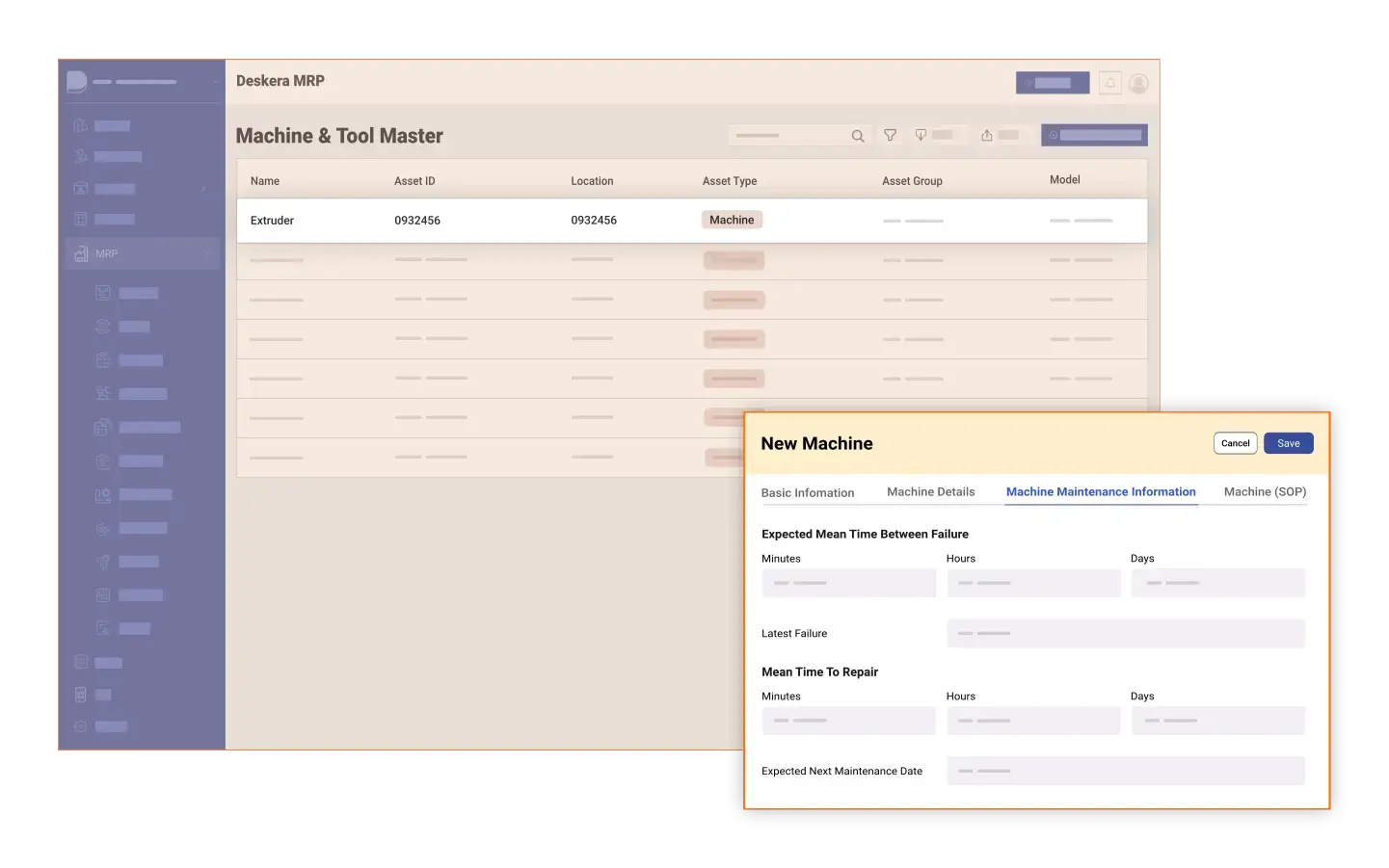
Implementing proactive maintenance becomes significantly easier with the right technology, and Deskera MRP, provides a comprehensive platform to plan, monitor, and optimize maintenance activities. By integrating maintenance with production, inventory, and analytics, Deskera enables manufacturers to shift from reactive fixes to a fully proactive, data-driven approach.
1. Automated Maintenance Scheduling
Deskera allows organizations to automate maintenance schedules based on time intervals, equipment usage, or condition monitoring. This ensures that maintenance activities are performed at the right time without manual intervention. Automated scheduling helps prevent missed maintenance tasks, reduces unexpected breakdowns, and keeps equipment operating efficiently with minimal disruptions.
2. Real-Time Equipment Monitoring
With built-in machine management and performance tracking, Deskera provides real-time visibility into equipment health. Maintenance teams can monitor key metrics such as usage, failures, and performance trends. This continuous monitoring enables early detection of anomalies and supports timely interventions, which are critical for preventing costly equipment failures.
3. Work Order and Maintenance Management
Deskera streamlines maintenance execution through automated work order creation, assignment, and tracking. Teams can manage maintenance requests, monitor progress, and ensure timely completion of tasks. This structured approach improves coordination, reduces delays, and ensures that maintenance activities are carried out efficiently and consistently.
4. Spare Parts and Inventory Optimization
Effective proactive maintenance requires the right parts to be available at the right time. Deskera integrates maintenance with inventory management, allowing organizations to track spare parts, monitor stock levels, and automate replenishment. This prevents delays caused by stockouts and ensures that maintenance activities are executed without interruptions.
5. Data-Driven Insights and Reporting
Deskera provides advanced reporting and analytics capabilities that help organizations analyze maintenance history, identify failure patterns, and optimize maintenance strategies. By leveraging real-time and historical data, maintenance managers can make informed decisions, refine schedules, and continuously improve asset performance.
6. Integration with Production Planning
One of the key advantages of Deskera ERP is its seamless integration between maintenance and production planning. Maintenance activities can be aligned with production schedules to minimize disruptions. This ensures that maintenance is performed during planned downtime, helping maintain productivity while still preserving equipment health.
7. Centralized and Mobile-Enabled Platform
Deskera offers a centralized platform where all maintenance-related data—assets, schedules, work orders, and performance metrics—are accessible in one place. With mobile accessibility, maintenance teams can update tasks, track issues, and collaborate in real time, improving responsiveness and operational efficiency across the organization.
By combining automation, real-time monitoring, and integrated workflows, Deskera ERP empowers manufacturers to implement and scale proactive maintenance strategies effectively. It not only reduces downtime and maintenance costs but also enhances overall equipment reliability and operational performance.
Key Takeaways
- Proactive maintenance focuses on identifying and eliminating potential equipment issues before they lead to failures, ensuring higher reliability and reduced downtime.
- Understanding the differences between reactive, preventive, predictive, and proactive maintenance helps organizations choose the right strategy mix for optimal performance.
- Proactive maintenance is essential in modern manufacturing due to rising downtime costs, increasing equipment complexity, and the need for operational efficiency.
- Key components such as condition monitoring, predictive analytics, root cause analysis, and MRP integration enable a strong and effective proactive maintenance framework.
- Characteristics like data-driven decision-making, continuous monitoring, and a preventive mindset define the effectiveness of proactive maintenance strategies.
- Comparing proactive and reactive maintenance highlights the long-term cost savings, efficiency, and reliability benefits of a proactive approach.
- Different types of proactive maintenance strategies, including preventive, predictive, condition-based, and reliability-centered maintenance, work best when combined.
- Proactive maintenance delivers benefits such as reduced downtime, lower costs, improved safety, extended asset lifespan, and better operational efficiency.
- Despite its advantages, challenges like high initial investment, data complexity, and resistance to change must be addressed for successful implementation.
- Transitioning from reactive to proactive maintenance requires structured planning, data utilization, workforce training, and the use of MRP systems.
- Tracking key metrics such as MTBF, MTTR, uptime, and OEE helps measure the success and effectiveness of proactive maintenance strategies.
- Deskera MRP supports proactive maintenance by enabling automation, real-time monitoring, efficient work order management, and data-driven decision-making.
Related Articles
 Niti Samani
 Niti Samani
 Niti Samani
 Niti Samani
 Niti Samani
 Niti Samani