

Enterprise Resource Planning (ERP) systems have long been the backbone of business operations, centralizing data across finance, supply chain, manufacturing, and HR. Yet, as enterprises face growing data volumes, fragmented workflows, and the need for faster decision-making, traditional ERP systems are being pushed beyond their original design. This is where generative AI is emerging as a transformative force—shifting ERP from a system of record to a system of intelligence.
The adoption of AI within ERP environments is accelerating rapidly. Studies indicate that nearly 72% of organizations already use AI-enabled capabilities in their ERP systems, while 65% are actively leveraging generative AI for advanced analytics and insight generation. More tellingly, 70% of enterprises now prioritize embedded generative AI as a core part of their digital transformation strategies. These numbers highlight a clear shift: businesses no longer view AI as an add-on, but as a foundational layer within modern ERP platforms.
Generative AI enhances ERP systems by enabling natural language interactions, intelligent automation, and context-aware insights. From automating time-consuming tasks such as data cleansing and mapping to generating real-time explanations for financial variances or supply chain disruptions, GenAI dramatically improves operational efficiency. By allowing users to query ERP data conversationally and receive actionable recommendations, organizations gain faster, more informed decision-making across functions—driving measurable productivity gains.
Modern ERP platforms like Deskera ERP are already embedding AI-driven capabilities to support this evolution. With integrated modules for finance, inventory, and manufacturing, Deskera enables businesses to leverage AI-powered insights, automated workflows, and real-time visibility across operations. By combining cloud scalability with intelligent automation, Deskera ERP helps organizations translate generative AI innovation into practical, day-to-day business value.
What Is Generative AI in ERP Systems?
Generative AI in ERP systems refers to the use of advanced AI models—such as large language models (LLMs)—that can understand context, generate insights, and create content directly from enterprise data. Unlike traditional rule-based automation or predictive analytics, generative AI can interpret complex datasets, produce human-like responses, and support decision-making across ERP functions such as finance, supply chain, manufacturing, HR, and procurement.
At its core, generative AI enables ERP systems to move beyond transaction processing to intelligent assistance. It allows users to interact with ERP data using natural language, automatically generate reports and summaries, explain variances or anomalies, and recommend next-best actions. For example, instead of manually pulling reports, users can ask the ERP system why costs increased or how inventory levels will impact cash flow—and receive contextual, data-backed responses.
Generative AI also enhances automation within ERP by handling tasks that traditionally required significant manual effort. This includes data cleansing and mapping, master data enrichment, document processing, and workflow configuration. By learning from historical patterns and real-time data, GenAI adapts to changing business conditions, making ERP processes more flexible and responsive.
Ultimately, generative AI transforms ERP systems into intelligent, self-learning platforms. By embedding AI directly into core workflows, ERP systems become more intuitive, insight-driven, and user-friendly—helping organizations improve productivity, accelerate decision-making, and extract greater strategic value from their enterprise data.
Why ERP Systems Need Generative AI Today
ERP systems are expected to do far more than record transactions—they must help businesses respond quickly to change, extract insights from growing data volumes, and support smarter decisions across functions. Generative AI addresses these evolving demands by adding intelligence, adaptability, and contextual understanding directly into ERP workflows.
Below are the key reasons why generative AI has become essential for modern ERP systems.
Growing Data Complexity Across Business Functions
As organizations scale, ERP systems accumulate massive volumes of structured and unstructured data across finance, supply chain, manufacturing, HR, and sales. Traditional ERP tools struggle to interpret this complexity in real time. Generative AI helps ERP systems synthesize data across modules, identify patterns, and present insights in a clear, consumable format—reducing information overload and improving data usability.
Demand for Faster, Insight-Driven Decision-Making
Business leaders can no longer rely on static reports or delayed dashboards. They need instant, context-aware insights to respond to market shifts, cost pressures, and operational risks. Generative AI enables ERP systems to generate real-time explanations, forecasts, and recommendations, helping decision-makers act faster with greater confidence.
Rising Expectations for Automation Beyond Rules
Conventional ERP automation is largely rule-based and limited in scope. However, modern enterprises require automation that can adapt to changing conditions. Generative AI enables intelligent automation—handling tasks such as data cleansing, reconciliation, report generation, and exception handling—while continuously learning from historical and real-time data.
Need for More Intuitive and User-Friendly ERP Experiences
ERP systems are often criticized for being complex and difficult to use, which impacts adoption and productivity. Generative AI introduces natural language interfaces and conversational assistants, allowing users to interact with ERP systems using simple queries. This lowers the learning curve, improves accessibility, and increases overall user engagement.
Pressure to Support Digital Transformation and Scalability
Digital transformation initiatives demand ERP systems that can evolve alongside business models and technologies. Embedded generative AI ensures ERP platforms remain scalable, future-ready, and capable of supporting advanced use cases such as predictive planning, scenario modeling, and autonomous operations—making them strategic enablers rather than operational constraints.
10 Key Use Cases of Generative AI in ERP Systems
Generative AI brings a new layer of intelligence to ERP platforms by enabling systems to generate insights, predictions, and content based on learned data patterns.
Unlike traditional automation, these capabilities allow ERP systems to adapt to dynamic business conditions and support strategic decision-making across functions.
The following use cases highlight where generative AI is delivering the most impact within ERP environments.
1. Financial Planning and Intelligent Automation
Generative AI significantly enhances financial operations within ERP systems by automating complex, multi-step processes such as procure-to-pay and accounts payable workflows.
Beyond transaction automation, it supports advanced financial planning by generating forecasts, budget scenarios, and variance explanations based on changing business conditions. It also strengthens fraud detection by identifying unusual patterns and anomalies in financial data.
2. Data Augmentation, Cleansing, and Enhancement
ERP systems rely heavily on accurate data, yet data gaps and inconsistencies remain a common challenge. Generative AI assists by creating synthetic datasets where data is limited or sensitive, improving analytics without compromising security.
It also automates data cleansing and correction by identifying errors, standardizing entries, and enriching master data—improving overall data reliability across ERP modules.
3. Demand Forecasting and Predictive Insights
Generative AI models analyze historical sales data, seasonal trends, and external signals to generate realistic demand forecasts. By creating multiple future demand scenarios, ERP systems can better support inventory planning, production scheduling, and sales strategies—reducing stockouts, excess inventory, and demand volatility risks.
4. Predictive Maintenance and Asset Intelligence
Within asset-intensive industries, generative AI enables ERP systems to simulate operational conditions and predict equipment failures before they occur. By generating maintenance recommendations based on usage patterns and historical performance, businesses can minimize downtime, extend asset life, and optimize maintenance schedules.
5. Scenario Planning and Business Simulation
Generative AI allows ERP users to model “what-if” scenarios across finance, supply chain, and operations. Organizations can simulate the impact of cost changes, supplier disruptions, demand spikes, or policy shifts—helping leadership anticipate risks, evaluate alternatives, and make data-backed strategic decisions.
6. Customization and Personalization Across ERP Modules
Generative AI supports dynamic personalization within ERP systems by tailoring dashboards, workflows, and alerts based on user roles and behavior. It also extends into customer-facing functions, enabling ERP-driven sales and marketing teams to generate personalized content, recommendations, and engagement strategies—improving both internal efficiency and customer experience.
7. Automated and Context-Aware Report Generation
ERP platforms generate vast volumes of operational, financial, and compliance reports. Generative AI automates this process by producing structured, narrative-driven reports customized for different stakeholders. It can also summarize key trends, explain deviations, and highlight risks—reducing manual effort while improving clarity and insight.
8. AI-Powered User Assistance and Knowledge Support
By leveraging natural language processing, generative AI enhances ERP usability through intelligent assistants and chatbots. Users can ask questions, receive workflow guidance, troubleshoot issues, or learn system features conversationally. This improves user adoption, reduces training time, and enables faster task completion across ERP functions.
9. Supply Chain Optimization and Resilience Planning
Generative AI strengthens ERP-based supply chain management by enabling scenario testing for disruptions such as delays, shortages, or sudden demand changes. By generating alternative supply strategies and recommendations, ERP systems help organizations build more resilient, responsive, and cost-efficient supply chains.
10. Product Design and Development in Manufacturing
In manufacturing-focused ERP modules, generative AI supports product design by generating design concepts based on performance criteria, cost constraints, or customer feedback. This accelerates innovation cycles, improves design accuracy, and helps align product development with market demand.
Business Benefits of Generative AI–Driven ERP Systems
Generative AI–driven ERP systems go beyond process automation to deliver measurable business value across functions. By embedding intelligence directly into core workflows, these systems help organizations operate faster, smarter, and with greater agility.
The key business benefits include:
Improved Decision-Making with Real-Time, Contextual Insights
Generative AI enables ERP systems to analyze large volumes of enterprise data and generate clear, actionable insights in real time. By providing explanations, forecasts, and scenario-based recommendations in natural language, decision-makers can respond quickly to operational changes with greater confidence and accuracy.
Increased Operational Efficiency and Productivity
By automating time-intensive tasks such as data cleansing, report generation, reconciliation, and exception handling, generative AI significantly reduces manual effort. This allows teams to focus on higher-value activities while improving overall productivity across finance, supply chain, manufacturing, and HR functions.
Faster Planning and Forecasting Cycles
Generative AI accelerates planning processes by dynamically generating financial models, demand forecasts, and what-if scenarios. ERP users can evaluate multiple business outcomes in minutes rather than weeks, enabling faster planning cycles and more responsive business strategies.
Enhanced User Experience and Higher ERP Adoption
Natural language interfaces and AI-powered assistants make ERP systems easier to use and more accessible. Employees can interact with ERP data conversationally, receive guided assistance, and access insights without deep technical expertise—leading to higher user adoption and reduced training costs.
Better Data Quality and Governance
Generative AI improves data accuracy by automatically identifying inconsistencies, filling data gaps, and standardizing master data across ERP modules. This ensures more reliable reporting, stronger compliance, and greater trust in enterprise data for decision-making.
Greater Agility and Business Resilience
By supporting scenario planning, predictive insights, and adaptive workflows, generative AI–driven ERP systems help organizations anticipate risks and respond proactively to disruptions. This agility enables businesses to remain resilient in the face of market volatility, supply chain uncertainty, and regulatory change.
Scalable Innovation and Future Readiness
As business needs evolve, generative AI allows ERP systems to scale intelligently without extensive reconfiguration. Organizations can continuously introduce new use cases, automate emerging processes, and support digital transformation initiatives—positioning ERP as a long-term strategic asset rather than a static operational tool.
Key Challenges and Considerations When Adopting Generative AI in ERP
While generative AI offers significant potential to transform ERP systems, successful adoption requires careful planning and governance. Organizations must address a set of technical, operational, and organizational considerations to ensure AI-driven ERP initiatives deliver sustainable value rather than unintended risk.
Data Security, Privacy, and Compliance
ERP systems store highly sensitive financial, operational, and employee data. Introducing generative AI increases the need for strong data governance, access controls, and compliance with regulations. Organizations must ensure that AI models do not expose sensitive information, misuse data, or violate industry and regional compliance requirements.
Data Quality and Readiness
Generative AI is only as effective as the data it learns from. Inconsistent, incomplete, or poorly governed ERP data can lead to inaccurate insights and unreliable recommendations. Before deploying generative AI, businesses must invest in data standardization, master data management, and integration across ERP modules.
Model Accuracy, Bias, and Reliability
Generative AI models can sometimes produce inaccurate or misleading outputs, especially when context is limited or data patterns are skewed. ERP-driven decisions often have financial and operational consequences, making accuracy critical. Organizations must validate AI outputs, monitor model performance, and implement human oversight for high-impact decisions.
Integration with Existing ERP Architecture
Embedding generative AI into legacy or highly customized ERP environments can be complex. Challenges may include system compatibility, performance impact, and workflow disruption. A clear integration strategy—supported by APIs, modular architecture, and scalable cloud infrastructure—is essential for smooth adoption.
Change Management and User Trust
Even the most advanced AI capabilities will fail without user adoption. Employees may resist AI-driven recommendations or distrust automated outputs. Organizations must focus on change management through training, transparency, and clear communication around how generative AI supports—not replaces—human decision-making.
Cost, ROI, and Scalability Considerations
Implementing generative AI within ERP systems requires investment in infrastructure, skills, and ongoing model maintenance. Businesses must clearly define use cases, measure ROI, and ensure solutions can scale over time without escalating costs or operational complexity.
Governance, Ethics, and Accountability
As generative AI takes on a more active role in ERP processes, organizations must establish clear governance frameworks. This includes defining accountability for AI-driven outcomes, ensuring ethical use of AI, and maintaining auditability for compliance and regulatory reporting.
Best Practices for Using Generative AI in ERP Systems
To unlock the full potential of generative AI within ERP systems, organizations must move beyond experimentation and adopt a structured, long-term approach.
The following best practices help ensure generative AI initiatives are scalable, secure, and aligned with business outcomes.
1. Establish a Strong Data Foundation
A consistent and centralized data platform is essential for successful generative AI adoption. ERP systems should serve as the single source of truth, bringing together data from finance, supply chain, manufacturing, HR, and sales. This unified foundation ensures generative AI models can access reliable, contextual data and deliver meaningful insights across the enterprise.
2. Ensure Data Quality, Accuracy, and Governance
Generative AI depends on clean, well-governed data. Organizations must focus on data standardization, validation, and master data management within their ERP systems. High-quality, accurate data improves model reliability, strengthens decision-making, and reduces the risk of misleading AI-generated outputs.
3. Unite Key Business Functions and Eliminate Data Silos
ERP platforms are most effective when they integrate cross-functional processes into a single system. By breaking down data silos and unifying business functions, generative AI models gain a holistic view of operations. This enables more accurate forecasting, better scenario planning, and stronger collaboration across departments.
4. Optimize Resource Utilization and Infrastructure
Generative AI requires adequate computational resources and efficient data management. Organizations should eliminate redundant data storage, optimize system performance, and ensure infrastructure scalability. Proper resource allocation ensures AI workloads run efficiently without disrupting core ERP operations.
5. Embrace Agile and Scalable Processes
Business requirements and AI capabilities evolve rapidly. ERP systems must be flexible enough to support continuous improvement and experimentation. An agile, modular ERP architecture allows organizations to adopt new generative AI use cases incrementally—without major system overhauls or operational downtime.
6. Enable Advanced Analytics and Insight Generation
Centralized ERP data enables advanced analytics and deeper insight generation through generative AI. By combining structured reporting with AI-generated narratives and predictions, organizations can uncover hidden patterns, understand root causes, and support data-driven strategic decisions at scale.
7. Prioritize Security, Privacy, and Compliance
Security and compliance must be embedded into every stage of generative AI adoption. ERP systems should enforce role-based access, data encryption, and audit trails to protect sensitive information. Generative AI processes must also comply with regulatory and data privacy requirements to ensure trust and accountability.
8. Drive Cost Efficiency Through Integration
Integrating generative AI directly into ERP systems reduces the complexity of managing multiple tools and data sources. This consolidation lowers operational costs, minimizes duplication, and maximizes the return on AI investments by leveraging existing ERP infrastructure.
9. Future-Proof the ERP and AI Technology Stack
Organizations should adopt ERP platforms that support open architectures, APIs, and cloud scalability. A future-ready technology stack ensures compatibility with emerging AI capabilities and allows businesses to continuously evolve their ERP systems alongside technological advancements.
10. Align Generative AI with Strategic Business Goals
Generative AI should not be implemented in isolation. Each use case must align with clear business objectives such as cost optimization, productivity improvement, customer experience, or risk reduction. When guided by strategy, generative AI becomes a competitive differentiator rather than a standalone innovation.
The Future of Generative AI in ERP Systems
The future of ERP systems is being shaped by generative AI’s ability to make enterprise software more intuitive, adaptive, and intelligent. As businesses demand faster insights and more flexible systems, ERP platforms will evolve from rigid process engines into responsive, learning-driven ecosystems that actively support decision-making.
More Human and Conversational Interactions
Future ERP systems will no longer require users to navigate complex menus or reports. Generative AI will enable employees to interact with ERP platforms using plain language—asking questions, issuing commands, or requesting summaries as naturally as speaking to a colleague. Tasks such as filtering reports, analyzing performance, or generating insights will become significantly faster and more intuitive.
Highly Personalized ERP Experiences
Generative AI will allow ERP systems to tailor experiences based on user roles, behavior, and preferences. Dashboards, alerts, and recommendations will adapt dynamically, ensuring that each user sees only the most relevant information. This level of personalization will improve productivity, reduce cognitive overload, and drive higher ERP adoption across the organization.
More Accurate Forecasting for Real-World Complexity
As generative AI models continue to improve, ERP systems will become better at handling real-world uncertainty. By analyzing vast datasets across internal and external sources, ERP platforms will generate more accurate forecasts and scenario models. Advanced analytical capabilities that once required deep technical expertise will become accessible to business users, empowering better strategic planning.
Automation That Learns and Improves Over Time
Future ERP automation will move beyond static, rule-based workflows. Generative AI–powered systems will learn from user behavior, corrections, and decisions—continuously refining recommendations and automating tasks more intelligently. This adaptive automation will reduce manual effort while ensuring processes evolve alongside business needs.
Greater Trust Through AI-Driven Security and Governance
Trust will be a defining factor in the future of generative AI–driven ERP systems. AI will play a critical role in continuous system monitoring, anomaly detection, and threat identification. At the same time, ERP vendors will need to embed strong ethical frameworks, data privacy controls, and transparent governance models to ensure AI remains secure, compliant, and reliable.
From Systems of Record to Autonomous Systems of Intelligence
Ultimately, generative AI will transform ERP systems into semi-autonomous platforms capable of recommending actions, executing routine decisions, and supporting strategic outcomes. While human oversight will remain essential, ERP systems will increasingly act as proactive partners—helping organizations anticipate change, adapt faster, and compete more effectively in a rapidly evolving business landscape.
How Deskera ERP Enables Generative AI–Driven Enterprise Operations
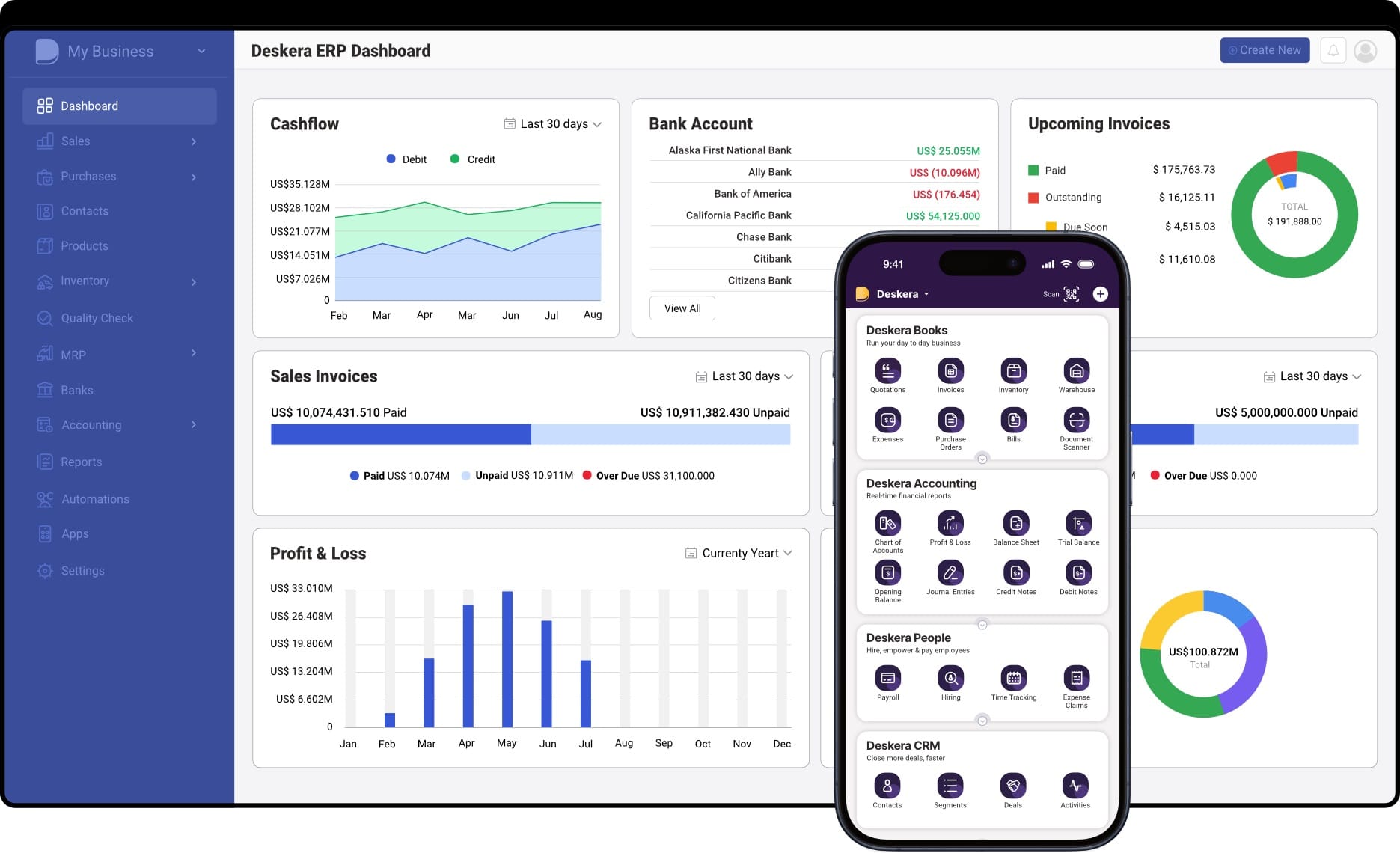
Deskera ERP is designed to help organizations move from traditional, transaction-focused systems to intelligent, AI-enabled enterprise platforms. By embedding generative AI capabilities across its core modules, Deskera enables businesses to automate processes, generate real-time insights, and support faster, data-driven decision-making across the enterprise.
Embedded AI Intelligence Across Core Business Functions
Deskera ERP integrates AI-driven capabilities across finance, inventory, manufacturing, and procurement. This unified architecture allows generative AI to analyze data holistically rather than in isolation, delivering contextual insights that reflect real business conditions. Users gain a single, intelligent view of operations instead of fragmented, module-specific data.
AI-Powered Insights and Natural Language Interaction
With AI-enabled assistance, Deskera ERP allows users to interact with enterprise data using natural language queries. Teams can ask questions, generate summaries, and receive explanations for trends or anomalies without manually navigating complex reports. This conversational experience improves accessibility, accelerates analysis, and increases ERP adoption across roles.
Intelligent Automation for Finance and Operations
Deskera ERP leverages generative AI to automate repetitive and time-consuming processes such as reporting, reconciliations, inventory tracking, and workflow approvals. By reducing manual intervention, businesses can improve accuracy, shorten cycle times, and allow teams to focus on higher-value strategic activities.
Smarter Planning, Forecasting, and Decision Support
Generative AI enhances Deskera ERP’s planning capabilities by enabling dynamic forecasting, scenario modeling, and predictive insights. Whether evaluating demand fluctuations, cash flow projections, or production requirements, decision-makers can explore multiple outcomes and make informed choices faster—based on real-time enterprise data.
Scalable, Secure, and Future-Ready Architecture
Built on a cloud-based, scalable architecture, Deskera ERP supports the continuous evolution of AI capabilities without disrupting existing operations. Strong data governance, role-based access controls, and compliance-ready frameworks ensure that generative AI is deployed securely and responsibly—making Deskera ERP a reliable foundation for long-term digital transformation.
Key Takeaways
- Generative AI is rapidly transforming ERP systems from static transaction platforms into intelligent, insight-driven systems that actively support faster and smarter enterprise decision-making.
- Generative AI enables ERP systems to understand context, generate insights, and interact in natural language—moving beyond rule-based automation to adaptive, learning-driven intelligence.
- Growing data complexity, the need for real-time insights, and demand for intuitive user experiences make generative AI a necessity—not an option—for modern ERP systems.
- Generative AI improves financial accuracy and efficiency by automating complex workflows and generating dynamic forecasts and risk insights.
- AI-driven data cleansing and enrichment strengthen ERP data quality, ensuring more reliable analytics and decision-making.
- Generative AI enables ERP systems to generate more accurate demand scenarios, helping businesses reduce inventory risks and respond to market shifts proactively.
- By anticipating equipment failures before they occur, generative AI helps ERP systems reduce downtime and optimize asset performance.
- AI-powered scenario modeling allows ERP users to evaluate “what-if” situations and make strategic decisions with greater confidence.
- Generative AI personalizes ERP experiences by adapting dashboards, workflows, and insights to individual user roles and behaviors.
- AI-generated reports reduce manual effort while delivering clearer, more actionable insights tailored to different stakeholders.
- Conversational AI significantly improves ERP usability, accelerating adoption and reducing reliance on technical expertise.
- Generative AI strengthens ERP-driven supply chains by enabling proactive planning for disruptions and demand volatility.
- AI-assisted product design within ERP systems accelerates innovation while aligning development with cost, performance, and customer expectations.
- Organizations gain faster decision-making, higher productivity, improved data trust, and greater operational agility through AI-powered ERP platforms.
- Successful adoption depends on strong data governance, model reliability, security, and user trust—not just AI capability.
- A unified data foundation, cross-functional integration, and strategic alignment are critical to scaling generative AI successfully within ERP environments.
- ERP systems will evolve into autonomous, conversational, and continuously learning platforms that actively guide enterprise operations.
- With embedded AI intelligence, unified data architecture, and scalable cloud design, Deskera ERP helps businesses translate generative AI innovation into real operational impact.
Related Articles
 Niti Samani
 Niti Samani
 Niti Samani
 Niti Samani
 Niti Samani
 Niti Samani