


How do successful projects stay within budget even when unexpected challenges arise? For project managers and business leaders, controlling costs is one of the most critical aspects of delivering projects successfully. Yet, many organizations struggle to maintain financial control as projects evolve. According to the Project Management Institute (PMI), 35% of projects fail because of budget-related issues, highlighting how difficult it can be to manage costs effectively throughout a project’s lifecycle.
The challenge becomes even greater for large-scale initiatives. Research shows that 91.5% of major projects—those with budgets exceeding $1 billion—end up going over budget, missing deadlines, or both. These statistics reveal an important reality: simply creating a budget is not enough. While a budget outlines how much a project is expected to cost, cost forecasting focuses on predicting what the project will actually cost as work progresses. It considers real-time factors such as project performance, schedule changes, risks, and evolving resource requirements.
Accurate cost forecasting plays a vital role in helping project teams make informed decisions. When forecasts are inaccurate, organizations may face delays, unexpected overspending, poor resource allocation, and difficulty responding to financial risks. At the same time, forecasting accuracy can be affected by several factors, including incomplete data, human errors, economic fluctuations, and market volatility. As a result, project leaders and Project Management Offices (PMOs) must rely on structured processes and reliable data to improve forecasting accuracy.
This is where modern ERP platforms like Deskera ERP can make a significant difference. Deskera provides an integrated platform that connects project accounting, financial management, and operational data in one place, giving businesses real-time visibility into project performance. With features such as project expense tracking, budget monitoring, payment milestone management, automated revenue recognition, and detailed project cost reports, organizations can track financial progress more effectively. By enabling teams to monitor costs, allocate resources efficiently, and update financial insights as projects evolve, Deskera ERP helps businesses improve forecasting accuracy and maintain stronger control over project budgets.
What Is Cost Forecasting in Project Management?
Cost forecasting in project management is the process of estimating the future costs a project is likely to incur based on the most recent information available. It is a financial planning technique that helps organizations anticipate upcoming expenses related to labor, materials, equipment, and other project resources. By predicting these costs in advance, businesses can create more realistic financial plans, secure the resources required for project execution, and respond more effectively to changes during the project lifecycle.
Unlike traditional budgeting, which is usually created before a project begins, cost forecasting is a continuous process that evolves throughout the project. As projects progress, factors such as changes in scope, resource availability, supply chain conditions, and market fluctuations can influence overall costs. Cost forecasting takes these dynamic elements into account, enabling project managers to update financial projections regularly and maintain better control over project spending.
Another key aspect of cost forecasting is its role in strategic financial planning and decision-making. When combined with revenue projections, cost forecasts help businesses estimate break-even points—where total costs equal total revenues—and evaluate potential profitability. This information is critical for determining pricing strategies, evaluating project feasibility, and making informed investment decisions.
The process of cost forecasting typically begins with analyzing historical cost data and current project information. Organizations often supplement this data with market insights, competitive analysis, and financial modeling to develop accurate projections. Modern businesses also rely on automated tools and project management systems to generate forecasts and update them as new information becomes available. By continuously monitoring costs and adjusting forecasts, project teams can manage financial risks more effectively and keep projects aligned with organizational goals.
Key Components of Project Cost Forecasting
Accurate project cost forecasting depends on several interconnected components that provide a complete picture of a project’s financial performance. These elements help project managers monitor spending, anticipate future costs, and identify potential financial risks early. By analyzing project scope, resource requirements, financial data, and external factors, organizations can develop forecasts that support better planning and decision-making.
Project Scope and Deliverables
A clearly defined project scope is the foundation of effective cost forecasting. It outlines the project’s objectives, deliverables, and key milestones, helping teams understand what needs to be accomplished and the resources required to achieve those outcomes. When the scope is well documented, project managers can estimate costs more accurately and identify how changes in deliverables or project requirements might affect the overall budget. Without a clearly defined scope, forecasting becomes difficult because even minor changes can significantly impact project costs.
Resource Costs
Resource costs are one of the largest components of project expenditure. These include labor costs, equipment usage, raw materials, software tools, and subcontractor or vendor expenses. Forecasting these costs requires understanding how resources will be allocated across different project stages and how pricing may fluctuate over time. For example, labor rates, supplier pricing, or equipment rental costs may change depending on market conditions, making it essential for project teams to regularly review and update cost projections.
Time and Schedule Factors
Project timelines have a direct impact on costs. Delays in completing tasks, resource shortages, or unexpected disruptions can increase labor expenses, extend equipment usage, and create additional operational costs. Cost forecasting therefore considers the project schedule, task dependencies, and potential delays that could influence overall spending. By monitoring schedule performance and adjusting forecasts when timelines change, organizations can maintain better control over their financial planning.
Risk and Contingency Planning
Uncertainty is a common challenge in project management, which makes risk planning a critical component of cost forecasting. Projects may face unexpected issues such as supply chain disruptions, regulatory changes, resource shortages, or market fluctuations. To address these uncertainties, project managers include contingency reserves or risk buffers within their cost forecasts. This ensures that organizations are financially prepared to handle unforeseen expenses without jeopardizing the project’s success.
Historical Data and Benchmarks
Historical project data plays an important role in improving forecast accuracy. By analyzing the financial performance of past projects, organizations can identify cost patterns, resource utilization trends, and potential risks that may occur in similar projects. Benchmarks from previous projects also help teams estimate the cost of tasks, set realistic budgets, and refine forecasting models over time. The more historical data an organization collects and analyzes, the more reliable its cost forecasting becomes.
Financial Tracking and Variance Analysis
Another key component of cost forecasting is the continuous monitoring of project financial performance. This involves tracking the original project budget, approved changes or variations, actual costs incurred, and the value of work completed. By comparing these figures with forecasted costs, project managers can identify cost variances and determine whether the project is likely to exceed its budget. Regular variance analysis helps teams take corrective action early, adjust forecasts, and ensure the project remains financially sustainable.
Together, these components create a structured framework for project cost forecasting. When organizations monitor these elements consistently and update forecasts based on real-time data, they can gain better financial visibility, reduce the risk of cost overruns, and improve the likelihood of successful project delivery.
Factors That Affect Cost Forecasting
Project cost forecasting is influenced by a range of internal and external factors that can change throughout the project lifecycle. These factors affect how accurately future costs can be estimated and how frequently forecasts need to be updated. By understanding the elements that influence project costs, organizations can improve forecasting accuracy and reduce the risk of budget overruns.
Availability and Quality of Historical Data
Historical data is one of the most important inputs in cost forecasting. Many forecasting techniques rely on past project costs, spending patterns, and resource utilization trends to estimate future expenses. When reliable historical data is available, organizations can identify patterns, estimate task costs more accurately, and benchmark new projects against previous ones. However, if historical data is incomplete, outdated, or inconsistent, forecasts may become less reliable.
Project Scope and Requirements
The scope of a project directly influences its cost forecast. A clearly defined scope outlines project deliverables, tasks, and resource requirements, making it easier to estimate costs accurately. However, if the scope is unclear or frequently changes during the project, cost estimates may need constant revision. Scope changes—often referred to as scope creep—can introduce additional tasks, materials, or resources, which can significantly increase project costs.
Project Duration and Timeline
The length of a project also plays a major role in cost forecasting. Short-term projects are generally easier to estimate because fewer variables are involved. In contrast, long-term projects are more likely to be affected by changing economic conditions, supply chain disruptions, or resource availability. As project timelines extend, the likelihood of cost fluctuations increases, requiring regular updates to forecasts.
Labor Costs and Workforce Availability
Labor is often one of the largest components of project costs. Wages, overtime payments, employee benefits, and payroll taxes must all be considered when forecasting project expenses. Labor costs may fluctuate due to factors such as inflation, labor shortages, or changes in industry demand for specific skills. For example, if specialized talent becomes scarce, wages may rise, increasing the overall project budget.
Material and Resource Costs
The cost of materials, equipment, and other resources can significantly influence project forecasts. Prices for raw materials or equipment may fluctuate due to supply chain disruptions, global demand, transportation costs, or currency exchange rates. If these prices increase unexpectedly, project budgets may need to be adjusted to accommodate higher costs.
Economic and Market Conditions
External economic factors can also affect cost forecasts. Inflation, interest rate changes, exchange rate fluctuations, and shifts in global markets can increase operational expenses and project costs. For example, rising fuel prices may increase transportation costs, while inflation can raise the cost of raw materials and labor. Organizations must monitor these factors to ensure forecasts remain realistic.
Technological and Operational Changes
Technology and operational improvements can either increase or reduce project costs. For instance, adopting automation tools or new project management systems may require an initial investment but can improve efficiency and reduce long-term operational costs. Similarly, improvements in processes or productivity can lower labor expenses and reduce the overall cost forecast.
Risk and Uncertainty
Unexpected events can significantly impact project costs. Risks such as regulatory changes, supplier delays, natural disasters, or geopolitical issues may disrupt project operations and increase expenses. Because of these uncertainties, organizations often include contingency reserves in their forecasts to prepare for unexpected costs.
Project Performance and Variance from Budget
As projects progress, actual spending may differ from the original budget. Variance analysis—comparing planned costs with actual expenses—helps identify cost overruns or savings early. If significant variances occur, project managers must update cost forecasts to reflect the most current financial situation and adjust resource allocation accordingly.
Understanding these factors helps organizations build more reliable cost forecasts and maintain better financial control over their projects. By continuously monitoring internal operations and external market conditions, project teams can adjust forecasts in real time, allowing them to respond proactively to cost changes and ensure successful project delivery.
Types of Cost Forecasting
Organizations use different cost forecasting methods depending on the nature of the project, the availability of data, and the level of uncertainty involved. Broadly, cost forecasting techniques can be categorized into quantitative, qualitative, and causal approaches. Quantitative methods rely on numerical data and statistical analysis, while qualitative approaches use expert insights and subjective assessments. Causal forecasting combines both data-driven analysis and contextual factors to estimate future costs. In practice, businesses often use a combination of methods to create more reliable forecasts and improve decision-making.
Time Series Analysis
Time series analysis is a quantitative forecasting technique that uses historical data to predict future costs. By analyzing past spending patterns, organizations can identify trends, seasonal variations, and cyclical patterns that may influence future expenses. For example, businesses may observe recurring increases in certain costs during specific periods or identify long-term growth trends in operational expenses.
Several methods fall under time series analysis, including moving averages, which smooth out short-term fluctuations to reveal underlying trends, and exponential smoothing, which assigns greater importance to recent data while still considering historical values. Advanced approaches such as ARIMA models and trend projection can also be used to estimate future costs based on historical patterns. This method works best when reliable historical data is available and cost patterns remain relatively stable over time.
Econometric Models
Econometric models use statistical techniques to analyze the relationship between different economic variables and project costs. These models help organizations understand how external factors—such as inflation, exchange rates, energy prices, or supply chain conditions—may influence future expenses.
For example, a company may use regression models to determine how fluctuations in raw material prices affect overall production costs. By identifying these relationships, businesses can create forecasts that reflect both internal project data and broader economic trends. Although econometric models can be mathematically complex, they provide valuable insights for long-term cost planning and strategic financial decisions.
Machine Learning and Predictive Analytics
Advancements in technology have introduced machine learning–based forecasting methods that analyze large volumes of historical and real-time data to predict future costs. Machine learning algorithms can detect complex patterns and continuously improve their predictions as new data becomes available.
These models are commonly used in predictive cost forecasting, where businesses anticipate future price changes, demand shifts, and supply chain conditions. In industries such as manufacturing and construction, predictive forecasting tools can analyze market trends, resource availability, and historical project data to estimate future expenses more accurately. Because these systems continuously learn from new information, they can adapt forecasts as conditions evolve.
Monte Carlo Simulation
Monte Carlo simulation is a probability-based forecasting method used when uncertainty is high or historical data is limited. Instead of generating a single cost estimate, this approach runs multiple simulations with different variables and assumptions to produce a range of possible outcomes.
By analyzing thousands of potential scenarios, organizations can estimate the probability of different cost levels and identify potential financial risks. This method is particularly useful for large or complex projects where variables such as resource availability, supplier pricing, or project delays may significantly influence costs.
Expert Judgment and Qualitative Forecasting
When reliable numerical data is limited, organizations may rely on expert judgment to estimate future costs. In this qualitative approach, experienced professionals use their knowledge of the industry, market conditions, and project requirements to develop forecasts.
Two commonly used techniques include the Delphi method, where a group of experts provides input through multiple rounds of questionnaires until a consensus forecast is reached, and panel consensus, where experts collaborate and share insights to develop a collective estimate. While these approaches rely on subjective insights, they can be valuable when forecasting new projects or emerging markets where historical data is unavailable.
Comparative Cost Analysis
Comparative cost forecasting involves analyzing and comparing the costs of multiple projects, products, or business initiatives. By evaluating similar projects or market alternatives, organizations can determine which option is the most cost-effective.
This method is often used when businesses are considering new investments or evaluating multiple project proposals. By comparing estimated costs and potential outcomes, decision-makers can allocate resources more effectively and identify opportunities to reduce expenses. However, the accuracy of this approach depends on the availability of reliable cost data and realistic assumptions.
Dynamic and Real-Time Cost Forecasting
Dynamic cost forecasting focuses on continuously updating cost estimates as new information becomes available. Instead of relying on a fixed forecast created at the beginning of a project, this method adjusts projections based on real-time changes in market conditions, resource availability, and project progress.
Industries with volatile costs—such as logistics, construction, and healthcare—often rely on dynamic forecasting to respond quickly to price fluctuations, supply chain disruptions, or unexpected operational changes. By updating forecasts regularly, organizations can maintain more accurate financial projections and avoid significant budget overruns.
In practice, no single method is sufficient for every situation. Many organizations combine multiple forecasting techniques to create a more comprehensive and reliable view of future costs. By integrating historical data analysis, statistical modeling, expert insights, and real-time updates, businesses can develop cost forecasts that support effective project planning and financial control.
Steps in Project Cost Forecasting
Project cost forecasting requires a structured approach that combines financial analysis, project planning, and continuous monitoring. Because project costs can change due to evolving requirements, market conditions, and operational challenges, organizations must follow a systematic process to ensure their forecasts remain accurate and reliable.
The following steps outline how businesses can develop and maintain effective project cost forecasts.
1. Gather Relevant Information
The first step in project cost forecasting is collecting all the data needed to build a reliable estimate. This includes historical cost records, labor and material prices, supplier quotes, market trends, and economic indicators such as inflation or interest rates. Information about the project’s scope, deliverables, and resource requirements is also essential. The more accurate and comprehensive the data, the stronger the foundation for forecasting.
2. Define the Project Scope and Structure the Work
Once the necessary information is gathered, project teams must clearly define the project scope. This involves outlining objectives, deliverables, requirements, and success criteria. A common approach is to create a Work Breakdown Structure (WBS) that divides the project into smaller tasks and activities. Breaking the project into manageable components helps ensure that all tasks and cost elements are considered when developing the forecast.
3. Analyze Historical Data and Trends
After defining the project structure, organizations analyze historical data from previous projects to identify cost patterns and trends. This may involve cleaning and standardizing the data to ensure it is accurate and usable. By reviewing past spending patterns, labor productivity rates, and resource usage, project managers can estimate costs more effectively and reduce uncertainty in their forecasts.
4. Estimate Resource Requirements and Costs
With a clear project structure in place, the next step is determining the resources required to complete each task. This includes identifying the labor, materials, equipment, facilities, and technology needed for project execution. Once resources are identified, their associated costs are calculated based on labor rates, supplier pricing, equipment rentals, and operational expenses. Both direct costs (such as materials and wages) and indirect costs (such as administrative overhead and utilities) should be included.
5. Assess Risks and Build Contingency Reserves
Every project faces uncertainties that can affect costs, including supply chain disruptions, changes in market prices, or unexpected technical challenges. Conducting a risk assessment helps identify potential threats and estimate their financial impact. Based on this analysis, organizations typically include contingency reserves or management reserves within their cost forecasts to cover unforeseen expenses.
6. Select and Apply Forecasting Models
Once cost estimates and risk factors are identified, businesses apply appropriate forecasting models to generate projections. Depending on the available data and the project’s complexity, this may involve statistical methods, scenario analysis, or predictive models. Choosing the right model is important because it determines how accurately future costs can be estimated and how well the forecast can adapt to new information.
7. Review and Validate the Forecast
Before finalizing the forecast, project managers typically review it with stakeholders, subject matter experts, and financial teams. This step helps verify assumptions, identify potential gaps, and ensure that the forecast reflects realistic expectations. Stakeholder feedback can lead to adjustments that improve the overall accuracy and reliability of the forecast.
8. Monitor Performance and Update the Forecast
Cost forecasting does not end once the initial estimate is created. As the project progresses, actual costs should be continuously compared with forecasted values. Variance analysis helps identify differences between planned and actual expenses, allowing project teams to update forecasts and adjust strategies as needed. Regular monitoring ensures that cost projections remain aligned with the project’s current performance and external conditions.
By following these steps, organizations can create cost forecasts that support effective financial planning and project management. A structured forecasting process enables project teams to anticipate cost changes, manage risks proactively, and maintain better control over project budgets throughout the project lifecycle.
Benefits of Cost Forecasting
Cost forecasting provides organizations with valuable insights into future expenses, enabling better financial planning and project management. By estimating future costs based on current data and trends, businesses can improve budgeting accuracy, anticipate potential risks, and make informed strategic decisions. Whether applied to individual projects or entire business operations, cost forecasting helps organizations maintain financial stability and operational efficiency.
Improved Budget Planning and Control
One of the primary benefits of cost forecasting is better budget management. By estimating future project expenses, organizations can create more realistic budgets and allocate funds appropriately. Continuous forecasting also allows project managers to monitor spending against planned budgets, helping them identify cost variances and take corrective action before financial issues escalate.
Early Identification of Cost Overruns
Cost forecasting enables organizations to detect potential cost overruns early in the project lifecycle. By regularly comparing forecasted costs with actual spending, project managers can quickly identify inefficiencies or unexpected increases in expenses. Early detection allows teams to adjust plans, optimize resource usage, or implement cost-saving measures to keep the project on track.
Better Decision-Making
Accurate cost forecasts provide decision-makers with reliable financial insights. Managers can evaluate the financial impact of project changes, investments, or operational adjustments before implementing them. This data-driven approach helps organizations make informed decisions regarding project scope, resource allocation, and strategic initiatives.
Efficient Resource Allocation
Cost forecasting helps organizations plan how resources such as labor, materials, equipment, and finances will be used throughout a project. By understanding future cost requirements, businesses can allocate resources more effectively, avoiding shortages or overuse. This improves operational efficiency and helps project teams maintain consistent productivity.
Risk Identification and Management
Forecasting future costs allows organizations to identify financial risks associated with market fluctuations, supply chain disruptions, or project delays. By analyzing different cost scenarios, businesses can prepare contingency plans and build financial reserves to handle uncertainties. This proactive approach reduces the likelihood of unexpected financial setbacks.
Strategic Planning and Investment Decisions
Cost forecasting plays a crucial role in long-term business planning. By modeling future cost scenarios, organizations can evaluate the financial feasibility of new initiatives, products, or infrastructure investments. Forecasting also helps businesses estimate potential returns and prioritize projects with the highest strategic value.
Identification of Cost-Saving Opportunities
Through detailed analysis of project expenses and operational costs, cost forecasting can reveal areas where businesses may reduce spending or improve efficiency. Managers can identify processes that require better cost control and implement strategies to optimize resource utilization and reduce unnecessary expenditures.
Improved Stakeholder Confidence and Transparency
Reliable cost forecasts help organizations communicate financial expectations clearly with stakeholders, including clients, investors, and project sponsors. Transparent financial projections build trust and demonstrate that the organization is managing resources responsibly. This transparency also supports accurate reporting and improves collaboration among project teams and stakeholders.
Better Future Project Planning
Cost forecasting not only supports current projects but also improves planning for future initiatives. By analyzing forecast accuracy and project outcomes, organizations can refine their estimation techniques and create more accurate budgets for upcoming projects. Over time, this continuous improvement leads to more efficient financial management and stronger project performance.
Overall, cost forecasting enables businesses to anticipate financial challenges, optimize resources, and make strategic decisions with greater confidence. When implemented effectively, it strengthens both project management practices and overall business performance.
Challenges in Cost Forecasting
While cost forecasting is an essential part of project and financial planning, it is not without challenges. Because forecasting involves predicting future costs based on current information and assumptions, it can never be completely accurate. Instead, it should be viewed as a strategic guide that helps organizations anticipate potential financial outcomes.
Several internal and external factors can influence the reliability of cost forecasts and make the forecasting process more complex.
Uncertainty and Cost Volatility
One of the biggest challenges in cost forecasting is dealing with uncertainty. Costs for labor, materials, transportation, and other resources often fluctuate due to changes in market demand or economic conditions. Variable costs can increase or decrease unexpectedly, while even fixed costs—such as rent or service contracts—may change over time. When cost volatility is high, forecasting becomes more difficult, especially for long-term projects where conditions can change significantly over time.
External Economic and Market Factors
External factors outside the organization’s control can significantly impact project costs. Changes in interest rates, inflation, currency exchange rates, and global commodity prices can increase operational expenses. Additionally, supply chain disruptions, supplier price changes, and labor shortages can cause sudden cost increases. Government regulations, taxation policies, and technological shifts may also influence project costs, making it challenging for organizations to predict expenses accurately.
Data Quality and Availability Issues
Accurate cost forecasting depends heavily on reliable data. However, many organizations face challenges related to incomplete, inconsistent, or outdated data. If historical records are poorly maintained or data is stored across multiple systems, it can be difficult to analyze trends and generate accurate forecasts. Since forecasts are only as reliable as the data used to create them, poor data quality can significantly reduce forecasting accuracy.
Rapid Changes in Project Scope or Requirements
Projects rarely remain static throughout their lifecycle. Changes in scope, additional deliverables, or evolving client requirements can alter project costs significantly. When these changes occur frequently, forecasts must be continuously revised, making it difficult to maintain consistent cost estimates. This dynamic environment requires organizations to adopt flexible forecasting methods that can adapt to project changes.
Selecting the Right Forecasting Model
Choosing an inappropriate forecasting method can lead to inaccurate results. Different projects require different forecasting techniques depending on the available data, project complexity, and time horizon. If organizations rely on overly simplistic models or use methods that do not match the project’s characteristics, the resulting forecasts may not reflect actual cost trends.
Balancing Accuracy and Timeliness
Another challenge in cost forecasting is balancing the need for accuracy with the need for timely insights. Highly detailed forecasting models may require extensive data analysis and complex calculations, which can delay decision-making. On the other hand, faster forecasting methods may sacrifice accuracy. Organizations must find a balance between generating precise forecasts and providing timely financial insights that support effective decision-making.
Managing Risks and Unexpected Events
Unexpected events such as geopolitical conflicts, natural disasters, technological disruptions, or sudden market shifts can significantly impact project costs. These events are difficult to predict and can cause major deviations from original forecasts. To address this challenge, organizations often use scenario planning, risk analysis, and contingency budgeting to prepare for potential disruptions.
Despite these challenges, organizations can improve the reliability of their cost forecasts by maintaining accurate data, regularly updating forecasts, and using appropriate forecasting methods. Continuous monitoring and proactive risk management also help project teams adapt to changing conditions and maintain better control over project costs.
Best Practices for Effective Project Cost Forecasting
Developing accurate project cost forecasts requires more than just estimating expenses. It involves using reliable data, applying appropriate forecasting techniques, and continuously monitoring project performance.
By following proven best practices, organizations can improve forecasting accuracy, manage financial risks, and ensure better project outcomes.
Use Reliable Historical Data
Historical data provides a strong foundation for cost forecasting. By analyzing costs from previous projects, organizations can identify spending patterns, resource utilization trends, and potential risks. Historical data also helps determine which forecasting models are most suitable.
For example, if an organization has extensive and reliable past data, time-based forecasting methods may be effective. Even for new projects, examining data from similar initiatives can provide useful insights for estimating future costs.
Standardize and Digitize Data
Accurate forecasting depends on consistent and well-organized data. Organizations should standardize data collection methods and maintain centralized digital records for project costs, resources, and financial transactions.
Using automated systems to collect and process data can reduce errors, improve data consistency, and make it easier to analyze cost trends. Digitized data also allows teams to quickly access up-to-date information when updating forecasts.
Use Automated and Analytical Tools
Modern forecasting tools and analytics platforms can process large volumes of data and generate more accurate projections. These tools can automate calculations, identify anomalies, and perform advanced modeling techniques such as predictive analytics and scenario simulations.
By leveraging automation and data analytics, organizations can streamline the forecasting process and gain deeper insights into potential cost trends.
Consider Multiple Scenarios
Project environments are often uncertain, so relying on a single forecast may not be sufficient. Scenario analysis helps organizations evaluate different cost outcomes under varying conditions, such as changes in market prices, resource availability, or economic factors. By modeling best-case, worst-case, and most likely scenarios, businesses can prepare strategies to manage potential risks and opportunities.
Maintain a Conservative and Realistic Approach
When preparing cost forecasts, it is important to avoid excessive optimism. Underestimating project costs can lead to financial strain, delays, and budget overruns. A conservative approach that considers potential risks and uncertainties helps create more realistic financial projections. Including contingency reserves and risk buffers ensures that organizations are better prepared for unexpected expenses.
Encourage Cross-Functional Collaboration
Cost forecasting is not solely a financial activity—it requires input from multiple departments. Project managers, finance teams, procurement specialists, and operational leaders all contribute valuable insights about resource requirements and cost drivers. Cross-functional collaboration ensures that forecasts consider operational realities and improves overall accuracy.
Communicate Assumptions and Methodologies Clearly
Transparency is essential in the forecasting process. Teams should clearly document the assumptions, data sources, and methodologies used when developing forecasts. Clear communication helps stakeholders understand how projections were created and increases trust in the results. It also ensures that future revisions can be made more easily if assumptions change.
Review and Update Forecasts Regularly
Cost forecasts should not remain static throughout a project. As new information becomes available—such as changes in project scope, market conditions, or resource costs—forecasts must be updated accordingly. Establishing regular review cycles allows organizations to refine forecasts and maintain accurate financial projections throughout the project lifecycle.
Measure Forecast Accuracy and Improve Continuously
Organizations should track how closely their forecasts match actual project outcomes. Comparing forecasted costs with actual expenses helps identify gaps in forecasting methods and highlights areas for improvement. Over time, this continuous learning process allows businesses to refine their forecasting models, improve data quality, and achieve more reliable financial predictions.
By implementing these best practices, organizations can strengthen their cost forecasting capabilities and enhance overall project financial management. Effective forecasting not only supports better budgeting and risk management but also enables businesses to make strategic decisions with greater confidence.
How Deskera ERP Helps with Project Cost Forecasting
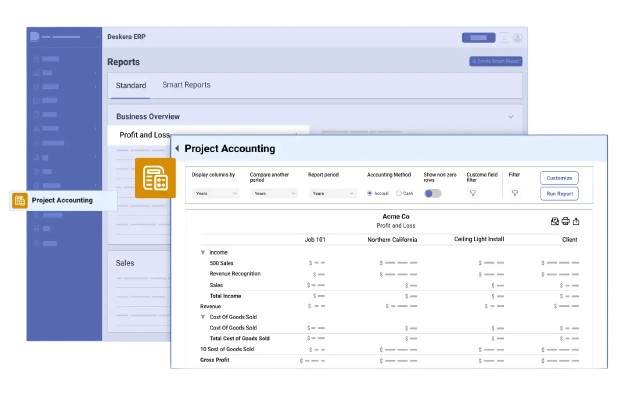
Deskera ERP helps businesses perform accurate and efficient project cost forecasting by providing tools that track project financials, monitor budgets, and analyze real-time performance data. By integrating project management and financial data in one system, it enables better prediction and control of future project costs.
1. Real-Time Financial Visibility
Deskera provides real-time insights into project revenue, expenses, and profitability, allowing managers to continuously monitor financial performance. This helps organizations compare actual costs with estimates and update forecasts when necessary.
2. Bill of Quantities for Accurate Cost Estimates
The Bill of Quantities (BOQ) feature allows businesses to list all materials, labor, and resources required for a project. This structured breakdown of costs helps create more accurate forecasts before and during project execution.
3. Project Time Tracking for Labor Cost Forecasting
Deskera enables teams to track time spent on project tasks and compare it with the estimated budget. This helps managers forecast labor costs more effectively and identify potential cost overruns early.
4. Expense Tracking and Budget Control
The system records project-related expenses and monitors them against planned budgets. With this information, businesses can analyze spending patterns and refine cost forecasts while maintaining tighter budget control.
5. Project Costing and Profit & Loss Monitoring
Deskera provides project costing and profit & loss analysis, allowing businesses to evaluate project profitability and detect cost variances. These insights support more reliable forecasting for future projects.
6. Resource Allocation and Utilization Tracking
By tracking how resources are allocated and utilized across tasks, Deskera helps organizations optimize workforce and equipment usage, improving both cost estimation and planning accuracy.
7. Reporting and Data-Driven Forecasting
Deskera generates project performance and cost reports that provide detailed insights into project progress, cost trends, and financial health. These reports support data-driven forecasting and better strategic decision-making.
In summary, Deskera ERP supports project cost forecasting by combining real-time financial tracking, budget monitoring, resource management, and comprehensive reporting. This integrated approach enables organizations to estimate project costs more accurately, identify potential deviations early, and improve forecasting accuracy over time.
Key Takeaways
- Estimating future project or operational costs using financial data, assumptions, and market trends supports accurate budgeting and financial planning.
- Improving decision-making, maintaining budget control, reducing financial risks, and supporting profitability throughout a project lifecycle are key benefits of cost forecasting.
- Historical data analysis, time-series forecasting, scenario analysis, and qualitative forecasting methods can be used depending on the availability and reliability of data.
- Reliable financial data, clearly defined cost structures, realistic assumptions, and appropriate forecasting models form the key components required for accurate cost predictions.
- Market conditions, project complexity, resource availability, inflation, and economic changes are important factors that influence the accuracy of cost forecasts.
- Using historical data, maintaining efficient data processes, considering multiple scenarios, including nonfinancial insights, ensuring clear communication, and reviewing forecasts regularly improve forecasting effectiveness.
- Data inaccuracies, changing market conditions, unexpected cost variations, and limited cross-department collaboration can create challenges in producing reliable forecasts.
- ERP systems and predictive analytics tools automate data collection, provide real-time financial insights, and improve forecasting accuracy through data-driven analysis.
- Deskera ERP supports cost forecasting through project budgeting, expense tracking, time monitoring, resource allocation, and real-time financial reporting that helps businesses predict and control project costs more effectively.
Related Articles
 Niti Samani
 Niti Samani
 Niti Samani
 Niti Samani
 Niti Samani
 Niti Samani