


Is capital planning just about budgeting for big purchases, or is it something far more strategic? At its core, capital planning is the disciplined way businesses decide where, when, and how to invest their financial resources to support long-term growth. It goes beyond short-term expense management and focuses on building the financial backbone required to sustain operations, expand capacity, and remain resilient in uncertain economic conditions.
In today’s dynamic business environment, capital planning has become a strategic necessity rather than a financial formality. Rising costs, fluctuating demand, and tighter access to capital mean that every major investment decision carries long-term implications. Whether it’s investing in new infrastructure, technology, equipment, or expansion initiatives, organizations must ensure that capital is allocated in alignment with their strategic priorities and risk appetite.
Effective capital planning also enables businesses to balance ambition with prudence. It helps leadership teams evaluate trade-offs, forecast future cash flows, and prepare for multiple scenarios without overextending financial resources. When done right, capital planning supports sustainable growth, improves financial visibility, and ensures that organizations are not caught off guard by funding gaps or misaligned investments.
This is where modern ERP systems play a critical role. Solutions like Deskera ERP help organizations streamline capital planning by centralizing financial data, improving forecasting accuracy, and enabling real-time visibility into budgets and capital expenditures. With integrated modules for finance, accounting, and operations, Deskera ERP allows businesses to evaluate investment decisions holistically, monitor capital utilization, and align financial planning with operational realities—making capital planning more informed, agile, and strategic.
What Is Capital Planning?
Capital planning is the long-term, strategic process of deciding which projects deserve investment, how limited capital should be allocated, and when those investments should be made to best support an organization’s goals.
At its essence, the objective of capital planning is to channel finite financial resources into the right projects—those that align most closely with an organization’s strategic priorities, risk tolerance, and long-term vision. Project owners, whether in the public or private sector, typically operate across three core phases: planning, constructing, and operating critical assets and infrastructure.
In an ideal world with unlimited capital, organizations could approve every proposed project. In reality, capital is constrained, forcing leaders to make difficult trade-offs. Some initiatives may be deprioritized, receive reduced funding, or be deferred altogether, while others may be canceled entirely.
Capital planning provides a structured framework to evaluate these choices objectively, ensuring that scarce resources are not spread too thin and are instead concentrated on initiatives that deliver the highest strategic value.
Funding sources also play a key role in capital planning decisions. Government entities often rely on public funding through taxes and bond measures, while private organizations typically use a mix of loans, equity, internal reserves, and external investments.
Regardless of the source, capital planning establishes which projects move forward, how funds are distributed across them, and how these investments collectively support long-term organizational objectives. As a result, capital plans are usually reviewed and approved by multiple stakeholders, including operations, finance, and executive leadership.
Given rising supply costs, workforce constraints, and economic uncertainty, capital planning has become increasingly complex. Organizations must evaluate and prioritize projects using a mix of quantitative criteria—such as return on investment (ROI) and net present value (NPV)—and qualitative factors, including resilience, sustainability, and environmental impact.
In manufacturing environments, capital planning is often led by engineering teams and focuses on both replacing aging equipment and introducing new capacity or technologies.
To manage this complexity, capital planning takes a long-term perspective, often spanning years or even decades. Organizations rely on methods such as long-term capital replacement planning, financial projections, portfolio risk assessments, and scenario analysis to forecast future needs and assess risk.
Ultimately, the goal of capital planning—distinct from capital budgeting—is to create a sustainable investment roadmap that balances growth ambitions with financial discipline, enabling organizations to navigate uncertainty while remaining aligned with their strategic mission.
Capital Planning vs Capital Budgeting
Although capital planning and capital budgeting are often used interchangeably, they serve distinct yet complementary roles in an organization’s financial decision-making framework.
Capital planning defines the long-term strategic direction for investments, while capital budgeting translates those strategic priorities into actionable, short-term financial decisions.
Understanding the difference between the two helps organizations allocate resources more effectively, manage risk, and align investments with business goals.
Below is a structured comparison across key dimensions to clearly highlight how capital planning vs capital budgeting differ in purpose, scope, and execution.
Focus and Scope
Time Horizon
Decision-Making Framework
Risk Management and Adaptability
Communication and Accountability
Degree of Control
Granularity of Analysis
In summary, capital planning shapes where the organization wants to go, while capital budgeting determines how it will pay to get there. Together, they form a cohesive financial strategy—capital planning sets the vision, and capital budgeting brings that vision to life through disciplined, data-driven investment decisions.
Components of Financial Planning
Effective financial planning provides the foundation for sound capital planning by ensuring that resources are allocated strategically, risks are anticipated, and long-term goals remain achievable. It balances immediate financial needs with future investment requirements, helping organizations manage both operational stability and long-term growth.
Below are the key components of financial planning that support a robust and sustainable capital plan.
Forecasting and Budgeting
Forecasting and budgeting form the backbone of financial planning. Senior leadership estimates future funding sources while projecting the costs associated with asset acquisitions, repairs, upgrades, and replacements over time.
Accurate forecasts help organizations anticipate capital requirements, avoid funding gaps, and prioritize investments based on realistic financial capacity rather than assumptions.
Alignment with Organizational Goals
Financial planning must be closely aligned with the organization’s strategic objectives. Every capital investment should directly support broader business goals such as growth, efficiency, resilience, or innovation.
By anchoring financial decisions to clearly defined goals, organizations ensure that capital is not only spent efficiently but also delivers long-term strategic value.
Asset Management Integration
Asset management plays a central role in effective financial planning. Organizations must integrate asset performance data, lifecycle costs, and maintenance requirements into financial plans to maximize asset value.
A data-driven approach enables better decisions around repair, replacement, and capacity expansion while ensuring assets support both current operations and future needs.
Capital Budgeting and Investment Evaluation
Capital budgeting translates strategic financial plans into actionable investment decisions. This component focuses on evaluating proposed projects using financial metrics such as return on investment, payback period, and long-term value contribution. It ensures that limited capital is allocated to initiatives that offer the strongest alignment with strategic and financial priorities.
Cash Flow Forecasting and Funding Requirements
Understanding cash flow patterns is critical to sustaining financial health. Financial planning involves forecasting inflows and outflows to determine funding needs, assess liquidity, and plan financing strategies.
This helps organizations ensure they have sufficient capital available when major investments or asset replacements are required.
Risk Assessment and Contingency Planning
Uncertainty is an inherent part of financial planning. Organizations must assess financial, operational, and market-related risks that could impact capital availability or investment outcomes.
Contingency planning ensures that alternative funding strategies and response plans are in place to manage disruptions without compromising long-term objectives.
Performance Monitoring and Capital Review Cycles
Financial planning is not a one-time exercise. Continuous performance monitoring and regular capital reviews help organizations track investment outcomes, compare actual results against forecasts, and adjust plans as conditions change. These review cycles ensure accountability, improve decision-making, and keep financial plans aligned with evolving business priorities.
Together, these components enable organizations to create a balanced financial plan—one that addresses immediate asset needs while maintaining a long-term, strategic approach to capital and operational management.
Process of Capital Planning
The capital planning process is a structured, long-term approach to identifying, evaluating, and prioritizing capital investments that support an organization’s strategic goals.
It is one of the most complex aspects of portfolio and asset management, requiring disciplined analysis, cross-functional collaboration, and continuous communication.
When organized into a standardized intake, evaluation, and monitoring framework, capital planning becomes more manageable and far more effective than disconnected spreadsheets or ad-hoc decisions.
Preparation and Data Gathering
The process begins with gathering the right data to build a realistic foundation. Teams assess current assets by evaluating facility conditions, asset performance, maintenance history, and expected lifespan.
This stage may include inspections, facility condition assessments, historical data analysis, and predictive modeling. Grounding the plan in real operational and financial data ensures that capital decisions are based on past performance and current realities—not overly optimistic assumptions.
Identify Capital Project Drivers
Organizations then identify the key drivers behind capital investments. These may include aging infrastructure, capacity constraints, regulatory requirements, safety concerns, technological upgrades, or growth initiatives.
Clearly defining these drivers helps frame why each project is necessary and ensures capital investments are tied to genuine organizational needs.
Stakeholder Involvement and Intake Process
An effective capital planning process includes input from the right stakeholders early on. Finance, operations, engineering, and the project management office (PMO) collaborate through a standardized intake process that captures project scope, schedules, resource requirements, costs, and risks. This shared visibility allows decision-makers to evaluate all proposals consistently and holistically.
Strategy Development and Project Evaluation
At this stage, organizations establish evaluation criteria aligned with their strategic goals. These criteria often combine quantitative measures—such as return on investment (ROI), net present value (NPV), and cost—with qualitative factors like sustainability, resiliency, regulatory impact, and risk of delay. Projects are scored against these criteria, creating an objective framework for comparison and decision-making.
Prioritize Capital Projects
With evaluation data in place, projects are ranked based on urgency, strategic alignment, available budget, and expected impact. Prioritization ensures that limited capital is directed toward high-value initiatives while lower-priority projects are deferred, scaled back, or eliminated. This “rank and stack” approach is central to effective capital planning.
Analyze Funding Options and Financial Modeling
Organizations then analyze funding requirements and explore financing options such as internal reserves, loans, bonds, grants, or equity.
Financial modeling plays a critical role here, helping teams quantify the impact of capital investments, assess liquidity needs, and model alternative scenarios.
Exploring “what-if” scenarios allows organizations to test different investment paths and funding structures before committing resources.
Develop and Approve the Capital Plan
The approved capital projects are consolidated into a formal capital plan outlining costs, timelines, funding sources, and expected outcomes—often spanning five years or more.
This plan is presented to senior leadership or a capital management committee for review and approval, ensuring alignment with long-term strategic objectives.
Implement Capital Projects
Once approved, the organization moves into execution. This includes procurement, resource allocation, and project delivery while adhering to defined budgets, timelines, and governance policies.
Clear roles, documentation, and approval processes help maintain financial discipline during implementation.
Monitor, Review, and Adjust
Capital planning is not a one-time exercise. Ongoing monitoring tracks performance against cost, quality, and schedule targets. Operations teams share updated forecasts with finance, and any required budget adjustments are formally reviewed and authorized. Regular review cycles help organizations adapt to changing conditions while staying aligned with long-term goals.
By following a structured capital planning process—from preparation and evaluation to implementation and review—organizations can make informed, realistic investment decisions that balance immediate needs with long-term strategic growth.
Capital Planning Tools and Techniques
Capital planning decisions rely heavily on quantitative analysis to justify long-term investments under uncertainty. To strengthen decision-making, organizations combine financial formulas, risk models, and analytical frameworks with modern planning tools.
Below are the most widely used capital planning tools and techniques, with relevant formulas included for clarity and practical application.
Financial Modeling and Investment Analysis
Financial modeling quantifies the economic impact of capital investments and compares alternatives objectively. The most common techniques include:
Discounted Cash Flow (DCF)
A valuation method that estimates an investment’s value based on expected future cash flows discounted to today.
DCF = (CF1 / (1 + r)^1) + (CF2 / (1 + r)^2) + ... + (CFn / (1 + r)^n)
Where:
CF = cash flow
r = discount rate
n = time period
Net Present Value (NPV)
Measures the total value created by an investment after accounting for the cost of capital.
NPV = Present value of cash inflows − Initial investment
Or expanded:
NPV = Σ [CFt / (1 + r)^t] − Initial investment
A positive NPV indicates that the project is expected to add value.
Internal Rate of Return (IRR)
The discount rate at which NPV equals zero, used to compare investment profitability.
0 = Σ [CFt / (1 + IRR)^t] − Initial investment
Payback Period
The time required to recover the initial investment from cash inflows.
Payback Period = Initial investment / Annual cash inflow
Profitability Index (PI)
Profitability Index = Present value of future cash flows / Initial investment
Scenario Planning and Sensitivity Analysis
Scenario planning evaluates outcomes under different assumptions such as cost overruns, demand changes, or schedule delays.
Sensitivity Analysis (simplified approach):
New output = Base output × (1 + Change in input)
Inputs are typically adjusted by ±10% or ±20% to assess impact. These techniques help identify which variables pose the greatest risk to capital outcomes.
Risk Assessment Models
Risk models quantify uncertainty and evaluate confidence in capital plans.
Monte Carlo Simulation
Uses repeated random sampling across probability distributions to simulate thousands of potential outcomes, helping estimate risk exposure and confidence intervals.
Value at Risk (VaR)
Estimates the maximum expected loss over a defined period.
Value at Risk (VaR) = vm × (vi / v(i−1))
VaR helps organizations understand downside risk and capital loss tolerance.
Portfolio Management Techniques
Portfolio-level tools help optimize capital allocation across multiple projects.
Capital Allocation Line (CAL):
E(Rc) = Rf + Sp × σ(Rc)
Where:
Rf = risk-free rate
Sp = slope of the capital allocation line
σ = portfolio risk (standard deviation)
Efficient Frontier
Represents portfolios that deliver the maximum expected return for a given level of risk, enabling better diversification and strategic investment balance.
Project Management and Governance Tools
These tools ensure capital plans translate into controlled execution. While formulas are less central here, cost variance and schedule variance are commonly tracked:
Cost Variance = Earned Value - Actual Cost
Strong governance frameworks ensure capital spending stays aligned with approved budgets and objectives.
Performance Measurement and KPIs
Measuring outcomes ensures accountability across the capital lifecycle.
Return on Investment (ROI):
ROI = Net income / Cost of investment
or
ROI = Investment gain / Investment base
Economic Value Added (EVA):
EVA = NOPAT − (WACC × Invested capital)
Where:
NOPAT = Net operating profit after tax
WACC = Weighted average cost of capital
EVA measures true economic profit after the cost of capital.
Advanced Analytics and Predictive Insights
Predictive analytics uses historical and real-time data to forecast capital needs and performance. Techniques include regression analysis, decision trees, and machine learning models that improve cost forecasting, risk prediction, and long-term capital optimization.
By combining financial formulas, analytical techniques, and integrated planning tools, organizations can move beyond intuition and spreadsheets—building capital plans that are defensible, data-driven, and aligned with long-term strategic value.
Benefits of Capital Planning
Capital planning plays a vital role in strengthening an organization’s financial discipline and long-term resilience. By establishing structured, forward-looking investment processes, organizations can optimize asset performance, control costs, and ensure that capital investments consistently support strategic objectives.
Below are the key benefits of capital planning for organizations across industries.
Better Asset Performance
Capital planning ensures that assets are maintained, upgraded, or replaced at the right time in their lifecycle. By taking a proactive approach to asset management, organizations can improve reliability, extend asset life, and ensure that equipment and infrastructure consistently meet performance standards. This leads to smoother operations and fewer unexpected failures.
Improved Cost Control
A structured capital planning process helps organizations anticipate future capital needs and spread large expenditures over time. By prioritizing investments and forecasting costs in advance, organizations can avoid budget overruns, reduce emergency spending, and maintain greater financial stability. Planned investments are almost always more cost-effective than reactive fixes.
Improved Decision-Making
Capital planning supports data-driven decision-making by enabling organizations to compare costs, benefits, and risks across multiple investment options. With clear evaluation criteria and financial analysis, leadership teams can prioritize projects that deliver the highest long-term value while staying aligned with organizational goals and risk tolerance.
Increased Operational Efficiency
Long-term capital planning reduces operational disruptions by ensuring timely upgrades, replacements, and capacity expansions. It fosters a culture of proactive planning rather than reactive problem-solving, which minimizes downtime, improves productivity, and allows teams to focus on core business activities.
Stronger Risk Management
Capital planning helps identify risks associated with aging assets, safety concerns, regulatory requirements, and environmental factors. By incorporating risk assessments into the planning process, organizations can mitigate these risks early, avoid costly emergency repairs, and reduce the likelihood of asset-related incidents or compliance issues.
Alignment with Strategic Objectives
By linking capital investments directly to organizational strategy, capital planning ensures that financial resources are deployed where they support long-term goals. This alignment helps organizations avoid fragmented or ad-hoc investments and ensures that capital spending contributes meaningfully to growth, resilience, and competitive advantage.
Enhanced Financial Visibility and Accountability
Capital planning improves transparency across the organization by clearly outlining where capital is being invested, why decisions were made, and how performance will be measured. This clarity strengthens accountability among stakeholders and supports better governance throughout the capital investment lifecycle.
Overall, capital planning enables organizations to move from short-term, reactive spending to a disciplined, strategic approach—one that improves asset performance, controls costs, manages risk, and supports sustainable long-term growth.
Challenges of Capital Planning
While capital planning is essential for long-term stability and growth, it is also a complex and demanding process. Organizations often face multiple financial, operational, and strategic challenges that can limit the effectiveness of their capital plans.
Understanding these challenges is the first step toward building a more resilient and realistic capital planning framework.
Limited Capital and Competing Priorities
One of the biggest challenges in capital planning is allocating finite resources across numerous competing projects. With more investment needs than available capital, organizations must make difficult trade-offs, often deferring or scaling back initiatives that may still be important but offer lower immediate returns.
Uncertain Market and Economic Conditions
Economic volatility, inflation, interest rate fluctuations, and changing market demand make long-term capital planning inherently uncertain. Assumptions made today may no longer hold true in the future, increasing the risk of misaligned investments or funding gaps.
Inaccurate Forecasting and Data Gaps
Capital planning relies heavily on accurate data and reliable forecasts. Incomplete asset data, outdated financial information, or overly optimistic assumptions can lead to unrealistic capital plans. Poor data quality increases the likelihood of cost overruns, underfunded projects, and delayed investments.
Balancing Short-Term Needs with Long-Term Goals
Organizations often struggle to balance immediate operational demands with long-term strategic investments. Urgent repairs or short-term financial pressures can divert capital away from initiatives that are critical for future growth, innovation, or capacity expansion.
Rising Costs and Resource Constraints
Escalating material costs, labor shortages, and supply chain disruptions can significantly impact capital project budgets and timelines. These factors make it harder to estimate costs accurately and increase the risk of budget overruns and project delays.
Stakeholder Alignment and Governance Complexity
Capital planning typically involves multiple stakeholders across finance, operations, engineering, and executive leadership. Aligning these groups around shared priorities and evaluation criteria can be challenging, particularly when departments have competing objectives or differing risk perspectives.
Risk Identification and Management
Identifying and quantifying risks—such as asset failure, regulatory changes, or environmental impacts—is complex and often subjective. Without a structured risk assessment framework, organizations may underestimate potential threats, leading to unexpected costs or operational disruptions.
Technology and Integration Challenges
Many organizations still rely on spreadsheets and disconnected systems for capital planning. Lack of integration between financial, asset management, and project management tools reduces visibility, slows decision-making, and increases the risk of errors or inconsistent data.
Maintaining Plan Flexibility Over Time
Capital plans often span several years, but business conditions rarely remain static. Adjusting plans without losing strategic focus can be difficult, especially when governance processes are rigid or approval cycles are slow.
Despite these challenges, organizations that adopt structured processes, data-driven tools, and strong governance frameworks are better equipped to overcome complexity and execute capital plans that support long-term resilience and sustainable growth.
Best Practices of Capital Planning
Capital planning is most effective when it is approached as a disciplined, organization-wide process rather than a one-time financial exercise. Given the long-term impact and high value of capital investments, following proven best practices helps organizations improve returns, reduce risk, and maintain strategic alignment.
Below are the most widely accepted best practices for successful capital planning.
Align Capital Planning with Strategic Goals
Every capital investment should directly support the organization’s long-term strategy. Capital planners must evaluate both internal and external factors that influence strategic objectives and ensure funding is directed toward projects that advance growth, productivity, resilience, or sustainability. Clear alignment prevents fragmented spending and ensures capital is deployed where it creates the greatest long-term value.
Implement a Rigorous Project Evaluation Process
A standardized evaluation and scoring framework eliminates bias and improves objectivity. Projects should be assessed based on criteria such as strategic alignment, urgency, feasibility, risk, and expected returns. This structured approach ensures that high-impact initiatives are prioritized over “pet projects” and that capital is allocated efficiently.
Establish a Strong Governance Framework
Strong governance ensures accountability throughout the capital lifecycle. Clearly defined roles, approval processes, policies, and reporting structures help maintain alignment between finance teams, capital planners, and the project management office (PMO). Regular forecasting updates and reauthorization mechanisms allow organizations to manage deviations while maintaining financial control.
Foster Cross-Functional Collaboration
Capital planning impacts the entire organization, making collaboration essential. Finance, operations, engineering, asset management, and project delivery teams must work together to share data, forecasts, and performance insights. Collaboration should also extend to external contractors and suppliers to ensure consistent communication and alignment during execution.
Embrace Flexibility and Adaptability
While predictability is important, capital plans must remain flexible. Market conditions, material costs, regulations, and environmental factors can change rapidly. Building contingencies into budgets and maintaining the ability to reallocate capital allows organizations to respond to uncertainty without compromising long-term objectives.
Leverage Technology and Data Analytics
Modern capital planning requires integrated digital tools that connect financial planning, asset management, and project execution. Technology enables real-time visibility into budgets, forecasts, and performance across the entire capital portfolio. Data analytics and dashboards help uncover trends, surface risks early, and support more informed decision-making.
Prioritize Risk Management
Risk management should be embedded across both the planning and execution phases. Capital planners assess strategic and financial risks during project selection, while delivery teams manage operational risks during execution. A unified risk framework ensures continuity, reduces surprises, and improves confidence in capital investment outcomes.
Ensure Transparency and Accountability
Clear communication and consistent reporting build trust and accountability among stakeholders. Regular updates, defined service-level agreements, and transparent decision-making help ensure everyone—from executives and project teams to regulators—understands project status, funding decisions, and performance expectations.
Emphasize Continuous Improvement
Capital planning should evolve with experience. Organizations that capture lessons learned from completed projects and apply those insights to future planning cycles continuously improve accuracy, efficiency, and outcomes. Regular process reviews help adapt capital planning practices to changing business needs and industry conditions.
By following these best practices, organizations can transform capital planning into a strategic capability—one that supports sustainable growth, strengthens governance, reduces risk, and maximizes the return on long-term investments.
How Deskera ERP Can Help You With Capital Planning
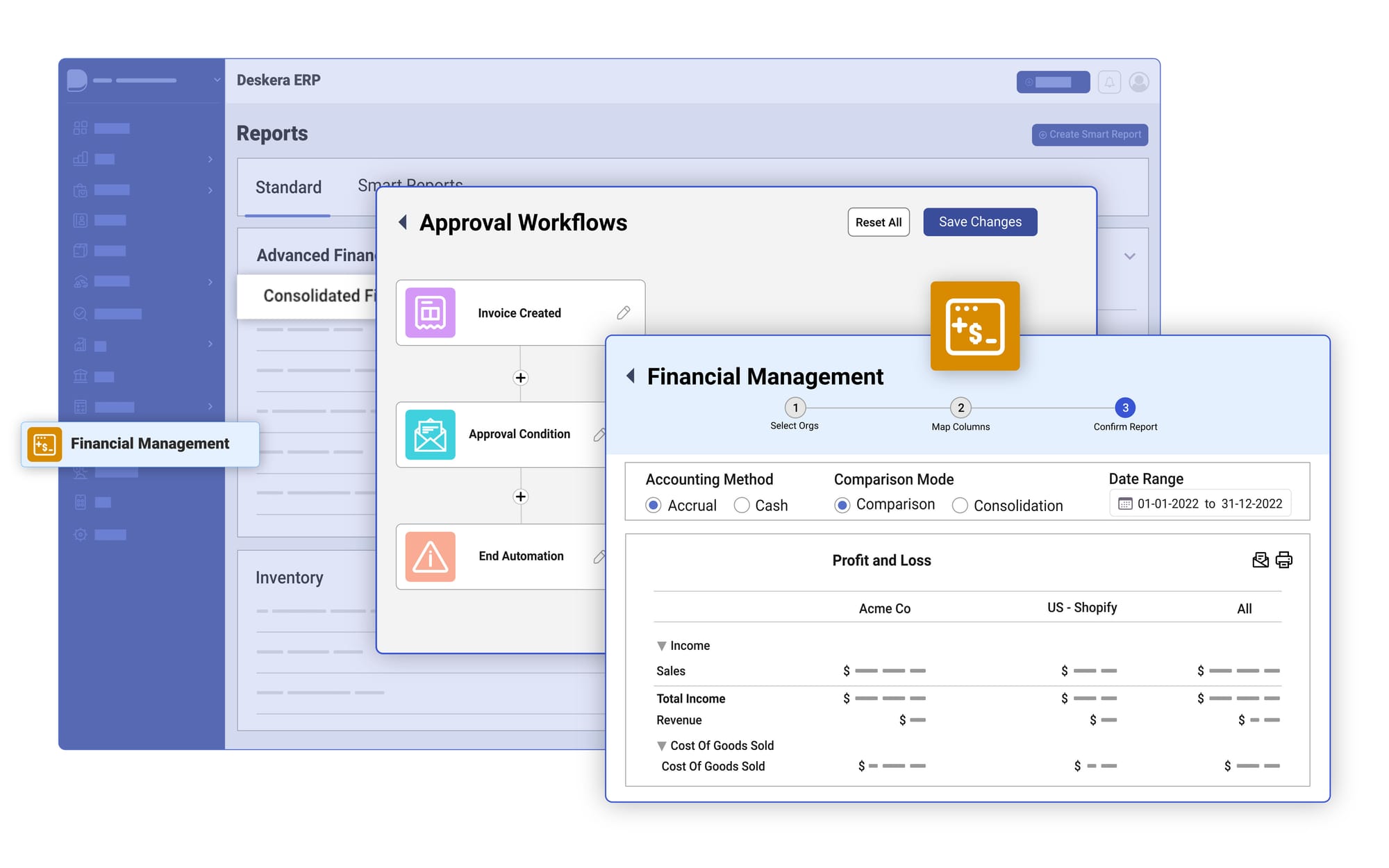
Effective capital planning requires accurate financial visibility, disciplined governance, and close alignment between strategy and execution. Deskera ERP supports organizations at every stage of the capital planning lifecycle by centralizing financial data, improving forecasting accuracy, and enabling informed investment decisions.
By integrating budgeting, analytics, approvals, and operational data into a single platform, Deskera ERP helps businesses plan capital expenditures more strategically, control risks, and maximize long-term returns.
Centralized Financial Data and Real-Time Visibility
Deskera ERP consolidates all your financial data—budget figures, forecasts, cash flows, and actuals—into one unified system. This single source of truth eliminates data silos and provides real-time visibility into your organization’s finances, helping you track performance against capital plans and make adjustments quickly.
Budgeting and Forecasting Tools
Capital planning relies on accurate budgeting and forecasting. Deskera ERP includes built-in tools that let you create detailed budgets, run “what-if” scenarios, and adjust forecasts as conditions change. These features help you anticipate future funding needs, evaluate financial feasibility, and align budgets with long-term capital goals.
Enhanced Decision-Making With Integrated Analytics
The platform provides customizable dashboards and financial reports that bring capital performance insights to the forefront. By analyzing trends, cost variances, and cash flow forecasts in real time, leadership teams can make informed decisions about capital allocations, prioritization, and risk mitigation.
Automated Approval Workflows and Governance
Deskera ERP allows you to build structured approval workflows and enforce governance controls across your capital planning process. Automated approvals ensure that budgets and project funding are authorized according to policy, reducing manual errors and increasing accountability.
Integrates Finance With Operations and Project Management
Deskera connects financial planning with operational modules like procurement, inventory, and project accounting so that capital plans reflect real operational needs. This integration ensures that actual performance, asset costs, and project expenditures feed back into your capital planning cycle without disconnected spreadsheets or manual updates.
Cash Flow Monitoring and Liquidity Planning
Good capital planning depends on understanding cash availability. Deskera ERP offers cash flow tracking and bank reconciliation tools that help you monitor liquidity, plan cash needs for capital projects, and ensure funding is available when projects begin or scale.
Scalability and Long-Term Planning Support
As your organization grows and capital needs become more complex, Deskera ERP scales with you. Whether you’re managing multi-year capital plans, multiple entities, or large fixed assets, the system supports ongoing financial planning without losing visibility or control.
In summary, Deskera ERP supports capital planning by offering real-time data integration, advanced budgeting and forecasting, robust reporting, governance workflows, and cross-functional alignment, making your capital planning process more accurate, strategic, and easier to manage over time.
Key Takeaways
- Capital Planning Overview: Capital planning is a strategic discipline that helps organizations allocate financial resources wisely while balancing immediate needs with long-term growth.
- Forecasting and Budgeting: Accurate forecasting and disciplined budgeting form the backbone of capital planning, enabling leadership to anticipate funding needs and avoid financial surprises.
- Alignment With Organizational Goals: Capital investments deliver the highest value when they are directly aligned with broader business objectives and long-term strategy.
- Asset Management Integration: Integrating asset management into capital planning ensures assets are maintained, upgraded, or replaced at the right time to maximize lifecycle value.
- Capital Budgeting and Investment Evaluation: Structured investment evaluation techniques help organizations prioritize projects that offer the best financial and strategic returns.
- Cash Flow Forecasting and Funding Requirements: Proactive cash flow planning ensures sufficient liquidity to support capital projects without straining operational finances.
- Risk Assessment and Contingency Planning: Identifying financial, operational, and environmental risks early allows organizations to build contingencies and reduce costly disruptions.
- Performance Monitoring and Capital Review Cycles: Regular performance tracking and review cycles ensure capital investments remain on track and continue to deliver expected outcomes.
- Benefits of Capital Planning: Effective capital planning improves asset performance, controls costs, strengthens decision-making, and enhances operational efficiency.
- Challenges of Capital Planning: Data silos, funding uncertainty, competing priorities, and changing market conditions make disciplined planning essential.
- Best Practices of Capital Planning: Aligning plans with strategy, enforcing governance, leveraging data, and fostering cross-functional collaboration significantly improve capital outcomes.
- Role of Technology in Capital Planning: Modern ERP systems streamline planning, forecasting, and monitoring, making capital planning more accurate and agile.
- How Deskera ERP Supports Capital Planning: Deskera ERP enables centralized financial visibility, integrated budgeting, and data-driven decision-making, helping organizations execute capital plans with greater confidence and control.
Related Articles
 Niti Samani
 Niti Samani
 Rhema Hans
 RVJ
RVJ
 Niti Samani
 Niti Samani