


Why do many businesses still struggle to build a strong financial strategy—even when they have access to vast amounts of data? The answer lies in fragmentation. Financial data is often scattered across systems, delayed, or manually processed, making it difficult for decision-makers to gain accurate, real-time insights. In 2026, where agility and precision are critical, relying on outdated financial practices can limit growth and expose businesses to unnecessary risks.
A winning finance strategy today goes beyond basic budgeting and accounting. It focuses on aligning financial goals with business objectives, ensuring healthy cash flow, improving profitability, and preparing for uncertainties. However, achieving this level of strategic clarity requires more than spreadsheets—it demands a centralized, data-driven approach that empowers leaders to make informed decisions quickly and confidently.
This is where Enterprise Resource Planning (ERP) systems play a transformative role. By integrating financial data with operations, sales, procurement, and inventory, ERP systems provide a unified view of business performance. Real-time reporting, automation, and advanced analytics enable organizations to streamline processes, reduce errors, and continuously optimize their financial strategies in a competitive landscape.
Solutions like Deskera ERP further enhance this capability by offering a comprehensive platform for financial management. With features such as automated accounting, real-time dashboards, AI-powered insights through its assistant David, and robust budgeting and forecasting tools, Deskera helps businesses gain complete financial visibility. Its scalability and ease of use make it an ideal choice for companies looking to build a resilient and future-ready finance strategy in 2026.
What Is a Finance Strategy?
A finance strategy is a comprehensive, high-level plan that defines how a business manages its financial resources to achieve its short-term and long-term objectives. It provides a structured approach to handling key financial elements such as cash flow, investments, expenses, and revenue generation, ensuring they are aligned with the company’s overall goals. Rather than being limited to accounting activities, a finance strategy serves as a roadmap that guides decision-making, supports growth initiatives, and strengthens financial stability.
At its core, a finance strategy focuses on aligning financial planning with business priorities. It emphasizes efficient resource allocation, data-driven decision-making, and continuous performance monitoring. This includes setting clear financial goals, optimizing capital structure, managing risks, and establishing financial policies that improve both internal processes and external reporting. In modern organizations, the CFO or finance leader plays a crucial role in designing and executing this strategy to ensure that every financial decision contributes to long-term value creation.
A strong finance strategy goes beyond managing day-to-day finances—it enables businesses to anticipate challenges, adapt to market changes, and seize new opportunities. By improving cost efficiency, enhancing profitability, and ensuring liquidity, it creates a foundation for sustainable growth. It also supports strategic initiatives such as expansion, digital transformation, and investment planning, helping organizations remain competitive in an increasingly dynamic business environment.
Key Elements of a Finance Strategy
- Financial Planning and Budgeting: Establishing realistic budgets aligned with business goals
- Cash Flow Management: Ensuring sufficient liquidity for operations and growth
- Revenue Forecasting: Predicting future income using historical and real-time data
- Cost Control and Optimization: Identifying inefficiencies and reducing unnecessary expenses
- Risk Management: Assessing financial risks and implementing mitigation strategies
- Investment Planning: Allocating capital to high-return opportunities
- Performance Monitoring: Tracking KPIs and financial metrics to measure success
In 2026, businesses operate in a fast-paced, data-driven environment where financial agility is critical. Traditional, reactive approaches are no longer sufficient. A well-defined finance strategy enables organizations to respond quickly to market shifts, leverage real-time insights, and make proactive decisions. With the increasing adoption of ERP systems and advanced analytics, finance strategies are becoming more integrated, automated, and strategic—helping businesses drive resilience, scalability, and long-term success.
Key Components of a Winning Finance Strategy
A winning finance strategy is built on a set of core components that work together to ensure stability, profitability, and long-term growth. These elements help businesses manage resources effectively, respond to uncertainties, and make informed decisions in a dynamic environment.
Financial Planning and Budgeting
Financial planning and budgeting form the foundation of any strong finance strategy. Businesses must set realistic and measurable financial goals that reflect both short-term priorities and long-term ambitions. These goals act as a guiding framework for allocating resources and tracking progress.
Equally important is aligning budgets with overall business objectives. A well-structured budget ensures that financial resources are directed toward high-impact areas such as growth initiatives, innovation, and operational improvements. This alignment helps organizations avoid overspending, maintain financial discipline, and stay focused on strategic outcomes.
Cash Flow Management
Effective cash flow management is critical to maintaining business continuity. Liquidity ensures that a company can meet its day-to-day obligations, such as paying suppliers, employees, and operational expenses, without disruption. Even profitable businesses can face challenges if cash flow is not properly managed.
Monitoring inflows and outflows in real time allows businesses to maintain control over their financial position. By tracking receivables, payables, and cash reserves, organizations can anticipate shortages, optimize working capital, and make proactive decisions to maintain financial stability.
Revenue Forecasting
Revenue forecasting enables businesses to predict future income and plan accordingly. Accurate forecasts help organizations set realistic targets, allocate resources efficiently, and prepare for growth opportunities or potential downturns.
By leveraging both historical data and real-time insights, businesses can improve the accuracy of their forecasts. Advanced tools and analytics make it easier to identify trends, seasonality, and market shifts, allowing companies to adjust their strategies and stay ahead of changes.
Cost Control and Optimization
Controlling costs is essential for improving profitability and maintaining competitiveness. Businesses need to regularly evaluate their expenses to identify unnecessary or excessive spending that does not contribute to value creation.
Improving operational efficiency is another key aspect of cost optimization. Streamlining processes, reducing waste, and leveraging automation can significantly lower costs while enhancing productivity. A disciplined approach to cost management ensures that resources are used effectively without compromising quality or performance.
Risk Management and Compliance
Every business faces financial risks, ranging from market fluctuations and credit risks to operational and regulatory challenges. Identifying these risks early allows organizations to implement strategies to mitigate their impact and protect financial health.
Regulatory compliance is equally important in today’s complex business environment. Adhering to financial regulations, tax laws, and reporting standards helps businesses avoid penalties and maintain credibility. A strong finance strategy incorporates robust controls and processes to ensure both risk management and compliance are consistently maintained.
Types of Finance Strategies
Businesses rely on different types of finance strategies to manage resources effectively, drive growth, and maintain stability. While the exact mix depends on company size, industry, and goals, most organizations adopt a combination of the following strategies to build a well-rounded financial approach.
Investment Strategies
Investment strategies focus on how a business allocates capital to generate maximum returns. This may include launching new products, expanding into new markets, upgrading technology, or pursuing mergers and acquisitions. Techniques like capital budgeting, net present value (NPV), and payback period analysis help evaluate whether an investment is worthwhile. The goal is to ensure that every financial commitment contributes to long-term value creation.
Cash Flow and Liquidity Management Strategies
These strategies ensure that a business has enough cash to meet its day-to-day obligations while supporting growth. They involve monitoring inflows and outflows, managing working capital, and forecasting future cash needs. Effective cash flow management helps businesses avoid liquidity crises, plan for major expenses, and maintain operational continuity.
Risk Management Strategies
Risk management strategies are designed to identify, assess, and mitigate financial risks such as market volatility, credit exposure, and currency fluctuations. Businesses use tools like diversification, insurance, hedging, and scenario planning to reduce potential losses. A proactive approach to risk ensures resilience and protects long-term profitability.
Cost Control and Profitability Strategies
These strategies aim to improve margins by controlling costs while maximizing revenue. Businesses analyze their cost structures, streamline operations, and refine pricing models to enhance profitability. The focus is on achieving operational efficiency without compromising quality or customer satisfaction.
Capital Allocation and Growth Strategies
Capital allocation strategies determine how financial resources are distributed across operations, investments, and expansion initiatives. This includes funding growth opportunities, entering new markets, and scaling operations. A well-defined approach ensures that resources are directed toward high-impact areas that drive sustainable business growth.
Debt Management Strategies
Debt management strategies focus on maintaining the right balance between borrowing and financial flexibility. Businesses optimize their mix of short-term and long-term debt, manage interest rates, and explore refinancing options to reduce costs. Effective debt management supports growth while minimizing financial risk.
Dividend and Reinvestment Strategies
Once a business generates profits, it must decide how to use them. Dividend strategies involve distributing profits to shareholders, while reinvestment strategies focus on using earnings to fund growth initiatives such as innovation, hiring, or expansion. The right approach depends on the company’s maturity, goals, and investor expectations.
Operational and Financial Planning Strategies
These strategies cover budgeting, forecasting, and day-to-day financial planning. They ensure that financial resources are aligned with operational needs and business objectives. By combining cost control with revenue growth initiatives, businesses can maintain efficiency while scaling their operations.
Tax and Compliance Strategies
Tax and compliance strategies help businesses meet regulatory requirements while optimizing tax liabilities. This includes tax planning, adhering to financial regulations, and structuring operations efficiently across regions. Strong compliance not only reduces legal risks but also enhances credibility and investor confidence.
A well-balanced finance strategy often integrates multiple approaches, ensuring that businesses can manage risks, optimize resources, and adapt to changing market conditions while driving long-term success.
Benefits of Using ERP for Financial Strategy
Integrating an ERP system into your financial strategy transforms how businesses manage, analyze, and act on financial data. By unifying processes and providing real-time visibility, ERP systems enable organizations to move from reactive financial management to proactive, strategic decision-making. The result is improved efficiency, accuracy, and long-term scalability.
Centralized Financial Data
ERP systems bring all financial information into a single, unified platform. This eliminates data silos across departments such as accounting, sales, procurement, and operations. With a single source of truth, businesses can ensure consistency, reduce duplication, and improve overall data integrity.
Enhanced Visibility and Transparency
With centralized data comes greater visibility into financial performance. ERP systems provide a clear view of transactions, budgets, and financial health across the organization. This transparency helps stakeholders track performance, identify issues early, and maintain accountability at every level.
Real-Time Insights and Reporting
ERP platforms enable access to real-time financial data and dynamic reporting. Instead of relying on outdated reports, businesses can monitor key metrics as they happen. This allows for quicker responses to changes, better forecasting, and more accurate financial planning.
Faster and More Accurate Reporting
Manual reporting processes are time-consuming and prone to errors. ERP systems automate data collection and report generation, significantly reducing the time required to produce financial statements. This ensures reports are not only faster but also more accurate and reliable.
Automation of Financial Processes
ERP systems streamline repetitive financial tasks such as invoicing, payroll, reconciliations, and expense tracking. Automation reduces manual intervention, minimizes errors, and frees up finance teams to focus on strategic activities rather than routine operations.
Improved Decision-Making
With access to accurate, real-time data and advanced analytics, businesses can make informed decisions with confidence. ERP systems provide actionable insights that help leaders evaluate performance, identify opportunities, and respond effectively to market changes.
Cost Savings and Efficiency
By automating processes, reducing errors, and improving resource allocation, ERP systems help lower operational costs. Increased efficiency across financial workflows ensures that businesses can achieve more with fewer resources while maintaining high levels of productivity.
Improved Accuracy and Compliance
ERP systems standardize financial processes and maintain detailed records, ensuring higher accuracy in financial data. They also support compliance with regulatory requirements by automating audits, tax calculations, and reporting standards, reducing the risk of penalties.
Better Scalability for Growth
As businesses expand, their financial operations become more complex. ERP systems are designed to scale with growth, allowing organizations to manage increased transaction volumes, multiple entities, and new markets without disrupting financial processes.
Common Finance Strategy Mistakes to Avoid for Long-Term Success
Even the most well-intentioned finance strategies can fall short if common pitfalls are not addressed early. Avoiding these mistakes helps businesses build a more resilient, growth-oriented financial foundation and make smarter, data-backed decisions.
Confusing Planning with Strategy
Many businesses mistake financial planning for strategy. Planning focuses on tasks, budgets, and timelines, while strategy defines the direction and key financial choices that drive growth. When the two are confused, organizations become overly focused on day-to-day activities instead of long-term value creation.
Over-Prioritizing Cost-Cutting
While controlling costs is important, focusing only on reducing expenses can limit growth potential. Excessive cost-cutting often leads to underinvestment in innovation, talent, and expansion opportunities. A balanced approach that combines cost efficiency with strategic investment is essential for sustainable success.
Ignoring Risk and Resilience
A finance strategy that does not account for risks leaves a business vulnerable to unexpected disruptions such as economic downturns, regulatory changes, or market shifts. Building resilience through risk assessment, contingency planning, and diversification ensures that the business can withstand and recover from uncertainties.
Failing to Measure Outcomes
Without tracking financial performance, businesses lack visibility into what is working and what is not. Relying on assumptions instead of data can lead to poor decision-making and wasted resources. Regularly monitoring KPIs and financial metrics is crucial for refining strategies and improving outcomes.
Mixing Personal and Business Finances
Combining personal and business finances creates confusion and reduces financial transparency. It makes it difficult to track performance, manage taxes, and maintain accurate records. Separating accounts ensures better financial control and supports more informed decision-making.
Over-Optimistic Forecasts
Unrealistic financial forecasts can create a false sense of security and lead to overcommitment of resources. Overly optimistic projections may also damage credibility with stakeholders. Using data-driven forecasting methods and realistic assumptions helps businesses plan more effectively and avoid unnecessary risks.
Falling for the Success Trap
Relying too heavily on past successes can prevent businesses from adapting to changing market conditions. What worked previously may not be effective in the future. A strong finance strategy requires continuous evaluation and the flexibility to evolve based on new trends, technologies, and competitive dynamics.
Steps to Build a Winning Finance Strategy with ERP
Building a strong finance strategy with ERP requires a structured, step-by-step approach that aligns technology with business goals. By leveraging ERP capabilities effectively, organizations can streamline financial operations, improve visibility, and drive smarter decision-making.
Step 1: Define Clear Financial Goals
The first step is to establish clear and measurable financial goals that guide your strategy. These goals should include both short-term objectives, such as improving cash flow or reducing costs, and long-term ambitions like expanding into new markets or increasing profitability. Defining these targets ensures that your financial strategy remains focused and aligned with overall business priorities.
Step 2: Choose the Right ERP System
Selecting the right ERP system is critical to the success of your finance strategy. Businesses should look for key features such as real-time reporting, automation capabilities, financial management tools, and user-friendly interfaces. Additionally, scalability and integration are essential—your ERP system should be able to grow with your business and seamlessly connect with existing tools and processes.
Step 3: Integrate Financial Data Across Departments
A winning finance strategy depends on having complete and accurate data. ERP systems help integrate financial information across departments like sales, procurement, inventory, and operations. This breaks down data silos and creates a single source of truth, ensuring consistency and enabling better collaboration across the organization.
Step 4: Automate Financial Processes
Automation is one of the most valuable benefits of ERP systems. Businesses can automate key financial processes such as invoicing, payroll, expense tracking, and reporting. This not only saves time but also reduces manual errors, improves accuracy, and allows finance teams to focus on strategic tasks rather than repetitive activities.
Step 5: Leverage Real-Time Analytics
ERP systems provide access to real-time data and advanced analytics, enabling data-driven decision-making. By tracking key performance indicators (KPIs) such as revenue, expenses, and cash flow, businesses can gain actionable insights into their financial performance. This helps leaders respond quickly to changes and make informed strategic decisions.
Step 6: Continuously Monitor and Optimize
A finance strategy is not a one-time effort—it requires continuous monitoring and improvement. Regular performance reviews help businesses assess whether they are meeting their financial goals. By analyzing insights generated through ERP systems, organizations can adjust their strategies, optimize processes, and stay agile in a constantly evolving business environment.
Common Challenges and How to Overcome Them
While implementing an ERP-driven finance strategy offers significant benefits, businesses often encounter challenges along the way. Understanding these obstacles and addressing them proactively can ensure a smoother transition and maximize the value of your ERP investment.
Resistance to Change: Overcome with Employee Training
One of the most common challenges is resistance from employees who are привыкed to existing systems and processes. Change can create uncertainty and hesitation, especially when new technologies are introduced. To overcome this, businesses should invest in comprehensive training programs, clear communication, and ongoing support. Helping employees understand the benefits of ERP and equipping them with the right skills encourages adoption and minimizes disruption.
High Implementation Costs: Manage with a Phased Rollout
ERP implementation can require a significant upfront investment, which may be a concern for many organizations. Instead of deploying the system all at once, businesses can adopt a phased rollout approach. This allows them to spread costs over time, prioritize critical functions first, and gradually scale implementation. A phased strategy also reduces risk and provides opportunities to learn and optimize during each stage.
Data Migration Issues: Address with Proper Planning
Migrating data from legacy systems to a new ERP platform can be complex and time-consuming. Inaccurate or incomplete data can lead to operational issues and poor decision-making. Proper planning is essential—this includes data cleaning, validation, and testing before migration. Establishing a clear data migration strategy ensures that only accurate and relevant information is transferred, maintaining data integrity from the start.
Integration Challenges: Solve by Choosing the Right ERP
Integrating ERP with existing tools and systems can be challenging, especially if compatibility issues arise. Selecting an ERP system with strong integration capabilities is key to overcoming this hurdle. Businesses should ensure that the ERP solution supports seamless connectivity with other applications, such as CRM, inventory, and payroll systems. This creates a cohesive ecosystem that enhances efficiency and data consistency across the organization.
Best Practices for Building a Successful ERP-Driven Finance Strategy in 2026
To stay competitive in 2026, businesses must go beyond simply implementing ERP systems and focus on optimizing how these platforms support financial strategy. A successful ERP-driven approach combines accurate data, strategic planning, and continuous improvement to drive efficiency, agility, and long-term growth.
Adopt a Data-Driven Approach
A strong finance strategy begins with reliable, real-time data. ERP systems enable businesses to collect and analyze financial information across the organization. By leveraging analytics and reporting tools, leaders can identify trends, improve forecasting, and make informed decisions with confidence.
Focus on Scalability and Flexibility
As businesses grow and market conditions change, financial systems must adapt. An ERP-driven strategy should be scalable enough to support expansion and flexible enough to adjust financial plans, budgets, and processes as needed. This ensures long-term sustainability without operational disruptions.
Ensure Cross-Department Collaboration
ERP systems connect finance with departments such as sales, procurement, and operations, enabling better alignment across the organization. This integration improves data accuracy, enhances planning, and ensures financial decisions reflect real business activities.
Regularly Update Financial Strategies
A finance strategy must evolve with changing business environments. Regular performance reviews and analysis of financial data help organizations refine their approach and stay aligned with business goals. ERP systems make it easier to track progress and adapt strategies in a timely manner.
Invest in Employee Training
For ERP systems to deliver full value, employees must be equipped to use them effectively. Ongoing training improves system adoption, enhances productivity, and enables teams to leverage financial insights for better decision-making.
Evaluate the Company’s Financial Position
Understanding the current financial health of the business is essential. This includes analyzing cash flow, liquidity, and overall financial performance. ERP systems provide a clear and consolidated view, helping leaders identify gaps and opportunities for improvement.
Establish Clear Financial Goals and KPIs
Defining measurable financial objectives ensures alignment between strategy and execution. Tracking key performance indicators (KPIs) such as profitability and cash flow helps businesses monitor progress and make necessary adjustments.
Conduct Market and Industry Analysis
External factors such as market trends, customer behavior, and competition play a critical role in shaping financial strategy. Incorporating these insights allows businesses to make more accurate forecasts and identify growth opportunities.
Strengthen Financial Analysis and Reporting
Effective reporting provides clarity on financial performance and supports better decision-making. ERP systems enable detailed analysis, helping businesses understand key drivers and uncover areas for improvement.
Leverage Automation for Efficiency
Automation streamlines financial processes such as budgeting, invoicing, and reporting. This reduces manual effort, minimizes errors, and allows finance teams to focus on strategic activities rather than routine tasks.
Plan for Risks and Opportunities
A well-rounded finance strategy prepares for uncertainties while identifying potential growth areas. Scenario planning and financial modeling help businesses stay resilient and make proactive decisions.
Prioritize Data Integrity and Governance
Accurate data is critical for effective financial management. Establishing strong data governance practices ensures consistency, reliability, and better decision-making across all financial processes.
Enhance Communication and Strategic Alignment
Clear communication of financial insights ensures that all departments are aligned with organizational goals. When finance teams collaborate effectively with leadership and other functions, it strengthens overall strategy execution.
How Deskera ERP Helps You Build a Winning Finance Strategy
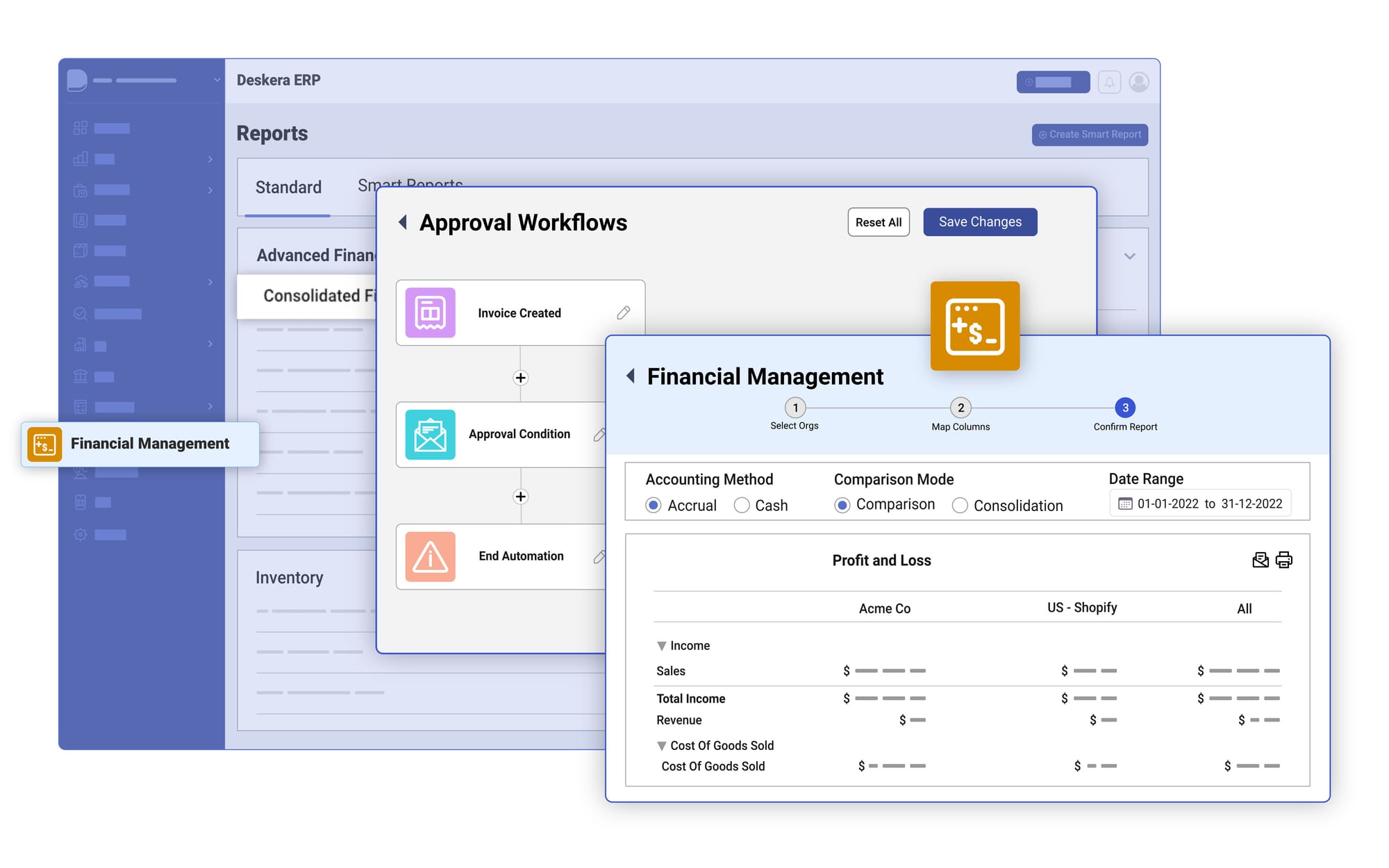
Implementing the right ERP solution can significantly strengthen your financial strategy, and Deskera ERP is designed to do exactly that. By combining automation, real-time insights, and integrated financial management, it enables businesses to move from manual processes to a more strategic, data-driven approach.
Centralized Financial Management
Deskera ERP consolidates all financial data into a single platform, covering accounting, budgeting, forecasting, and reporting. This centralized system eliminates data silos and ensures consistency across departments, giving businesses a complete and accurate view of their financial health.
Real-Time Insights and Reporting
With built-in dashboards and reporting tools, Deskera provides real-time visibility into financial performance. Businesses can track key metrics, monitor cash flow, and generate up-to-date financial reports instantly, enabling faster and more informed decision-making.
Automation of Financial Processes
Deskera automates repetitive financial tasks such as invoicing, payroll, bank reconciliation, and expense tracking. This reduces manual errors, improves efficiency, and frees up finance teams to focus on strategic initiatives rather than routine operations.
Advanced Budgeting and Forecasting
The platform includes robust tools for budgeting and financial forecasting, allowing businesses to set targets, plan resources, and compare actual performance against projections. This helps organizations anticipate challenges and make proactive adjustments to their financial strategy.
Improved Accuracy and Compliance
Deskera ERP enhances financial accuracy through automated workflows and standardized processes. It also supports compliance with accounting standards and regulatory requirements by maintaining detailed records and audit trails, reducing the risk of errors and penalties.
Multi-Entity and Scalable Financial Management
For growing businesses, Deskera supports multi-entity consolidation and scalable operations. Companies can manage multiple business units, locations, or subsidiaries from a single dashboard, making it easier to scale without losing financial control.
Enhanced Financial Control and Visibility
With features like role-based access control, approval workflows, and KPI tracking, Deskera ensures better governance over financial processes. Leaders gain deeper visibility into performance, enabling tighter control and improved accountability across the organization.
By combining automation, real-time data, and integrated financial tools, Deskera ERP empowers businesses to build a more agile, accurate, and future-ready finance strategy—essential for success in 2026 and beyond.
Key Takeaways
- A finance strategy provides a structured roadmap to manage financial resources, align with business goals, and drive long-term growth.
- Different types of finance strategies—such as investment, cash flow, risk management, and profitability—work together to ensure financial stability and scalability.
- Financial planning and budgeting help set clear goals and ensure resources are allocated effectively toward strategic priorities.
- Strong cash flow management ensures liquidity, enabling businesses to meet obligations and sustain operations smoothly.
- Accurate revenue forecasting supports better planning by predicting future income using data-driven insights.
- Cost control and optimization improve profitability by eliminating inefficiencies and enhancing operational performance.
- Risk management and compliance protect businesses from financial uncertainties and ensure adherence to regulations.
- ERP systems enhance finance strategies by centralizing data, improving visibility, and enabling real-time decision-making.
- Building a finance strategy with ERP requires clear goals, the right system, integrated data, automation, analytics, and continuous optimization.
- ERP-driven financial management improves efficiency, accuracy, scalability, and overall business performance.
- Common mistakes such as poor forecasting, lack of risk planning, and overemphasis on cost-cutting can weaken financial strategies.
- Following best practices like adopting a data-driven approach, ensuring collaboration, and investing in training maximizes ERP effectiveness.
- Deskera ERP strengthens financial strategy through automation, real-time insights, advanced forecasting, and scalable financial management.