


Struggling to keep your inventory balanced without overstocking or running into costly stockouts? The answer often lies in how well your procurement schedules are planned and executed. Procurement schedules act as a roadmap for purchasing activities, helping businesses ensure that the right materials are available at the right time—without tying up excess capital in inventory.
In today’s fast-paced and demand-driven market, procurement scheduling is no longer just a back-office task. It plays a critical role in maintaining smooth operations, controlling costs, and improving overall supply chain efficiency. Without a well-defined schedule, businesses may face delays, supplier misalignment, and disruptions that can directly impact production and customer satisfaction.
A well-structured procurement schedule enables organizations to align purchasing decisions with demand forecasts, supplier lead times, and inventory levels. This not only improves operational efficiency but also strengthens supplier relationships and enhances financial planning. As businesses grow and processes become more complex, having a clear and adaptable procurement schedule becomes essential for long-term success.
This is where Deskera ERP comes into play. Deskera ERP helps businesses streamline procurement scheduling through automation, real-time inventory tracking, and intelligent demand forecasting. It centralizes procurement, inventory, and financial data into a single platform, enabling better decision-making and improved visibility across operations. With its user-friendly interface and advanced features, Deskera ERP empowers businesses to create accurate, flexible, and efficient procurement schedules.
What Are Procurement Schedules?
A procurement schedule is a structured timeline that outlines when and how a business will acquire goods or services—from initial planning to final delivery and payment. It connects procurement activities with operational or project milestones, ensuring that materials arrive exactly when needed while keeping spending under control. Instead of reacting to shortages or delays, businesses can proactively manage purchasing with greater accuracy and confidence.
More than just a list of deadlines, a procurement schedule provides a detailed view of the entire procurement process. It defines what needs to be purchased, when each step should happen, who is responsible, and what resources are required. This level of clarity helps teams stay aligned, improves accountability, and ensures that procurement activities support broader business or project goals.
It is important to distinguish procurement schedules from procurement plans. While a procurement plan focuses on the overall strategy—such as supplier selection and sourcing approach—a procurement schedule translates that strategy into actionable timelines and specific tasks. In simple terms, the plan sets the direction, and the schedule ensures execution happens on time and without disruption.
Without a clear procurement schedule, businesses often face late deliveries, rushed supplier decisions, and unexpected cost overruns. For example, if supplier evaluation is delayed during a product launch, it can push back production timelines and increase expenses due to urgent shipping needs. A well-defined procurement schedule prevents such issues by making dependencies, deadlines, and responsibilities visible early, allowing teams to address potential risks before they escalate.
Components of a Procurement Schedule
To be effective, a procurement schedule must include several key components that provide clarity, structure, and control over the entire purchasing process. These elements ensure that every task is planned, tracked, and executed efficiently.
1. Tasks
Tasks refer to the specific procurement activities that need to be completed. These may include requirement gathering, request for proposal (RFP) development, vendor evaluation, contract negotiation, and purchase order creation. Clearly defining tasks helps teams understand what needs to be done at each stage of the process.
2. Timelines
Timelines outline the expected duration for each task, typically measured in days, weeks, or months. These timelines should be realistic and aligned with business needs. A well-defined timeline ensures that procurement activities stay on track and support overall operational deadlines.
3. Dependencies and Critical Path
Dependencies highlight the relationships between tasks, showing which activities must be completed before others can begin. Identifying the critical path—the sequence of tasks that directly impacts the final delivery date—helps businesses prioritize activities and prevent bottlenecks.
4. Resources
Resources include the people, tools, budget, and materials required to execute each task. This involves both internal teams—such as procurement, finance, and operations—and external stakeholders like suppliers. Proper resource allocation ensures smooth execution and avoids delays.
5. Milestones
Milestones are key checkpoints that mark significant progress or decision points, such as RFP release, vendor selection, or contract approval. They help track progress, maintain alignment, and ensure the procurement process is moving forward as planned.
6. Contingencies
Contingencies are buffer plans or extra time built into the schedule to handle unexpected delays, such as supplier issues or approval bottlenecks. Including contingencies ensures that disruptions do not derail the entire procurement process.
7. Stakeholder Responsibilities
Clearly defined roles and responsibilities ensure accountability across the procurement process. When each stakeholder understands their role, communication improves and tasks are completed more efficiently.
8. Demand Forecasting
Demand forecasting involves predicting future material or service requirements based on historical data, market trends, and business goals. Accurate forecasting ensures that procurement schedules align with actual demand, reducing the risk of overstocking or stockouts.
9. Supplier Lead Times
Supplier lead times refer to the time it takes for suppliers to deliver goods or services after an order is placed. Factoring in lead times is essential for scheduling orders accurately and ensuring timely delivery without disruptions.
10. Inventory Levels and Reorder Points
Monitoring current inventory levels and setting reorder points helps determine when new orders should be placed. This ensures a continuous supply of materials while avoiding excess inventory carrying costs.
11. Budget Constraints
Budget constraints define the financial limits within which procurement activities must operate. Including budget considerations in the schedule helps control costs, prevent overspending, and align procurement decisions with financial planning.
12. Procurement Timelines and Milestones
Beyond individual task timelines, the overall procurement timeline provides a complete view of the procurement cycle from start to finish. Combined with clearly defined milestones, it ensures better coordination, tracking, and execution of procurement activities.
By incorporating these components, a procurement schedule becomes a comprehensive roadmap that outlines what needs to happen, when it should happen, and who is responsible. This level of visibility helps businesses reduce risks, improve efficiency, and ensure timely and cost-effective procurement.
Types of Procurement Schedules
Different businesses require different approaches to procurement scheduling depending on demand patterns, supplier reliability, and operational complexity. Understanding the various types of procurement schedules helps organizations choose the right strategy to balance cost, efficiency, and flexibility.
1. Fixed Procurement Schedules
Fixed procurement schedules follow a predetermined timeline where orders are placed at regular intervals, regardless of fluctuations in demand. This approach works well for businesses with stable and predictable consumption patterns.
For example, a company may order raw materials on the first day of every month in fixed quantities. This method simplifies planning, improves supplier coordination, and reduces administrative effort. However, it can lead to overstocking or shortages if demand changes unexpectedly, making it less suitable for highly dynamic environments.
2. Flexible Procurement Schedules
Flexible procurement schedules allow businesses to adjust order quantities and timing based on real-time demand, inventory levels, and market conditions. Unlike fixed schedules, this approach provides greater adaptability and responsiveness.
This type is ideal for businesses dealing with demand variability or seasonal fluctuations. By continuously monitoring data and adjusting procurement plans, companies can reduce excess inventory and avoid stockouts. However, it requires strong data visibility, accurate forecasting, and close coordination with suppliers to be effective.
3. Just-in-Time (JIT) Scheduling
Just-in-time (JIT) scheduling focuses on ordering and receiving goods only when they are needed for production or sales. The goal is to minimize inventory holding costs and eliminate waste by maintaining very low inventory levels.
JIT is widely used in manufacturing and lean supply chain environments. While it improves efficiency and reduces storage costs, it also increases dependency on supplier reliability and precise timing. Any delays in delivery can disrupt operations, making risk management and supplier performance critical in JIT systems.
4. Blanket Purchase Schedules
Blanket purchase schedules are based on long-term agreements with suppliers, where a business commits to purchasing a certain quantity of goods or services over a specified period. Instead of placing multiple individual orders, releases are made against the agreement as needed.
This approach helps streamline procurement processes, reduce administrative workload, and often secure better pricing through bulk commitments. It is particularly useful for recurring purchases of standard items. However, businesses must carefully manage usage and timelines to avoid overcommitting or underutilizing the agreement.
Choosing the right type of procurement schedule depends on factors such as demand predictability, supplier reliability, inventory strategy, and cost considerations. Many organizations use a combination of these approaches to create a balanced and efficient procurement system.
Benefits of Using Procurement Schedules
Implementing procurement schedules offers significant advantages for businesses by bringing structure, predictability, and efficiency to the purchasing process. Here are the key benefits:
1. Improved Planning and Operational Efficiency
Procurement schedules provide a clear roadmap of purchasing activities, helping businesses plan ahead with greater accuracy. By aligning procurement tasks with production or operational timelines, organizations can avoid last-minute decisions and disruptions. This structured approach ensures smoother workflows, better coordination between teams, and improved overall efficiency across the supply chain.
2. Better Cost Control and Budget Management
A well-defined procurement schedule helps businesses manage costs by planning purchases in advance and avoiding emergency orders, which are often more expensive. It also enables better budget allocation by aligning procurement activities with financial plans. With improved visibility into spending, organizations can reduce waste, negotiate better deals, and maintain tighter control over procurement expenses.
3. Reduced Risk of Stockouts and Overstocking
Procurement schedules ensure that materials are ordered at the right time and in the right quantities. This helps businesses maintain optimal inventory levels, preventing both stockouts and excess inventory. By balancing supply with demand, organizations can minimize storage costs, avoid production delays, and ensure uninterrupted operations.
4. Enhanced Supplier Relationships
Consistent and predictable procurement schedules improve communication and collaboration with suppliers. When suppliers have clear visibility into order timelines, they can plan their production and deliveries more effectively. This leads to better reliability, stronger partnerships, and the potential for more favorable pricing and contract terms over time.
5. Increased Transparency and Accountability
Procurement schedules clearly define tasks, timelines, and responsibilities, making it easier to track progress and hold stakeholders accountable. This transparency ensures that everyone involved understands their role and deadlines. As a result, communication improves, delays are minimized, and procurement activities are executed more efficiently and with fewer errors.
6. Improved Decision-Making with Data Insights
With a structured procurement schedule in place, businesses can leverage historical data and performance metrics to make informed decisions. It becomes easier to analyze trends, evaluate supplier performance, and identify areas for improvement. Data-driven insights enable organizations to optimize procurement strategies and respond proactively to changing market conditions.
7. Greater Flexibility and Risk Management
Procurement schedules often include buffer time and contingency plans, allowing businesses to handle unexpected disruptions such as supplier delays or demand fluctuations. This built-in flexibility helps organizations adapt quickly without affecting overall operations. By anticipating risks and planning accordingly, businesses can maintain continuity and reduce the impact of unforeseen challenges.
Step-by-Step Process to Create a Procurement Schedule
Creating an effective procurement schedule requires a structured approach that aligns purchasing activities with business goals, timelines, and resource availability. By following these steps, businesses can build a realistic and efficient schedule that minimizes risks and ensures smooth execution.
1. Define Scope and Objectives
Start by clearly identifying what needs to be procured and how it supports your overall business or project goals. This includes understanding requirements, timelines, budget constraints, and quality standards. Conduct a needs assessment by gathering input from key stakeholders to ensure all expectations are aligned from the beginning.
Clear objectives act as a benchmark for performance, helping you measure success through factors like cost control, timely delivery, and reduced procurement cycle time. Defining scope early prevents miscommunication, delays, and costly changes later in the process.
2. Break Down the Procurement Process
Once the scope is defined, divide the procurement process into smaller, manageable phases. This can be done using a structured approach such as a Work Breakdown Structure (WBS), which helps organize tasks and ensures nothing is overlooked.
Typical procurement phases include requisition and approval, vendor identification, request for proposals, bid evaluation, contract negotiation, and final delivery. Breaking the process into clear steps improves visibility, simplifies planning, and allows better coordination across teams.
3. Estimate Task Durations
Determine how long each task will take by using historical data, expert judgment, or procurement software insights. Accurate time estimates are essential for building a realistic schedule and avoiding delays.
Consider factors such as supplier responsiveness, approval cycles, and internal processing times. Proper estimation ensures that timelines are practical and aligned with overall business or project deadlines.
4. Identify Dependencies and Relationships
Map out task dependencies to understand the sequence of activities and how they impact each other. Some tasks must be completed before others can begin, while others can run simultaneously.
Account for internal dependencies (such as approvals from finance) and external dependencies (such as supplier lead times). Identifying these relationships helps prevent bottlenecks and ensures a smoother workflow.
5. Allocate Resources
Assign the necessary resources required to complete each task, including personnel, budget, tools, and materials. This step ensures that every activity has the support it needs to be executed on time.
Proper resource planning also helps avoid overloading teams, reduces delays, and improves overall efficiency. Leveraging technology and automation tools can further streamline resource allocation and reduce manual effort.
6. Establish Timelines and Milestones
Create a detailed timeline by working backward from the final delivery date. Set clear milestones for key stages such as vendor selection, contract approval, and delivery completion.
Including buffer time for approvals, supplier delays, and unexpected issues ensures that the schedule remains realistic and flexible. Well-defined milestones help track progress and keep all stakeholders aligned throughout the process.
7. Incorporate Flexibility and Contingencies
No procurement schedule is complete without accounting for uncertainty. Build contingency plans and buffer time into your schedule to handle risks such as supplier delays, quality issues, or changes in demand.
Identify potential risks early and define mitigation strategies to minimize their impact. Collaborating with suppliers can also help anticipate external challenges and improve responsiveness.
8. Review and Validate the Schedule
Before finalizing the procurement schedule, review it with all key stakeholders to ensure accuracy, feasibility, and alignment with business objectives. This step helps identify gaps, unrealistic timelines, or resource constraints.
Making necessary adjustments at this stage ensures that the schedule is practical, achievable, and ready for execution.
9. Implement Monitoring and Control Systems
Once the schedule is in action, continuous monitoring is essential to ensure everything stays on track. Use key performance indicators such as procurement cycle time, supplier performance, and cost savings to measure progress.
Leverage dashboards, regular review meetings, and automated alerts to identify issues early. Monitoring allows businesses to make timely adjustments and prevent small delays from turning into major disruptions.
By following these steps, businesses can create a procurement schedule that is not only well-structured but also adaptable to changing conditions. A strong schedule improves coordination, reduces risks, and ensures that procurement activities support overall business success.
Common Challenges in Procurement Scheduling
Despite their importance, creating and managing procurement schedules is not without difficulties. Businesses often face a range of challenges that can disrupt timelines, increase costs, and reduce overall efficiency. These challenges typically arise from demand uncertainty, supplier dependencies, and limited visibility into procurement processes.
Understanding these common obstacles is the first step toward building more resilient and effective procurement schedules. By identifying potential issues early, organizations can implement strategies to minimize risks, improve coordination, and ensure smoother execution of procurement activities.
1. Demand Variability and Forecasting Errors
One of the biggest challenges in procurement scheduling is unpredictable demand. Inaccurate forecasting can lead to ordering too much or too little inventory, both of which impact costs and operations. Sudden changes in market trends, seasonality, or customer behavior make it difficult to create reliable schedules, forcing businesses to constantly adjust their procurement plans.
2. Supplier Delays and Unreliability
Procurement schedules heavily depend on supplier performance. Delays in production, shipping issues, or inconsistent supplier reliability can disrupt even the most well-planned schedules. When suppliers fail to meet deadlines, it can lead to production delays, missed delivery commitments, and increased costs due to expedited shipping or last-minute sourcing.
3. Lack of Real-Time Data and Visibility
Without access to real-time data, businesses struggle to make informed procurement decisions. Limited visibility into inventory levels, supplier status, and order progress can result in poor planning and delayed responses to issues. This lack of transparency makes it difficult to adjust schedules proactively and increases the risk of inefficiencies.
4. Poor Coordination Between Departments
Procurement scheduling often involves multiple departments, including finance, operations, and inventory management. Misalignment or lack of communication between these teams can lead to delays, duplicated efforts, or incorrect orders. Without a centralized system, coordinating schedules and ensuring everyone is on the same page becomes a significant challenge.
5. Manual Processes and Inefficiencies
Many organizations still rely on spreadsheets or manual processes to manage procurement schedules. This increases the likelihood of human errors, outdated information, and inefficiencies. Manual tracking also makes it harder to scale operations or respond quickly to changes, limiting the effectiveness of procurement planning.
6. Budget Constraints and Cost Fluctuations
Procurement schedules must operate within defined budgets, but fluctuating material costs, supplier pricing, and market conditions can make this difficult. Unexpected price increases or financial limitations may force businesses to revise their schedules, delay purchases, or compromise on quality, affecting overall performance.
7. Managing Dependencies and Complex Workflows
Procurement processes involve multiple interconnected tasks, where delays in one activity can impact the entire schedule. Managing these dependencies becomes increasingly complex in large organizations or projects. Without proper planning and tracking, small delays can quickly cascade into major disruptions across the supply chain.
8. Handling Unexpected Disruptions
External factors such as transportation issues, regulatory changes, or global supply chain disruptions can significantly impact procurement schedules. These unforeseen events make it challenging to stick to planned timelines and require businesses to quickly adapt and implement contingency measures to minimize impact.
Addressing these challenges requires a combination of accurate data, strong supplier relationships, effective communication, and the use of technology to improve visibility and control over procurement scheduling.
Best Practices for Effective Procurement Schedules
Creating a procurement schedule is only the first step—ensuring it remains effective requires consistent optimization and strategic execution. By following proven best practices, businesses can improve accuracy, enhance coordination, and build procurement schedules that are both efficient and adaptable to change.
1. Use Data-Driven Demand Forecasting
Relying on accurate data is essential for building effective procurement schedules. Businesses should use historical data, market trends, and analytics tools to forecast demand more precisely. Data-driven forecasting reduces uncertainty, helps maintain optimal inventory levels, and ensures procurement activities are aligned with actual business needs rather than assumptions.
2. Maintain Strong Supplier Communication
Open and consistent communication with suppliers is critical for keeping procurement schedules on track. Sharing forecasts, timelines, and expectations helps suppliers plan better and deliver on time. Strong relationships also make it easier to handle disruptions, negotiate terms, and ensure reliability in the procurement process.
3. Incorporate Flexibility into Scheduling
Procurement schedules should not be rigid. Building flexibility into timelines allows businesses to adapt to demand fluctuations, supplier delays, or unexpected disruptions. Including buffer time and contingency plans ensures that minor changes do not lead to major operational issues, helping maintain continuity.
4. Automate Procurement Processes
Manual processes can slow down procurement and increase the risk of errors. Using automation tools or ERP systems helps streamline tasks such as purchase order creation, approvals, and tracking. Automation improves accuracy, saves time, and provides real-time visibility into procurement activities, making schedules more reliable and easier to manage.
5. Align Procurement with Inventory and Financial Planning
An effective procurement schedule should be closely integrated with inventory management and financial planning. This alignment ensures that purchasing decisions are based on current stock levels, reorder points, and budget constraints. It also helps avoid overstocking, reduce carrying costs, and maintain financial discipline.
6. Regularly Review and Update Schedules
Procurement schedules should be treated as dynamic tools rather than fixed plans. Regular reviews help identify inefficiencies, track performance, and make necessary adjustments based on changing business conditions. Continuous improvement ensures that the schedule remains relevant and effective over time.
7. Define Clear Roles and Responsibilities
Assigning clear ownership for each task ensures accountability and reduces confusion. When stakeholders understand their roles in the procurement process, approvals happen faster, communication improves, and tasks are completed more efficiently. Clear responsibility structures are essential for smooth execution.
8. Monitor Performance with Key Metrics
Tracking key performance indicators such as procurement cycle time, supplier performance, and cost savings helps evaluate the effectiveness of procurement schedules. Monitoring these metrics allows businesses to identify gaps, improve processes, and make informed decisions that enhance overall efficiency.
By implementing these best practices, businesses can create procurement schedules that are not only well-structured but also resilient, scalable, and aligned with long-term operational goals.
Key Metrics to Track in Procurement Scheduling
Tracking the right metrics is essential to evaluate how effective your procurement schedule is and identify areas for improvement. These key performance indicators (KPIs) provide valuable insights into efficiency, cost control, supplier performance, and overall procurement effectiveness.
1. Procurement Cycle Time
Procurement cycle time measures the total time taken from identifying a need to receiving the goods or services. A shorter cycle time indicates a more efficient procurement process. Monitoring this metric helps businesses identify delays, streamline workflows, and improve scheduling accuracy.
2. Supplier Lead Time
Supplier lead time tracks how long it takes for a supplier to deliver goods after an order is placed. Understanding and monitoring lead times is critical for accurate scheduling and avoiding delays. Consistently high or variable lead times may indicate the need to reassess supplier performance or sourcing strategies.
3. On-Time Delivery Rate
This metric measures the percentage of orders delivered on or before the scheduled date. A high on-time delivery rate reflects reliable suppliers and effective scheduling. Tracking this KPI helps ensure that procurement timelines are met and production or operations are not disrupted.
4. Inventory Turnover Ratio
Inventory turnover ratio shows how frequently inventory is used and replenished over a specific period. A higher ratio indicates efficient inventory management and well-aligned procurement schedules, while a lower ratio may signal overstocking or slow-moving inventory.
5. Stockout Frequency
Stockout frequency measures how often inventory runs out, leading to potential disruptions in operations or lost sales. Monitoring this metric helps businesses identify gaps in procurement scheduling and adjust order timing or quantities to maintain consistent supply.
6. Procurement Cost Savings
This metric tracks the cost reductions achieved through efficient procurement practices, such as better supplier negotiations, bulk purchasing, or optimized scheduling. It helps evaluate the financial impact of procurement strategies and ensures alignment with budget goals.
7. Purchase Order Accuracy
Purchase order accuracy measures how often orders are placed correctly without errors in quantity, pricing, or specifications. High accuracy reduces delays, rework, and supplier disputes, contributing to smoother procurement operations.
8. Supplier Performance Score
Supplier performance score evaluates vendors based on criteria such as delivery reliability, quality, and responsiveness. Tracking this metric helps businesses identify high-performing suppliers and address issues with underperforming ones, ensuring better alignment with procurement schedules.
By consistently monitoring these metrics, businesses can gain better visibility into their procurement processes, improve scheduling accuracy, and drive continuous improvement in efficiency, cost management, and supplier relationships.
How Deskera ERP Helps Manage Procurement Schedules
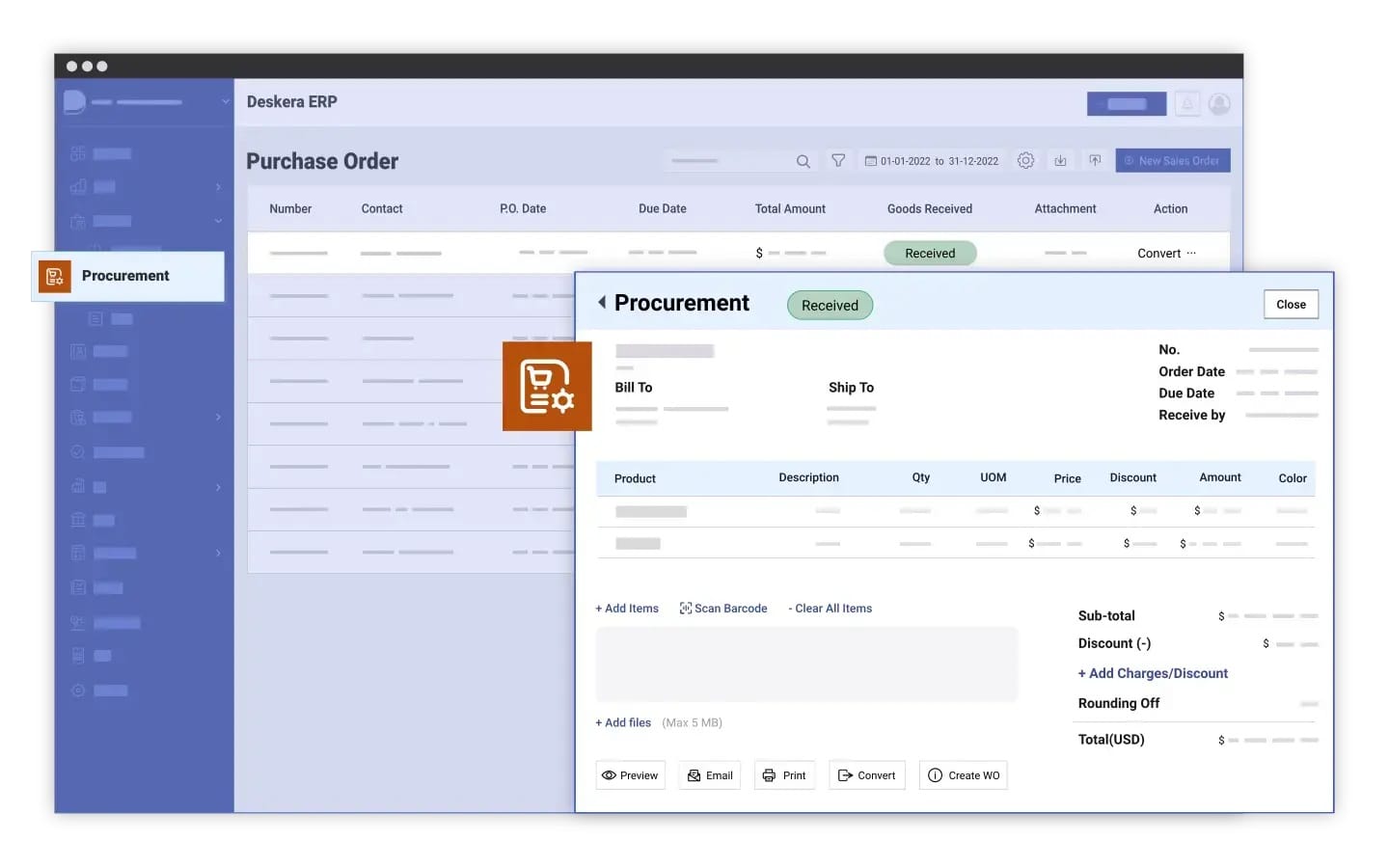
Managing procurement schedules manually can be time-consuming and prone to errors, especially as business operations grow more complex. Deskera ERP simplifies and streamlines procurement scheduling by providing a centralized platform that integrates purchasing, inventory, and financial data, enabling better planning, execution, and control.
1. Automated Procurement Planning
Deskera ERP automates key procurement activities such as purchase requisitions and purchase order creation. By using predefined rules, demand forecasts, and inventory thresholds, the system ensures that orders are generated at the right time, reducing manual effort and improving scheduling accuracy.
2. Real-Time Inventory Tracking
With real-time visibility into inventory levels, businesses can make informed procurement decisions. Deskera ERP continuously updates stock data, helping teams determine when to reorder and how much to purchase. This prevents stockouts and overstocking while keeping procurement schedules aligned with actual inventory needs.
3. Demand Forecasting and Insights
Deskera ERP leverages historical data and analytics to provide accurate demand forecasts. These insights help businesses anticipate future requirements and adjust procurement schedules accordingly. Better forecasting reduces uncertainty and ensures that procurement activities are aligned with business demand.
4. Supplier Management and Coordination
The platform enables businesses to manage supplier information, track performance, and maintain consistent communication. By having clear visibility into supplier lead times and reliability, organizations can create more realistic procurement schedules and reduce the risk of delays.
5. Centralized Data and Improved Visibility
Deskera ERP consolidates procurement, inventory, and financial data into a single system. This centralized approach improves transparency, allowing all stakeholders to access real-time information and stay aligned. Better visibility ensures that procurement schedules are executed efficiently and adjusted when needed.
6. Automated Alerts and Notifications
The system provides automated alerts for low inventory levels, delayed orders, and upcoming procurement activities. These notifications help teams take timely action, preventing disruptions and ensuring that procurement schedules stay on track.
7. Integration with Finance and Budget Control
Deskera ERP integrates procurement with financial management, allowing businesses to track spending and stay within budget. This alignment ensures that procurement schedules are not only operationally efficient but also financially sustainable.
8. Scalability and Flexibility
As businesses grow, their procurement needs become more complex. Deskera ERP offers scalable solutions that adapt to changing requirements, allowing organizations to update schedules, manage multiple suppliers, and handle increased procurement volumes without compromising efficiency.
By leveraging Deskera ERP, businesses can move from reactive procurement practices to a more proactive and strategic approach. The platform enhances accuracy, improves coordination, and ensures that procurement schedules support overall business efficiency and growth.
Key Takeaways
- Procurement schedules provide a structured timeline that ensures timely purchasing, better cost control, and alignment with business operations.
- Procurement schedules go beyond planning by defining clear timelines, responsibilities, and dependencies, ensuring smooth execution of procurement activities.
- Key components such as tasks, timelines, resources, and contingencies create a comprehensive framework for effective procurement scheduling.
- Different types of procurement schedules—fixed, flexible, just-in-time, and blanket purchase—allow businesses to choose strategies based on their operational needs.
- Creating a procurement schedule requires a step-by-step approach, including defining scope, estimating timelines, allocating resources, and continuous monitoring.
- Using procurement schedules improves efficiency, reduces costs, enhances supplier relationships, and minimizes inventory risks.
- Common challenges such as demand variability, supplier delays, and lack of visibility can disrupt procurement schedules if not managed properly.
- Following best practices like data-driven forecasting, automation, and regular reviews ensures procurement schedules remain effective and adaptable.
- Tracking key metrics such as cycle time, lead time, and inventory turnover helps measure performance and optimize procurement processes.
- Deskera ERP streamlines procurement scheduling through automation, real-time insights, and centralized data, improving accuracy and decision-making.