


How do you know if your procurement function is truly delivering value—or just controlling costs? The answer lies in procurement ROI metrics. While negotiated savings may look impressive on paper, they don’t always reflect the real impact procurement has on profitability, efficiency, and long-term business growth. Tracking the right ROI metrics helps businesses move beyond assumptions and measure procurement performance with clarity and confidence.
Procurement today plays a far more strategic role than simply sourcing goods at the lowest price. It influences cash flow, supplier reliability, risk management, and operational continuity. Without clearly defined procurement ROI metrics, businesses struggle to justify investments, identify inefficiencies, or align procurement outcomes with broader financial goals. This is where data-backed measurement becomes essential.
By tracking key procurement ROI metrics, organizations gain visibility into how effectively procurement initiatives translate into measurable business value. These metrics help quantify savings, evaluate supplier performance, improve spend control, and uncover opportunities for optimization. More importantly, they enable procurement teams to demonstrate their contribution in financial terms that leadership understands.
Modern ERP platforms like Deskera ERP make tracking procurement ROI far more structured and actionable. Deskera centralizes procurement, purchasing, supplier, and financial data in a single system, enabling real-time visibility into spend, costs, and performance. With automated workflows, analytics, and built-in reporting, businesses can monitor procurement metrics consistently, reduce manual effort, and turn procurement insights into informed, data-driven decisions.
What Is Procurement ROI?
Procurement ROI (Return on Investment) measures the value generated by procurement activities in relation to the costs incurred to deliver those outcomes. In simple terms, it evaluates whether procurement initiatives—such as strategic sourcing, supplier negotiations, or process improvements—are delivering measurable financial and operational benefits to the business.
At its core, procurement ROI compares the gains achieved through procurement (including cost savings, cost avoidance, efficiency improvements, and risk reduction) against the investments made in people, processes, and technology. This goes beyond tracking negotiated savings alone and provides a more holistic view of procurement’s contribution to overall business performance.
Procurement ROI is also a critical performance indicator for assessing the effectiveness and profitability of procurement strategies. By quantifying the financial impact of procurement efforts, businesses can determine how well procurement supports margin improvement, cash flow optimization, and long-term growth objectives.
Ultimately, measuring procurement ROI helps organizations position procurement as a strategic value driver rather than a transactional cost center. It enables leadership to justify procurement investments, prioritize high-impact initiatives, and align procurement outcomes with broader financial and operational goals.
Importance of Measuring Procurement ROI
Measuring procurement ROI is essential for understanding how procurement activities contribute to overall business performance. It helps organizations move beyond surface-level cost savings and gain a clear, data-backed view of the value created through sourcing, supplier management, and process optimization. By tracking procurement ROI, businesses can make more informed decisions, improve accountability saying how procurement supports strategic and financial objectives.
Improves Financial Visibility and Control
Tracking procurement ROI provides clear visibility into how procurement decisions impact costs, margins, and cash flow. It helps finance and procurement teams understand where money is being spent, how much value is being generated, and where inefficiencies exist, enabling better budget control and spend optimization.
Demonstrates Procurement’s Strategic Value
Measuring ROI allows procurement teams to quantify their contribution in financial terms that leadership understands. Instead of being seen as a cost-focused function, procurement is positioned as a strategic partner that drives profitability, risk mitigation, and long-term business value.
Supports Data-Driven Decision-Making
Procurement ROI metrics replace assumptions with measurable insights. Businesses can evaluate which suppliers, contracts, and sourcing strategies deliver the highest returns, helping teams prioritize initiatives that align with organizational goals and deliver the greatest impact.
Justifies Investments in Procurement Initiatives
Whether investing in new technology, talent, or process improvements, measuring procurement ROI helps build a strong business case. It enables organizations to compare the cost of procurement initiatives against tangible outcomes, making it easier to secure leadership buy-in.
Identifies Process Inefficiencies and Cost Leakages
By tracking ROI, businesses can uncover hidden costs such as maverick spending, contract non-compliance, or lengthy procurement cycles. These insights help organizations streamline processes, reduce waste, and improve operational efficiency.
Aligns Procurement with Business Growth Objectives
Measuring procurement ROI ensures that procurement strategies are aligned with broader business goals such as scalability, resilience, and growth. It helps organizations shift focus from short-term savings to sustainable value creation that supports long-term success.
How to Calculate Procurement ROI
Calculating procurement ROI helps businesses quantify the financial value created by procurement activities relative to the cost of running the function. When done correctly, it turns procurement performance into a clear, defensible business metric rather than a collection of isolated savings claims. Below are the key steps to accurately calculate procurement ROI in a structured and repeatable way.
Step 1: Define the Scope and Timeframe
Start by clearly defining what you are measuring and over what period. Procurement ROI can be calculated at different levels depending on your objective, such as:
- A specific sourcing event or contract negotiation
- Procurement performance over a quarter or fiscal year
- The impact of a new procurement technology or process improvement initiative
A clearly defined scope and timeframe ensure that all relevant costs and benefits are captured consistently, avoiding inflated or misleading ROI figures.
Step 2: Identify and Quantify Procurement Costs
Next, calculate the total cost of procurement, including both direct and indirect expenses. This should reflect the fully loaded cost of running procurement, not just external spend.
Key cost components typically include:
- Salaries and benefits of procurement staff
- Supplier research, RFP, and sourcing-related expenses
- Procurement technology and data subscription fees
- Travel and expenses for supplier negotiations and meetings
- Allocated overhead such as IT support, facilities, and shared services
Capturing the full cost base provides a realistic investment figure for the ROI calculation.
Step 3: Identify and Quantify Procurement Benefits
This step focuses on measuring the financial value created by procurement activities. Benefits can be broad and may require collaboration with finance and other business functions.
Common benefit categories include:
- Hard cost savings from reduced prices, better terms, or demand consolidation
- Cost avoidance from preventing price increases or mitigating future costs
- Working capital improvements from inventory reductions or improved payment terms
- Revenue impact from faster time to market or supplier-led innovation
- Risk mitigation value from improved compliance, continuity, or supplier resilience
While hard savings are easier to quantify, softer benefits should still be estimated conservatively to reflect procurement’s full impact.
Step 4: Apply the Procurement ROI Formula
Once costs and benefits are quantified, calculate procurement ROI using a clear and consistent formula:
Procurement ROI = ((Total Benefits – Total Cost of Procurement) ÷ Total Cost of Procurement) × 100
Where:
- Total Benefits include cost savings, cost avoidance, and working capital gains
- Total Cost of Procurement includes operational expenses, salaries, technology, and overhead
Example: If procurement delivered ₹10 million in total benefits and the total cost of procurement was ₹2 million:
(10M – 2M) ÷ 2M × 100 = 400% ROI
This means the organization generated four units of value for every unit invested in procurement. Many businesses target a 3:1 benefit-to-cost ratio (around 300% ROI) as a healthy benchmark.
Step 5: Track and Communicate Procurement ROI Over Time
Procurement ROI should not be treated as a one-time calculation. To demonstrate sustained value:
- Define clear goals such as cost reduction, efficiency gains, or supplier performance improvement
- Select relevant metrics aligned with those goals, including savings, cycle time, compliance, and spend under management
- Ensure accurate data collection through consistent reporting and procurement systems
- Analyze trends by comparing ROI over time, against benchmarks, or across business units
Use these insights to refine procurement strategies, improve weak areas, and clearly communicate procurement’s ongoing contribution to business performance.
When measured consistently, procurement ROI becomes a powerful tool for decision-making—helping organizations move from cost control to value creation with confidence and credibility.
9 Key Procurement ROI Metrics Every Business Should Track
Tracking procurement ROI requires looking beyond headline savings to understand how procurement activities translate into measurable business value. The following metrics help organizations evaluate financial impact, execution effectiveness, operational efficiency, and risk reduction—offering a well-rounded view of procurement performance.
1. Cost Avoidance
What it is: Cost avoidance measures spend that did not increase, even though it reasonably could have. This includes avoiding supplier price hikes, preventing expedited freight costs, or holding pricing steady during market volatility.
What it tells you: Cost avoidance highlights procurement’s ability to protect margins and maintain budget stability. While it may not always appear as a direct reduction in spend, it represents real economic value.
How it’s measured: Typically tracked against a defined baseline such as prior-year pricing, supplier proposals, or market indices. Avoided increases are documented separately from realized savings to maintain clarity in procurement cost savings measurement.
2. Savings Realization Rate
What it is: The savings realization rate compares identified or negotiated savings to savings actually reflected in financial results.
What it tells you: This metric reveals execution discipline. A gap between identified and realized savings often points to issues with compliance, timing, or internal adoption.
How it’s measured: Procurement-reported savings are reconciled with actual spend data over a defined period. A strong realization rate improves confidence in procurement ROI metrics and forecasting accuracy.
3. Procurement Cycle Time
What it is: Procurement cycle time measures how long it takes to move from sourcing initiation to supplier selection or contract execution.
What it tells you: Shorter cycle times improve responsiveness, reduce exposure to market changes, and enable earlier budget alignment. Faster execution often supports better savings outcomes.
How it’s measured: Tracked across defined sourcing or contracting stages, linking process efficiency to financial outcomes such as working capital timing and forecast reliability.
4. Supplier Performance ROI
What it is: Supplier performance ROI quantifies the financial impact of improvements in delivery reliability, quality, lead times, and service levels.
What it tells you: Improved supplier performance reduces rework, downtime, and operational disruptions. These gains often translate into measurable cost reductions or avoided losses.
How it’s measured: Performance improvements are associated with outcomes such as fewer penalties, reduced downtime, or higher throughput, helping capture value beyond price-based analysis.
5. Contract Compliance Rate
What it is: Contract compliance measures the percentage of spend that follows negotiated terms and approved suppliers.
What it tells you: Low compliance leads to value leakage and increased risk, while high compliance indicates that negotiated benefits are being realized across the organization.
How it’s measured: Actual spend is compared against contract terms and approved catalogs. Because non-compliance directly erodes savings, this metric is a critical driver of procurement ROI.
6. Process Efficiency Gains
What it is: Process efficiency gains track reductions in time, steps, and manual effort across procurement workflows.
What it tells you: Efficiency improvements lower operating costs, reduce errors, and enable teams to manage higher volumes without increasing headcount.
How it’s measured: Time savings are translated into labor cost equivalents or reduced dependency on external support, helping quantify operational ROI beyond direct savings.
7. Risk Mitigation Value
What it is: Risk mitigation value captures the financial benefit of reducing exposure to supply disruptions, price volatility, compliance failures, or supplier concentration.
What it tells you: This metric reflects procurement’s role in protecting business continuity and financial predictability, especially in volatile or regulated environments.
How it’s measured: Often estimated through avoided emergency sourcing costs, reduced premiums, or improved continuity indicators, and used in scenario planning and risk assessments.
8. Total Cost of Ownership (TCO)
What it is: TCO evaluates the full lifecycle cost of a product or service, including acquisition, operation, maintenance, quality issues, and end-of-life costs.
What it tells you: TCO shifts procurement decision-making from price-focused to value-driven, explaining why the lowest upfront cost may not deliver the best long-term outcome.
How it’s measured: Cost categories are modeled over time and compared across alternatives, forming the foundation for accurate procurement savings calculations and long-term value assessment.
9. Spend Under Management
What it is: The percentage of total organizational spend that is actively governed by procurement processes, contracts, and policies.
What it tells you: Higher spend under management means greater visibility, stronger control, and more opportunities to drive savings and efficiencies.
How it’s measured: Calculated by dividing procurement-managed spend by total addressable spend. It is a foundational metric for scaling procurement ROI.
What Is a Good Procurement ROI?
A good procurement ROI reflects how much measurable value procurement generates for every unit of cost invested. While the exact benchmark varies by industry and procurement maturity, there are widely accepted ranges that indicate healthy performance.
What Is Considered a Good Procurement ROI?
- 300% ROI (3:1 return) is commonly viewed as a strong benchmark This means the business generates three units of value for every one unit spent on procurement operations.
- 200%–300% ROI is typical for well-run, mature procurement teams This range suggests effective savings realization, solid compliance, and efficient processes.
- 400%+ ROI is achievable for high-performing organizations Often driven by high spend under management, strong supplier relationships, and advanced automation.
Why Procurement ROI Varies
There is no single “ideal” number, as procurement ROI depends on several factors:
- Industry dynamics and spend complexity
- Procurement maturity and governance models
- Level of technology and automation adoption
- Scope of benefits included, such as cost avoidance, working capital gains, and risk mitigation
Organizations that measure only hard savings often report lower ROI than those capturing total procurement value.
What Matters More Than the Number
A truly strong procurement ROI is not just high—it is:
- Credible: Validated by finance and measured consistently
- Repeatable: Achieved year over year
- Comprehensive: Reflects savings, efficiency, and risk reduction
- Actionable: Used to inform decisions and guide strategy
A Practical Rule of Thumb
- Below 200%: Indicates under-leveraged procurement capabilities
- Around 300%: Represents strong, defensible performance
- 400% and above: Signals best-in-class procurement maturity
Ultimately, a good procurement ROI is one that leadership trusts and uses to drive smarter, value-focused decisions across the business.
Procurement Maturity Stages and Their Impact on ROI
Procurement ROI is not static—it increases as procurement capabilities evolve. As organizations move from basic purchasing toward strategic value creation, improvements in processes, technology, and governance directly influence the level of ROI achieved. The procurement maturity model illustrates how each stage of evolution shapes procurement’s financial and strategic impact.
Stage 1: Basic — Ensuring Supply Continuity
At the basic stage, procurement focuses primarily on keeping the business running. Activities are largely transactional, with heavy reliance on manual processes, limited spend visibility, and reactive issue resolution.
The objective at this stage is supply assurance rather than optimization or strategic contribution. While this level of maturity supports operational continuity, procurement ROI remains low because measurable value creation is minimal beyond fulfilling immediate needs.
Stage 2: Developed — Improving Cost Control and Efficiency
In the developed stage, procurement becomes more structured and disciplined. Teams begin adopting strategic sourcing, managing contracts more effectively, and evaluating total cost of ownership (TCO). Early automation tools and stronger collaboration with finance and operations also emerge.
These improvements enable organizations to identify cost-saving opportunities and streamline processes. As a result, procurement delivers moderate ROI, driven by a balance of cost reduction, improved efficiency, and better spend governance.
Stage 3: Mature — Creating Strategic and Competitive Value
At the mature stage, procurement operates as a strategic partner to the business. Advanced analytics, automation, and AI support data-driven decisions, deeper supplier collaboration, and continuous innovation.
Procurement aligns closely with enterprise objectives such as sustainability, resilience, and growth. At this level, ROI is high—procurement not only reduces costs but also enables revenue growth, mitigates risk, and strengthens long-term competitive advantage.
As organizations progress through these maturity stages, procurement ROI shifts from operational necessity to strategic value creation—making maturity a key driver of sustained procurement performance.
Common Challenges in Tracking Procurement ROI Metrics
While procurement ROI metrics are essential for demonstrating value, tracking them accurately is often challenging. Many organizations struggle with data gaps, inconsistent measurement approaches, and difficulties linking procurement outcomes to financial results.
Understanding these challenges is the first step toward building a more reliable and credible procurement ROI framework.
Lack of Clear Metric Definitions
One of the most common challenges is the absence of standardized definitions for procurement ROI metrics. Terms like cost savings, cost avoidance, and value creation are often interpreted differently across teams, leading to inconsistent reporting and confusion when results are reviewed by finance or leadership.
Difficulty Linking Procurement Activities to Financial Outcomes
Procurement impacts the business in indirect ways, such as risk reduction, efficiency gains, or improved supplier performance. Quantifying these benefits and tying them back to financial outcomes can be complex, especially when the impact is shared across multiple functions.
Data Silos and Poor Data Quality
Procurement data is often spread across multiple systems, spreadsheets, and departments. Incomplete, outdated, or inconsistent data makes it difficult to track ROI metrics accurately and undermines confidence in reported results.
Overreliance on Savings Alone
Many organizations focus almost exclusively on negotiated cost savings while overlooking other value drivers such as working capital improvements, compliance, and risk mitigation. This narrow view can significantly understate procurement’s true ROI.
Limited Spend Visibility
Without a clear view of total spend and spend under management, it becomes difficult to measure compliance, savings realization, or efficiency improvements. Poor visibility reduces the accuracy of procurement ROI calculations.
Manual and Time-Consuming Reporting
When procurement ROI tracking relies heavily on manual data collection and spreadsheets, reporting becomes slow, error-prone, and difficult to scale. This often limits the ability to track performance consistently over time.
Misalignment Between Procurement and Finance
Procurement and finance teams may use different assumptions, timelines, or validation methods when calculating ROI. This misalignment can lead to disputes over numbers and weaken the credibility of procurement performance metrics.
Short-Term Focus on Results
Focusing only on short-term savings can make it difficult to capture long-term value such as supplier innovation, resilience, and total cost of ownership improvements. As a result, procurement ROI metrics may not reflect sustainable business impact.
Addressing these challenges requires clear definitions, aligned measurement practices, reliable data, and close collaboration between procurement and finance—turning ROI tracking into a strategic advantage rather than a reporting burden.
Best Practices for Tracking and Maximizing Procurement ROI Effectively
Tracking procurement ROI is only the first step. To truly maximize returns, organizations must adopt best practices that strengthen supplier relationships, improve efficiency, reduce risk, and turn procurement data into actionable insights. In today’s competitive environment, procurement ROI is driven by a combination of strategy, technology, and continuous improvement.
Strengthen Supplier Relationship Management
Building strong, long-term supplier relationships is critical to maximizing procurement ROI. Strategic supplier partnerships improve quality, reliability, and delivery performance, which directly reduces rework, delays, and cycle times. Collaborative relationships also create opportunities for innovation, better pricing structures, and shared cost-saving initiatives that go beyond one-time negotiations.
Embed Continuous Risk Management
Proactive risk management helps protect procurement ROI by preventing costly disruptions, compliance failures, and emergency sourcing. Regularly assessing supplier, market, and operational risks allows procurement teams to develop mitigation strategies early. Effective risk management reduces uncertainty and preserves both financial performance and business continuity.
Leverage the Right Procurement Technology
Modern procurement technology plays a central role in maximizing ROI by increasing efficiency, reducing cycle times, and improving visibility. E-procurement platforms centralize sourcing, supplier management, spend analysis, and reporting in one place. Automation reduces manual errors, accelerates workflows, and enables procurement teams to focus on higher-value activities.
Prioritize Automation Across Procurement Processes
Automation is one of the most impactful drivers of procurement ROI. Automating tasks such as requisition approvals, purchase order creation, invoice matching, and supplier performance tracking shortens cycle times and improves accuracy. Reduced manual effort translates directly into lower operating costs and higher productivity.
Build and Execute a Strategic Procurement Plan
A clear procurement strategy aligns sourcing decisions with business goals. Defining measurable objectives, identifying high-impact categories, and outlining supplier management approaches ensures procurement efforts are focused where they deliver the greatest ROI. A structured plan also improves accountability and long-term value creation.
Track, Analyze, and Act on Procurement Data
Data-driven decision-making is essential for sustaining procurement ROI. Monitoring key metrics such as cost savings, compliance rates, cycle times, and supplier performance helps identify inefficiencies and improvement opportunities. Regular analysis turns raw data into insights that guide smarter sourcing and investment decisions.
Benchmark Performance Against Industry Standards
Benchmarking procurement metrics against industry peers provides valuable context for ROI performance. It helps organizations identify gaps, validate targets, and adopt proven best practices. Benchmarking also strengthens the credibility of procurement ROI reporting with leadership.
Focus on Continuous Improvement
Procurement ROI is not static—it improves through ongoing refinement. Regularly reviewing workflows, renegotiating contracts, reassessing suppliers, and adopting new tools ensures that procurement performance evolves with business needs. Continuous improvement keeps ROI gains sustainable over time.
By combining strong supplier management, proactive risk mitigation, smart technology adoption, and continuous performance tracking, organizations can move beyond measuring procurement ROI to consistently maximizing it—turning procurement into a long-term driver of efficiency, resilience, and business growth.
How Deskera ERP Supports Procurement ROI
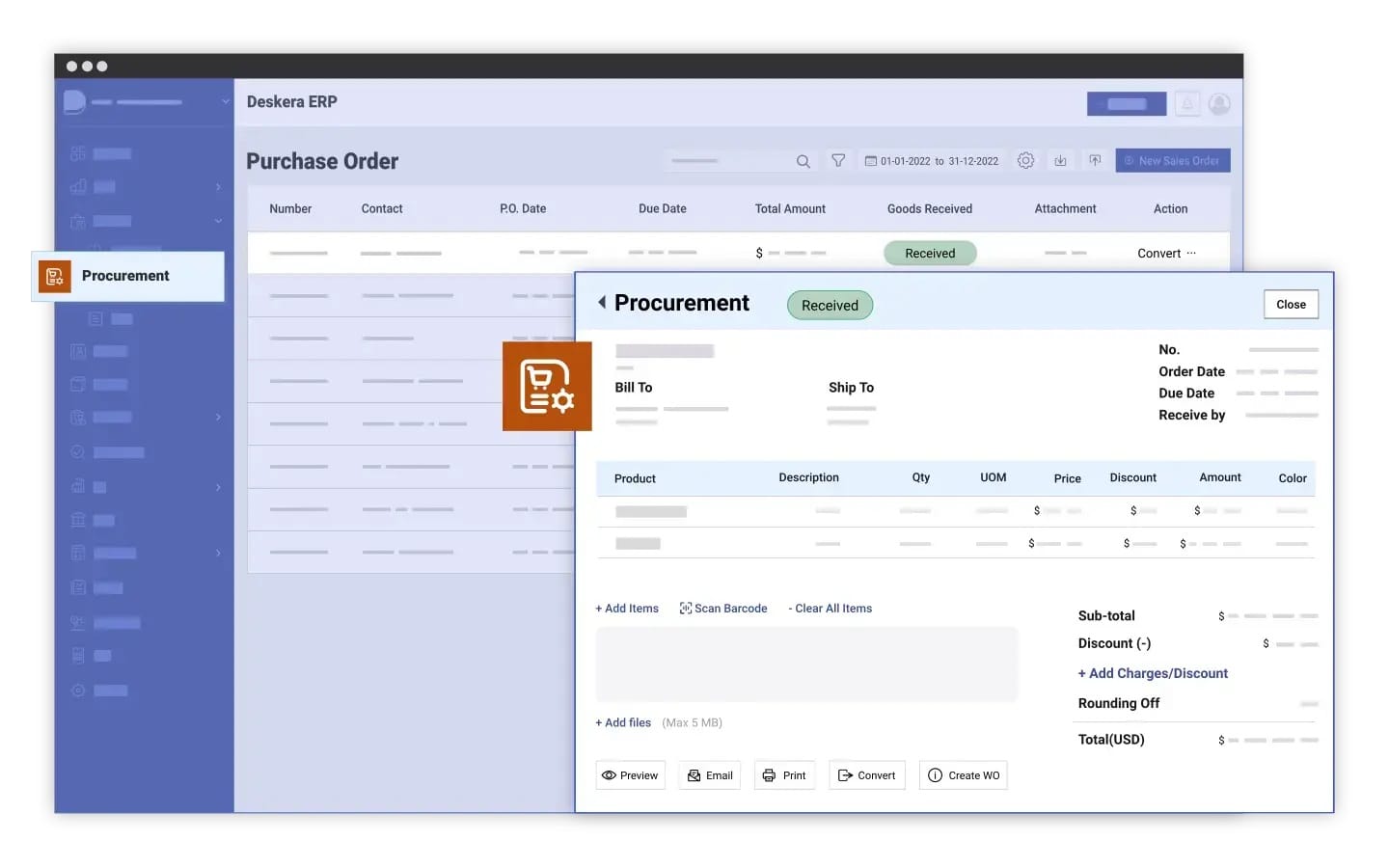
Modern ERP solutions like Deskera ERP play a crucial role in helping organizations track, measure, and maximize procurement ROI. By centralizing procurement, finance, and supplier data, Deskera provides the tools needed to turn procurement from a transactional function into a strategic value driver.
Centralized Spend and Supplier Management
Deskera ERP consolidates all procurement data in a single platform, giving businesses complete visibility over spend, supplier performance, and contract compliance. This helps identify cost-saving opportunities, reduce maverick spending, and ensure that procurement strategies are aligned with financial goals.
Real-Time Analytics and Reporting
With built-in analytics and reporting dashboards, Deskera ERP allows procurement teams to monitor key ROI metrics such as cost savings, cost avoidance, procurement cycle time, and supplier performance. Real-time insights make it easier to spot inefficiencies, track progress against targets, and make informed, data-driven decisions.
Automation and Process Efficiency
Deskera ERP automates repetitive procurement tasks, including purchase order approvals, invoice matching, and supplier onboarding. Automation reduces manual errors, shortens procurement cycle times, and frees up the team to focus on strategic initiatives, directly improving ROI.
Risk Mitigation and Compliance
Deskera ERP helps manage contracts, supplier documentation, and regulatory compliance in a centralized system. By reducing compliance risks and improving supplier reliability, organizations can avoid costly disruptions, enhancing both operational efficiency and procurement ROI.
Integrated Workflow Across Functions
Procurement decisions are closely linked to finance, inventory, and operations. Deskera ERP ensures seamless integration across these functions, enabling holistic ROI measurement that captures savings, efficiency gains, and working capital improvements.
By leveraging Deskera ERP, organizations can track procurement performance, optimize processes, reduce costs, and ultimately maximize the ROI of every procurement dollar spent, turning procurement into a measurable driver of business growth.
Key Takeaways
- Procurement ROI quantifies the financial and strategic value generated by procurement activities relative to the costs invested, helping organizations measure and communicate procurement’s contribution to business performance.
- Tracking procurement ROI ensures that procurement decisions drive real financial impact, improves accountability, identifies efficiency gains, and highlights procurement’s strategic role in organizational growth.
- Focusing on metrics such as cost avoidance, savings realization, cycle time, supplier performance, contract compliance, and TCO provides a comprehensive view of procurement’s financial and operational impact.
- Procurement ROI can be calculated using the formula: ((Total Benefits – Total Cost of Procurement) ÷ Total Cost of Procurement) × 100, capturing both direct savings and indirect value like risk mitigation and efficiency gains.
- A strong procurement ROI typically falls between 200%–400%, with higher values achievable through strategic sourcing, automation, and integrated data-driven procurement practices.
- As organizations progress from basic to mature procurement stages, ROI improves—from operational continuity at the basic stage to cost efficiency at the developed stage, and high strategic value creation at the mature stage.
- Challenges such as inconsistent metric definitions, data silos, limited spend visibility, and misalignment between procurement and finance can reduce the accuracy and credibility of procurement ROI measurement.
- Implementing strategic planning, leveraging procurement technology, automating processes, managing supplier relationships, and continuously tracking metrics ensures procurement ROI is maximized and sustainable.
- Deskera ERP centralizes procurement and finance data, automates workflows, provides real-time analytics, and improves spend visibility, enabling organizations to measure, track, and enhance procurement ROI effectively.
Related Articles
 Niti Samani
 RVJ
RVJ
 Niti Samani
 Niti Samani
 Niti Samani
 Rhema Hans